
st 21 Century Manufacturing The Role of the
- Slides: 78
st 21 Century Manufacturing: The Role of the MEP Program National Institute of Standards and Technology Gaithersburg, MD September, 28 2012 Charles W. Wessner, Ph. D. Director, Technology, Innovation, and Entrepreneurship The National Academies 1 © Charles W. Wessner Ph. D
Today’s Presentation • An Overview of the NAS Innovation Program • The Academies’ Study of MEP • The Manufacturing Challenge • Review of Leading Foreign Programs • Assessing MEP • Key Recommendations 2 © Charles W. Wessner Ph. D.
Disclaimer: This presentation is a summary of the Committee’s Report. The Committee’s Findings and Recommendations need to be considered in their entirety in the Report. 3 © Charles W. Wessner Ph. D.
The National Academies 4 © Charles W. Wessner, Ph. D.
The Academies’ Board on Science, Technology, and Economic Policy is Globally Recognized as a Center of Expertise on Innovation • For over 20 years, STEP has identified ways to: – Accelerate innovation, – Advance U. S. competitiveness through better policy, – Improve our understanding of the nation’s economic performance, and – Learn from other nations’ policies and practices. 5 © Charles W. Wessner, Ph. D.
STEP’s Recent Study of Global Innovation • Comparative National Innovation Policies: Best Practice for the 21 st Century – Chaired by Ambassador Alan Wm. Wolff, Mc. Kenna Long & Aldridge, Former Deputy USTR • Widely Cited Report: Rising to the Challenge: U. S. Innovation Policies for the Global Economy – Documents policies and programs around the world to develop innovative capacity – Highlights America’s competitive challenges – Provides concrete recommendations on how to capitalize on US and foreign investments in research 6 © Charles W. Wessner Ph. D.
STEP’s Current Innovation Work • Best Practices in State and Regional Programs: – Chaired by Mary Good, University of Arkansas, Former Under Secretary for Technology at the Department of Commerce – Consensus Report published in Summer 2013 • Best Practices in National Innovation Programs for Flexible Electronics – Chaired by A. Michael Andrews, L 3 Corporation and former Chief Scientist to the U. S. Army and Donald Siegel, Dean of the Business School at the University at Albany-SUNY 7 © Charles W. Wessner Ph. D
STEP’s Study of SBIR • Crossing the Valley of Death: An Assessment of the SBIR Program – Improved the public’s understanding of the challenges of Early Stage Finance – Documented the diversity, flexibility, and effectiveness of the SBIR programs • The Study has had a Major Impact on the 2012 SBIR Reauthorization – Extension of the program until 2017 – Increase in program from 2. 5% to 3. 2% over 6 years 8 © Charles W. Wessner Ph. D.
The Academies’ Review of the MEP Program An evaluation of the operation, achievements, and challenges of the Manufacturing Extension Partnership program at the National Institute of Standards and Technology 9 © Charles W. Wessner Ph. D
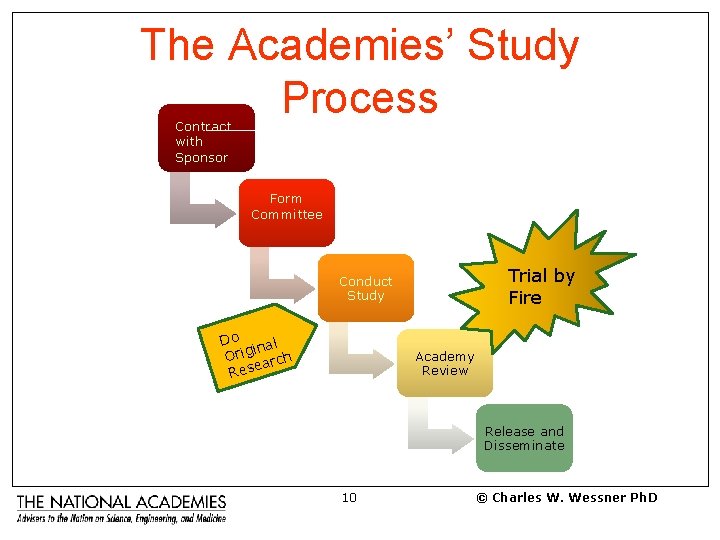
The Academies’ Study Process Contract with Sponsor Form Committee Trial by Fire Conduct Study Do inal Orig arch Rese Academy Review Release and Disseminate 10 © Charles W. Wessner Ph. D
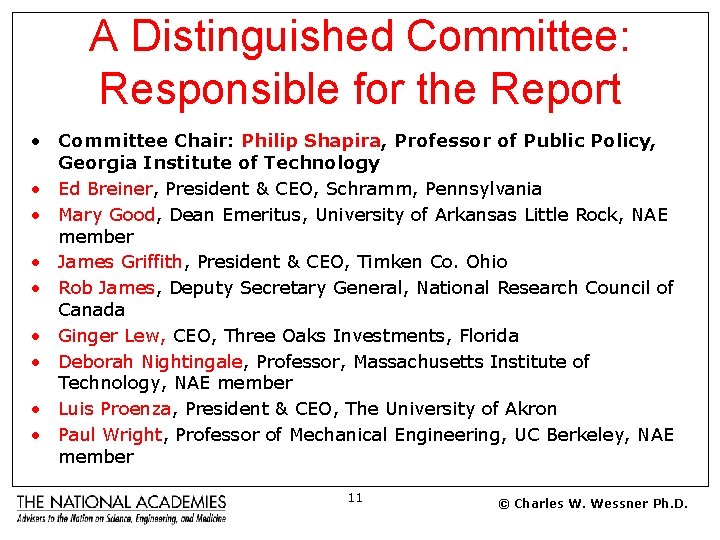
A Distinguished Committee: Responsible for the Report • Committee Chair: Philip Shapira, Professor of Public Policy, Georgia Institute of Technology • Ed Breiner, President & CEO, Schramm, Pennsylvania • Mary Good, Dean Emeritus, University of Arkansas Little Rock, NAE member • James Griffith, President & CEO, Timken Co. Ohio • Rob James, Deputy Secretary General, National Research Council of Canada • Ginger Lew, CEO, Three Oaks Investments, Florida • Deborah Nightingale, Professor, Massachusetts Institute of Technology, NAE member • Luis Proenza, President & CEO, The University of Akron • Paul Wright, Professor of Mechanical Engineering, UC Berkeley, NAE member 11 © Charles W. Wessner Ph. D.
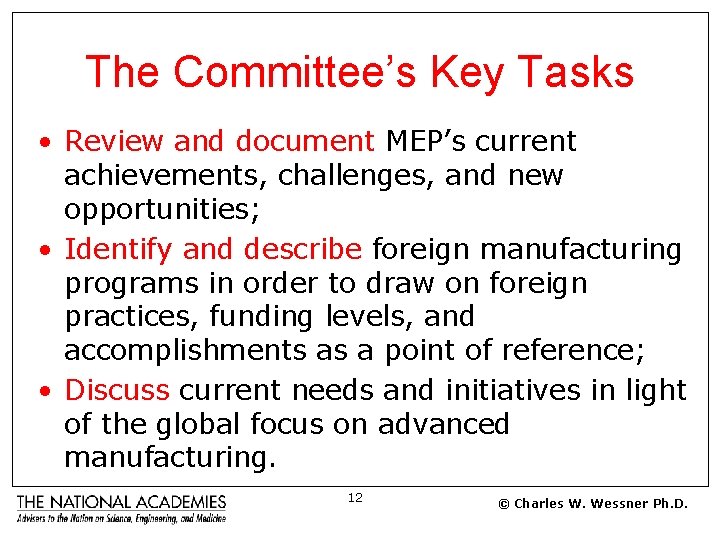
The Committee’s Key Tasks • Review and document MEP’s current achievements, challenges, and new opportunities; • Identify and describe foreign manufacturing programs in order to draw on foreign practices, funding levels, and accomplishments as a point of reference; • Discuss current needs and initiatives in light of the global focus on advanced manufacturing. 12 © Charles W. Wessner Ph. D.
The Committee’s Study of MEP Key Challenges, Activities, and Deliverables 13 © Charles W. Wessner Ph. D.
Key Study Challenges • MEP is a complex and highly distributed program – More than 60, highly diverse MEP Centers – Diverse Clientele, with varying needs and capacities • We studied the MEP program as it evolves to a new strategic focus on innovation • Drawing applicable lessons for MEP from foreign programs that are embedded in different national innovation systems. 14 © Charles W. Wessner Ph. D.
Analysis Based on Multiple Sources • An informed committee • Five NRC workshops • Site visits and/or consultations with MEP Centers – Georgia: GA-Tech; Ohio: MAGNET; Pennsylvania: DVIRC and Catalyst; Indiana: Purdue; California: CMTC; Minnesota: Enterprise Minnesota; Alabama: Alabama Technology Network; MEP of Mississippi, Tennessee MEP; North Carolina MEP • Onsite visits to foreign programs 15 © Charles W. Wessner Ph. D.
Additional Sources of Information • Interviews with MEP and Center staff • Interviews with academic and policy experts • Input data from the MEP awards base • Comprehensive literature review of MEP assessments • Analysis of NIST, GAO, and other reports 16 © Charles W. Wessner Ph. D.
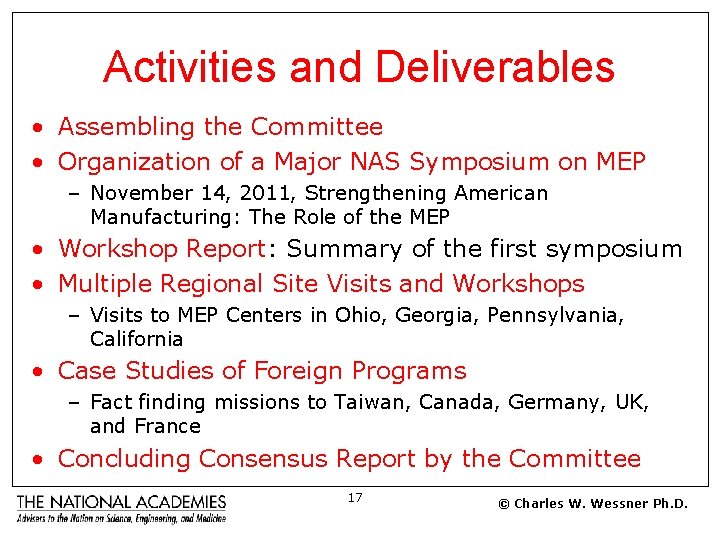
Activities and Deliverables • Assembling the Committee • Organization of a Major NAS Symposium on MEP – November 14, 2011, Strengthening American Manufacturing: The Role of the MEP • Workshop Report: Summary of the first symposium • Multiple Regional Site Visits and Workshops – Visits to MEP Centers in Ohio, Georgia, Pennsylvania, California • Case Studies of Foreign Programs – Fact finding missions to Taiwan, Canada, Germany, UK, and France • Concluding Consensus Report by the Committee 17 © Charles W. Wessner Ph. D.
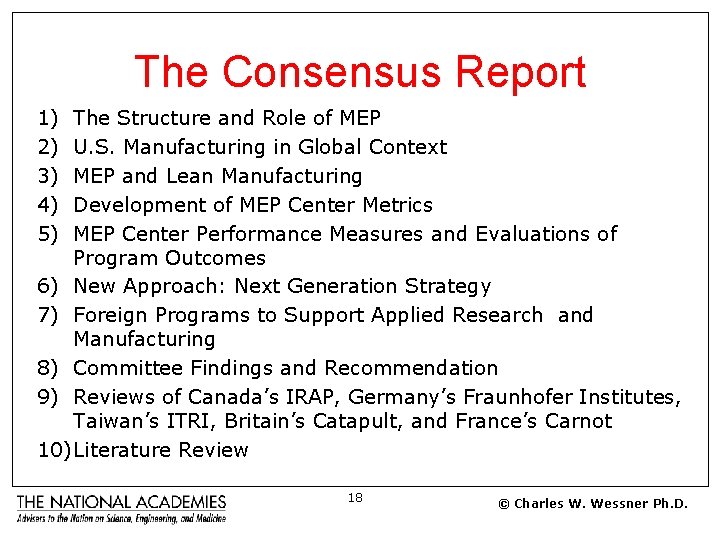
The Consensus Report 1) 2) 3) 4) 5) The Structure and Role of MEP U. S. Manufacturing in Global Context MEP and Lean Manufacturing Development of MEP Center Metrics MEP Center Performance Measures and Evaluations of Program Outcomes 6) New Approach: Next Generation Strategy 7) Foreign Programs to Support Applied Research and Manufacturing 8) Committee Findings and Recommendation 9) Reviews of Canada’s IRAP, Germany’s Fraunhofer Institutes, Taiwan’s ITRI, Britain’s Catapult, and France’s Carnot 10) Literature Review 18 © Charles W. Wessner Ph. D.
Academy Review of the MEP Study A Thorough and Independent Review of the Committee’s Analysis 19 © Charles W. Wessner Ph. D.
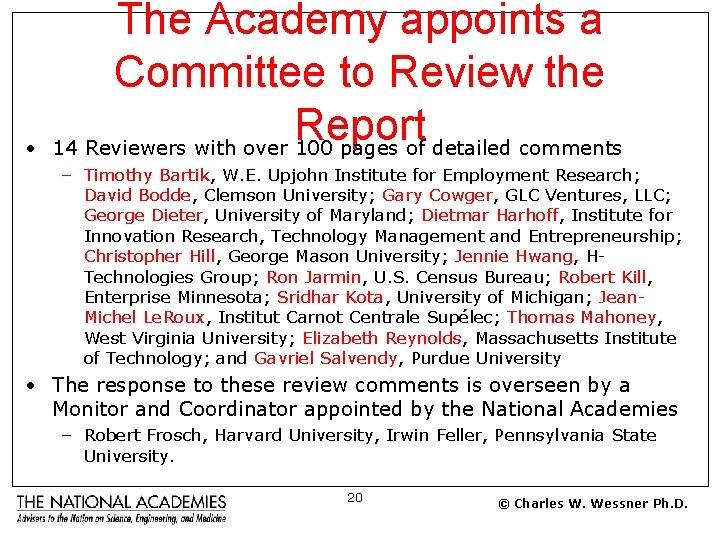
• The Academy appoints a Committee to Review the Report 14 Reviewers with over 100 pages of detailed comments – Timothy Bartik, W. E. Upjohn Institute for Employment Research; David Bodde, Clemson University; Gary Cowger, GLC Ventures, LLC; George Dieter, University of Maryland; Dietmar Harhoff, Institute for Innovation Research, Technology Management and Entrepreneurship; Christopher Hill, George Mason University; Jennie Hwang, HTechnologies Group; Ron Jarmin, U. S. Census Bureau; Robert Kill, Enterprise Minnesota; Sridhar Kota, University of Michigan; Jean. Michel Le. Roux, Institut Carnot Centrale Supélec; Thomas Mahoney, West Virginia University; Elizabeth Reynolds, Massachusetts Institute of Technology; and Gavriel Salvendy, Purdue University • The response to these review comments is overseen by a Monitor and Coordinator appointed by the National Academies – Robert Frosch, Harvard University, Irwin Feller, Pennsylvania State University. 20 © Charles W. Wessner Ph. D.
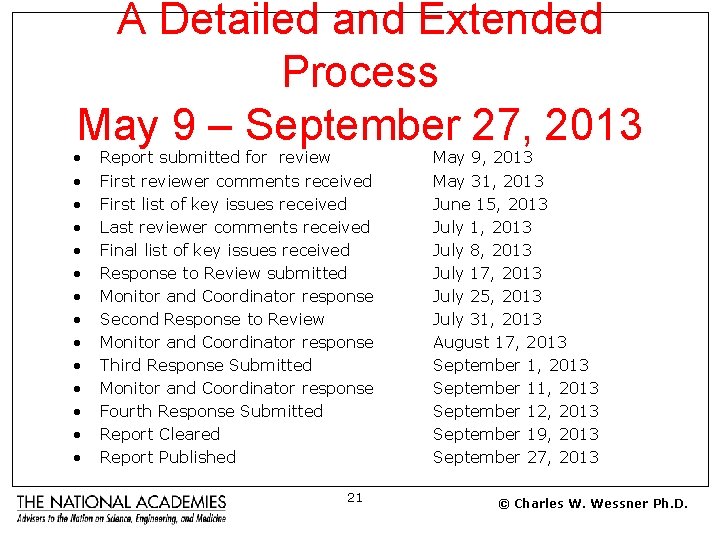
A Detailed and Extended Process May 9 – September 27, 2013 • • • • Report submitted for review First reviewer comments received First list of key issues received Last reviewer comments received Final list of key issues received Response to Review submitted Monitor and Coordinator response Second Response to Review Monitor and Coordinator response Third Response Submitted Monitor and Coordinator response Fourth Response Submitted Report Cleared Report Published 21 May 9, 2013 May 31, 2013 June 15, 2013 July 1, 2013 July 8, 2013 July 17, 2013 July 25, 2013 July 31, 2013 August 17, 2013 September 11, 2013 September 12, 2013 September 19, 2013 September 27, 2013 © Charles W. Wessner Ph. D.
Setting the Stage: The Report Describes the Nation’s Manufacturing Challenge Manufacturing Matters for Innovation and Competitiveness 22 © Charles W. Wessner Ph. D
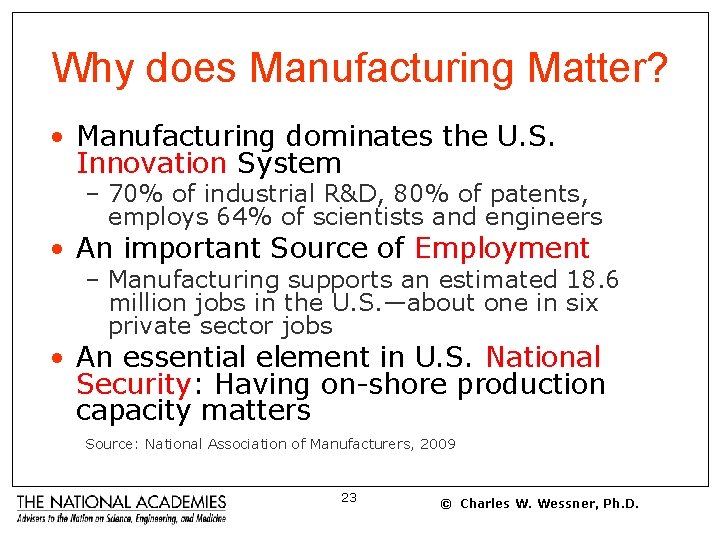
Why does Manufacturing Matter? • Manufacturing dominates the U. S. Innovation System – 70% of industrial R&D, 80% of patents, employs 64% of scientists and engineers • An important Source of Employment – Manufacturing supports an estimated 18. 6 million jobs in the U. S. —about one in six private sector jobs • An essential element in U. S. National Security: Having on-shore production capacity matters Source: National Association of Manufacturers, 2009 23 © Charles W. Wessner, Ph. D.
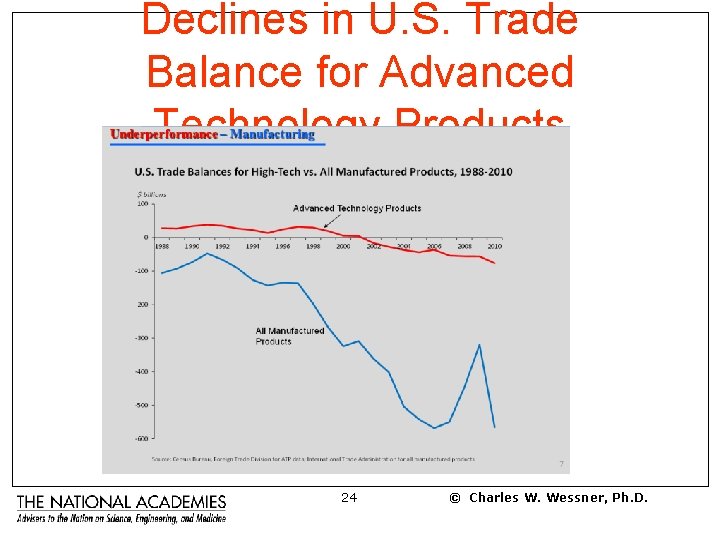
Declines in U. S. Trade Balance for Advanced Technology Products 24 © Charles W. Wessner, Ph. D.
MIT Views on the Flight of Manufacturing • Decline of vertically integrated industries* – The great new American companies of the past 30 years like Dell, Cisco, Apple, and Qualcomm have little or no manufacturing in-house. • Focus on “Core Competence”* – Higher stock market valuations of leaner, “asset-light” companies led firms to move and offshore and outsource manufacturing. • Growth in Capabilities Overseas** – Rapid Growth of Skills, R&D, and Government Support have Created Substantial Manufacturing Capabilities Overseas. * Suzanne Berger, Making in America, MIT, 2013 ** NRC, Rising to the Challenge; U. S. Innovation Policy for the Global Economy, 2012 25 ©Charles W. Wessner Ph. D
“The loss of companies that can make things will end up in the loss of research that can invent them. ” Suzanne Berger et al. , Production in the Innovation Economy Preview of MIT’s major new report on Manufacturing Released, February 22, 2013, at the National Academies 26 ©Charles W. Wessner Ph. D
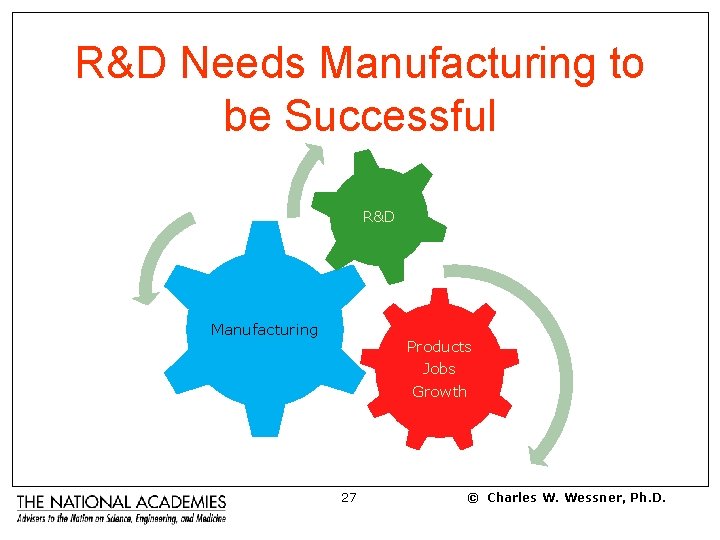
R&D Needs Manufacturing to be Successful R&D Manufacturing Products Jobs Growth 27 © Charles W. Wessner, Ph. D.
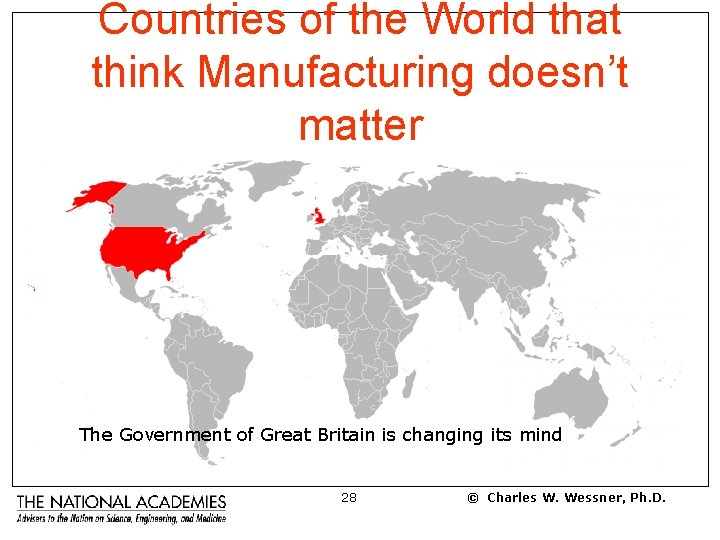
Countries of the World that think Manufacturing doesn’t matter The Government of Great Britain is changing its mind 28 © Charles W. Wessner, Ph. D.
The Problem: The premise that products developed in the United States will be manufactured here no longer holds NAS: Rising to the Challenge, Innovation Policy for the Global Economy, 2012 Making Matters: We need to revive the paradigm: “Innovated Here; Made Here” 29 © Charles W. Wessner, Ph. D.
The U. S. needs to be an Attractive Location for R&D and Manufacturing • The Results of Research are Mobile: They can be— and are being—exploited around the world. • Attracting Private R&D: Governments around the world are employing a host of measures (e. g. , market access, quality research) to attract Corporate R&D Centers. • Securing Production: Many governments have active programs to grow and attract and retain manufacturing, and the jobs, growth, and security they bring. 30 © Charles W. Wessner, Ph. D.
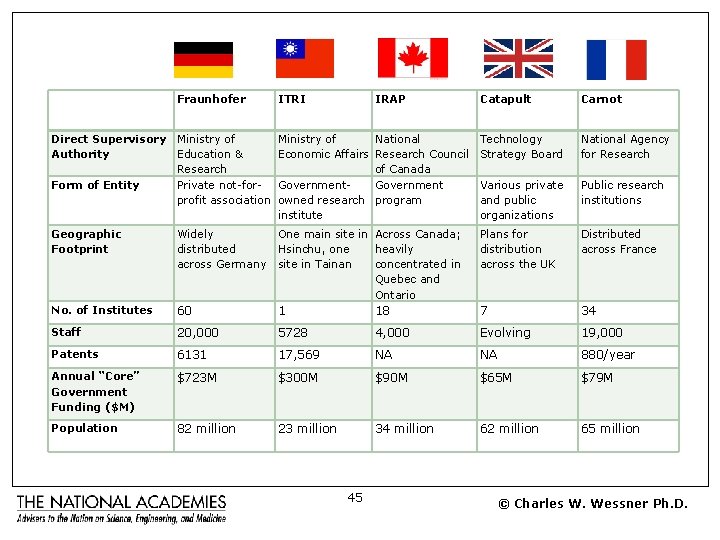
The Committee’s Review of Leading National Programs to Support Applied Research and Manufacturing Canada’s Industrial Research Assistance Program Germany’s Fraunhofer Institutes Taiwan’s Industrial Technology Research Insitute Britain’s Catapult Initiative France’s Carnot Institutes 31 © Charles W. Wessner Ph. D.
Why Review Foreign Programs? • Insights drawn from programs with similar components can be relevant. • The importance of a comparative perspective • MEP’s mission now includes promotion of innovation in manufacturing by SMEs – Best practices used by leading foreign programs to foster innovation can provide valuable lessons. • MEP is seeking to improve the efficiency of its services. – Leading foreign programs like Fraunhofer and ITRI have provided similar services and MEP can learn from their experiences. 32 © Charles W. Wessner Ph. D.
Canada’s Industrial Research Assistance Program (IRAP) • Brand: Canada's premier innovation assistance program for SMEs • Reach: Supports over 8, 500 SME’s across Canada to develop and commercialize their technologies • Network: More than 200 field staff located in over 130 offices across Canada • Budget: Federal support for IRAP roughly doubled in 2012 from $128 to $220 M. • Services: Comprehensive suite of locally-delivered advisory services. 33 © Charles W. Wessner Ph. D.
Canada’s IRAP Provides 3 types of Services • Technical and business advisory services: Industrial technology advisors coach clients’ projects through all stages of the innovationcommercialization process. • Financial Assistance: Provides funding to qualified firms and their innovative research and development related projects • Networking and Linkage Services: Industrial technology advisors connect clients with industry experts and potential business partners 34 © Charles W. Wessner Ph. D.
The German Fraunhofer Institutes • Broad Network: Stable and well-organized system of over 60 research institutes covering major areas of basic & applied research • Scale: Over 22, 000 employees, many with advanced degrees • Partnership: Each institute paired with a university • Competition: Institutes compete, but also network effectively • Budget: Sustained and substantial investment – $2. 45 Billion budget with state and federal contributions (~80%) plus contributions from industry fees
The Fraunhofer Advantage • Focus primarily on applied research, incremental improvements with market orientation • Training: Builds a skilled work force closely engaged with industry, with academic and practical skills • Facilities: Well funded, up-to-date facilities – Training on newest equipment donated by companies – Product benchmarking for new firms • Brand: Outstanding brand backed by dense networks of collaboration 36
Fraunhofer Strengths • Enjoys broad public support and increasing funding • Works with large as well as small companies • Helps maintain German advantage in machine tools, automotive, chemicals, and many niche products • It does not generate new industries, but does create new technologies and provides top flight training of engineers for industry 37
Fraunhofer Weaknesses • Focused on demand for research from existing industries, rather than on creating new ones – Many incremental improvements; some major innovations, but few high-growth start-ups. • Draw on research funding and talent may have contributed to erosion of university-based applied research in Germany • Focus on low risk, short horizon, early pay-off projects undermines ability to support high risk, long horizon sectors like biotechnology • Limited success with start-ups 38
Taiwan’s Industrial Technology Research Institute (ITRI) • Strong Brand: Transformed Taiwan’s economy with its focus on applied research and technical services for existing firms • Strategy fosters the creation of entire industry chains supporting the manufacturing process – From design, materials, equipment, testing, packaging, quality control, and applications • Budget of $600 million/year; half from the government: but no growth and aging staff • Close Links to Taiwan’s universities to turn research into new products and manufacturing processes. 39 © Charles W. Wessner Ph. D.
ITRI Functions • Technology Diffusion – R&D alliances to diffuse knowledge – Licenses technologies to domestic companies on favorable terms – Performs contract research for firms – Serves as an incubator: “Open Lab” • Spin-offs – ITRI researchers spin out to form companies, e. g. , TSMC – 162 direct spin-outs since 1977 – ITIC provides early stage funding 40 © Charles W. Wessner, Ph. D.
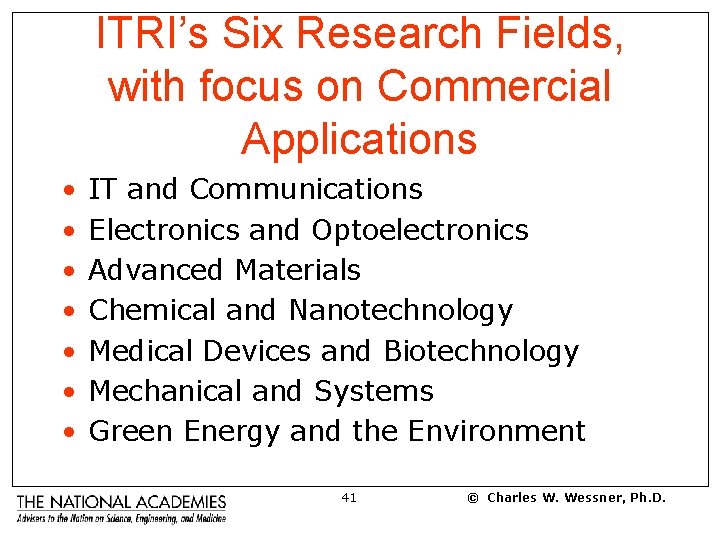
ITRI’s Six Research Fields, with focus on Commercial Applications • • IT and Communications Electronics and Optoelectronics Advanced Materials Chemical and Nanotechnology Medical Devices and Biotechnology Mechanical and Systems Green Energy and the Environment 41 © Charles W. Wessner, Ph. D.
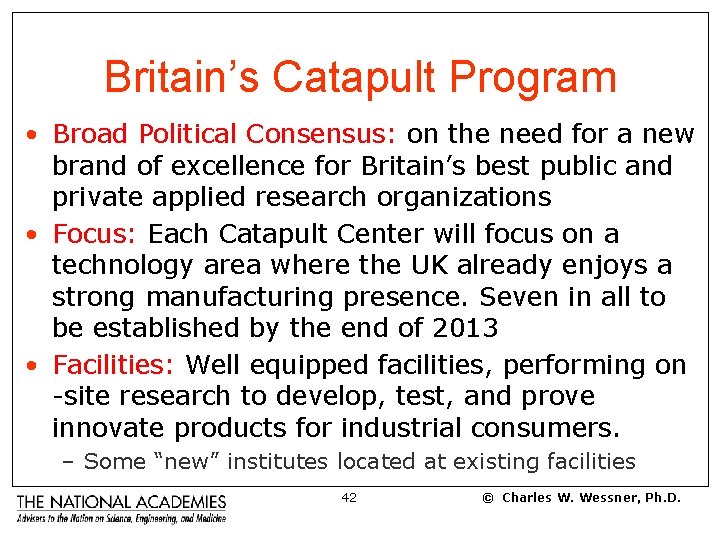
Britain’s Catapult Program • Broad Political Consensus: on the need for a new brand of excellence for Britain’s best public and private applied research organizations • Focus: Each Catapult Center will focus on a technology area where the UK already enjoys a strong manufacturing presence. Seven in all to be established by the end of 2013 • Facilities: Well equipped facilities, performing on -site research to develop, test, and prove innovate products for industrial consumers. – Some “new” institutes located at existing facilities 42 © Charles W. Wessner, Ph. D.
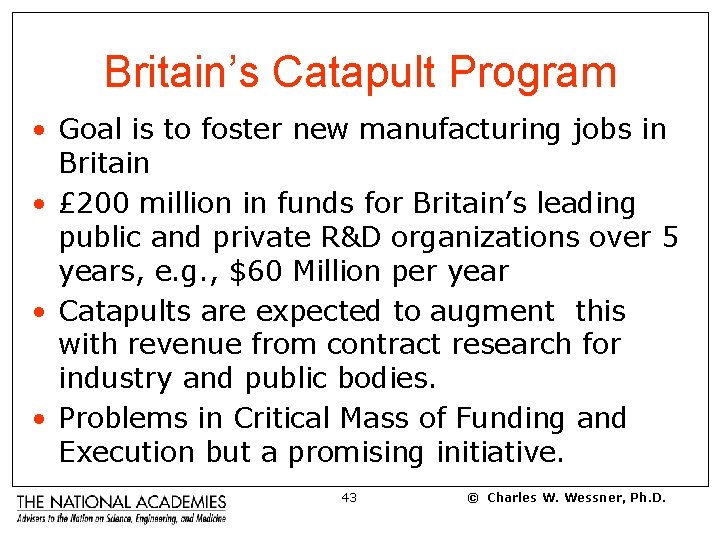
Britain’s Catapult Program • Goal is to foster new manufacturing jobs in Britain • £ 200 million in funds for Britain’s leading public and private R&D organizations over 5 years, e. g. , $60 Million per year • Catapults are expected to augment this with revenue from contract research for industry and public bodies. • Problems in Critical Mass of Funding and Execution but a promising initiative. 43 © Charles W. Wessner, Ph. D.
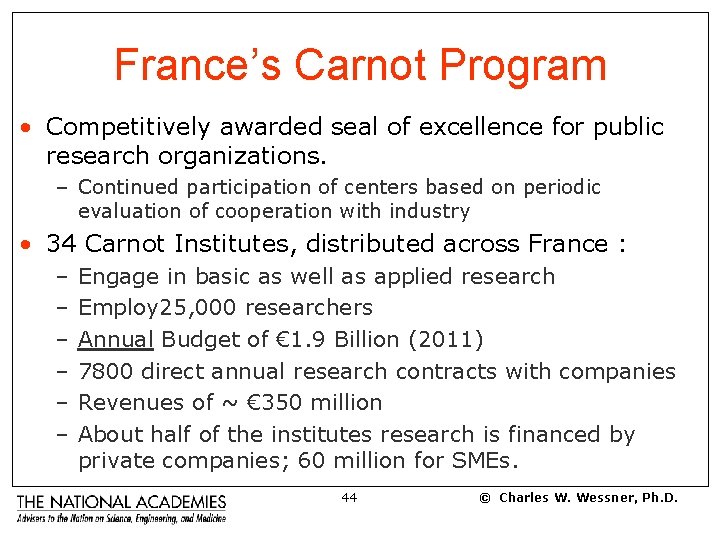
France’s Carnot Program • Competitively awarded seal of excellence for public research organizations. – Continued participation of centers based on periodic evaluation of cooperation with industry • 34 Carnot Institutes, distributed across France : – – – Engage in basic as well as applied research Employ 25, 000 researchers Annual Budget of € 1. 9 Billion (2011) 7800 direct annual research contracts with companies Revenues of ~ € 350 million About half of the institutes research is financed by private companies; 60 million for SMEs. 44 © Charles W. Wessner, Ph. D.
Fraunhofer ITRI IRAP Catapult Carnot Direct Supervisory Ministry of Authority Education & Research Form of Entity Private not-forprofit association Ministry of National Economic Affairs Research Council of Canada Government owned research program institute Technology Strategy Board National Agency for Research Various private and public organizations Public research institutions Geographic Footprint Widely distributed across Germany One main site in Across Canada; Hsinchu, one heavily site in Tainan concentrated in Quebec and Ontario Plans for distribution across the UK Distributed across France No. of Institutes 60 1 18 7 34 Staff 20, 000 5728 4, 000 Evolving 19, 000 Patents 6131 17, 569 NA NA 880/year Annual “Core” Government Funding ($M) $723 M $300 M $90 M $65 M $79 M Population 82 million 23 million 34 million 62 million 65 million 45 © Charles W. Wessner Ph. D.
Key Point Leading nations are focused on manufacturing 46 © Charles W. Wessner Ph. D.
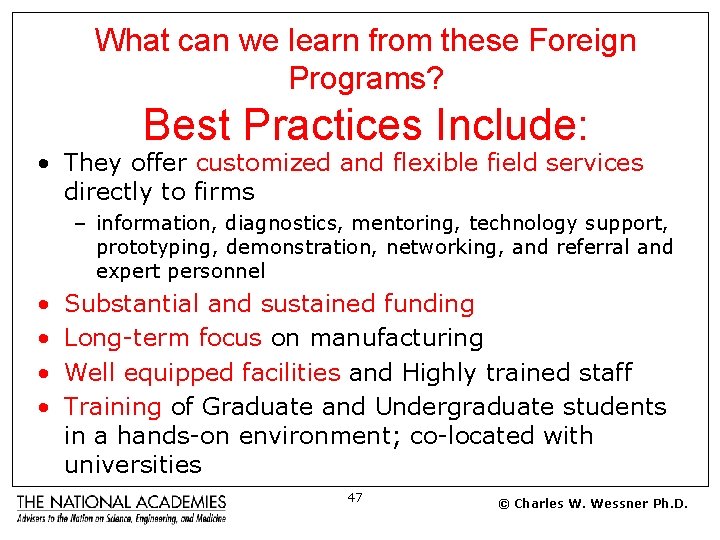
What can we learn from these Foreign Programs? Best Practices Include: • They offer customized and flexible field services directly to firms – information, diagnostics, mentoring, technology support, prototyping, demonstration, networking, and referral and expert personnel • • Substantial and sustained funding Long-term focus on manufacturing Well equipped facilities and Highly trained staff Training of Graduate and Undergraduate students in a hands-on environment; co-located with universities 47 © Charles W. Wessner Ph. D.
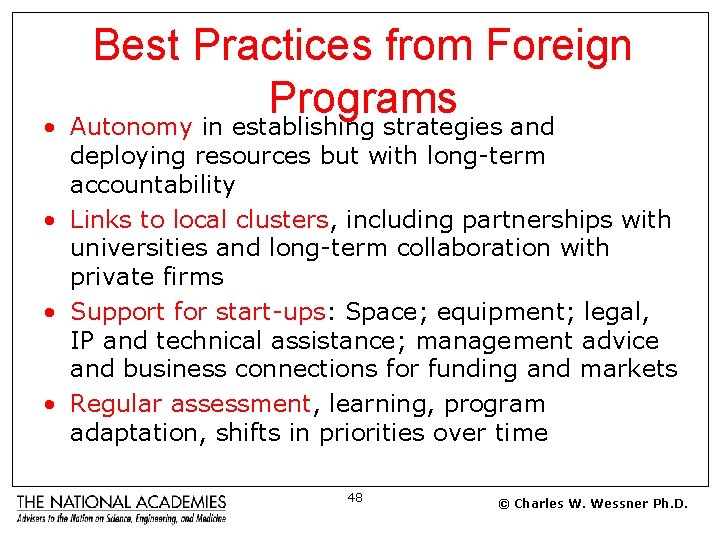
Best Practices from Foreign Programs • Autonomy in establishing strategies and deploying resources but with long-term accountability • Links to local clusters, including partnerships with universities and long-term collaboration with private firms • Support for start-ups: Space; equipment; legal, IP and technical assistance; management advice and business connections for funding and markets • Regular assessment, learning, program adaptation, shifts in priorities over time 48 © Charles W. Wessner Ph. D.
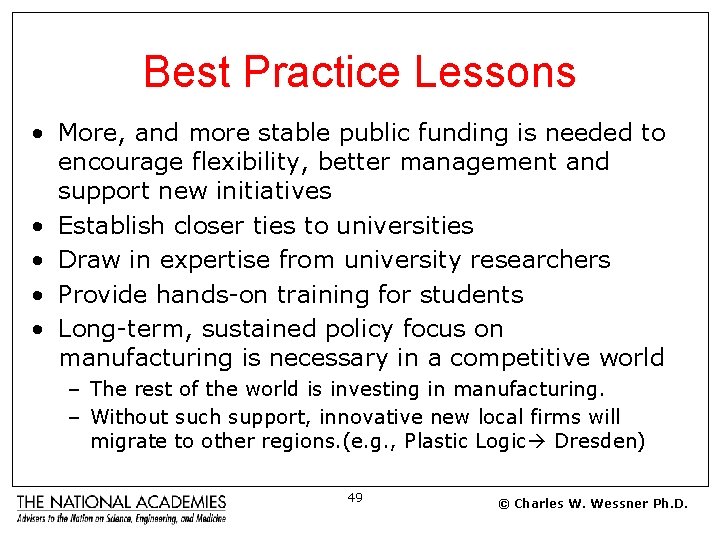
Best Practice Lessons • More, and more stable public funding is needed to encourage flexibility, better management and support new initiatives • Establish closer ties to universities • Draw in expertise from university researchers • Provide hands-on training for students • Long-term, sustained policy focus on manufacturing is necessary in a competitive world – The rest of the world is investing in manufacturing. – Without such support, innovative new local firms will migrate to other regions. (e. g. , Plastic Logic Dresden) 49 © Charles W. Wessner Ph. D.
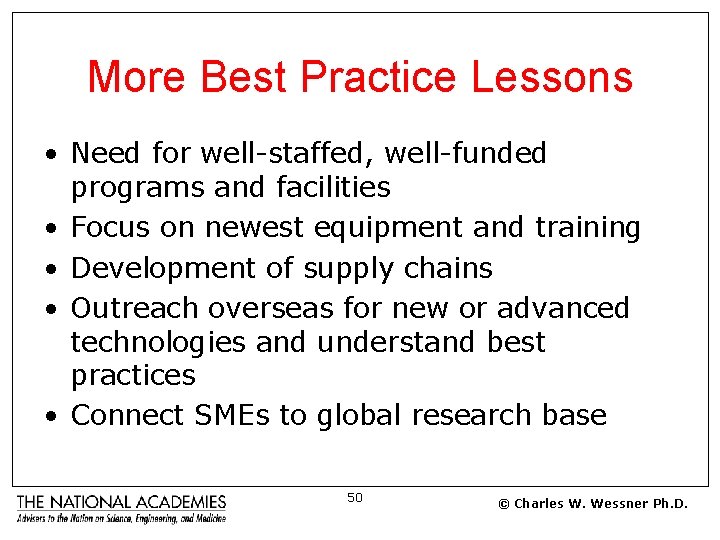
More Best Practice Lessons • Need for well-staffed, well-funded programs and facilities • Focus on newest equipment and training • Development of supply chains • Outreach overseas for new or advanced technologies and understand best practices • Connect SMEs to global research base 50 © Charles W. Wessner Ph. D.
U. S. Support for Manufacturing A New Strategy 51 © Charles W. Wessner Ph. D.
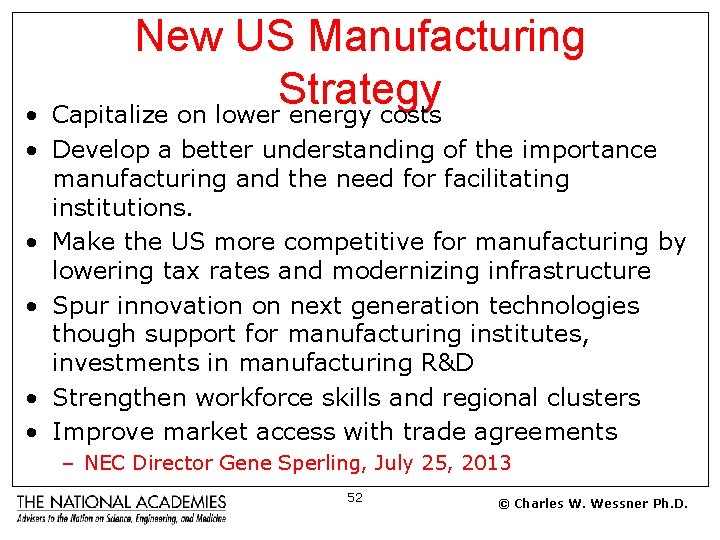
New US Manufacturing Strategy Capitalize on lower energy costs • • Develop a better understanding of the importance manufacturing and the need for facilitating institutions. • Make the US more competitive for manufacturing by lowering tax rates and modernizing infrastructure • Spur innovation on next generation technologies though support for manufacturing institutes, investments in manufacturing R&D • Strengthen workforce skills and regional clusters • Improve market access with trade agreements – NEC Director Gene Sperling, July 25, 2013 52 © Charles W. Wessner Ph. D.
What is MEP’s Role? MEP provides advisory services and technical assistance focused on lean manufacturing New shift to a more Innovation-driven strategy 53 © Charles W. Wessner Ph. D.
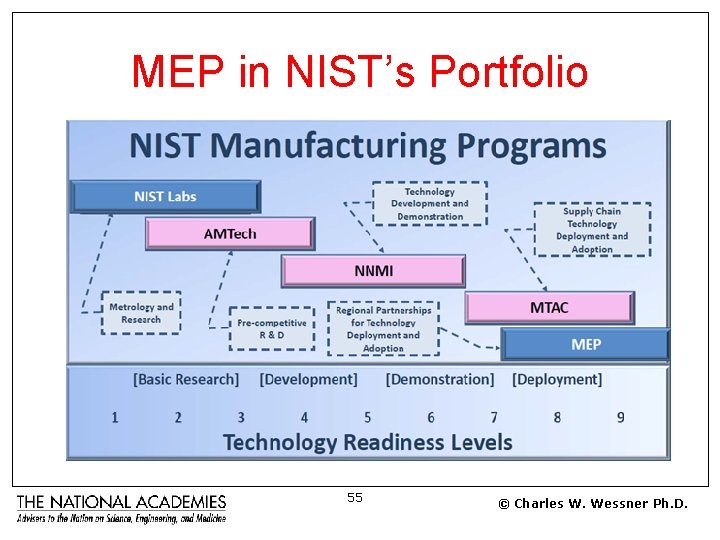
MEP’s Unique Role • Leading US program designed explicitly to provide support services to small and medium manufacturers – These SMEs have limited market alternatives – MEP reaches out to some 7000 SMEs a year – Distributed program, with Centers addressing needs particular to different regions • Key element in NIST’s suite of programs to support U. S. based manufacturing 54 © Charles W. Wessner Ph. D.
MEP in NIST’s Portfolio 55 © Charles W. Wessner Ph. D.
Challenges facing MEP Today • A changing competitive environment – Globalization of Innovation and Manufacturing – Growth of Regulations • A challenging mission – High variation in size, technologies, and needs of manufacturing firms – Need to maximize mission impact on a small budget, while raising revenues • New focus on innovation – Need to move 60+ Centers that are diverse in size, capabilities, strategic orientation, organization, innovative capacity • Existential Challenge 56 © Charles W. Wessner Ph. D.
Key Findings Challenges, Risks, and Opportunities for MEP 57 © Charles W. Wessner Ph. D.
Core Findings • Program Value: The MEP program makes effective use of relatively limited resources for reaching and supporting small and medium sized manufacturers. • Focus on Lean: MEP has provided valuable help to small manufacturers in the introduction of lean manufacturing techniques. • New Strategy: MEP has made a concerted effort to encourage MEP Centers to develop a wider range of services focused on innovation and growth. • Best Practices: NIST needs to better understand the operations and impact of leading foreign programs and draw on their best practices lessons. 58 © Charles W. Wessner Ph. D.
Center Diversity is an Advantage • Commendable diversity among MEP Centers in terms of structure, services, and business models – Significant scope for experimentation and adaptation to local needs – Large variation in MEP Center performance • However, MEP does not yet capitalize sufficiently on this diversity of experience – Learning across the system could be enhanced 59 © Charles W. Wessner Ph. D.
MEP’s Valuable Focus on Lean • Most MEP Centers have developed tools and services focused on lean manufacturing as a primary line of business. • Overall, MEP’s support for lean manufacturing shows evidence of success. – Based on Case studies, Literature Review, and Interviews • But Lean is not enough to grow and expand the innovativeness of the manufacturing sector. 60 © Charles W. Wessner Ph. D.
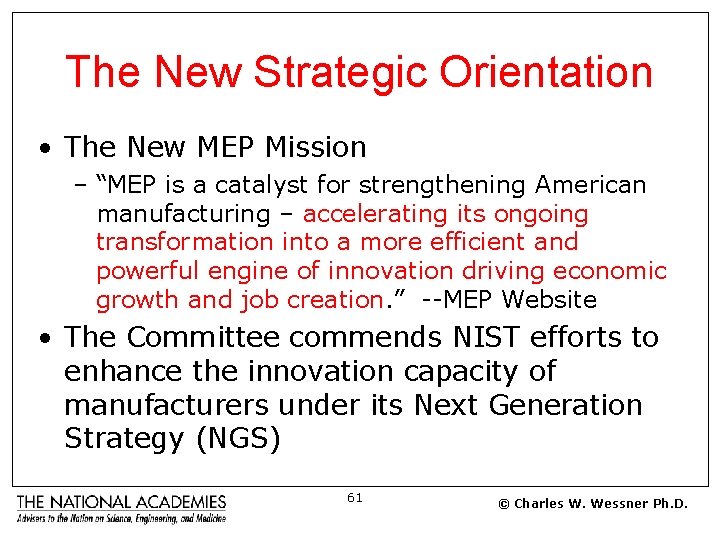
The New Strategic Orientation • The New MEP Mission – “MEP is a catalyst for strengthening American manufacturing – accelerating its ongoing transformation into a more efficient and powerful engine of innovation driving economic growth and job creation. ” --MEP Website • The Committee commends NIST efforts to enhance the innovation capacity of manufacturers under its Next Generation Strategy (NGS) 61 © Charles W. Wessner Ph. D.
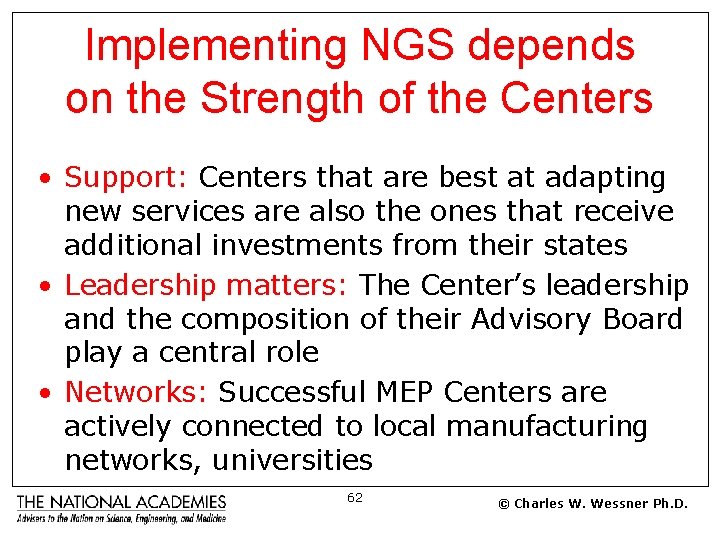
Implementing NGS depends on the Strength of the Centers • Support: Centers that are best at adapting new services are also the ones that receive additional investments from their states • Leadership matters: The Center’s leadership and the composition of their Advisory Board play a central role • Networks: Successful MEP Centers are actively connected to local manufacturing networks, universities 62 © Charles W. Wessner Ph. D.
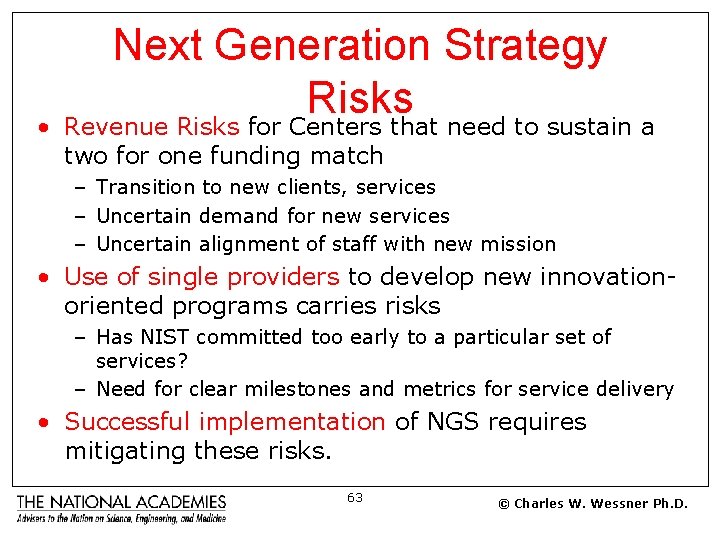
Next Generation Strategy Risks • Revenue Risks for Centers that need to sustain a two for one funding match – Transition to new clients, services – Uncertain demand for new services – Uncertain alignment of staff with new mission • Use of single providers to develop new innovationoriented programs carries risks – Has NIST committed too early to a particular set of services? – Need for clear milestones and metrics for service delivery • Successful implementation of NGS requires mitigating these risks. 63 © Charles W. Wessner Ph. D.
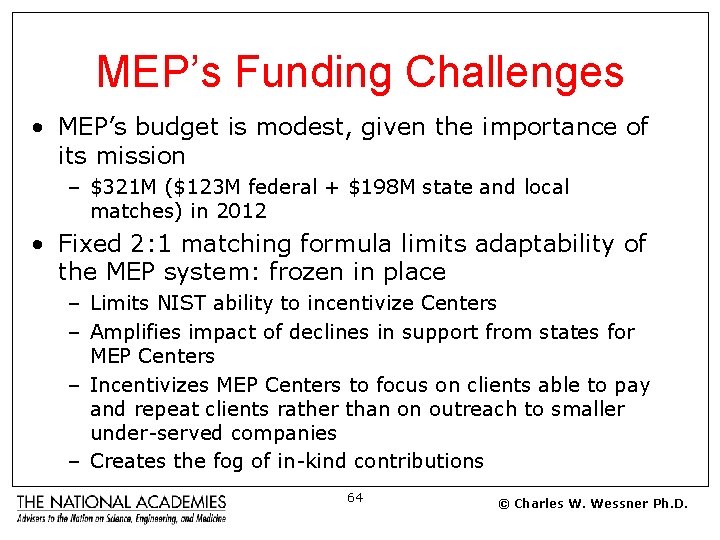
MEP’s Funding Challenges • MEP’s budget is modest, given the importance of its mission – $321 M ($123 M federal + $198 M state and local matches) in 2012 • Fixed 2: 1 matching formula limits adaptability of the MEP system: frozen in place – Limits NIST ability to incentivize Centers – Amplifies impact of declines in support from states for MEP Centers – Incentivizes MEP Centers to focus on clients able to pay and repeat clients rather than on outreach to smaller under-served companies – Creates the fog of in-kind contributions 64 © Charles W. Wessner Ph. D.
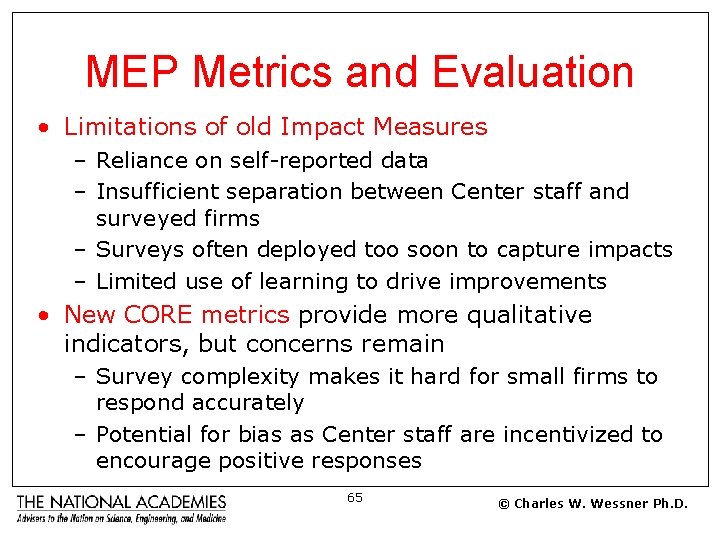
MEP Metrics and Evaluation • Limitations of old Impact Measures – Reliance on self-reported data – Insufficient separation between Center staff and surveyed firms – Surveys often deployed too soon to capture impacts – Limited use of learning to drive improvements • New CORE metrics provide more qualitative indicators, but concerns remain – Survey complexity makes it hard for small firms to respond accurately – Potential for bias as Center staff are incentivized to encourage positive responses 65 © Charles W. Wessner Ph. D.
Key Recommendations Making a valuable program more effective 66 © Charles W. Wessner Ph. D.
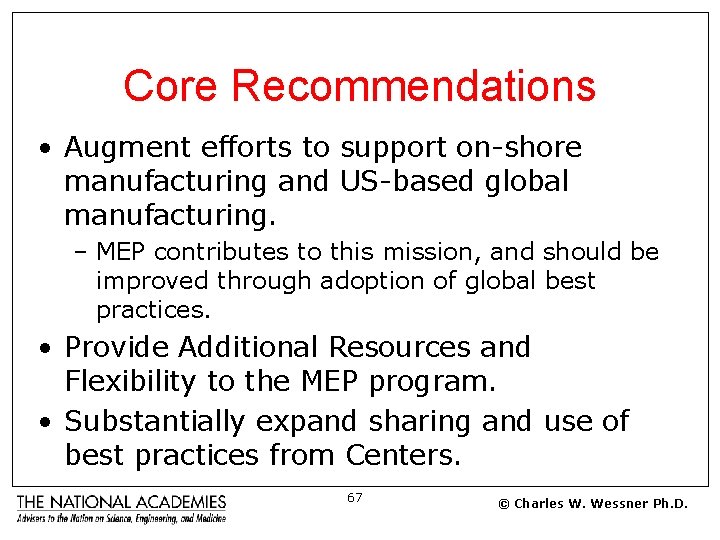
Core Recommendations • Augment efforts to support on-shore manufacturing and US-based global manufacturing. – MEP contributes to this mission, and should be improved through adoption of global best practices. • Provide Additional Resources and Flexibility to the MEP program. • Substantially expand sharing and use of best practices from Centers. 67 © Charles W. Wessner Ph. D.
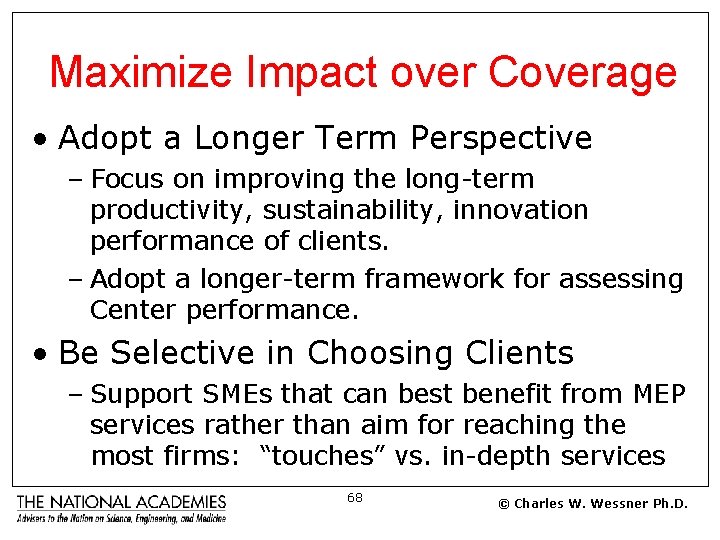
Maximize Impact over Coverage • Adopt a Longer Term Perspective – Focus on improving the long-term productivity, sustainability, innovation performance of clients. – Adopt a longer-term framework for assessing Center performance. • Be Selective in Choosing Clients – Support SMEs that can best benefit from MEP services rather than aim for reaching the most firms: “touches” vs. in-depth services 68 © Charles W. Wessner Ph. D.
Focus on MEP Center Performance • Develop positive incentives to improve Center performance • Encourage Centers to share best practices through peer-to-peer exchange – Annual conferences – Forum for Center Directors • Encourage experimentation with pilot programs • Foster Centers of Excellence 69 © Charles W. Wessner Ph. D.
Keep Lean Manufacturing • Maintain current Center capacities. • Integrate lean manufacturing with new initiatives related to innovation. • Adjust metrics to better reflect the importance of lean manufacturing to the Centers. 70 © Charles W. Wessner Ph. D.
Go with the New Strategy but address Challenges • Review market demand for new services region by region • Recognize that Centers need to maintain their revenue base • Identify and promote emerging best practices across Centers • Recruit and train new staff • Draw on Advisory Boards to chart NIST-MEP and MEP-Center strategies 71 © Charles W. Wessner Ph. D.
Benchmark Service Providers • Set standards of performance for major service providers – Evaluate them regularly • Use single providers sparingly: monitor closely and evaluate regularly – Provide justification for use of single providers – Use multiple contractors where possible for comparative and competitive purposes 72 © Charles W. Wessner Ph. D.
Improve Data Collection & Analysis • Commission independent and ongoing evaluations of new initiatives • Incentivize contractors to develop high quality data with appropriate response rates • Develop Milestones to gauge progress • Consult Stakeholders: Small firms, state and regional governments, universities 73 © Charles W. Wessner Ph. D.
Change the matching requirement • A one-to-one match would: – Improve the financial stability of MEP Centers – Encourage long-term planning and transition to the Next Generation Strategy – Provide more flexibility in managing the program – Bring MEP cost share in line with other Commerce programs • Key risk: – States reduce funding and the program shrinks. 74 © Charles W. Wessner Ph. D.
Match Federal Funding of MEP against International Benchmarks • Canada funds IRAP at twice the level as the US funds MEP, but the US economy is 10 times as large • Current levels of funding are not adequate to address MEP’s mission to: – Expand the Next Generation Strategy – Sustain Lean Manufacturing Support – Support adoption of best practices – Improve data collection and analysis – Reach more small firms 75 © Charles W. Wessner Ph. D.
In Conclusion: Adapting MEP for the Future 76 © Charles W. Wessner Ph. D.
NIST can move MEP forward • Carefully roll out a more innovation-oriented program • Improve flexibility and experimentation for MEP Centers • Facilitate learning of best practices across MEP Centers • Improve data collection of program outcomes • Implement regular arms-length evaluations of suppliers • Draw on best practices from foreign programs • Integrate MEP as a part of a national manufacturing strategy 77 © Charles W. Wessner Ph. D.
Thank You Charles W. Wessner, Ph. D. Director, Program on Technology, Innovation and Entrepreneurship The U. S. National Academies 500 Fifth Street NW Washington, D. C. 20001 cwessner@nas. edu Tel: 202 334 3801 http: //www. nationalacademies. org/step 78 © Charles W. Wessner Ph. D.