
ST 21 CENTURY EDUCATION THE FUTURE OF TECHNOLOGY
- Slides: 32
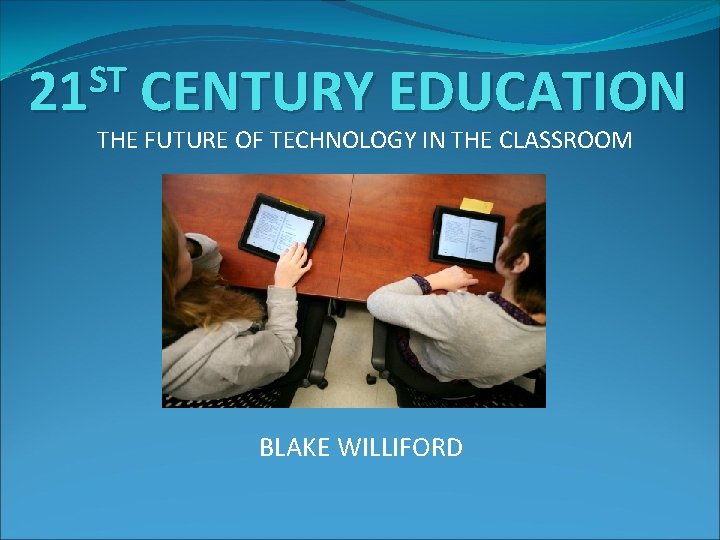
ST 21 CENTURY EDUCATION THE FUTURE OF TECHNOLOGY IN THE CLASSROOM BLAKE WILLIFORD
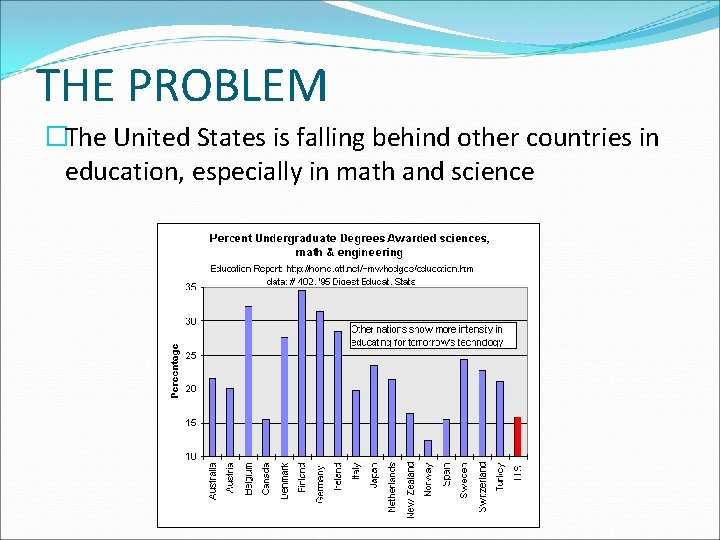
THE PROBLEM �The United States is falling behind other countries in education, especially in math and science
THE PROBLEM �Kids go home to video games, TV, etc. but education is largely the same as it was 100 years ago. Teachers are losing control of kids and having a hard time keeping them engaged �The country is becoming more bilingual �Correlation between economic productivity and education is undeniable �Throwing more money at it has not solved the problem National graduation rates and achievement scores are flat, while spending on education has increased more than 100 percent since 1971. More money hasn't helped American kids.
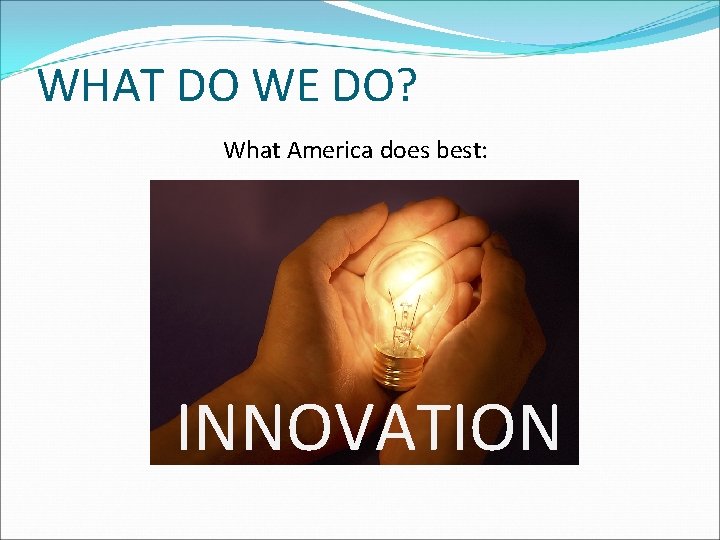
WHAT DO WE DO? What America does best: INNOVATION
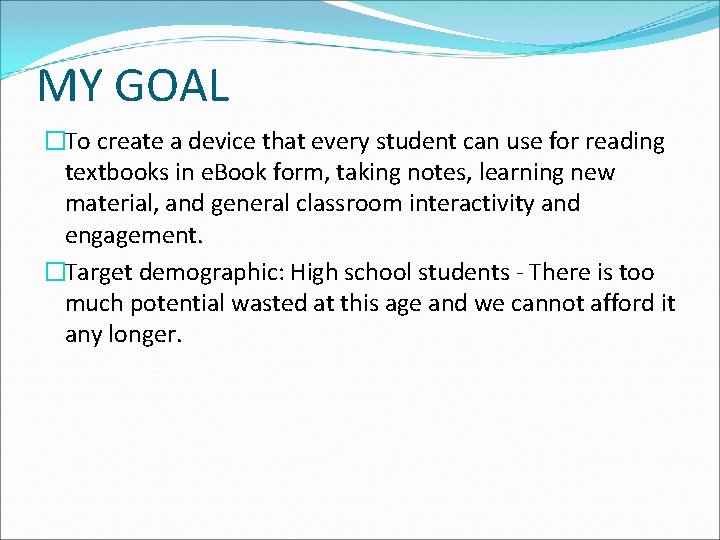
MY GOAL �To create a device that every student can use for reading textbooks in e. Book form, taking notes, learning new material, and general classroom interactivity and engagement. �Target demographic: High school students - There is too much potential wasted at this age and we cannot afford it any longer.
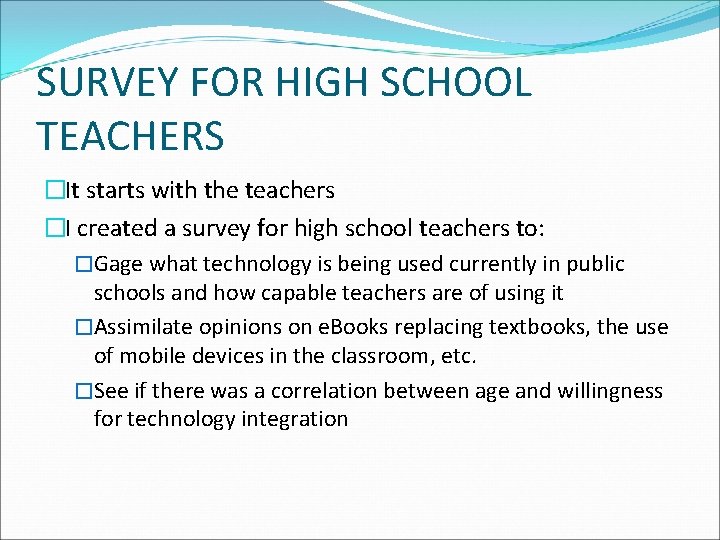
SURVEY FOR HIGH SCHOOL TEACHERS �It starts with the teachers �I created a survey for high school teachers to: �Gage what technology is being used currently in public schools and how capable teachers are of using it �Assimilate opinions on e. Books replacing textbooks, the use of mobile devices in the classroom, etc. �See if there was a correlation between age and willingness for technology integration
SURVEY RESULTS • 17 teachers from Monroe High School in Monroe, GA in a wide variety of subjects • Ages 22 -60 (Average 40)
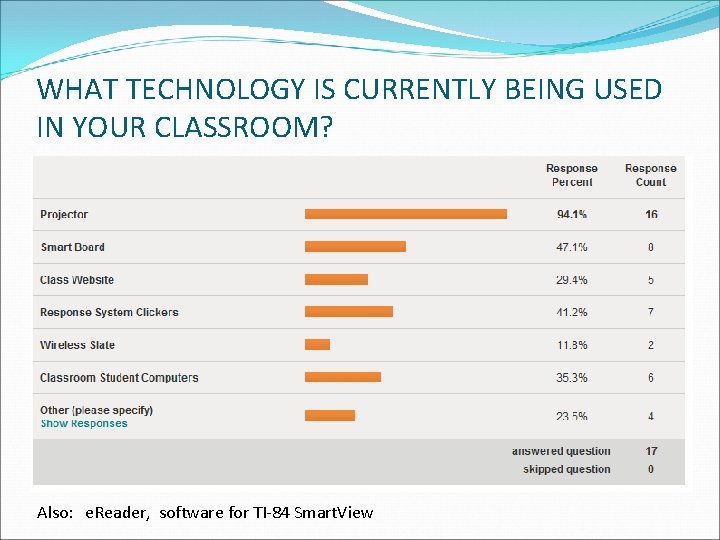
WHAT TECHNOLOGY IS CURRENTLY BEING USED IN YOUR CLASSROOM? Also: e. Reader, software for TI-84 Smart. View
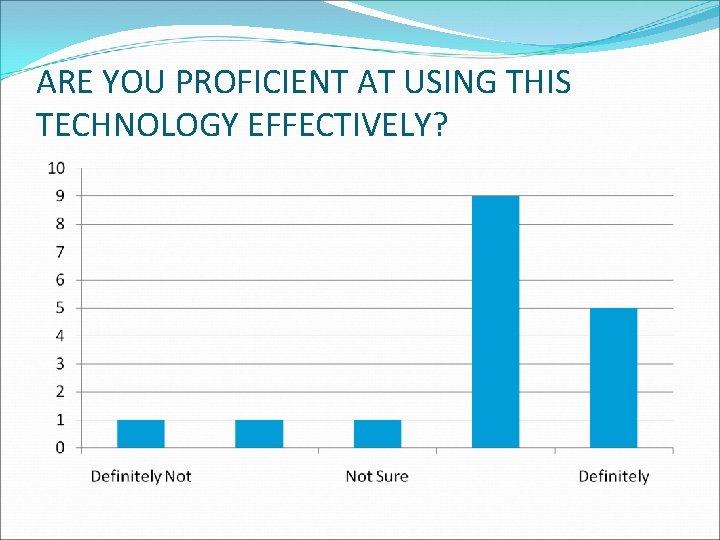
ARE YOU PROFICIENT AT USING THIS TECHNOLOGY EFFECTIVELY?
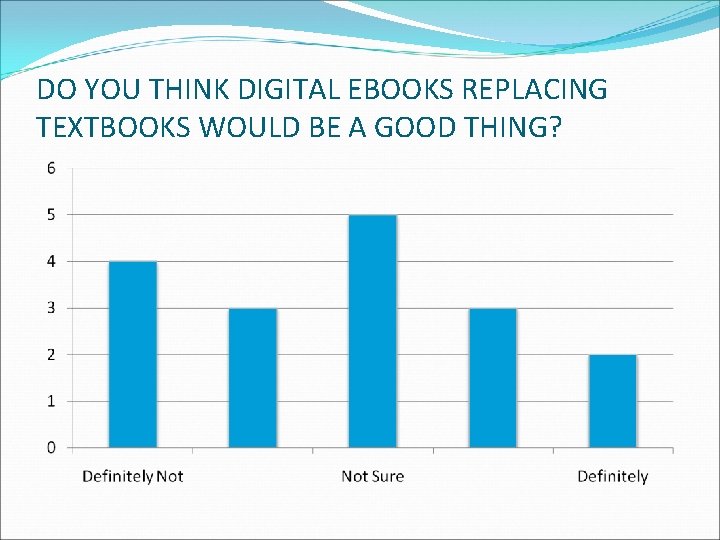
DO YOU THINK DIGITAL EBOOKS REPLACING TEXTBOOKS WOULD BE A GOOD THING?
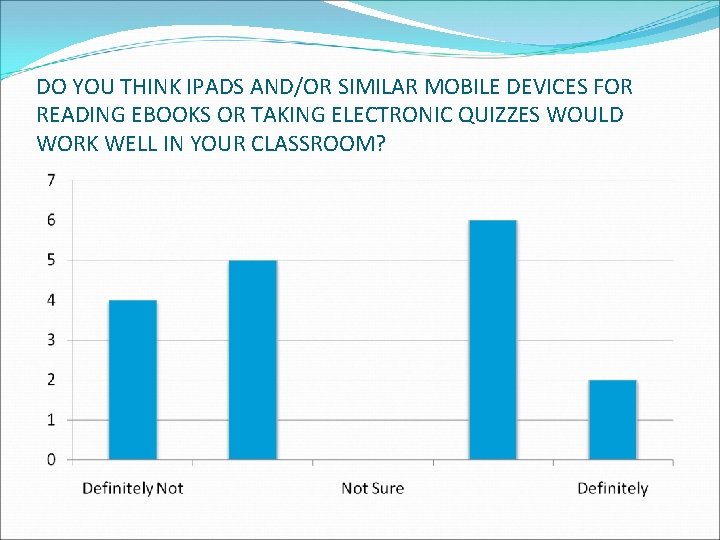
DO YOU THINK IPADS AND/OR SIMILAR MOBILE DEVICES FOR READING EBOOKS OR TAKING ELECTRONIC QUIZZES WOULD WORK WELL IN YOUR CLASSROOM?
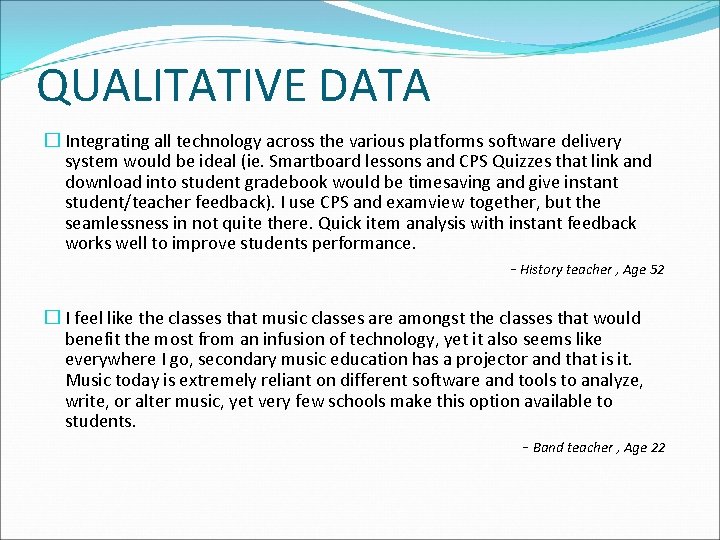
QUALITATIVE DATA � Integrating all technology across the various platforms software delivery system would be ideal (ie. Smartboard lessons and CPS Quizzes that link and download into student gradebook would be timesaving and give instant student/teacher feedback). I use CPS and examview together, but the seamlessness in not quite there. Quick item analysis with instant feedback works well to improve students performance. - History teacher , Age 52 � I feel like the classes that music classes are amongst the classes that would benefit the most from an infusion of technology, yet it also seems like everywhere I go, secondary music education has a projector and that is it. Music today is extremely reliant on different software and tools to analyze, write, or alter music, yet very few schools make this option available to students. - Band teacher , Age 22
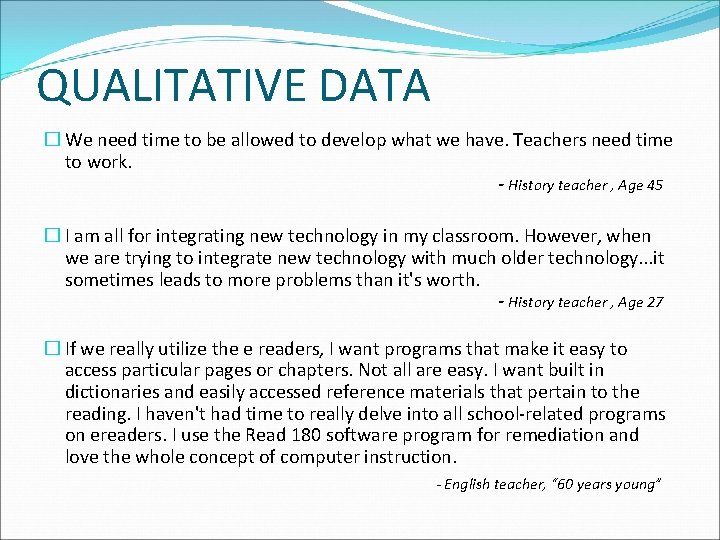
QUALITATIVE DATA � We need time to be allowed to develop what we have. Teachers need time to work. - History teacher , Age 45 � I am all for integrating new technology in my classroom. However, when we are trying to integrate new technology with much older technology. . . it sometimes leads to more problems than it's worth. - History teacher , Age 27 � If we really utilize the e readers, I want programs that make it easy to access particular pages or chapters. Not all are easy. I want built in dictionaries and easily accessed reference materials that pertain to the reading. I haven't had time to really delve into all school-related programs on ereaders. I use the Read 180 software program for remediation and love the whole concept of computer instruction. - English teacher, “ 60 years young”
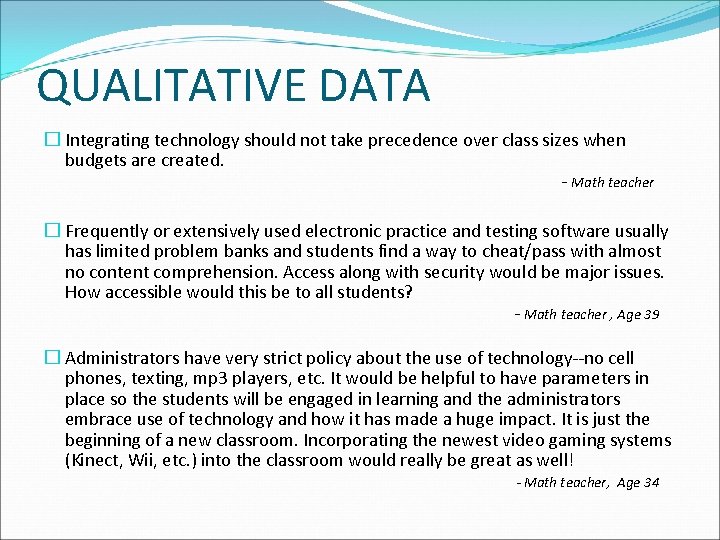
QUALITATIVE DATA � Integrating technology should not take precedence over class sizes when budgets are created. - Math teacher � Frequently or extensively used electronic practice and testing software usually has limited problem banks and students find a way to cheat/pass with almost no content comprehension. Access along with security would be major issues. How accessible would this be to all students? - Math teacher , Age 39 � Administrators have very strict policy about the use of technology--no cell phones, texting, mp 3 players, etc. It would be helpful to have parameters in place so the students will be engaged in learning and the administrators embrace use of technology and how it has made a huge impact. It is just the beginning of a new classroom. Incorporating the newest video gaming systems (Kinect, Wii, etc. ) into the classroom would really be great as well! - Math teacher, Age 34
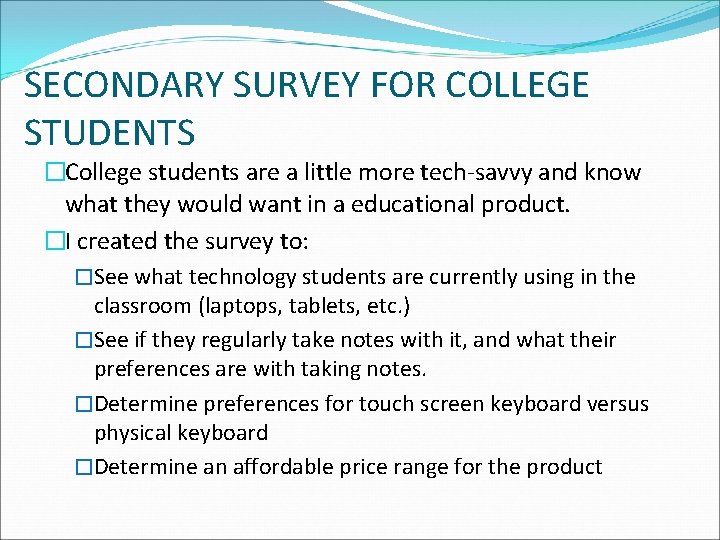
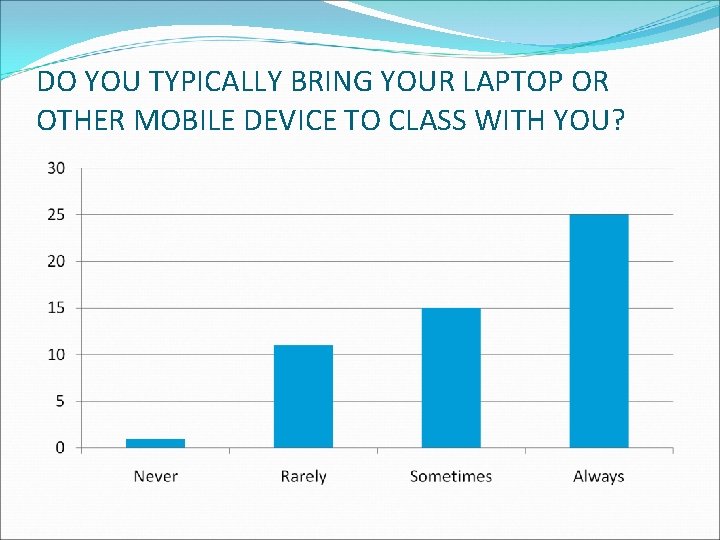
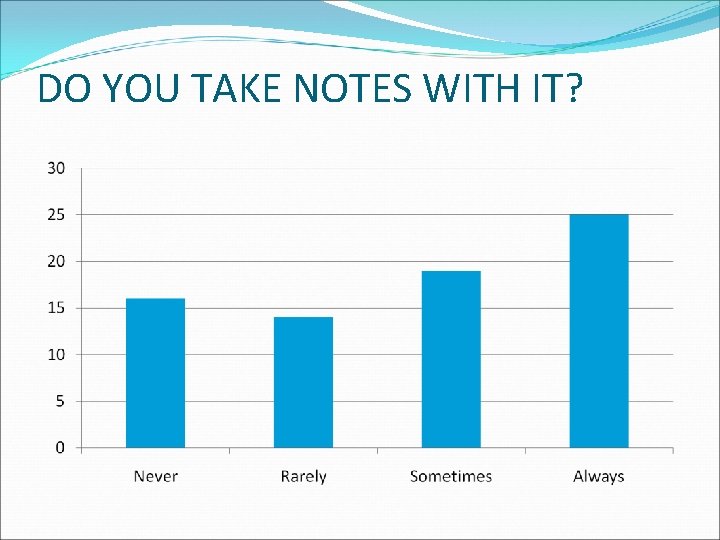
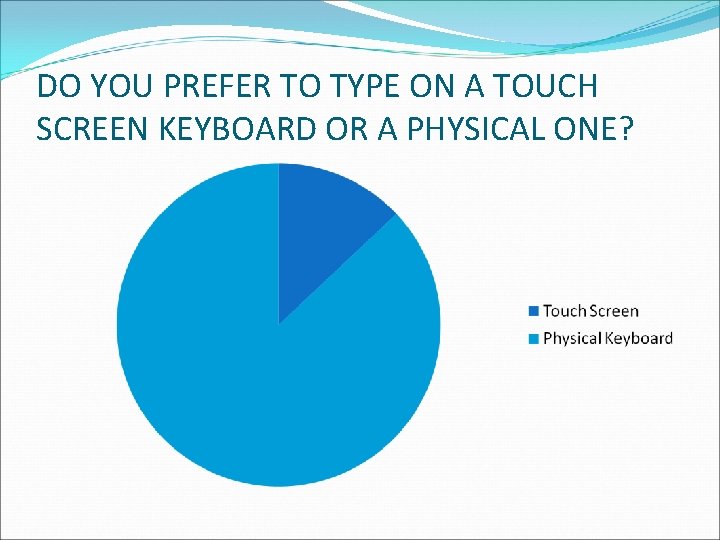
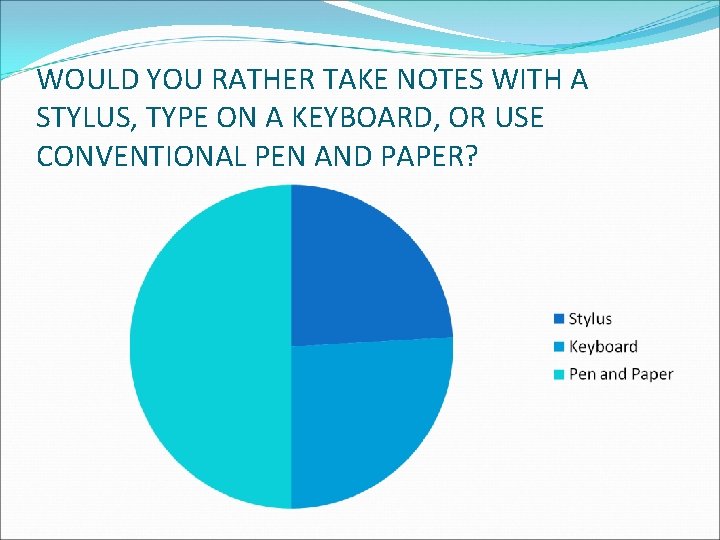
SECONDARY SURVEY FOR COLLEGE STUDENTS �College students are a little more tech-savvy and know what they would want in a educational product. �I created the survey to: �See what technology students are currently using in the classroom (laptops, tablets, etc. ) �See if they regularly take notes with it, and what their preferences are with taking notes. �Determine preferences for touch screen keyboard versus physical keyboard �Determine an affordable price range for the product
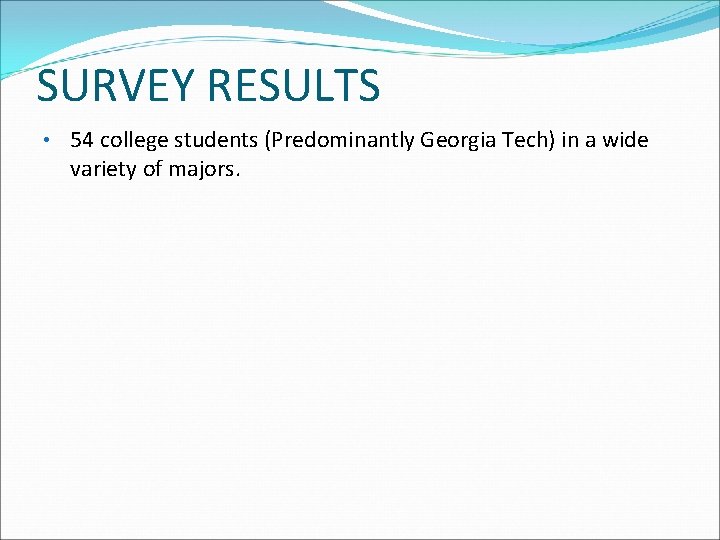
SURVEY RESULTS • 54 college students (Predominantly Georgia Tech) in a wide variety of majors.
DO YOU TYPICALLY BRING YOUR LAPTOP OR OTHER MOBILE DEVICE TO CLASS WITH YOU?
DO YOU TAKE NOTES WITH IT?
DO YOU PREFER TO TYPE ON A TOUCH SCREEN KEYBOARD OR A PHYSICAL ONE?
WOULD YOU RATHER TAKE NOTES WITH A STYLUS, TYPE ON A KEYBOARD, OR USE CONVENTIONAL PEN AND PAPER?
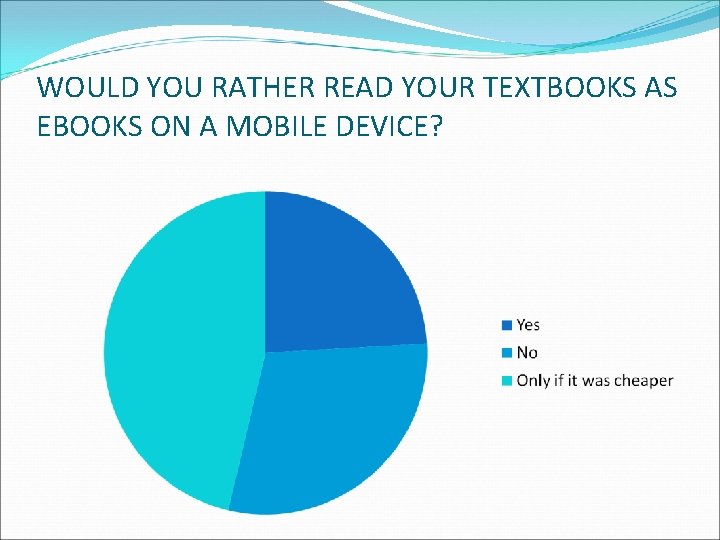
WOULD YOU RATHER READ YOUR TEXTBOOKS AS EBOOKS ON A MOBILE DEVICE?
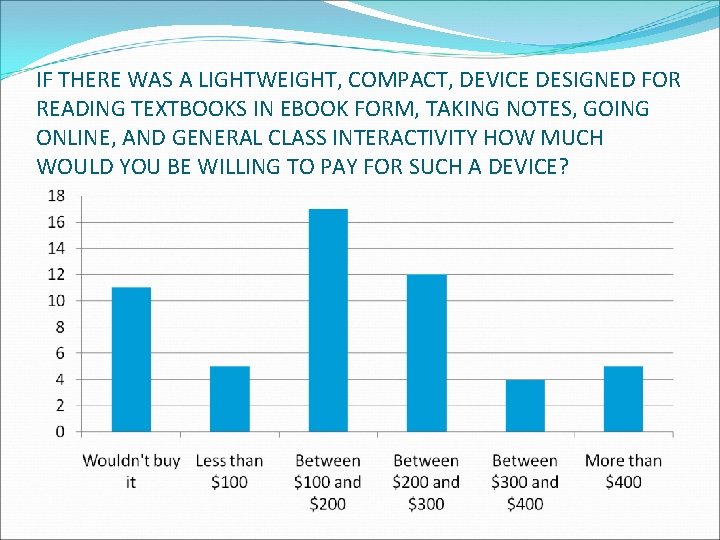
IF THERE WAS A LIGHTWEIGHT, COMPACT, DEVICE DESIGNED FOR READING TEXTBOOKS IN EBOOK FORM, TAKING NOTES, GOING ONLINE, AND GENERAL CLASS INTERACTIVITY HOW MUCH WOULD YOU BE WILLING TO PAY FOR SUCH A DEVICE?
EXPERT INTERVIEW �Duane Embry �Director of Instructional Technology, Walton County School District Duane is in charge of technology integration in the Walton County School system as well as instructing teachers on how to use this technology
What is your opinion on the i. Pad being used in numerous schools throughout the nation right now? What are some pros/cons of this? Duane: The i. Pad is a great beginning. The wide variety of apps is excellent and the “instant on” ability is nice. Some drawbacks include the inability to use Flash, and the cumbersome touch screen typing. Also they are difficult to manage from IT, we would probably have to install programs on each device individually. There are numerous ports missing that would be helpful for connecting to other devices in the classroom. Additionally, the price is too expensive for widespread use.
What features would make a new product more school-focused and advantageous over existing products such as the i. Pad (size, cost, hardware, look/feel, attachments, etc. ) Duane: Having a slide-out keyboard like we discussed would be great. I mentioned having more ports for input/output. The size (10 inches) is fine. The device would just need wi-fi, no need for 4 G or anything. The ability to display Flash and Javascript is a must. A price range closer to $200 - $300 would be ideal.
What is your view on e. Books replacing textbooks and how would that process work? How would the e. Books be distributed? Duane: I think e. Books are a great idea. The back problems associated with kids hauling around heavy textbooks would be eliminated. There is the possibility of only buying say 30 instead of hundreds and having them only be used in the specific class. Theoretically they would be cheaper because once they’re made there would not be any further work actually printing them. I think that there would probably be some sort of licensing and students would download them. They would need to have them on their hard drive so that they could access the books without an internet connection.
Other topics we discussed �As part of the public school system we would likely purchase these products but there would need to be some kind of insurance policy to prevent the devices from being lost/stolen/broken. �There would need to be a relatively intense summer orientation for teachers to learn the new technology. The sooner we got it in to their hands to play around with the better. �Use in middle school as well would be great so that by high school students are already proficient at using the technology.
LITERATURE REVIEW �Classroom 2000 �Gregory D. Abowd and many others �Classroom 2000 was a huge research project at Georgia Tech that focused on capturing the lecture experience. Often times you can take notes during a lecture but will still miss a great portion of the experience. �Implications: This may be something to include in the product – Possibly a built-in audio recorder for recording the teacher’s lecture. The integration between Smart. Boards, computers, mobile devices, etc. is a must
LITERATURE REVIEW �i. Pads in Education (Website) �Series of articles on current use of i. Pads in secondary and post-secondary education �Survey results were very positive with many students adapting to the i. Pad quickly and easily. Not surprisingly, many students did not like typing notes on the touch screen keyboard. Quite a few believed a laptop would be better. Many students preferred to read textbooks as e. Books on the i. Pad after having experienced it.
LITERATURE REVIEW �The Future of the Web, Intelligent Devices, and Education �An interesting article that discusses the future of education. One thing it makes note of is the Plato model of education which involved 1 -on-1 tutoring and complete mastery of a subject before moving on, no exceptions. In this day of age it is of course impossible due to the millions that must be taught thousands of subjects and specialties. It proposes the concept of SMILE (Software-Managed Instruction, Learning, and Education) and to get rid of degrees but rather students graduate with a list of mastered skills. �Implications: It is today possible to have 1 -on-1 virtual tutoring. I’ve often felt that even in a specialized field such as Industrial Design, I don’t get enough 1 -on-1 time with my professors and that it prevents me from being some new age Da. Vinci. Although this is more of a software issue that I may not be able to tackle, it is nevertheless an important aspect of the future of education
CONCLUSIONS �$200 - $300 price range is ideal – The surveys and interview both supported this. This is half the price of the i. Pad. The device will not need to have the computing power the i. Pad has. There could be multiple versions of the product with different features such as “Starter Edition”, “Student Edition”, “Professional Edition” �A slide-out / fold-out keyboard is a must. Nothing can replace the tactile experience of physical keyboards for large amounts of text. �Incorporating a stylus as well is ideal (if it can be done well) �All the necessary ports for connecting to projectors, smartboards, desktop computers, calculators, smart phones, etc. should be there. �A 10” screen is fine but a smaller size may be better for battery life, which is important. �Durability �Palm Branding – I appreciate the organic “stone” branding of Palm in recent years and will likely incorporate that in to the design of the product.
WORKS CITED � “Classroom 2000” Gregory D. Abowd, Georgia Institute of Technology http: //www. cc. gatech. edu/fce/eclass/pubs/index. html � “i. Pads in Education” http: //ipadeducators. ning. com/profiles/blogs/what-do-students-think-of � “i. Pads in Public Schools” Cathy Davidson, Duke University http: //news. duke. edu/2011/01/ipads. html � “Unique Ideas for Improving the Public Education System” http: //ipadeducators. ning. com/profiles/blogs/what-do-students-think-of � “Handhelds in the Classroom” http: //www. educationworld. com/a_tech/tech 083. shtml � “Can Mobile Devices Transform Education” http: //www. ascd. org/publications/newsletters/educationupdate/feb 11/vol 53/num 02/Can-Mobile-Devices-Transform. Education%C 2%A 2. aspx � “The Future of the Web, Intelligent Devices, and Education” http: //www. educause. edu/EDUCAUSE+Review/EDUCAUSEReview. Magazine. Volume 42/The. Futureofthe. Web. Intelligent. De/158108