
st 1 Law of Thermodynamics Aka the Law
- Slides: 17
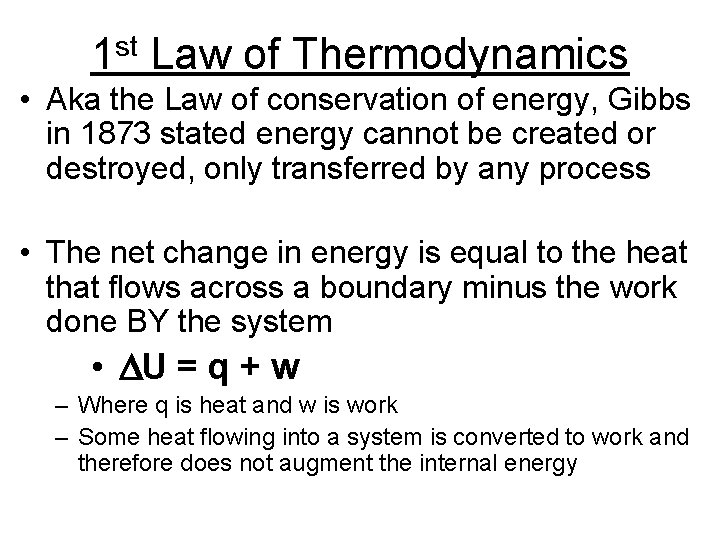
st 1 Law of Thermodynamics • Aka the Law of conservation of energy, Gibbs in 1873 stated energy cannot be created or destroyed, only transferred by any process • The net change in energy is equal to the heat that flows across a boundary minus the work done BY the system • DU = q + w – Where q is heat and w is work – Some heat flowing into a system is converted to work and therefore does not augment the internal energy
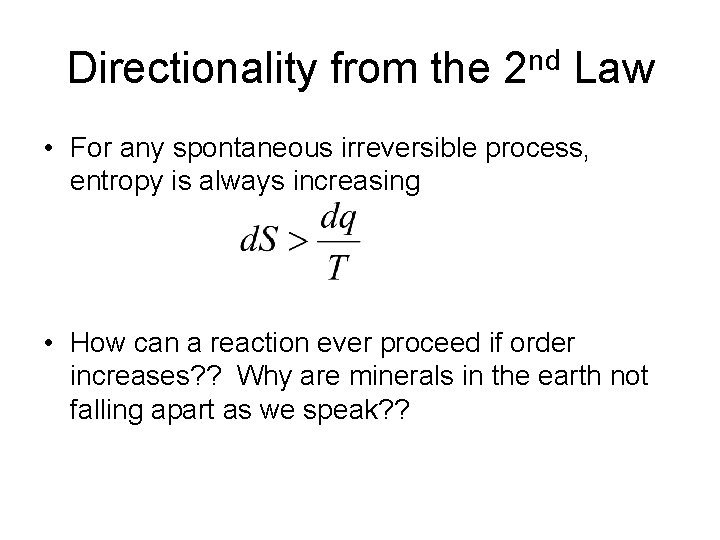
Directionality from the 2 nd Law • For any spontaneous irreversible process, entropy is always increasing • How can a reaction ever proceed if order increases? ? Why are minerals in the earth not falling apart as we speak? ?
NEED FOR THE SECOND LAW • The First Law of Thermodynamics tells us that during any process, energy must be conserved. • However, the First Law tells us nothing about in which direction a process will proceed spontaneously. • It would not contradict the First Law if a book suddenly jumped off the table and maintained itself at some height above the table. • It would not contradict the First Law if all the oxygen molecules in the air in this room suddenly entered a gas cylinder and stayed there while the valve was open.
MEANING OF ENTROPY AND THE SECOND LAW • Entropy is a measure of the disorder (randomness) of a system. The higher the entropy of the system, the more disordered it is. • The second law states that the universe always becomes more disordered in any real process. • The entropy (order) of a system can decrease, but in order for this to happen, the entropy (disorder) of the surroundings must increase to a greater extent, so that the total entropy of the universe always increases.
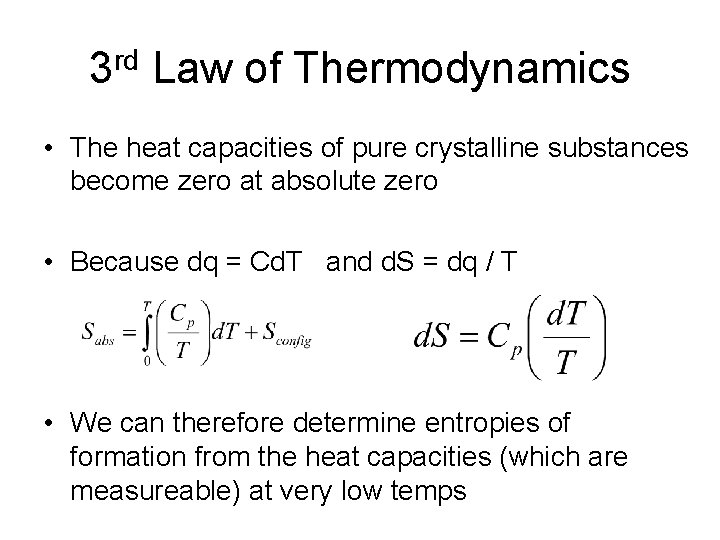
3 rd Law of Thermodynamics • The heat capacities of pure crystalline substances become zero at absolute zero • Because dq = Cd. T and d. S = dq / T • We can therefore determine entropies of formation from the heat capacities (which are measureable) at very low temps
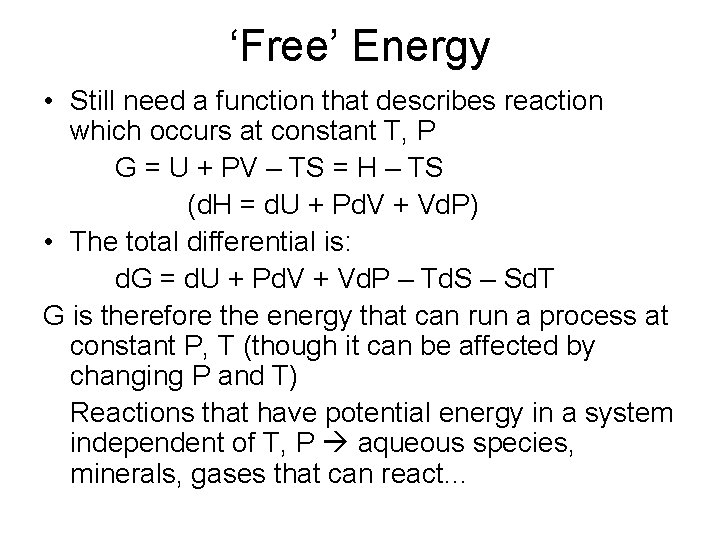
‘Free’ Energy • Still need a function that describes reaction which occurs at constant T, P G = U + PV – TS = H – TS (d. H = d. U + Pd. V + Vd. P) • The total differential is: d. G = d. U + Pd. V + Vd. P – Td. S – Sd. T G is therefore the energy that can run a process at constant P, T (though it can be affected by changing P and T) Reactions that have potential energy in a system independent of T, P aqueous species, minerals, gases that can react…
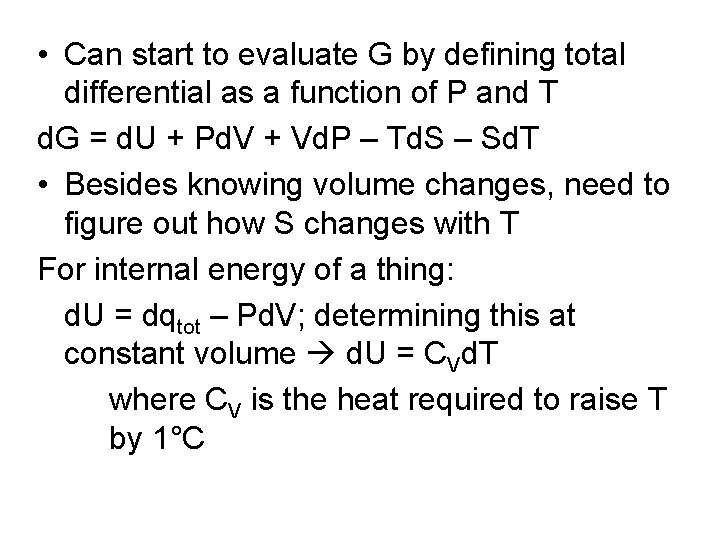
• Can start to evaluate G by defining total differential as a function of P and T d. G = d. U + Pd. V + Vd. P – Td. S – Sd. T • Besides knowing volume changes, need to figure out how S changes with T For internal energy of a thing: d. U = dqtot – Pd. V; determining this at constant volume d. U = CVd. T where CV is the heat required to raise T by 1°C
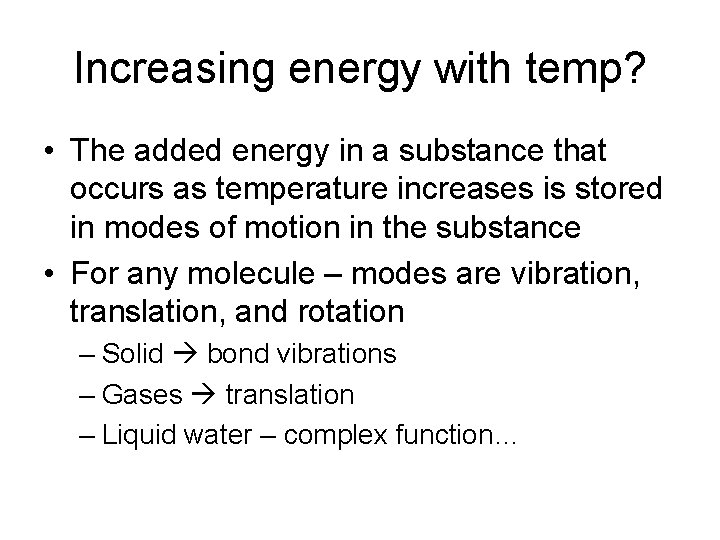
Increasing energy with temp? • The added energy in a substance that occurs as temperature increases is stored in modes of motion in the substance • For any molecule – modes are vibration, translation, and rotation – Solid bond vibrations – Gases translation – Liquid water – complex function…
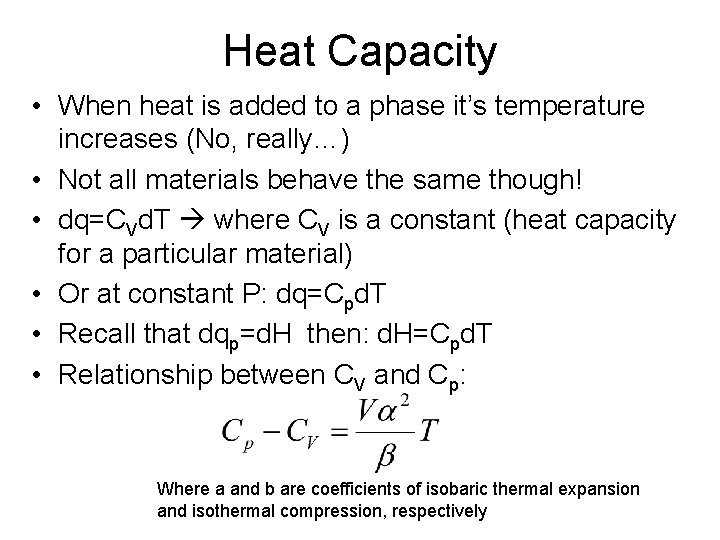
Heat Capacity • When heat is added to a phase it’s temperature increases (No, really…) • Not all materials behave the same though! • dq=CVd. T where CV is a constant (heat capacity for a particular material) • Or at constant P: dq=Cpd. T • Recall that dqp=d. H then: d. H=Cpd. T • Relationship between CV and Cp: Where a and b are coefficients of isobaric thermal expansion and isothermal compression, respectively
Enthalpy at different temps… • HOWEVER C isn’t really constant…. • C also varies with temperature, so to really describe enthalpy of formation at any temperature, we need to define C as a function of temperature • Maier-Kelley empirical determination: • Cp=a+(bx 10 -3)T+(cx 10 -6)T 2 – Where this is a fit to experimental data and a, b, and c are from the fit line (non-linear)
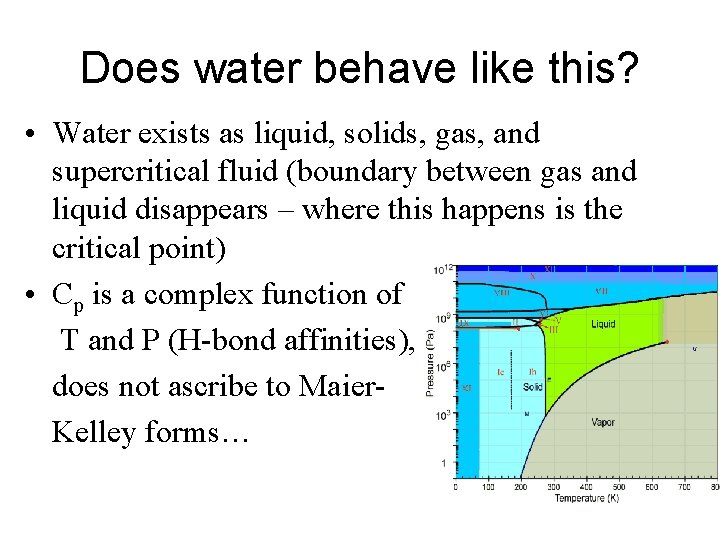
Does water behave like this? • Water exists as liquid, solids, gas, and supercritical fluid (boundary between gas and liquid disappears – where this happens is the critical point) • Cp is a complex function of T and P (H-bond affinities), does not ascribe to Maier. Kelley forms…
Heats of Formation, DHf • Enthalpies, H, are found by calorimetry • Enthalpies of formation are heats associated with formation of any molecule/mineral from it’s constituent elements
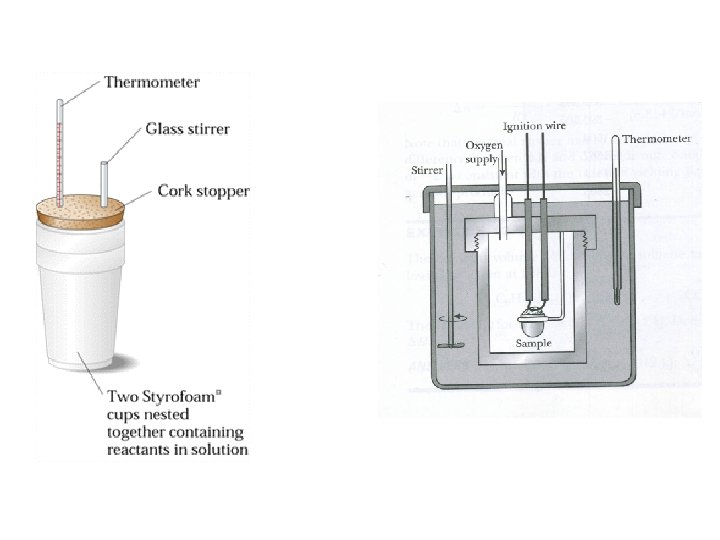
Calorimetry • Measurement of heat flow (through temperature) associated with a reaction • Because d. H = q / d. T, measuring Temperature change at constant P yields enthalpy
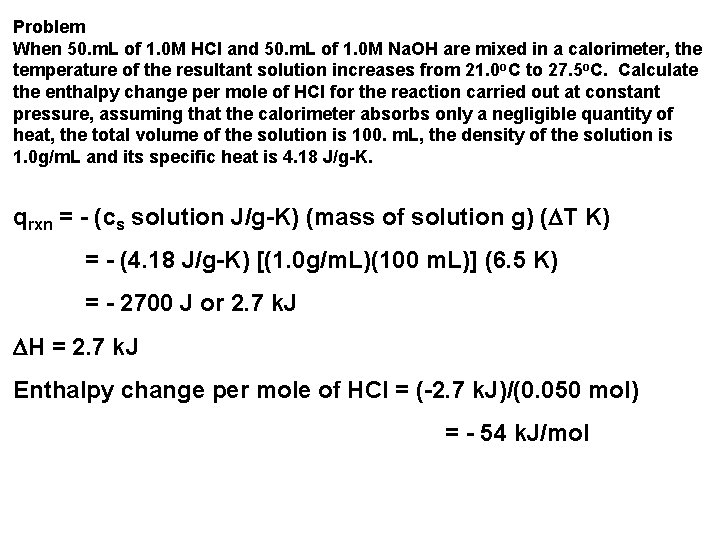
Problem When 50. m. L of 1. 0 M HCl and 50. m. L of 1. 0 M Na. OH are mixed in a calorimeter, the temperature of the resultant solution increases from 21. 0 o. C to 27. 5 o. C. Calculate the enthalpy change per mole of HCl for the reaction carried out at constant pressure, assuming that the calorimeter absorbs only a negligible quantity of heat, the total volume of the solution is 100. m. L, the density of the solution is 1. 0 g/m. L and its specific heat is 4. 18 J/g-K. qrxn = - (cs solution J/g-K) (mass of solution g) (DT K) = - (4. 18 J/g-K) [(1. 0 g/m. L)(100 m. L)] (6. 5 K) = - 2700 J or 2. 7 k. J DH = 2. 7 k. J Enthalpy change per mole of HCl = (-2. 7 k. J)/(0. 050 mol) = - 54 k. J/mol
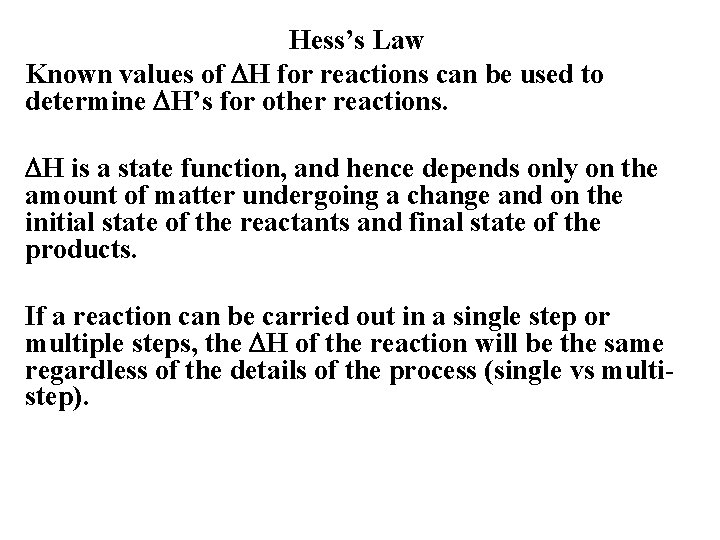
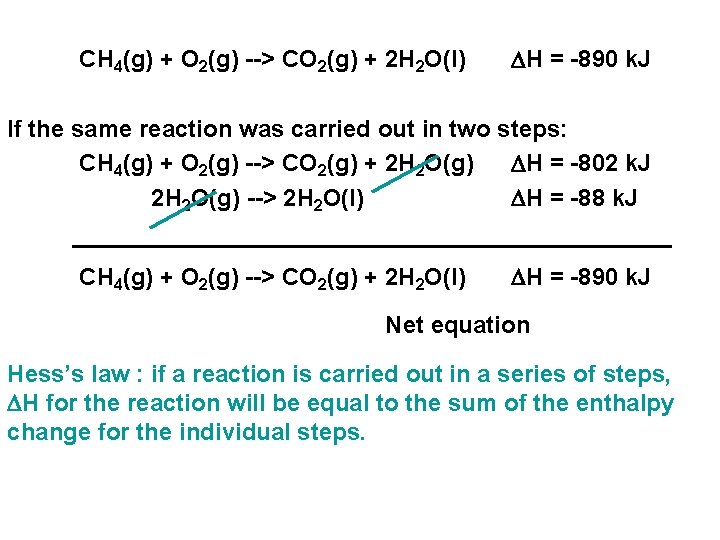
Hess’s Law Known values of DH for reactions can be used to determine DH’s for other reactions. DH is a state function, and hence depends only on the amount of matter undergoing a change and on the initial state of the reactants and final state of the products. If a reaction can be carried out in a single step or multiple steps, the DH of the reaction will be the same regardless of the details of the process (single vs multistep).
CH 4(g) + O 2(g) --> CO 2(g) + 2 H 2 O(l) DH = -890 k. J If the same reaction was carried out in two steps: CH 4(g) + O 2(g) --> CO 2(g) + 2 H 2 O(g) DH = -802 k. J 2 H 2 O(g) --> 2 H 2 O(l) DH = -88 k. J CH 4(g) + O 2(g) --> CO 2(g) + 2 H 2 O(l) DH = -890 k. J Net equation Hess’s law : if a reaction is carried out in a series of steps, DH for the reaction will be equal to the sum of the enthalpy change for the individual steps.