
SSV EMS MICN Course Module 5 Specialty Systems
- Slides: 24
S-SV EMS MICN Course Module 5 Specialty Systems Of Care (STEMI, Stroke, Burn, & Trauma) S-SV EMS Agency MICN Training (Updated 12 -2019) 1
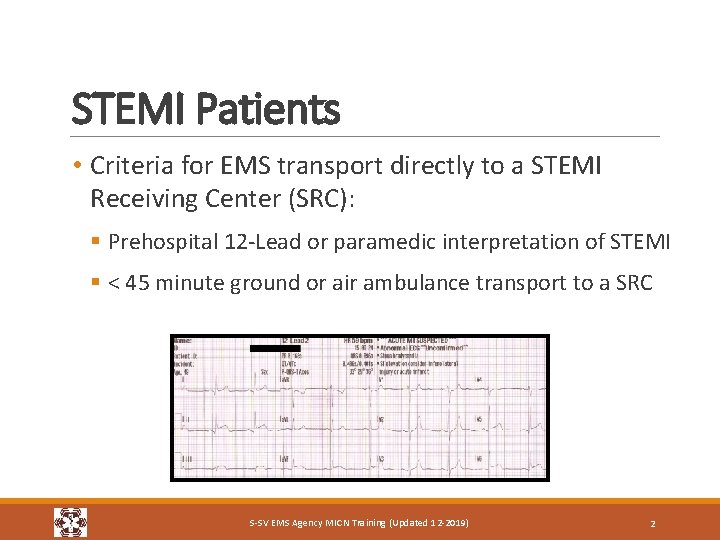
STEMI Patients • Criteria for EMS transport directly to a STEMI Receiving Center (SRC): § Prehospital 12 -Lead or paramedic interpretation of STEMI § < 45 minute ground or air ambulance transport to a SRC S-SV EMS Agency MICN Training (Updated 12 -2019) 2
STEMI Patients • Base hospital/SRC destination consultation required for the following: § STEMI patient outside the 45 minute transport catchment area § Critical STEMI patients: o Cardiac arrest o Unmanageable airway o Unstable v-tach o 2 nd degree type 2 or 3 rd degree heart block S-SV EMS Agency MICN Training (Updated 12 -2019) 3
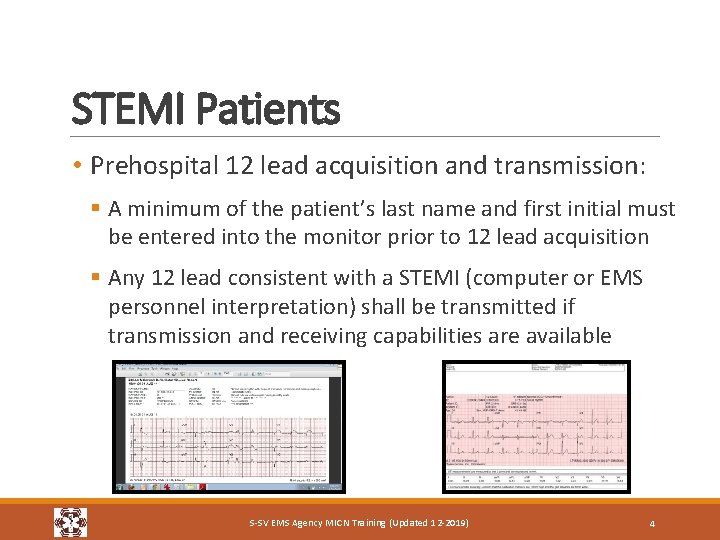
STEMI Patients • Prehospital 12 lead acquisition and transmission: § A minimum of the patient’s last name and first initial must be entered into the monitor prior to 12 lead acquisition § Any 12 lead consistent with a STEMI (computer or EMS personnel interpretation) shall be transmitted if transmission and receiving capabilities are available S-SV EMS Agency MICN Training (Updated 12 -2019) 4
STEMI Patients • STEMI patient rapid re-triage & IFT: § STEMI patients shall be accepted for transfer by a SRC unless the SRC is on STEMI diversion or internal disaster § The timeline goals for STEMI referral hospital (SRH) identified STEMI patients are <90 minutes SRH arrival-to. SRC first intervention for walk in patients and <120 minutes 911 call-to-SRC first intervention for EMS patients § If SRH arrival-to-SRC intervention is anticipated to be greater than 90 minutes, administration of lytic agents should be considered in eligible patients S-SV EMS Agency MICN Training (Updated 12 -2019) 5
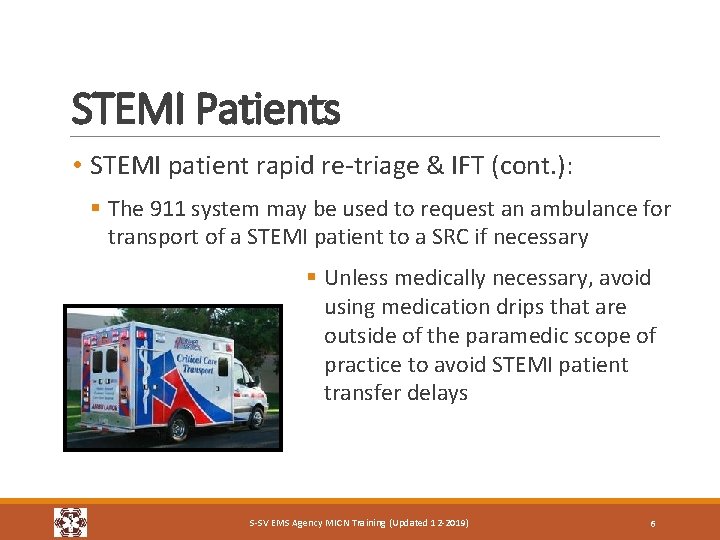
STEMI Patients • STEMI patient rapid re-triage & IFT (cont. ): § The 911 system may be used to request an ambulance for transport of a STEMI patient to a SRC if necessary § Unless medically necessary, avoid using medication drips that are outside of the paramedic scope of practice to avoid STEMI patient transfer delays S-SV EMS Agency MICN Training (Updated 12 -2019) 6
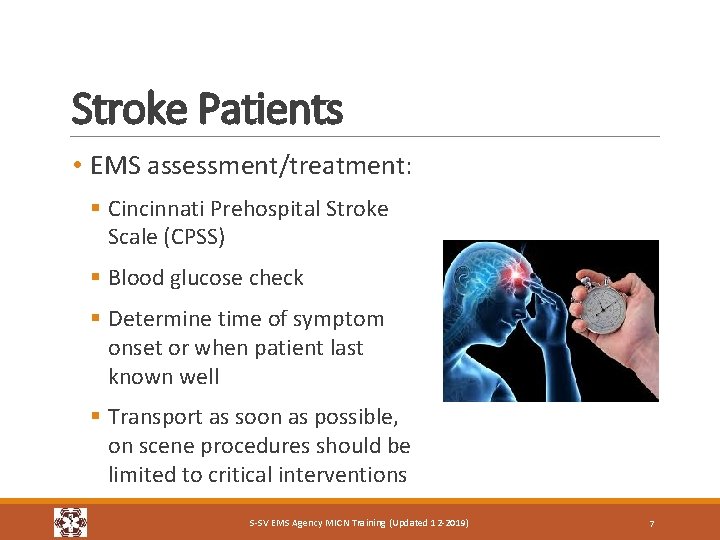
Stroke Patients • EMS assessment/treatment: § Cincinnati Prehospital Stroke Scale (CPSS) § Blood glucose check § Determine time of symptom onset or when patient last known well § Transport as soon as possible, on scene procedures should be limited to critical interventions S-SV EMS Agency MICN Training (Updated 12 -2019) 7
Stroke Patients • Criteria for EMS transport directly to a stroke receiving center: § Onset of symptoms ≤ 24 hours (including wake-up stroke) § < 45 minute ground or air ambulance transport time to a stroke receiving center S-SV EMS Agency MICN Training (Updated 12 -2019) 8
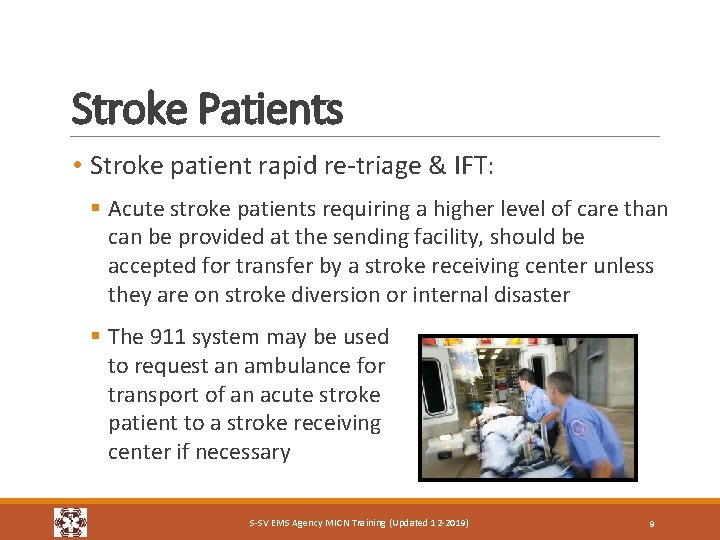
Stroke Patients • Stroke patient rapid re-triage & IFT: § Acute stroke patients requiring a higher level of care than can be provided at the sending facility, should be accepted for transfer by a stroke receiving center unless they are on stroke diversion or internal disaster § The 911 system may be used to request an ambulance for transport of an acute stroke patient to a stroke receiving center if necessary S-SV EMS Agency MICN Training (Updated 12 -2019) 9
Stroke Patients • Additional stroke patient notes: § Blood draws may be obtained by EMS personnel (per pre-arranged agreement with a stroke receiving center) § EMS personnel may provide minimum necessary patient identifiable information (name, DOB, MR#, etc. ) over a secured line if requested by a stroke receiving center § EMS personnel should contact the closest base/modified base hospital for destination consultation of a possible acute stroke patient if necessary S-SV EMS Agency MICN Training (Updated 12 -2019) 10
Burn Patients • Patients with an electrical burn shall be transported by EMS for evaluation • Base hospital destination consultation is required for the following types of burn patients: § 3 O burns of the hands, feet, face, perineum, or > 2% of any body surface § 2 O burns > 9% of body surface § Significant electrical or chemical burns § When transport to a burn center may be warranted S-SV EMS Agency MICN Training (Updated 12 -2019) 11
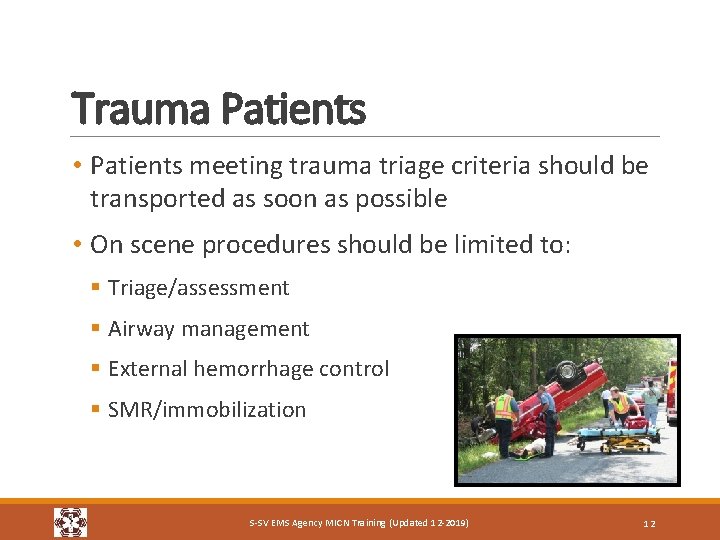
Trauma Patients • Patients meeting trauma triage criteria should be transported as soon as possible • On scene procedures should be limited to: § Triage/assessment § Airway management § External hemorrhage control § SMR/immobilization S-SV EMS Agency MICN Training (Updated 12 -2019) 12
S-SV EMS Trauma Triage Criteria • Physiologic trauma triage criteria (one or more): § Respiratory rate <10 or >29 breaths per minute (<20 in infants < 1 year of age) or need for ventilatory support § Altered Mental Status: o <65 yo: GCS ≤ 13 o ≥ 65 yo: GCS <15 with evidence/suspicion of a head strike § Hypotension: o <65 yo: SBP <90 o ≥ 65 yo: SBP <100 S-SV EMS Agency MICN Training (Updated 12 -2019) 13
S-SV EMS Trauma Triage Criteria • Anatomic Trauma Triage Criteria (one or more): § Penetrating injuries to the head, neck, chest, torso, and extremities proximal to the elbow or knee § Chest wall instability or deformity (e. g. flail chest) § Two or more proximal long-bone fx’s in a patient of any age, or any suspected proximal long bone fx following a MVA in a patient ≥ 65 yo § Paralysis § Suspected pelvic fractures § Amputation or crushed/degloved/mangled/pulseless extremity proximal to wrist or ankle § Depressed or suspected open skull fx S-SV EMS Agency MICN Training (Updated 12 -2019) 14
S-SV EMS Trauma Triage Criteria • Mechanism of Injury Trauma Triage Criteria (any): § High-risk auto crash (one or more of the following) o Ejections (partial or complete) from automobile o Death in the same passenger compartment o Intrusion, including roof: >12” at occupant site or >18” at any site § Non-automotive crash >20 mph (motorcycle, ATV, go-cart, bicycle, skateboard, watercraft, aircraft, etc. ) S-SV EMS Agency MICN Training (Updated 12 -2019) 15
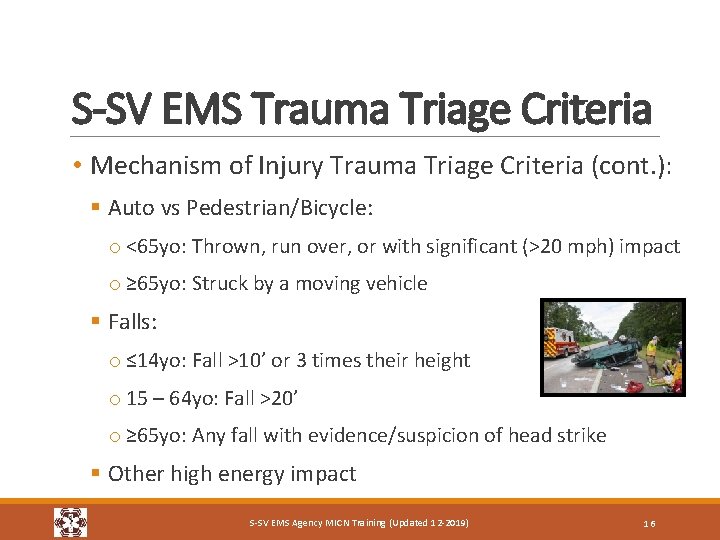
S-SV EMS Trauma Triage Criteria • Mechanism of Injury Trauma Triage Criteria (cont. ): § Auto vs Pedestrian/Bicycle: o <65 yo: Thrown, run over, or with significant (>20 mph) impact o ≥ 65 yo: Struck by a moving vehicle § Falls: o ≤ 14 yo: Fall >10’ or 3 times their height o 15 – 64 yo: Fall >20’ o ≥ 65 yo: Any fall with evidence/suspicion of head strike § Other high energy impact S-SV EMS Agency MICN Training (Updated 12 -2019) 16
S-SV EMS Trauma Triage Criteria • Special Considerations Trauma Triage Criteria (any): § Current anticoagulation or antiplatelet use, or history of bleeding disorder § Pregnancy > 20 weeks § Prehospital personnel judgement S-SV EMS Agency MICN Training (Updated 12 -2019) 17
Spinal Motion Restriction (SMR) • SMR with a backboard is required for: § Patients with gross motor/sensory deficits or complaints § High energy impact blunt trauma patients meeting anatomical &/or physiological trauma triage criteria § Unstable patients where removal of a backboard would delay transport, or backboard utilization is necessary for other treatment priorities • SMR without a backboard should be utilized for all other patients who meet SMR criteria S-SV EMS Agency MICN Training (Updated 12 -2019) 18
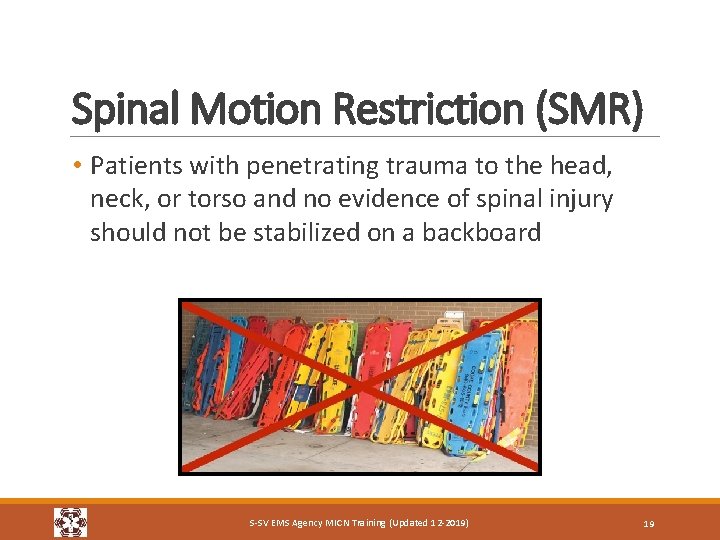
Spinal Motion Restriction (SMR) • Patients with penetrating trauma to the head, neck, or torso and no evidence of spinal injury should not be stabilized on a backboard S-SV EMS Agency MICN Training (Updated 12 -2019) 19
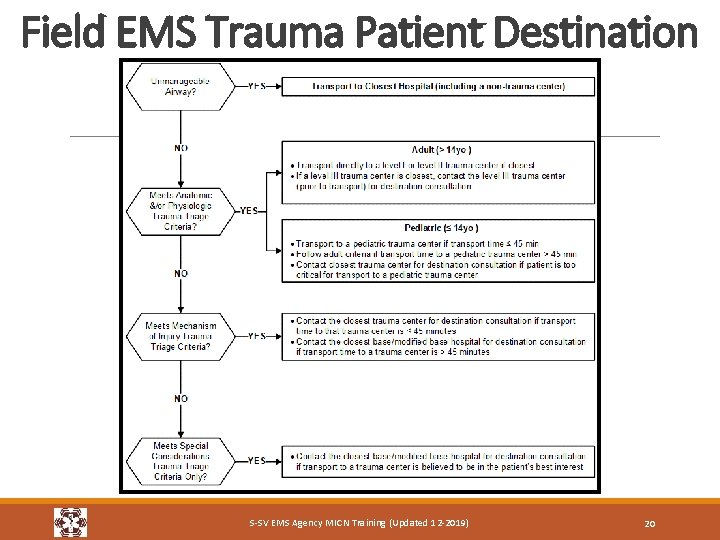
Field EMS Trauma Patient Destination S-SV EMS Agency MICN Training (Updated 12 -2019) 20
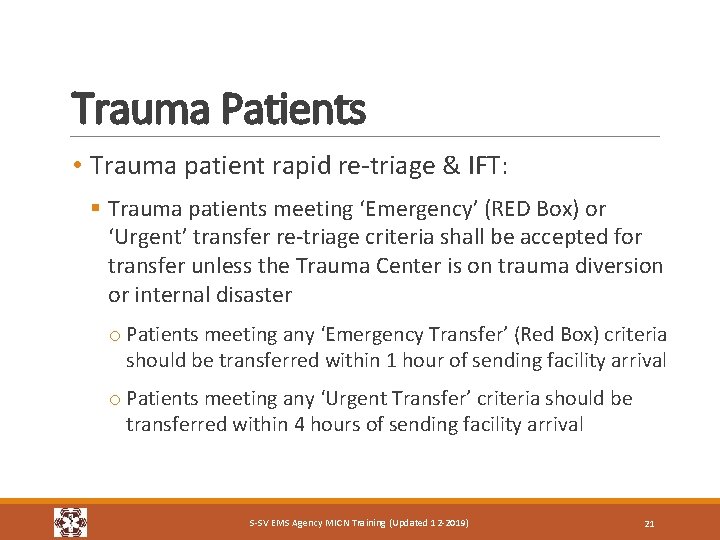
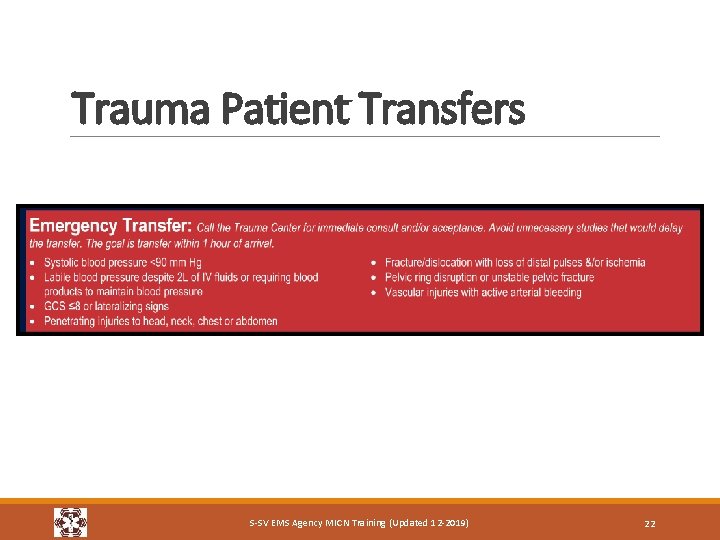
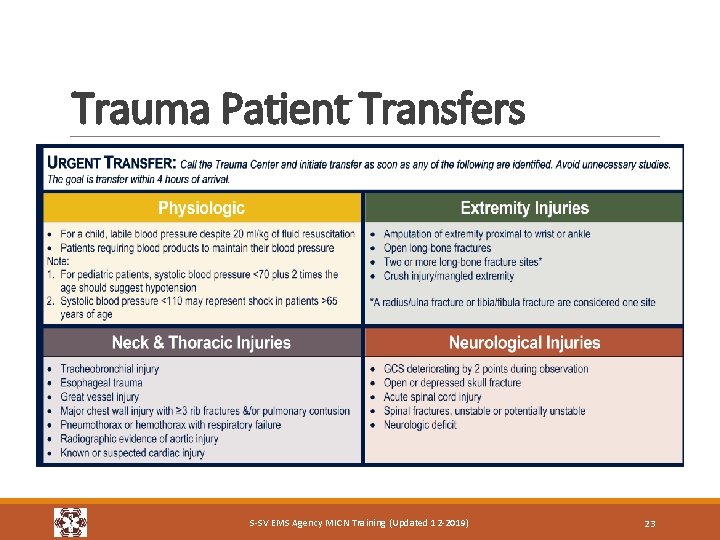
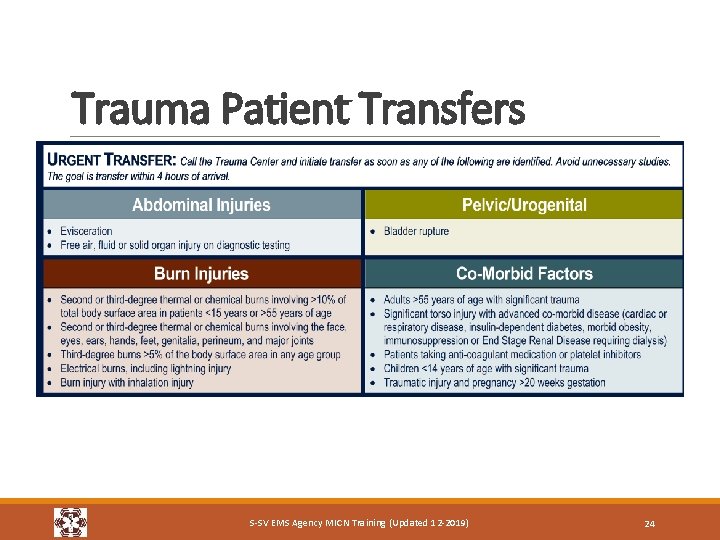
Trauma Patients • Trauma patient rapid re-triage & IFT: § Trauma patients meeting ‘Emergency’ (RED Box) or ‘Urgent’ transfer re-triage criteria shall be accepted for transfer unless the Trauma Center is on trauma diversion or internal disaster o Patients meeting any ‘Emergency Transfer’ (Red Box) criteria should be transferred within 1 hour of sending facility arrival o Patients meeting any ‘Urgent Transfer’ criteria should be transferred within 4 hours of sending facility arrival S-SV EMS Agency MICN Training (Updated 12 -2019) 21
Trauma Patient Transfers S-SV EMS Agency MICN Training (Updated 12 -2019) 22
Trauma Patient Transfers S-SV EMS Agency MICN Training (Updated 12 -2019) 23
Trauma Patient Transfers S-SV EMS Agency MICN Training (Updated 12 -2019) 24