
SSUSH 4 The student will identify the ideological
- Slides: 43
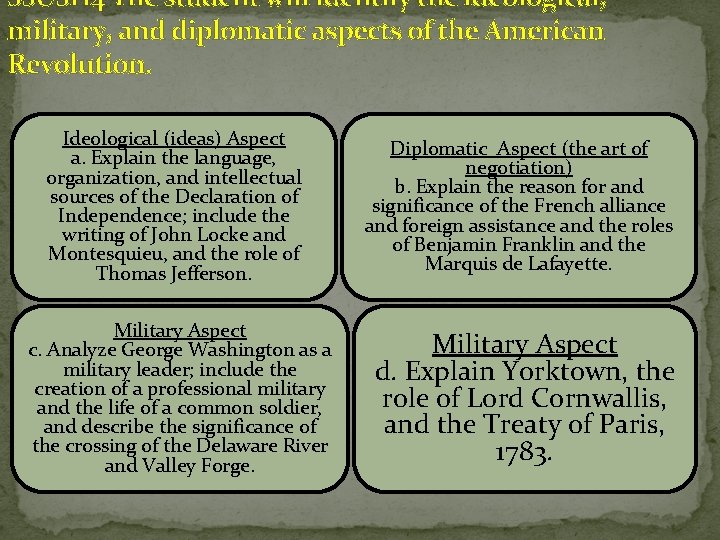
SSUSH 4 The student will identify the ideological, military, and diplomatic aspects of the American Revolution. Ideological (ideas) Aspect a. Explain the language, organization, and intellectual sources of the Declaration of Independence; include the writing of John Locke and Montesquieu, and the role of Thomas Jefferson. Military Aspect c. Analyze George Washington as a military leader; include the creation of a professional military and the life of a common soldier, and describe the significance of the crossing of the Delaware River and Valley Forge. Diplomatic Aspect (the art of negotiation) b. Explain the reason for and significance of the French alliance and foreign assistance and the roles of Benjamin Franklin and the Marquis de Lafayette. Military Aspect d. Explain Yorktown, the role of Lord Cornwallis, and the Treaty of Paris, 1783.
GPS 4 Essential Questions 1. http: //www. youtube. com/watch? v=Y 6 ik. O 6 LMx. F 4&safety_mode=true&persist_safety_mode=1&safe=active 2. What is the language and organization of the Declaration of the Independence? 3. What are the intellectual sources of the Declaration of Independence? 4. How did the writings of John Locke and Montesquieu influence the D. O. I? What was the role of Thomas Jefferson in the creation of the D. O. I? 5. What was the reason for the alliance between the Americans and France? 6. What was the significance of the French alliance and foreign assistance for the Americans? 7. What were the roles of Benjamin Franklin and the Marquis de Lafayette in securing the alliance with France? 8. What kind of military leader was George Washington? How did Washington create a professional military? What was life like for a common soldier? 9. What is the significance of General Washington crossing of the Delaware River and the winter encampment at Valley Forge? 10. What happened at the Battle of Yorktown? Who was Lord Cornwallis? 11. What is the Treaty of Paris, 1783?
GPS 4 Vocabulary 1. Declaration of Independence 2. John Locke 3. Charles de Montesquieu 4. George Washington 5. Crossing the Delaware River 6. Valley Forge 7. Benjamin Franklin 8. Marquis de Lafayette 9. Lord Cornwallis 10. Battle of Yorktown 11. 1783 Treaty of Paris Definition Check off when you feel you KNOW this word
Ideology of the Declaration of Independence USH 4 a 1. Intellectual Sources 2. Organization 3. Language 4. Thomas Jefferson’s role
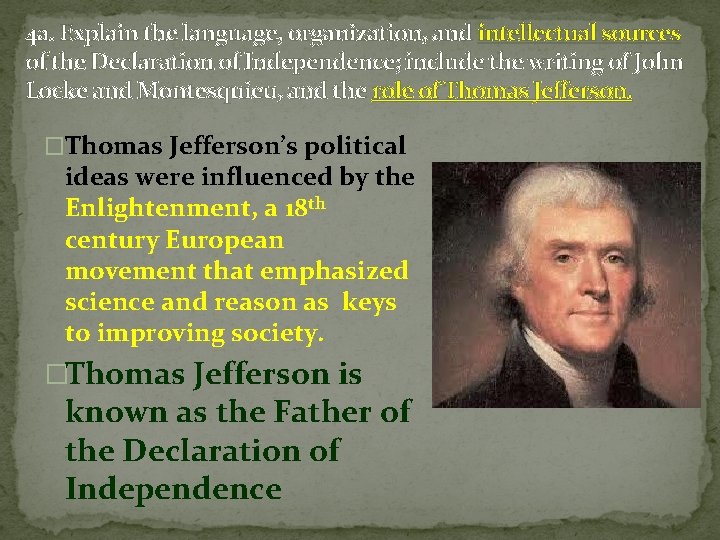
4 a. Explain the language, organization, and intellectual sources of the Declaration of Independence; include the writing of John Locke and Montesquieu, and the role of Thomas Jefferson. �Thomas Jefferson’s political ideas were influenced by the Enlightenment, a 18 th century European movement that emphasized science and reason as keys to improving society. �Thomas Jefferson is known as the Father of the Declaration of Independence
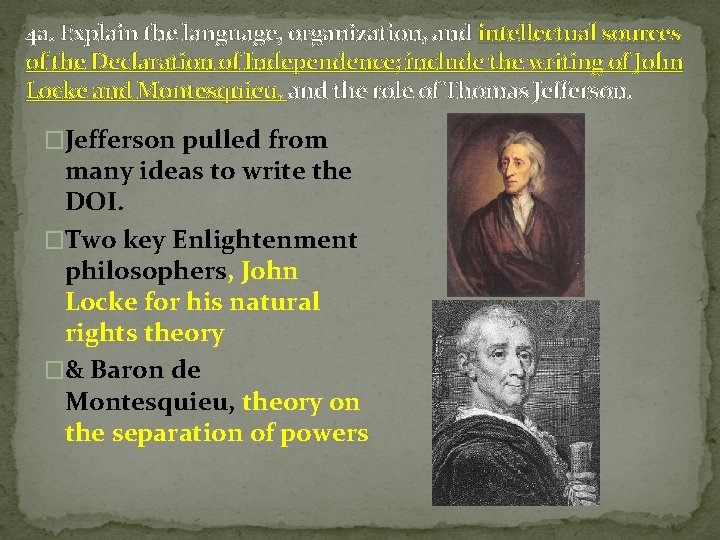
4 a. Explain the language, organization, and intellectual sources of the Declaration of Independence; include the writing of John Locke and Montesquieu, and the role of Thomas Jefferson. �Jefferson pulled from many ideas to write the DOI. �Two key Enlightenment philosophers, John Locke for his natural rights theory �& Baron de Montesquieu, theory on the separation of powers
4 a. DOI Organization: Jefferson divided the Declaration into four sections. 1. 3. 2. 4.
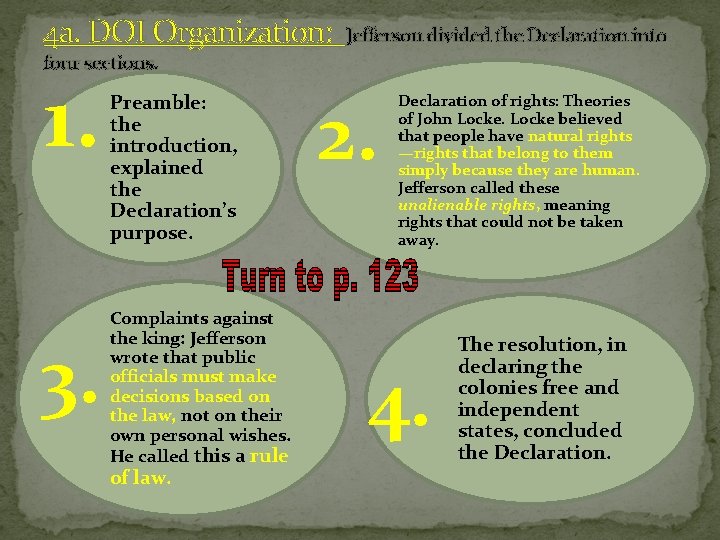
4 a. DOI Organization: Jefferson divided the Declaration into four sections. 1. 3. Preamble: the introduction, explained the Declaration’s purpose. Complaints against the king: Jefferson wrote that public officials must make decisions based on the law, not on their own personal wishes. He called this a rule of law. 2. Declaration of rights: Theories of John Locke believed that people have natural rights —rights that belong to them simply because they are human. Jefferson called these unalienable rights, meaning rights that could not be taken away. 4. The resolution, in declaring the colonies free and independent states, concluded the Declaration.
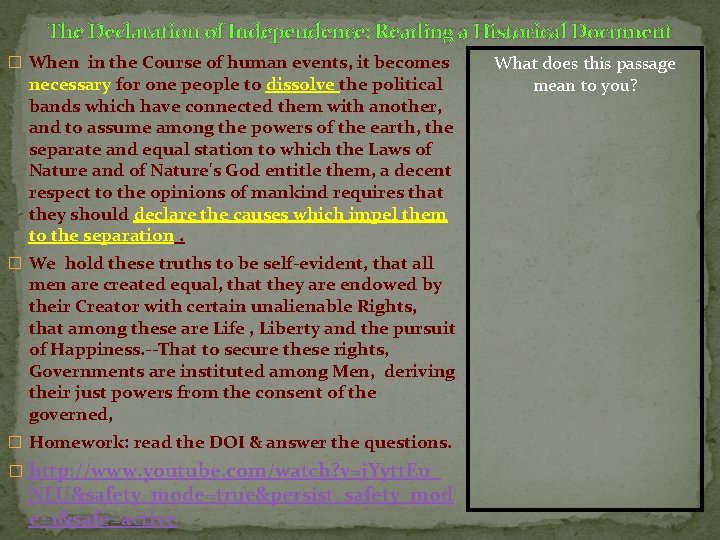
The Declaration of Independence: Reading a Historical Document � When in the Course of human events, it becomes necessary for one people to dissolve the political bands which have connected them with another, and to assume among the powers of the earth, the separate and equal station to which the Laws of Nature and of Nature's God entitle them, a decent respect to the opinions of mankind requires that they should declare the causes which impel them to the separation. � We hold these truths to be self-evident, that all men are created equal, that they are endowed by their Creator with certain unalienable Rights, that among these are Life , Liberty and the pursuit of Happiness. --That to secure these rights, Governments are instituted among Men, deriving their just powers from the consent of the governed, � Homework: read the DOI & answer the questions. � http: //www. youtube. com/watch? v=j. Yytt. Eu_ NLU&safety_mode=true&persist_safety_mod e=1&safe=active What does this passage mean to you?
4 a. Explain the language, organization, and intellectual sources of the Declaration of Independence; include the writing of John Locke and Montesquieu, and the role of Thomas Jefferson. �Congressional delegates voted to approve the Declaration on July 4, 1776. �How would you have voted? WHY?
4 b. Diplomatic Aspect of the American Revolutionary War Essential Questions 1. Why is the Battle of Saratoga important? 2. This battle is known as what? 3. After this battle , which country formally enters the war? What do they contribute t 0 the war? (specifically) 4. Who helps to facilitate (bring about) this foreign help? (2 people)
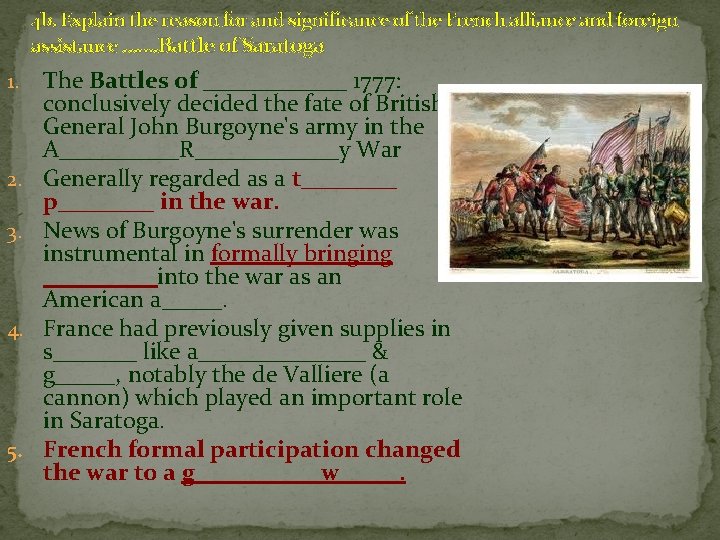
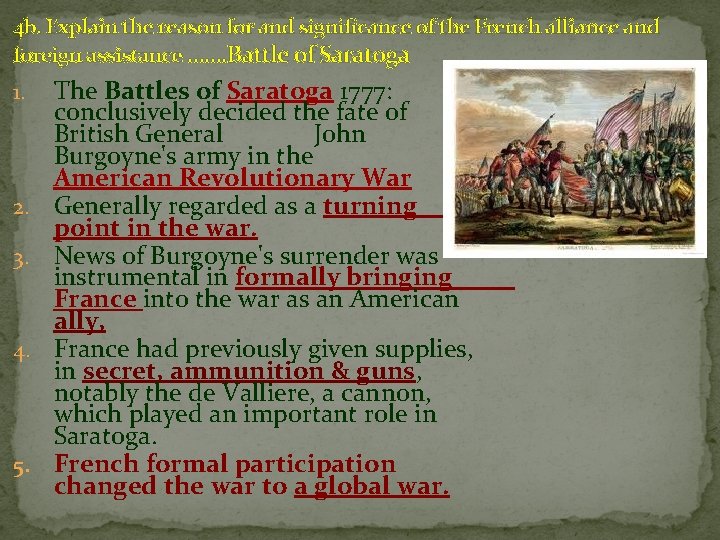
4 b. Explain the reason for and significance of the French alliance and foreign assistance ……. Battle of Saratoga 1. 2. 3. 4. 5. The Battles of ______ 1777: conclusively decided the fate of British General John Burgoyne's army in the A_____R______y War Generally regarded as a t____ p____ in the war. News of Burgoyne's surrender was instrumental in formally bringing _____ into the war as an American a_____. France had previously given supplies in s_______ like a_______ & g_____, notably the de Valliere (a cannon) which played an important role in Saratoga. French formal participation changed the war to a g_____ w_____.
4 b. Explain the reason for and significance of the French alliance and foreign assistance ……. Battle of Saratoga 1. 2. 3. 4. 5. The Battles of Saratoga 1777: conclusively decided the fate of British General John Burgoyne's army in the American Revolutionary War Generally regarded as a turning point in the war. News of Burgoyne's surrender was instrumental in formally bringing France into the war as an American ally, France had previously given supplies, in secret, ammunition & guns, notably the de Valliere, a cannon, which played an important role in Saratoga. French formal participation changed the war to a global war.
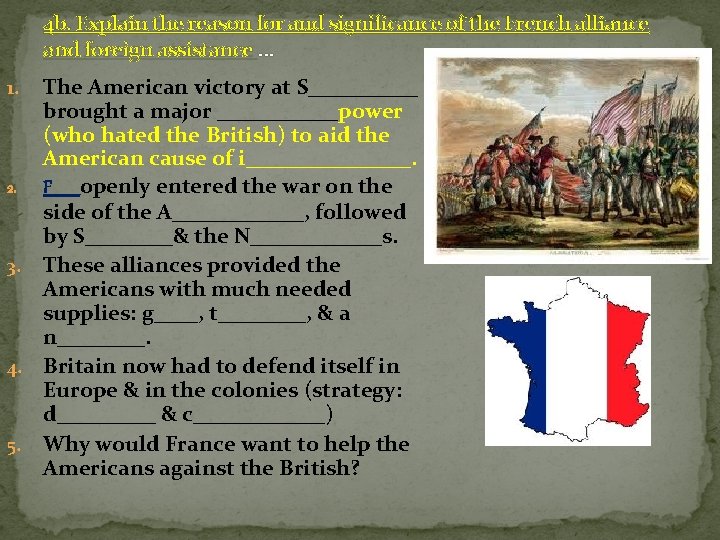
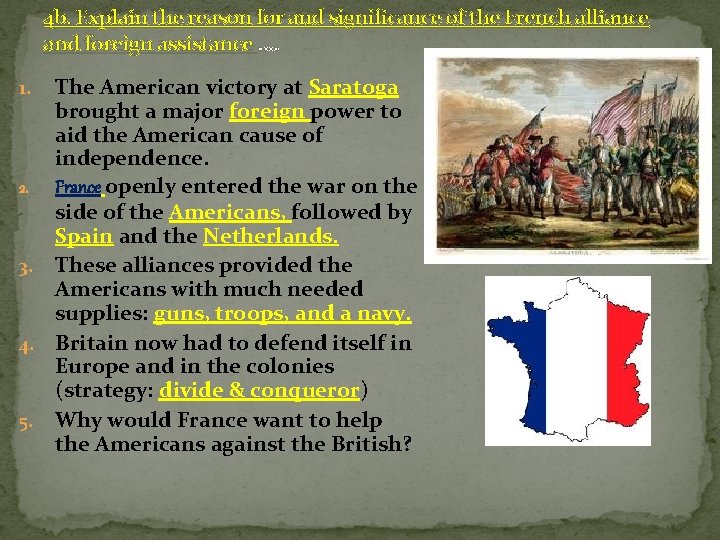
4 b. Explain the reason for and significance of the French alliance and foreign assistance … The American victory at S_____ brought a major ______power (who hated the British) to aid the American cause of i________. 2. F____openly entered the war on the side of the A______, followed by S____& the N______s. 3. These alliances provided the Americans with much needed supplies: g____, t____, & a n____. 4. Britain now had to defend itself in Europe & in the colonies (strategy: d_____ & c______) 5. Why would France want to help the Americans against the British? 1.
4 b. Explain the reason for and significance of the French alliance and foreign assistance. . The American victory at Saratoga brought a major foreign power to aid the American cause of independence. 2. France openly entered the war on the side of the Americans, followed by Spain and the Netherlands. 3. These alliances provided the Americans with much needed supplies: guns, troops, and a navy. 4. Britain now had to defend itself in Europe and in the colonies (strategy: divide & conqueror) 5. Why would France want to help the Americans against the British? 1.
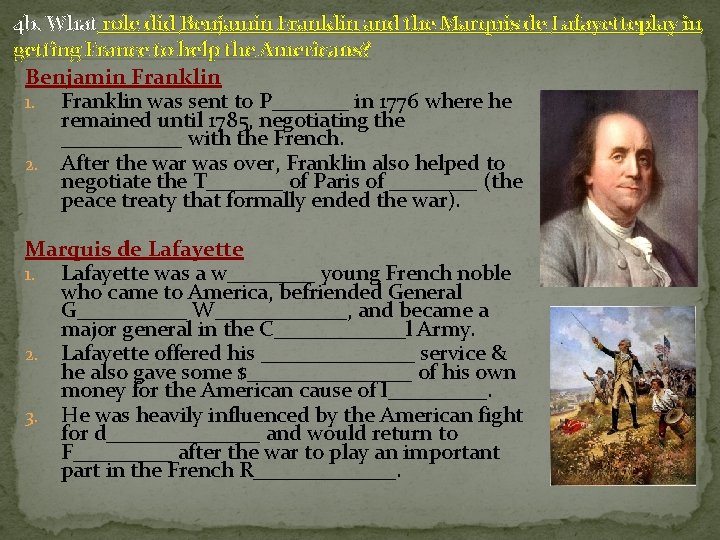
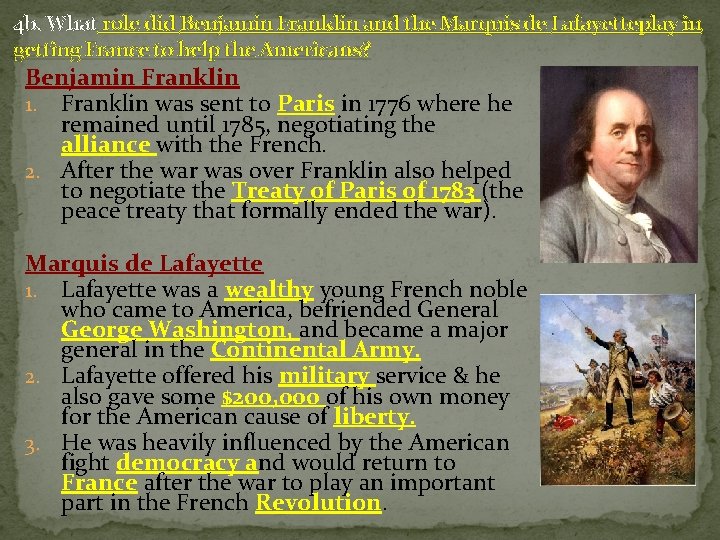
4 b. What role did Benjamin Franklin and the Marquis de Lafayetteplay in getting France to help the Americans? Benjamin Franklin 1. Franklin was sent to P_______ in 1776 where he remained until 1785, negotiating the ______ with the French. 2. After the war was over, Franklin also helped to negotiate the T_______ of Paris of ____ (the peace treaty that formally ended the war). Marquis de Lafayette 1. Lafayette was a w____ young French noble who came to America, befriended General G_____ W______, and became a major general in the C______l Army. 2. Lafayette offered his _______ service & he also gave some $________ of his own money for the American cause of l_____. 3. He was heavily influenced by the American fight for d_______ and would return to F_____ after the war to play an important part in the French R_______.
4 b. What role did Benjamin Franklin and the Marquis de Lafayetteplay in getting France to help the Americans? Benjamin Franklin 1. Franklin was sent to Paris in 1776 where he remained until 1785, negotiating the alliance with the French. 2. After the war was over Franklin also helped to negotiate the Treaty of Paris of 1783 (the peace treaty that formally ended the war). Marquis de Lafayette 1. Lafayette was a wealthy young French noble who came to America, befriended General George Washington, and became a major general in the Continental Army. 2. Lafayette offered his military service & he also gave some $200, 000 of his own money for the American cause of liberty. 3. He was heavily influenced by the American fight democracy and would return to France after the war to play an important part in the French Revolution.
4 c. Analyze George Washington as a military leader; include the creation of a professional military and the life of a common soldier, http: //www. youtube. com/watch? v=YHx. KPPkp. XSM&safety_mode=true&persist_safety_mod e=1&safe=active Washington’s Military Experience Before the Revolution? Washington’s Military Tactics During the Revolution? Washington’s Resources During the Revolution? Washington’s Military Men: What were the soldier’s lives like?
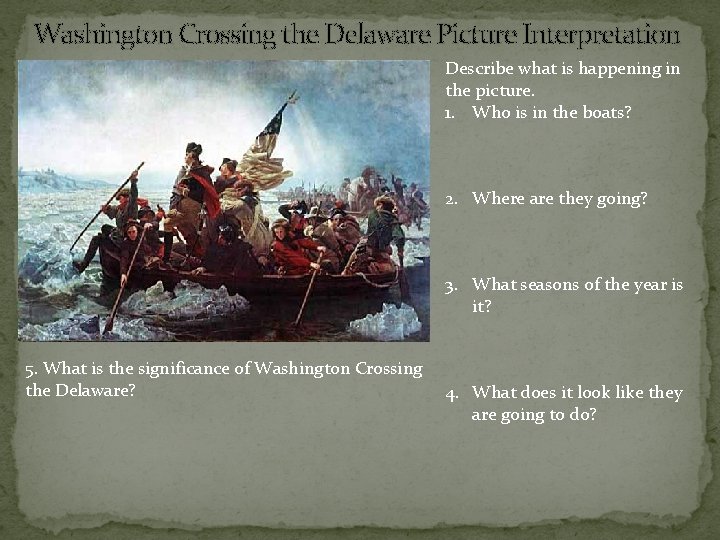
4 c. Analyze George Washington as a military leader; include the creation of a professional military and the life of a common soldier, and describe the significance of the crossing of the Delaware River and Valley Forge. � In July 1775, George Washington was named commanding general of the Patriot forces He worked to train & transform the militia groups into the Continental Army � Lacking adequate financial support, supplies, and experienced troops, George Washington had to be innovative � Abandoned the army tradition of not fighting during winter, led his troops across the Delaware River on Christmas night. � Early the next morning, the American troops landed in New Jersey and surprised about 1, 400 mercenaries—called Hessians. � The battle that followed was called the Battle of Trenton, in which nearly the entire Hessian force was captured and the Americans suffered only five casualties. � A similar victory in Princeton, New Jersey, boosted Patriot morale and convinced more Americans to support the Patriot cause.
Washington Crossing the Delaware Picture Interpretation Describe what is happening in the picture. 1. Who is in the boats? 2. Where are they going? 3. What seasons of the year is it? 5. What is the significance of Washington Crossing the Delaware? 4. What does it look like they are going to do?
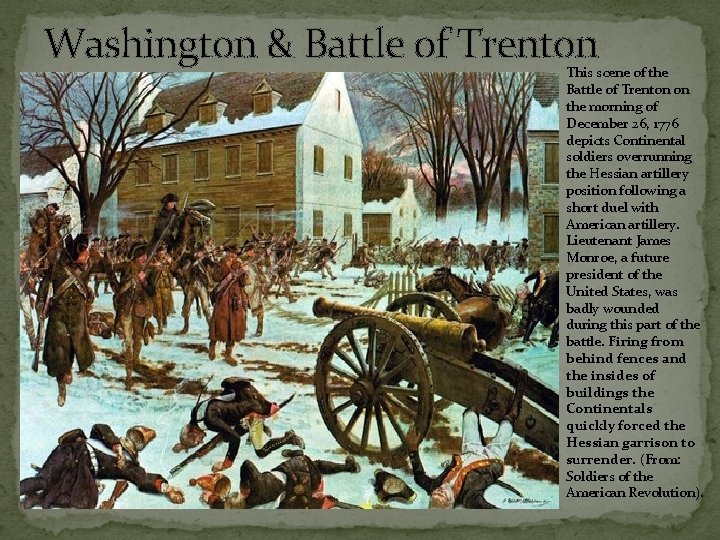
Washington & Battle of Trenton This scene of the Battle of Trenton on the morning of December 26, 1776 depicts Continental soldiers overrunning the Hessian artillery position following a short duel with American artillery. Lieutenant James Monroe, a future president of the United States, was badly wounded during this part of the battle. Firing from behind fences and the insides of buildings the Continentals quickly forced the Hessian garrison to surrender. (From: Soldiers of the American Revolution).
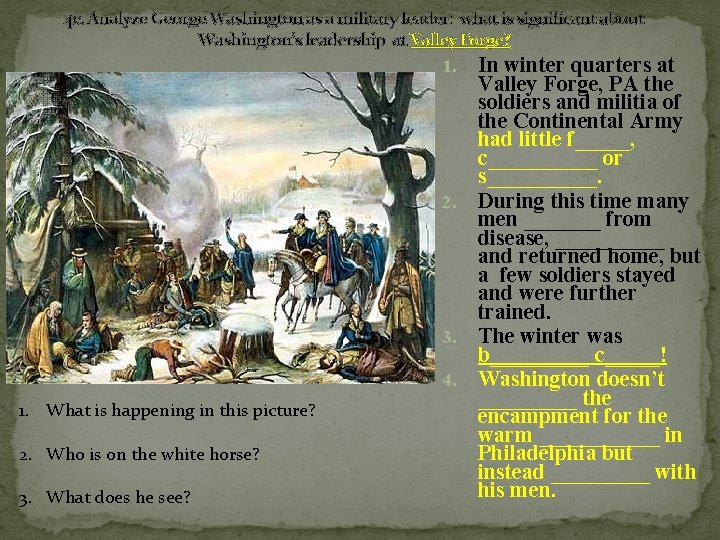
4 c. Analyze George Washington as a military leader: what is significant about Washington’s leadership at Valley Forge? In winter quarters at Valley Forge, PA the soldiers and militia of the Continental Army had little f_____, c_____ or s_____. 2. During this time many men _______ from disease, _____ and returned home, but a few soldiers stayed and were further trained. 3. The winter was b_____ c_____! 4. Washington doesn’t _____ the encampment for the warm ______ in Philadelphia but instead _____ with his men. 1. What is happening in this picture? 2. Who is on the white horse? 3. What does he see?
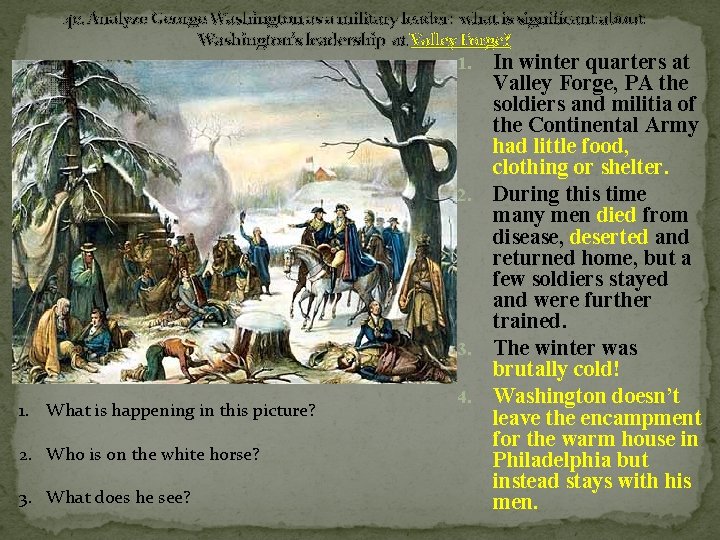
4 c. Analyze George Washington as a military leader: what is significant about Washington’s leadership at Valley Forge? In winter quarters at Valley Forge, PA the soldiers and militia of the Continental Army had little food, clothing or shelter. 2. During this time many men died from disease, deserted and returned home, but a few soldiers stayed and were further trained. 3. The winter was brutally cold! 4. Washington doesn’t leave the encampment for the warm house in Philadelphia but instead stays with his men. 1. What is happening in this picture? 2. Who is on the white horse? 3. What does he see?
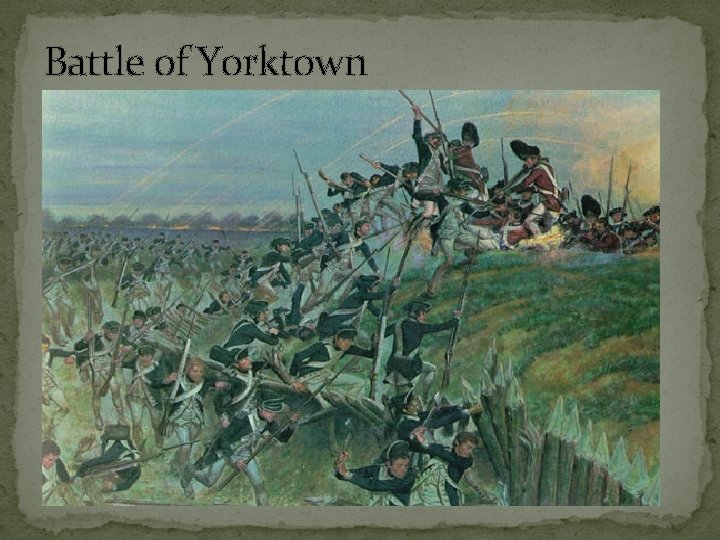
4 d. Explain Yorktown, the role of Lord Cornwallis, and the Treaty of Paris, 1783. � Battle of Yorktown: Dang! 1. August 1781, ________________ set up camp at Yorktown, VA. 2. ___________ needed to reinforce his troops & wait for the _____to arrive. 3. Washington, in the _____, seized the opportunity to deal the British a fatal blow. Lord Cornwallis 4. A ______army had just joined the Continental Army in New York. General _________moved the combined troops south (toward Yorktown), while the ______ fleet set up a blockade off the Virginia coast to block _____ ships.
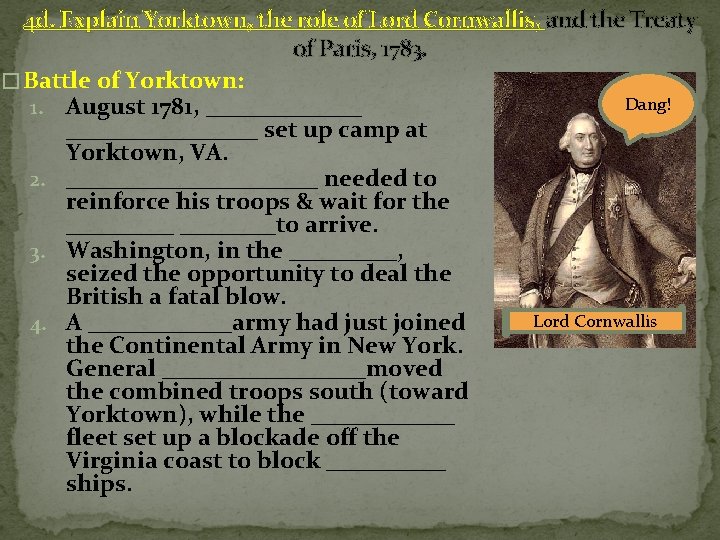
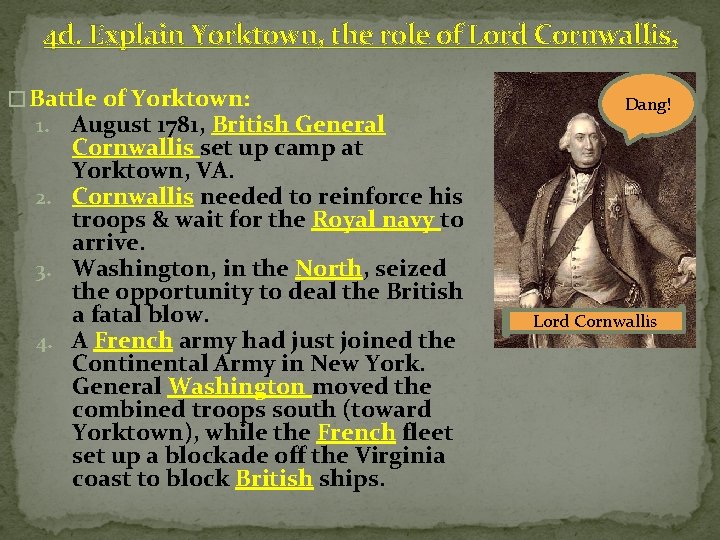
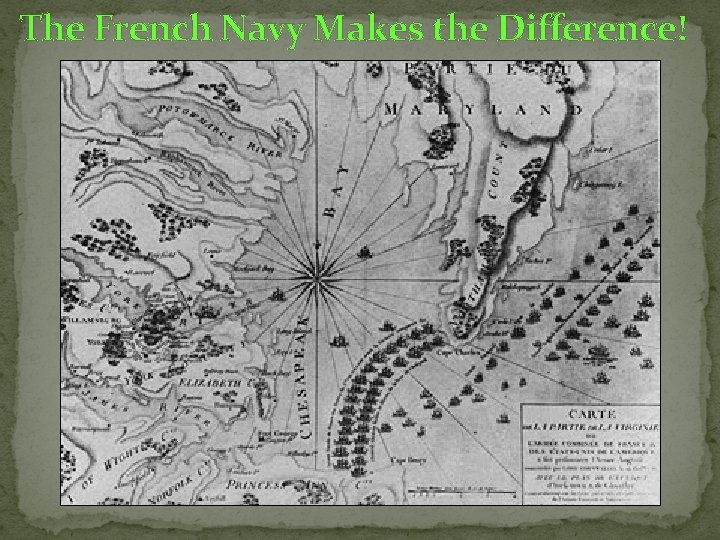
4 d. Explain Yorktown, the role of Lord Cornwallis, � Battle of Yorktown: 1. August 1781, British General Cornwallis set up camp at Yorktown, VA. 2. Cornwallis needed to reinforce his troops & wait for the Royal navy to arrive. 3. Washington, in the North, seized the opportunity to deal the British a fatal blow. 4. A French army had just joined the Continental Army in New York. General Washington moved the combined troops south (toward Yorktown), while the French fleet set up a blockade off the Virginia coast to block British ships. Dang! Lord Cornwallis
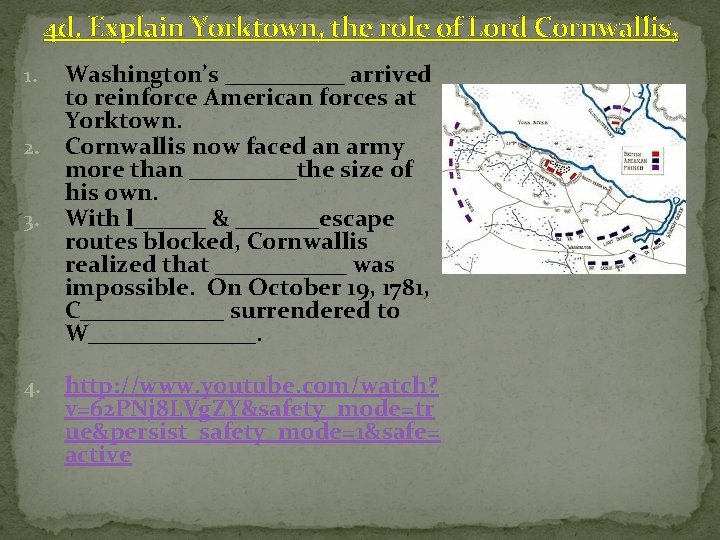
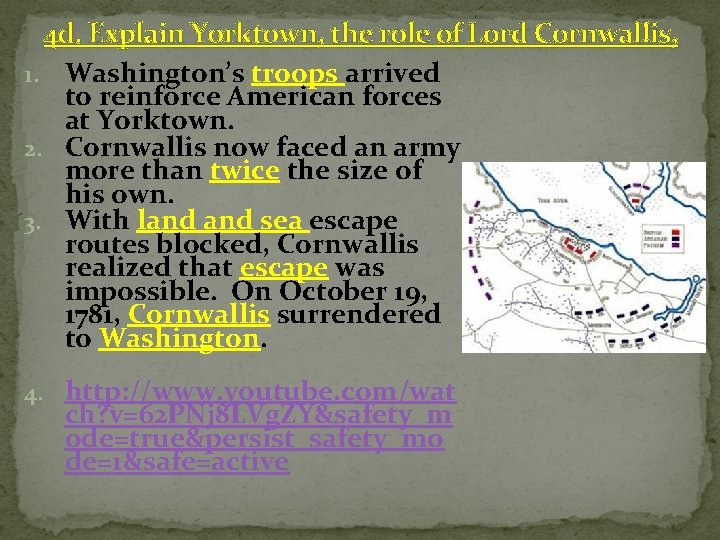
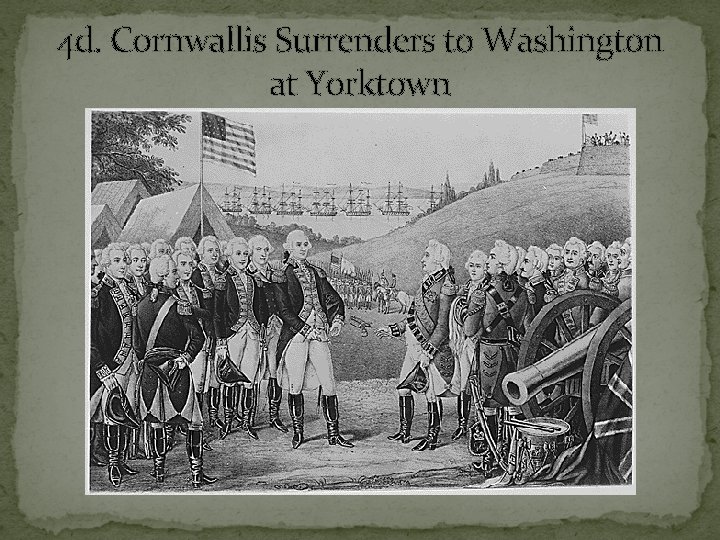
4 d. Explain Yorktown, the role of Lord Cornwallis, 1. 2. 3. 4. Washington’s _____ arrived to reinforce American forces at Yorktown. Cornwallis now faced an army more than _____the size of his own. With l______ & _______escape routes blocked, Cornwallis realized that ______ was impossible. On October 19, 1781, C______ surrendered to W_______. http: //www. youtube. com/watch? v=62 PNj 8 LVg. ZY&safety_mode=tr ue&persist_safety_mode=1&safe= active
4 d. Explain Yorktown, the role of Lord Cornwallis, 1. Washington’s troops arrived to reinforce American forces at Yorktown. 2. Cornwallis now faced an army more than twice the size of his own. 3. With land sea escape routes blocked, Cornwallis realized that escape was impossible. On October 19, 1781, Cornwallis surrendered to Washington. 4. http: //www. youtube. com/wat ch? v=62 PNj 8 LVg. ZY&safety_m ode=true&persist_safety_mo de=1&safe=active
The French Navy Makes the Difference!
Battle of Yorktown
4 d. Cornwallis Surrenders to Washington at Yorktown
4 d. Explain the Treaty of Paris, 1783. 1. 2. 3. 4. Nearly ____years passed between the surrender of Cornwallis and the signing of the ____treaty that ended the American Revolutionary War. Four nations were involved in the peace negotiations: G______ B_____, F_______, S____ & the new United States of America. It was this peace treaty that lead to the establishment and f____l recognition of the United States of America as an independent nation that could engage in t_______, c______ & make l____. Establishing this new nation would not come e______.
4 d. Explain the Treaty of Paris, 1783. Nearly two years passed between the surrender of Cornwallis and the signing of the peace treaty that ended the war. 2. Four nations were involved: Great Britain, France, Spain, and the United States. 3. It was this peace treaty that lead to the establishment and formal recognition of the United States of America as an independent nation that could engage in trade, commerce & make laws. 4. This establishment would not come easily. 1.
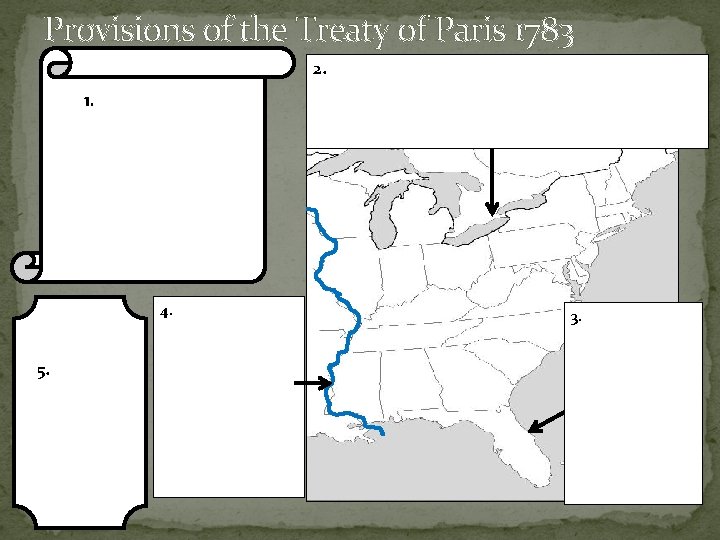
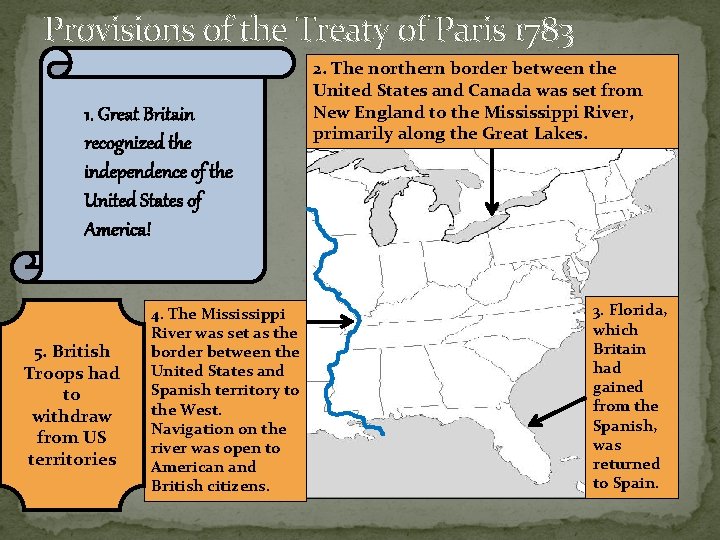
Provisions of the Treaty of Paris 1783 2. 1. 4. 5. 3.
Provisions of the Treaty of Paris 1783 1. Great Britain recognized the independence of the United States of America! 5. British Troops had to withdraw from US territories 4. The Mississippi River was set as the border between the United States and Spanish territory to the West. Navigation on the river was open to American and British citizens. 2. The northern border between the United States and Canada was set from New England to the Mississippi River, primarily along the Great Lakes. 3. Florida, which Britain had gained from the Spanish, was returned to Spain.
SSUSH 4 Assessment 1. Which of the following writers influenced the Declaration of Independence? (SSUSH 4 a) (A) Oliver Cromwell (B) Nicolo Machiavelli (C) John Locke (D) Ernest Hemingway 2. Which victory brought a foreign power to aid the American cause? (SSUSH 4 b) (A) The Battle of Saratoga (B) The Battle of Trenton (C) The Battle of Bunker Hill (D) The Siege of Boston
SSUSH 4 Assessment 1. Which of the following writers influenced the Declaration of Independence? (SSUSH 4 a) (A) Oliver Cromwell (B) Nicolo Machiavelli (C) John Locke (D) Ernest Hemingway 2. Which victory brought a foreign power to aid the American cause? (SSUSH 4 b) (A) The Battle of Saratoga (B) The Battle of Trenton (C) The Battle of Bunker Hill (D) The Siege of Boston
SSUSH 4 Assessment 3. One of the biggest problems facing Washington and his troops was (SSUSH 4 c) (A) corruption in the army. (B) a lack of enthusiasm for the war. (C) a lack of food and clothing. (D) the absence of support for the war among the colonists. 4. The peace treaty that ended the war was called __________. (SSUSH 4 d) (A) the Treaty of Yorktown (B) the Treaty of Cornwallis (C) the Treaty of Saratoga (D) the Treaty of Paris
SSUSH 4 Assessment 3. One of the biggest problems facing Washington and his troops was (SSUSH 4 c) (A) corruption in the army. (B) a lack of enthusiasm for the war. (C) a lack of food and clothing. (D) the absence of support for the war among the colonists. 4. The peace treaty that ended the war was called __________. (SSUSH 4 d) (A) the Treaty of Yorktown (B) the Treaty of Cornwallis (C) the Treaty of Saratoga (D) the Treaty of Paris
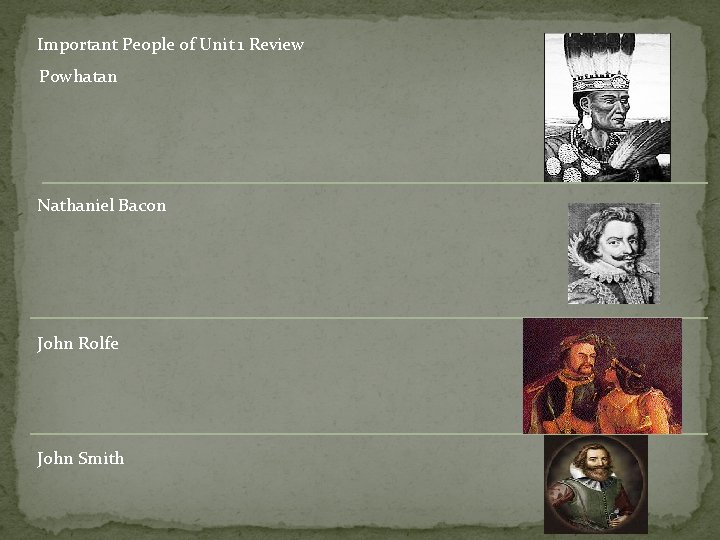
Important People of Unit 1 Review Powhatan Nathaniel Bacon John Rolfe John Smith
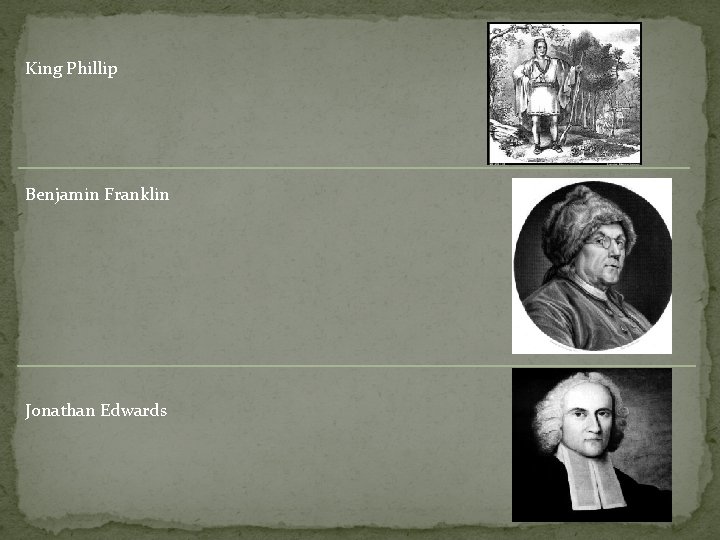
King Phillip Benjamin Franklin Jonathan Edwards
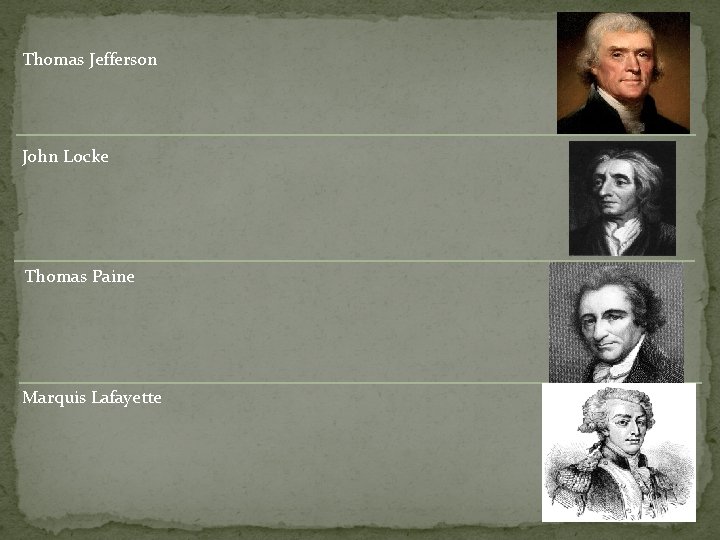
Thomas Jefferson John Locke Thomas Paine Marquis Lafayette
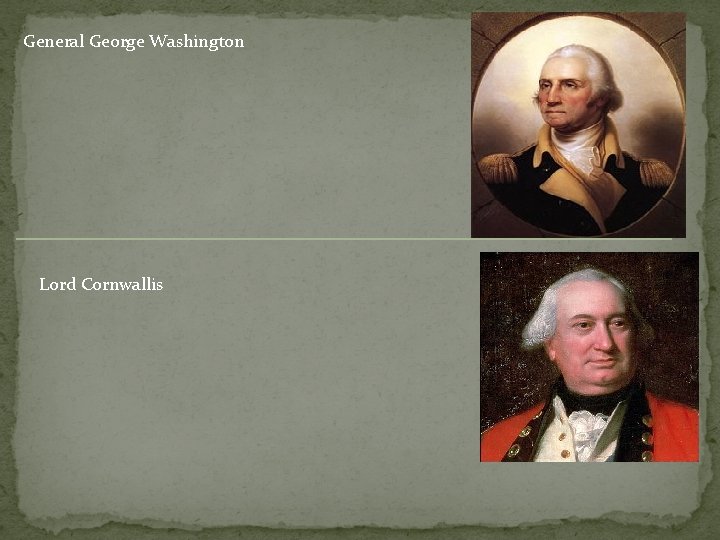
General George Washington Lord Cornwallis
Review for the Unit 1 Test 1. 2. 3. 4. 5. 6. 7. 8. 9. 10. 11. 12. 13. 14. 15. 16. 17. 18. 19. 20. 21. What were the causes of the American Revolution? What factors contributed to the survival of the Virginia colony? Compare and contrast the New England, Middle and Southern colonies. Why were the early years in Jamestown full of hardship? Who were the Puritans? Describe their beliefs. How did the rapid spread of English settlement affect Native Americans? What were the beliefs of the Quakers? Who settled New York? Why was Pennsylvania founded? Which colonial region used predominately slave labor? Why? What was the Great Awakening? What was the most successful French colony in North America? Who would have been in favor of the half-way covenant? Why? What is social mobility? How was Benjamin Franklin a symbol of social mobility? What was the first representative government in the British colonies? What was triangular trade and the middle passage? What was the significance of Thomas Paine's Common Sense? What was the significance of Jonathan Edwards sermon, “Sinners in the Hands of an Angry God? ” What were the Salem Witch Trials? What event signified the struggles of the soldiers of the American Revolution? Describe the impact of the Declaration of Independence.