
SSMT Progress Monitoring By Holli Farr SSMT Process
SSMT Progress Monitoring By: Holli Farr
SSMT Process • Begin with CASA process • Complete PEP packet – Parent Contact Log • At least 2 contacts – Educational History – Interventions Page
SSMT Process • Prior to First Meeting – Check out SSMT folder – Send home RE 2 and get parent signature – Complete SSMT packet RE-1 – Copy completed PEP forms – Request vision & hearing screenings – Check cum folder and CO for prior SSMT/ EC referrals
SSMT Process • Prior to First SSMT meeting – Return folder with • RE-2 with parent signature • Copy of completed PEP • Completed SSMT packet (pgs RE 1 -2) – Collect Student Data (i. e. grades, benchmark info, attendance, etc. )
First Meeting • Further define and refine problem/target behaviors • Develop 2 research based interventions per area • Determine progress monitoring for each target behavior • Based on available data, determine what screening is needed, i. e. KBIT, KTEA, Conners’, Vision, Hearing • Assign observations (one during an intervention)
First Meeting • Immediately following the meeting – Check out probes/make copies – Administer probes to baseline for each targeted area – Implement Interventions decided upon SSMT • For the next 6 -8 weeks – Implement interventions with fidelity – Monitor progress monitoring (administer probes weeklyneed 3 for baseline and 5 data points after the baseline) – Review and revise interventions based upon data
Second Meeting • Bring progress monitoring data and graphs – • Update RE packet Review progress and determine action: 1. Exit process 2. Continue interventions and progress monitoring 3. Revise interventions and progress monitor 4. Refer to special education referral committee
How do we obtain a baseline? • Administer three probes in the designated target area. • The “middlemost” score is the baseline. • For Example: – Scores: 30, 25 – The baseline would be the median of these numbers which is 25. • (Math Reasoning, Written Expression & Behavior do not require a baseline)

Basic Reading Probes • Administration • Baseline 3 probes – Student has 1 minute to complete the probe – Read directions in the grade level probe book to student. • Reading fluency is calculated by first determining the total words attempted within the timed reading probe and then deducting from that the total number of incorrectly read words. • Words read correctly are scored as correct: – – – Self-corrected words are counted as correct within 3 seconds. Repetitions are counted as correct. Examples of dialectical speech are counted as correct. Inserted words are ignored. Norms are available
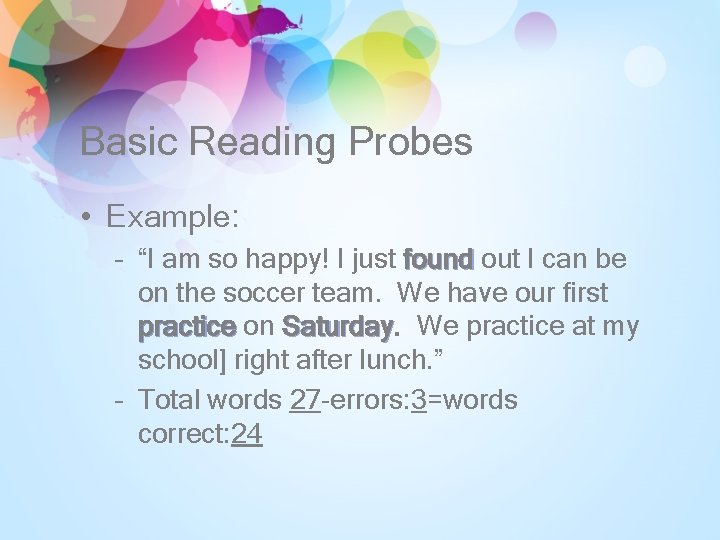
Basic Reading Probes • Example: – “I am so happy! I just found out I can be on the soccer team. We have our first practice on Saturday We practice at my school] right after lunch. ” – Total words 27 -errors: 3=words correct: 24
Reading Comprehension • • Baseline-3 probes Administer sample if needed The student has 3 minutes to complete probe The number correct is the score that can be used to determine progress • Refer to AIMSweb table in your grade level progress monitoring notebook. • The norms can be viewed in Fall, Winter, and Spring. • Can be administered in a group.
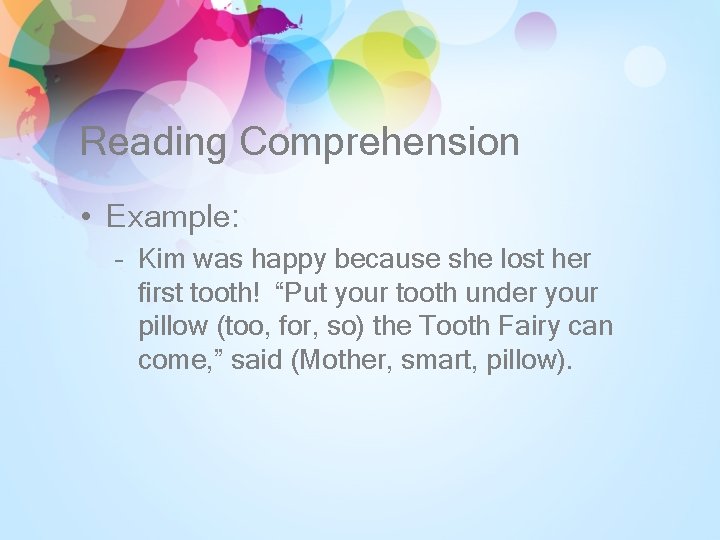
Reading Comprehension • Example: – Kim was happy because she lost her first tooth! “Put your tooth under your pillow (too, for, so) the Tooth Fairy can come, ” said (Mother, smart, pillow).
Math Calculation Progress Monitoring • Baseline 3 probes • Read directions on page 2 -12 from the math probe book at the particular grade level. • After 2 minutes have passed, the examiner says “Stop”. • Scoring – Scored based on number of “Digits Correct” Assigned credit to each individual correct digit – Graph on worksheet
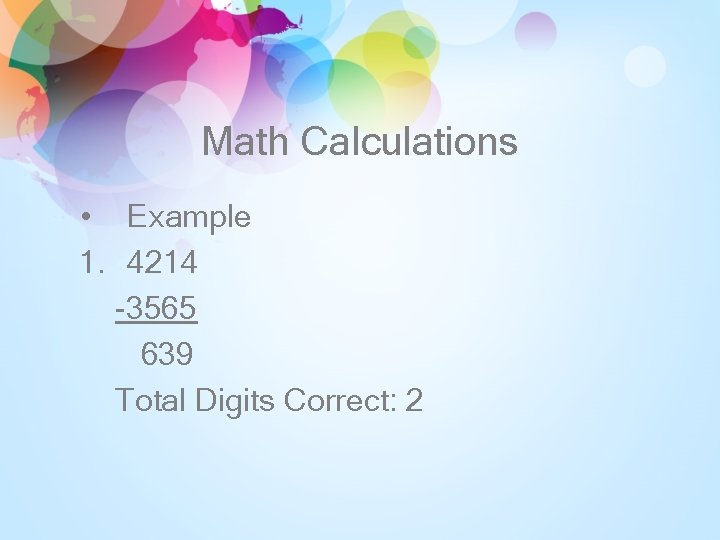
Math Calculations • Example 1. 4214 -3565 639 Total Digits Correct: 2
Math Reasoning • Administration – Read the directions to the student (located at the top of the probe) – At the end of one minute the examiner says, “stop” – Can be administered within a group
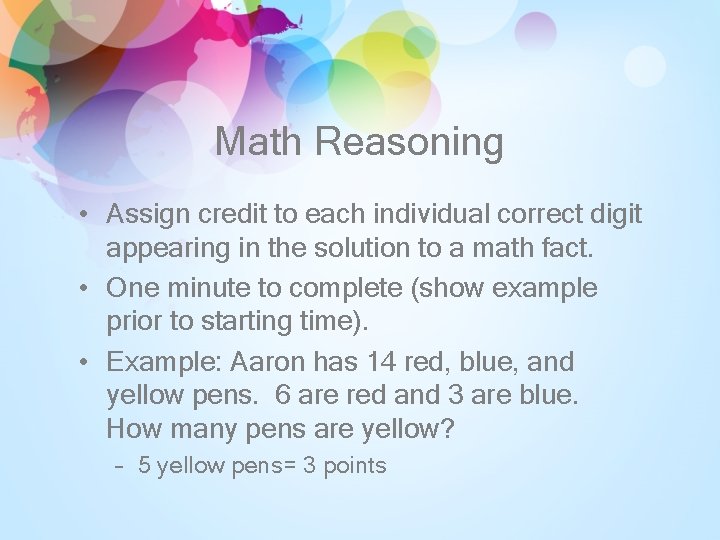
Math Reasoning • Assign credit to each individual correct digit appearing in the solution to a math fact. • One minute to complete (show example prior to starting time). • Example: Aaron has 14 red, blue, and yellow pens. 6 are red and 3 are blue. How many pens are yellow? – 5 yellow pens= 3 points
Written Expression • • • Read directions to the student from the probe book. Student has one minute to brainstorm. Student has three minutes to complete the task. (Note: Can be administered in a group. ) Ways to score writing: • Total words • Total letters • Correctly spelled words • Correct writing sequences • Correct sequences goes beyond confines of isolated word to consider units of writing and their relation to one another (fluency!); the words in each writing sequence must make sense within the context of the sentence • Repeating Kindergarteners’ through 5 th grade

Attention/Behavior • Track behavior with behavior charts (i. e. how many stickers, or rewards did student receive) • Use daily behavior report card, or Classroom Dojo

Graphing • You can use the blank graph in the probe book, your own, excel, or online graphing, such as, chartdog
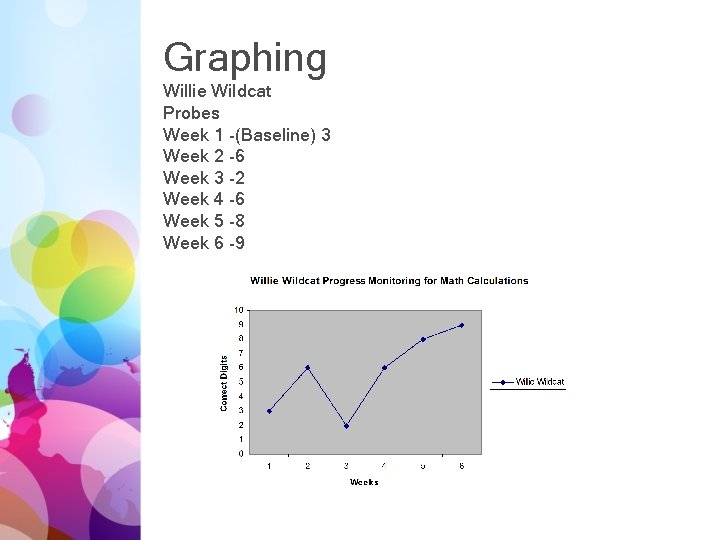
Graphing Willie Wildcat Probes Week 1 -(Baseline) 3 Week 2 -6 Week 3 -2 Week 4 -6 Week 5 -8 Week 6 -9

Questions? ? ? Holli Farr hfarr@rock. k 12. nc. us
- Slides: 21