
SSME Education Innovation and Economic Growth Services Sciences
![SSME: Education, Innovation, and Economic Growth What can you do to get involved? [government]](https://slidetodoc.com/presentation_image/568f72648234f054aa5181ed2a0f85ff/image-23.jpg "SSME: Education, Innovation, and Economic Growth What can you do to get involved? [government]")
![SSME: Education, Innovation, and Economic Growth What can you do to get involved? [industry]](https://slidetodoc.com/presentation_image/568f72648234f054aa5181ed2a0f85ff/image-24.jpg "SSME: Education, Innovation, and Economic Growth What can you do to get involved? [industry]")
![SSME: Education, Innovation, and Economic Growth What can you do to get involved? [academics]](https://slidetodoc.com/presentation_image/568f72648234f054aa5181ed2a0f85ff/image-25.jpg "SSME: Education, Innovation, and Economic Growth What can you do to get involved? [academics]")
- Slides: 59
SSME: Education, Innovation, and Economic Growth Services Sciences, Management, Engineering (SSME): A next frontier in education, innovation, and economic growth and the role of knowledge representation techniques in services innovation Jim Spohrer Director, Almaden Services Research (with Michael Maximilien, maxim@us. ibm. com) Ontolog Forum | http: //ontolog. cim 3. net | December 8 th, 2005
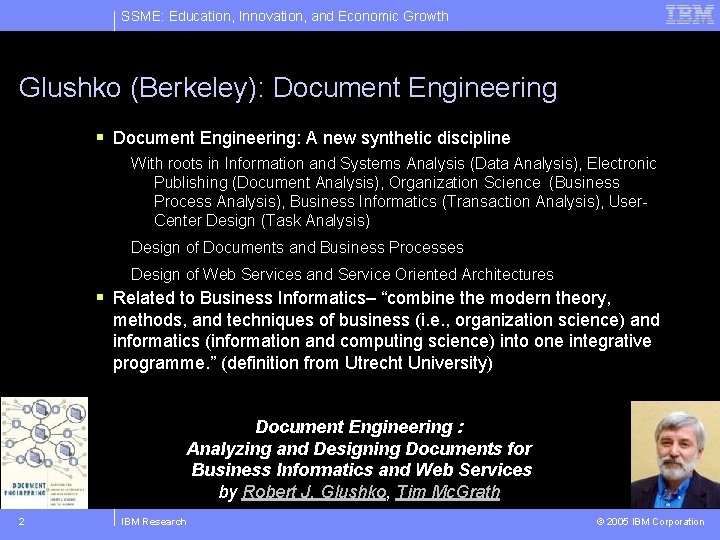
SSME: Education, Innovation, and Economic Growth Glushko (Berkeley): Document Engineering § Document Engineering: A new synthetic discipline With roots in Information and Systems Analysis (Data Analysis), Electronic Publishing (Document Analysis), Organization Science (Business Process Analysis), Business Informatics (Transaction Analysis), User. Center Design (Task Analysis) Design of Documents and Business Processes Design of Web Services and Service Oriented Architectures § Related to Business Informatics– “combine the modern theory, methods, and techniques of business (i. e. , organization science) and informatics (information and computing science) into one integrative programme. ” (definition from Utrecht University) Document Engineering : Analyzing and Designing Documents for Business Informatics and Web Services by Robert J. Glushko, Tim Mc. Grath 2 IBM Research © 2005 IBM Corporation
SSME: Education, Innovation, and Economic Growth Today’s talk § What is SSME or “a Science of Services”? Why is SSME so important? Why does IBM care? Who else cares? What kinds of skills should a service scientist have? What kinds of tools should a service scientist have? § How does this relate to the Ontolog Forum discussion? Revisit definition – importance of knowledge SOAs and service delivery Ontologies and service systems Some open challenges Are there “scale laws” of service innovation? § What next? What can you do to get involved? [government] What can you do to get involved? [industry] What can you do to get involved? [academic] What is IBM doing to support others? § Questions? 3 IBM Research © 2005 IBM Corporation
SSME: Education, Innovation, and Economic Growth What is SSME? (Services Sciences, Management, and Engineering) § An urgent “call to action” To become more systematic about innovation in services Complements product and process innovation methods To develop “a science of services” § A proposed academic discipline Draws on many existing disciplines Aims to integrate them into a new specialty § A proposed research area Service systems are designed (computer systems) Service systems evolve (linguistic and social systems) Service systems have scale-emergent properties (economic systems) 4 IBM Research © 2005 IBM Corporation
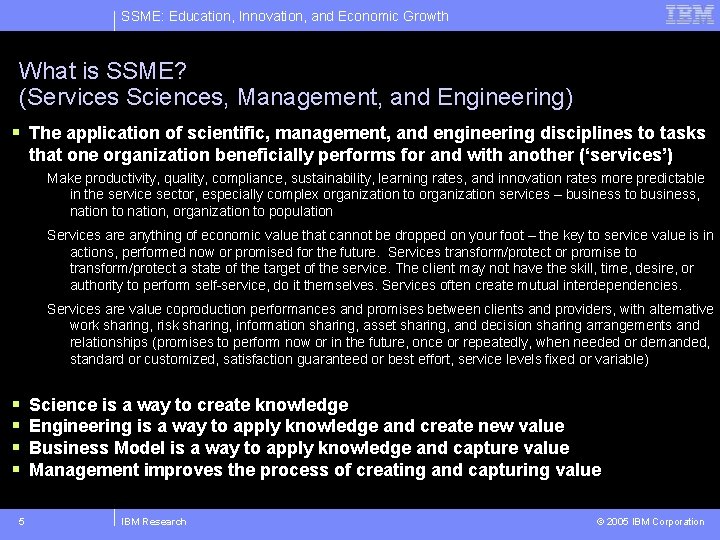
SSME: Education, Innovation, and Economic Growth What is SSME? (Services Sciences, Management, and Engineering) § The application of scientific, management, and engineering disciplines to tasks that one organization beneficially performs for and with another (‘services’) Make productivity, quality, compliance, sustainability, learning rates, and innovation rates more predictable in the service sector, especially complex organization to organization services – business to business, nation to nation, organization to population Services are anything of economic value that cannot be dropped on your foot – the key to service value is in actions, performed now or promised for the future. Services transform/protect or promise to transform/protect a state of the target of the service. The client may not have the skill, time, desire, or authority to perform self-service, do it themselves. Services often create mutual interdependencies. Services are value coproduction performances and promises between clients and providers, with alternative work sharing, risk sharing, information sharing, asset sharing, and decision sharing arrangements and relationships (promises to perform now or in the future, once or repeatedly, when needed or demanded, standard or customized, satisfaction guaranteed or best effort, service levels fixed or variable) § § 5 Science is a way to create knowledge Engineering is a way to apply knowledge and create new value Business Model is a way to apply knowledge and capture value Management improves the process of creating and capturing value IBM Research © 2005 IBM Corporation
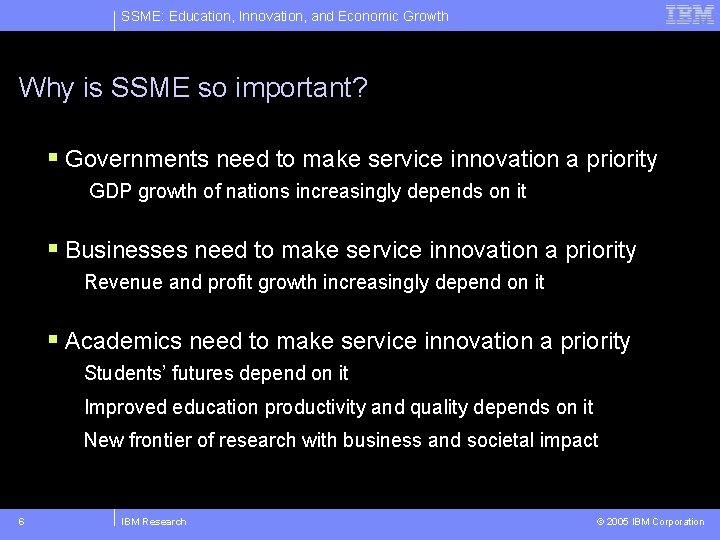
SSME: Education, Innovation, and Economic Growth Why is SSME so important? § Governments need to make service innovation a priority GDP growth of nations increasingly depends on it § Businesses need to make service innovation a priority Revenue and profit growth increasingly depend on it § Academics need to make service innovation a priority Students’ futures depend on it Improved education productivity and quality depends on it New frontier of research with business and societal impact 6 IBM Research © 2005 IBM Corporation
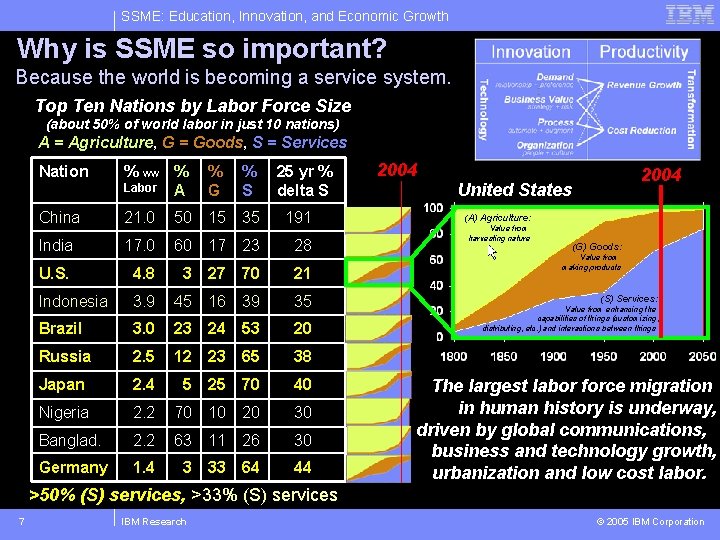
SSME: Education, Innovation, and Economic Growth Why is SSME so important? Because the world is becoming a service system. Top Ten Nations by Labor Force Size (about 50% of world labor in just 10 nations) A = Agriculture, G = Goods, S = Services Nation % WW % Labor A % G % S China 25 yr % delta S 21. 0 50 15 35 191 India 17. 0 60 17 23 28 U. S. 4. 8 3 27 70 21 Indonesia 3. 9 45 16 39 35 Brazil 3. 0 23 24 53 20 Russia 2. 5 12 23 65 38 Japan 2. 4 5 25 70 40 Nigeria 2. 2 70 10 20 30 Banglad. 2. 2 63 11 26 30 Germany 1. 4 3 33 64 44 2004 United States (A) Agriculture: Value from harvesting nature (G) Goods: Value from making products (S) Services: Value from enhancing the capabilities of things (customizing, distributing, etc. ) and interactions between things The largest labor force migration in human history is underway, driven by global communications, business and technology growth, urbanization and low cost labor. >50% (S) services, >33% (S) services 7 IBM Research © 2005 IBM Corporation
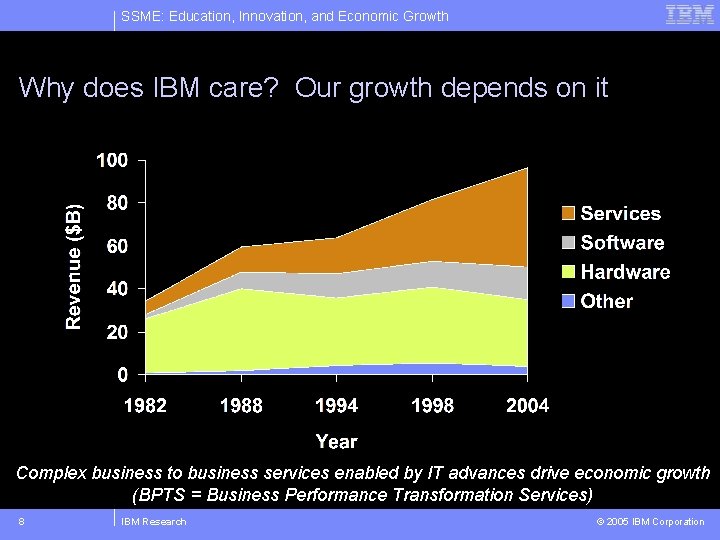
SSME: Education, Innovation, and Economic Growth Why does IBM care? Our growth depends on it Complex business to business services enabled by IT advances drive economic growth (BPTS = Business Performance Transformation Services) 8 IBM Research © 2005 IBM Corporation
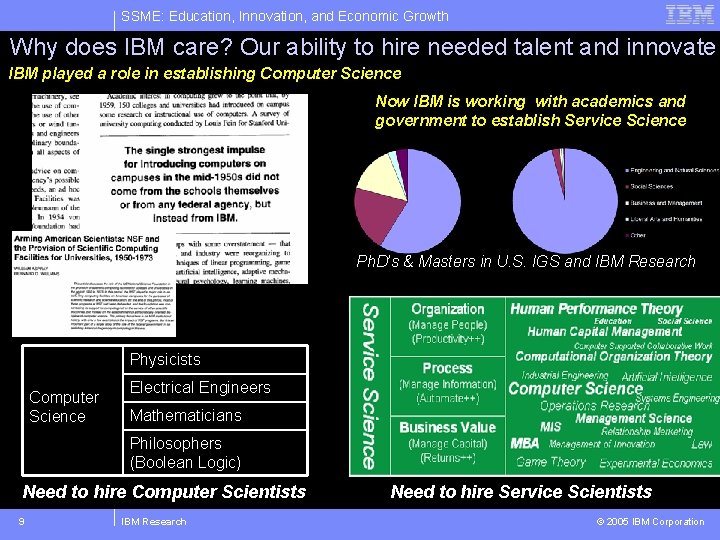
SSME: Education, Innovation, and Economic Growth Why does IBM care? Our ability to hire needed talent and innovate IBM played a role in establishing Computer Science Now IBM is working with academics and government to establish Service Science Ph. D’s & Masters in U. S. IGS and IBM Research Physicists Computer Science Electrical Engineers Mathematicians Philosophers (Boolean Logic) Need to hire Computer Scientists 9 IBM Research Need to hire Service Scientists © 2005 IBM Corporation
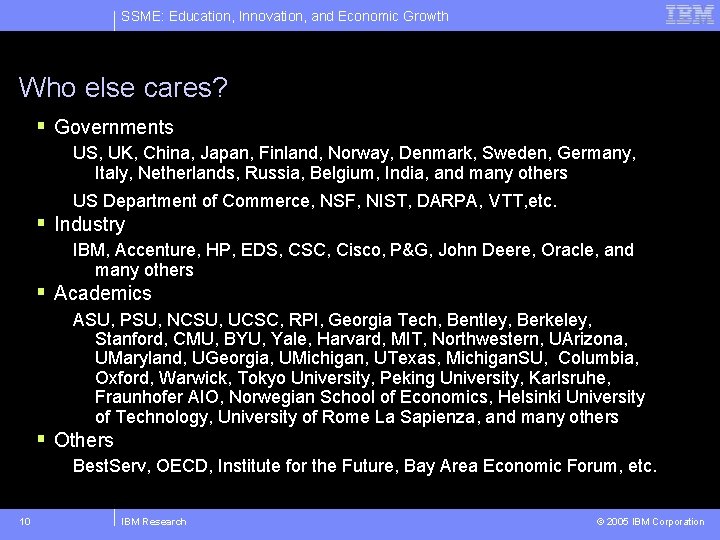
SSME: Education, Innovation, and Economic Growth Who else cares? § Governments US, UK, China, Japan, Finland, Norway, Denmark, Sweden, Germany, Italy, Netherlands, Russia, Belgium, India, and many others US Department of Commerce, NSF, NIST, DARPA, VTT, etc. § Industry IBM, Accenture, HP, EDS, CSC, Cisco, P&G, John Deere, Oracle, and many others § Academics ASU, PSU, NCSU, UCSC, RPI, Georgia Tech, Bentley, Berkeley, Stanford, CMU, BYU, Yale, Harvard, MIT, Northwestern, UArizona, UMaryland, UGeorgia, UMichigan, UTexas, Michigan. SU, Columbia, Oxford, Warwick, Tokyo University, Peking University, Karlsruhe, Fraunhofer AIO, Norwegian School of Economics, Helsinki University of Technology, University of Rome La Sapienza, and many others § Others Best. Serv, OECD, Institute for the Future, Bay Area Economic Forum, etc. 10 IBM Research © 2005 IBM Corporation
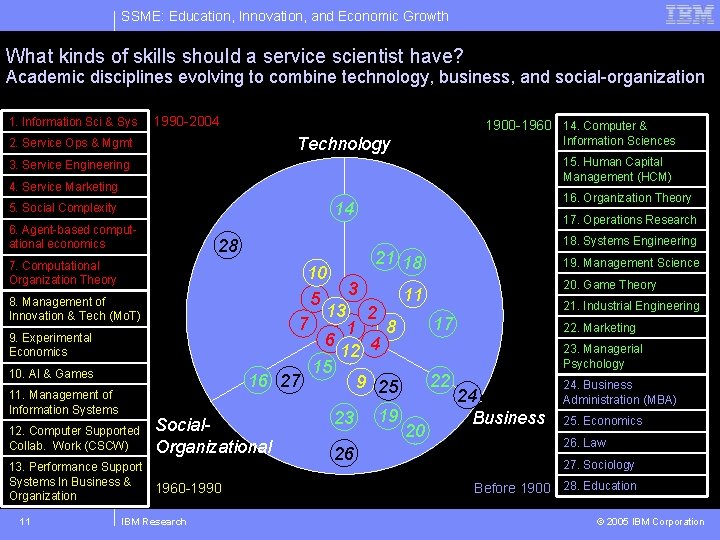
SSME: Education, Innovation, and Economic Growth What kinds of skills should a service scientist have? Academic disciplines evolving to combine technology, business, and social-organization 1. Information Sci & Sys 1990 -2004 1900 -1960 14. Computer & Technology 2. Service Ops & Mgmt Information Sciences 15. Human Capital Management (HCM) 3. Service Engineering 4. Service Marketing 6. Agent-based computational economics 28 7. Computational Organization Theory 9. Experimental Economics 10. AI & Games 11. Management of Information Systems 12. Computer Supported Collab. Work (CSCW) 13. Performance Support Systems In Business & Organization 17. Operations Research Social. Organizational 1960 -1990 IBM Research 18. Systems Engineering 21 18 10 3 11 5 13 2 7 17 8 1 6 12 4 15 16 27 22 9 25 8. Management of Innovation & Tech (Mo. T) 11 16. Organization Theory 14 5. Social Complexity 23 26 19 20 19. Management Science 20. Game Theory 21. Industrial Engineering 22. Marketing 23. Managerial Psychology 24 Business 24. Business Administration (MBA) 25. Economics 26. Law 27. Sociology Before 1900 28. Education © 2005 IBM Corporation
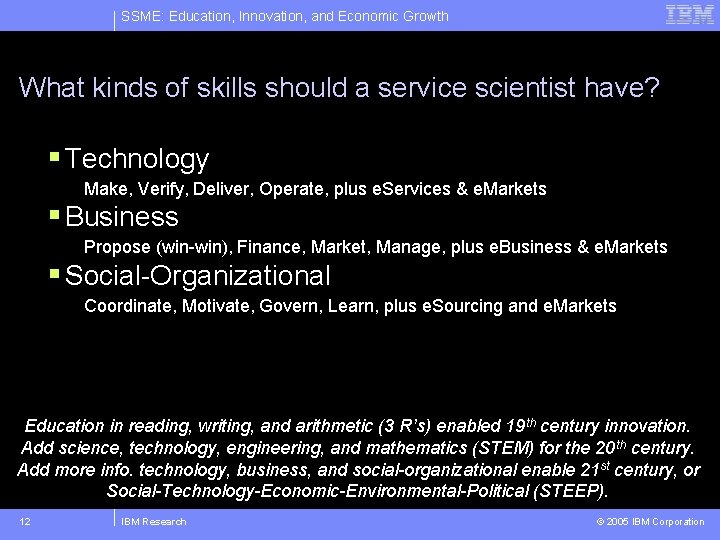
SSME: Education, Innovation, and Economic Growth What kinds of skills should a service scientist have? § Technology Make, Verify, Deliver, Operate, plus e. Services & e. Markets § Business Propose (win-win), Finance, Market, Manage, plus e. Business & e. Markets § Social-Organizational Coordinate, Motivate, Govern, Learn, plus e. Sourcing and e. Markets Education in reading, writing, and arithmetic (3 R’s) enabled 19 th century innovation. Add science, technology, engineering, and mathematics (STEM) for the 20 th century. Add more info. technology, business, and social-organizational enable 21 st century, or Social-Technology-Economic-Environmental-Political (STEEP). 12 IBM Research © 2005 IBM Corporation
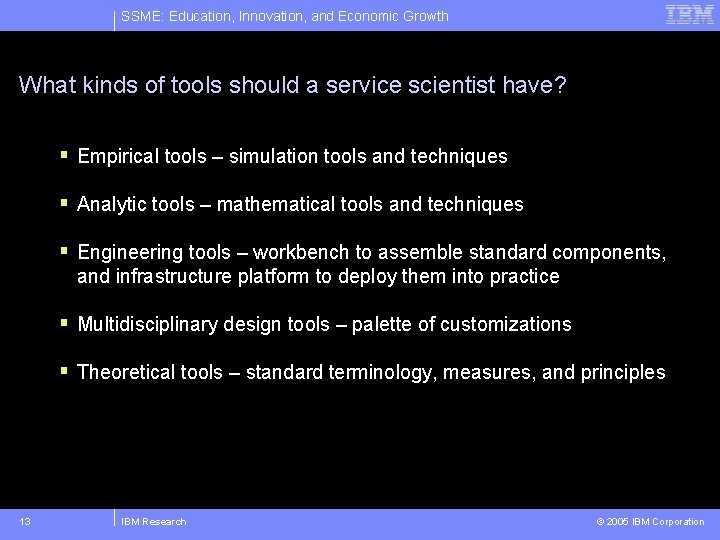
SSME: Education, Innovation, and Economic Growth What kinds of tools should a service scientist have? § Empirical tools – simulation tools and techniques § Analytic tools – mathematical tools and techniques § Engineering tools – workbench to assemble standard components, and infrastructure platform to deploy them into practice § Multidisciplinary design tools – palette of customizations § Theoretical tools – standard terminology, measures, and principles 13 IBM Research © 2005 IBM Corporation
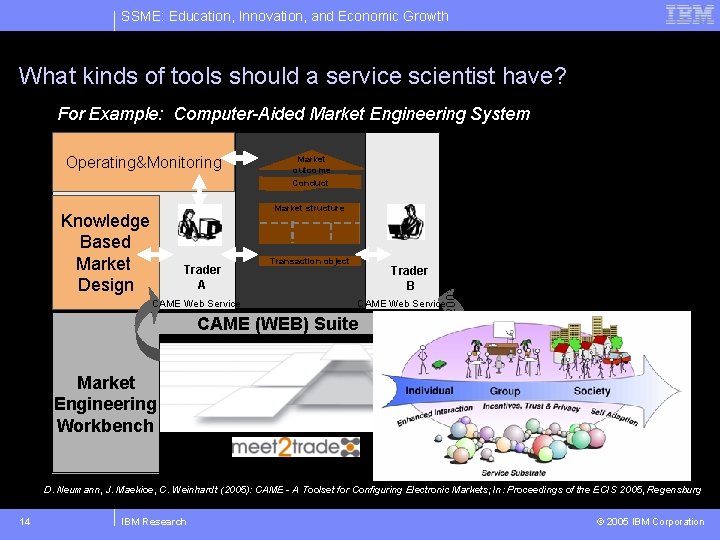
SSME: Education, Innovation, and Economic Growth What kinds of tools should a service scientist have? Operating&Monitoring Market outcome Conduct Market structure Knowledge Based Market Design Trader A CAME Web Service Transaction object Trader B CAME Web Service CAME (WEB) Suite Market Engineering Workbench ( Bichler, Kersten, Strecker 2003) (Transcoop, Weinhardt, Neumann, 2003) For Example: Computer-Aided Market Engineering System (Av. H and SSHRC) D. Neumann, J. Maekioe, C. Weinhardt (2005): CAME - A Toolset for Configuring Electronic Markets; In: Proceedings of the ECIS 2005, Regensburg 14 IBM Research © 2005 IBM Corporation
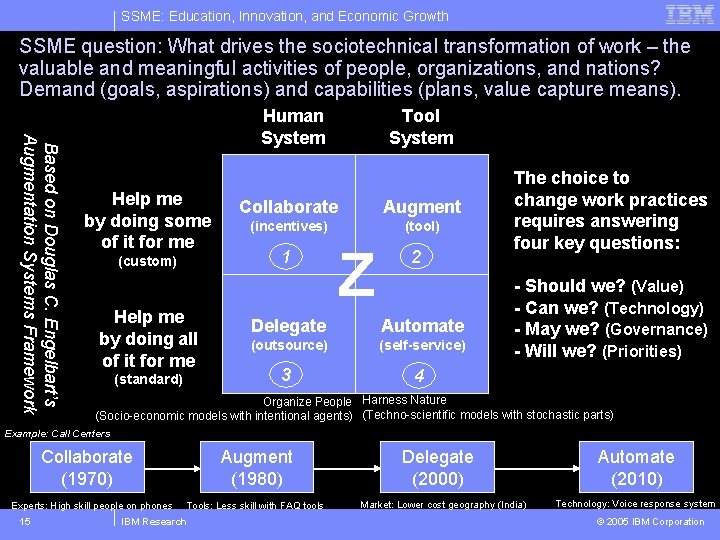
SSME: Education, Innovation, and Economic Growth SSME question: What drives the sociotechnical transformation of work – the valuable and meaningful activities of people, organizations, and nations? Demand (goals, aspirations) and capabilities (plans, value capture means). Based on Douglas C. Engelbart’s Augmentation Systems Framework Human System Help me by doing some of it for me (custom) Help me by doing all of it for me (standard) Tool System Collaborate Augment (incentives) (tool) 1 Z 2 Delegate Automate (outsource) (self-service) 3 4 The choice to change work practices requires answering four key questions: - Should we? (Value) - Can we? (Technology) - May we? (Governance) - Will we? (Priorities) Organize People Harness Nature (Socio-economic models with intentional agents) (Techno-scientific models with stochastic parts) Example: Call Centers Collaborate (1970) Experts: High skill people on phones 15 Augment (1980) Tools: Less skill with FAQ tools IBM Research Delegate (2000) Market: Lower cost geography (India) Automate (2010) Technology: Voice response system © 2005 IBM Corporation
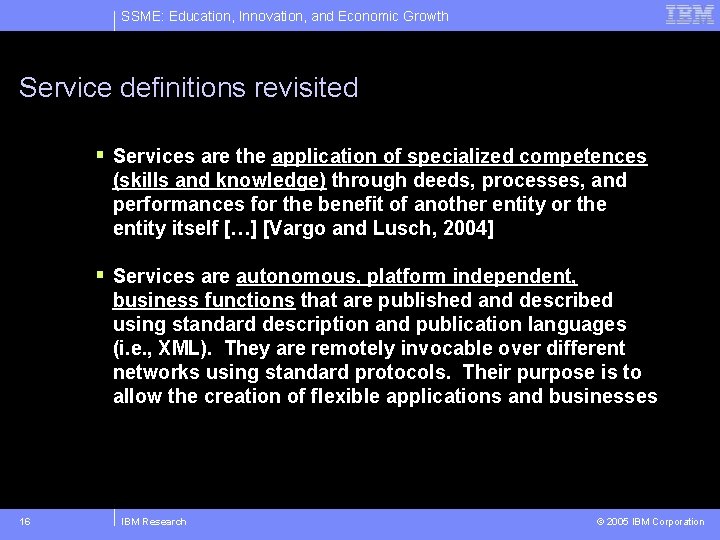
SSME: Education, Innovation, and Economic Growth Service definitions revisited § Services are the application of specialized competences (skills and knowledge) through deeds, processes, and performances for the benefit of another entity or the entity itself […] [Vargo and Lusch, 2004] § Services are autonomous, platform independent, business functions that are published and described using standard description and publication languages (i. e. , XML). They are remotely invocable over different networks using standard protocols. Their purpose is to allow the creation of flexible applications and businesses 16 IBM Research © 2005 IBM Corporation
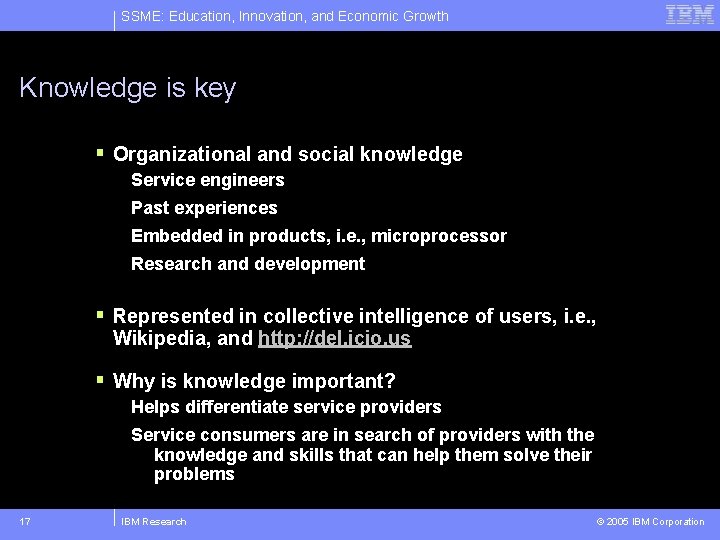
SSME: Education, Innovation, and Economic Growth Knowledge is key § Organizational and social knowledge Service engineers Past experiences Embedded in products, i. e. , microprocessor Research and development § Represented in collective intelligence of users, i. e. , Wikipedia, and http: //del. icio. us § Why is knowledge important? Helps differentiate service providers Service consumers are in search of providers with the knowledge and skills that can help them solve their problems 17 IBM Research © 2005 IBM Corporation
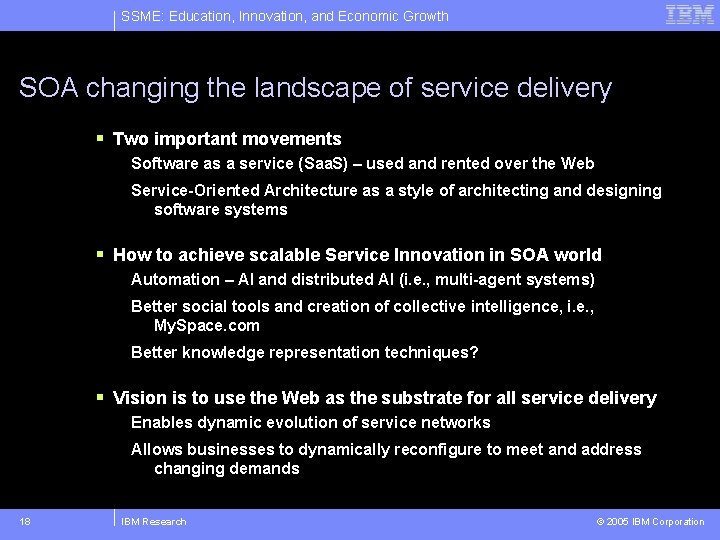
SSME: Education, Innovation, and Economic Growth SOA changing the landscape of service delivery § Two important movements Software as a service (Saa. S) – used and rented over the Web Service-Oriented Architecture as a style of architecting and designing software systems § How to achieve scalable Service Innovation in SOA world Automation – AI and distributed AI (i. e. , multi-agent systems) Better social tools and creation of collective intelligence, i. e. , My. Space. com Better knowledge representation techniques? § Vision is to use the Web as the substrate for all service delivery Enables dynamic evolution of service networks Allows businesses to dynamically reconfigure to meet and address changing demands 18 IBM Research © 2005 IBM Corporation
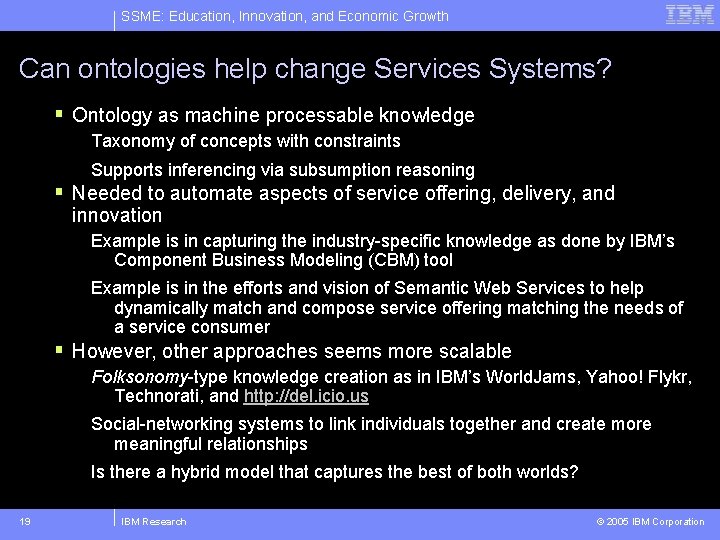
SSME: Education, Innovation, and Economic Growth Can ontologies help change Services Systems? § Ontology as machine processable knowledge Taxonomy of concepts with constraints Supports inferencing via subsumption reasoning § Needed to automate aspects of service offering, delivery, and innovation Example is in capturing the industry-specific knowledge as done by IBM’s Component Business Modeling (CBM) tool Example is in the efforts and vision of Semantic Web Services to help dynamically match and compose service offering matching the needs of a service consumer § However, other approaches seems more scalable Folksonomy-type knowledge creation as in IBM’s World. Jams, Yahoo! Flykr, Technorati, and http: //del. icio. us Social-networking systems to link individuals together and create more meaningful relationships Is there a hybrid model that captures the best of both worlds? 19 IBM Research © 2005 IBM Corporation
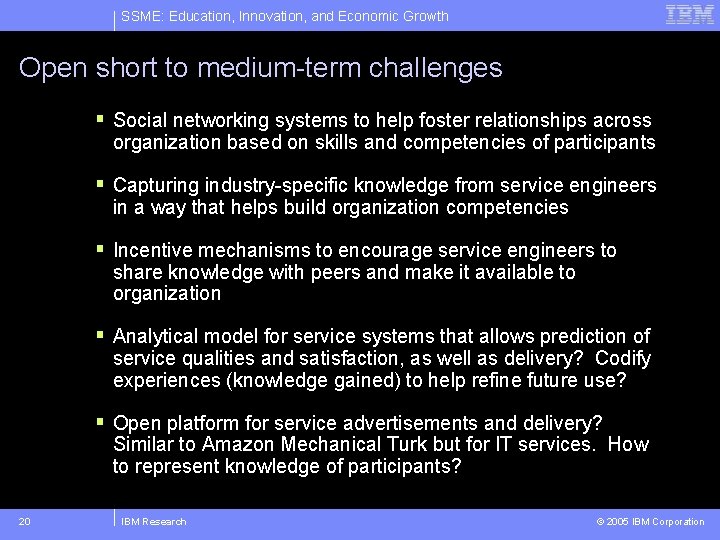
SSME: Education, Innovation, and Economic Growth Open short to medium-term challenges § Social networking systems to help foster relationships across organization based on skills and competencies of participants § Capturing industry-specific knowledge from service engineers in a way that helps build organization competencies § Incentive mechanisms to encourage service engineers to share knowledge with peers and make it available to organization § Analytical model for service systems that allows prediction of service qualities and satisfaction, as well as delivery? Codify experiences (knowledge gained) to help refine future use? § Open platform for service advertisements and delivery? Similar to Amazon Mechanical Turk but for IT services. How to represent knowledge of participants? 20 IBM Research © 2005 IBM Corporation
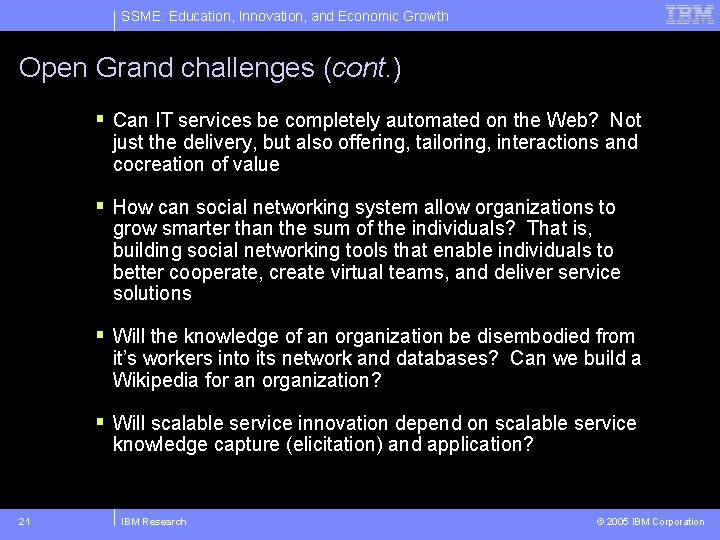
SSME: Education, Innovation, and Economic Growth Open Grand challenges (cont. ) § Can IT services be completely automated on the Web? Not just the delivery, but also offering, tailoring, interactions and cocreation of value § How can social networking system allow organizations to grow smarter than the sum of the individuals? That is, building social networking tools that enable individuals to better cooperate, create virtual teams, and deliver service solutions § Will the knowledge of an organization be disembodied from it’s workers into its network and databases? Can we build a Wikipedia for an organization? § Will scalable service innovation depend on scalable service knowledge capture (elicitation) and application? 21 IBM Research © 2005 IBM Corporation
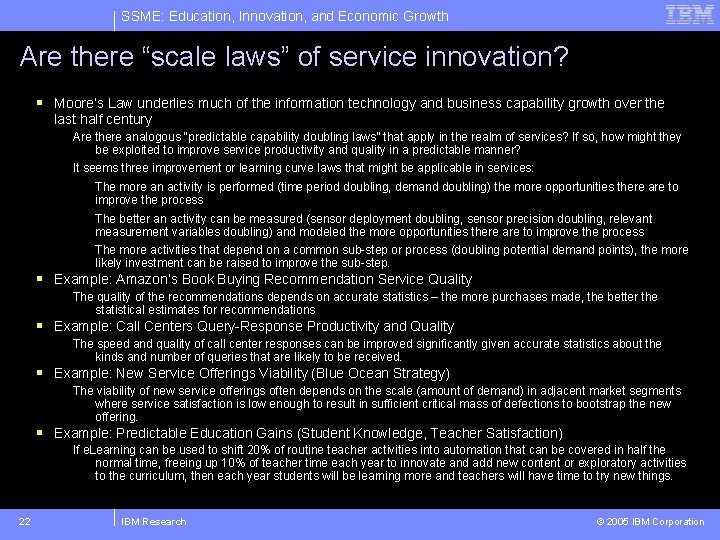
SSME: Education, Innovation, and Economic Growth Are there “scale laws” of service innovation? § Moore’s Law underlies much of the information technology and business capability growth over the last half century Are there analogous “predictable capability doubling laws” that apply in the realm of services? If so, how might they be exploited to improve service productivity and quality in a predictable manner? It seems three improvement or learning curve laws that might be applicable in services: The more an activity is performed (time period doubling, demand doubling) the more opportunities there are to improve the process The better an activity can be measured (sensor deployment doubling, sensor precision doubling, relevant measurement variables doubling) and modeled the more opportunities there are to improve the process The more activities that depend on a common sub-step or process (doubling potential demand points), the more likely investment can be raised to improve the sub-step. § Example: Amazon’s Book Buying Recommendation Service Quality The quality of the recommendations depends on accurate statistics – the more purchases made, the better the statistical estimates for recommendations § Example: Call Centers Query-Response Productivity and Quality The speed and quality of call center responses can be improved significantly given accurate statistics about the kinds and number of queries that are likely to be received. § Example: New Service Offerings Viability (Blue Ocean Strategy) The viability of new service offerings often depends on the scale (amount of demand) in adjacent market segments where service satisfaction is low enough to result in sufficient critical mass of defections to bootstrap the new offering. § Example: Predictable Education Gains (Student Knowledge, Teacher Satisfaction) If e. Learning can be used to shift 20% of routine teacher activities into automation that can be covered in half the normal time, freeing up 10% of teacher time each year to innovate and add new content or exploratory activities to the curriculum, then each year students will be learning more and teachers will have time to try new things. 22 IBM Research © 2005 IBM Corporation
SSME: Education, Innovation, and Economic Growth What can you do to get involved? [government] § § § 23 Does your agency fund innovation? Does your agency influence innovation policy? Does your agency establish standards? Does your agency deal with intellectual property? Does your agency deal with economic statistics? IBM Research © 2005 IBM Corporation
SSME: Education, Innovation, and Economic Growth What can you do to get involved? [industry] § Does your business develop, sell, and/or deliver service offerings? § Does your business have a service innovation process? § Does your business use services to complement and add value to § § § § 24 manufactured products? Does your business invest in internal R&D? Does your business fund university or other external R&D? Does your business create case studies, success stories, white papers, or point-of-view documents about service offerings? Does your business recruit service professionals? Service researchers? Does your business provide feedback to schools (survey recent graduates hired) on what skills are desired to be most effective in your business? Does your business procure services? e. Source of services? Outsource services? Does your company patent or otherwise protect intellectual property related to service innovation? IBM Research © 2005 IBM Corporation
SSME: Education, Innovation, and Economic Growth What can you do to get involved? [academics] § Do you teach courses that include or could include complex business to § § § § § 25 business service case studies? Do you have responsibility for revising or creating new curriculum? Do you perform research that could be published in the Journal of Service Research or other relevant journals or conferences? Do you have students who could intern with business service or service research organizations? Compete for Ph. D fellowships in services? Are you interested in industry-academic rotations? Are you interested in developing tools that could enable SSME? Are you interested in creating business proposals or grant proposals related to SSME and service innovation? Competing for university research awards? Are you interested in participating/speaking in SSME events? Hosting one at your university? Does your school already have services related courses, degrees, centers, or institutes? Are you a service innovation pioneer? Are you interested in competing for a faculty award? IBM Research © 2005 IBM Corporation
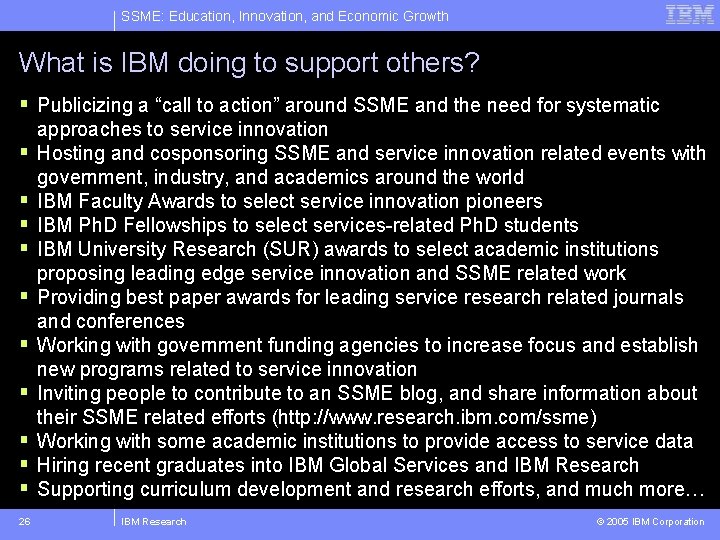
SSME: Education, Innovation, and Economic Growth What is IBM doing to support others? § Publicizing a “call to action” around SSME and the need for systematic § § § § § 26 approaches to service innovation Hosting and cosponsoring SSME and service innovation related events with government, industry, and academics around the world IBM Faculty Awards to select service innovation pioneers IBM Ph. D Fellowships to select services-related Ph. D students IBM University Research (SUR) awards to select academic institutions proposing leading edge service innovation and SSME related work Providing best paper awards for leading service research related journals and conferences Working with government funding agencies to increase focus and establish new programs related to service innovation Inviting people to contribute to an SSME blog, and share information about their SSME related efforts (http: //www. research. ibm. com/ssme) Working with some academic institutions to provide access to service data Hiring recent graduates into IBM Global Services and IBM Research Supporting curriculum development and research efforts, and much more… IBM Research © 2005 IBM Corporation
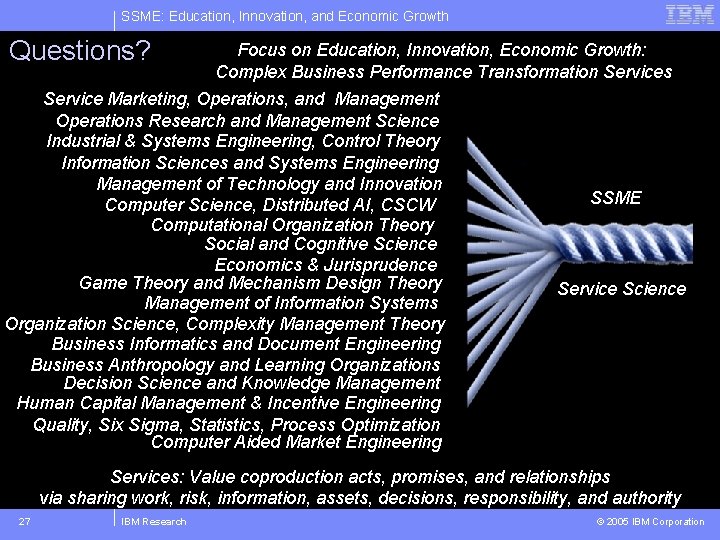
SSME: Education, Innovation, and Economic Growth Questions? Focus on Education, Innovation, Economic Growth: Complex Business Performance Transformation Services Service Marketing, Operations, and Management Operations Research and Management Science Industrial & Systems Engineering, Control Theory Information Sciences and Systems Engineering Management of Technology and Innovation Computer Science, Distributed AI, CSCW Computational Organization Theory Social and Cognitive Science Economics & Jurisprudence Game Theory and Mechanism Design Theory Management of Information Systems Organization Science, Complexity Management Theory Business Informatics and Document Engineering Business Anthropology and Learning Organizations Decision Science and Knowledge Management Human Capital Management & Incentive Engineering Quality, Six Sigma, Statistics, Process Optimization Computer Aided Market Engineering SSME Service Science Services: Value coproduction acts, promises, and relationships via sharing work, risk, information, assets, decisions, responsibility, and authority 27 IBM Research © 2005 IBM Corporation
SSME: Education, Innovation, and Economic Growth REST IS BACKUP Contact Wendy Murphy (wendym@us. ibm. com) Ontolog Forum | http: //ontolog. cim 3. net | December 8 th, 2005
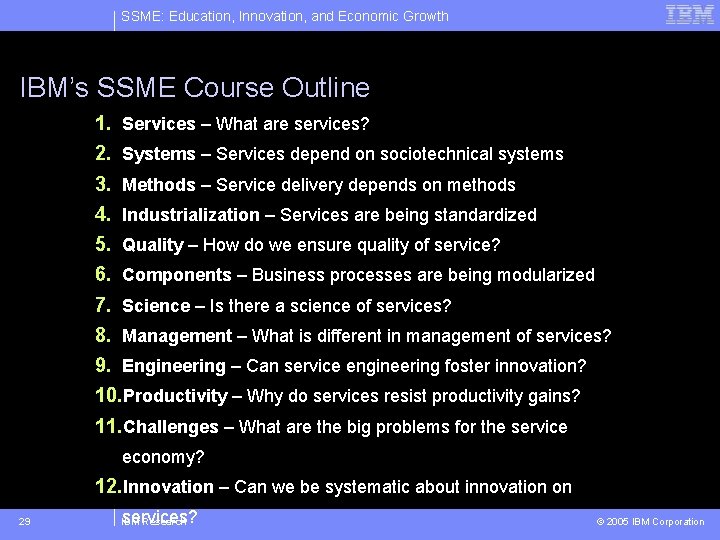
SSME: Education, Innovation, and Economic Growth IBM’s SSME Course Outline 1. Services – What are services? 2. Systems – Services depend on sociotechnical systems 3. Methods – Service delivery depends on methods 4. Industrialization – Services are being standardized 5. Quality – How do we ensure quality of service? 6. Components – Business processes are being modularized 7. Science – Is there a science of services? 8. Management – What is different in management of services? 9. Engineering – Can service engineering foster innovation? 10. Productivity – Why do services resist productivity gains? 11. Challenges – What are the big problems for the service economy? 12. Innovation – Can we be systematic about innovation on 29 services? IBM Research © 2005 IBM Corporation
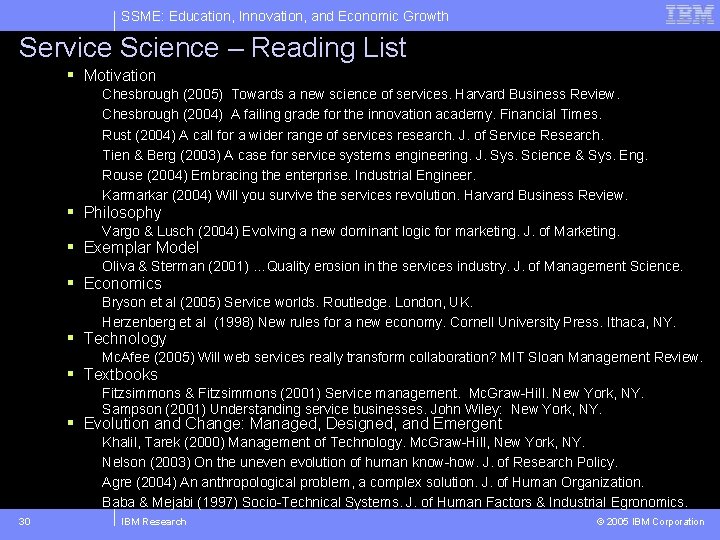
SSME: Education, Innovation, and Economic Growth Service Science – Reading List § Motivation Chesbrough (2005) Towards a new science of services. Harvard Business Review. Chesbrough (2004) A failing grade for the innovation academy. Financial Times. Rust (2004) A call for a wider range of services research. J. of Service Research. Tien & Berg (2003) A case for service systems engineering. J. Sys. Science & Sys. Eng. Rouse (2004) Embracing the enterprise. Industrial Engineer. Karmarkar (2004) Will you survive the services revolution. Harvard Business Review. § Philosophy Vargo & Lusch (2004) Evolving a new dominant logic for marketing. J. of Marketing. § Exemplar Model Oliva & Sterman (2001) …Quality erosion in the services industry. J. of Management Science. § Economics Bryson et al (2005) Service worlds. Routledge. London, UK. Herzenberg et al (1998) New rules for a new economy. Cornell University Press. Ithaca, NY. § Technology Mc. Afee (2005) Will web services really transform collaboration? MIT Sloan Management Review. § Textbooks Fitzsimmons & Fitzsimmons (2001) Service management. Mc. Graw-Hill. New York, NY. Sampson (2001) Understanding service businesses. John Wiley: New York, NY. § Evolution and Change: Managed, Designed, and Emergent Khalil, Tarek (2000) Management of Technology. Mc. Graw-Hill, New York, NY. Nelson (2003) On the uneven evolution of human know-how. J. of Research Policy. Agre (2004) An anthropological problem, a complex solution. J. of Human Organization. Baba & Mejabi (1997) Socio-Technical Systems. J. of Human Factors & Industrial Egronomics. 30 IBM Research © 2005 IBM Corporation
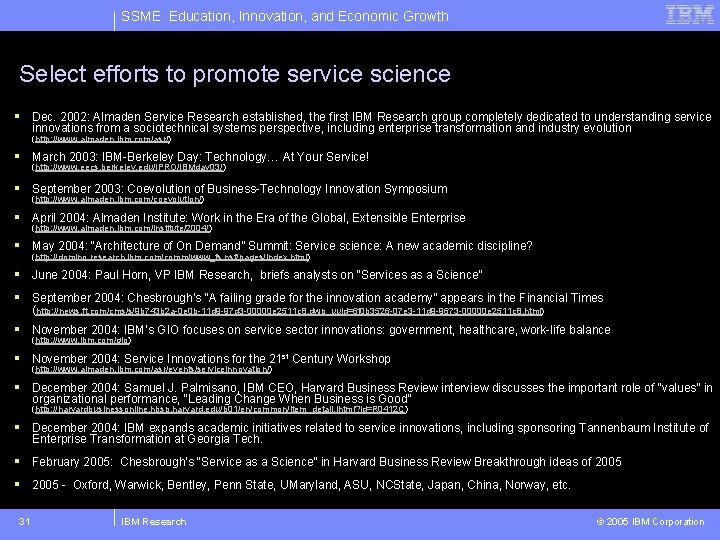
SSME: Education, Innovation, and Economic Growth Select efforts to promote service science § Dec. 2002: Almaden Service Research established, the first IBM Research group completely dedicated to understanding service innovations from a sociotechnical systems perspective, including enterprise transformation and industry evolution (http: //www. almaden. ibm. com/asr/) § March 2003: IBM-Berkeley Day: Technology… At Your Service! (http: //www. eecs. berkeley. edu/IPRO/IBMday 03/) § September 2003: Coevolution of Business-Technology Innovation Symposium (http: //www. almaden. ibm. com/coevolution/) § April 2004: Almaden Institute: Work in the Era of the Global, Extensible Enterprise (http: //www. almaden. ibm. com/institute/2004/) § May 2004: “Architecture of On Demand” Summit: Service science: A new academic discipline? (http: //domino. research. ibm. com/comm/www_fs. nsf/pages/index. html) § June 2004: Paul Horn, VP IBM Research, briefs analysts on “Services as a Science” § September 2004: Chesbrough’s “A failing grade for the innovation academy” appears in the Financial Times (http: //news. ft. com/cms/s/9 b 743 b 2 a-0 e 0 b-11 d 9 -97 d 3 -00000 e 2511 c 8, dwp_uuid=6 f 0 b 3526 -07 e 3 -11 d 9 -9673 -00000 e 2511 c 8. html) § November 2004: IBM’s GIO focuses on service sector innovations: government, healthcare, work-life balance (http: //www. ibm. com/gio) § November 2004: Service Innovations for the 21 st Century Workshop (http: //www. almaden. ibm. com/asr/events/serviceinnovation/) § December 2004: Samuel J. Palmisano, IBM CEO, Harvard Business Review interview discusses the important role of “values” in organizational performance, “Leading Change When Business is Good” (http: //harvardbusinessonline. hbsp. harvard. edu/b 01/en/common/item_detail. jhtml? id=R 0412 C) § December 2004: IBM expands academic initiatives related to service innovations, including sponsoring Tannenbaum Institute of Enterprise Transformation at Georgia Tech. § February 2005: Chesbrough’s “Service as a Science” in Harvard Business Review Breakthrough ideas of 2005 § 2005 - Oxford, Warwick, Bentley, Penn State, UMaryland, ASU, NCState, Japan, China, Norway, etc. 31 IBM Research © 2005 IBM Corporation
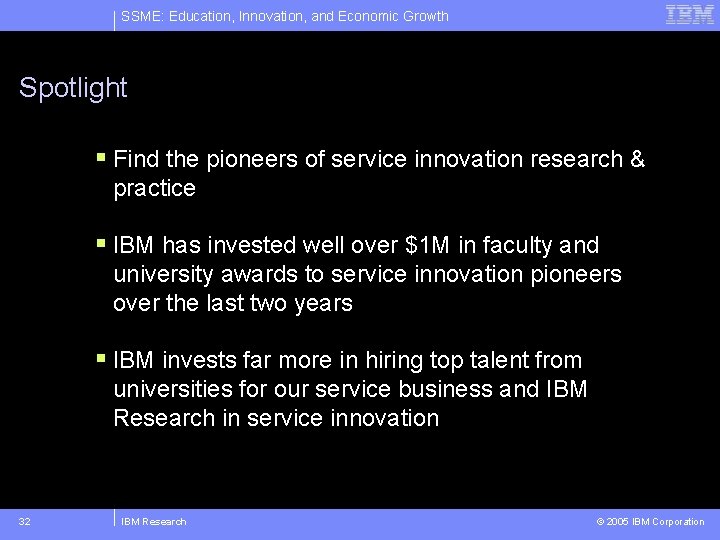
SSME: Education, Innovation, and Economic Growth Spotlight § Find the pioneers of service innovation research & practice § IBM has invested well over $1 M in faculty and university awards to service innovation pioneers over the last two years § IBM invests far more in hiring top talent from universities for our service business and IBM Research in service innovation 32 IBM Research © 2005 IBM Corporation
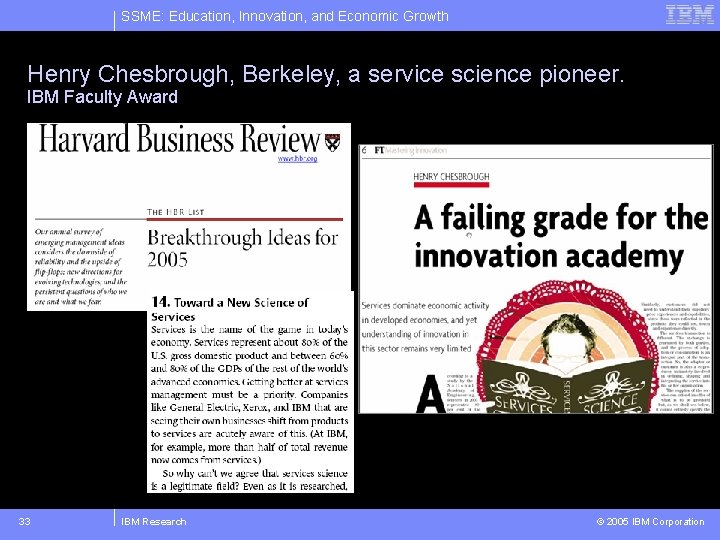
SSME: Education, Innovation, and Economic Growth Henry Chesbrough, Berkeley, a service science pioneer. IBM Faculty Award 33 IBM Research © 2005 IBM Corporation
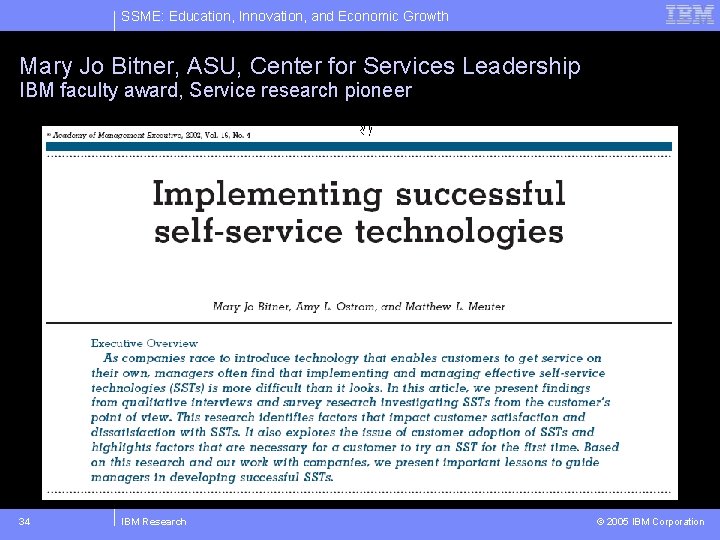
SSME: Education, Innovation, and Economic Growth Mary Jo Bitner, ASU, Center for Services Leadership IBM faculty award, Service research pioneer 34 IBM Research © 2005 IBM Corporation
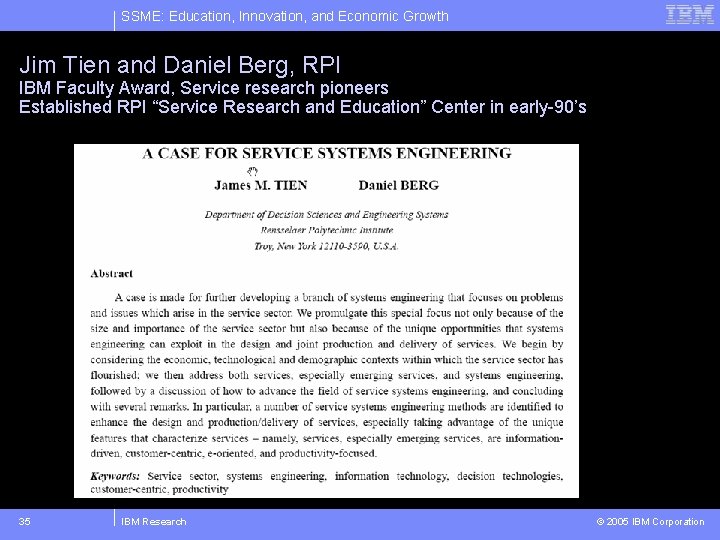
SSME: Education, Innovation, and Economic Growth Jim Tien and Daniel Berg, RPI IBM Faculty Award, Service research pioneers Established RPI “Service Research and Education” Center in early-90’s 35 IBM Research © 2005 IBM Corporation
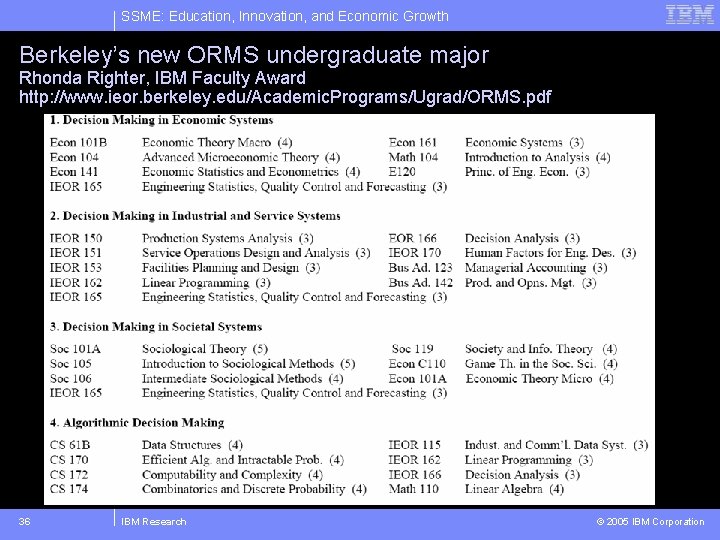
SSME: Education, Innovation, and Economic Growth Berkeley’s new ORMS undergraduate major Rhonda Righter, IBM Faculty Award http: //www. ieor. berkeley. edu/Academic. Programs/Ugrad/ORMS. pdf 36 IBM Research © 2005 IBM Corporation
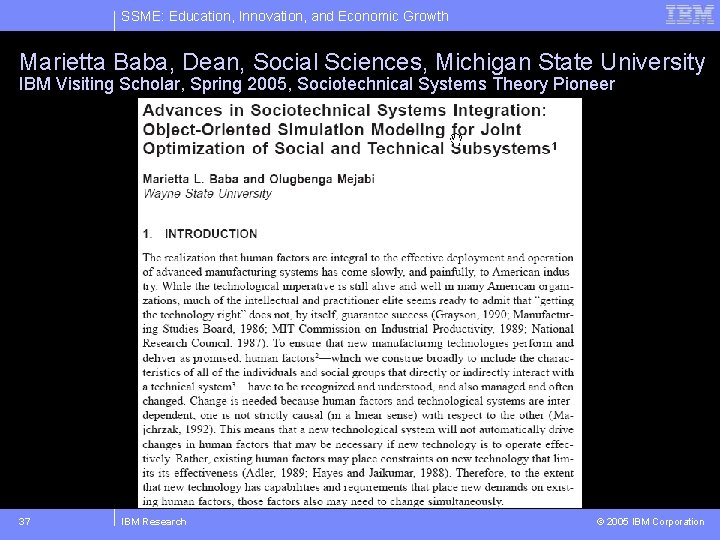
SSME: Education, Innovation, and Economic Growth Marietta Baba, Dean, Social Sciences, Michigan State University IBM Visiting Scholar, Spring 2005, Sociotechnical Systems Theory Pioneer 37 IBM Research © 2005 IBM Corporation
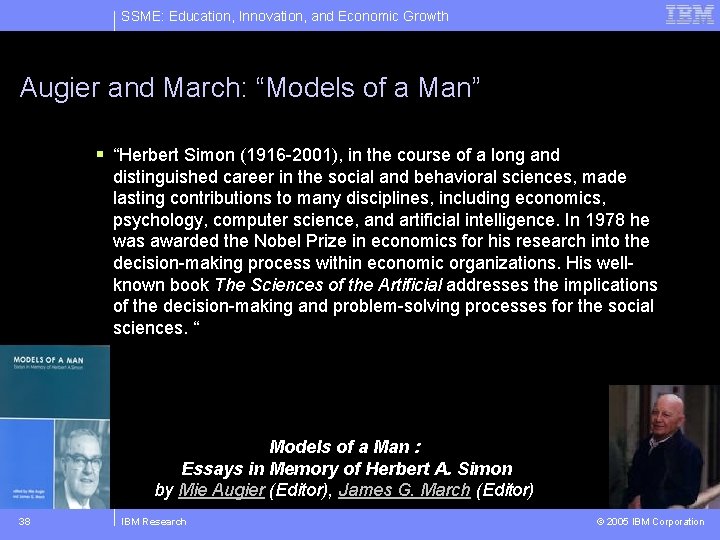
SSME: Education, Innovation, and Economic Growth Augier and March: “Models of a Man” § “Herbert Simon (1916 -2001), in the course of a long and distinguished career in the social and behavioral sciences, made lasting contributions to many disciplines, including economics, psychology, computer science, and artificial intelligence. In 1978 he was awarded the Nobel Prize in economics for his research into the decision-making process within economic organizations. His wellknown book The Sciences of the Artificial addresses the implications of the decision-making and problem-solving processes for the social sciences. “ Models of a Man : Essays in Memory of Herbert A. Simon by Mie Augier (Editor), James G. March (Editor) 38 IBM Research © 2005 IBM Corporation
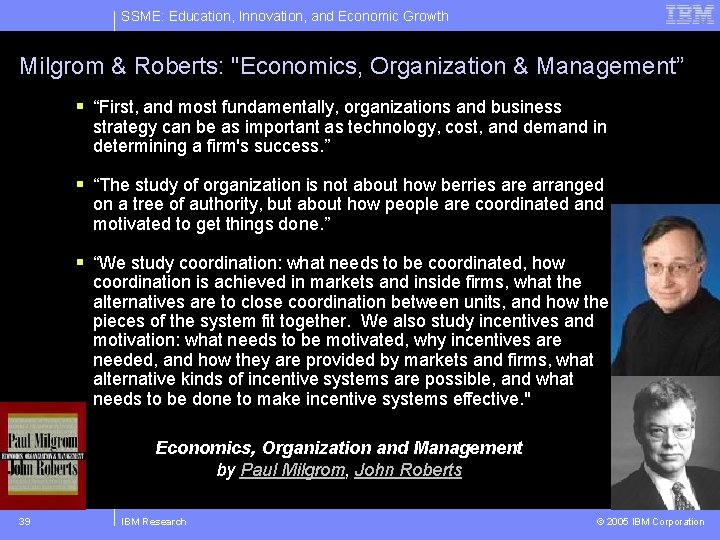
SSME: Education, Innovation, and Economic Growth Milgrom & Roberts: "Economics, Organization & Management” § “First, and most fundamentally, organizations and business strategy can be as important as technology, cost, and demand in determining a firm's success. ” § “The study of organization is not about how berries are arranged on a tree of authority, but about how people are coordinated and motivated to get things done. ” § “We study coordination: what needs to be coordinated, how coordination is achieved in markets and inside firms, what the alternatives are to close coordination between units, and how the pieces of the system fit together. We also study incentives and motivation: what needs to be motivated, why incentives are needed, and how they are provided by markets and firms, what alternative kinds of incentive systems are possible, and what needs to be done to make incentive systems effective. " Economics, Organization and Management by Paul Milgrom, John Roberts 39 IBM Research © 2005 IBM Corporation
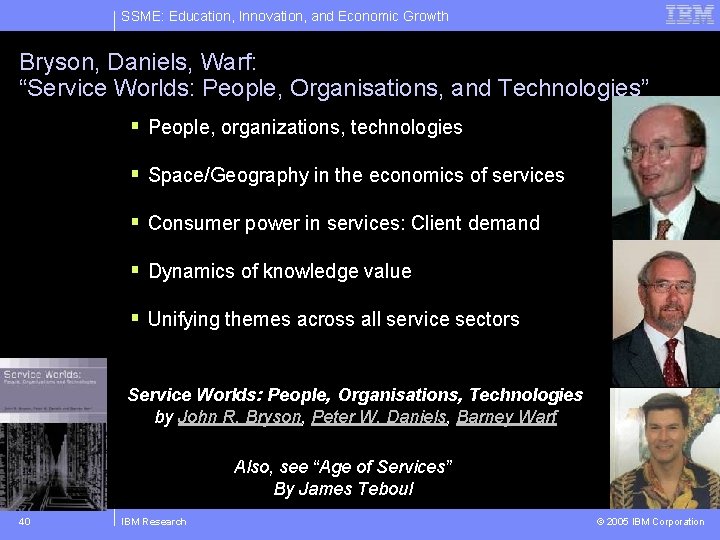
SSME: Education, Innovation, and Economic Growth Bryson, Daniels, Warf: “Service Worlds: People, Organisations, and Technologies” § People, organizations, technologies § Space/Geography in the economics of services § Consumer power in services: Client demand § Dynamics of knowledge value § Unifying themes across all service sectors Service Worlds: People, Organisations, Technologies by John R. Bryson, Peter W. Daniels, Barney Warf Also, see “Age of Services” By James Teboul 40 IBM Research © 2005 IBM Corporation
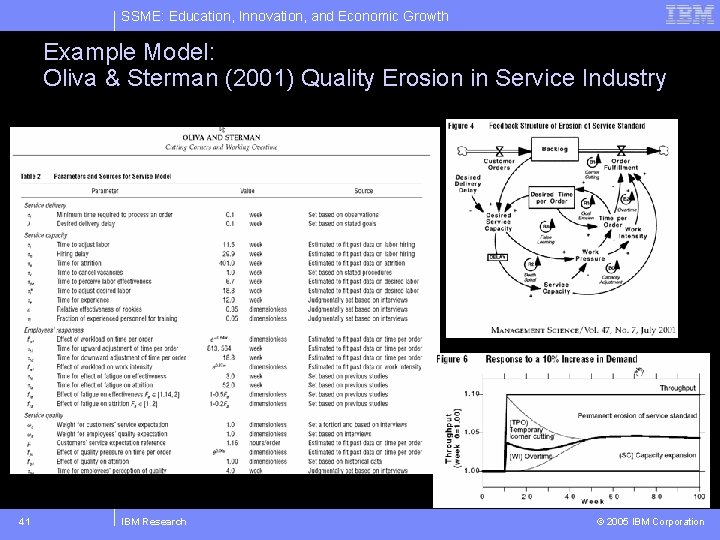
SSME: Education, Innovation, and Economic Growth Example Model: Oliva & Sterman (2001) Quality Erosion in Service Industry 41 IBM Research © 2005 IBM Corporation
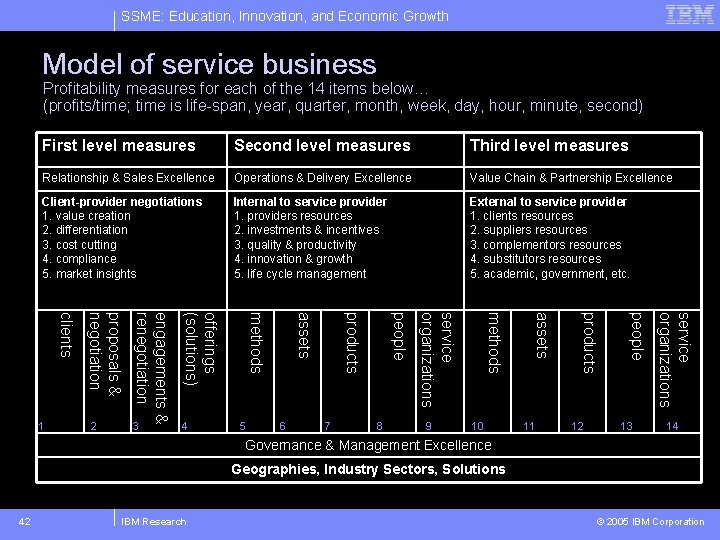
SSME: Education, Innovation, and Economic Growth Model of service business Profitability measures for each of the 14 items below… (profits/time; time is life-span, year, quarter, month, week, day, hour, minute, second) First level measures Second level measures Third level measures Relationship & Sales Excellence Operations & Delivery Excellence Value Chain & Partnership Excellence Client-provider negotiations 1. value creation 2. differentiation 3. cost cutting 4. compliance 5. market insights Internal to service provider 1. providers resources 2. investments & incentives 3. quality & productivity 4. innovation & growth 5. life cycle management External to service provider 1. clients resources 2. suppliers resources 3. complementors resources 4. substitutors resources 5. academic, government, etc. 13 service organizations 12 people 11 products 10 assets 9 methods 8 service organizations 7 people 6 products 5 assets 4 methods 3 offerings (solutions) 2 engagements & renegotiation proposals & negotiation clients 1 14 Governance & Management Excellence Geographies, Industry Sectors, Solutions 42 IBM Research © 2005 IBM Corporation
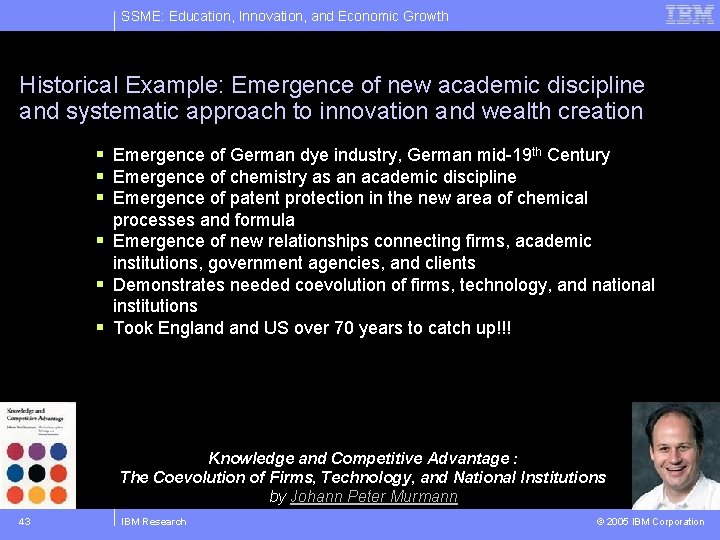
SSME: Education, Innovation, and Economic Growth Historical Example: Emergence of new academic discipline and systematic approach to innovation and wealth creation § Emergence of German dye industry, German mid-19 th Century § Emergence of chemistry as an academic discipline § Emergence of patent protection in the new area of chemical processes and formula § Emergence of new relationships connecting firms, academic institutions, government agencies, and clients § Demonstrates needed coevolution of firms, technology, and national institutions § Took England US over 70 years to catch up!!! Knowledge and Competitive Advantage : The Coevolution of Firms, Technology, and National Institutions by Johann Peter Murmann 43 IBM Research © 2005 IBM Corporation
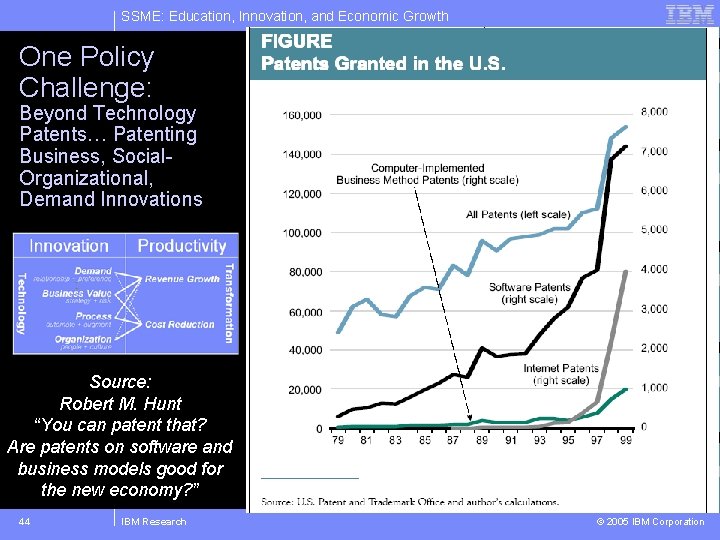
SSME: Education, Innovation, and Economic Growth One Policy Challenge: Beyond Technology Patents… Patenting Business, Social. Organizational, Demand Innovations Source: Robert M. Hunt “You can patent that? Are patents on software and business models good for the new economy? ” 44 IBM Research © 2005 IBM Corporation
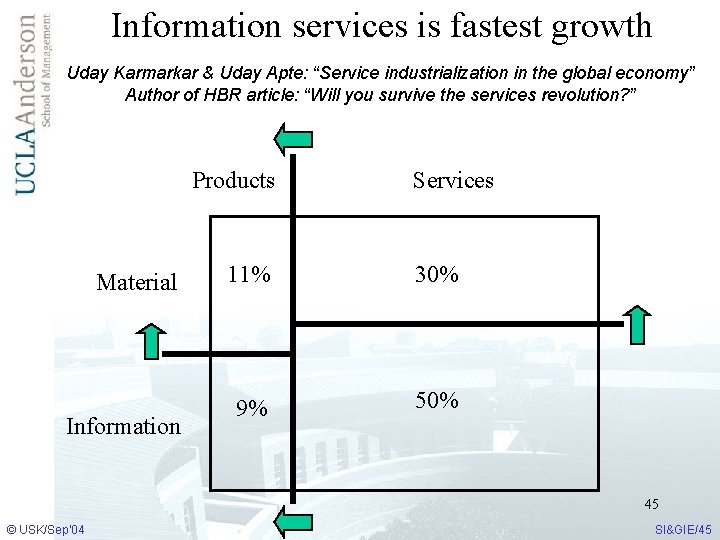
Information services is fastest growth Uday Karmarkar & Uday Apte: “Service industrialization in the global economy” Author of HBR article: “Will you survive the services revolution? ” Products Material Information Services 11% 30% 9% 50% 45 © USK/Sep’ 04 SI&GIE/45
Growing role of services Average annual growth rate of business R&D expenditure, 1990 -2001 Source: OECD Science, Technology and Industry Outlook 2004 Jerry Sheehan 46 46
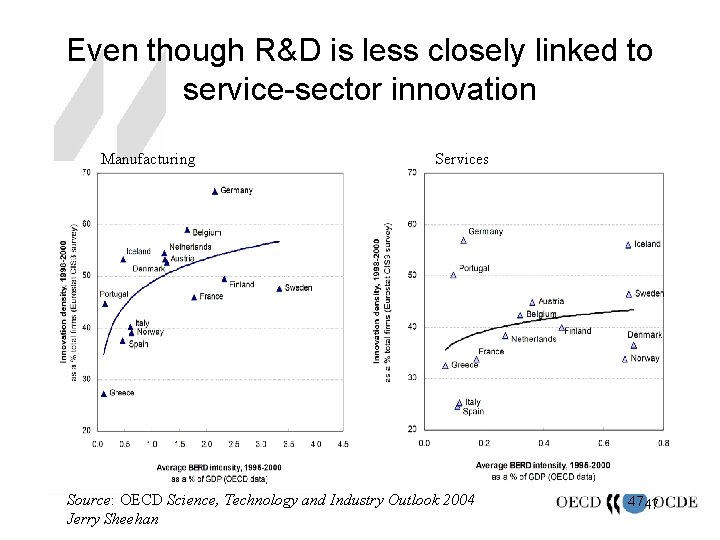
Even though R&D is less closely linked to service-sector innovation Manufacturing Services Source: OECD Science, Technology and Industry Outlook 2004 Jerry Sheehan 47 47
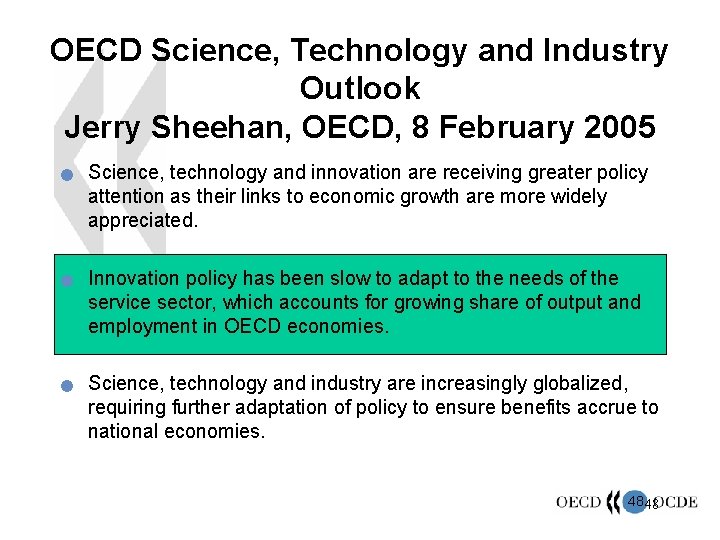
OECD Science, Technology and Industry Outlook Jerry Sheehan, OECD, 8 February 2005 n n n Science, technology and innovation are receiving greater policy attention as their links to economic growth are more widely appreciated. Innovation policy has been slow to adapt to the needs of the service sector, which accounts for growing share of output and employment in OECD economies. Science, technology and industry are increasingly globalized, requiring further adaptation of policy to ensure benefits accrue to national economies. 48 48
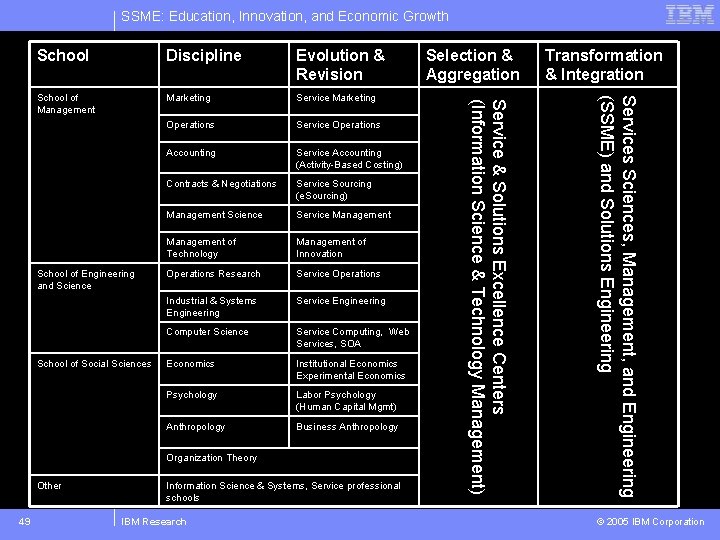
SSME: Education, Innovation, and Economic Growth Evolution & Revision School of Management Marketing Service Marketing Operations Service Operations Accounting Service Accounting (Activity-Based Costing) Contracts & Negotiations Service Sourcing (e. Sourcing) Management Science Service Management of Technology Management of Innovation Operations Research Service Operations Industrial & Systems Engineering Service Engineering Computer Science Service Computing, Web Services, SOA Economics Institutional Economics Experimental Economics Psychology Labor Psychology (Human Capital Mgmt) Anthropology Business Anthropology School of Engineering and Science School of Social Sciences Organization Theory Other 49 Information Science & Systems, Service professional schools IBM Research Selection & Aggregation Transformation & Integration Services Sciences, Management, and Engineering (SSME) and Solutions Engineering Discipline Service & Solutions Excellence Centers (Information Science & Technology Management) School © 2005 IBM Corporation
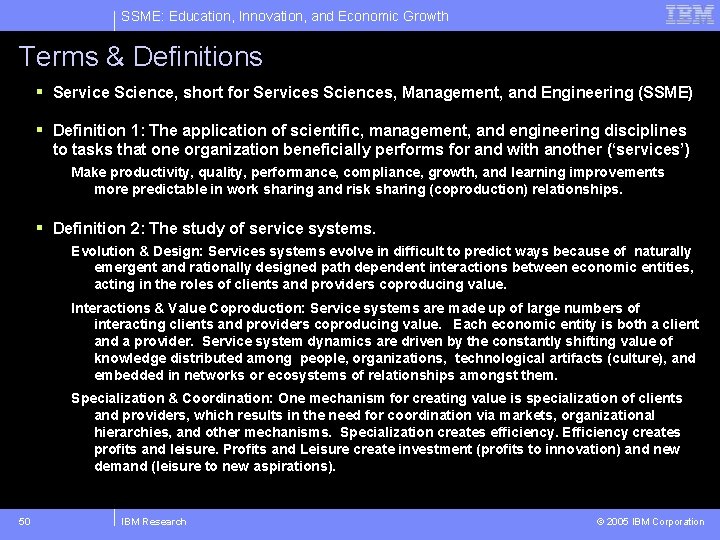
SSME: Education, Innovation, and Economic Growth Terms & Definitions § Service Science, short for Services Sciences, Management, and Engineering (SSME) § Definition 1: The application of scientific, management, and engineering disciplines to tasks that one organization beneficially performs for and with another (‘services’) Make productivity, quality, performance, compliance, growth, and learning improvements more predictable in work sharing and risk sharing (coproduction) relationships. § Definition 2: The study of service systems. Evolution & Design: Services systems evolve in difficult to predict ways because of naturally emergent and rationally designed path dependent interactions between economic entities, acting in the roles of clients and providers coproducing value. Interactions & Value Coproduction: Service systems are made up of large numbers of interacting clients and providers coproducing value. Each economic entity is both a client and a provider. Service system dynamics are driven by the constantly shifting value of knowledge distributed among people, organizations, technological artifacts (culture), and embedded in networks or ecosystems of relationships amongst them. Specialization & Coordination: One mechanism for creating value is specialization of clients and providers, which results in the need for coordination via markets, organizational hierarchies, and other mechanisms. Specialization creates efficiency. Efficiency creates profits and leisure. Profits and Leisure create investment (profits to innovation) and new demand (leisure to new aspirations). 50 IBM Research © 2005 IBM Corporation
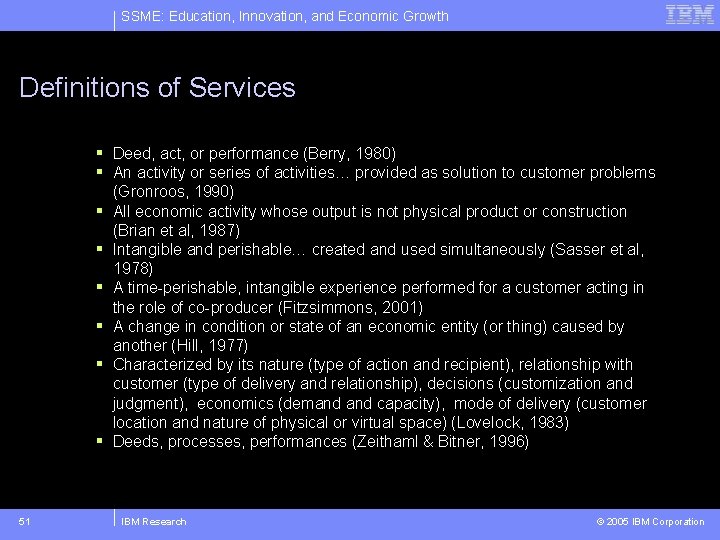
SSME: Education, Innovation, and Economic Growth Definitions of Services § Deed, act, or performance (Berry, 1980) § An activity or series of activities… provided as solution to customer problems § § § 51 (Gronroos, 1990) All economic activity whose output is not physical product or construction (Brian et al, 1987) Intangible and perishable… created and used simultaneously (Sasser et al, 1978) A time-perishable, intangible experience performed for a customer acting in the role of co-producer (Fitzsimmons, 2001) A change in condition or state of an economic entity (or thing) caused by another (Hill, 1977) Characterized by its nature (type of action and recipient), relationship with customer (type of delivery and relationship), decisions (customization and judgment), economics (demand capacity), mode of delivery (customer location and nature of physical or virtual space) (Lovelock, 1983) Deeds, processes, performances (Zeithaml & Bitner, 1996) IBM Research © 2005 IBM Corporation
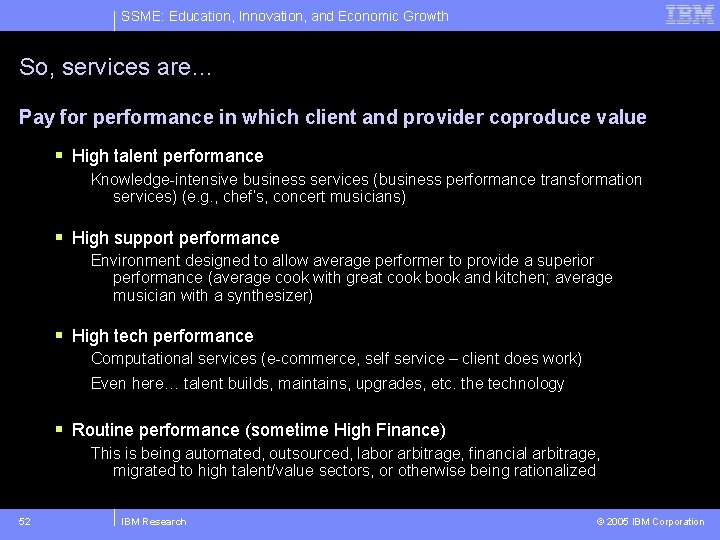
SSME: Education, Innovation, and Economic Growth So, services are… Pay for performance in which client and provider coproduce value § High talent performance Knowledge-intensive business services (business performance transformation services) (e. g. , chef’s, concert musicians) § High support performance Environment designed to allow average performer to provide a superior performance (average cook with great cook book and kitchen; average musician with a synthesizer) § High tech performance Computational services (e-commerce, self service – client does work) Even here… talent builds, maintains, upgrades, etc. the technology § Routine performance (sometime High Finance) This is being automated, outsourced, labor arbitrage, financial arbitrage, migrated to high talent/value sectors, or otherwise being rationalized 52 IBM Research © 2005 IBM Corporation
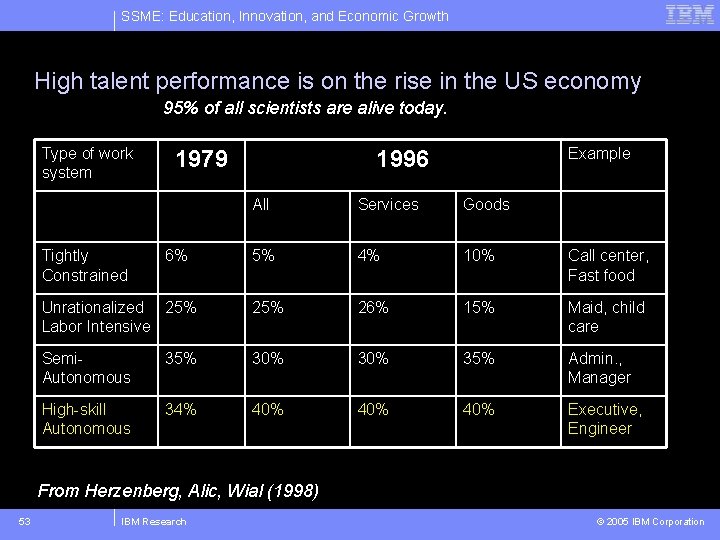
SSME: Education, Innovation, and Economic Growth High talent performance is on the rise in the US economy 95% of all scientists are alive today. Type of work system 1979 Example 1996 All Services Goods 5% 4% 10% Call center, Fast food Unrationalized 25% Labor Intensive 25% 26% 15% Maid, child care Semi. Autonomous 35% 30% 35% Admin. , Manager High-skill Autonomous 34% 40% 40% Executive, Engineer Tightly Constrained 6% From Herzenberg, Alic, Wial (1998) 53 IBM Research © 2005 IBM Corporation
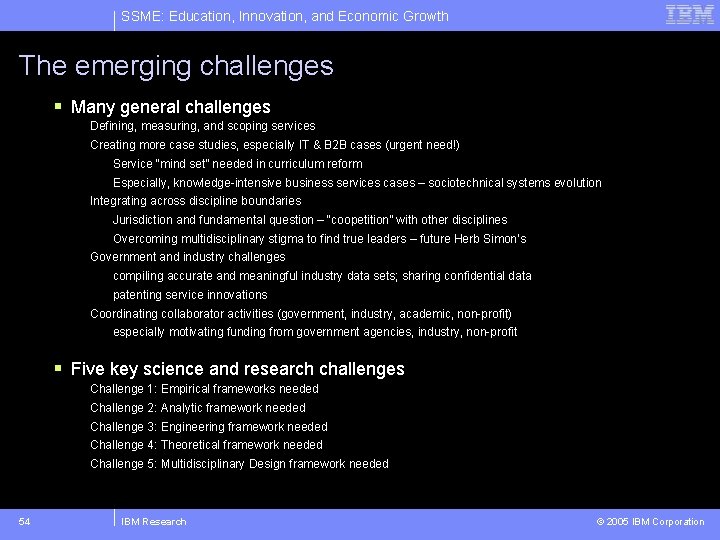
SSME: Education, Innovation, and Economic Growth The emerging challenges § Many general challenges Defining, measuring, and scoping services Creating more case studies, especially IT & B 2 B cases (urgent need!) Service “mind set” needed in curriculum reform Especially, knowledge-intensive business services cases – sociotechnical systems evolution Integrating across discipline boundaries Jurisdiction and fundamental question – “coopetition” with other disciplines Overcoming multidisciplinary stigma to find true leaders – future Herb Simon’s Government and industry challenges compiling accurate and meaningful industry data sets; sharing confidential data patenting service innovations Coordinating collaborator activities (government, industry, academic, non-profit) especially motivating funding from government agencies, industry, non-profit § Five key science and research challenges Challenge 1: Empirical frameworks needed Challenge 2: Analytic framework needed Challenge 3: Engineering framework needed Challenge 4: Theoretical framework needed Challenge 5: Multidisciplinary Design framework needed 54 IBM Research © 2005 IBM Corporation
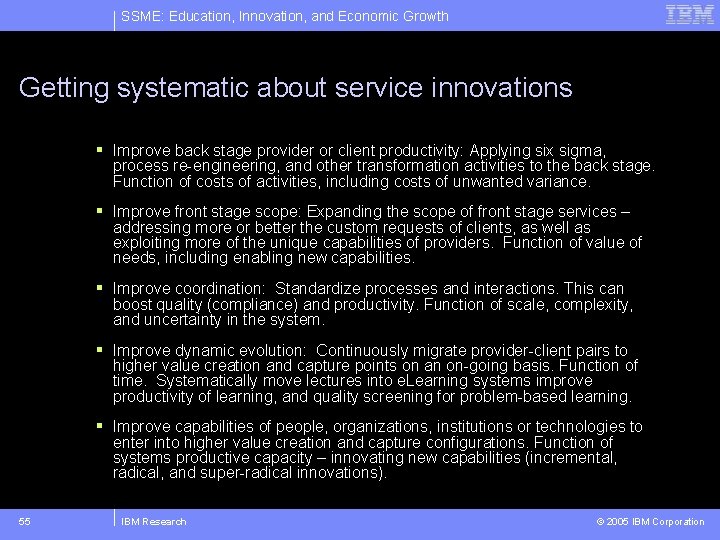
SSME: Education, Innovation, and Economic Growth Getting systematic about service innovations § Improve back stage provider or client productivity: Applying six sigma, process re-engineering, and other transformation activities to the back stage. Function of costs of activities, including costs of unwanted variance. § Improve front stage scope: Expanding the scope of front stage services – addressing more or better the custom requests of clients, as well as exploiting more of the unique capabilities of providers. Function of value of needs, including enabling new capabilities. § Improve coordination: Standardize processes and interactions. This can boost quality (compliance) and productivity. Function of scale, complexity, and uncertainty in the system. § Improve dynamic evolution: Continuously migrate provider-client pairs to higher value creation and capture points on an on-going basis. Function of time. Systematically move lectures into e. Learning systems improve productivity of learning, and quality screening for problem-based learning. § Improve capabilities of people, organizations, institutions or technologies to enter into higher value creation and capture configurations. Function of systems productive capacity – innovating new capabilities (incremental, radical, and super-radical innovations). 55 IBM Research © 2005 IBM Corporation
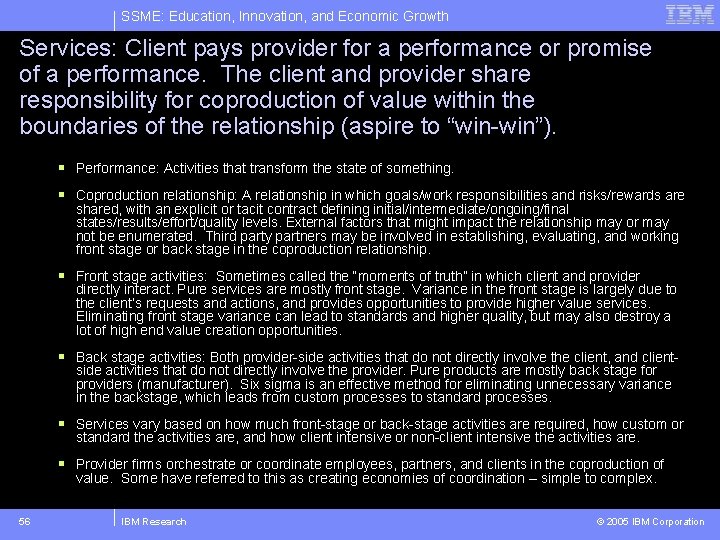
SSME: Education, Innovation, and Economic Growth Services: Client pays provider for a performance or promise of a performance. The client and provider share responsibility for coproduction of value within the boundaries of the relationship (aspire to “win-win”). § Performance: Activities that transform the state of something. § Coproduction relationship: A relationship in which goals/work responsibilities and risks/rewards are shared, with an explicit or tacit contract defining initial/intermediate/ongoing/final states/results/effort/quality levels. External factors that might impact the relationship may or may not be enumerated. Third party partners may be involved in establishing, evaluating, and working front stage or back stage in the coproduction relationship. § Front stage activities: Sometimes called the “moments of truth” in which client and provider directly interact. Pure services are mostly front stage. Variance in the front stage is largely due to the client’s requests and actions, and provides opportunities to provide higher value services. Eliminating front stage variance can lead to standards and higher quality, but may also destroy a lot of high end value creation opportunities. § Back stage activities: Both provider-side activities that do not directly involve the client, and clientside activities that do not directly involve the provider. Pure products are mostly back stage for providers (manufacturer). Six sigma is an effective method for eliminating unnecessary variance in the backstage, which leads from custom processes to standard processes. § Services vary based on how much front-stage or back-stage activities are required, how custom or standard the activities are, and how client intensive or non-client intensive the activities are. § Provider firms orchestrate or coordinate employees, partners, and clients in the coproduction of value. Some have referred to this as creating economies of coordination – simple to complex. 56 IBM Research © 2005 IBM Corporation
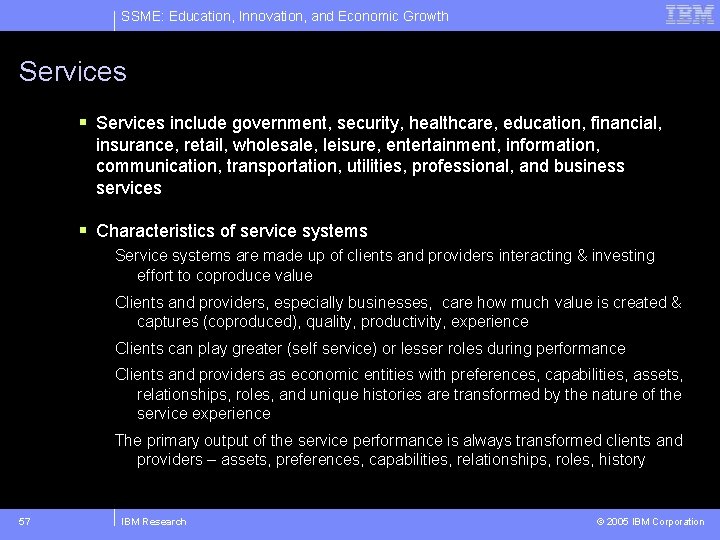
SSME: Education, Innovation, and Economic Growth Services § Services include government, security, healthcare, education, financial, insurance, retail, wholesale, leisure, entertainment, information, communication, transportation, utilities, professional, and business services § Characteristics of service systems Service systems are made up of clients and providers interacting & investing effort to coproduce value Clients and providers, especially businesses, care how much value is created & captures (coproduced), quality, productivity, experience Clients can play greater (self service) or lesser roles during performance Clients and providers as economic entities with preferences, capabilities, assets, relationships, roles, and unique histories are transformed by the nature of the service experience The primary output of the service performance is always transformed clients and providers – assets, preferences, capabilities, relationships, roles, history 57 IBM Research © 2005 IBM Corporation
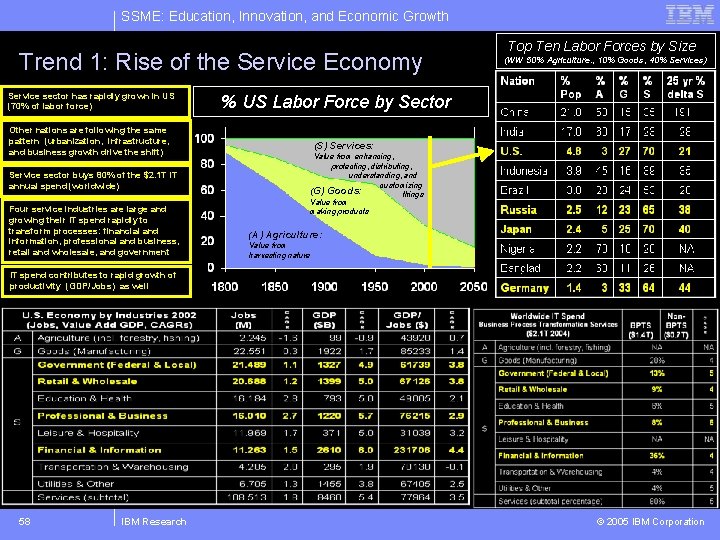
SSME: Education, Innovation, and Economic Growth Trend 1: Rise of the Service Economy Service sector has rapidly grown in US (70% of labor force) Other nations are following the same pattern (urbanization, infrastructure, and business growth drive the shift) Service sector buys 80% of the $2. 1 T IT annual spend (worldwide) Four service industries are large and growing their IT spend rapidly to transform processes: financial and information, professional and business, retail and wholesale, and government Top Ten Labor Forces by Size (WW 50% Agriculture. , 10% Goods, 40% Services) % US Labor Force by Sector (S) Services: Value from enhancing, protecting, distributing, understanding, and customizing (G) Goods: things Value from making products (A) Agriculture: Value from harvesting nature IT spend contributes to rapid growth of productivity (GDP/Jobs) as well 58 IBM Research © 2005 IBM Corporation
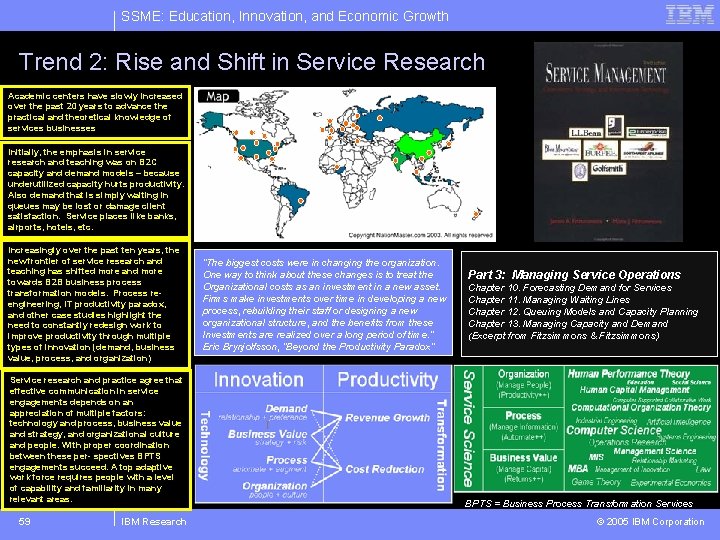
SSME: Education, Innovation, and Economic Growth Trend 2: Rise and Shift in Service Research Academic centers have slowly increased over the past 20 years to advance the practical and theoretical knowledge of services businesses Initially, the emphasis in service research and teaching was on B 2 C capacity and demand models – because underutilized capacity hurts productivity. Also demand that is simply waiting in queues may be lost or damage client satisfaction. Service places like banks, airports, hotels, etc. Increasingly over the past ten years, the new frontier of service research and teaching has shifted more and more towards B 2 B business process transformation models. Process reengineering, IT productivity paradox, and other case studies highlight the need to constantly redesign work to improve productivity through multiple types of innovation (demand, business value, process, and organization) Service research and practice agree that effective communication in service engagements depends on an appreciation of multiple factors: technology and process, business value and strategy, and organizational culture and people. With proper coordination between these per- spectives BPTS engagements succeed. A top adaptive work force requires people with a level of capability and familiarity in many relevant areas. 59 IBM Research “The biggest costs were in changing the organization. One way to think about these changes is to treat the Organizational costs as an investment in a new asset. Firms make investments over time in developing a new process, rebuilding their staff or designing a new organizational structure, and the benefits from these Investments are realized over a long period of time. ” Eric Brynjolfsson, “Beyond the Productivity Paradox” Part 3: Managing Service Operations Chapter 10. Forecasting Demand for Services Chapter 11. Managing Waiting Lines Chapter 12. Queuing Models and Capacity Planning Chapter 13. Managing Capacity and Demand (Excerpt from Fitzsimmons & Fitzsimmons) BPTS = Business Process Transformation Services © 2005 IBM Corporation