
SSLTLS SMU CSE 53497349 Layers of Security SMU
- Slides: 24
SSL/TLS SMU CSE 5349/7349
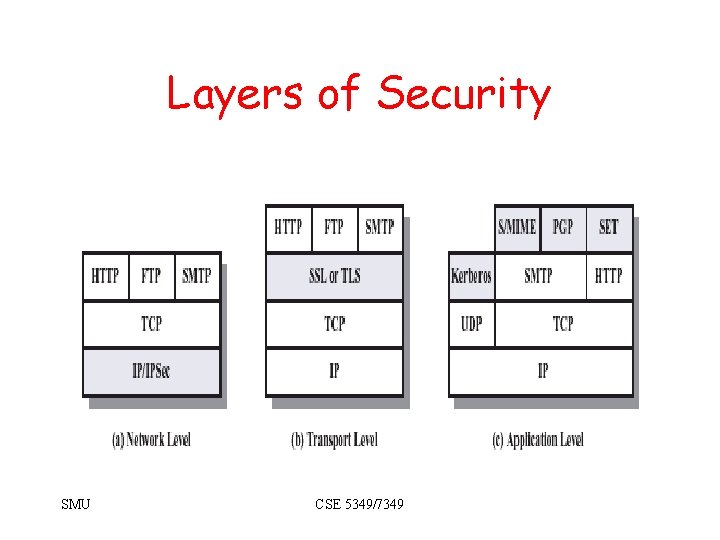
Layers of Security SMU CSE 5349/7349
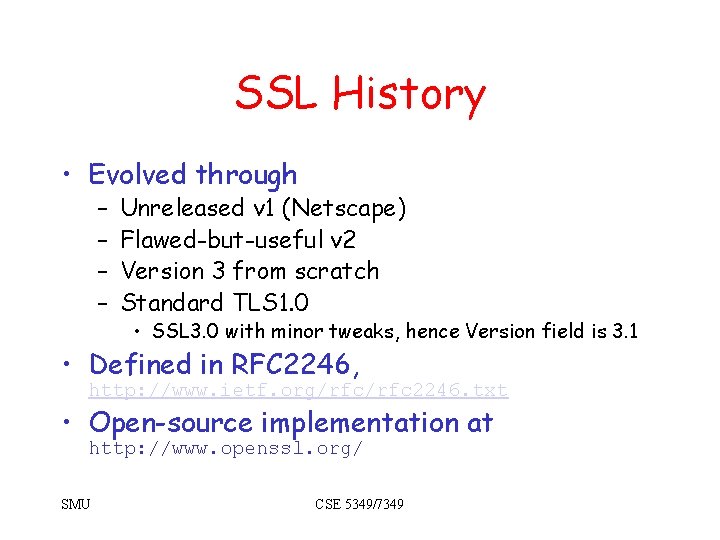
SSL History • Evolved through – – Unreleased v 1 (Netscape) Flawed-but-useful v 2 Version 3 from scratch Standard TLS 1. 0 • SSL 3. 0 with minor tweaks, hence Version field is 3. 1 • Defined in RFC 2246, http: //www. ietf. org/rfc 2246. txt • Open-source implementation at http: //www. openssl. org/ SMU CSE 5349/7349
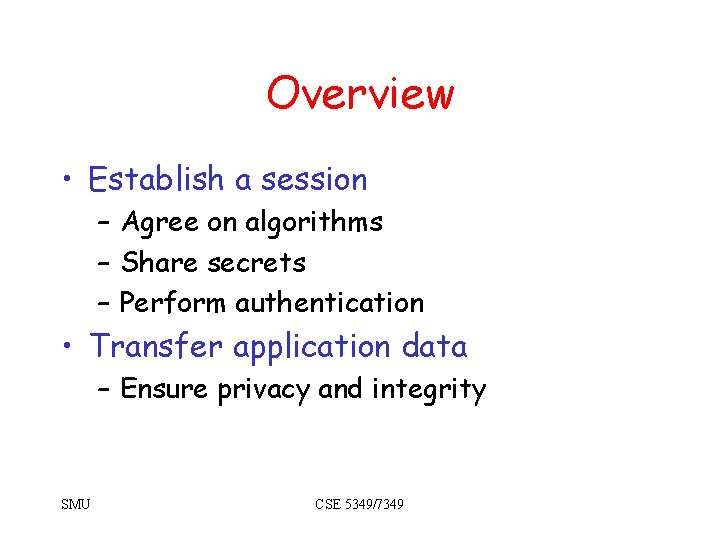
Overview • Establish a session – Agree on algorithms – Share secrets – Perform authentication • Transfer application data – Ensure privacy and integrity SMU CSE 5349/7349
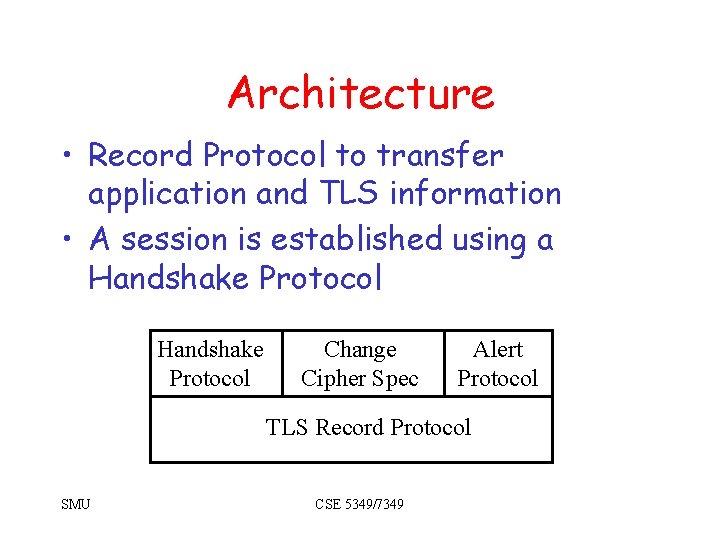
Architecture • Record Protocol to transfer application and TLS information • A session is established using a Handshake Protocol Change Cipher Spec Alert Protocol TLS Record Protocol SMU CSE 5349/7349
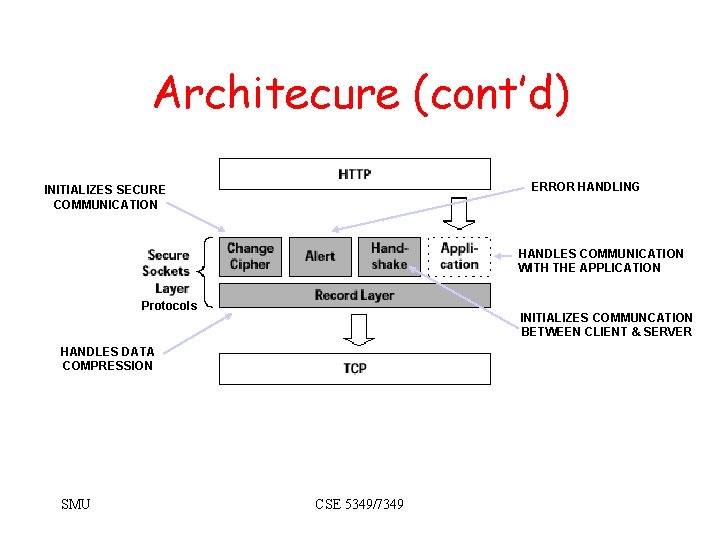
Architecure (cont’d) ERROR HANDLING INITIALIZES SECURE COMMUNICATION HANDLES COMMUNICATION WITH THE APPLICATION Protocols INITIALIZES COMMUNCATION BETWEEN CLIENT & SERVER HANDLES DATA COMPRESSION SMU CSE 5349/7349
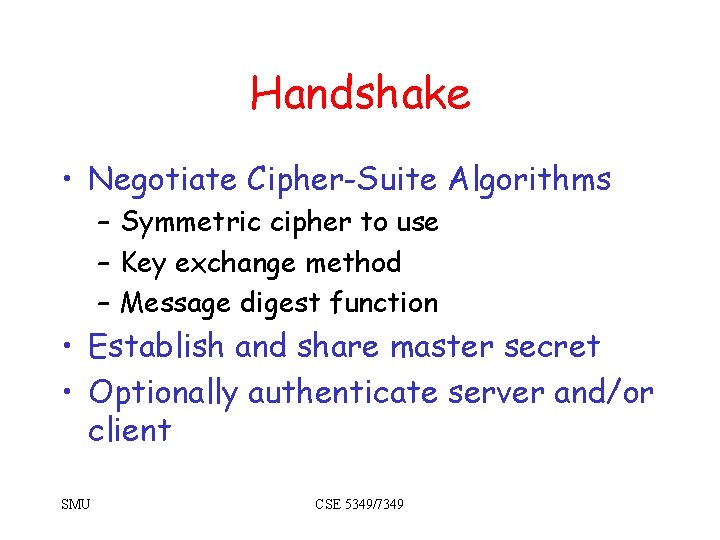
Handshake • Negotiate Cipher-Suite Algorithms – Symmetric cipher to use – Key exchange method – Message digest function • Establish and share master secret • Optionally authenticate server and/or client SMU CSE 5349/7349
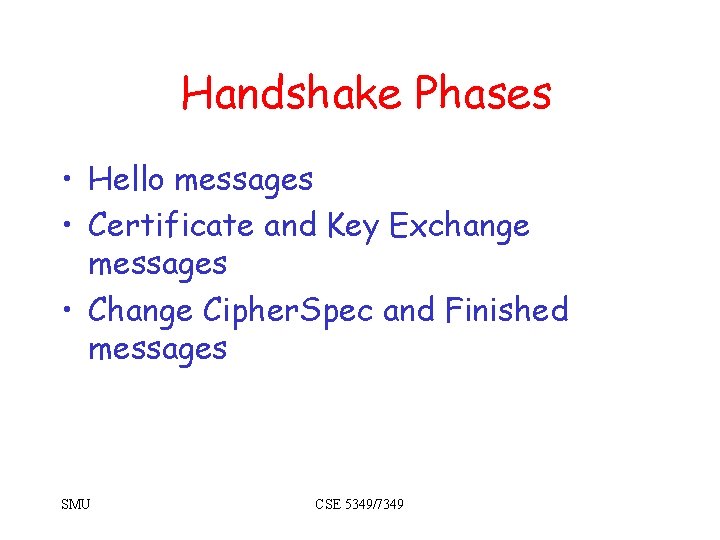
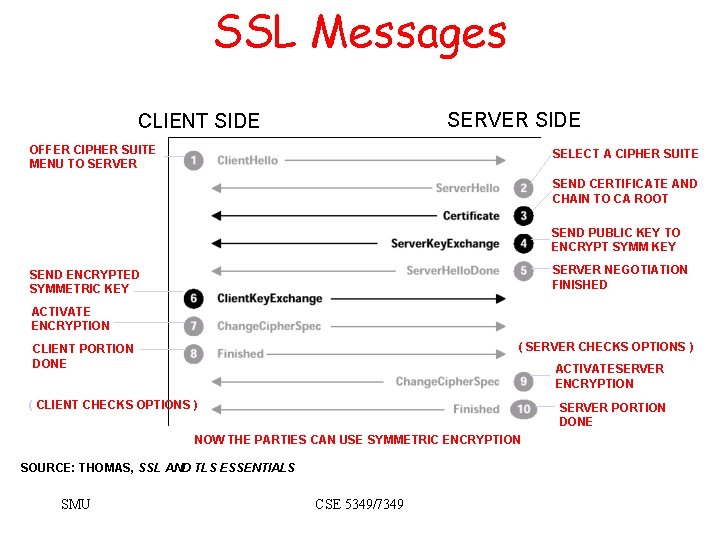
Handshake Phases • Hello messages • Certificate and Key Exchange messages • Change Cipher. Spec and Finished messages SMU CSE 5349/7349
SSL Messages SERVER SIDE CLIENT SIDE OFFER CIPHER SUITE MENU TO SERVER SELECT A CIPHER SUITE SEND CERTIFICATE AND CHAIN TO CA ROOT SEND PUBLIC KEY TO ENCRYPT SYMM KEY SERVER NEGOTIATION FINISHED SEND ENCRYPTED SYMMETRIC KEY ACTIVATE ENCRYPTION ( SERVER CHECKS OPTIONS ) CLIENT PORTION DONE ACTIVATESERVER ENCRYPTION ( CLIENT CHECKS OPTIONS ) SERVER PORTION DONE NOW THE PARTIES CAN USE SYMMETRIC ENCRYPTION SOURCE: THOMAS, SSL AND TLS ESSENTIALS SMU CSE 5349/7349
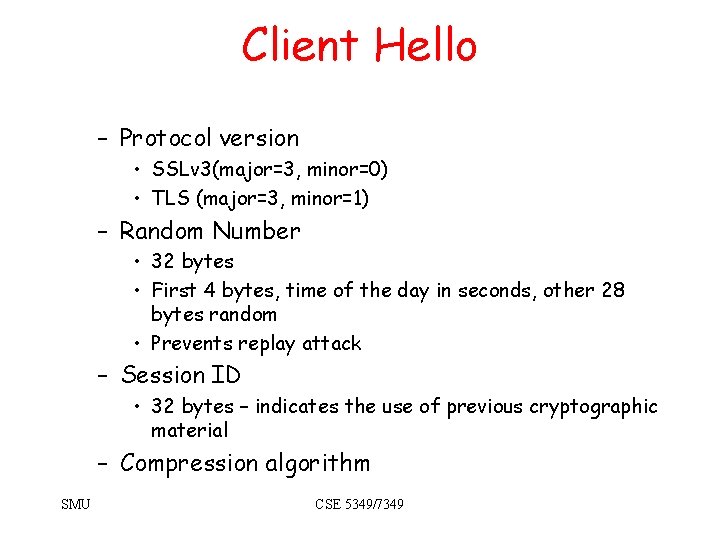
Client Hello – Protocol version • SSLv 3(major=3, minor=0) • TLS (major=3, minor=1) – Random Number • 32 bytes • First 4 bytes, time of the day in seconds, other 28 bytes random • Prevents replay attack – Session ID • 32 bytes – indicates the use of previous cryptographic material – Compression algorithm SMU CSE 5349/7349
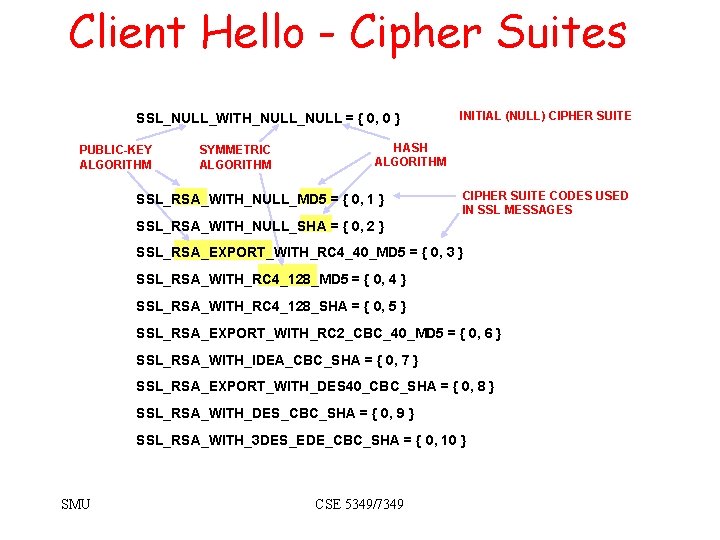
Client Hello - Cipher Suites SSL_NULL_WITH_NULL = { 0, 0 } PUBLIC-KEY ALGORITHM SYMMETRIC ALGORITHM INITIAL (NULL) CIPHER SUITE HASH ALGORITHM SSL_RSA_WITH_NULL_MD 5 = { 0, 1 } CIPHER SUITE CODES USED IN SSL MESSAGES SSL_RSA_WITH_NULL_SHA = { 0, 2 } SSL_RSA_EXPORT_WITH_RC 4_40_MD 5 = { 0, 3 } SSL_RSA_WITH_RC 4_128_MD 5 = { 0, 4 } SSL_RSA_WITH_RC 4_128_SHA = { 0, 5 } SSL_RSA_EXPORT_WITH_RC 2_CBC_40_MD 5 = { 0, 6 } SSL_RSA_WITH_IDEA_CBC_SHA = { 0, 7 } SSL_RSA_EXPORT_WITH_DES 40_CBC_SHA = { 0, 8 } SSL_RSA_WITH_DES_CBC_SHA = { 0, 9 } SSL_RSA_WITH_3 DES_EDE_CBC_SHA = { 0, 10 } SMU CSE 5349/7349
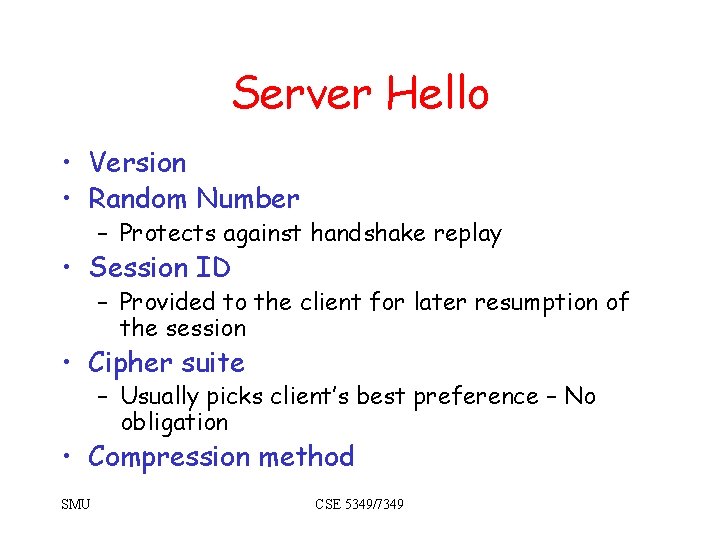
Server Hello • Version • Random Number – Protects against handshake replay • Session ID – Provided to the client for later resumption of the session • Cipher suite – Usually picks client’s best preference – No obligation • Compression method SMU CSE 5349/7349
Certificates • Sequence of X. 509 certificates – Server’s, CA’s, … • X. 509 Certificate associates public key with identity • Certification Authority (CA) creates certificate – Adheres to policies and verifies identity – Signs certificate • User of Certificate must ensure it is valid SMU CSE 5349/7349
Validating a Certificate • Must recognize accepted CA in certificate chain – One CA may issue certificate for another CA • Must verify that certificate has not been revoked – CA publishes Certificate Revocation List (CRL) SMU CSE 5349/7349
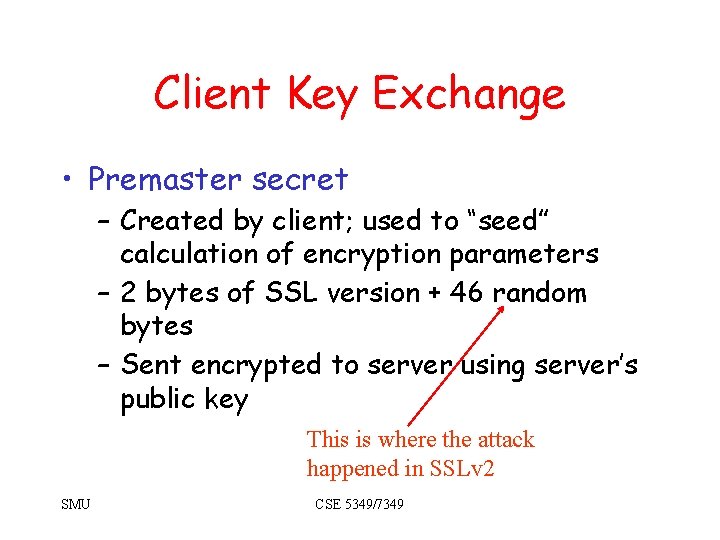
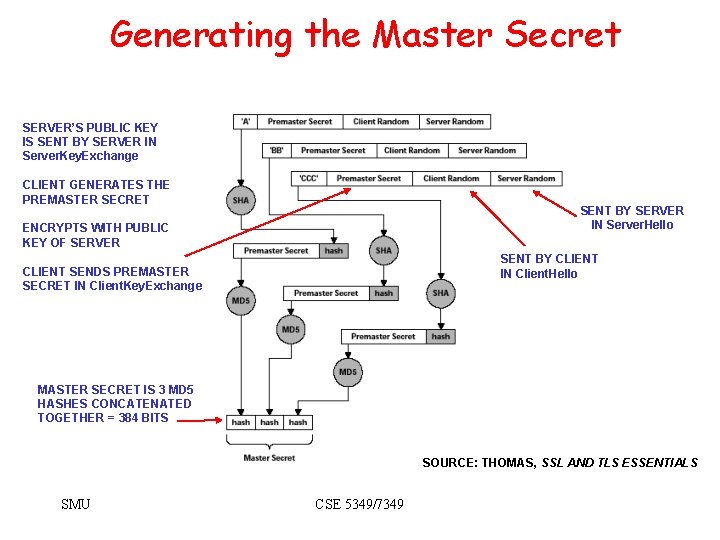
Client Key Exchange • Premaster secret – Created by client; used to “seed” calculation of encryption parameters – 2 bytes of SSL version + 46 random bytes – Sent encrypted to server using server’s public key This is where the attack happened in SSLv 2 SMU CSE 5349/7349
Change Cipher Spec & Finished Messages • Change Cipher Spec – Switch to newly negotiated algorithms and key material • Finished – First message encrypted with new crypto parameters – Digest of negotiated master secret, the ensemble of handshake messages, sender constant – HMAC approach of nested hashing SMU CSE 5349/7349
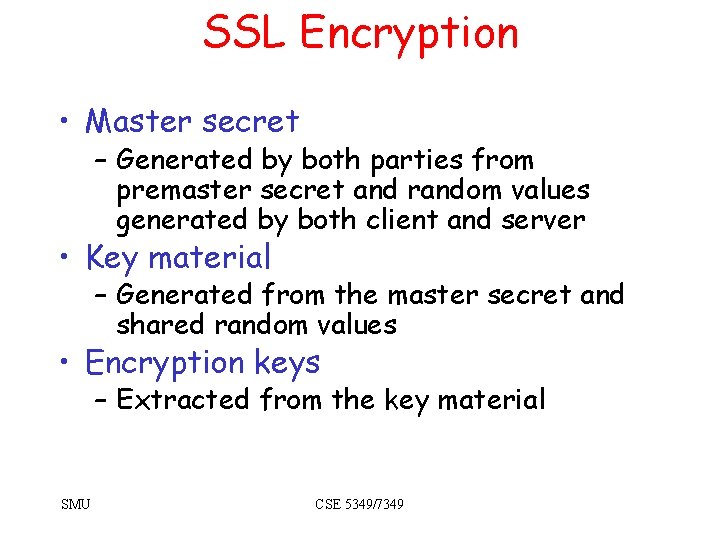
SSL Encryption • Master secret – Generated by both parties from premaster secret and random values generated by both client and server • Key material – Generated from the master secret and shared random values • Encryption keys – Extracted from the key material SMU CSE 5349/7349
Generating the Master Secret SERVER’S PUBLIC KEY IS SENT BY SERVER IN Server. Key. Exchange CLIENT GENERATES THE PREMASTER SECRET SENT BY SERVER IN Server. Hello ENCRYPTS WITH PUBLIC KEY OF SERVER SENT BY CLIENT IN Client. Hello CLIENT SENDS PREMASTER SECRET IN Client. Key. Exchange MASTER SECRET IS 3 MD 5 HASHES CONCATENATED TOGETHER = 384 BITS SOURCE: THOMAS, SSL AND TLS ESSENTIALS SMU CSE 5349/7349
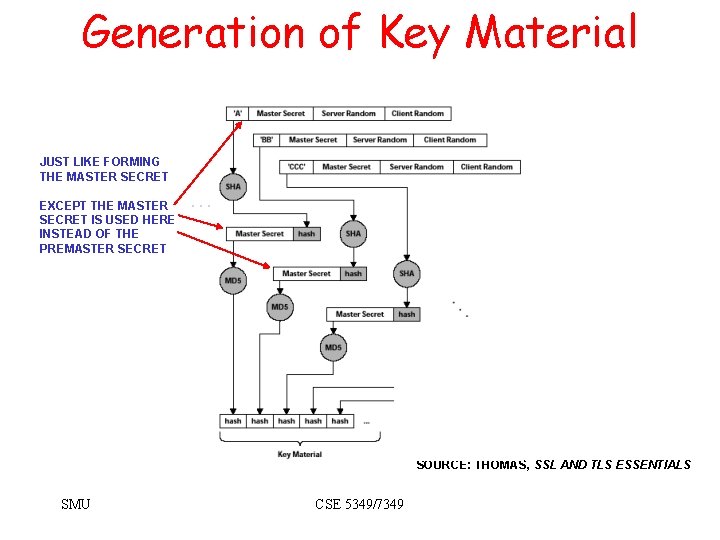
Generation of Key Material JUST LIKE FORMING THE MASTER SECRET EXCEPT THE MASTER SECRET IS USED HERE INSTEAD OF THE PREMASTER SECRET . . . SOURCE: THOMAS, SSL AND TLS ESSENTIALS SMU CSE 5349/7349
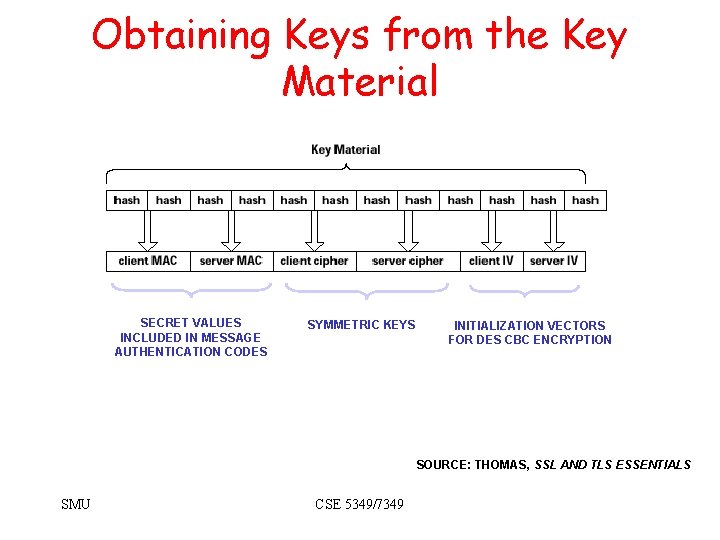
Obtaining Keys from the Key Material SECRET VALUES INCLUDED IN MESSAGE AUTHENTICATION CODES SYMMETRIC KEYS INITIALIZATION VECTORS FOR DES CBC ENCRYPTION SOURCE: THOMAS, SSL AND TLS ESSENTIALS SMU CSE 5349/7349
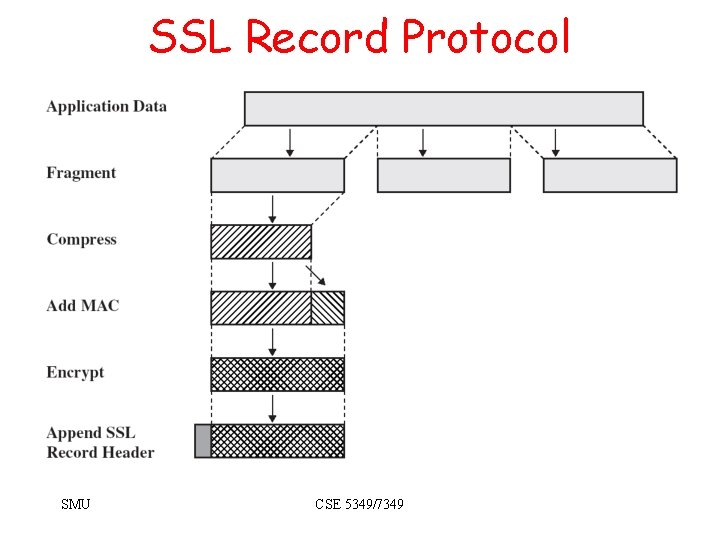
SSL Record Protocol SMU CSE 5349/7349
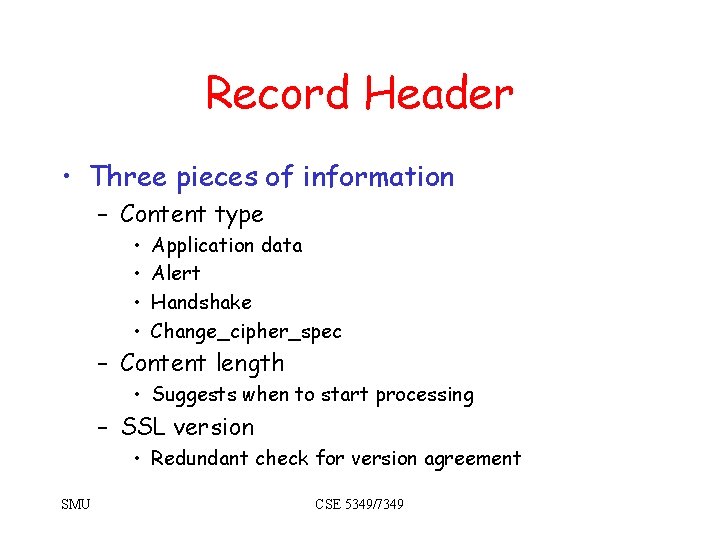
Record Header • Three pieces of information – Content type • • Application data Alert Handshake Change_cipher_spec – Content length • Suggests when to start processing – SSL version • Redundant check for version agreement SMU CSE 5349/7349
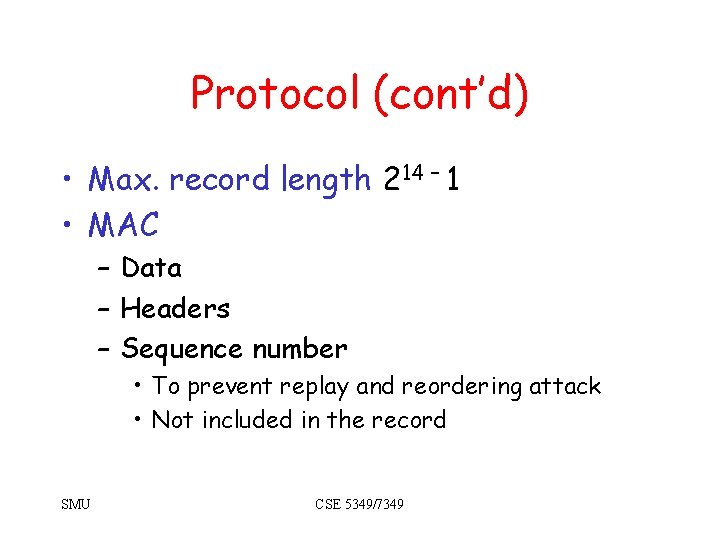
Protocol (cont’d) • Max. record length 214 – 1 • MAC – Data – Headers – Sequence number • To prevent replay and reordering attack • Not included in the record SMU CSE 5349/7349
Alerts and Closure • Alert the other side of exceptions – Different levels – Terminate and session cannot be resumed • Closure notify – To prevent truncation attack (sending a TCP FIN before the sender is finished) SMU CSE 5349/7349