
SSC 2030 Energy Systems Sustainability 8 Engines 8
SSC 2030: Energy Systems & Sustainability 8. Engines 8. 1 8. 2 8. 3 8. 4 8. 5 8. 6 Oil & gas engines: an introduction Spark ignition engines Diesel compression engine Reducing pollution Gas turbines Stirling engines (external combustion)
8. Engines 8. 1 Introduction
Evolution of engines Reciprocating steam engines: • 1700 s to late 1800 s • Evolved to become a reliable power supply for: • Factories; • Transportation (trains & ships); & • Power stations. • An external combustion engine, since combustion of the fuel is used to make steam and only steam enters the engine’s cylinders or pistons Internal combustion engines: fuel is combusted within the engine’s cylinders (or turbine) • Expansion of combustion gases does work, moving pistons Energy Systems & Sustainability, 2/e, Chapter 8
8. Engines 8. 2 Spark ignition engines
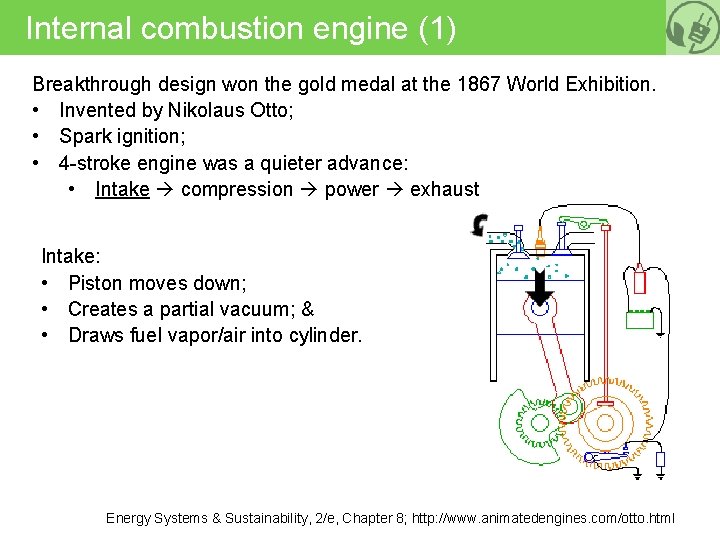
Internal combustion engine (1) Breakthrough design won the gold medal at the 1867 World Exhibition. • Invented by Nikolaus Otto; • Spark ignition; • 4 -stroke engine was a quieter advance: • Intake compression power exhaust Intake: • Piston moves down; • Creates a partial vacuum; & • Draws fuel vapor/air into cylinder. Energy Systems & Sustainability, 2/e, Chapter 8; http: //www. animatedengines. com/otto. html

Internal combustion engine (2) Breakthrough design won the gold medal at the 1867 World Exhibition. • Invented by Nikolaus Otto; • Spark ignition; • 4 -stroke engine was a quieter advance: • Intake compression power exhaust Compression: • Piston rises, driven by flywheel momentum; • Forces the poppet valve shut; • Compressing the mixture of fuel & air. Energy Systems & Sustainability, 2/e, Chapter 8; http: //www. animatedengines. com/otto. html

Internal combustion engine (3) Breakthrough design won the gold medal at the 1867 World Exhibition. • Invented by Nikolaus Otto; • Spark ignition; • 4 -stroke engine was a quieter advance: • Intake compression power exhaust Power: • At the top of the compression stroke; • The spark plug fires; • Igniting the compressed fuel/air; • The burning fuel expands; • Driving the piston down. Energy Systems & Sustainability, 2/e, Chapter 8; http: //www. animatedengines. com/otto. html
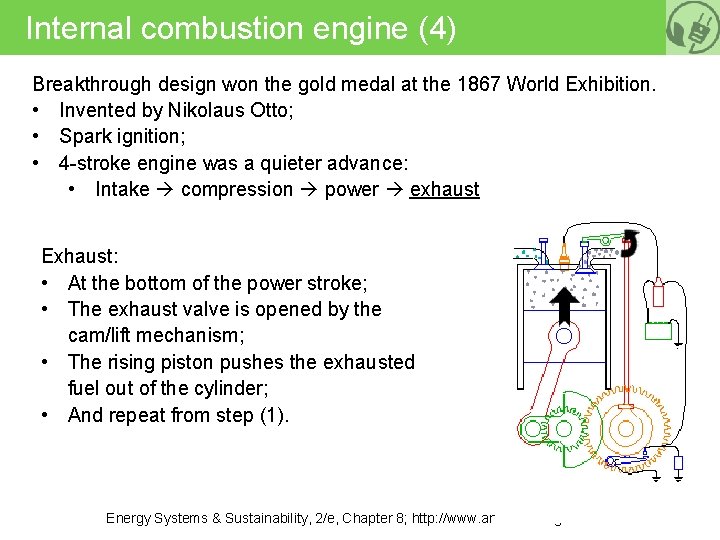
Internal combustion engine (4) Breakthrough design won the gold medal at the 1867 World Exhibition. • Invented by Nikolaus Otto; • Spark ignition; • 4 -stroke engine was a quieter advance: • Intake compression power exhaust Exhaust: • At the bottom of the power stroke; • The exhaust valve is opened by the cam/lift mechanism; • The rising piston pushes the exhausted fuel out of the cylinder; • And repeat from step (1). Energy Systems & Sustainability, 2/e, Chapter 8; http: //www. animatedengines. com/otto. html
Internal combustion engine advances 1882 -3 Gottlieb Daimler & Wilhelm Maybach: small, high-speed engines 1885 Maybach: float carburetor to deliver a precise mix of fuel &air 1889 2 -cyliner engine design; higher rpm & power 1893 Karl Benz produces a 3 -hp four wheel vehicle 1900 de Dion Bouton produces a 3. 5 hp vehicle Mercedes sells car for the equivalent of $240, 000 1904 The Daimler car company offers a 24 -hp, 34 -seat bus Energy Systems & Sustainability, 2/e, Chapter 8
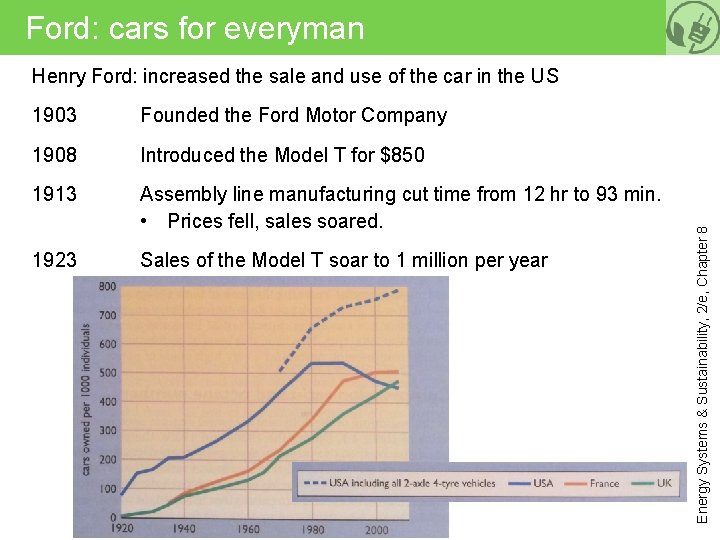
Ford: cars for everyman 1903 Founded the Ford Motor Company 1908 Introduced the Model T for $850 1913 Assembly line manufacturing cut time from 12 hr to 93 min. • Prices fell, sales soared. 1923 Sales of the Model T soar to 1 million per year Energy Systems & Sustainability, 2/e, Chapter 8 Henry Ford: increased the sale and use of the car in the US
Aircraft engines had some special requirements: • Lightweight; • Powerful; • Capable of coping with thinner air at higher altitudes. Superchargers are engine-driven pumps that compress air before it enters the engine. • Turbochargers compress air using hot exhaust gases. • Both increase the power of engines & can be used on the ground too. Aircraft engines used other strategies to increase power without increasing size and weight: • High compression ratios; & • High octane fuels. Energy Systems & Sustainability, 2/e, Chapter 8
Compression ratio & octane numbers Compression ratio: the ratio of smallest & largest volumes of a cylinder • Higher compression ratios allow higher combustion temperatures; • And higher power outputs 4: 1 6: 1 7. 5: 1 9: 1 1930 s 1940 s today Octane rating: the ability of the fuel to avoid knocking or pinging • ‘Knocking’ is caused when sparking & ignition aren’t synchronized. • Fuel octane rating must be matched with compression ratio. • Pure octane is the best anti-knocking fuel. • Mixtures are therefore rated in relation to octane. Energy Systems & Sustainability, 2/e, Chapter 8
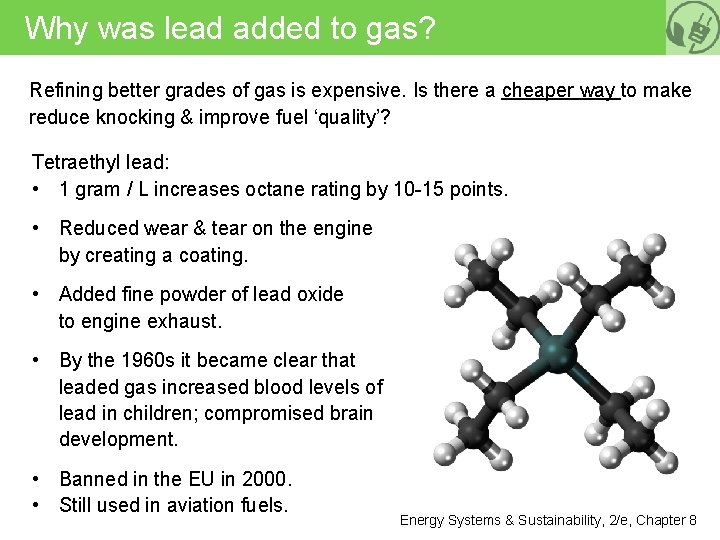
Why was lead added to gas? Refining better grades of gas is expensive. Is there a cheaper way to make reduce knocking & improve fuel ‘quality’? Tetraethyl lead: • 1 gram / L increases octane rating by 10 -15 points. • Reduced wear & tear on the engine by creating a coating. • Added fine powder of lead oxide to engine exhaust. • By the 1960 s it became clear that leaded gas increased blood levels of lead in children; compromised brain development. • Banned in the EU in 2000. • Still used in aviation fuels. Energy Systems & Sustainability, 2/e, Chapter 8
Alternative fossil fuels Liquified petroleum gas (LPG) • Propane (C 3 H 8) • Butane (C 4 H 10) high octane ratings Compressed natural gas (CNG) • Methane (CH 4) Methanol (CH 3 OH) liquid fuel made from methane • Rocket fuel! • High octane • Toxic Energy Systems & Sustainability, 2/e, Chapter 8; wikipedia
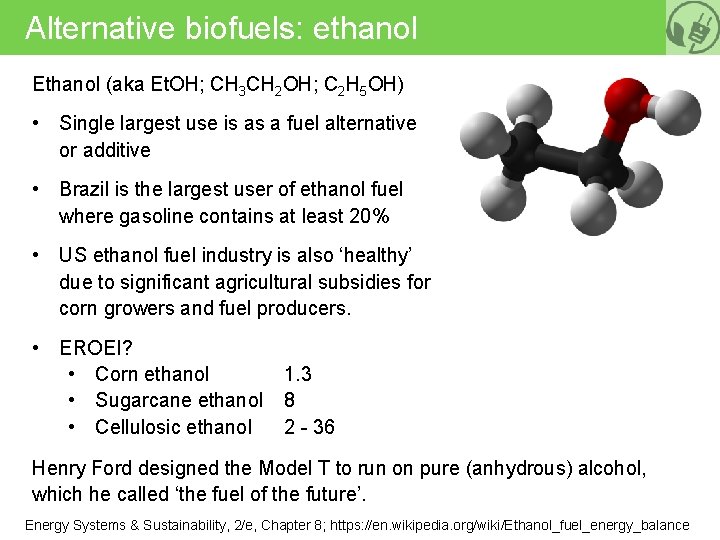
Alternative biofuels: ethanol Ethanol (aka Et. OH; CH 3 CH 2 OH; C 2 H 5 OH) • Single largest use is as a fuel alternative or additive • Brazil is the largest user of ethanol fuel where gasoline contains at least 20% • US ethanol fuel industry is also ‘healthy’ due to significant agricultural subsidies for corn growers and fuel producers. • EROEI? • Corn ethanol • Sugarcane ethanol • Cellulosic ethanol 1. 3 8 2 - 36 Henry Ford designed the Model T to run on pure (anhydrous) alcohol, which he called ‘the fuel of the future’. Energy Systems & Sustainability, 2/e, Chapter 8; https: //en. wikipedia. org/wiki/Ethanol_fuel_energy_balance
8. Engines 8. 3 Diesel compression engine
Diesel’s compression engine Rudolph Diesel wanted to create an engine that would be rugged & could run on a wide variety of inexpensive fuels. He wanted an engine for the everyman. "In 1900 a small Diesel engine was exhibited by the Otto company which, on the suggestion of the French Government, was run on arachide [peanut] oil, and operated so well that very few people were aware of the fact. The motor was built for ordinary oils, and without any modification was run on vegetable oil. ” "I have recently repeated these experiments on a large scale with full success and entire confirmation of the results formerly obtained. ” While he didn’t meet his goal of producing an engine that could run on coaldust, the diesel engine can run on a wide range of fuels, including thick, viscous oils. • More efficient than the gasoline engines of its day. Energy Systems & Sustainability, 2/e, Chapter 8; https: //en. wikipedia. org/wiki/Rudolf_Diesel
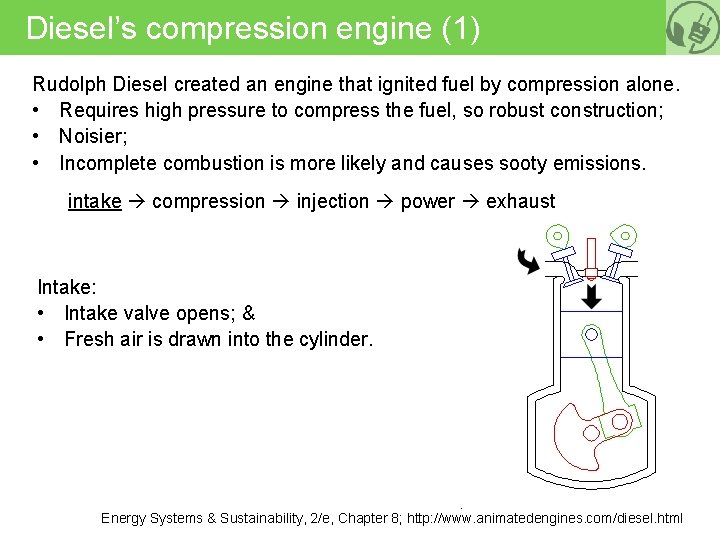
Diesel’s compression engine (1) Rudolph Diesel created an engine that ignited fuel by compression alone. • Requires high pressure to compress the fuel, so robust construction; • Noisier; • Incomplete combustion is more likely and causes sooty emissions. intake compression injection power exhaust Intake: • Intake valve opens; & • Fresh air is drawn into the cylinder. Energy Systems & Sustainability, 2/e, Chapter 8; http: //www. animatedengines. com/diesel. html
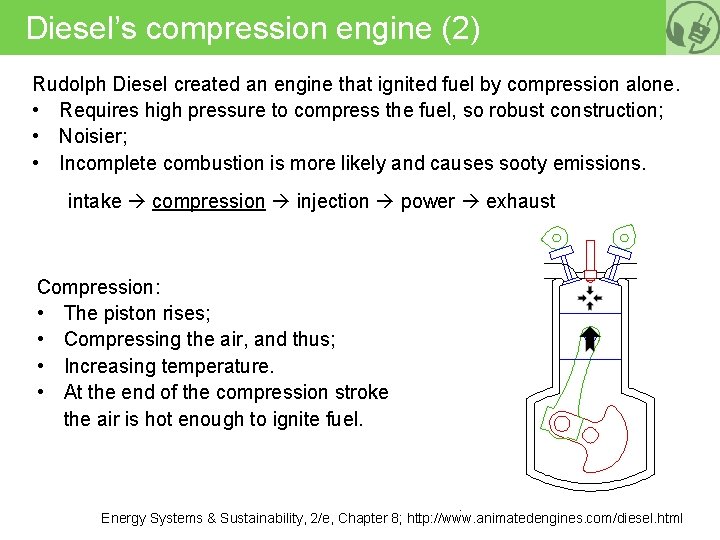
Diesel’s compression engine (2) Rudolph Diesel created an engine that ignited fuel by compression alone. • Requires high pressure to compress the fuel, so robust construction; • Noisier; • Incomplete combustion is more likely and causes sooty emissions. intake compression injection power exhaust Compression: • The piston rises; • Compressing the air, and thus; • Increasing temperature. • At the end of the compression stroke the air is hot enough to ignite fuel. Energy Systems & Sustainability, 2/e, Chapter 8; http: //www. animatedengines. com/diesel. html
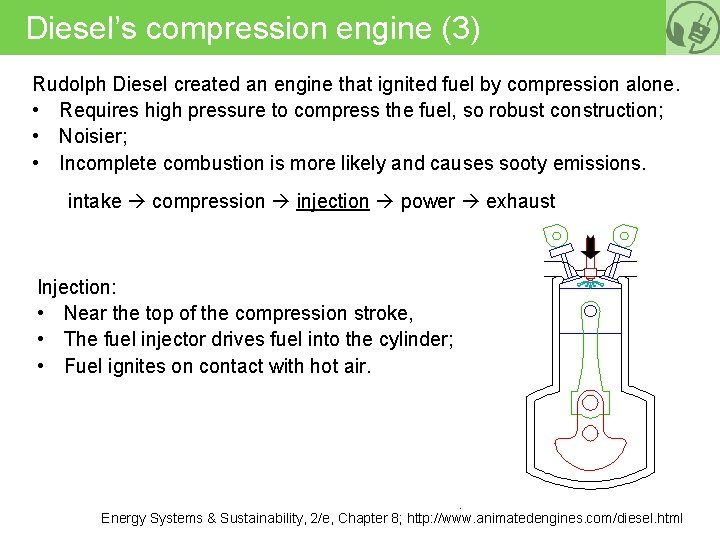
Diesel’s compression engine (3) Rudolph Diesel created an engine that ignited fuel by compression alone. • Requires high pressure to compress the fuel, so robust construction; • Noisier; • Incomplete combustion is more likely and causes sooty emissions. intake compression injection power exhaust Injection: • Near the top of the compression stroke, • The fuel injector drives fuel into the cylinder; • Fuel ignites on contact with hot air. Energy Systems & Sustainability, 2/e, Chapter 8; http: //www. animatedengines. com/diesel. html
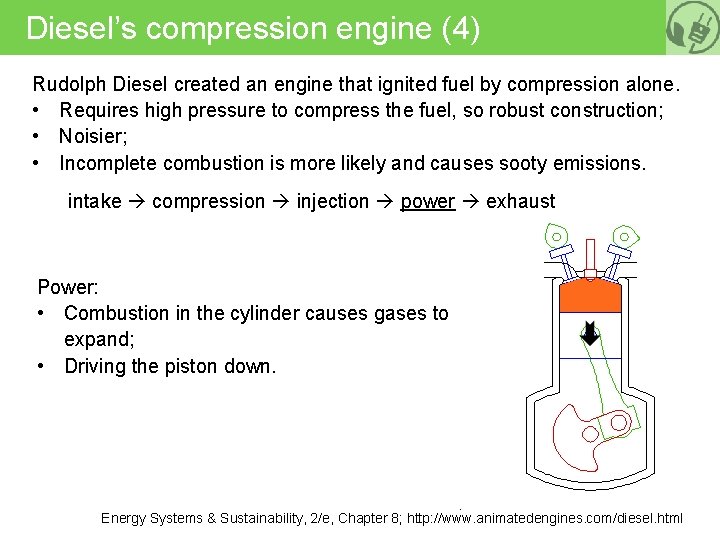
Diesel’s compression engine (4) Rudolph Diesel created an engine that ignited fuel by compression alone. • Requires high pressure to compress the fuel, so robust construction; • Noisier; • Incomplete combustion is more likely and causes sooty emissions. intake compression injection power exhaust Power: • Combustion in the cylinder causes gases to expand; • Driving the piston down. Energy Systems & Sustainability, 2/e, Chapter 8; http: //www. animatedengines. com/diesel. html
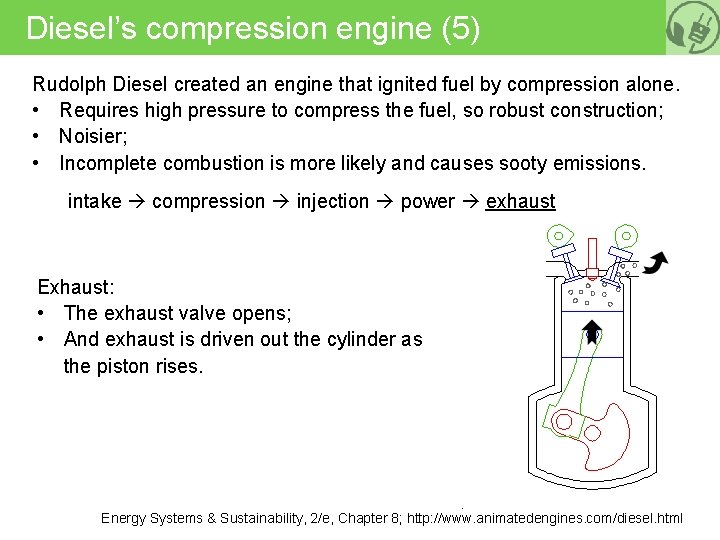
Diesel’s compression engine (5) Rudolph Diesel created an engine that ignited fuel by compression alone. • Requires high pressure to compress the fuel, so robust construction; • Noisier; • Incomplete combustion is more likely and causes sooty emissions. intake compression injection power exhaust Exhaust: • The exhaust valve opens; • And exhaust is driven out the cylinder as the piston rises. Energy Systems & Sustainability, 2/e, Chapter 8; http: //www. animatedengines. com/diesel. html
Diesel engines dominate shipping The nearly 40% efficiency of diesel engines and their pumpable liquid fuel made them the dominant engine for shipping. • Though diesel fuel is 3 -4 times as expensive than coal. • Diesel engines still power nearly all commercial shipping. • Heat produced by the massive engines produces steam for electric production. • With electricity, total efficiency is ~ 50%. Marine diesels tend to run on the least expensive oil with high sulfur content & thus produce high levels of air pollution. Energy Systems & Sustainability, 2/e, Chapter 8
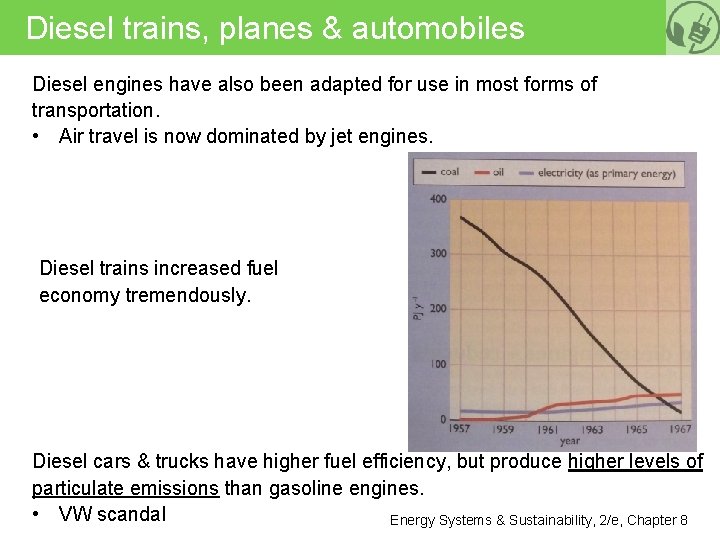
Diesel trains, planes & automobiles Diesel engines have also been adapted for use in most forms of transportation. • Air travel is now dominated by jet engines. Diesel trains increased fuel economy tremendously. Diesel cars & trucks have higher fuel efficiency, but produce higher levels of particulate emissions than gasoline engines. • VW scandal Energy Systems & Sustainability, 2/e, Chapter 8
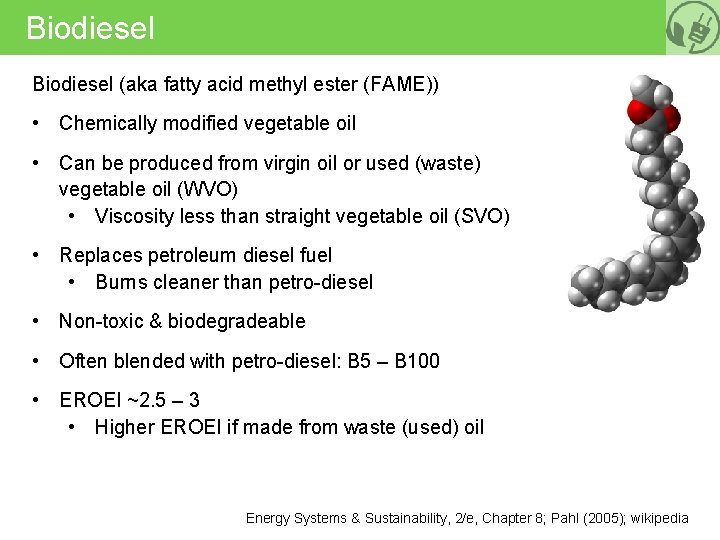
Biodiesel (aka fatty acid methyl ester (FAME)) • Chemically modified vegetable oil • Can be produced from virgin oil or used (waste) vegetable oil (WVO) • Viscosity less than straight vegetable oil (SVO) • Replaces petroleum diesel fuel • Burns cleaner than petro-diesel • Non-toxic & biodegradeable • Often blended with petro-diesel: B 5 – B 100 • EROEI ~2. 5 – 3 • Higher EROEI if made from waste (used) oil Energy Systems & Sustainability, 2/e, Chapter 8; Pahl (2005); wikipedia
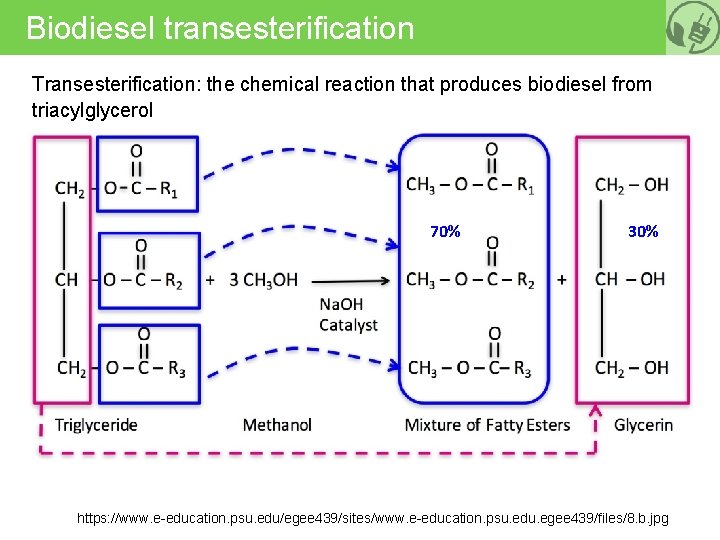
Biodiesel transesterification Transesterification: the chemical reaction that produces biodiesel from triacylglycerol 70% 30% https: //www. e-education. psu. edu/egee 439/sites/www. e-education. psu. edu. egee 439/files/8. b. jpg
8. Engines 8. 4 Reducing pollution
Pollutants from combustion of petroleum Air pollutants produced by combustion of petroleum fuels include: GHG • Carbon dioxide (CO ) 2 • Carbon monoxide (CO) Toxic (modifies hemoglobin) • Hydrogen gas (H 2) • Sulfur oxides (SOx) Forms acid rain • Nitrogen oxides (NOx) Forms smog Energy Systems & Sustainability, 2/e, Chapter 8
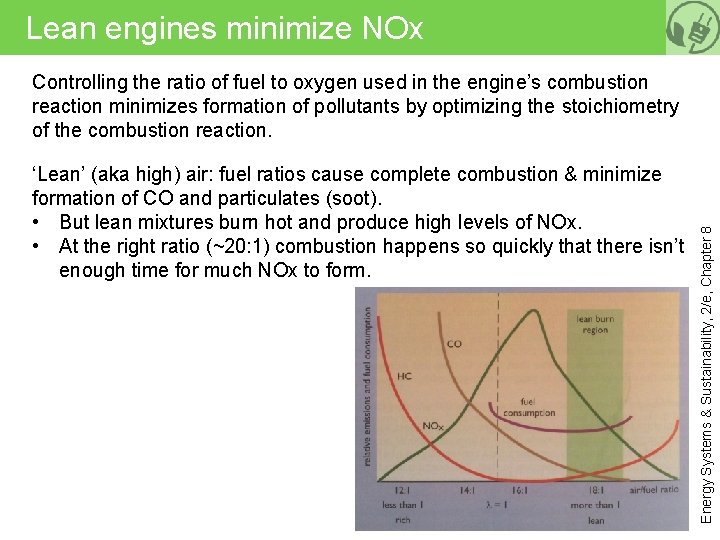
Lean engines minimize NOx ‘Lean’ (aka high) air: fuel ratios cause complete combustion & minimize formation of CO and particulates (soot). • But lean mixtures burn hot and produce high levels of NOx. • At the right ratio (~20: 1) combustion happens so quickly that there isn’t enough time for much NOx to form. Energy Systems & Sustainability, 2/e, Chapter 8 Controlling the ratio of fuel to oxygen used in the engine’s combustion reaction minimizes formation of pollutants by optimizing the stoichiometry of the combustion reaction.
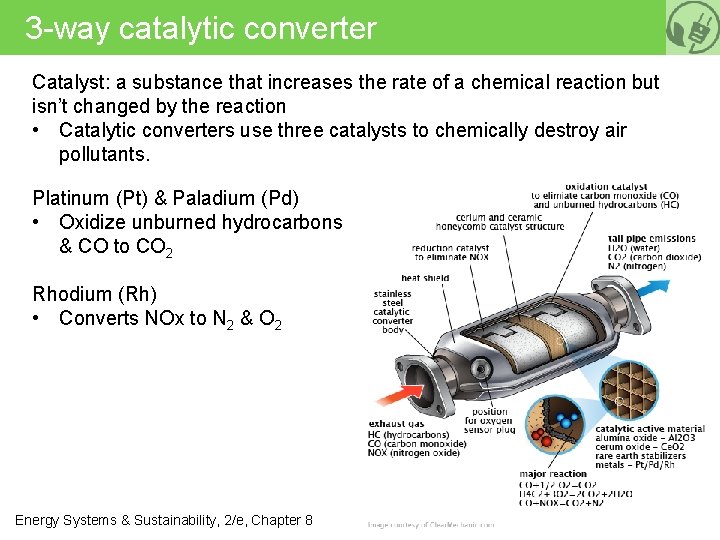
3 -way catalytic converter Catalyst: a substance that increases the rate of a chemical reaction but isn’t changed by the reaction • Catalytic converters use three catalysts to chemically destroy air pollutants. Platinum (Pt) & Paladium (Pd) • Oxidize unburned hydrocarbons & CO to CO 2 Rhodium (Rh) • Converts NOx to N 2 & O 2 Energy Systems & Sustainability, 2/e, Chapter 8
Diesel engines: more pollution Diesel engines produce more pollution than gasoline engines. Particulates (soot) can be reduced with: • Better management of air: fuel ratios • Filters • Oxidizing catalytic converters • Require low-sulfur diesel fuel NOx? • Diesel engines produce higher levels of NOx than gasoline engines. Recently, a number of European cities have banned diesel engines because of air pollution concerns, particularly particulates. • Bans will be phased in slowly. Energy Systems & Sustainability, 2/e, Chapter 8
Optimizing efficiency & pollution When petro engines are run at full capacity and their most efficient rotational speed they are most efficient and produce the fewest pollutants. One solution: hybrid petro-electric • Uses petroleum fuel only under the optimal conditions & charges a battery under those conditions. • Uses the battery when petroleum fuel use would be inefficient or more polluting. Energy Systems & Sustainability, 2/e, Chapter 8
8. Engines 8. 5 Gas turbines
Developmental mirror? In 1884 Norwegian Egidius Elling proposed a gas turbine, but could not build it because metals would have failed at the high temperatures of continuous combustion. Instead, he created the steam injected gas turbine: • Used fuel to heat a water jacket, producing steam; • Jet of steam + exhaust gases powered turbine. Not truly competitive with steam & diesel turbines. Energy Systems & Sustainability, 2/e, Chapter 8
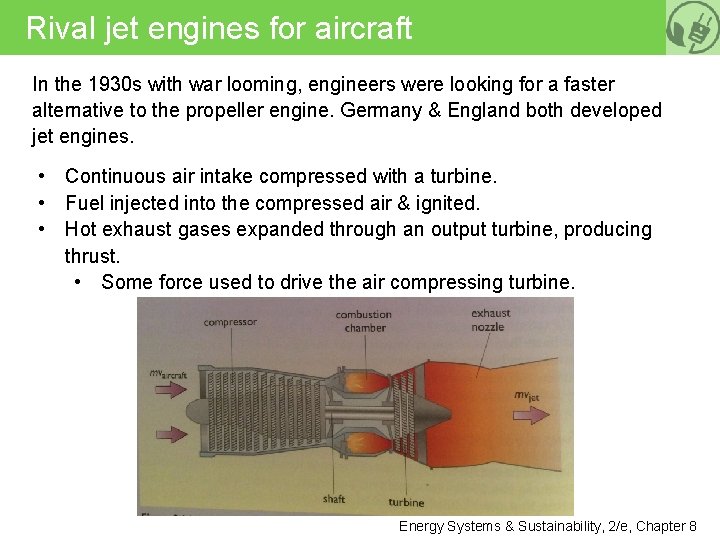
Rival jet engines for aircraft In the 1930 s with war looming, engineers were looking for a faster alternative to the propeller engine. Germany & England both developed jet engines. • Continuous air intake compressed with a turbine. • Fuel injected into the compressed air & ignited. • Hot exhaust gases expanded through an output turbine, producing thrust. • Some force used to drive the air compressing turbine. Energy Systems & Sustainability, 2/e, Chapter 8
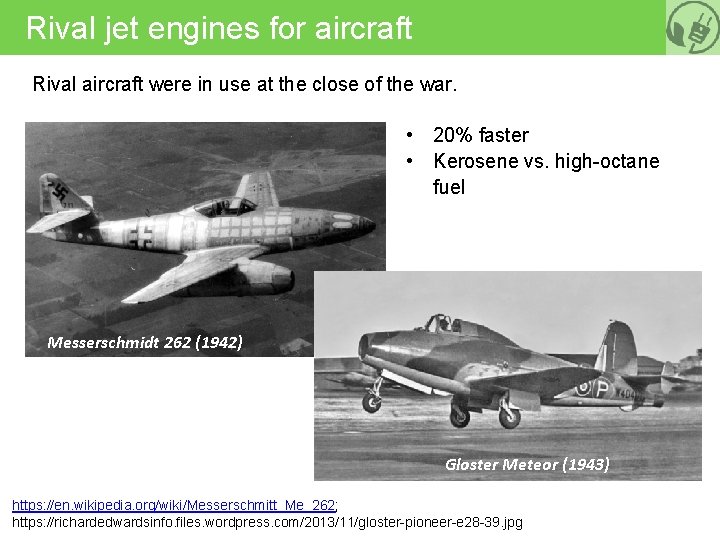
Rival jet engines for aircraft Rival aircraft were in use at the close of the war. • 20% faster • Kerosene vs. high-octane fuel Messerschmidt 262 (1942) Gloster Meteor (1943) https: //en. wikipedia. org/wiki/Messerschmitt_Me_262; https: //richardedwardsinfo. files. wordpress. com/2013/11/gloster-pioneer-e 28 -39. jpg
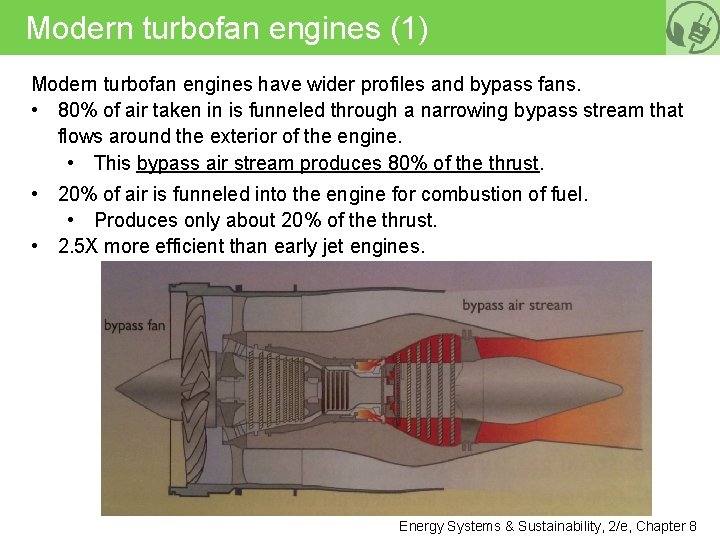
Modern turbofan engines (1) Modern turbofan engines have wider profiles and bypass fans. • 80% of air taken in is funneled through a narrowing bypass stream that flows around the exterior of the engine. • This bypass air stream produces 80% of the thrust. • 20% of air is funneled into the engine for combustion of fuel. • Produces only about 20% of the thrust. • 2. 5 X more efficient than early jet engines. Fig 8. 18= Energy Systems & Sustainability, 2/e, Chapter 8
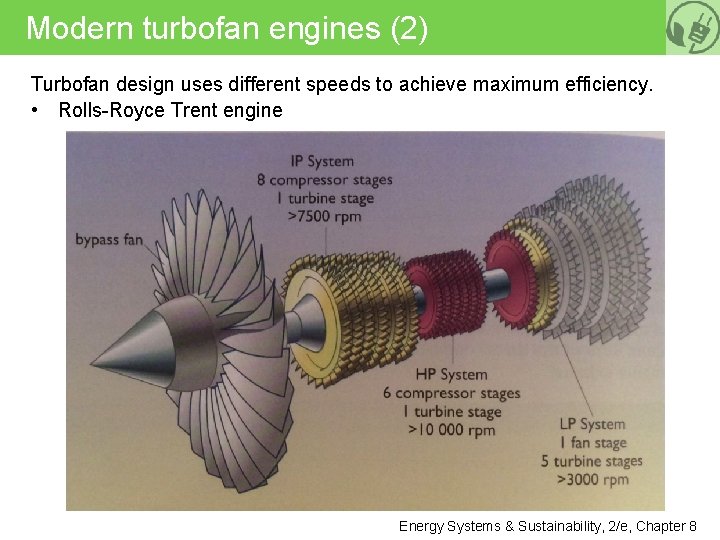
Modern turbofan engines (2) Turbofan design uses different speeds to achieve maximum efficiency. • Rolls-Royce Trent engine Energy Systems & Sustainability, 2/e, Chapter 8
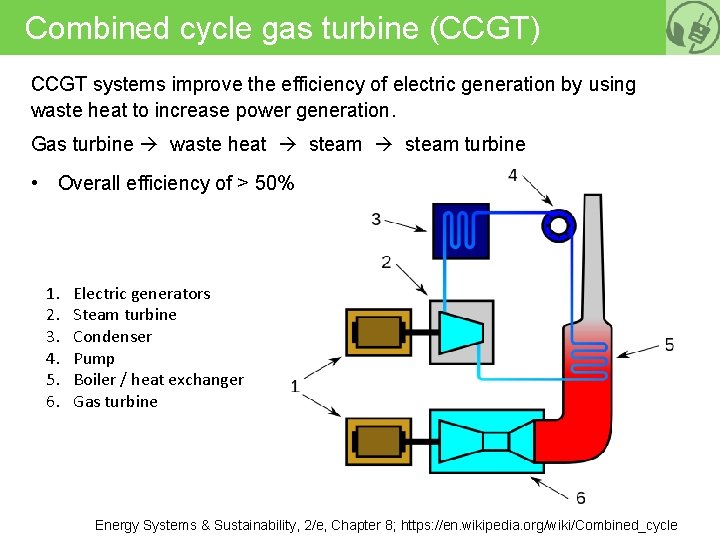
Combined cycle gas turbine (CCGT) CCGT systems improve the efficiency of electric generation by using waste heat to increase power generation. Gas turbine waste heat steam turbine • Overall efficiency of > 50% 1. 2. 3. 4. 5. 6. Electric generators Steam turbine Condenser Pump Boiler / heat exchanger Gas turbine Energy Systems & Sustainability, 2/e, Chapter 8; https: //en. wikipedia. org/wiki/Combined_cycle
8. Engines 8. 6 Stirling engines
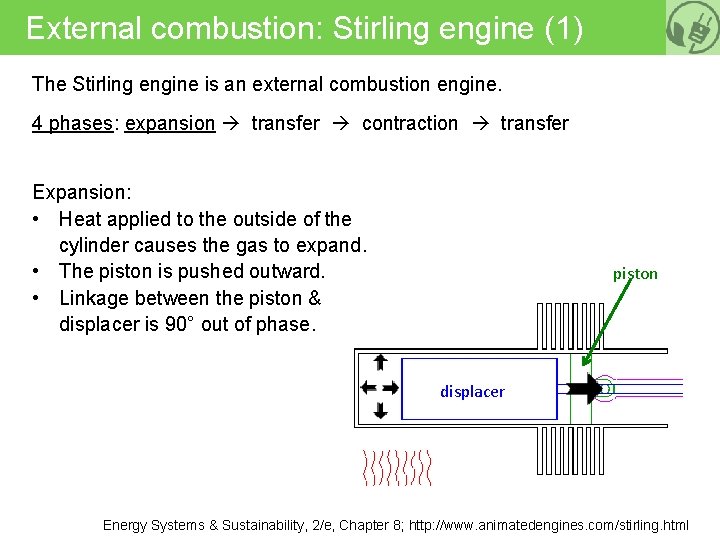
External combustion: Stirling engine (1) The Stirling engine is an external combustion engine. 4 phases: expansion transfer contraction transfer Expansion: • Heat applied to the outside of the cylinder causes the gas to expand. • The piston is pushed outward. • Linkage between the piston & displacer is 90° out of phase. piston displacer Energy Systems & Sustainability, 2/e, Chapter 8; http: //www. animatedengines. com/stirling. html
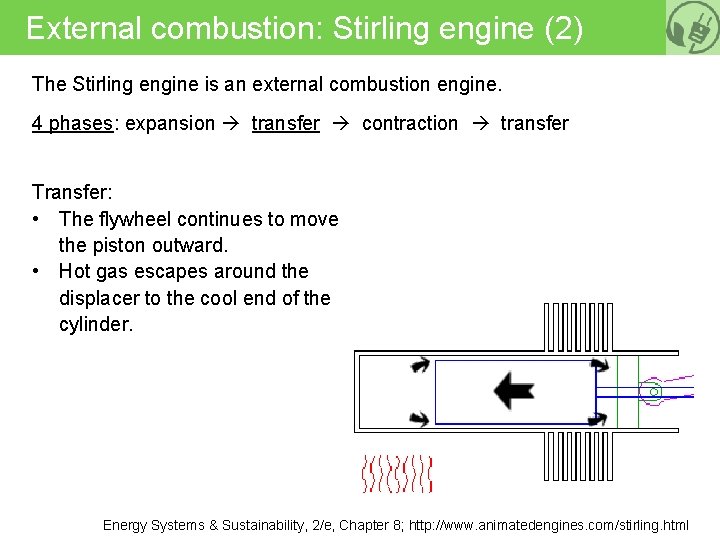
External combustion: Stirling engine (2) The Stirling engine is an external combustion engine. 4 phases: expansion transfer contraction transfer Transfer: • The flywheel continues to move the piston outward. • Hot gas escapes around the displacer to the cool end of the cylinder. Energy Systems & Sustainability, 2/e, Chapter 8; http: //www. animatedengines. com/stirling. html
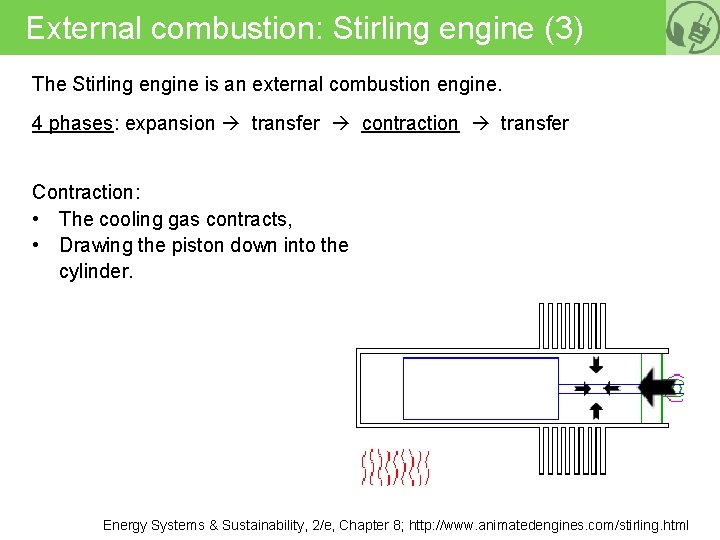
External combustion: Stirling engine (3) The Stirling engine is an external combustion engine. 4 phases: expansion transfer contraction transfer Contraction: • The cooling gas contracts, • Drawing the piston down into the cylinder. Energy Systems & Sustainability, 2/e, Chapter 8; http: //www. animatedengines. com/stirling. html
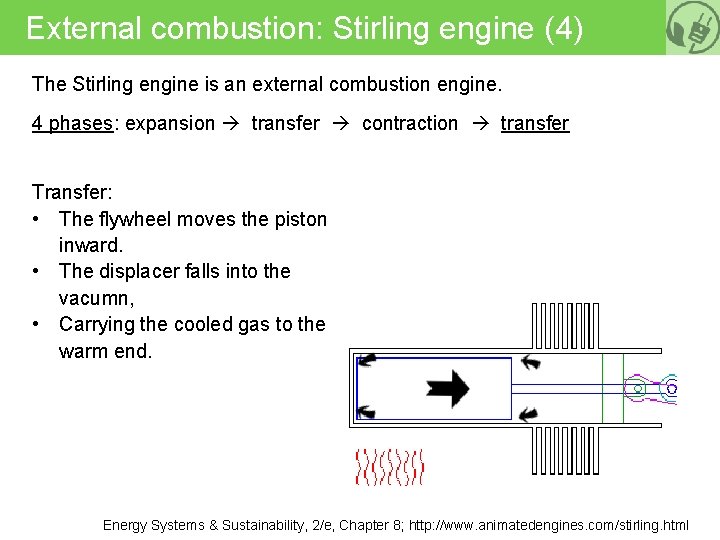
External combustion: Stirling engine (4) The Stirling engine is an external combustion engine. 4 phases: expansion transfer contraction transfer Transfer: • The flywheel moves the piston inward. • The displacer falls into the vacumn, • Carrying the cooled gas to the warm end. Energy Systems & Sustainability, 2/e, Chapter 8; http: //www. animatedengines. com/stirling. html
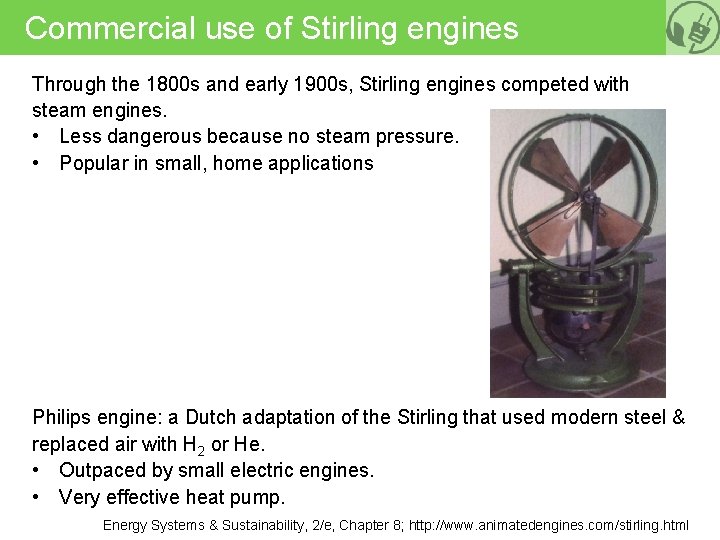
Commercial use of Stirling engines Through the 1800 s and early 1900 s, Stirling engines competed with steam engines. • Less dangerous because no steam pressure. • Popular in small, home applications Philips engine: a Dutch adaptation of the Stirling that used modern steel & replaced air with H 2 or He. • Outpaced by small electric engines. • Very effective heat pump. Energy Systems & Sustainability, 2/e, Chapter 8; http: //www. animatedengines. com/stirling. html
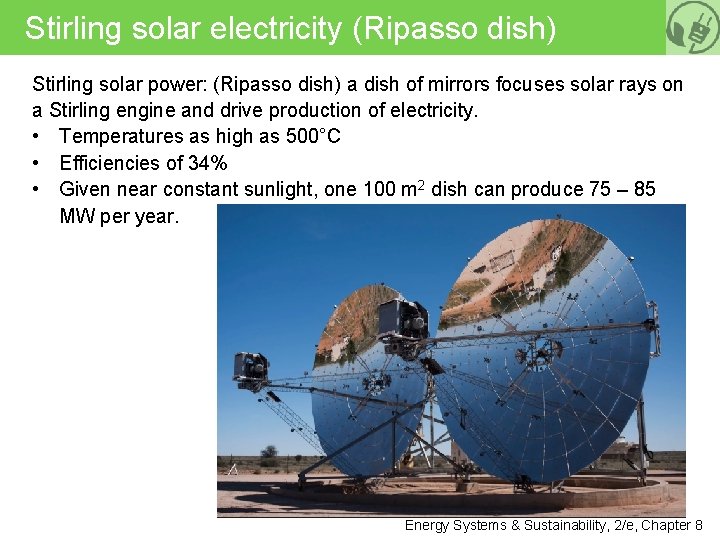
Stirling solar electricity (Ripasso dish) Stirling solar power: (Ripasso dish) a dish of mirrors focuses solar rays on a Stirling engine and drive production of electricity. • Temperatures as high as 500°C • Efficiencies of 34% • Given near constant sunlight, one 100 m 2 dish can produce 75 – 85 MW per year. Energy Systems & Sustainability, 2/e, Chapter 8
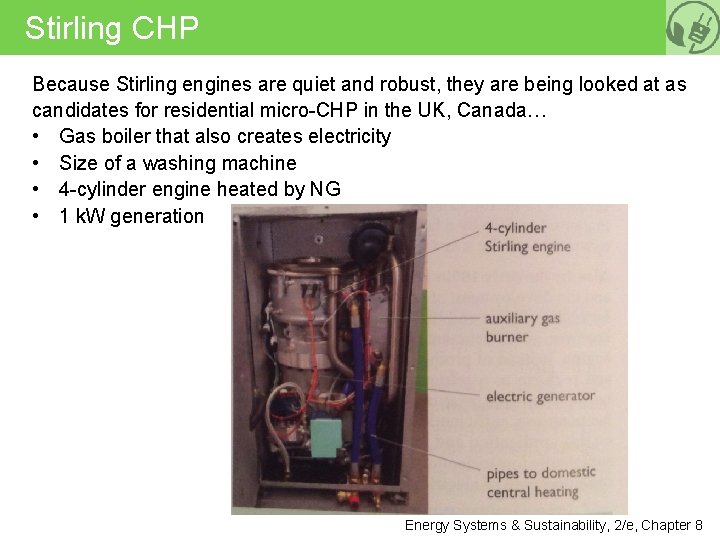
Stirling CHP Because Stirling engines are quiet and robust, they are being looked at as candidates for residential micro-CHP in the UK, Canada… • Gas boiler that also creates electricity • Size of a washing machine • 4 -cylinder engine heated by NG • 1 k. W generation Energy Systems & Sustainability, 2/e, Chapter 8
- Slides: 47