
SSA in Scheme Static single assignment SSA assignment
![(let ([x (+ a 1)]) (let ([y (* b 2)]) (let ([y (+ (*](https://slidetodoc.com/presentation_image_h/ac1541e32e57d5dc83b0f1c99dc89b67/image-16.jpg "(let ([x (+ a 1)]) (let ([y (* b 2)]) (let ([y (+ (*")
![(let ([x 0 0]) (let ([x 3 (letrec* ([loop 0 (lambda (x 1) (if](https://slidetodoc.com/presentation_image_h/ac1541e32e57d5dc83b0f1c99dc89b67/image-19.jpg "(let ([x 0 0]) (let ([x 3 (letrec* ([loop 0 (lambda (x 1) (if")
![(let ([x 0 0]) (let ([x 3 (letrec* ([loop 0 (lambda (x 1) (if](https://slidetodoc.com/presentation_image_h/ac1541e32e57d5dc83b0f1c99dc89b67/image-20.jpg "(let ([x 0 0]) (let ([x 3 (letrec* ([loop 0 (lambda (x 1) (if")
![(let ([x 0 0]) (let ([x 3 (let ([loop 0 ‘()]) (set! loop 0](https://slidetodoc.com/presentation_image_h/ac1541e32e57d5dc83b0f1c99dc89b67/image-21.jpg "(let ([x 0 0]) (let ([x 3 (let ([loop 0 ‘()]) (set! loop 0")
![(let ([x 0 0]) (let ([x 3 (let ([loop 0 ‘()]) (set! loop 0](https://slidetodoc.com/presentation_image_h/ac1541e32e57d5dc83b0f1c99dc89b67/image-22.jpg "(let ([x 0 0]) (let ([x 3 (let ([loop 0 ‘()]) (set! loop 0")
![(let ([x 0 0]) (let ([x 3 (let ([loop 0 (make-vector 1 ’())]) (vector-set!](https://slidetodoc.com/presentation_image_h/ac1541e32e57d5dc83b0f1c99dc89b67/image-23.jpg "(let ([x 0 0]) (let ([x 3 (let ([loop 0 (make-vector 1 ’())]) (vector-set!")
- Slides: 23
SSA in Scheme Static single assignment (SSA) : assignment conversion (“boxing”), alpha-renaming/alphatization, and administrative normal form (ANF)
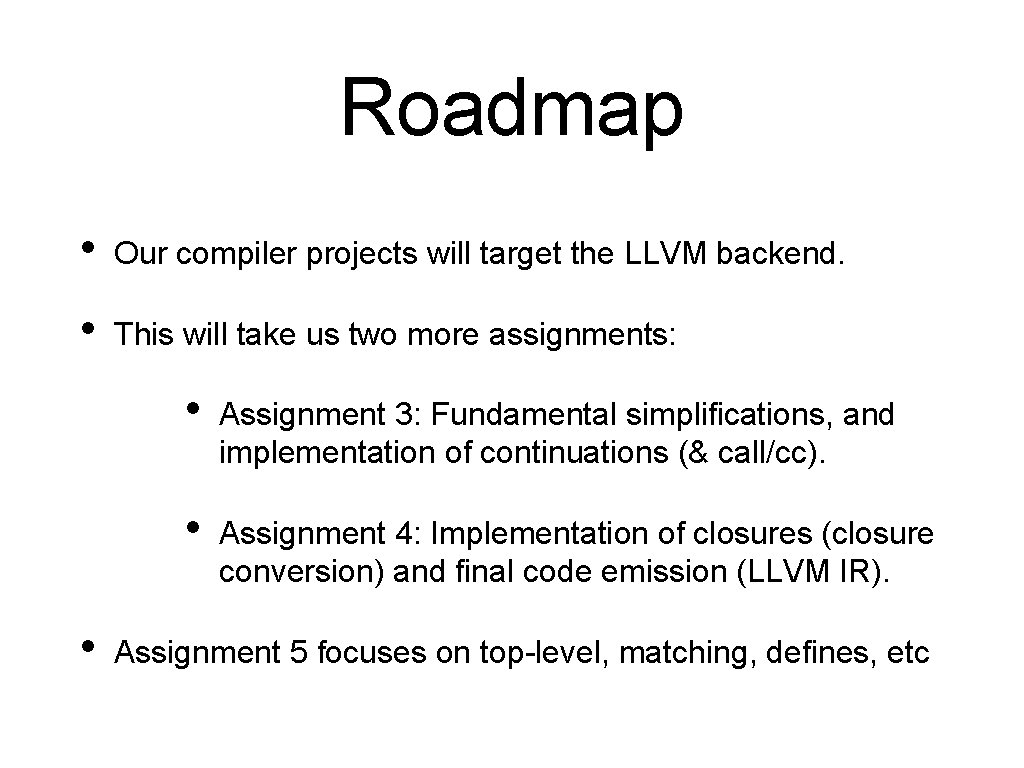
Roadmap • Our compiler projects will target the LLVM backend. • This will take us two more assignments: • • Assignment 3: Fundamental simplifications, and implementation of continuations (& call/cc). • Assignment 4: Implementation of closures (closure conversion) and final code emission (LLVM IR). Assignment 5 focuses on top-level, matching, defines, etc
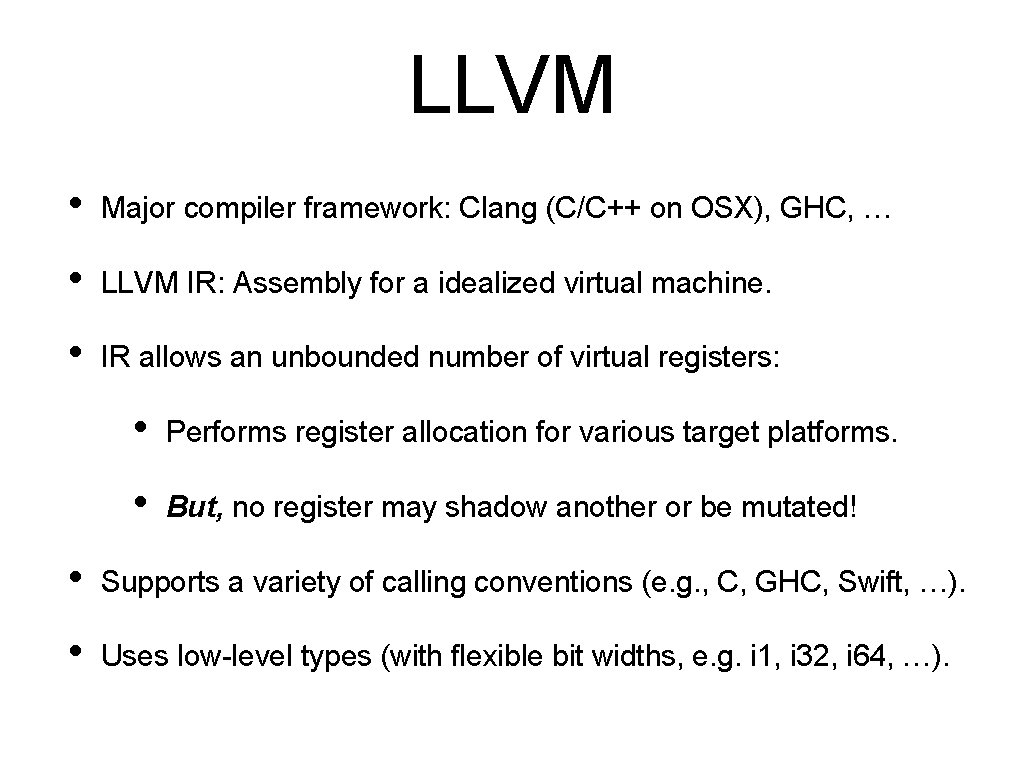
LLVM • Major compiler framework: Clang (C/C++ on OSX), GHC, … • LLVM IR: Assembly for a idealized virtual machine. • IR allows an unbounded number of virtual registers: • Performs register allocation for various target platforms. • But, no register may shadow another or be mutated! • Supports a variety of calling conventions (e. g. , C, GHC, Swift, …). • Uses low-level types (with flexible bit widths, e. g. i 1, i 32, i 64, …).
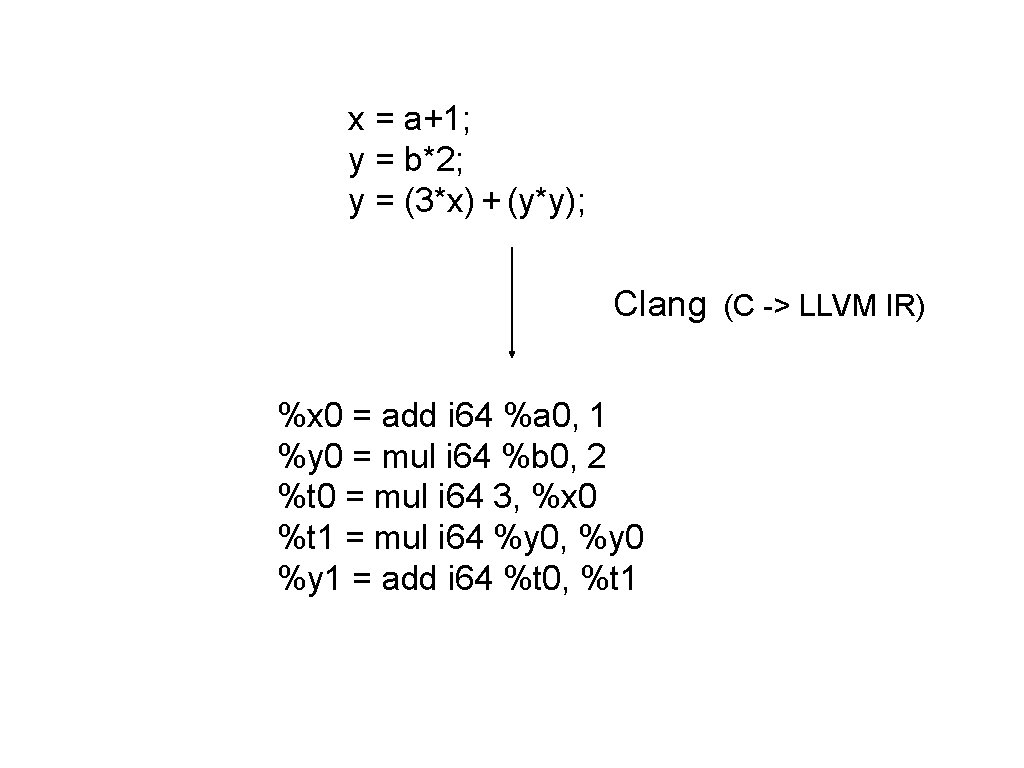
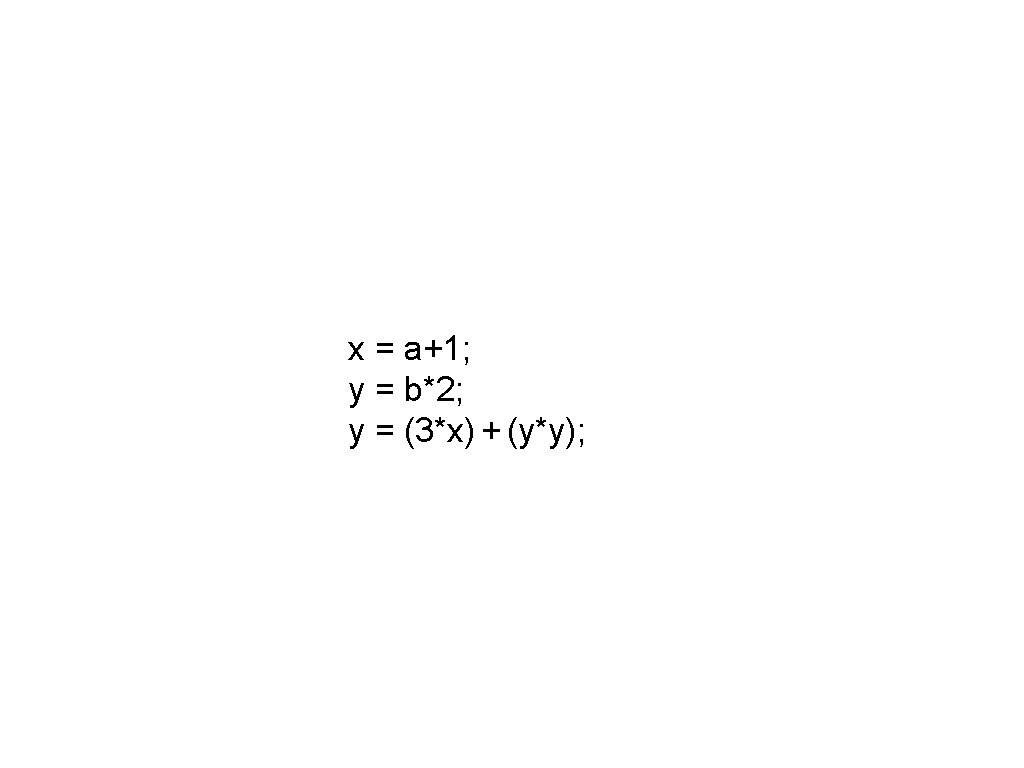
x = a+1; y = b*2; y = (3*x) + (y*y); Clang (C -> LLVM IR) %x 0 = add i 64 %a 0, 1 %y 0 = mul i 64 %b 0, 2 %t 0 = mul i 64 3, %x 0 %t 1 = mul i 64 %y 0, %y 0 %y 1 = add i 64 %t 0, %t 1
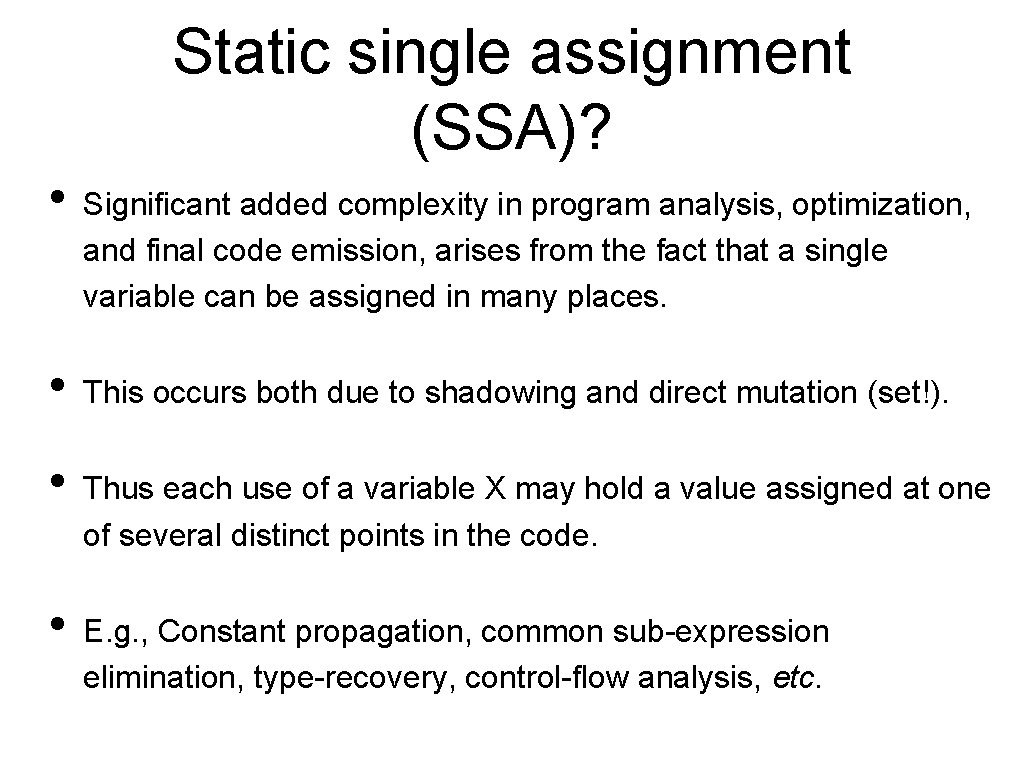
Static single assignment (SSA)? • • Significant added complexity in program analysis, optimization, and final code emission, arises from the fact that a single variable can be assigned in many places. This occurs both due to shadowing and direct mutation (set!). Thus each use of a variable X may hold a value assigned at one of several distinct points in the code. E. g. , Constant propagation, common sub-expression elimination, type-recovery, control-flow analysis, etc.
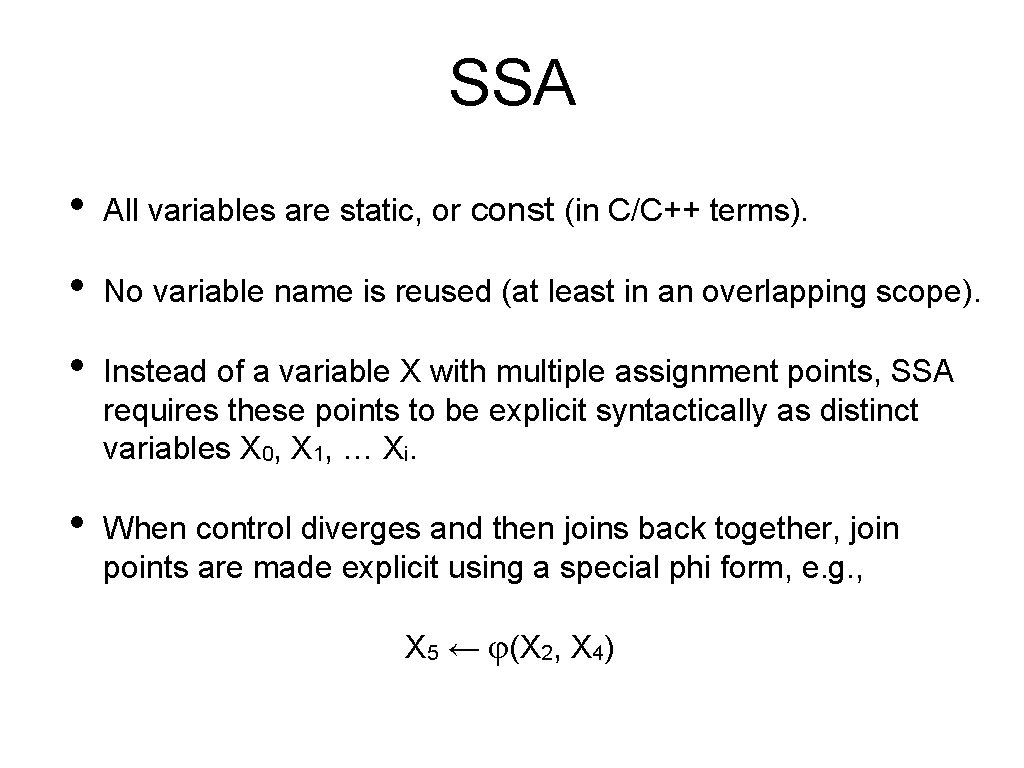
SSA • All variables are static, or const (in C/C++ terms). • No variable name is reused (at least in an overlapping scope). • Instead of a variable X with multiple assignment points, SSA requires these points to be explicit syntactically as distinct variables X 0, X 1, … Xi. • When control diverges and then joins back together, join points are made explicit using a special phi form, e. g. , X 5 ← φ(X 2, X 4)
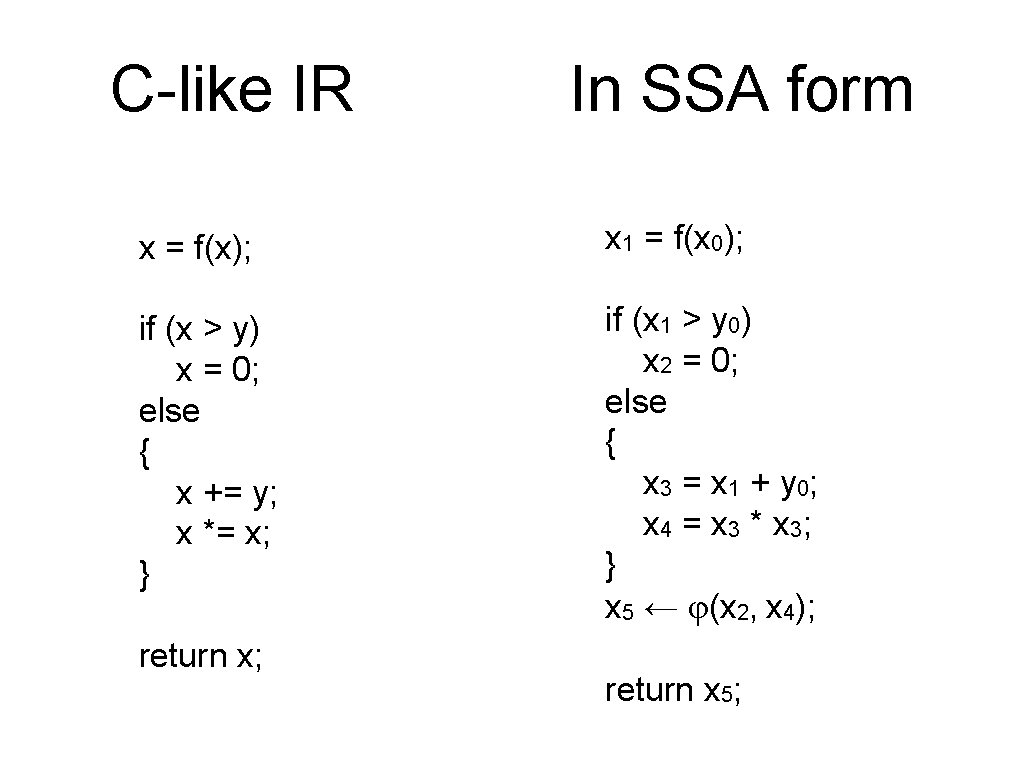
C-like IR In SSA form x = f(x); x 1 = f(x 0); if (x > y) x = 0; else { x += y; x *= x; } if (x 1 > y 0) x 2 = 0; else { x 3 = x 1 + y 0; x 4 = x 3 * x 3; } x 5 ← φ(x 2, x 4); return x 5;
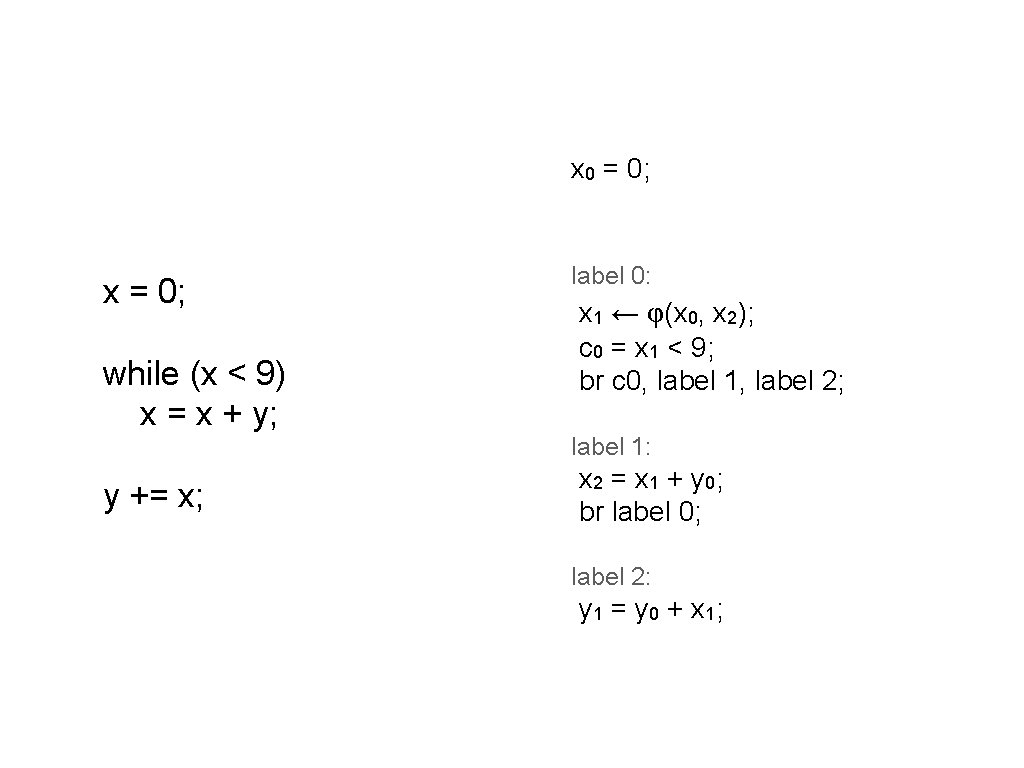
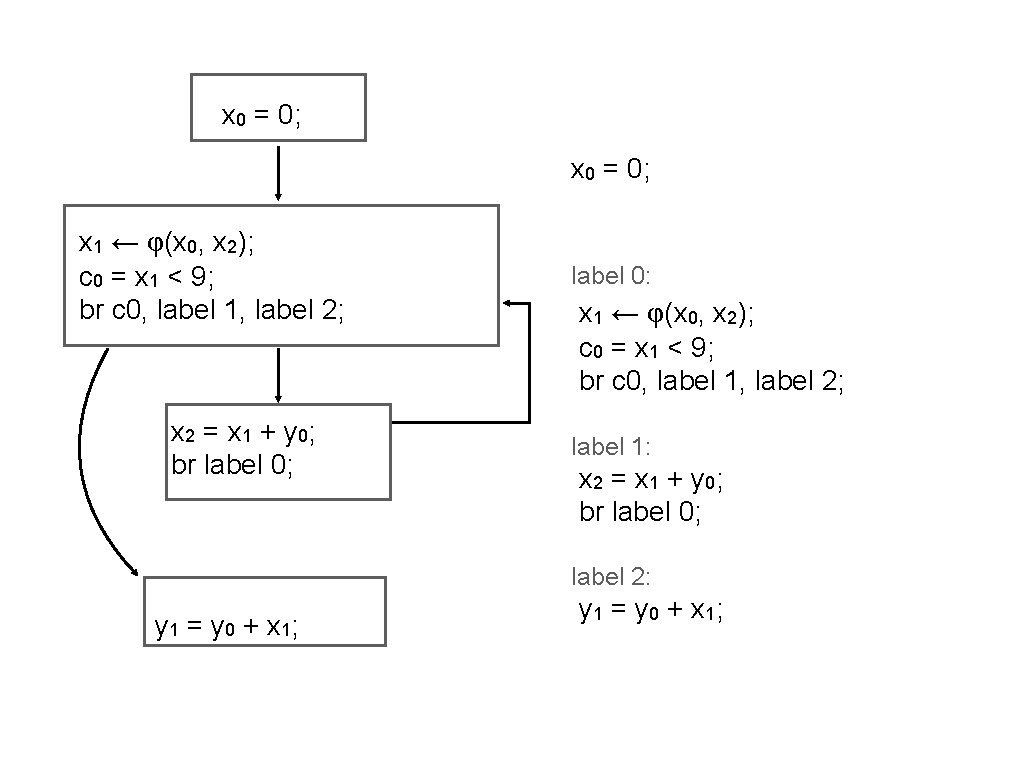
x 0 = 0; x = 0; while (x < 9) x = x + y; y += x; label 0: x 1 ← φ(x 0, x 2); c 0 = x 1 < 9; br c 0, label 1, label 2; label 1: x 2 = x 1 + y 0; br label 0; label 2: y 1 = y 0 + x 1;
x 0 = 0; x 1 ← φ(x 0, x 2); c 0 = x 1 < 9; br c 0, label 1, label 2; x 2 = x 1 + y 0; br label 0; label 0: x 1 ← φ(x 0, x 2); c 0 = x 1 < 9; br c 0, label 1, label 2; label 1: x 2 = x 1 + y 0; br label 0; label 2: y 1 = y 0 + x 1;
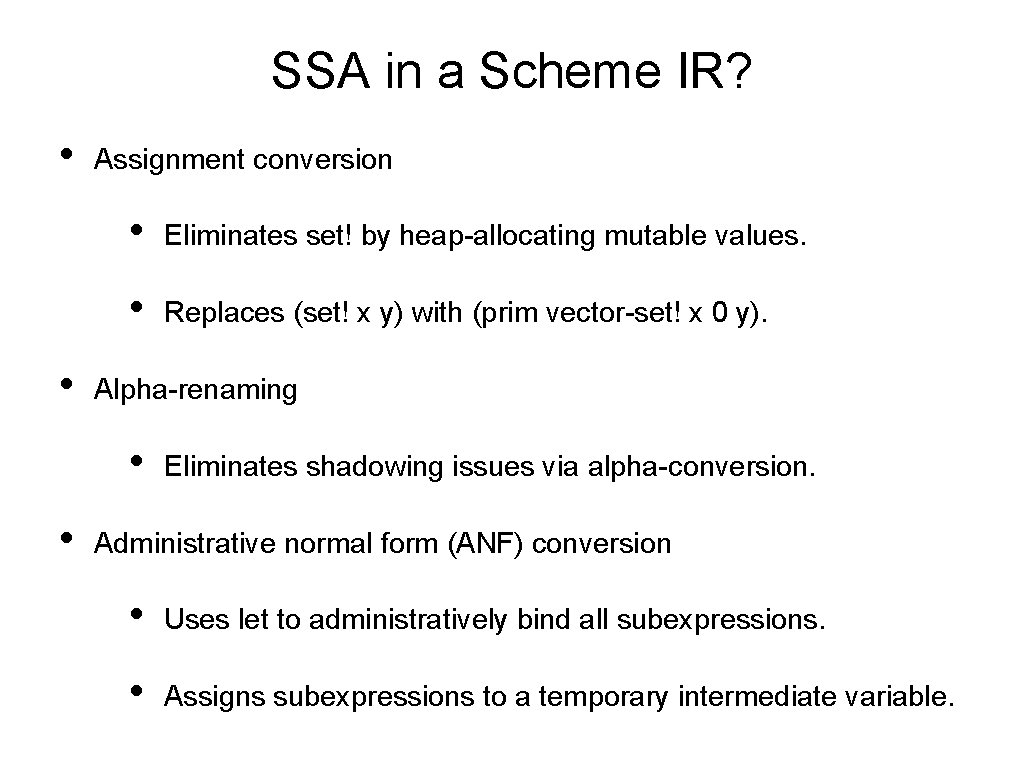
SSA in a Scheme IR? • • Assignment conversion • Eliminates set! by heap-allocating mutable values. • Replaces (set! x y) with (prim vector-set! x 0 y). Alpha-renaming • • Eliminates shadowing issues via alpha-conversion. Administrative normal form (ANF) conversion • Uses let to administratively bind all subexpressions. • Assigns subexpressions to a temporary intermediate variable.
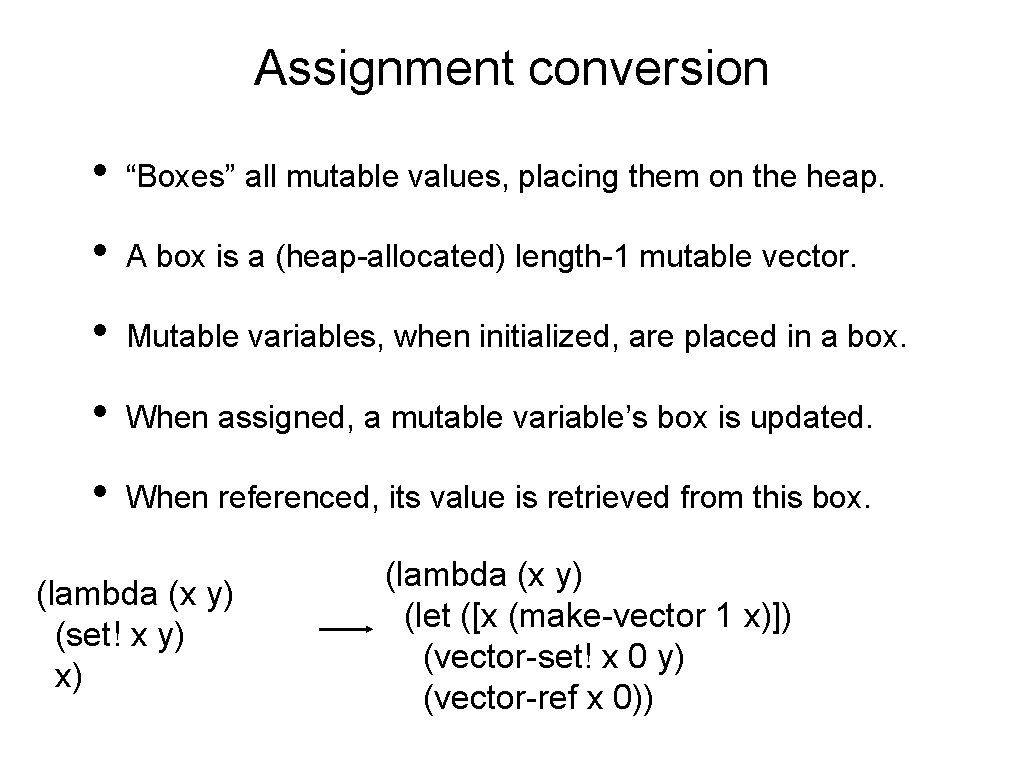
Assignment conversion • “Boxes” all mutable values, placing them on the heap. • A box is a (heap-allocated) length-1 mutable vector. • Mutable variables, when initialized, are placed in a box. • When assigned, a mutable variable’s box is updated. • When referenced, its value is retrieved from this box. (lambda (x y) (set! x y) x) (lambda (x y) (let ([x (make-vector 1 x)]) (vector-set! x 0 y) (vector-ref x 0))
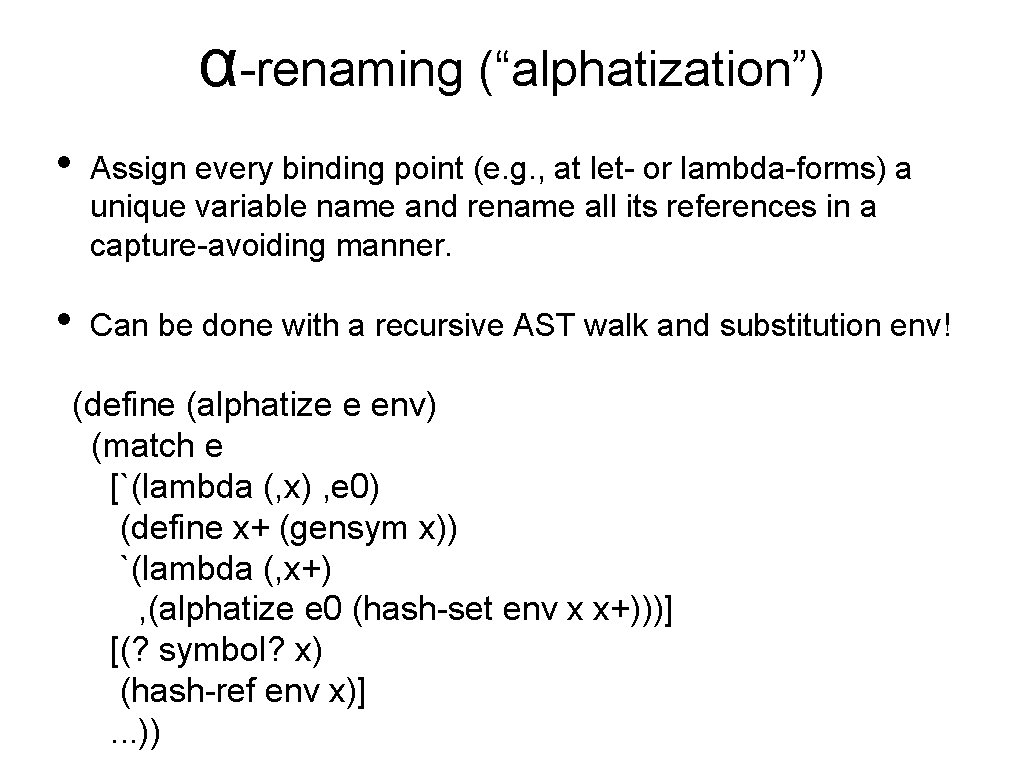
α-renaming (“alphatization”) • Assign every binding point (e. g. , at let- or lambda-forms) a unique variable name and rename all its references in a capture-avoiding manner. • Can be done with a recursive AST walk and substitution env! (define (alphatize e env) (match e [`(lambda (, x) , e 0) (define x+ (gensym x)) `(lambda (, x+) , (alphatize e 0 (hash-set env x x+)))] [(? symbol? x) (hash-ref env x)]. . . ))
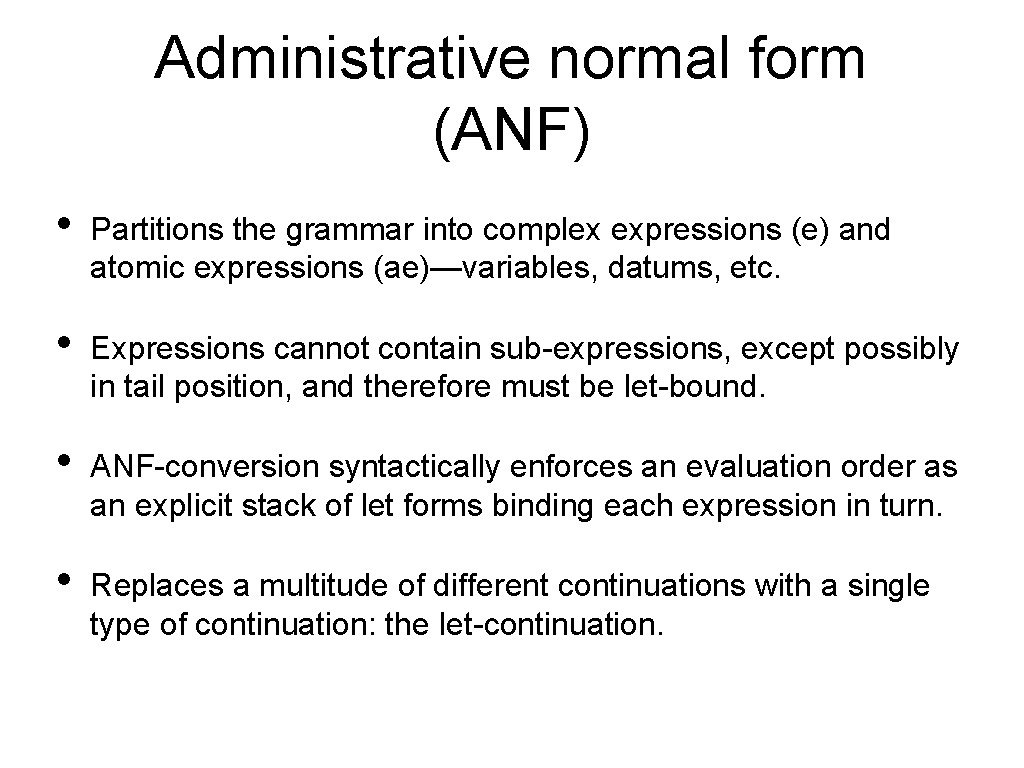
Administrative normal form (ANF) • Partitions the grammar into complex expressions (e) and atomic expressions (ae)—variables, datums, etc. • Expressions cannot contain sub-expressions, except possibly in tail position, and therefore must be let-bound. • ANF-conversion syntactically enforces an evaluation order as an explicit stack of let forms binding each expression in turn. • Replaces a multitude of different continuations with a single type of continuation: the let-continuation.
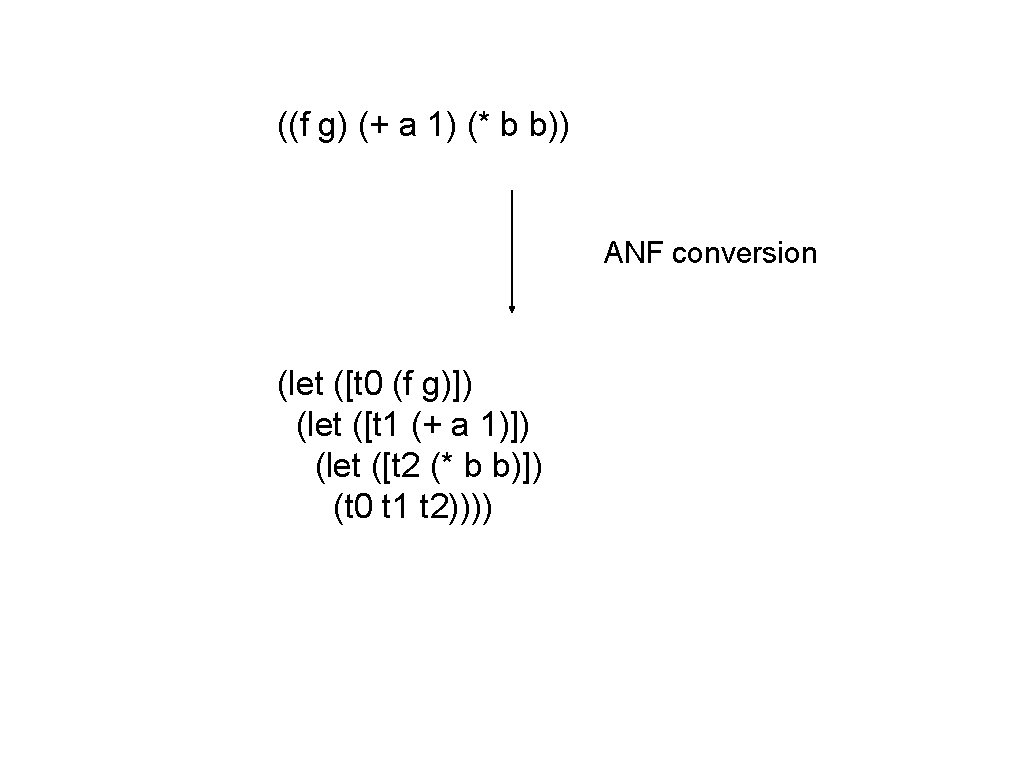
((f g) (+ a 1) (* b b)) ANF conversion (let ([t 0 (f g)]) (let ([t 1 (+ a 1)]) (let ([t 2 (* b b)]) (t 0 t 1 t 2))))
(let ([x (+ a 1)]) (let ([y (* b 2)]) (let ([y (+ (* 3 x) (* y y))]). . . ))) ANF conversion & alpha-renaming (let ([x 0 (+ a 0 1)]) (let ([y 0 (* b 0 2)]) (let ([t 0 (* 3 x 0)]) (let ([t 1 (* y 0)]) (let ([y 1 (+ t 0 t 1)]). . . )))))
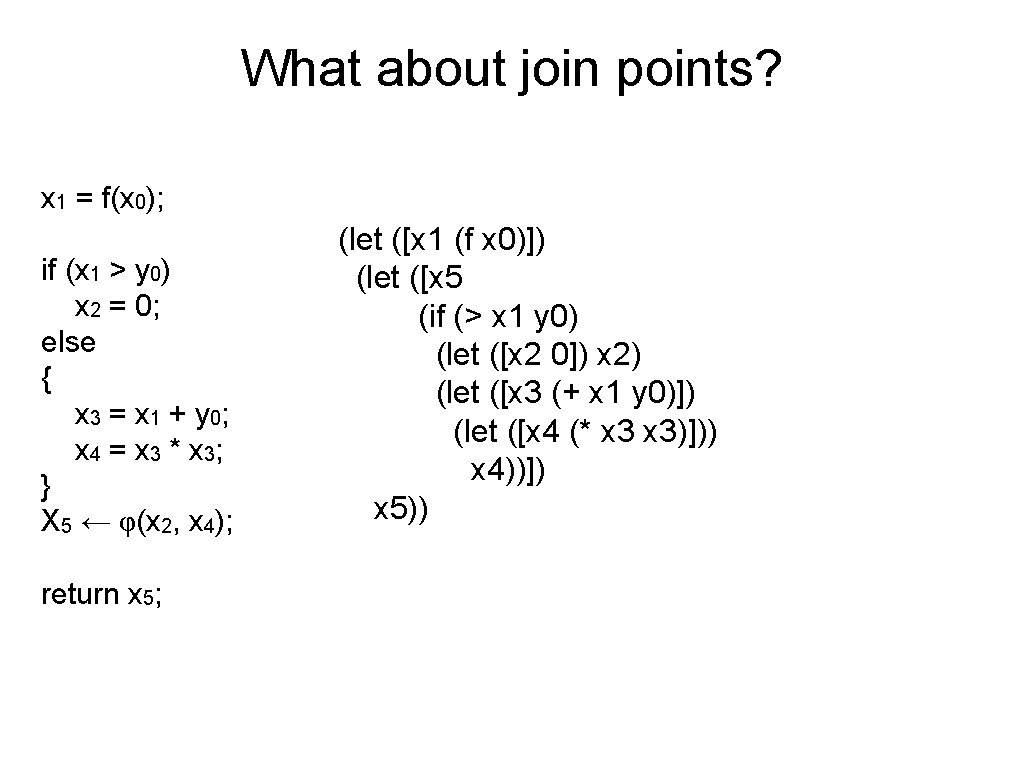
What about join points? x 1 = f(x 0); if (x 1 > y 0) x 2 = 0; else { x 3 = x 1 + y 0; x 4 = x 3 * x 3; } X 5 ← φ(x 2, x 4); return x 5; (let ([x 1 (f x 0)]) (let ([x 5 (if (> x 1 y 0) (let ([x 2 0]) x 2) (let ([x 3 (+ x 1 y 0)]) (let ([x 4 (* x 3)])) x 4))]) x 5))
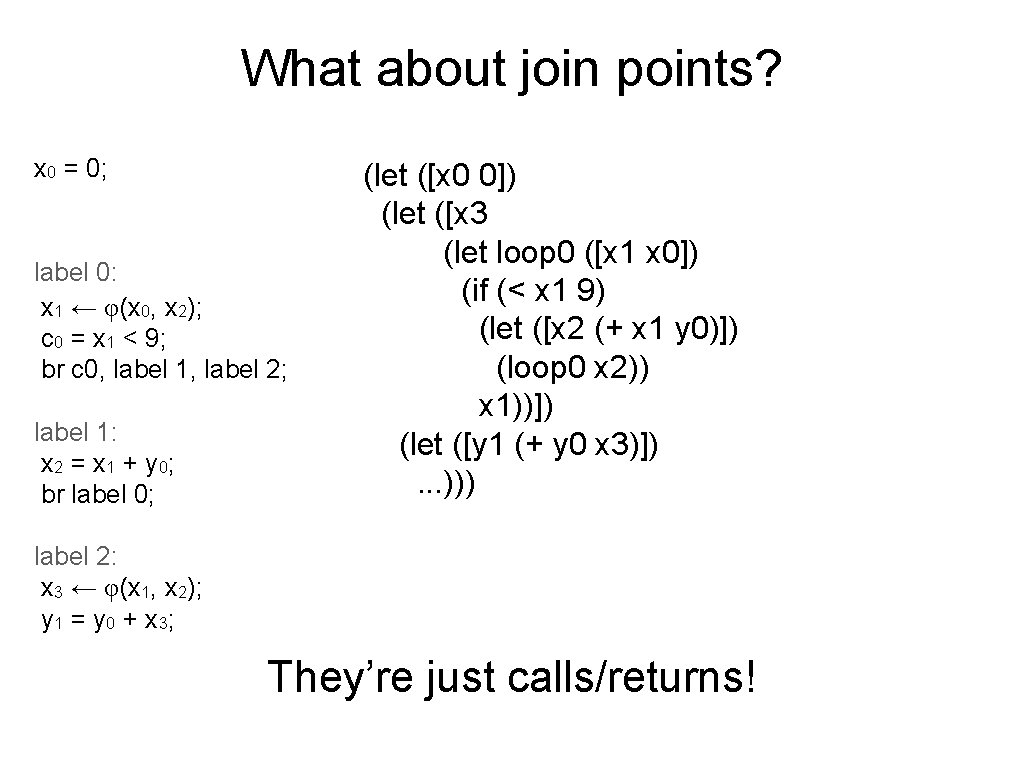
What about join points? x 0 = 0; label 0: x 1 ← φ(x 0, x 2); c 0 = x 1 < 9; br c 0, label 1, label 2; label 1: x 2 = x 1 + y 0; br label 0; (let ([x 0 0]) (let ([x 3 (let loop 0 ([x 1 x 0]) (if (< x 1 9) (let ([x 2 (+ x 1 y 0)]) (loop 0 x 2)) x 1))]) (let ([y 1 (+ y 0 x 3)]). . . ))) label 2: x 3 ← φ(x 1, x 2); y 1 = y 0 + x 3; They’re just calls/returns!
(let ([x 0 0]) (let ([x 3 (letrec* ([loop 0 (lambda (x 1) (if (< x 1 9) (let ([x 2 (+ x 1 y 0)]) (loop 0 x 2)) x 1))]) (loop 0 x 0))]) (let ([y 1 (+ y 0 x 3)]). . . )))
(let ([x 0 0]) (let ([x 3 (letrec* ([loop 0 (lambda (x 1) (if (< x 1 9) (let ([x 2 (+ x 1 y 0)]) (loop 0 x 2)) x 1))]) (loop 0 x 0))]) (let ([y 1 (+ y 0 x 3)]). . . )))
(let ([x 0 0]) (let ([x 3 (let ([loop 0 ‘()]) (set! loop 0 (lambda (x 1) (if (< x 1 9) (let ([x 2 (+ x 1 y 0)]) (loop 0 x 2)) x 1))) (loop 0 x 0))]) (let ([y 1 (+ y 0 x 3)]). . . )))
(let ([x 0 0]) (let ([x 3 (let ([loop 0 ‘()]) (set! loop 0 (lambda (x 1) (if (< x 1 9) (let ([x 2 (+ x 1 y 0)]) (loop 0 x 2)) x 1))) (loop 0 x 0))]) (let ([y 1 (+ y 0 x 3)]). . . )))
(let ([x 0 0]) (let ([x 3 (let ([loop 0 (make-vector 1 ’())]) (vector-set! loop 0 0 (lambda (x 1) (if (< x 1 9) (let ([x 2 (+ x 1 y 0)]) (let ([loop 2 (vector-ref loop 0 0)]) (loop 2 x 2)) x 1))) (let ([loop 1 (vector-ref loop 0 0)]) (loop 1 x 0)))]) (let ([y 1 (+ y 0 x 3)]). . . )))