
SS SELFTALK AND PERCEIVED EXERTION IN PHYSICAL ACTIVITY
- Slides: 1
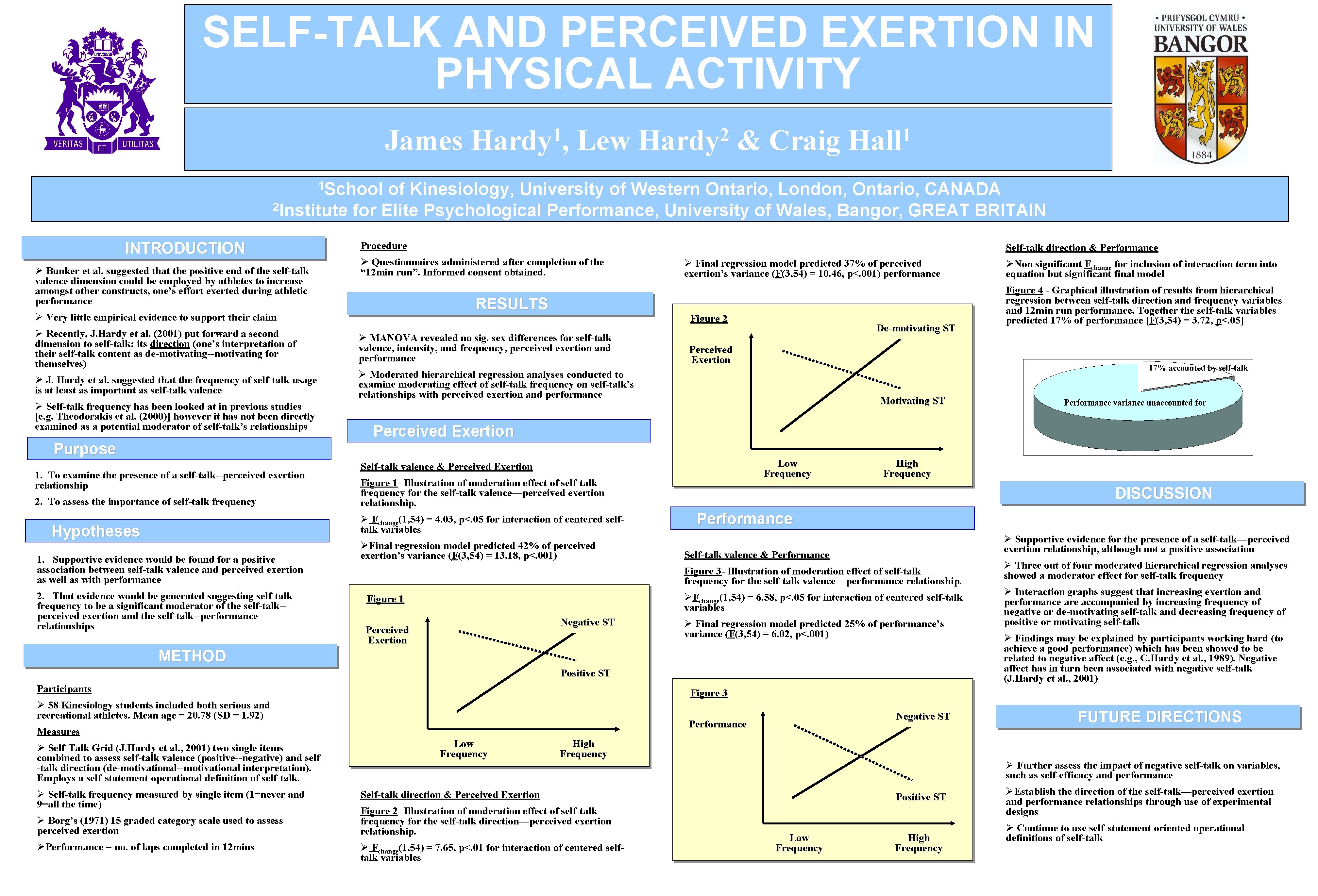
SS SELF-TALK AND PERCEIVED EXERTION IN PHYSICAL ACTIVITY James 1 Hardy , Lew 2 Hardy & Craig 1 Hall 1 School of Kinesiology, University of Western Ontario, London, Ontario, CANADA 2 Institute for Elite Psychological Performance, University of Wales, Bangor, GREAT BRITAIN INTRODUCTION Ø Bunker et al. suggested that the positive end of the self-talk valence dimension could be employed by athletes to increase amongst other constructs, one’s effort exerted during athletic performance Procedure Ø Questionnaires administered after completion of the “ 12 min run”. Informed consent obtained. RESULTS Ø Very little empirical evidence to support their claim Ø Recently, J. Hardy et al. (2001) put forward a second dimension to self-talk; its direction (one’s interpretation of their self-talk content as de-motivating--motivating for themselves) Ø J. Hardy et al. suggested that the frequency of self-talk usage is at least as important as self-talk valence Ø Self-talk frequency has been looked at in previous studies [e. g. Theodorakis et al. (2000)] however it has not been directly examined as a potential moderator of self-talk’s relationships Purpose 1. To examine the presence of a self-talk--perceived exertion relationship 2. To assess the importance of self-talk frequency Self-talk direction & Performance Figure 2 Ø MANOVA revealed no sig. sex differences for self-talk valence, intensity, and frequency, perceived exertion and performance 1. Supportive evidence would be found for a positive association between self-talk valence and perceived exertion as well as with performance 2. That evidence would be generated suggesting self-talk frequency to be a significant moderator of the self-talk-perceived exertion and the self-talk--performance relationships De-motivating ST Perceived Exertion Low Frequency Self-talk valence & Perceived Exertion Figure 1 - Illustration of moderation effect of self-talk frequency for the self-talk valence—perceived exertion relationship. ØFinal regression model predicted 42% of perceived exertion’s variance (F(3, 54) = 13. 18, p<. 001) High Frequency DISCUSSION Performance Ø Supportive evidence for the presence of a self-talk—perceived exertion relationship, although not a positive association Self-talk valence & Performance Figure 3 - Illustration of moderation effect of self-talk frequency for the self-talk valence—performance relationship. ØFchange(1, 54) = 6. 58, p<. 05 for interaction of centered self-talk variables Figure 1 Negative ST Perceived Exertion Ø Final regression model predicted 25% of performance’s variance (F(3, 54) = 6. 02, p<. 001) Positive ST Participants ØPerformance = no. of laps completed in 12 mins Negative ST Performance Measures Ø Borg’s (1971) 15 graded category scale used to assess perceived exertion Ø Three out of four moderated hierarchical regression analyses showed a moderator effect for self-talk frequency Ø Interaction graphs suggest that increasing exertion and performance are accompanied by increasing frequency of negative or de-motivating self-talk and decreasing frequency of positive or motivating self-talk Ø Findings may be explained by participants working hard (to achieve a good performance) which has been showed to be related to negative affect (e. g. , C. Hardy et al. , 1989). Negative affect has in turn been associated with negative self-talk (J. Hardy et al. , 2001) Figure 3 Ø 58 Kinesiology students included both serious and recreational athletes. Mean age = 20. 78 (SD = 1. 92) Ø Self-talk frequency measured by single item (1=never and 9=all the time) Figure 4 - Graphical illustration of results from hierarchical regression between self-talk direction and frequency variables and 12 min run performance. Together the self-talk variables predicted 17% of performance [F(3, 54) = 3. 72, p<. 05] Motivating ST METHOD Ø Self-Talk Grid (J. Hardy et al. , 2001) two single items combined to assess self-talk valence (positive--negative) and self -talk direction (de-motivational--motivational interpretation). Employs a self-statement operational definition of self-talk. ØNon significant Fchange for inclusion of interaction term into equation but significant final model Perceived Exertion Ø Moderated hierarchical regression analyses conducted to examine moderating effect of self-talk frequency on self-talk’s relationships with perceived exertion and performance Ø Fchange(1, 54) = 4. 03, p<. 05 for interaction of centered selftalk variables Hypotheses Ø Final regression model predicted 37% of perceived exertion’s variance (F(3, 54) = 10. 46, p<. 001) performance Low Frequency High Frequency Ø Further assess the impact of negative self-talk on variables, such as self-efficacy and performance Self-talk direction & Perceived Exertion Figure 2 - Illustration of moderation effect of self-talk frequency for the self-talk direction—perceived exertion relationship. Ø Fchange(1, 54) = 7. 65, p<. 01 for interaction of centered selftalk variables FUTURE DIRECTIONS Positive ST Low Frequency High Frequency ØEstablish the direction of the self-talk—perceived exertion and performance relationships through use of experimental designs Ø Continue to use self-statement oriented operational definitions of self-talk