
SS Princess Kathleen Fuel Removal Project February 12
S/S Princess Kathleen Fuel Removal Project February 12 to June 4, 2010 Point Lena Juneau, Alaska © 2010 Global Diving & Salvage, Inc.
© 2010 Global Diving & Salvage, Inc.
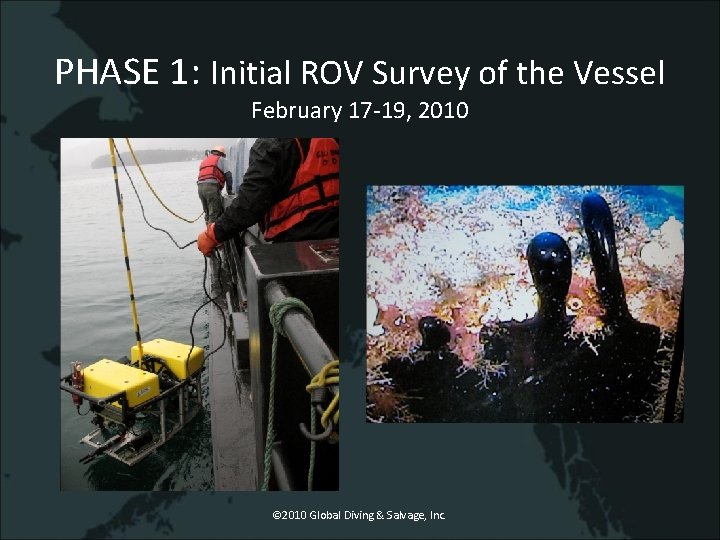
PHASE 1: Initial ROV Survey of the Vessel February 17 -19, 2010 © 2010 Global Diving & Salvage, Inc.
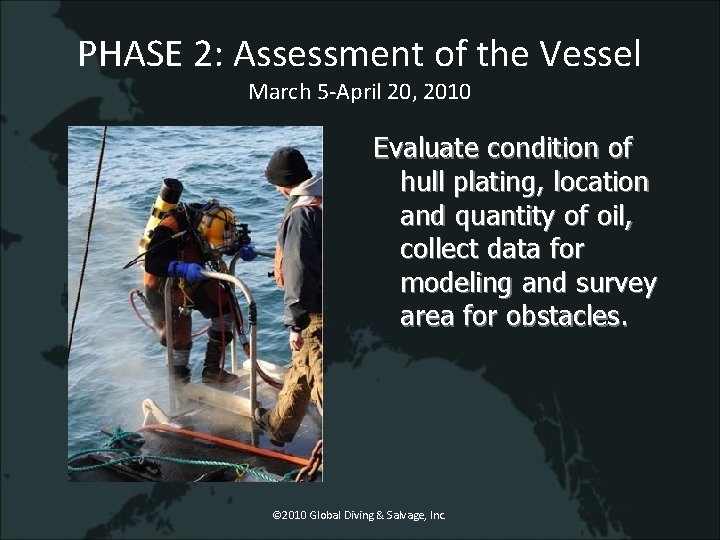
PHASE 2: Assessment of the Vessel March 5 -April 20, 2010 Evaluate condition of hull plating, location and quantity of oil, collect data for modeling and survey area for obstacles. © 2010 Global Diving & Salvage, Inc.
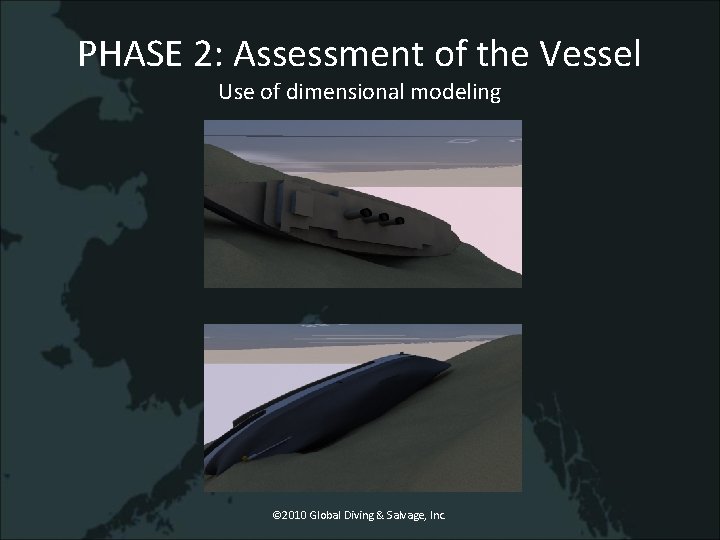
PHASE 2: Assessment of the Vessel Use of dimensional modeling © 2010 Global Diving & Salvage, Inc.
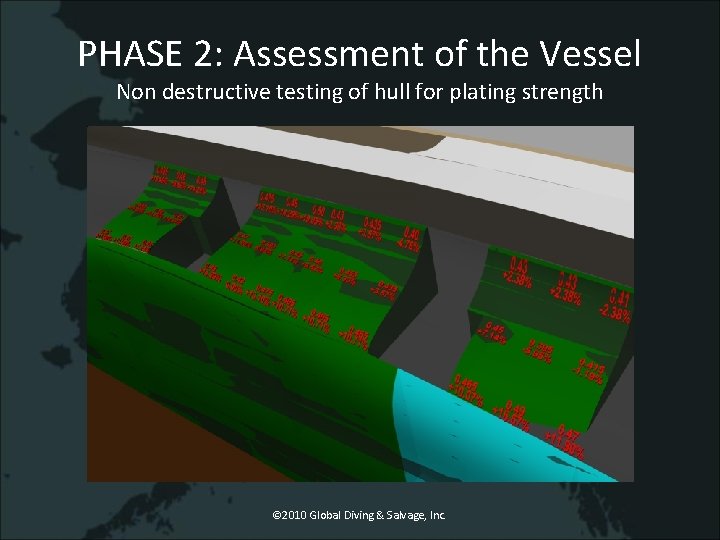
PHASE 2: Assessment of the Vessel Non destructive testing of hull for plating strength © 2010 Global Diving & Salvage, Inc.
PHASE 2: Assessment of the Vessel Sampling tanks and hull for confirmation of oil © 2010 Global Diving & Salvage, Inc.
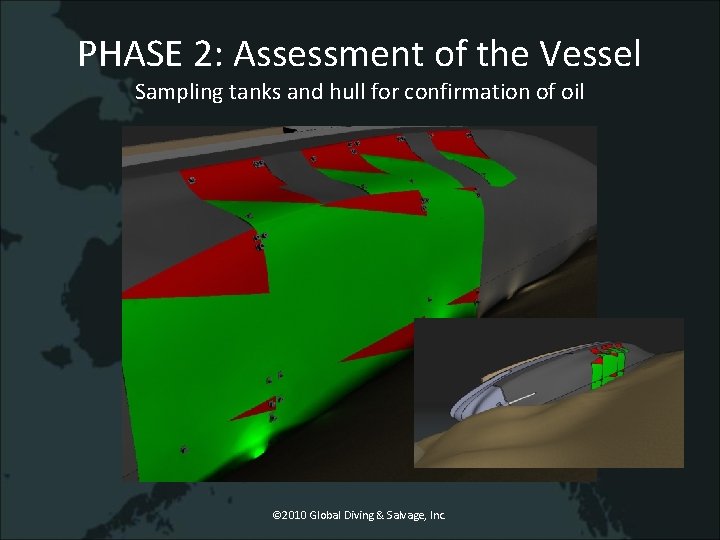
PHASE 2: Assessment of the Vessel Sampling tanks and hull for confirmation of oil © 2010 Global Diving & Salvage, Inc.
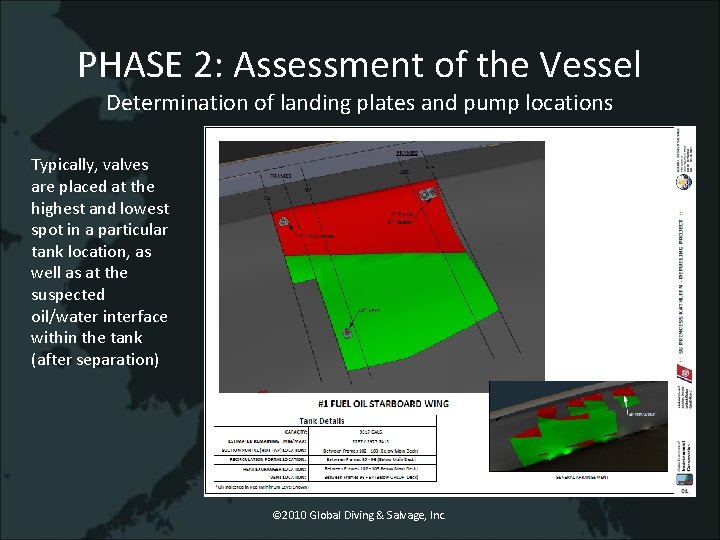
PHASE 2: Assessment of the Vessel Determination of landing plates and pump locations Typically, valves are placed at the highest and lowest spot in a particular tank location, as well as at the suspected oil/water interface within the tank (after separation) © 2010 Global Diving & Salvage, Inc.
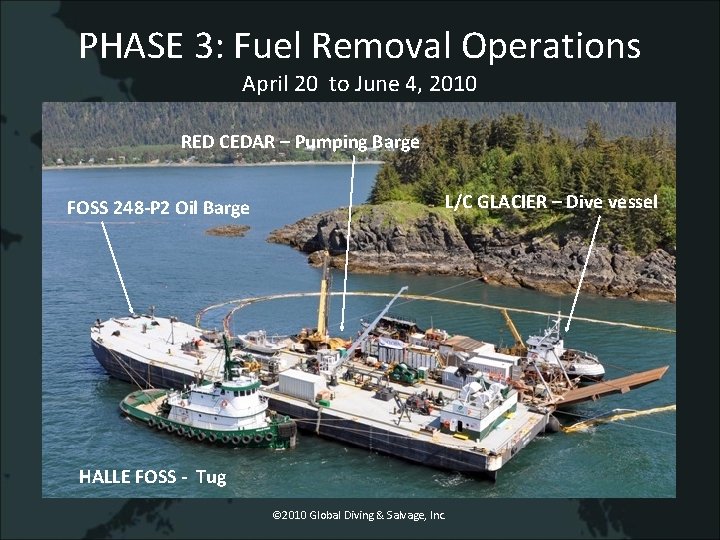
PHASE 3: Fuel Removal Operations April 20 to June 4, 2010 RED CEDAR – Pumping Barge FOSS 248 -P 2 Oil Barge L/C GLACIER – Dive vessel HALLE FOSS - Tug © 2010 Global Diving & Salvage, Inc.
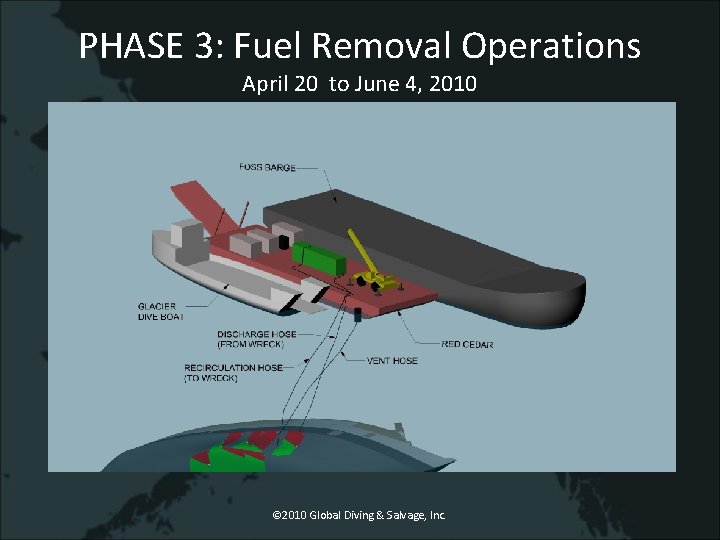
PHASE 3: Fuel Removal Operations April 20 to June 4, 2010 © 2010 Global Diving & Salvage, Inc.
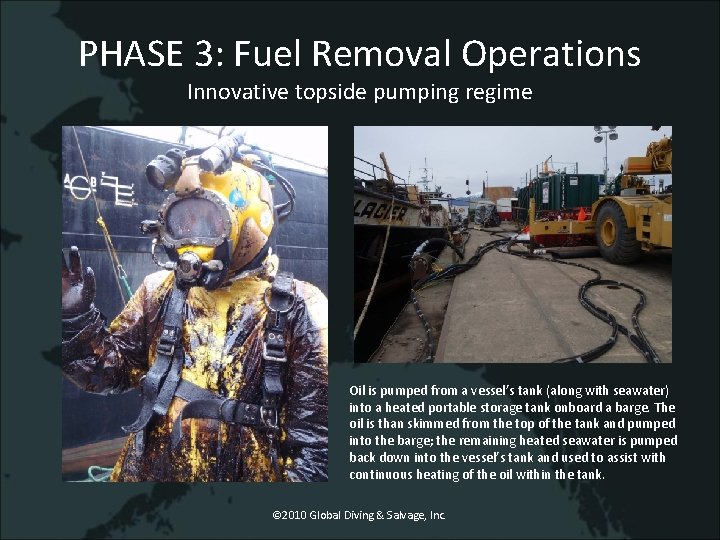
PHASE 3: Fuel Removal Operations Innovative topside pumping regime Oil is pumped from a vessel’s tank (along with seawater) into a heated portable storage tank onboard a barge. The oil is than skimmed from the top of the tank and pumped into the barge; the remaining heated seawater is pumped back down into the vessel’s tank and used to assist with continuous heating of the oil within the tank. © 2010 Global Diving & Salvage, Inc.
PHASE 3: Fuel Removal Operations Challenges Hydrogen Sulfide (H 2 S) -Anaerobic decay aided by bacteria produces H 2 S, a potentially deadly gas, which may be present in fuel tanks due to microbial interaction with the hydrocarbons -At least one of Princess Kathleen’s fuel tanks contained significant H 2 S which was detected by alert crewmen and air monitoring equipment on deck -Air monitoring must be continuous during pumping operations. Personnel must be trained, equipped and prepared to react to the onset of a release of H 2 S during pumping operations Hull Pressurization -While the steel hull of the vessel was in reasonably good condition the rivets were failing -Pressurization of the internal spaces in the tank being pumped could cause oil to be pressed around the rivets and through the hull. Excessive pressure could lead to rivet failure and a breach of the tank -Specialized pressure monitoring systems were developed to allow constant monitoring of the internal pressure and vacuum of the tank being pumped © 2010 Global Diving & Salvage, Inc.
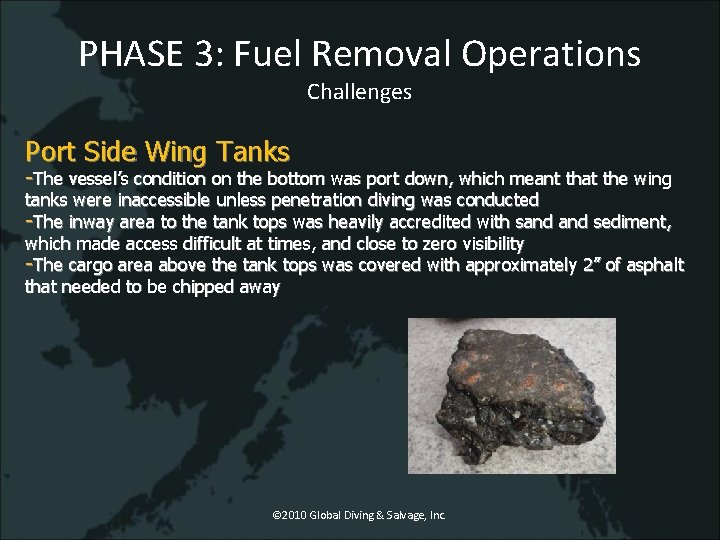
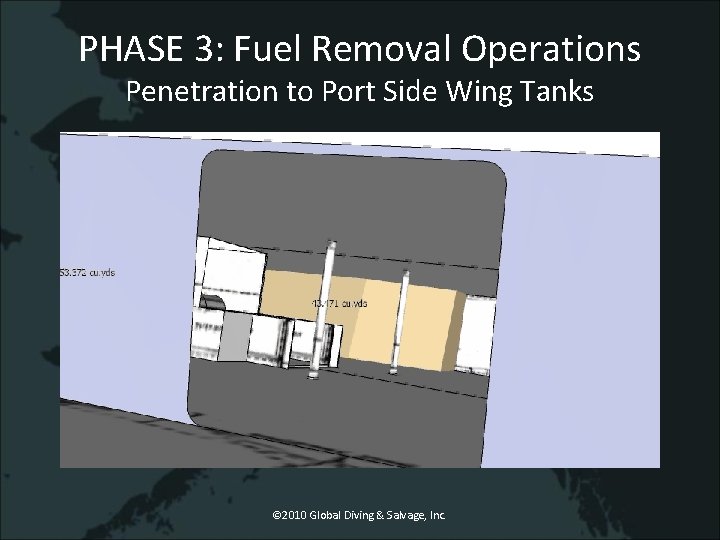
PHASE 3: Fuel Removal Operations Challenges Port Side Wing Tanks -The vessel’s condition on the bottom was port down, which meant that the wing tanks were inaccessible unless penetration diving was conducted -The inway area to the tank tops was heavily accredited with sand sediment, which made access difficult at times, and close to zero visibility -The cargo area above the tank tops was covered with approximately 2” of asphalt that needed to be chipped away © 2010 Global Diving & Salvage, Inc.
PHASE 3: Fuel Removal Operations Penetration to Port Side Wing Tanks © 2010 Global Diving & Salvage, Inc.
PHASE 3: Fuel Removal Operations Penetration to Port Side Wing Tanks © 2010 Global Diving & Salvage, Inc.
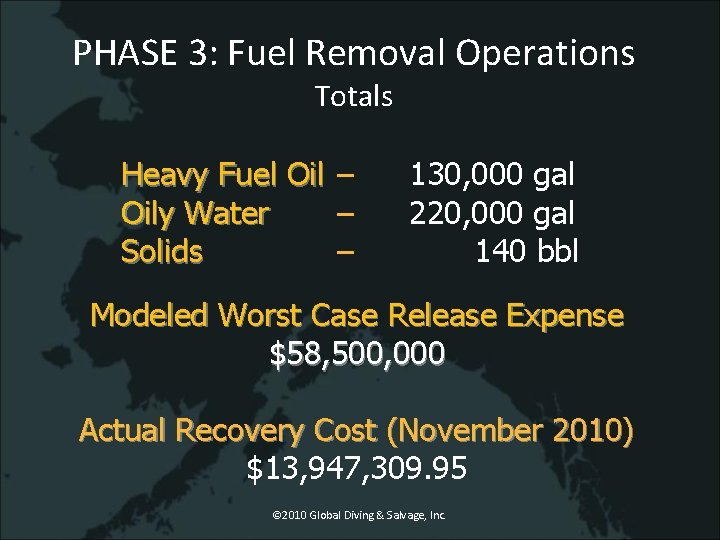
PHASE 3: Fuel Removal Operations Totals Heavy Fuel Oil – Oily Water – Solids – 130, 000 gal 220, 000 gal 140 bbl Modeled Worst Case Release Expense $58, 500, 000 Actual Recovery Cost (November 2010) $13, 947, 309. 95 © 2010 Global Diving & Salvage, Inc.
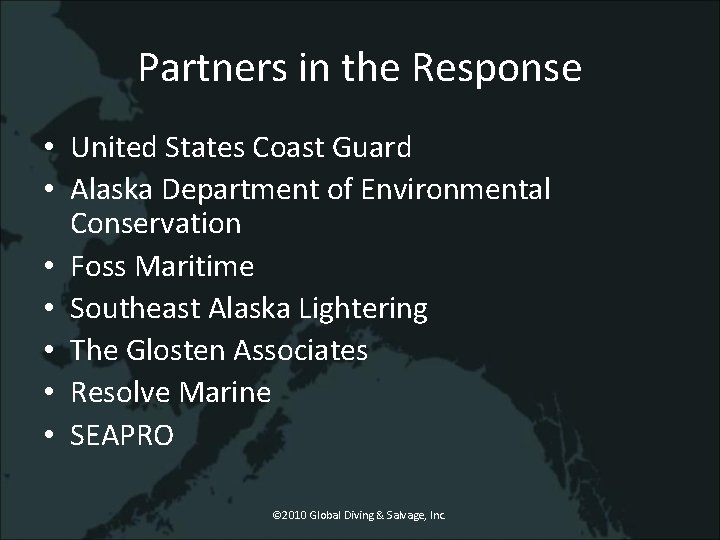
Partners in the Response • United States Coast Guard • Alaska Department of Environmental Conservation • Foss Maritime • Southeast Alaska Lightering • The Glosten Associates • Resolve Marine • SEAPRO © 2010 Global Diving & Salvage, Inc.
- Slides: 18