
SS Chapter 2 Lesson 1 Hunters and Gatherers
- Slides: 12
SS Chapter 2, Lesson 1, Hunters and Gatherers
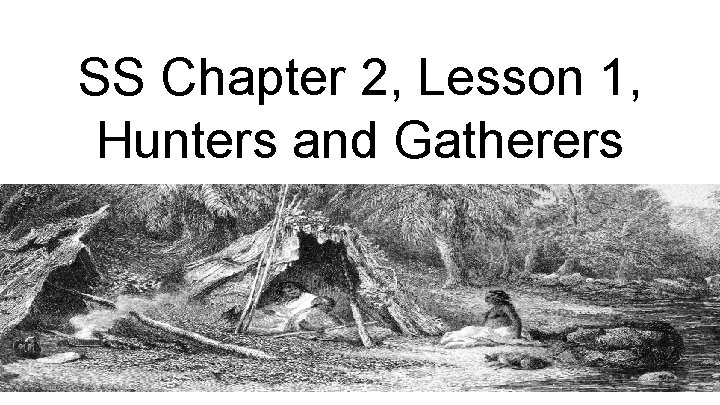
SS Chapter 2, Lesson 1, *How did early humans interact with the environment? Slide 1 *Early humans were hunter-gatherers that hunted animals and gathered plant food in order to survive. *When hunter-gatherers no longer had enough to eat, they moved on to another location. *Early humans depended on the natural environment for shelter. *Some lived in caves and rock shelters, while those that lived in plains or desert areas made shelters out of branches, plant fibers, or animal skins.
SS Chapter 2, Lesson 1, -Why did huntergatherers live in small bands? Slide 2 -Hunter-gatherers lived together in small bands of around 30 people, made up of several families. -The size of the group reflected the number of people who could live off the plants and animals of a given region. -Men hunted and fished while women gathered foods, such as berries and nuts. -Women, also, cared for the children, who also worked.
SS Chapter 2, Lesson 1, *Why were early humans on the move? Slide 3 *Hunter-gatherers were nomads, people who moved from place to place. *Movement was often limited and groups returned to the same places with the changing of the seasons. *The act of moving from one place to another is called migration. *Early humans probably moved to new and distant lands in order to follow animals to hunt. *By around 15000 B. C. , hunter-gatherers had migrated throughout much of the world
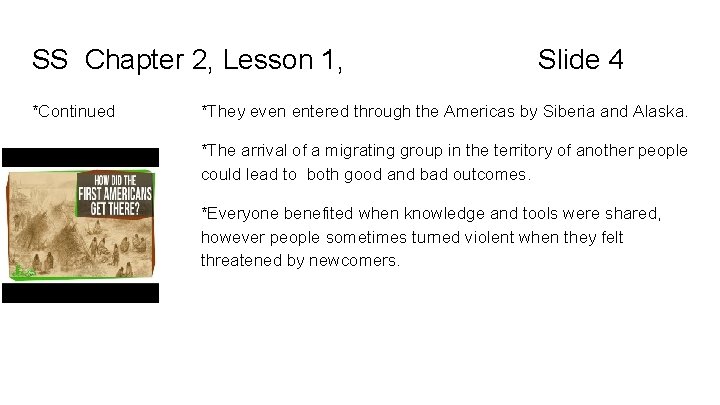
SS Chapter 2, Lesson 1, *Continued Slide 4 *They even entered through the Americas by Siberia and Alaska. *The arrival of a migrating group in the territory of another people could lead to both good and bad outcomes. *Everyone benefited when knowledge and tools were shared, however people sometimes turned violent when they felt threatened by newcomers.
SS Chapter 2, Lesson 1, -What were some of the tools created by early humans? Slide 5 -Around 500, 000 years ago, early humans learned how to make and control fire. -Fire provided heat and light, offered protection from animals, enabled people to cook food, and was used to temper, or harden tools made of metal. -Technology consists of all the ways in which people applied knowledge, tools, and inventions to meet their needs. -At least 2 million years ago, people made stone tools for cutting and eventually made carrying bags, stone hand axes, awls, and drills.
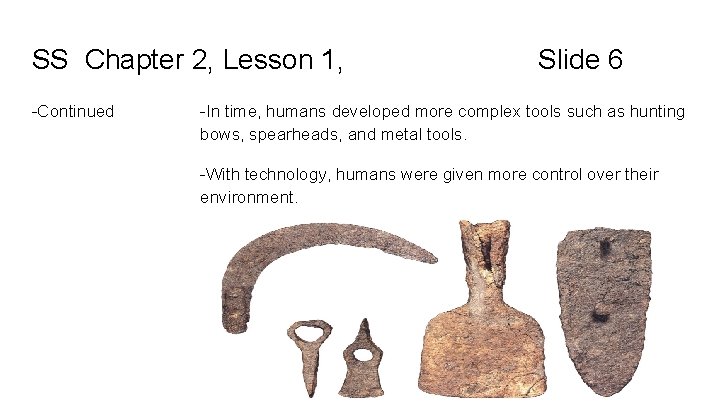
SS Chapter 2, Lesson 1, -Continued Slide 6 -In time, humans developed more complex tools such as hunting bows, spearheads, and metal tools. -With technology, humans were given more control over their environment.
SS Chapter 2, Lesson 1, *What kind of culture did early humans create? Slide 7 *Art, language, and religion are special to humans and help create their culture. *Language probably developed as a result of the need for people to work together. *One theory is that Hunters needed to be able to talk to one another in order to outsmart, trap, and kill animals for food. *Another theory suggests that the cooperation needed to gather and share food led to the development of language.
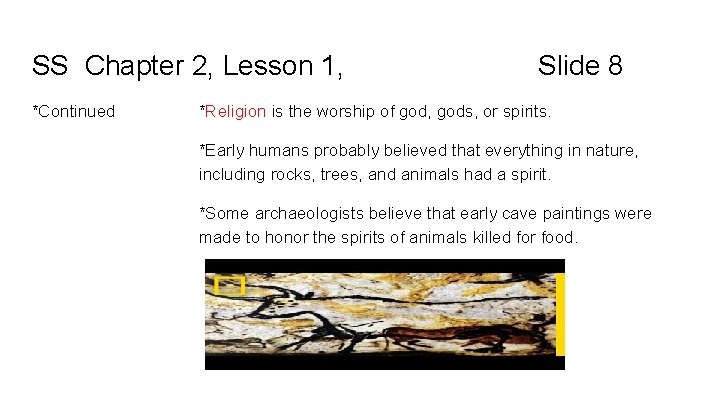
SS Chapter 2, Lesson 1, *Continued Slide 8 *Religion is the worship of god, gods, or spirits. *Early humans probably believed that everything in nature, including rocks, trees, and animals had a spirit. *Some archaeologists believe that early cave paintings were made to honor the spirits of animals killed for food.
SS Chapter 2, Lesson 1, *Continued Slide 9 *Prehistoric art gives insights into humans’ daily life and shared beliefs. *Early humans created art in caves and rock shelters, as well as art they could carry with themselves. *Prehistoric art exists in Africa, Asia, Australia, Europe, and the Americas showing lively images of bulls, stallions, and bison. *Art also included music, dance, stories, jewelry, and figurines.
SS Chapter 2, Lesson 1, -Summary Slide 10 ● Hunter-gatherers were nomads ● Fire and tools improved lives ● Early humans created language religion and art
Questions? ? ? 1. 2. 3. 4. What did hunter-gatherers do when they no longer had enough food to eat? What is a job that early women performed? What did technology provide for early humans? What is a theory that explains why early humans developed language?