
SS 8 H 3 a Georgias History The
- Slides: 54
SS 8 H 3 a Georgia’s History: The Road to Revolution © 2014 Brain Wrinkles
Standards SS 8 H 3 The student will analyze the role of Georgia in the American Revolution. a. Explain the immediate and long-term causes of the American Revolution and their impact on Georgia; include the French and Indian War (Seven Years War), Proclamation of 1763, Stamp Act, Intolerable Acts, and the Declaration of Independence. © 2014 Brain Wrinkles
Teacher Info – Who’s & What’s • Print off the Who’s & What’s handout for each student. (Print front and back to save paper. ) • BEFORE the unit, have students fill in the squares with what they think each term means. • AFTER the presentation, the students will write down new (factual) information about each term. • Check the answers as a class. © 2014 Brain Wrinkles
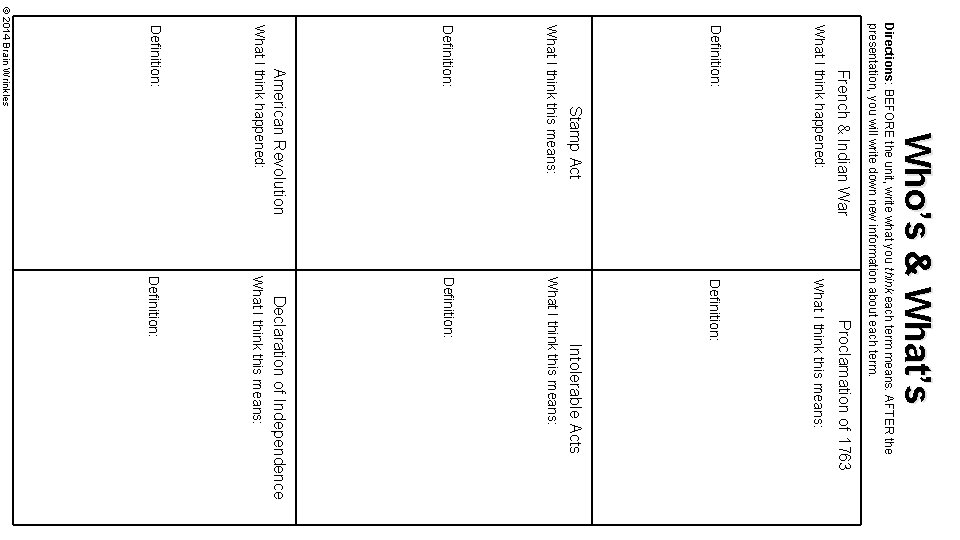
Who’s & What’s Directions: BEFORE the unit, write what you think each term means. AFTER the presentation, you will write down new information about each term. What I think this means: Proclamation of 1763 What I think happened: Definition: French & Indian War Definition: What I think this means: Intolerable Acts What I think this means: Definition: Stamp Act Definition: What I think this means: Declaration of Independence What I think happened: Definition: American Revolution Definition: © 2014 Brain Wrinkles
Teacher Directions – CLOZE Notes • The next pages are handouts for the students to use for notetaking during the presentation. (Print front to back to save paper and ink. ) • Check the answers as a class after the presentation. • *Please note – the slides in this presentation are content-heavy. Feel free to open the editable file if you’d like to delete anything. I’ve found that it’s better to have too much than not enough! © 2014 Brain Wrinkles
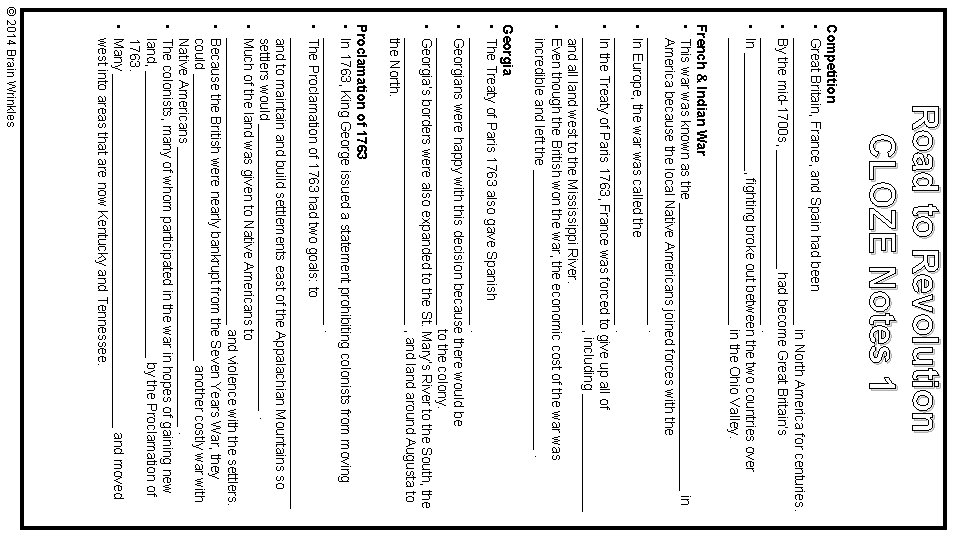
Road to Revolution CLOZE Notes 1 Competition • Great Britain, France, and Spain had been ____________________ in North America for centuries. • By the mid-1700 s, ________ had become Great Britain’s ____________________. • In ________, fighting broke out between the two countries over ____________________ in the Ohio Valley. French & Indian War • This war was known as the ____________________ in America because the local Native Americans joined forces with the ____________________. • In Europe, the war was called the ____________________. • In the Treaty of Paris 1763, France was forced to give up all of ____________________ , including ________ and all land west to the Mississippi River. • Even though the British won the war, the economic cost of the war was incredible and left the ___________________. Georgia • The Treaty of Paris 1763 also gave Spanish ____________________. • Georgians were happy with this decision because there would be ____________________ to the colony. • Georgia’s borders were also expanded to the St. Mary’s River to the South, the ____________________ , and land around Augusta to the North. Proclamation of 1763 • In 1763, King George issued a statement prohibiting colonists from moving ____________________. • The Proclamation of 1763 had two goals: to ________________________________ and to maintain and build settlements east of the Appalachian Mountains so settlers would ____________________. • Much of the land was given to Native Americans to ____________________ and violence with the settlers. • Because the British were nearly bankrupt from the Seven Years War, they could ____________________ another costly war with Native Americans ___________________. • The colonists, many of whom participated in the war in hopes of gaining new land, ____________________ by the Proclamation of 1763. • Many ________________________ and moved west into areas that are now Kentucky and Tennessee. © 2014 Brain Wrinkles
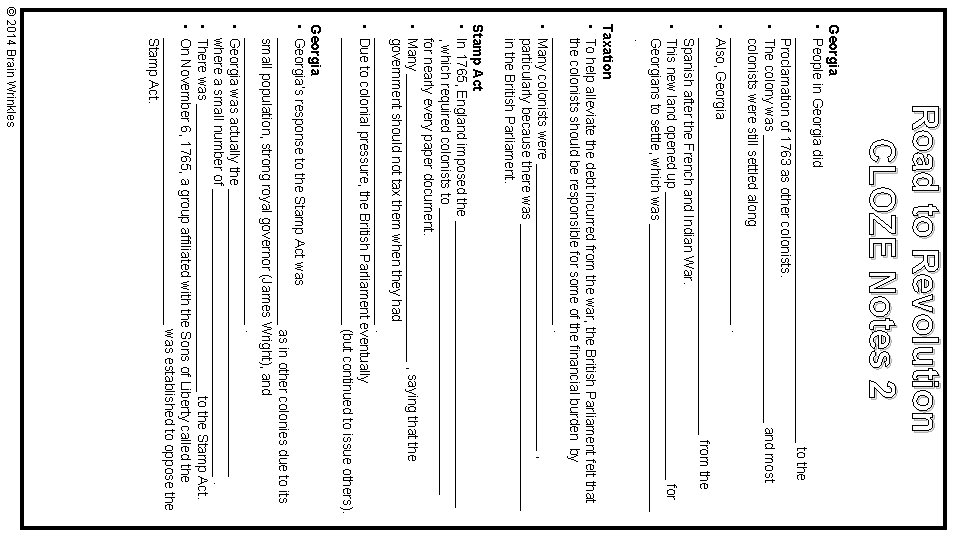
Road to Revolution CLOZE Notes 2 Georgia • People in Georgia did ____________________________ to the Proclamation of 1763 as other colonists. • The colony was ____________________ and most colonists were still settled along ____________________. • Also, Georgia ___________________________ from the Spanish after the French and Indian War. • This new land opened up ____________________ for Georgians to settle, which was ____________________. Taxation • To help alleviate the debt incurred from the war, the British Parliament felt that the colonists should be responsible for some of the financial burden by ____________________. • Many colonists were ____________________ , particularly because there was ____________________ in the British Parliament. Stamp Act • In 1765, England imposed the ____________________ , which required colonists to ____________________ for nearly every paper document. • Many ____________________ , saying that the government should not tax them when they had ____________________. • Due to colonial pressure, the British Parliament eventually ____________________ (but continued to issue others). Georgia • Georgia’s response to the Stamp Act was ____________________ as in other colonies due to its small population, strong royal governor (James Wright), and ____________________. • Georgia was actually the ____________________ where a small number of ____________________. • There was ____________________ to the Stamp Act. • On November 6, 1765, a group affiliated with the Sons of Liberty called the ____________________ was established to oppose the Stamp Act. © 2014 Brain Wrinkles
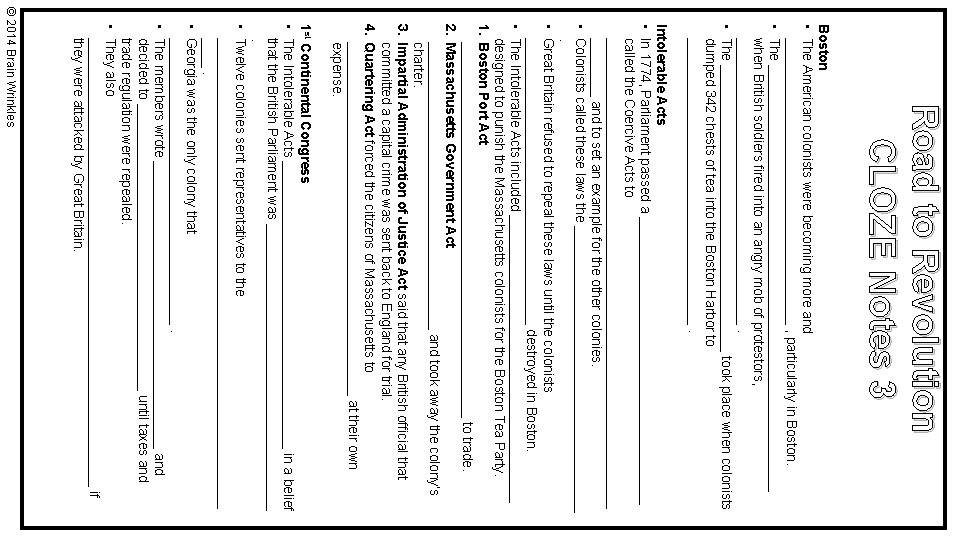
Road to Revolution CLOZE Notes 3 Boston • The American colonists were becoming more and ____________________ , particularly in Boston. • The _____________________________ when British soldiers fired into an angry mob of protestors, ____________________. • The ____________________ took place when colonists dumped 342 chests of tea into the Boston Harbor to ____________________. Intolerable Acts • In 1774, Parliament passed a ____________________ called the Coercive Acts to ________________________________ and to set an example for the other colonies. • Colonists called these laws the ____________________. • Great Britain refused to repeal these laws until the colonists ____________________ destroyed in Boston. • The Intolerable Acts included ____________________ designed to punish the Massachusetts colonists for the Boston Tea Party. 1. Boston Port Act __________________________ to trade. 2. Massachusetts Government Act ____________________ and took away the colony’s charter. 3. Impartial Administration of Justice Act said that any British official that committed a capital crime was sent back to England for trial. 4. Quartering Act forced the citizens of Massachusetts to ________________________ at their own expense. 1 st Continental Congress • The Intolerable Acts ____________________ in a belief that the British Parliament was ____________________. • Twelve colonies sent representatives to the ________________________________. • Georgia was the only colony that ____________________. • The members wrote ____________________ and decided to ____________________ until taxes and trade regulation were repealed. • They also _______________________________ if they were attacked by Great Britain. © 2014 Brain Wrinkles
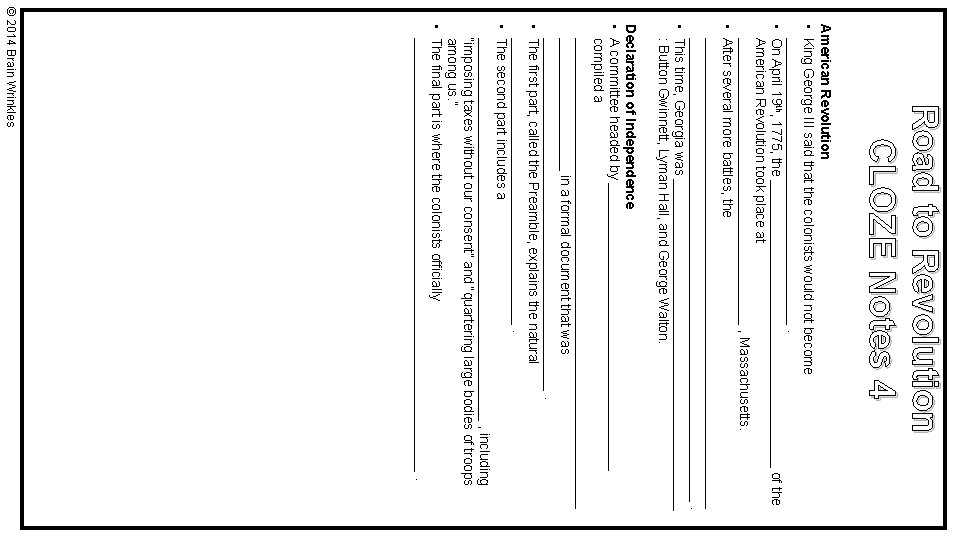
Road to Revolution CLOZE Notes 4 American Revolution • King George III said that the colonists would not become ____________________. • On April 19 th, 1775, the ____________________ of the American Revolution took place at ____________________ , Massachusetts. • After several more battles, the ________________________________. • This time, Georgia was _______________________ : Button Gwinnett, Lyman Hall, and George Walton. Declaration of Independence • A committee headed by ____________________ compiled a ________________________________ in a formal document that was ________________________. • The first part, called the Preamble, explains the natural ____________________. • The second part includes a __________________________ , including “imposing taxes without our consent” and “quartering large bodies of troops among us. ” • The final part is where the colonists officially ______________________________. © 2014 Brain Wrinkles
SS 8 H 3 a Georgia’s History: The Road to Revolution © 2014 Brain Wrinkles
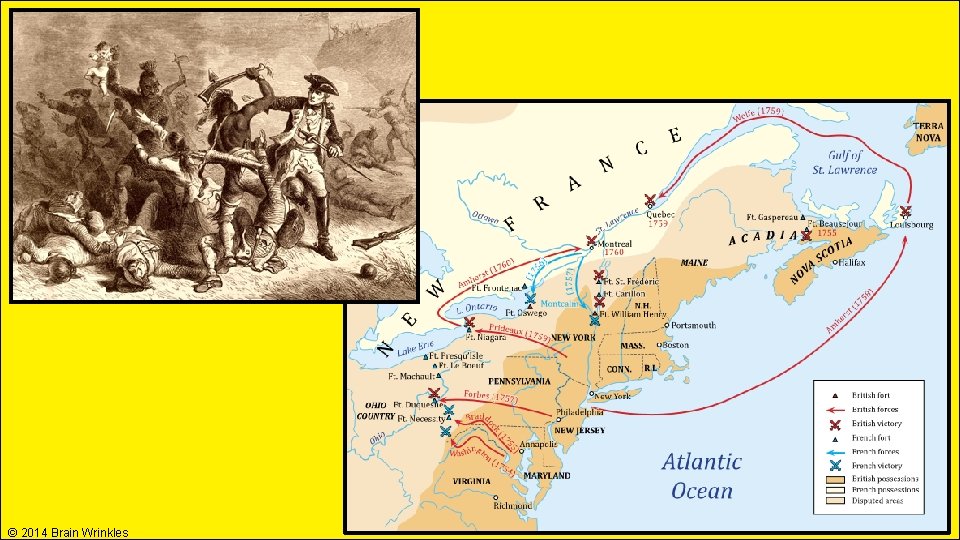
Competition • Great Britain, France, and Spain had been competing for land in North America for centuries. • By the mid-1700 s, France had become Great Britain’s biggest rival. • In 1756, fighting broke out between the two countries over fur trading territory in the Ohio Valley. © 2014 Brain Wrinkles
French & Indian War • This war was known as the French and Indian War in America because the local Native Americans joined forces with the French troops. • They were worried that the British settlers would take over their land. • In Europe, the war was called the Seven Years’ War. © 2014 Brain Wrinkles
© 2014 Brain Wrinkles
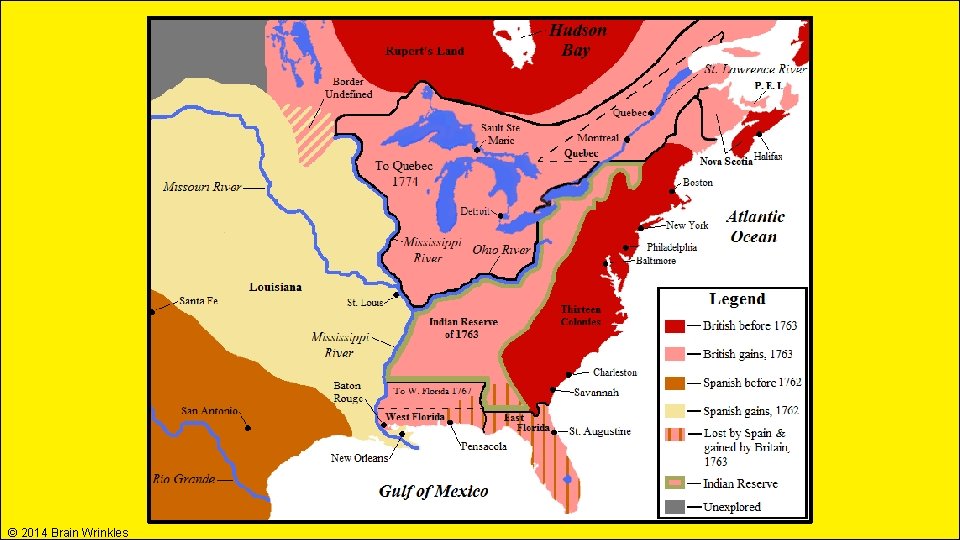
French & Indian War • Great Britain won the war. • In the Treaty of Paris 1763, France was forced to give up all of its North American colonies, including Canada and all land west to the Mississippi River. • Even though the British won the war, the economic cost of the war was incredible and left the country virtually bankrupt. © 2014 Brain Wrinkles
© 2014 Brain Wrinkles
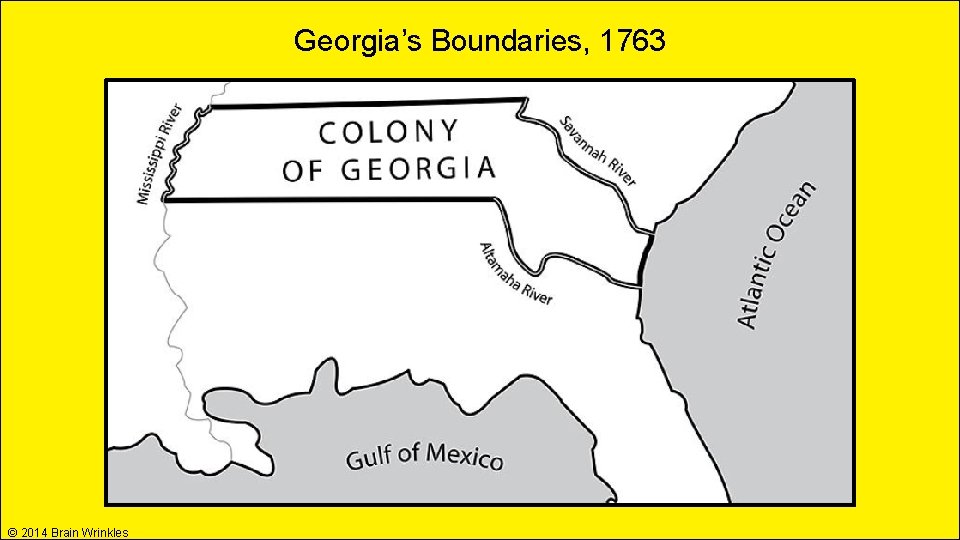
Georgia • The Treaty of Paris 1763 also gave Spanish Florida to England. • Georgians were happy with this decision because there would be no more Spanish threat to the colony. • Georgia’s borders were also expanded to the St. Mary’s River to the South, the Mississippi River to the West, and land around Augusta to the North. © 2014 Brain Wrinkles
Georgia’s Boundaries, 1763 © 2014 Brain Wrinkles
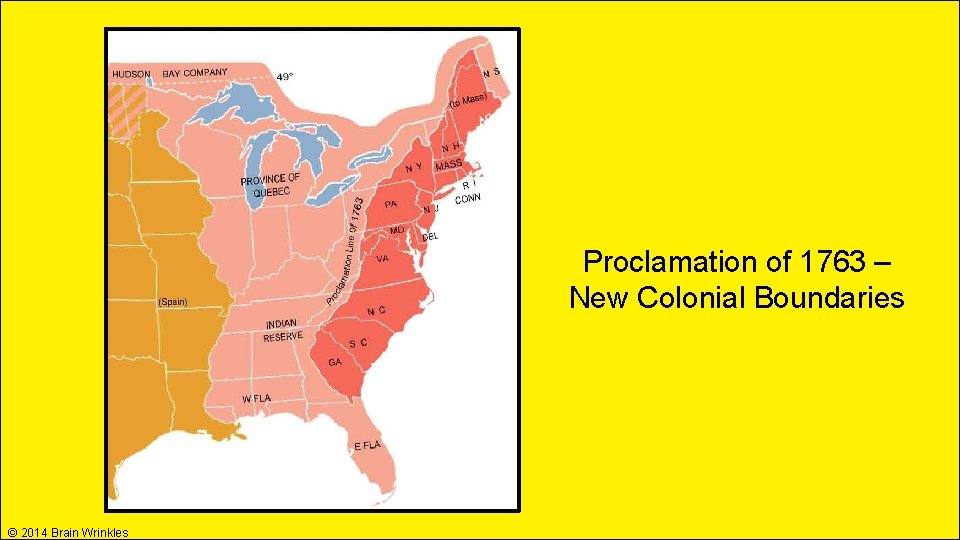
Proclamation of 1763 • In 1763, King George issued a statement prohibiting colonists from moving west of the Appalachian Mountains. • Colonists who lived there had to pack up and move back east. • The Proclamation of 1763 had two goals: to avoid future conflicts with Indians and to maintain and build settlements east of the Appalachian Mountains so settlers would trade with England. © 2014 Brain Wrinkles
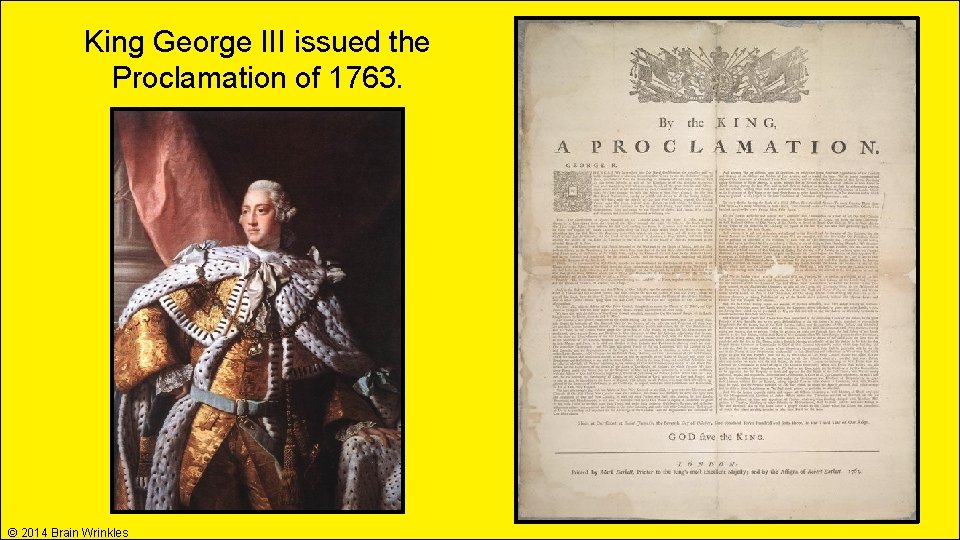
King George III issued the Proclamation of 1763. © 2014 Brain Wrinkles
Proclamation of 1763 • Much of the land was given to Native Americans to avoid uprisings and violence with the settlers. • The intent was to stabilize relations between Great Britain and the Native American tribes who lived in the area. • Because the British were nearly bankrupt from the Seven Years War, they could not afford to fight another costly war with Native Americans over territory. © 2014 Brain Wrinkles
Proclamation of 1763 – New Colonial Boundaries © 2014 Brain Wrinkles
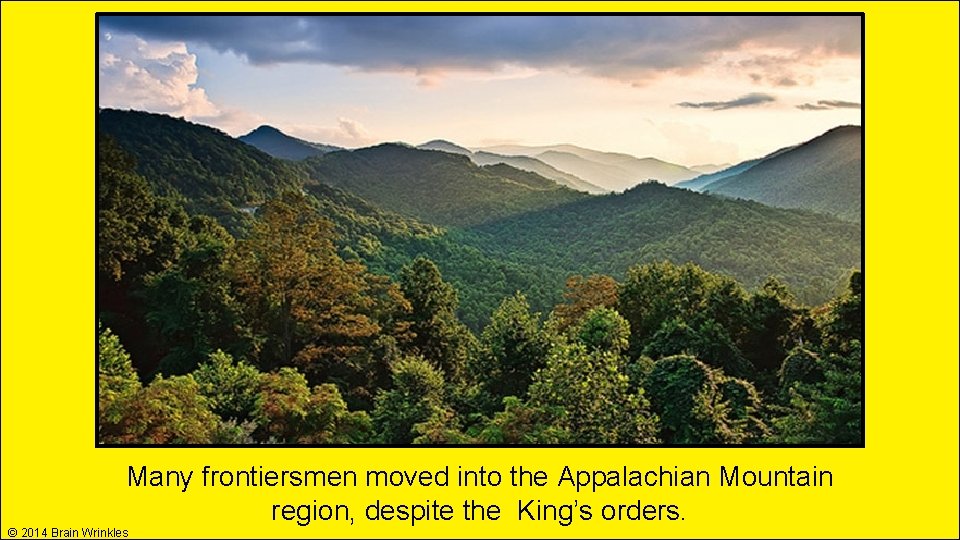
Proclamation of 1763 • The colonists, many of whom participated in the war in hopes of gaining new land, were extremely upset by the Proclamation of 1763. • © 2014 Brain Wrinkles Many frontiersmen ignored the treaty and moved west into areas that are now Kentucky and Tennessee.
Many frontiersmen moved into the Appalachian Mountain region, despite the King’s orders. © 2014 Brain Wrinkles
Georgia • People in Georgia did not share the same reactions to the Proclamation of 1763 as other colonists. • The colony was relatively small and most colonists were still settled along Georgia’s coastline. • Also, Georgia gained land resources from the Spanish after the French and Indian War. • This new land opened up new coastal areas for Georgians to settle, which was great for trade. © 2014 Brain Wrinkles
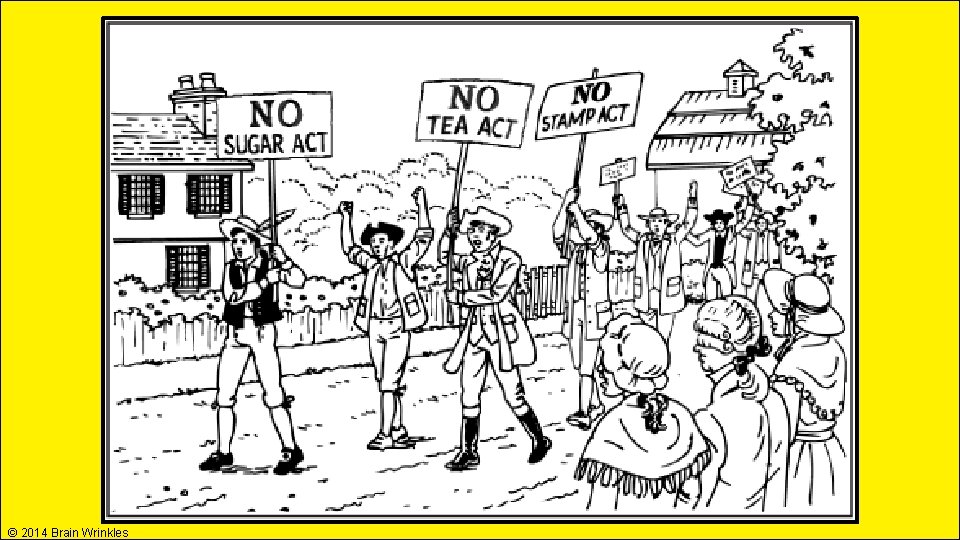
Taxation • In the 1760 s and 1770 s, Great Britain began asserting more and more control over the colonies. • To help alleviate the debt incurred from the war, the British Parliament felt that the colonists should be responsible for some of the financial burden by paying new taxes. • Many colonists were angered by the taxation, particularly because there was no colonial representation in the British Parliament. © 2014 Brain Wrinkles
© 2014 Brain Wrinkles
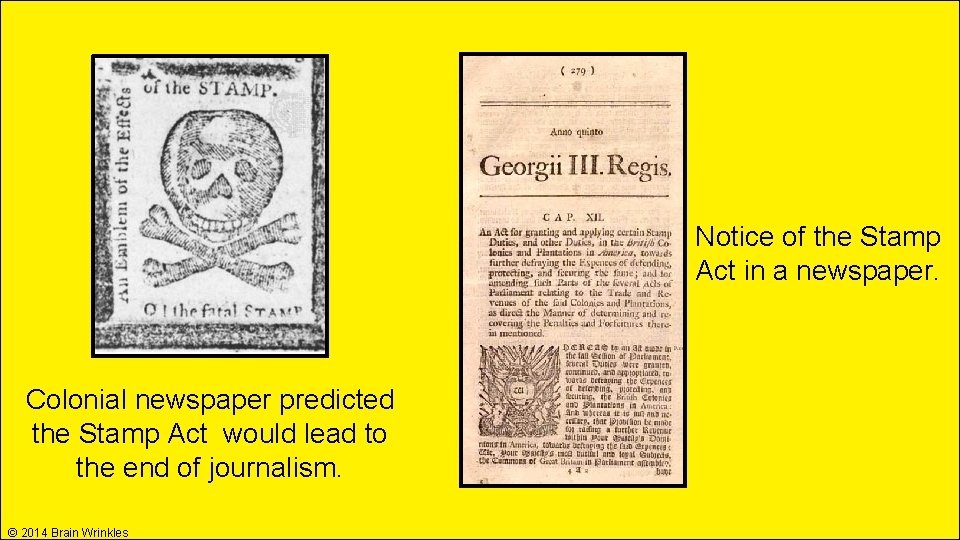
Stamp Act • In 1765, England imposed the Stamp Act, which required colonists to buy a government stamp for nearly every paper document. • It put a direct tax on items that were commonly used by almost every colonist, including newspapers, licenses, and legal documents. • Many colonists rebelled, saying that the government should not tax them when they had no representation in Parliament. © 2014 Brain Wrinkles
Notice of the Stamp Act in a newspaper. Colonial newspaper predicted the Stamp Act would lead to the end of journalism. © 2014 Brain Wrinkles
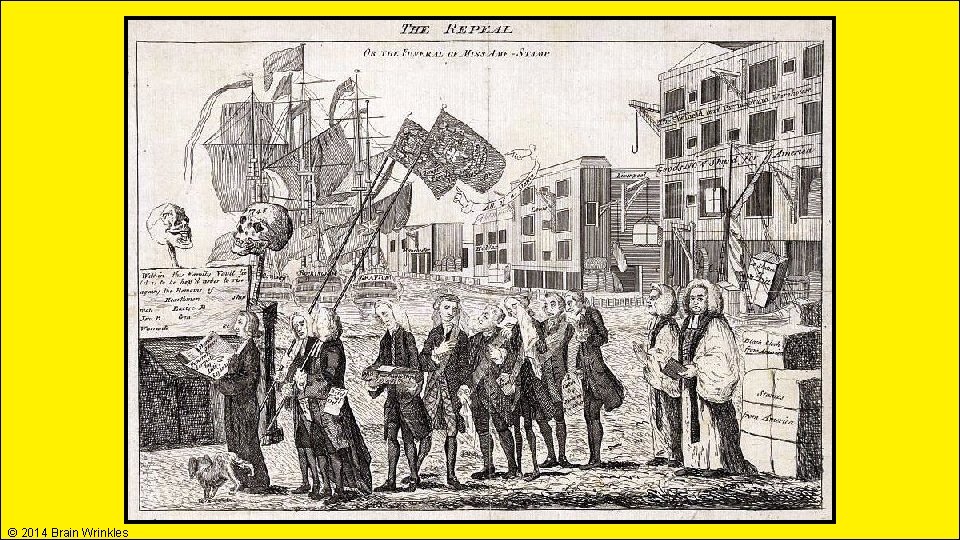
Stamp Act • Due to colonial pressure, the British Parliament eventually repealed the Stamp Act (but continued to issue others). • These acts caused even more discontent and began to set the stage for the Revolutionary War… © 2014 Brain Wrinkles
© 2014 Brain Wrinkles
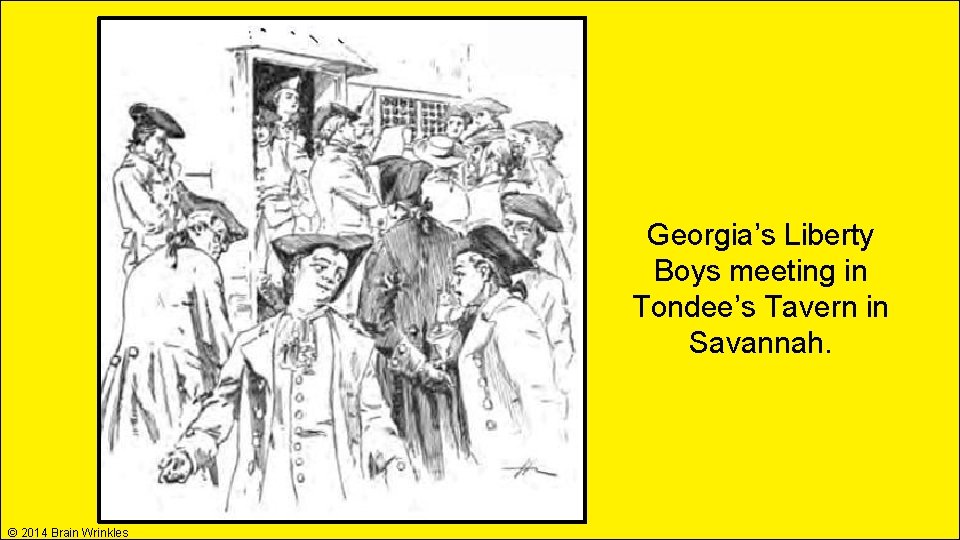
Georgia • Georgia’s response to the Stamp Act was not as violent as in other colonies due to its small population, strong royal governor (James Wright), and economic dependence on Great Britain. • Georgia was actually the only colony where a small number of stamps were sold. • However, there was some resistance to the Stamp Act. • On November 6, 1765, a group affiliated with the Sons of Liberty called the “Liberty Boys” was established to oppose the Stamp Act. © 2014 Brain Wrinkles
Georgia’s Liberty Boys meeting in Tondee’s Tavern in Savannah. © 2014 Brain Wrinkles
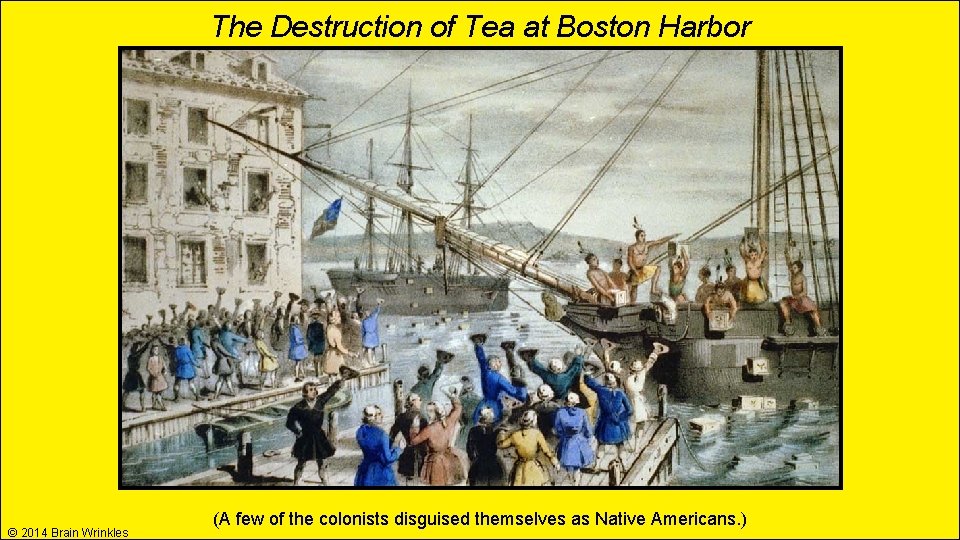
Boston • The American colonists were becoming more and more rebellious, particularly in Boston. • The Boston Massacre occurred in 1770 when British soldiers fired into an angry mob of protestors, killing five colonists. • The 1773 Boston Tea Party took place when colonists dumped 342 chests of tea into the Boston Harbor to protest the Tea Act. © 2014 Brain Wrinkles
The Destruction of Tea at Boston Harbor © 2014 Brain Wrinkles (A few of the colonists disguised themselves as Native Americans. )
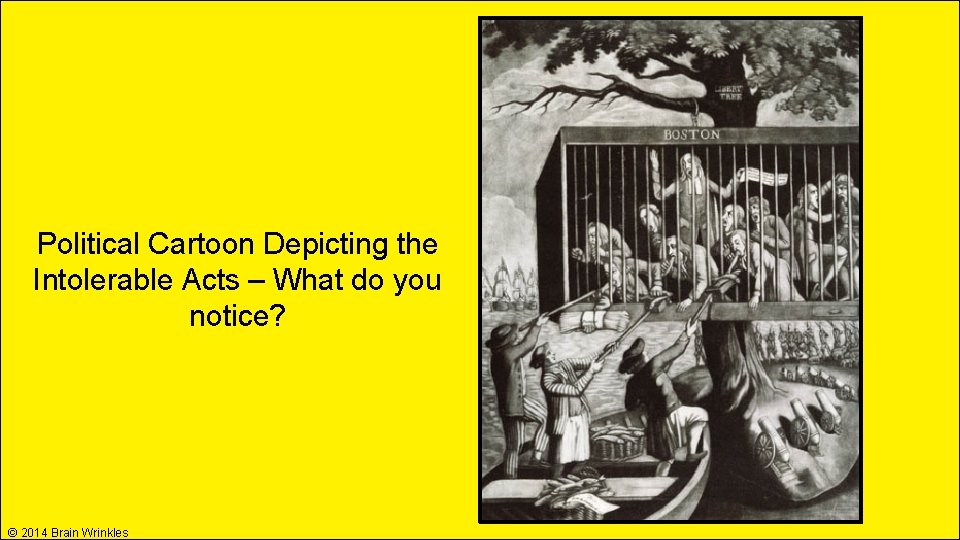
Intolerable Acts • Great Britain was angered by the unruly colonists. • In 1774, Parliament passed a series of laws called the Coercive Acts to punish the colony of Massachusetts and to set an example for the other colonies. • Colonists called these laws the Intolerable Acts. • Great Britain refused to repeal these laws until the colonists paid for the tea destroyed in Boston. © 2014 Brain Wrinkles
• Intolerable Acts The Intolerable Acts included four laws designed to punish the Massachusetts colonists for the Boston Tea Party. 1. Boston Port Act closed the port of Boston to trade. 2. Massachusetts Government Act prohibited town meetings and took away the colony’s charter. 3. Impartial Administration of Justice Act said that any British official that committed a capital crime was sent back to England for trial. 4. Quartering Act forced the citizens of Massachusetts to house and feed British soldiers at their own expense. © 2014 Brain Wrinkles
Political Cartoon Depicting the Intolerable Acts – What do you notice? © 2014 Brain Wrinkles
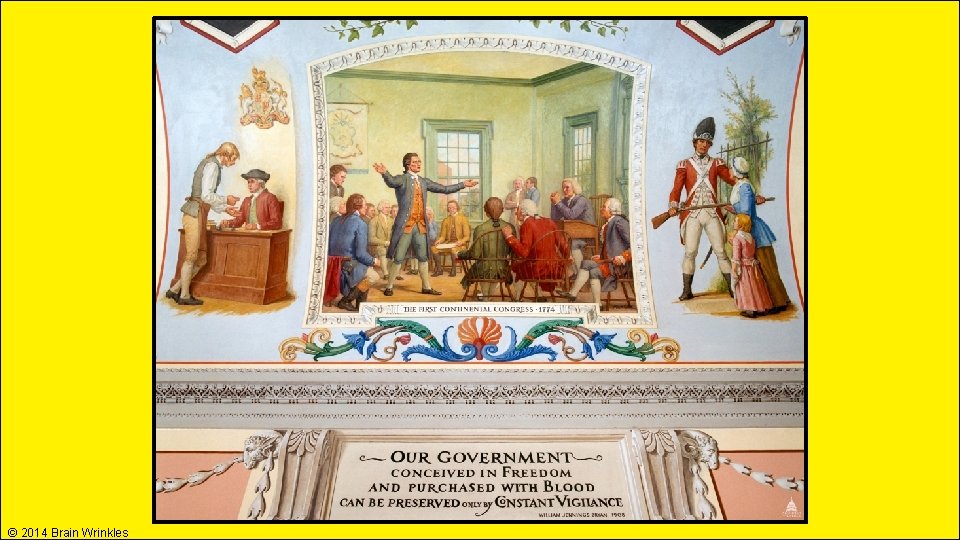
st 1 Continental Congress • Other American colonies were outraged and joined in sympathy with Massachusetts. • The Intolerable Acts unified the colonies in a belief that the British Parliament was violating their rights. • Twelve colonies sent representatives to the First Continental Congress of 1774. • Georgia was the only colony that did not send a representative. © 2014 Brain Wrinkles
st 1 Continental Congress • The First Continental Congress met in Philadelphia in 1774. • The members wrote protests to England decided to boycott British goods until taxes and trade regulation were repealed. • They also pledged military support to Massachusetts if they were attacked by Great Britain. © 2014 Brain Wrinkles
© 2014 Brain Wrinkles
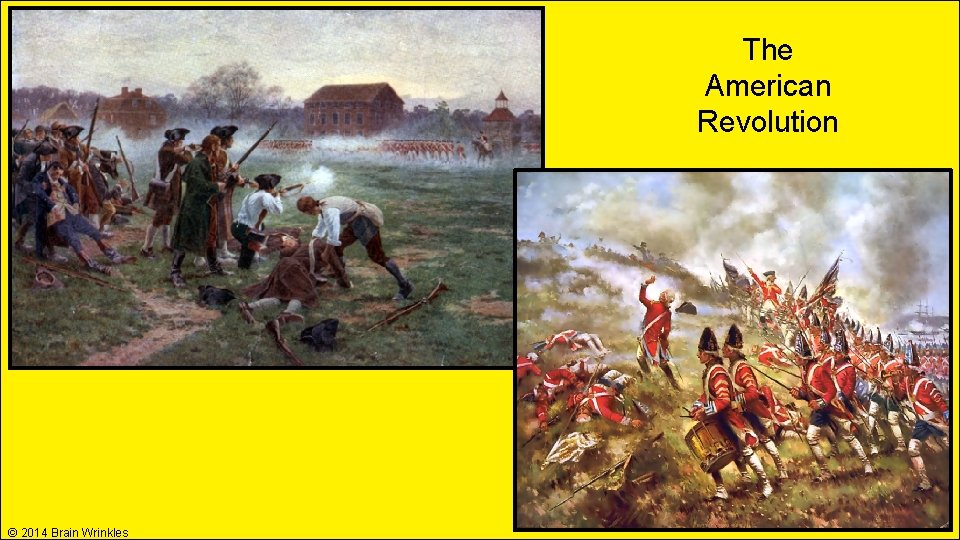
American Revolution • King George III said that the colonists would not become independent without a fight. • On April 19 th, 1775, the first battle of the American Revolution took place at Lexington and Concord, Massachusetts. • After several more battles, the Second Continental Congress met in May 1775. • This time, Georgia was represented by 3 delegates: Button Gwinnett, Lyman Hall, and George Walton. © 2014 Brain Wrinkles
The American Revolution © 2014 Brain Wrinkles
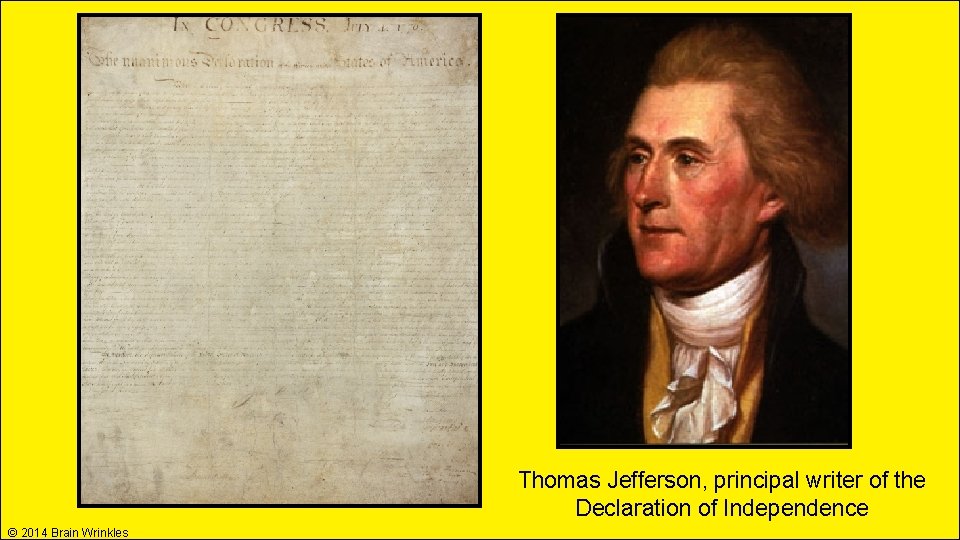
Declaration of Independence • A committee headed by Thomas Jefferson compiled a list of reasons why the American colonies should become independent in a formal document that was adopted on July 4, 1776. • The first part, called the Preamble, explains the natural rights of all people. • The second part includes a list of grievances against King George, including “imposing taxes without our consent” and “quartering large bodies of troops among us. ” • The final part is where the colonists officially severed ties from Great Britain. © 2014 Brain Wrinkles
Thomas Jefferson, principal writer of the Declaration of Independence © 2014 Brain Wrinkles
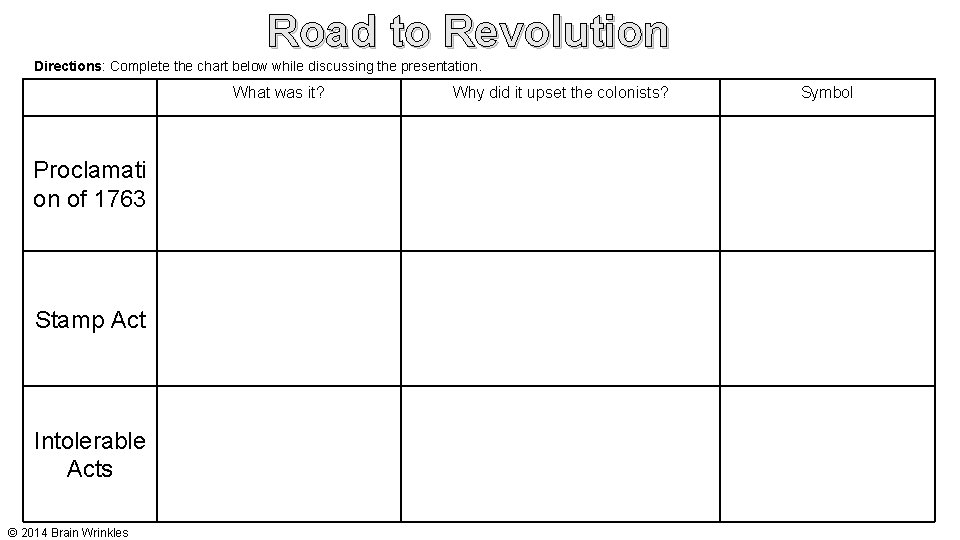
Teacher Directions – Road to Revolution Chart • Print the Road to Revolution graphic organizer for each student. • Students will complete the graphic organizer after discussing the presentation. • Check answers as a class at the end of the presentation to be sure that all charts are completed correctly. © 2014 Brain Wrinkles
Road to Revolution Directions: Complete the chart below while discussing the presentation. What was it? Proclamati on of 1763 Stamp Act Intolerable Acts © 2014 Brain Wrinkles Why did it upset the colonists? Symbol
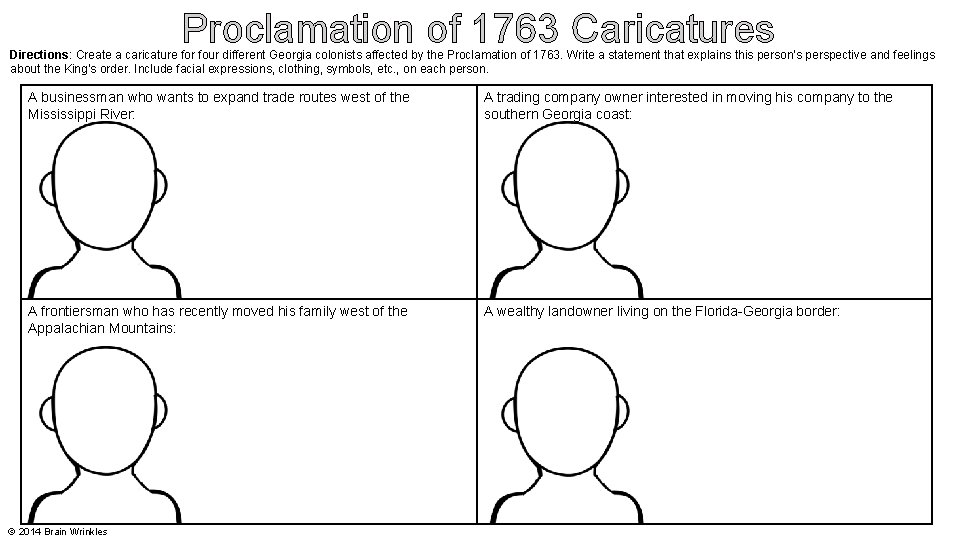
Teacher Directions – Proclamation of 1763 Caricatures • Have the students create a caricature for each colonist mentioned. • The students will write a statement from each colonist that explains how he/she feels about the Proclamation of 1763. • If time, they will draw clothes/jewelry, belongings, and facial expressions to represent the colonist’s perspective and lifestyle. © 2014 Brain Wrinkles
Proclamation of 1763 Caricatures Directions: Create a caricature for four different Georgia colonists affected by the Proclamation of 1763. Write a statement that explains this person’s perspective and feelings about the King’s order. Include facial expressions, clothing, symbols, etc. , on each person. A businessman who wants to expand trade routes west of the Mississippi River: A trading company owner interested in moving his company to the southern Georgia coast: A frontiersman who has recently moved his family west of the Appalachian Mountains: A wealthy landowner living on the Florida-Georgia border: © 2014 Brain Wrinkles
Teacher Info – Road to Revolution Snapchats • Snapchat is a photo messaging app that is similar to Instagram. Users take “snaps” and send them to a list of friends. You can also add captions and draw onto the snaps. • Have the students take 4 snaps of noteworthy events from this time period (French & Indian War, Proclamation of 1763, Stamp Act, Intolerable Acts) and snapchat them to their friends to see. • The snaps should include a picture of the event as well as a caption that summarizes the event. © 2014 Brain Wrinkles
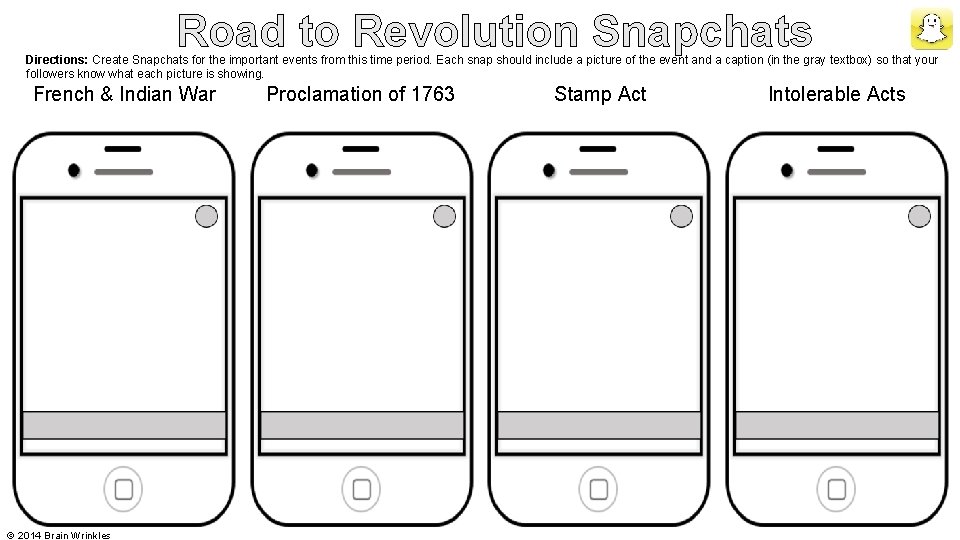
Road to Revolution Snapchats Directions: Create Snapchats for the important events from this time period. Each snap should include a picture of the event and a caption (in the gray textbox) so that your followers know what each picture is showing. French & Indian War © 2014 Brain Wrinkles Proclamation of 1763 Stamp Act Intolerable Acts
Teacher Info – Declaration of Independence Stamp • Print off the Declaration of Independence Stamp handout for each student. • The students will design a stamp to represent the Declaration of Independence. • They will also write a caption that describes the stamp’s design. © 2014 Brain Wrinkles
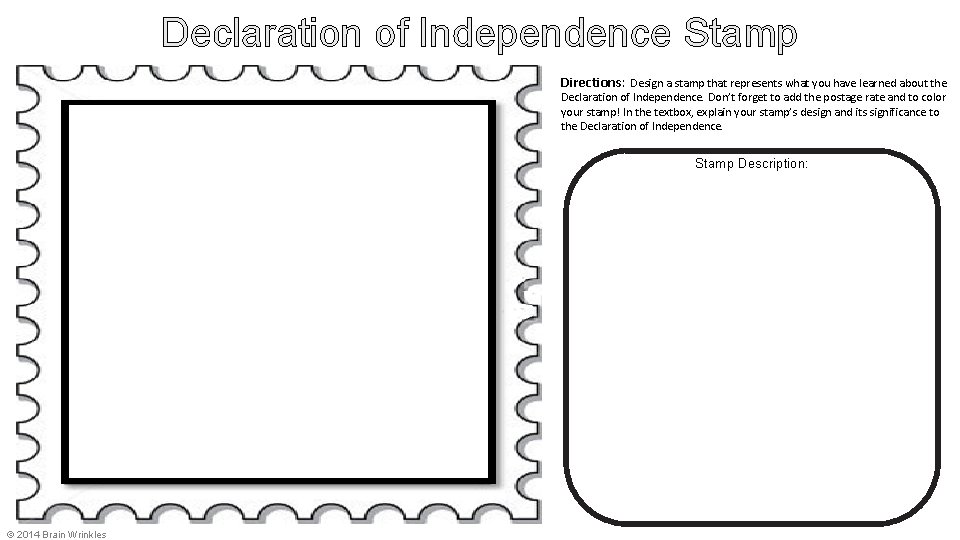
Declaration of Independence Stamp Directions: Design a stamp that represents what you have learned about the Declaration of Independence. Don’t forget to add the postage rate and to color your stamp! In the textbox, explain your stamp’s design and its significance to the Declaration of Independence. Stamp Description: © 2014 Brain Wrinkles
Teacher Directions – Tweet All About It…Ticket Out the Door • Have students write a tweet summary of important events that led to the American Revolution (less than 140 characters). © 2014 Brain Wrinkles
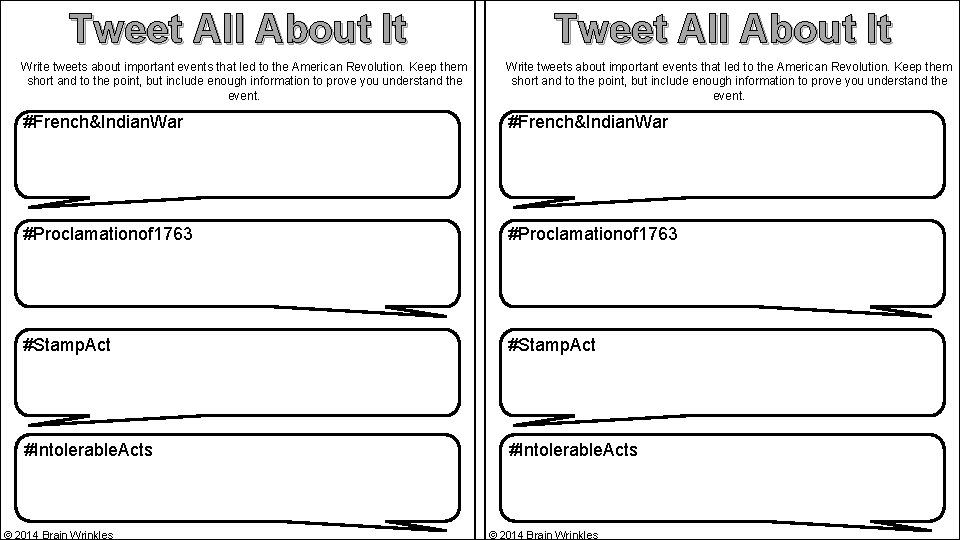
Tweet All About It Write tweets about important events that led to the American Revolution. Keep them short and to the point, but include enough information to prove you understand the event. #French&Indian. War #Proclamationof 1763 #Stamp. Act #Intolerable. Acts © 2014 Brain Wrinkles