
Sri Lanka as a Knowledge Hub By Dr
Sri Lanka as a Knowledge Hub By Dr. Sunil Jayantha Nawaratne Secretary, Ministry of Higher Education Sri Lanka sec@mohe. gov. lk; jaynawa@gmail. com Sunil Nawaratne Colombo University MBA Alumnai - 2014 - 02 - 25 Ministry of Higher Education - Sri Lanka
Sri Lanka as a Knowledge Hub Sunil Nawaratne Colombo University MBA Alumnai - 2014 - 02 - 25 2
What Are Knowledge Hubs? • Knowledge Hubs are institutions or networks that institutions or networks enable countries to learn systematically by sharing and exchanging development exchanging experiences with domestic and international partners in order international partners to accelerate development. • http: //wbi. worldbank. org/sske /news/what-are-knowledgehubs Sunil Nawaratne Colombo University MBA Alumnai - 2014 - 02 - 25 3
Two types of Knowledge Hubs National Knowledge Hubs , which usually act as central coordination agencies • They cover a certain range of, if not all, sectors and certain range of, if not all themes on which solutions can be exchanged and involve mostly governmental institutions of a country, governmental such as line ministries, sector institutions or thematic centers of excellence • These hubs stand for a broad effort to channel knowledge to and from partners abroad and among domestic players. As such, they are often coordinating domestic players with thematic knowledge hubs as implementing with thematic knowledge hubs entities. Sunil Nawaratne Colombo University MBA Alumnai - 2014 - 02 - 25 4
Two types of Knowledge Hubs • Thematic Knowledge Hubs, which focus on specific solutions in distinct sectors and areas, such as solutions in distinct sectors and areas agriculture, climate change, agriculture, climate change public health or social protection. Institutional models are very diverse, protection. depending on the specific national and sector context, and range from departments in line ministries, to cross -country Communities of Practice. Thematic knowledge hubs are usually practitioner-driven and tend to hubs are usually practitioner-driven proactively involve broad groups of specialized actors, proactively involve broad groups including central governments, local authorities, academia, the private sector, and civil society organizations. Sunil Nawaratne Colombo University MBA Alumnai - 2014 - 02 - 25 5
Knowledge Clusters • Knowledge clusters are agglomerations (Jumbled Mass) of organizations that are production-oriented • Their production is primarily directed to knowledge as output or input. Knowledge clusters have the output or input organizational capability to drive innovations and create new industries. They are central places within create new industries an epistemic landscape, i. e. in a wider structure of knowledge production and dissemination. • Examples for organizations in knowledge clusters are organizations in knowledge clusters universities and colleges, research institutions, think tanks, government research agencies and knowledgeintensive firms Sunil Nawaratne Colombo University MBA Alumnai - 2014 - 02 - 25 6
Knowledge Hubs • Knowledge hubs may exist in the same locations as knowledge clusters and may be nested within them. Knowledge hubs are local innovation systems that are nodes in networks of knowledge production and knowledge sharing. They are characterized by high connectedness and sharing high internal and external networking and knowledge sharing capabilities. As meeting points of communities of knowledge and interest, knowledge hubs fulfill three major functions: (GTT) • 1) to generate knowledge, generate • 2) to transfer knowledge to sites of application; transfer to sites of application • 3) and to transmit knowledge to other people through to transmit education and training Sunil Nawaratne Colombo University MBA Alumnai - 2014 - 02 - 25 7
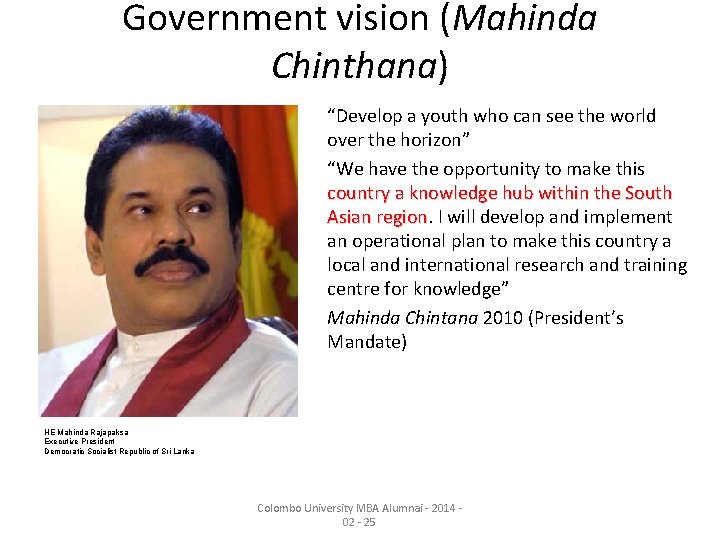
Government vision (Mahinda Chinthana) “Develop a youth who can see the world over the horizon” “We have the opportunity to make this country a knowledge hub within the South Asian region. I will develop and implement Asian region an operational plan to make this country a local and international research and training centre for knowledge” Mahinda Chintana 2010 (President’s Mandate) HE Mahinda Rajapaksa Executive President Democratic Socialist Republic of Sri Lanka Colombo University MBA Alumnai - 2014 - 02 - 25
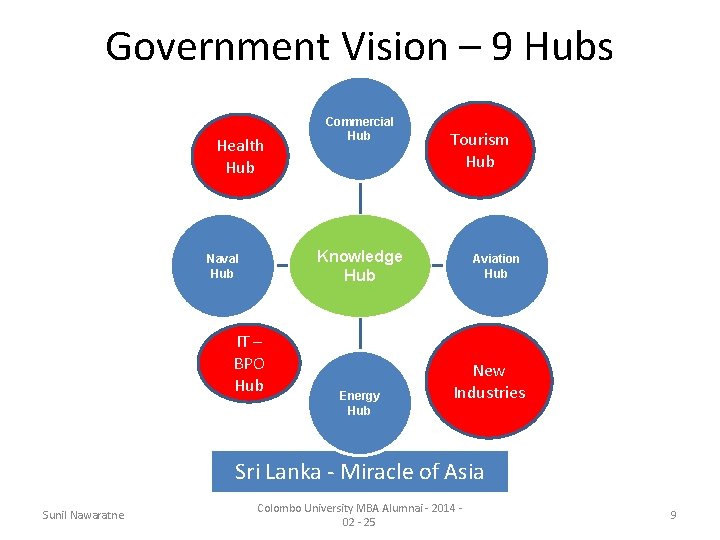
Government Vision – 9 Hubs Health Hub Commercial Hub Tourism Hub Knowledge Hub Naval Hub IT – BPO Hub Energy Hub Aviation Hub New Industries Sri Lanka - Miracle of Asia Sunil Nawaratne Colombo University MBA Alumnai - 2014 - 02 - 25 9
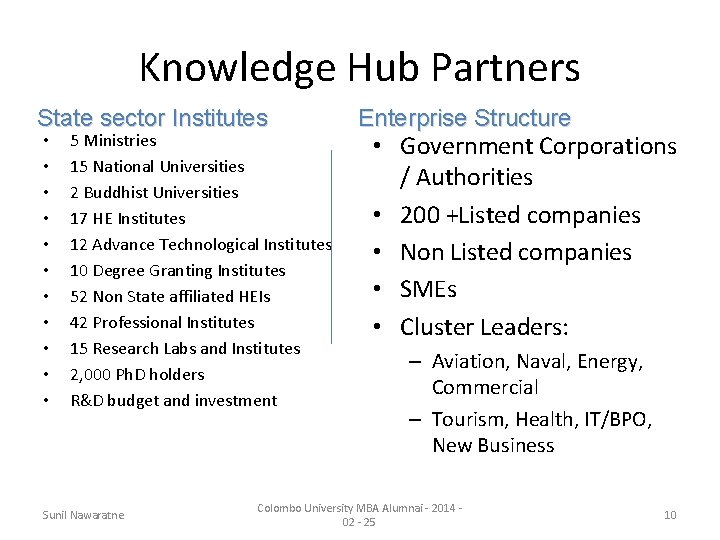
Knowledge Hub Partners State sector Institutes • • • 5 Ministries 15 National Universities 2 Buddhist Universities 17 HE Institutes 12 Advance Technological Institutes 10 Degree Granting Institutes 52 Non State affiliated HEIs 42 Professional Institutes 15 Research Labs and Institutes 2, 000 Ph. D holders R&D budget and investment Sunil Nawaratne Enterprise Structure • Government Corporations / Authorities • 200 +Listed companies • Non Listed companies • SMEs • Cluster Leaders: – Aviation, Naval, Energy, Commercial – Tourism, Health, IT/BPO, New Business Colombo University MBA Alumnai - 2014 - 02 - 25 10
What Higher Education can do? • Human Capital Development – Q+Q Human Capital Development • Research – Knowledge Creation, Research Creation Gathering and Adoption (acceptance) & Adaption (alternation, change) • Innovation (novelty), Invention (discovery) and Product Creation & Commercialization • Competitive and Comparative Advantages • Marketing Knowhow + Networks and channels Sunil Nawaratne Colombo University MBA Alumnai - 2014 - 02 - 25 11
Vision To make Sri Lanka as an international hub of excellence in higher education by 2020
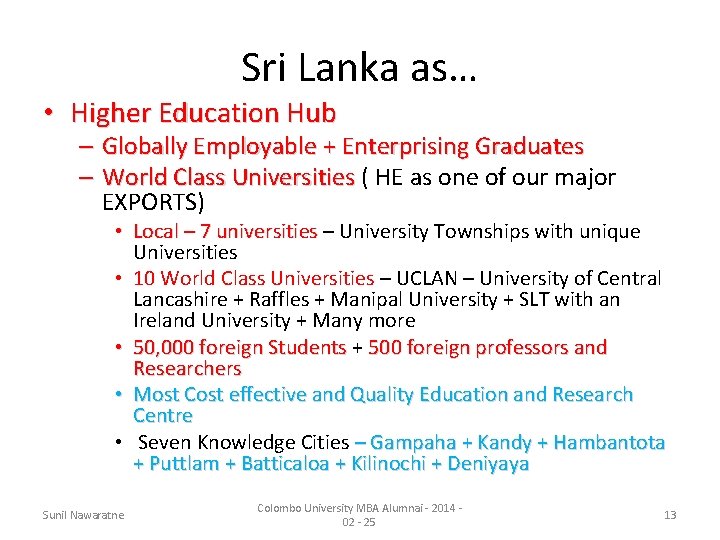
Sri Lanka as… • Higher Education Hub – Globally Employable + Enterprising Graduates – World Class Universities ( HE as one of our major World Class Universities EXPORTS) • Local – 7 universities – University Townships with unique Local – 7 universities Universities • 10 World Class Universities – UCLAN – University of Central Lancashire + Raffles + Manipal University + SLT with an Ireland University + Many more • 50, 000 foreign Students + 50, 000 foreign Students 500 foreign professors and Researchers • Most Cost effective and Quality Education and Research Centre • Seven Knowledge Cities – Gampaha + Kandy + Hambantota + Puttlam + Batticaloa + Kilinochi + Deniyaya Sunil Nawaratne Colombo University MBA Alumnai - 2014 - 02 - 25 13
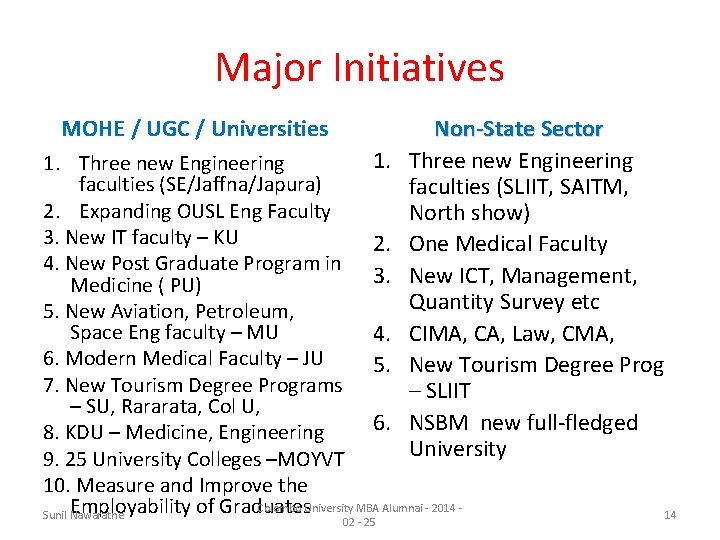
Major Initiatives MOHE / UGC / Universities Non-State Sector Three new Engineering faculties (SLIIT, SAITM, North show) One Medical Faculty New ICT, Management, Quantity Survey etc CIMA, CA, Law, CMA, New Tourism Degree Prog – SLIIT NSBM new full-fledged University 1. 1. Three new Engineering faculties (SE/Jaffna/Japura) 2. Expanding OUSL Eng Faculty 3. New IT faculty – KU 2. 4. New Post Graduate Program in 3. Medicine ( PU) 5. New Aviation, Petroleum, Space Eng faculty – MU 4. 6. Modern Medical Faculty – JU 5. 7. New Tourism Degree Programs – SU, Rararata, Col U, 6. 8. KDU – Medicine, Engineering 9. 25 University Colleges –MOYVT 10. Measure and Improve the Colombo University MBA Alumnai - 2014 - Employability of Graduates Sunil Nawaratne 02 - 25 14
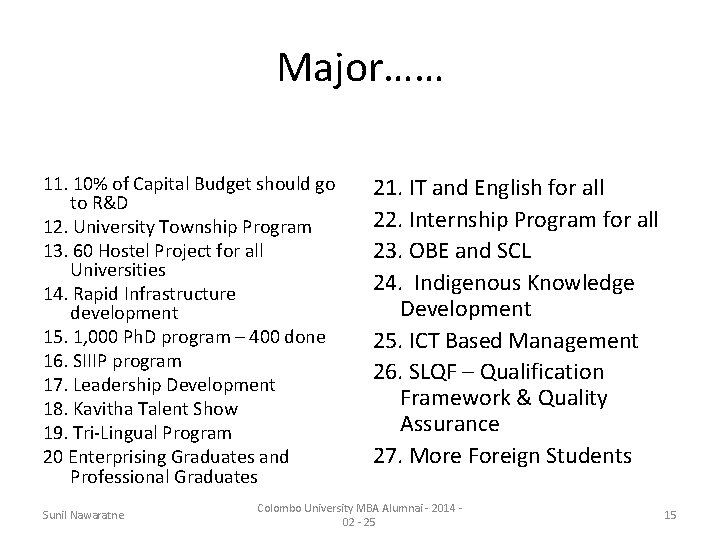
Major…… 11. 10% of Capital Budget should go to R&D 12. University Township Program 13. 60 Hostel Project for all Universities 14. Rapid Infrastructure development 15. 1, 000 Ph. D program – 400 done 16. SIIIP program 17. Leadership Development 18. Kavitha Talent Show 19. Tri-Lingual Program 20 Enterprising Graduates and Professional Graduates Sunil Nawaratne 21. IT and English for all 22. Internship Program for all 23. OBE and SCL 24. Indigenous Knowledge Development 25. ICT Based Management 26. SLQF – Qualification Framework & Quality Assurance 27. More Foreign Students Colombo University MBA Alumnai - 2014 - 02 - 25 15
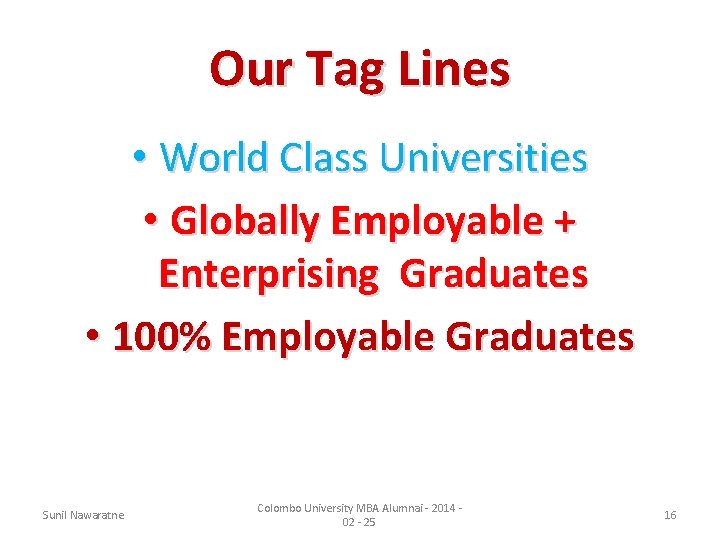
Our Tag Lines • World Class Universities • Globally Employable + Enterprising Graduates • 100% Employable Graduates Sunil Nawaratne Colombo University MBA Alumnai - 2014 - 02 - 25 16
OBE • Outcome-based education calls for a shift in that paradigm (model, pattern), paradigm from content to process in which a child is called process upon to demonstrate what (s)he knows and can do against standards established at the state and national [3] level. ] level • Instead of core knowledge being the focal point of education, problems, issues, and challenges based as on future trends presented in the context of unit themes (also known as thematic themes units) becomes the focal point. Sunil Nawaratne Colombo University MBA Alumnai - 2014 - 02 - 25 17
Exit Outcomes • Exit outcomes, stated in various ways, are pivotal to the Exit outcomes entire restructuring process, are based on future trends, are complex demonstrations of personal development, and are intended to produce children who… • are self directed learners; • are critical thinkers/problem solvers/decision makers; are critical thinkers/problem solvers/decision makers • are communicators and collaborators (team players); • can express themselves creatively, proactively, and responsibly; • easily adapt to change; • exhibit self-esteem; and • demonstrate concern, tolerance and respect for others as citizens in a global society [5] society Sunil Nawaratne Colombo University MBA Alumnai - 2014 - 02 - 25 18
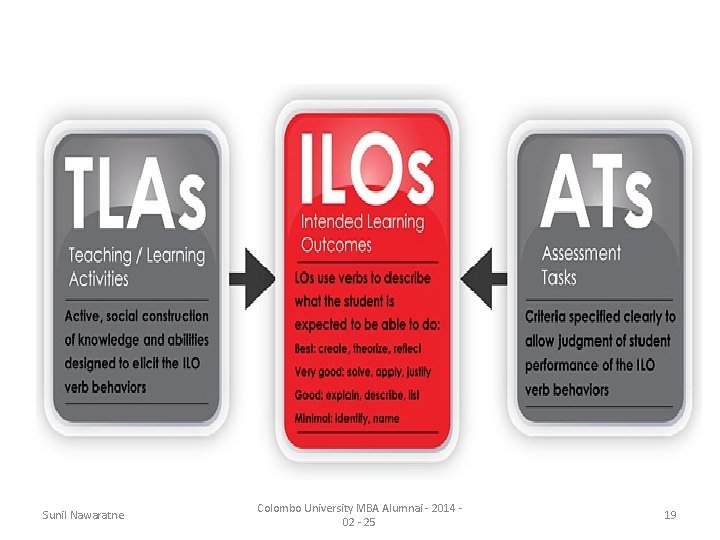
Sunil Nawaratne Colombo University MBA Alumnai - 2014 - 02 - 25 19
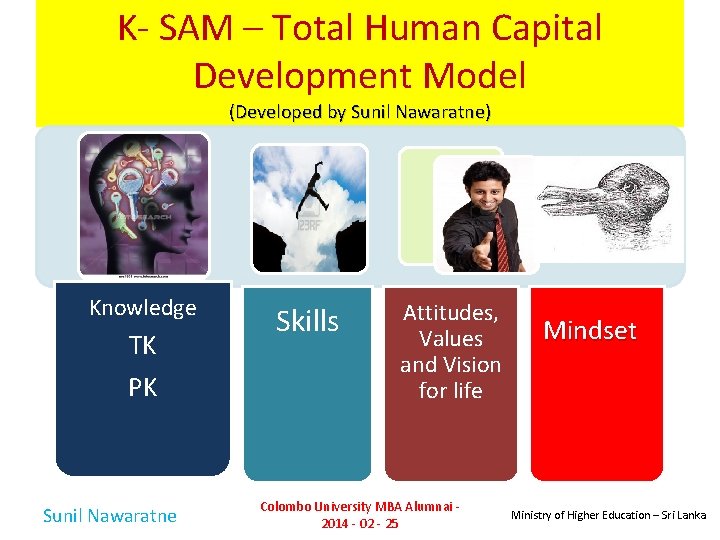
K- SAM – Total Human Capital Development Model (Developed by Sunil Nawaratne) Knowledge TK PK Sunil Nawaratne Skills Attitudes, Values and Vision for life Colombo University MBA Alumnai - 2014 - 02 - 25 Mindset Ministry of Higher Education – Sri Lanka
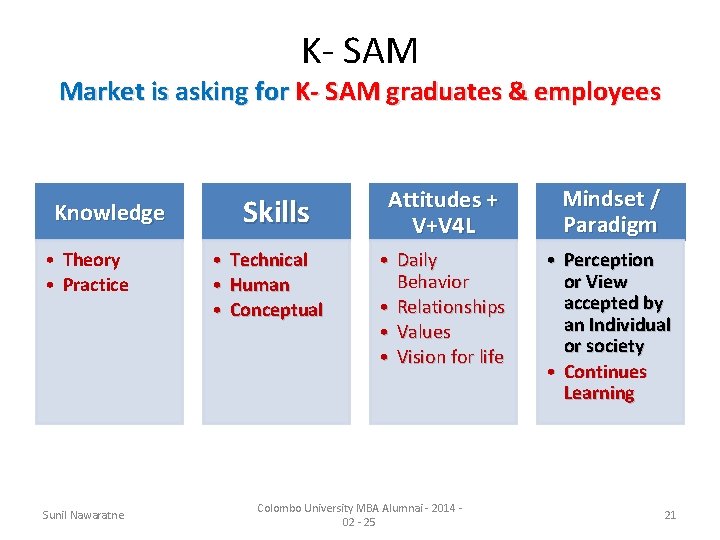
K- SAM Market is asking for K- SAM graduates & employees Knowledge • Theory • Practice Sunil Nawaratne Skills • Technical • Human • Conceptual Attitudes + V+V 4 L Mindset / Paradigm • Daily Behavior • Relationships • Values • Vision for life • Perception or View accepted by an Individual or society • Continues Learning Colombo University MBA Alumnai - 2014 - 02 - 25 21
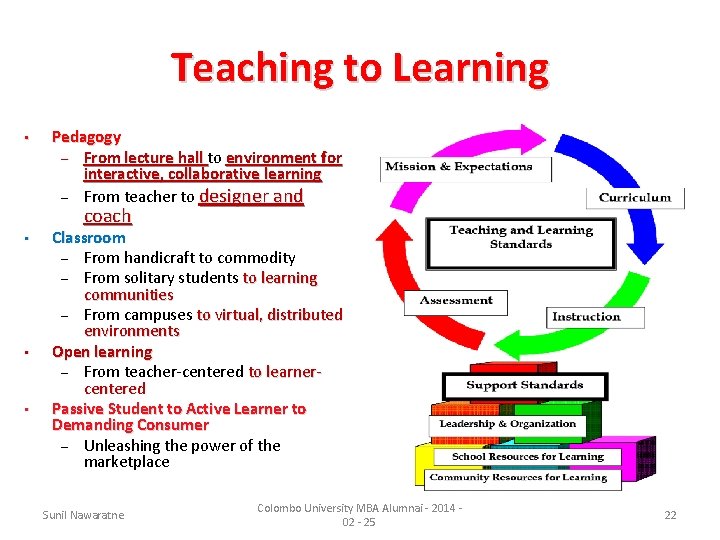
Teaching to Learning • Pedagogy – From lecture hall to From lecture hall environment for interactive, collaborative learning – From teacher to designer and coach • • • Classroom – From handicraft to commodity – From solitary students to learning communities – From campuses to virtual, distributed environments Open learning – From teacher-centered to learnercentered Passive Student to Active Learner to Demanding Consumer – Unleashing the power of the marketplace Sunil Nawaratne Colombo University MBA Alumnai - 2014 - 02 - 25 22
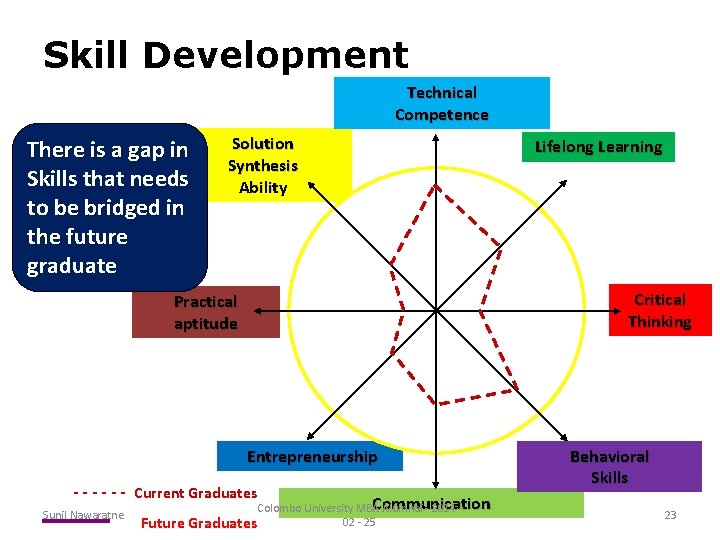
Skill Development Technical Competence There is a gap in Skills that needs to be bridged in the future graduate Solution Synthesis Ability Critical Thinking Practical aptitude Entrepreneurship - - - Current Graduates Sunil Nawaratne Lifelong Learning Communication Colombo University MBA Alumnai - 2014 - 02 - 25 Future Graduates Behavioral Skills 23
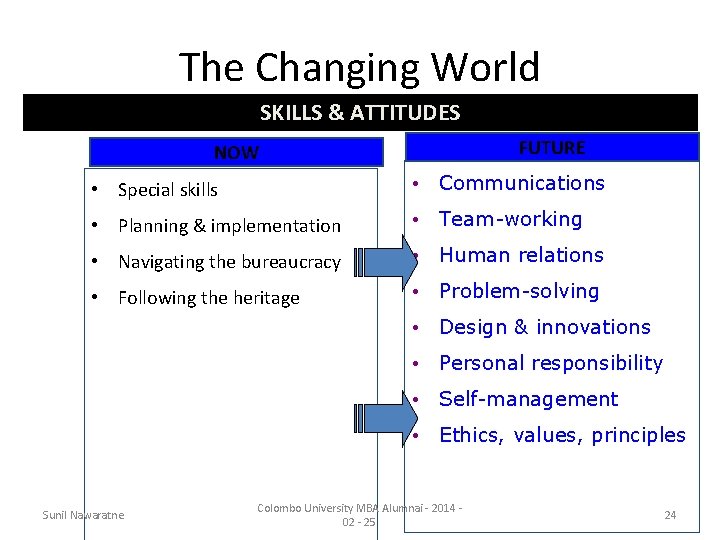
The Changing World SKILLS & ATTITUDES FUTURE NOW • Special skills • Communications • Planning & implementation • Team-working • Navigating the bureaucracy • Human relations • Following the heritage • Problem-solving • Design & innovations • Personal responsibility • Self-management • Ethics, values, principles Sunil Nawaratne Colombo University MBA Alumnai - 2014 - 02 - 25 24
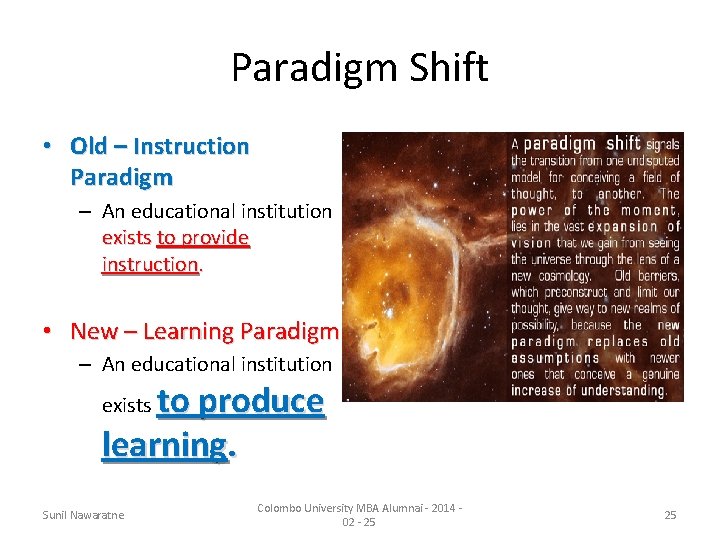
Paradigm Shift • Old – Instruction Paradigm – An educational institution exists to provide instruction. • New – Learning Paradigm – An educational institution to produce learning. exists Sunil Nawaratne Colombo University MBA Alumnai - 2014 - 02 - 25 25
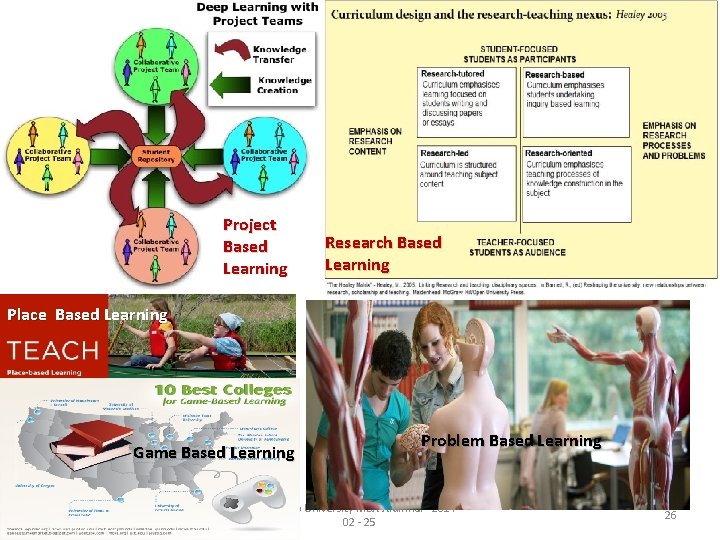
Project Based Learning Research Based Learning Place Based Learning Game Based Learning Sunil Nawaratne Problem Based Learning Colombo University MBA Alumnai - 2014 - 02 - 25 26
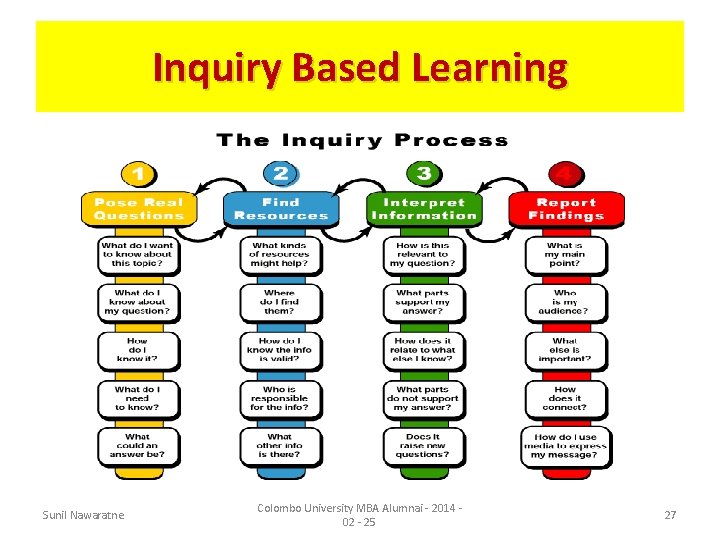
Inquiry Based Learning Sunil Nawaratne Colombo University MBA Alumnai - 2014 - 02 - 25 27
E-Learning? The idea is that learning is not based on objects and contents that are stored, as though in a library http: //www. cetis. ac. uk/members/ple/resourc Colombo University MBA Alumnai - 2014 - Sunil Nawaratne 02 - 25 es/edf. ppt 28
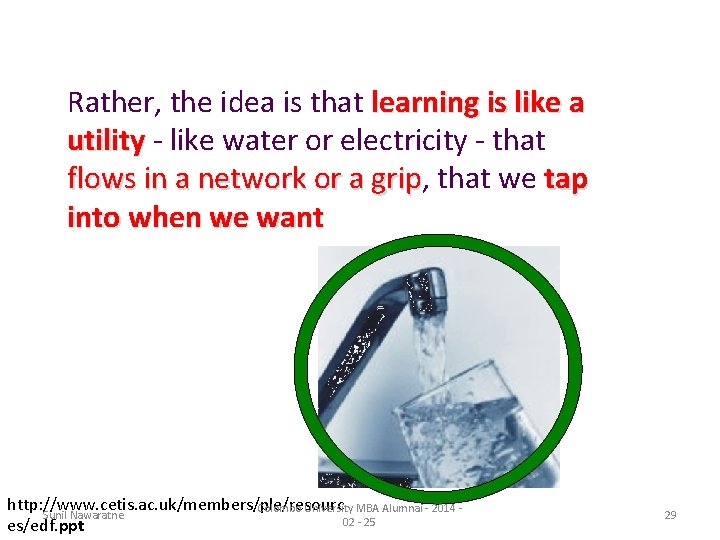
Rather, the idea is that learning is like a utility - like water or electricity - that utility flows in a network or a grip, that we tap flows in a network or a grip into when we want http: //www. cetis. ac. uk/members/ple/resourc Colombo University MBA Alumnai - 2014 - Sunil Nawaratne 02 - 25 es/edf. ppt 29
The successful teacher is the teacher who becomes progressively redundant. Sunil Nawaratne Colombo University MBA Alumnai - 2014 - 02 - 25 30
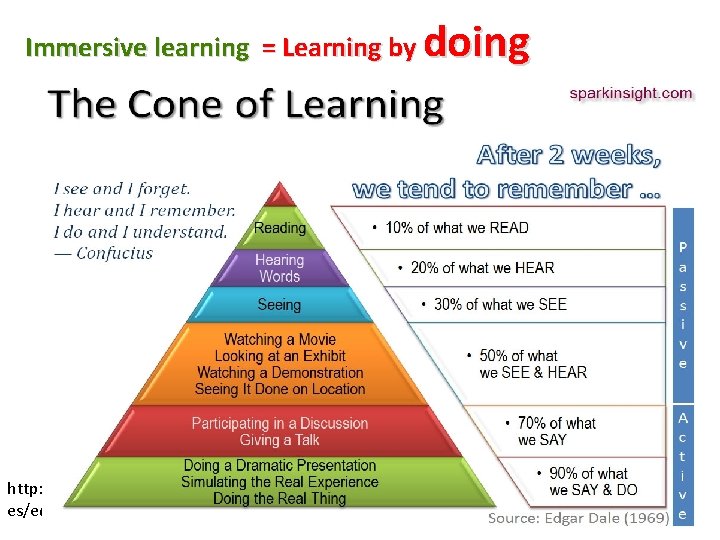
doing Immersive learning = Learning by http: //www. cetis. ac. uk/members/ple/resourc Colombo University MBA Alumnai - 2014 - es/edf. ppt Sunil Nawaratne 02 - 25 31
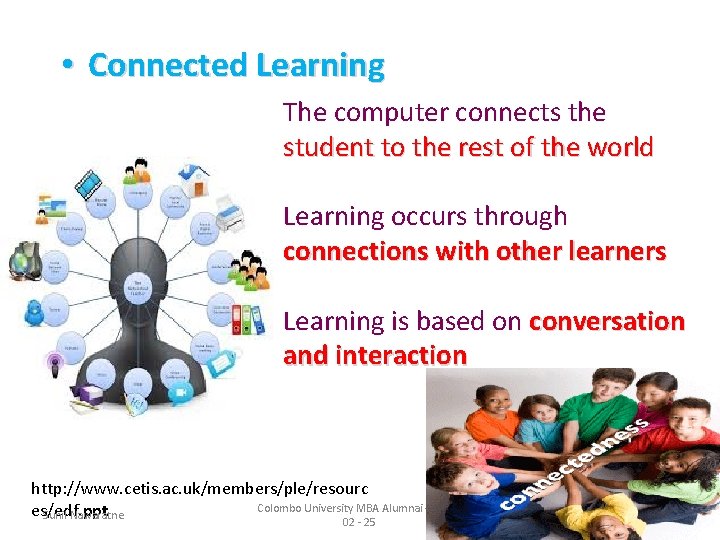
• Connected Learning The computer connects the student to the rest of the world Learning occurs through connections with other learners Learning is based on conversation and interaction http: //www. cetis. ac. uk/members/ple/resourc Colombo University MBA Alumnai - 2014 - es/edf. ppt Sunil Nawaratne 02 - 25 32
Ministry of Education • 1, 000 School Program with ICT Lab, Language Lab and Science Lab • Technological Stream and Degree program • New Teachers for Science, ICT, English, Tamil and Singhalese • Teaching as a new profession Sunil Nawaratne Colombo University MBA Alumnai - 2014 - 02 - 25 33
Other Ministries • • Young Inventors Program SLINTEC – Nano – Technology Institute More funding for Research & Development Vidatha Program Sunil Nawaratne Colombo University MBA Alumnai - 2014 - 02 - 25 34
Key Achievements under e Sri Lanka Development Initiative towards ICT Sector • E-Sri Lanka Development initiative • Key Achievements • ICT Development Ranking – 2005 – 72, 2013 – 48. • ICT Literacy – 2005 – 8%, 2012 – 35% • 750 – Nenasala – 62. 5% are financially viable Sunil Nawaratne Colombo University MBA Alumnai - 2014 - 02 - 25 35
IT-BPO Sector • As of 2013, export revenues from IT-BPO services are estimated at over US$ 500 m, growing at approximately 22% per annum. When combined with the domestic market, total revenues are close to US$ One Billion Direct employment exceeded 75, 000 highpaying (Gold Collar) jobs in the IT/BPO sector, with indirect employment at 180, 000. Sunil Nawaratne Colombo University MBA Alumnai - 2014 - 02 - 25 36
Sri Lanka among top - 10 • Sri Lanka was awarded the prestigious “outsourcing destination of the Year” award by the National Outsourcing Association (NOA), UK in 2013. Sri Lanka was ranked in the top 10 most improved countries for doing business in 2013. Sri Lanka was also ranked among the top 25 global outsourcing destinations by AT Kearney and among the top 30 outsourcing destinations by Gartner. Sunil Nawaratne Colombo University MBA Alumnai - 2014 - 02 - 25 37
Finally • Many prospect to become Knowledge Hub in the region • Each sector is trying their best to deliver their outcomes • But missing point is: • There is no integrated approach with PPP Sunil Nawaratne • Let’s work together to make our mother land – the miracle of Asia – • By achieving 9 Hubs in action • Specially with reference to KNOWLEDGE Hub • Generate – Transfer – Transmit the Knowledge – leading to Inventions, Innovations and commercialization Colombo University MBA Alumnai - 2014 - 02 - 25 38
Vision - 1 To make Sri Lanka as an international hub of excellence for higher education by 2020
Strategic GOALS • • • Increased opportunities and access to HE Converted & new world class universities Improved employability and quality of graduates Improved stakeholder satisfaction Improved global compatibility, global links and exchanges Enhanced research, innovation and commercialization Empowered universities & institutes with freedom to be competitive & unique Improved effectiveness and efficiency of the HEIs Converted higher education for attracting investments & foreign exchange Enhanced entrepreneurship among graduates & diploma-holders Contributing to the national development, reconciliation and peace Improved infrastructure facilities of national higher education system
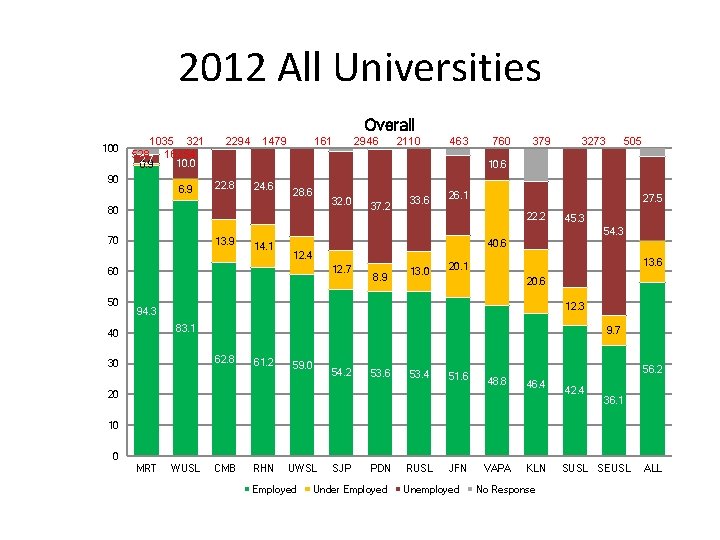
2012 All Universities Overall 100 1035 321 528 2. 7 16254 0. 9 90 2294 1479 161 2110 463 10. 0 6. 9 70 760 379 3273 22. 8 13. 9 24. 6 28. 6 32. 0 37. 2 33. 6 26. 1 27. 5 22. 2 45. 3 54. 3 14. 1 40. 6 12. 4 12. 7 60 8. 9 13. 0 13. 6 20. 1 20. 6 12. 3 94. 3 83. 1 40 505 10. 6 80 50 2946 9. 7 62. 8 30 61. 2 59. 0 54. 2 53. 6 53. 4 51. 6 56. 2 48. 8 20 46. 4 42. 4 36. 1 10 0 MRT WUSL CMB RHN UWSL Employed SJP PDN Under Employed RUSL JFN Unemployed VAPA KLN No Response SUSL SEUSL ALL
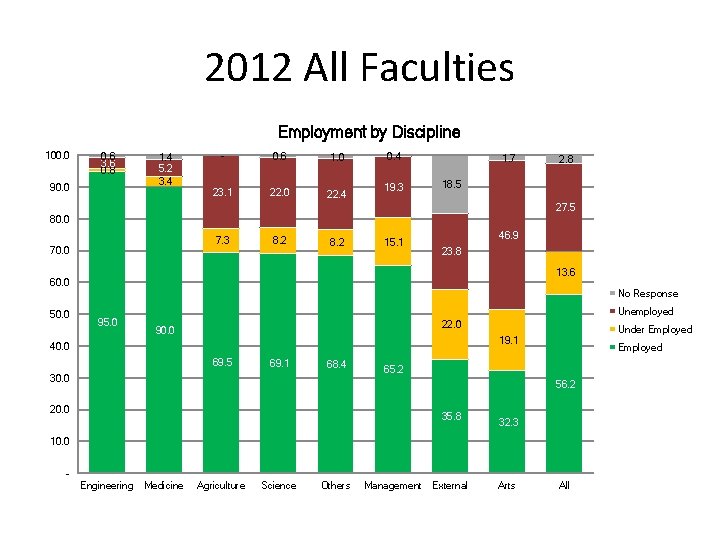
2012 All Faculties Employment by Discipline 100. 0 0. 6 3. 6 0. 8 90. 0 1. 4 5. 2 3. 4 - 0. 6 1. 0 23. 1 22. 0 22. 4 0. 4 19. 3 1. 7 2. 8 18. 5 27. 5 80. 0 7. 3 70. 0 8. 2 15. 1 46. 9 23. 8 13. 6 60. 0 50. 0 No Response 95. 0 Unemployed 22. 0 90. 0 Under Employed 19. 1 40. 0 69. 5 69. 1 68. 4 30. 0 Employed 65. 2 56. 2 20. 0 35. 8 32. 3 10. 0 Engineering Medicine Agriculture Science Others Management External Arts All

SEUSL 2012 & 2013
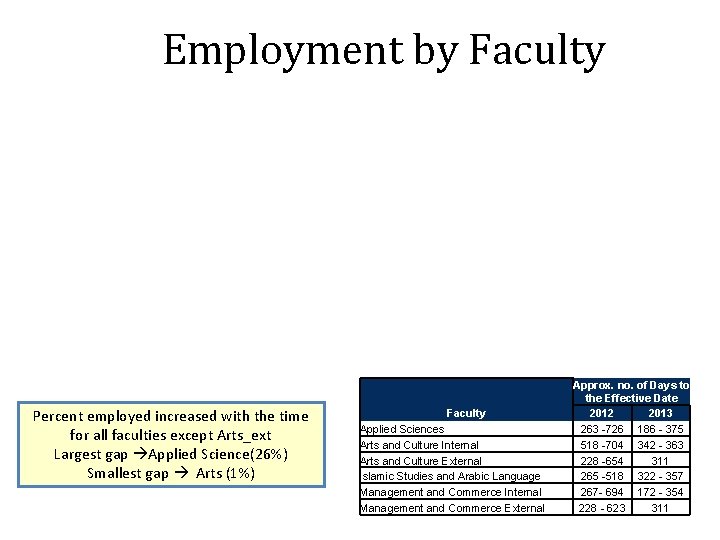
Employment by Faculty Percent employed increased with the time for all faculties except Arts_ext Largest gap Applied Science(26%) Smallest gap Arts (1%) Faculty Applied Sciences Arts and Culture Internal Arts and Culture External Islamic Studies and Arabic Language Management and Commerce Internal Management and Commerce External Approx. no. of Days to the Effective Date 2012 2013 263 -726 186 - 375 518 -704 342 - 363 228 -654 311 265 -518 322 - 357 267 - 694 172 - 354 228 - 623 311

RUSL 2012 & 2013
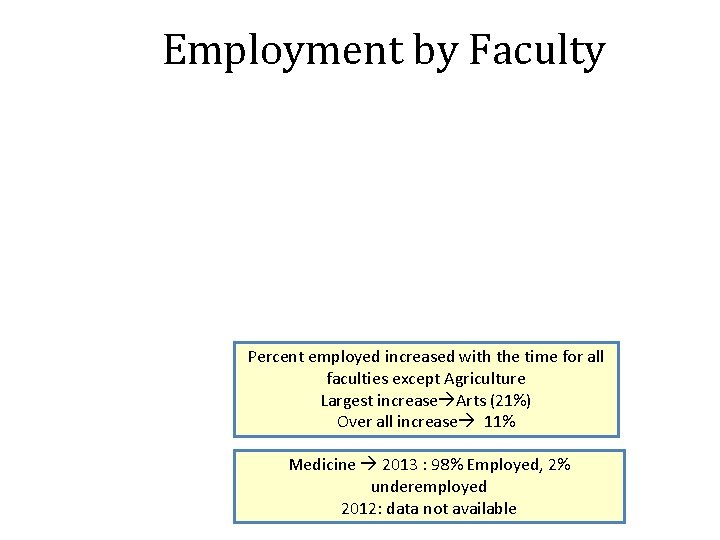
Employment by Faculty Percent employed increased with the time for all faculties except Agriculture Largest increase Arts (21%) Over all increase 11% Medicine 2013 : 98% Employed, 2% underemployed 2012: data not available

WUSL 2012 & 2013
Employment by Faculty Percent employed increased with the time for faculties Agriculture (int) and Business Studies Largest increase Business (12%) Over all increase 6%
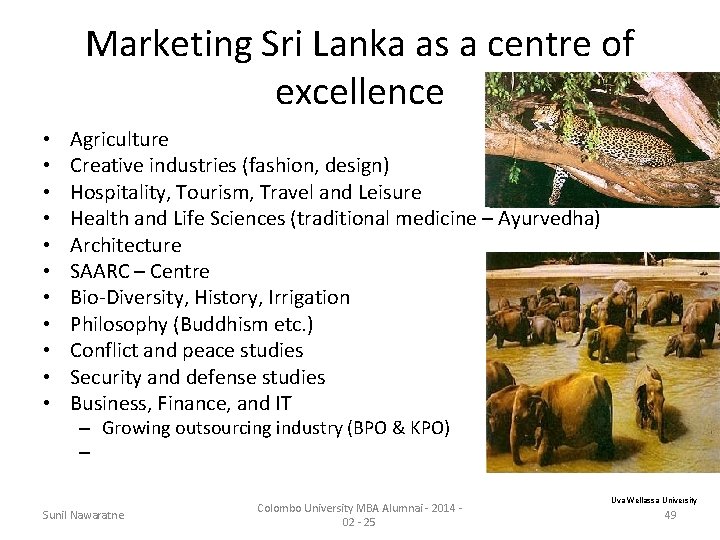
Marketing Sri Lanka as a centre of excellence • • • Agriculture Creative industries (fashion, design) Hospitality, Tourism, Travel and Leisure Health and Life Sciences (traditional medicine – Ayurvedha) Architecture SAARC – Centre Bio-Diversity, History, Irrigation Philosophy (Buddhism etc. ) Conflict and peace studies Security and defense studies Business, Finance, and IT – Growing outsourcing industry (BPO & KPO) – Sunil Nawaratne Colombo University MBA Alumnai - 2014 - 02 - 25 Uva Wellassa University 49
Questions and learning from others What is our niche? (subject areas, UG or PG? ) Regional accessibility? Student experience/support systems? Brain gain? Access, equity, quality – avoiding state/private divide? • How to balance international academic standards with national needs and local identity and culture? • Funding models? • • • Sunil Nawaratne Colombo University MBA Alumnai - 2014 - 02 - 25 50
Marketing Sri Lanka as a centre of excellence • • • Agriculture Creative industries (fashion, design) Hospitality, Tourism, Travel and Leisure Health and Life Sciences (traditional medicine – Ayurvedha) Architecture Philosophy (Buddhism etc. ) Conflict and peace studies Security and defense studies Business, Finance, and IT – Growing outsourcing industry (BPO & KPO) – Sunil Nawaratne Colombo University MBA Alumnai - 2014 - 02 - 25 Uva Wellassa University 51
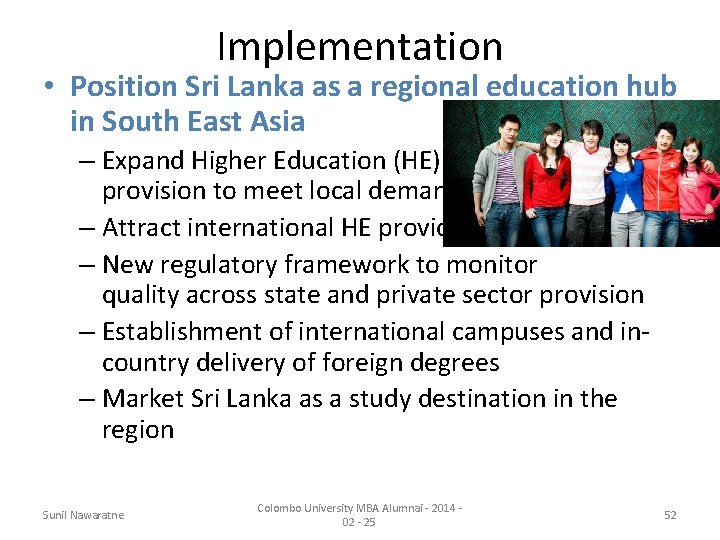
Implementation • Position Sri Lanka as a regional education hub in South East Asia – Expand Higher Education (HE) provision to meet local demand – Attract international HE providers – New regulatory framework to monitor quality across state and private sector provision – Establishment of international campuses and incountry delivery of foreign degrees – Market Sri Lanka as a study destination in the region Sunil Nawaratne Colombo University MBA Alumnai - 2014 - 02 - 25 52
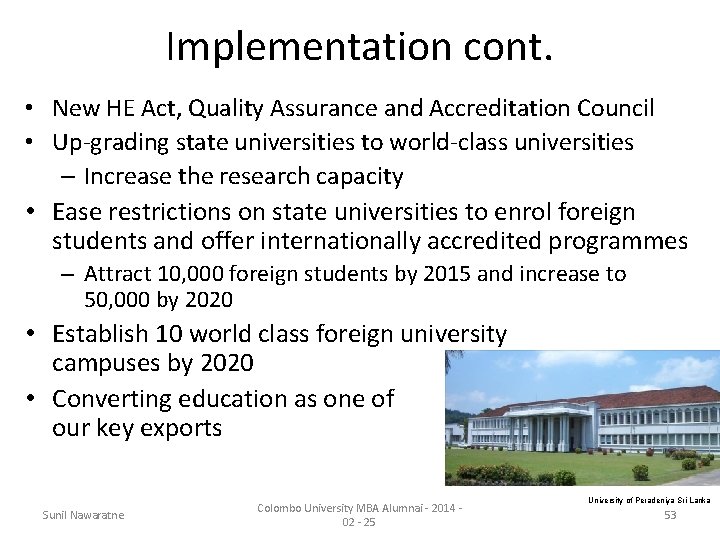
Implementation cont. • New HE Act, Quality Assurance and Accreditation Council • Up-grading state universities to world-class universities – Increase the research capacity • Ease restrictions on state universities to enrol foreign students and offer internationally accredited programmes – Attract 10, 000 foreign students by 2015 and increase to 50, 000 by 2020 • Establish 10 world class foreign university campuses by 2020 • Converting education as one of our key exports Sunil Nawaratne Colombo University MBA Alumnai - 2014 - 02 - 25 University of Peradeniya Sri Lanka 53
Questions and learning from others • What is our niche? (subject areas, UG or PG? ) • Regional accessibility? • Student experience/support systems? • Brain gain? • Access, equity, quality – avoiding state/private divide? • How to balance international academic standards with national needs and local identity and culture? • Funding models? Sunil Nawaratne Colombo University MBA Alumnai - 2014 - 02 - 25 54
12 Competencies • 12 Competencies Well Researched by landmark studies by a number of major U. S. corporations have identified the 12 key competencies that highly effective managers and supervisors possess to a greater degree than do average performers. These critical competencies are the basis for the complete management development program MAP-Excel Proficiency and for EXCEL. A description of the competencies may be downloaded here. The Twelve Competencies Are. . . • 1. Time Management and Prioritizing 2. Setting Goals and Standards 3. Planning and Scheduling Work 4. Listening and Organizing 5. Giving Clear Information 6. Getting Unbiased Information 7. Training, Coaching, and Delegating 8. Appraising People and Performance 9. Disciplining and Counseling 10. Identifying and Solving Problems 11. Making Decisions, Weighing Risk 12. Thinking Clearly & Analytically • • • Sunil Nawaratne Colombo University MBA Alumnai - 2014 - 02 - 25 55
• 4. K-Clusters and K-hubs • • Most of the current literature does not draw a distinction between knowledge clusters and knowledge hubs. Policy statements in particular use both term arbitrarily. We feel that turning these terms into different analytical concepts would enhance our understanding of spatial processes. The most general concept would be “agglomeration”, i. e. clusters are agglomerations with ”proximity” as a crucial variable. Henry and Pinch use the term agglomeration and cluster synonymously “to refer to geographical groupings of firms (both large and small but often SMEs), broadly in the same sector, but extending beyond to incorporate greater parts of the value chain” (Henry and Pinch 2006: 117). The cluster concept emphasizes the organizational aspect of agglomerations, while the term hub refers to the knowledge sharing and dissemination aspect. A more precise definition reads as follows Sunil Nawaratne Colombo University MBA Alumnai - 2014 - 02 - 25 56
Education Hub • Education hubs are important new developments. They represent a new generation of crossborder education activities. There is no ‘one size fits all’ model for education hubs, as local conditions, priorities and rationales vary from country to country and from hub to hub. There are different levels and types of hubs emerging but an education hub can be generally described as ‘the process of building a critical mass of local and foreign actors – including students, education institutions, companies, knowledge industries, science and technology centres – who collaborate in a strategic way on crossborder education, training, knowledge and innovation initiatives. ’ Sunil Nawaratne Colombo University MBA Alumnai - 2014 - 02 - 25 57
K-Hub • Knowledge hubs are about integrative institutional configurations around new knowledge, education, intellectual capital development, innovation and investment. Obviously, in order to supply new knowledge, there must be a demand for it. What use of knowledge is made and therefore, what knowledge is demanded by business enterprises in Sri Lanka? This is a weak side of the equation. On the side of the government, is there a will; political, professional and bureaucratic? When is this will likely to become positive? First, let’s look at what knowledge hubs are and what they can do to business and economy. The term knowledge hub/education hub is being used by countries who are trying to build a critical mass of local and foreign players such as including students, education institutions, companies, science and technology centres who, thorough interaction engage in education, training, knowledge creation, and innovation. Some countries who have declared as knowledge hubs such as Singapore, Malaysia and Hong Kong, are trying to position themselves as centres for student recruitment, education and training, and in some cases research and innovation. The term hub is being used by many sectors; transportation, finance, communication and fashion. • http: //www. ft. lk/2013/10/21/developing-sri-lanka-as-a-knowledge-hub-in Colombo University MBA Alumnai - 2014 - Sunil Nawaratne 58 02 - 25 -asia-the-role-of-public-private-partnership/
BALI COMMUNIQUE BY THE CO-ORGANIZERS HIGH LEVEL MEETING “TOWARDS COUNTRY-LED KNOWLEDGE HUBS” BALI, 10 JULY 2012 • 3. Governments, bilateral, regional and multilateral development partners, as well as civil society, academia and the private sector need to work hand in hand to foster Knowledge Exchange around the key development challenges of today. These challenges can no longer be addressed in isolation, but demand comprehensive, collaborative and inclusive approaches that draw on the comparative strengths of all stakeholders Sunil Nawaratne Colombo University MBA Alumnai - 2014 - 02 - 25 59
BALI COMMUNIQUE BY THE CO-ORGANIZERS HIGH LEVEL MEETING “TOWARDS COUNTRY-LED KNOWLEDGE HUBS” BALI, 10 JULY 2012 • 4. Developing countries understand that, in order to respond to the increased demand for Knowledge Exchange, they need to invest in their institutional capacity to share their experiences more systematically. Thus, they are taking a lead in setting up Knowledge Hubs. A Knowledge Hub is an organization or a network, dedicated to share and exchange development experiences and models with partners from other countries. Knowledge hubs facilitate mutual learning about helpful and innovative approaches that may be adapted and scaled up elsewhere. • http: //api. ning. com/files/UHn. SOwweu. KQQVln. LZZn. UK 7 lm*Ji. Fyweu. S-lqc. TCXBrip 35 ya. D 97 SOX 2 Utyht 5 SZot. D 9 e. QRYKSk. Spxw 0 kf. Yfu. IO 0 THwj. HOx/Bal i. Communi Sunil Nawaratne Colombo University MBA Alumnai - 2014 - 02 - 25 60
BALI COMMUNIQUE BY THE CO-ORGANIZERS HIGH LEVEL MEETING “TOWARDS COUNTRY-LED KNOWLEDGE HUBS” BALI, 10 JULY 2012 • 5. Successful approaches to Knowledge Hubs build on the endeavors of trial-and-error at various stages of development, and the energy and commitment of all relevant national stakeholders. Strengthening of Knowledge Hubs can be effectively supported by development partners, e. g. as facilitators and brokers. Political leadership, sound coordination and sustainable funding arrangements are needed to develop and maintain Knowledge Hubs. Sunil Nawaratne Colombo University MBA Alumnai - 2014 - 02 - 25 61
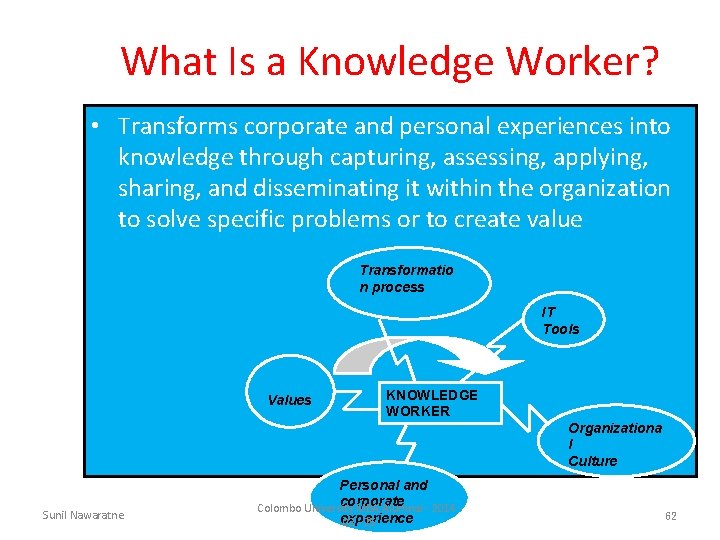
What Is a Knowledge Worker? • Transforms corporate and personal experiences into knowledge through capturing, assessing, applying, sharing, and disseminating it within the organization to solve specific problems or to create value Transformatio n process IT Tools Values KNOWLEDGE WORKER Organizationa l Culture Sunil Nawaratne Personal and corporate Colombo University MBA Alumnai - 2014 - experience 02 - 25 62
Core Competencies • Thinking skills — having a vision how the product or the company can be better • Continuous learning — unlearning and relearning in tune with fast-changing conditions • Innovative teams and teamwork — via collaboration, cooperation, and coordination • Creativity — ”dreaming” new ways to advance the firm Colombo University MBA Alumnai - 2014 - 02 - 25 63
Core Competencies (cont’d) • Risk taking and potential success — making joint decisions with calculated risk • Decision action taking — be willing to embrace professional discipline, patience, and determination • Culture of responsibility toward knowledge — loyalty and commitment to one’s manager or leader Colombo University MBA Alumnai - 2014 - 02 - 25 64
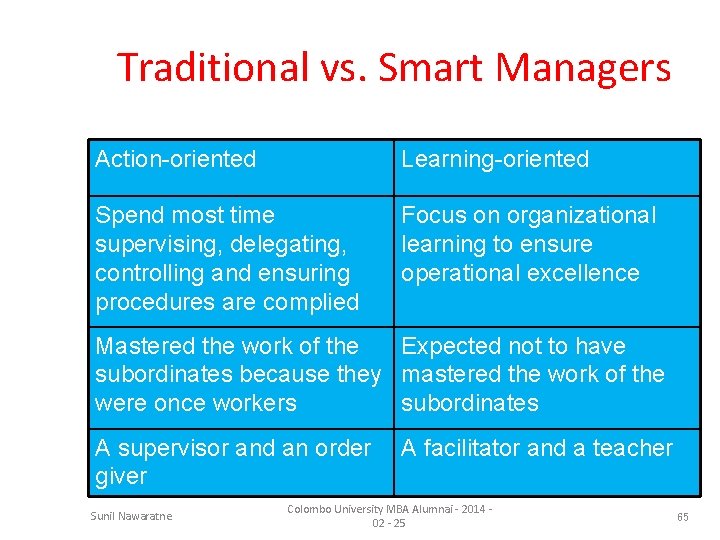
Traditional vs. Smart Managers Action-oriented Learning-oriented Spend most time supervising, delegating, controlling and ensuring procedures are complied Focus on organizational learning to ensure operational excellence Mastered the work of the Expected not to have subordinates because they mastered the work of the were once workers subordinates A supervisor and an order giver Sunil Nawaratne A facilitator and a teacher Colombo University MBA Alumnai - 2014 - 02 - 25 65
Major Challenges • Get the organization moving towards achieving goals in line with rate of change • Promote active learning to improve knowledge worker’s capacity to create, produce, and respond to change • Provide opportunities for knowledge workers to brainstorm ideas, exchange knowledge, and devise new ways of doing business Colombo University MBA Alumnai - 2014 - 02 - 25 66
Responsibilities of Smart Managers • Managing knowledge workers • Searching out, creating, sharing, and using knowledge regularly • Maintaining work motivation among knowledge workers Colombo University MBA Alumnai - 2014 - 02 - 25 67
What is Knowledge Society? • The emergence of the knowledge society, building on the pervasive influence of modern pervasive influence information and communication technologies, is information and communication technologies bringing about a fundamental reshaping of the global economy. Its significance goes well beyond global economy the hyping of the Internet. What is underway is a transformation of our economy and society • http: //www. pragfoundation. net/concept/what-is -knowledge-society/ Sunil Nawaratne Colombo University MBA Alumnai - 2014 - 02 - 25 68
Linking to Universities? • Knowledge has become the key resource. Knowledge has value, but so too does knowledge about knowledge. Creating value is about creating new knowledge and capturing its value. • The most important property is now intellectual property, not physical property. And it is the hearts and minds of people, rather than traditional labour, that are essential to people growth and prosperity. • Workers at all levels in the 21 st century knowledge society will need to be lifelong learners, adapting continuously to changed opportunities, work practices, business models and forms of economic and social organization http: //www. pragfoundation. net/concept/what-isknowledge-society/ Sunil Nawaratne Colombo University MBA Alumnai - 2014 - 02 - 25 69
Knowledge Workers • Knowledge workers are employees who have workers are employees a deep background in education and experience and are considered people who experience "think for a living. " They "think for a living. " include doctors, lawyers, inventors, teachers, nurses, financial analysts and architects. [6] As businesses increase their dependence on information technology, the number of fields in which knowledge workers must operate has expanded dramatically. Sunil Nawaratne Colombo University MBA Alumnai - 2014 - 02 - 25 70
• Knowledge workers spend 38% of their time searching for information. They are also often searching for information displaced from their bosses, working in various displaced departments and time zones or from remote sites such as home offices and airport lounges [5] • Even though they sometimes are called "gold collars", [7] because of their high salaries, as well their high salaries as because of their relative independence in relative independence controlling the process of their own work, [8] • http: //en. wikipedia. org/wiki/Knowledge_worke r Sunil Nawaratne Colombo University MBA Alumnai - 2014 - 02 - 25 71
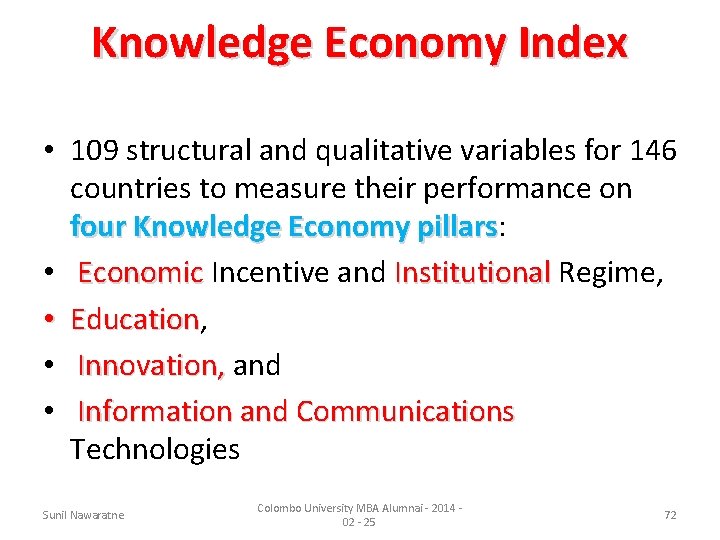
Knowledge Economy Index • 109 structural and qualitative variables for 146 countries to measure their performance on four Knowledge Economy pillars: four Knowledge Economy pillars • Economic Incentive and Institutional Regime, Economic Institutional • Education, Education • Innovation, and Innovation, • Information and Communications Technologies Sunil Nawaratne Colombo University MBA Alumnai - 2014 - 02 - 25 72
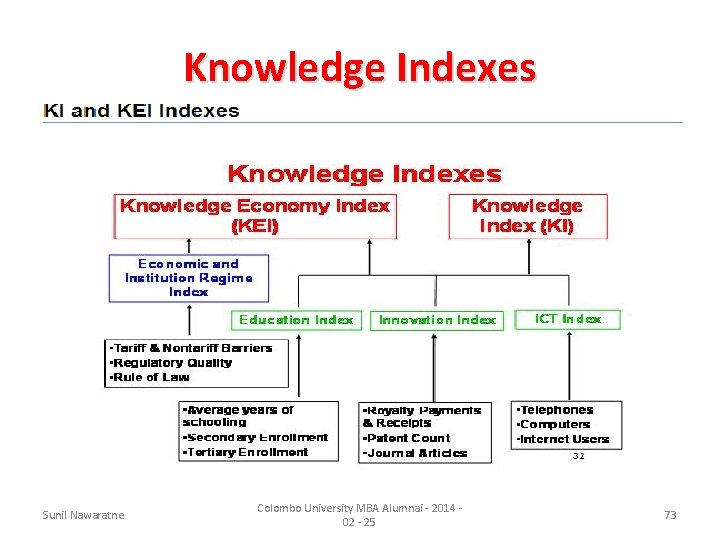
Knowledge Indexes Sunil Nawaratne Colombo University MBA Alumnai - 2014 - 02 - 25 73
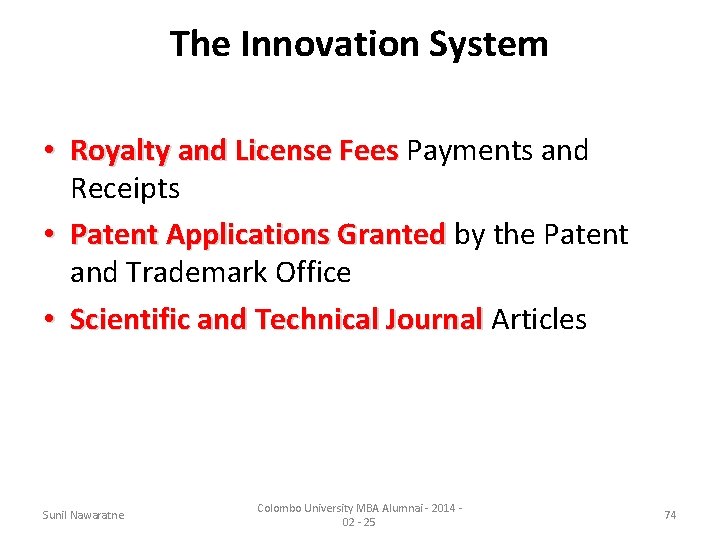
The Innovation System • Royalty and License Fees Payments and Royalty and License Fees Receipts • Patent Applications Granted by the Patent Applications Granted and Trademark Office • Scientific and Technical Journal Articles Scientific and Technical Journal Sunil Nawaratne Colombo University MBA Alumnai - 2014 - 02 - 25 74
A Model of a Knowledge Society Sunil Nawaratne Colombo University MBA Alumnai - 2014 - 02 - 25 75
- Slides: 75