
SRF RD SC EM properties of bulkcoated materials
SRF R&D SC EM properties of bulk/coated materials S. Aull, A. Castilla, H. Furci, K. Ilyina, K. Hernandez Chahin, T. Koettig, A. Macpherson, A. Miyazaki, G. Rosaz, S. Teixeira, N. Schwerg, A. Sublet, W. Venturini Delsolaro
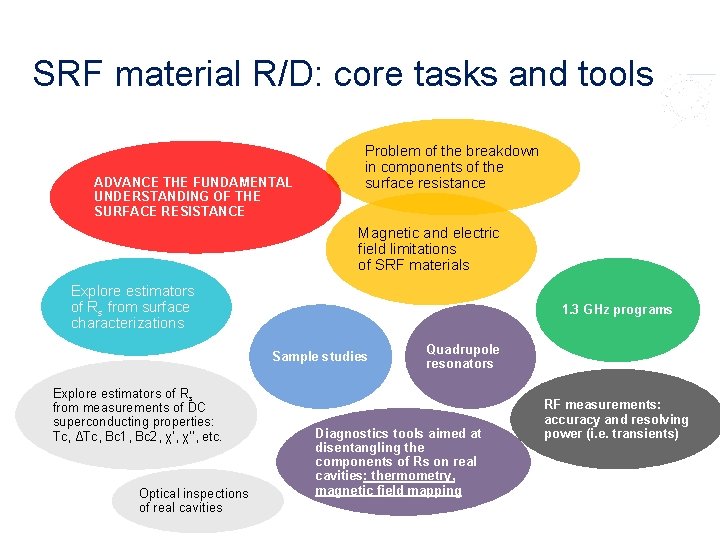
SRF material R/D: core tasks and tools ADVANCE THE FUNDAMENTAL UNDERSTANDING OF THE SURFACE RESISTANCE Problem of the breakdown in components of the surface resistance Magnetic and electric field limitations of SRF materials Explore estimators of Rs from surface characterizations 1. 3 GHz programs Sample studies Explore estimators of Rs from measurements of DC superconducting properties: Tc, ΔTc, Bc 1, Bc 2, χ’’, etc. Optical inspections of real cavities Quadrupole resonators Diagnostics tools aimed at disentangling the components of Rs on real cavities: thermometry, magnetic field mapping RF measurements: accuracy and resolving power (i. e. transients)
SRF Materials • SC thin films on copper substrates: Well known advantages (see NIM-A 463, 1 -8, 2001): – Thermal stability – Independent tailoring of SC and cooling functions – Cost effective – Insensitive to trapped flux – Insensitive to microphonics – Nb/Cu • was used in all CERN machines (LEP, LHC, HIE-ISOLDE) • has not yet reached fundamental performance limits • Problem: Q slope (crossover with Nb bulk at 15 MV/m) – New materials: A 15 on Copper substrates • Bulk Nb: aiming at state of the art performances – SRF physics largely the same or “complementary” – What can be learnt from transients – Field limitations, Quenches – Influence test conditions, loss of performances in cryomodules…
Some key questions • • • Why Nb/Cu behaves differently from bulk Nb? How to decompose the surface resistance? BCS vs. residual surface resistance? Which components differ for the two cases? Is RBCS the only temperature dependent component? How does RBCS behave at high fields? What other identified contributors to the surface resistance? How the coating process parameters influence them? What is the influence of the surface preparation?
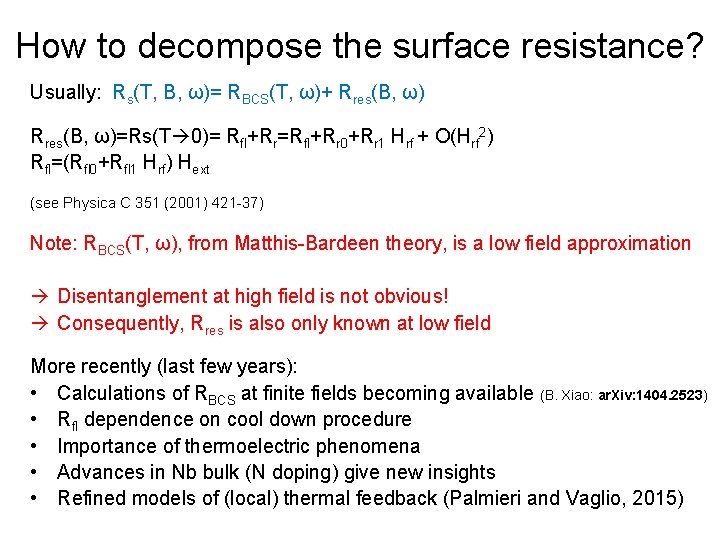
How to decompose the surface resistance? Usually: Rs(T, B, ω)= RBCS(T, ω)+ Rres(B, ω)=Rs(T 0)= Rfl+Rr=Rfl+Rr 0+Rr 1 Hrf + O(Hrf 2) Rfl=(Rfl 0+Rfl 1 Hrf) Hext (see Physica C 351 (2001) 421 -37) Note: RBCS(T, ω), from Matthis-Bardeen theory, is a low field approximation Disentanglement at high field is not obvious! Consequently, Rres is also only known at low field More recently (last few years): • Calculations of RBCS at finite fields becoming available (B. Xiao: ar. Xiv: 1404. 2523) • Rfl dependence on cool down procedure • Importance of thermoelectric phenomena • Advances in Nb bulk (N doping) give new insights • Refined models of (local) thermal feedback (Palmieri and Vaglio, 2015)
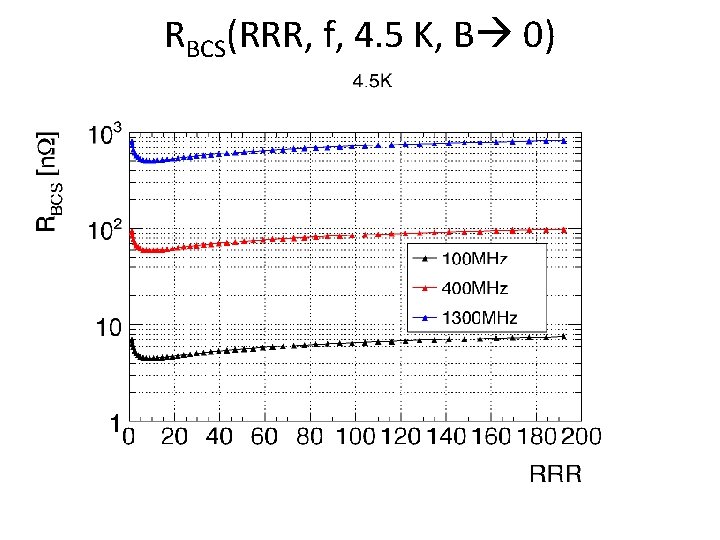
RBCS(RRR, f, 4. 5 K, B 0)
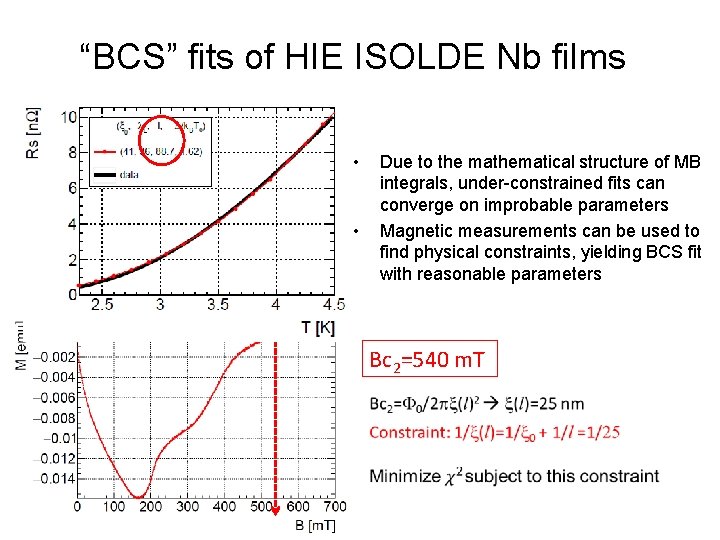
“BCS” fits of HIE ISOLDE Nb films • Due to the mathematical structure of MB integrals, under-constrained fits can converge on improbable parameters Magnetic measurements can be used to find physical constraints, yielding BCS fit with reasonable parameters • l =2. 7 nm RRR=1 !? Bc 2=540 m. T
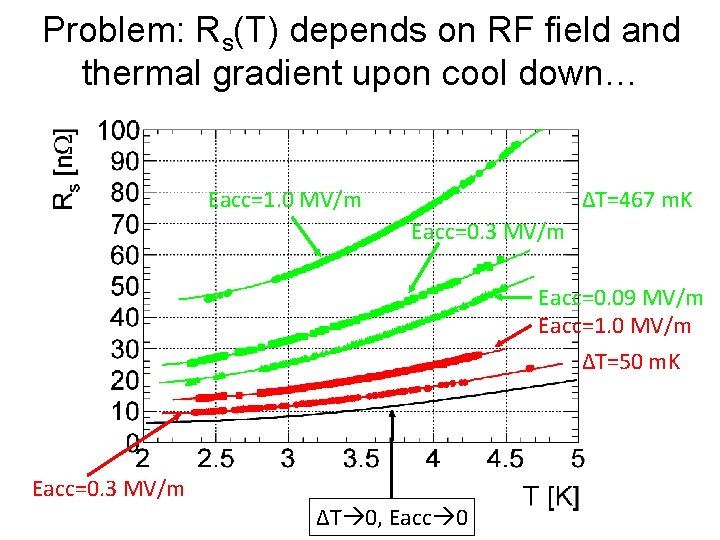
Problem: Rs(T) depends on RF field and thermal gradient upon cool down… Eacc=1. 0 MV/m ΔT=467 m. K Eacc=0. 3 MV/m Eacc=0. 09 MV/m Eacc=1. 0 MV/m ΔT=50 m. K Eacc=0. 3 MV/m ΔT 0, Eacc 0
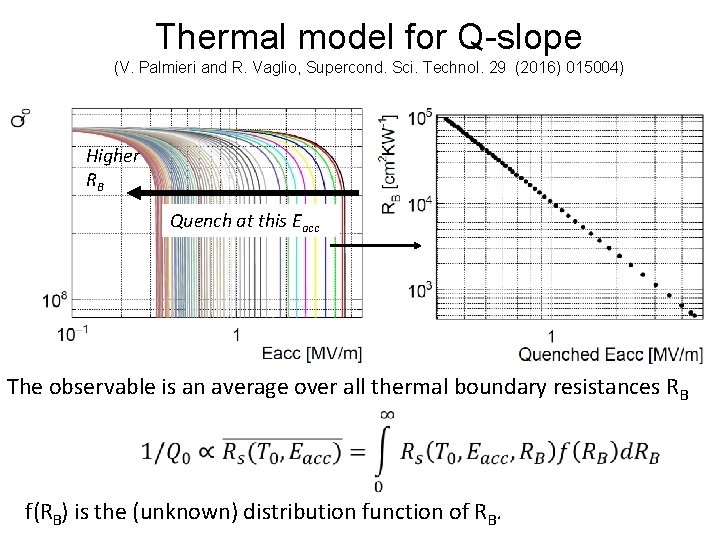
Thermal model for Q-slope (V. Palmieri and R. Vaglio, Supercond. Sci. Technol. 29 (2016) 015004) Higher RB Quench at this Eacc The observable is an average over all thermal boundary resistances RB f(RB) is the (unknown) distribution function of RB.
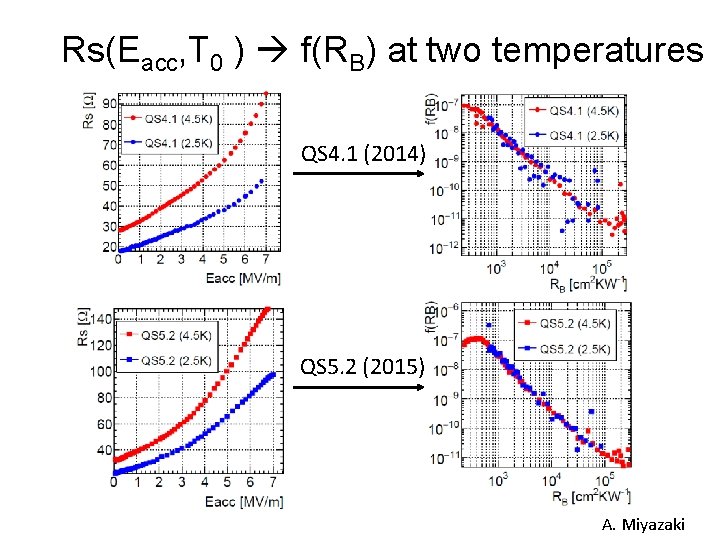
Rs(Eacc, T 0 ) f(RB) at two temperatures QS 4. 1 (2014) QS 5. 2 (2015) A. Miyazaki
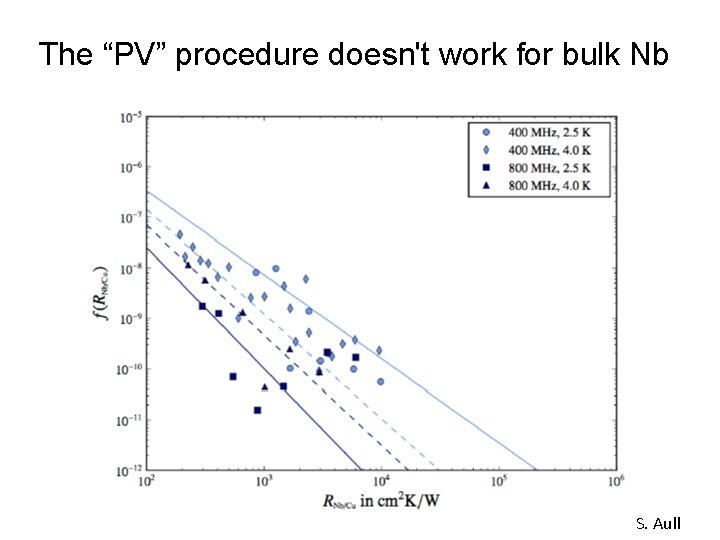
The “PV” procedure doesn't work for bulk Nb S. Aull
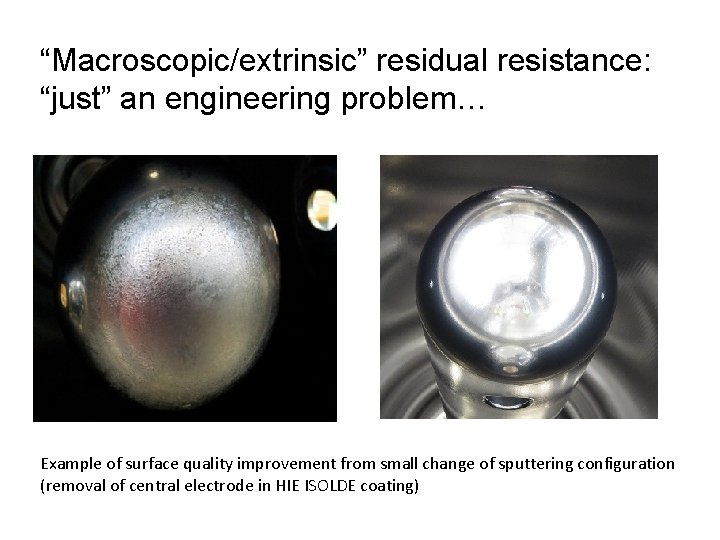
“Macroscopic/extrinsic” residual resistance: “just” an engineering problem… Example of surface quality improvement from small change of sputtering configuration (removal of central electrode in HIE ISOLDE coating)
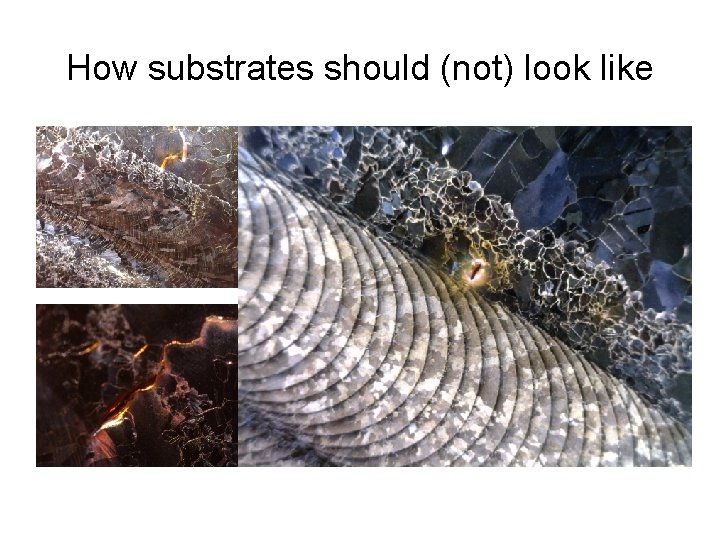
How substrates should (not) look like
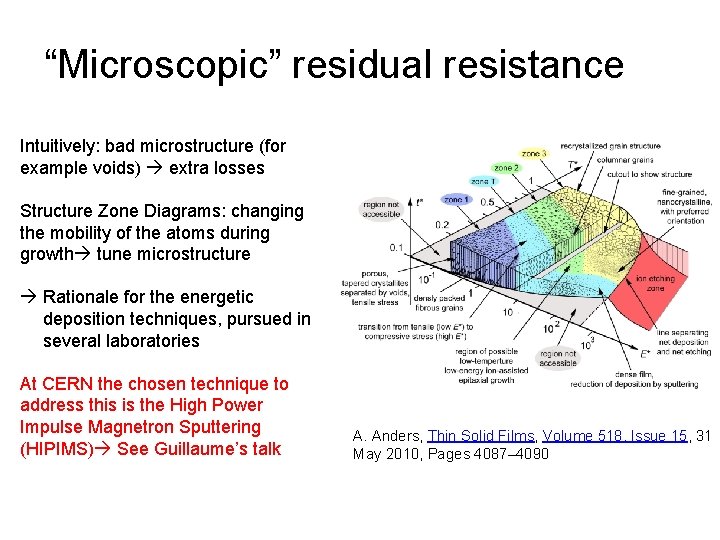
“Microscopic” residual resistance Intuitively: bad microstructure (for example voids) extra losses Structure Zone Diagrams: changing the mobility of the atoms during growth tune microstructure Rationale for the energetic deposition techniques, pursued in several laboratories At CERN the chosen technique to address this is the High Power Impulse Magnetron Sputtering (HIPIMS) See Guillaume’s talk A. Anders, Thin Solid Films, Volume 518, Issue 15, 31 May 2010, Pages 4087– 4090
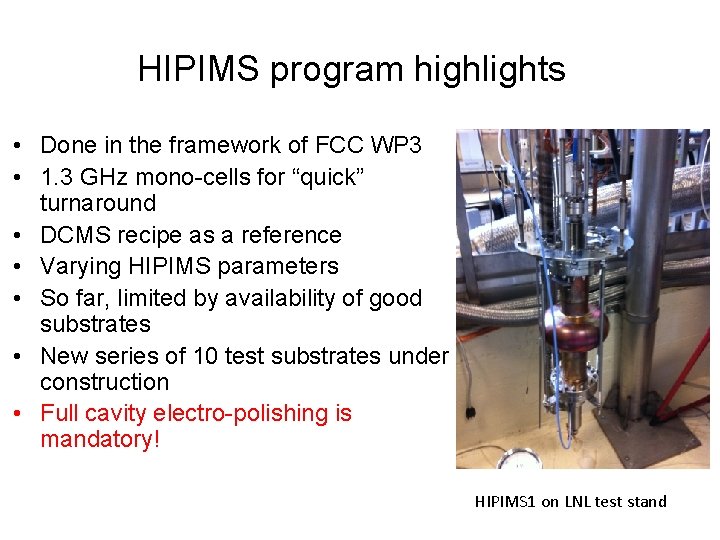
HIPIMS program highlights • Done in the framework of FCC WP 3 • 1. 3 GHz mono-cells for “quick” turnaround • DCMS recipe as a reference • Varying HIPIMS parameters • So far, limited by availability of good substrates • New series of 10 test substrates under construction • Full cavity electro-polishing is mandatory! HIPIMS 1 on LNL test stand
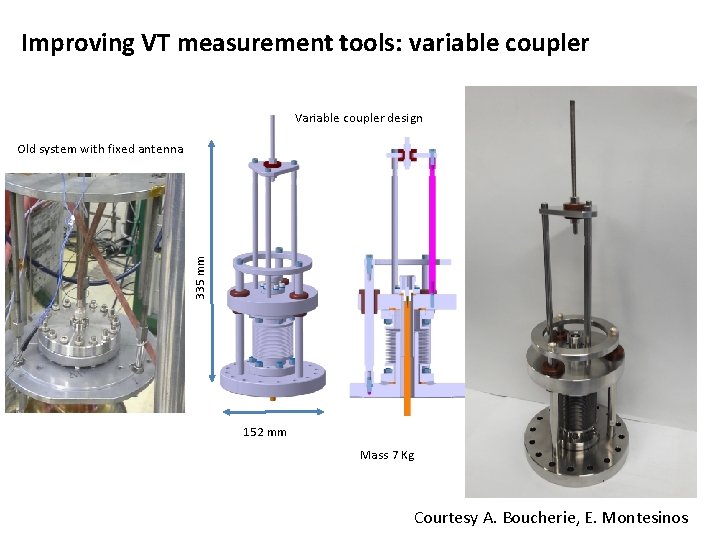
Improving VT measurement tools: variable coupler Variable coupler design Old system with fixed antenna 1) Constant (and minimal) measurement uncertainty independent of cavity Q 0 335 mm 2) Easiness of MP conditioning 152 mm Mass 7 Kg Courtesy A. Boucherie, E. Montesinos
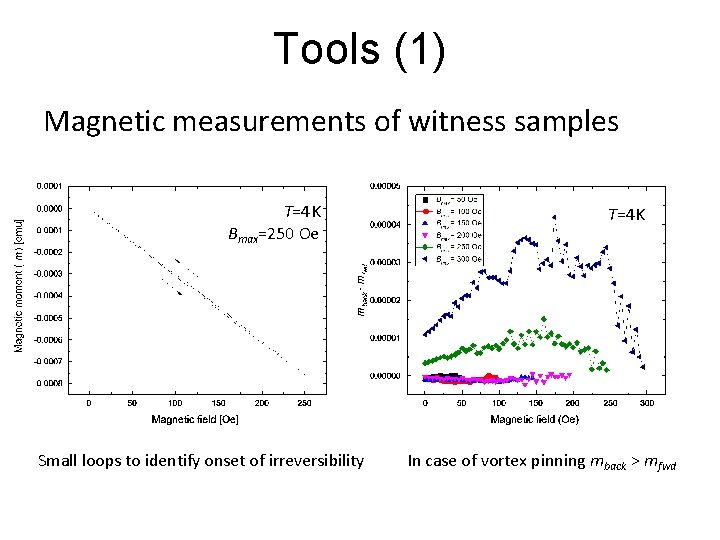
Tools (1) Magnetic measurements of witness samples T=4 K Bmax=250 Oe Small loops to identify onset of irreversibility T=4 K In case of vortex pinning mback > mfwd
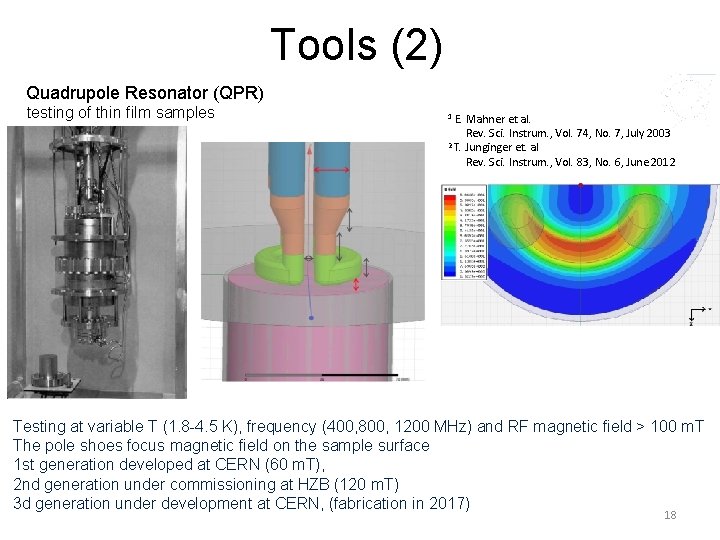
Tools (2) Quadrupole Resonator (QPR) testing of thin film samples 1 E. Mahner et al. Rev. Sci. Instrum. , Vol. 74, No. 7, July 2003 2 T. Junginger et. al Rev. Sci. Instrum. , Vol. 83, No. 6, June 2012 Testing at variable T (1. 8 -4. 5 K), frequency (400, 800, 1200 MHz) and RF magnetic field > 100 m. T The pole shoes focus magnetic field on the sample surface 1 st generation developed at CERN (60 m. T), 2 nd generation under commissioning at HZB (120 m. T) 3 d generation under development at CERN, (fabrication in 2017) 18
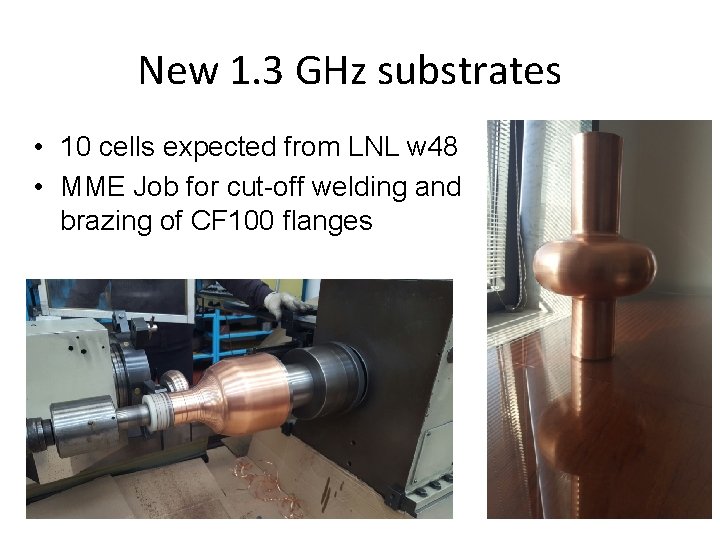
New 1. 3 GHz substrates • 10 cells expected from LNL w 48 • MME Job for cut-off welding and brazing of CF 100 flanges
Final considerations • • Ultimate goal of our R/D is to advance the technology for SRF cavities for CERN present and future accelerators Fundamental studies are instrumental and essential to this CERN resources for SRF are focused on existing projects/machines R/D work in CRYOLAB is decoupled from projects, for infrastructure use and manpower: work was mainly done by fellows. Support from CERN technical staff and access to infrastructures must be increased Fundamental studies must be complemented with engineering work Part of the outlined R/D activities on SRF cavity material and performance are defined in RF R/D WP 3 of the FCC study. – Main focus on Nb/Cu with energetic condensation techniques – At the moment, we are still re-establishing conditions for high quality coatings of 1. 3 GHz mono-cells • • More is done for diagnostics, bulk Nb, etc. (covered in other talks) R/D coordination meeting for sharing knowledge and follow up progress
- Slides: 20