
Sret Skibsadministration BJ BS Philip Cossen IMO Conventions
Søret & Skibsadministration BJ & BS Philip Cossen
IMO Conventions
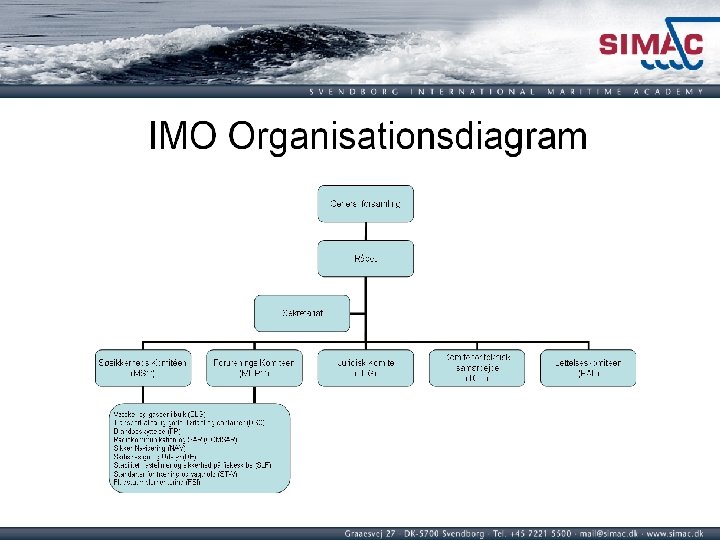
IMO ØUN Organisation ØEstablished in 1948 i Geneva - IMCO Ø First meeting held in 1959 Ø 168 member states and 3 associate members
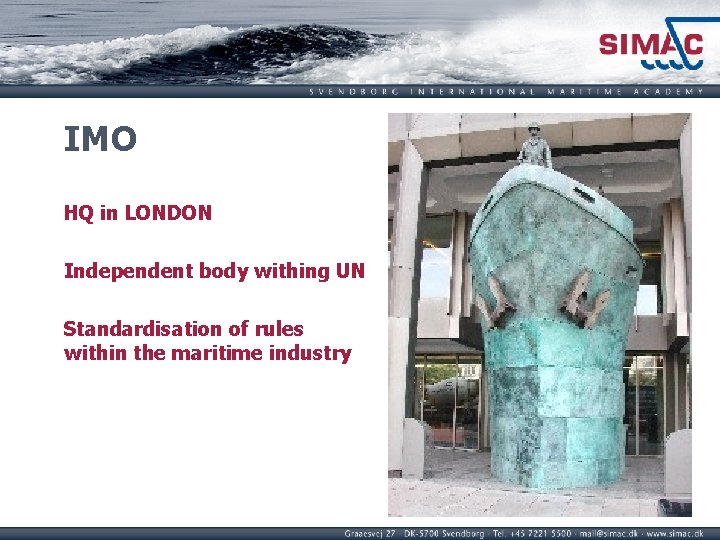
IMO HQ in LONDON Independent body withing UN Standardisation of rules within the maritime industry
IMO Main areas of influence: : Safety Security Environment Legislation Technical matters Facilitation of Shipping IMO does not enforce the law, it creates the legal framework
IMO Key Conventions: Ø SOLAS Ø Tonnage Ø STCW Ø COLREG Ø MARPOL Ø HNS Ø ILLC Ø BUNKERS Ø GMDSS Ø AFS Ø SAR Ø BWM Ø SALVAGE Ø CLC Ø FAL Ø MLC
SOLAS - 1974 – Int. Convention for the Safety of Lives at Sea Chapter I - General Provisions Chapter II-1 - Construction - Subdivision and stability, machinery and electrical installations Chapter II-2 - Fire protection, fire detection and fire extinction Chapter III - Life-saving appliances and arrangements Chapter IV- Radio communications Chapter V - Safety of navigation Chapter VI - Carriage of Cargoes Chapter VII - Carriage of dangerous goods Chapter VIII - Nuclear ships Chapter IX - Management for the Safe Operation of Ships Chapter X - Safety measures for high-speed craft Chapter XI-1 - Special measures to enhance maritime safety Chapter XI-2 - Special measures to enhance maritime security Chapter XII - Additional safety measures for bulk carriers
STCW - International Convention on Standards of Training, Certification and Watchkeeping for Seafarers, 1978 Chapter I - General Provisions Chapter II - Master and Deck Department Chapter III - Engine Department Chapter IV - Radio Communication and radio Peronnel Chapter V - Special training requirements for personnel on certain types of ships Chapter VI - Emergency, occupational health, medical care and survival functions Chapter VII - Alternative certification (dual) Chapter VIII - Watchkeeping STCW Code PART A – Mandatory minimum standards in table form STCW Code PART B – Recommended guidance and examples
MARPOL 73/78 - International Convention for the Prevention of Marine Pollution from Ships, 1973 as modified by the Protocol of 1978 Annex I: Prevention of pollution by oil Annex II: Control of pollution by noxious liquid substances Annex III: Prevention of pollution by harmful substances in packaged form Annex IV: Prevention of pollution by sewage from ships Annex V: Prevention of pollution by garbage from ships Annex VI: Prevention of Air Pollution from Ships
MLC 2006 - The Maritime Labour Convention 2006 • MLC 2006 entered into force 20 August 2013 • It replaces 40 existing conventions and 29 regulations • It provides seafarers with fair terms of employment and guarantee them safe, secure and decent living and working conditions on board ship • Shipowners will benefit from having a clear, consistent set of standards with which all must comply.
COLREG - Convention on the International Regulations for Preventing Collisions at Sea, 1972 International Collision avoidance rules Lights and symbols Sound signals
ILLC 1966 - International Convention on Load Lines, 1966 Load Lines 1966 – Annexes Annex I, divided into four Chapters: · Chapter I - General; · Chapter II - Conditions of assignment of freeboard; · Chapter III - Freeboards; · Chapter IV - Special requirements for ships assigned timber freeboards. Annex II covers Zones, areas and seasonal periods. Annex III contains certificates, including the International Load Line Certificate
International Convention on Civil Liability for Oil Pollution Damage (CLC) The Civil Liability Convention was adopted to ensure that adequate compensation is available to persons who suffer oil pollution damage resulting from maritime casualties involving oil-carrying ships. The Convention places the liability for such damage on the owner of the ship from which the polluting oil escaped or was discharged. • Strict Liability • Limitation of liability • Mandatory insurance Applies to tankers carrying +2000 tons oil in bulk as cargo
International Convention on Civil Liability for Bunker Oil Pollution Damage (BUNKER) Ensures adequate, prompt, and effective compensation to persons who suffer damage caused by spills of oil, caused by fuel from ships of over 1, 000 GT. Covers loss or damage caused outside the ship by contamination resulting from the escape or discharge of bunker oil from the ship, Modelled on CLC Oil Strict Liability Limitation of liability Mandatory insurance
SAR 1979 - International Convention on Maritime Search and Rescue, 1979 IMO's MSC divided the world's oceans into 13 search and rescue areas, in each of which the countries concerned have delimited search and rescue regions for which they are responsible Chapter 1 - Terms and Definitions Chapter 2 - Organization and Co-ordination Chapter 3 - Co-operation between States Chapter 4 - Operating Procedures Chapter 5 - Ship reporting systems IAMSAR - International Aeronautical and Maritime Search and Rescue Manual
INMARSAT - Convention on the Int. Maritime Satellite Organization, 1976 INMARSAT Convention …to improve maritime communications, thereby assisting in improving distress and safety of life at sea communications, the efficiency and management of ships, maritime public correspondence services, and radio determination capabilities. International Mobile Satellite Organization
AFS 2001 - International Convention on the Control of Harmful Anti-fouling Systems on Ships - 2001 Resolution 1 Early and Effective Application of the Convention Resolution 2 Future work of the Organization pertaining to the Convention Resolution 3 Approval and Test Methodologies for Anti-Fouling Systems on Ships Resolution 4 Promotion of Technical Co-operation International Anti-fouling System Certificate
BWM 2004 - International Convention for the Control and Management of Ships' Ballast Water and Sediments, 2004 Entry into force 12 months after ratification by 30 States, representing 35 per cent of world merchant shipping tonnage. NOT YET IN FORCE. Under Article 2 General Obligations Parties undertake to prevent, minimize and ultimately eliminate the transfer of harmful aquatic organisms and pathogens through the control and management of ships' ballast water and sediments. Ballast Water Management Certificate and Ballast Water Record Book
Nairobi International Convention on the Removal of Wrecks 2007 The Convention will provide the legal basis for States to remove, or have removed, shipwrecks that may have the potential to affect adversely the safety of lives, goods and property at sea, as well as the marine environment Liability of the owner for the costs of locating, marking and removing ships and wrecks – Registered shipowner is required to maintain compulsory insurance or other financial security to cover liability under the convention Entry into force: Twelve months after ten States have signed it. April 2015
SALVAGE 1989 - International Convention on Salvage, 1989 The 1989 Convention replaced a convention on the law of salvage adopted in Brussels in 1910 which incorporated the "'no cure, no pay" principle. This philosophy did not take pollution into account. A salvor who prevented a major pollution incident in an environmentally sensitive area. but did not manage to save the ship or the cargo got nothing. There was therefore little incentive to a salvor to undertake an operation which has only a slim chance of success.
TONNAGE 1969 - International Convention on Tonnage Measurement of Ships, 1969 The Convention, adopted by IMO in 1969, was the first successful attempt to introduce a universal tonnage measurement system. Gross tonnage forms the basis for manning regulations, safety rules and registration fees. Both gross and net tonnages are used to calculate port dues. The gross tonnage is a function of the moulded volume of all enclosed spaces of the ship. The net tonnage is produced by a formula which is a function of the moulded volume of all cargo spaces of the ship.
- Slides: 22