
Squamous cell carcinoma pathway update University Hospitals Bristol
Squamous cell carcinoma pathway update University Hospitals Bristol NHS Foundation Trust Dermatology Service Dr Adam Bray Consultant Dermatologist MDT Lead
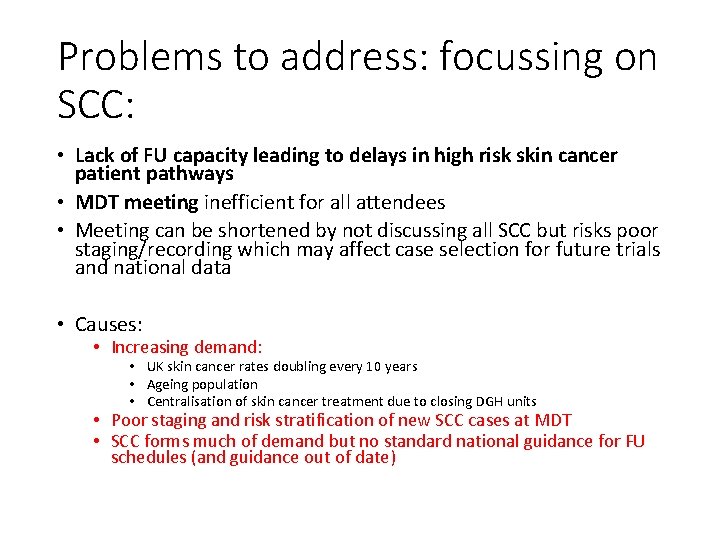
Problems to address: focussing on SCC: • Lack of FU capacity leading to delays in high risk skin cancer patient pathways • MDT meeting inefficient for all attendees • Meeting can be shortened by not discussing all SCC but risks poor staging/recording which may affect case selection for future trials and national data • Causes: • Increasing demand: • UK skin cancer rates doubling every 10 years • Ageing population • Centralisation of skin cancer treatment due to closing DGH units • Poor staging and risk stratification of new SCC cases at MDT • SCC forms much of demand but no standard national guidance for FU schedules (and guidance out of date)
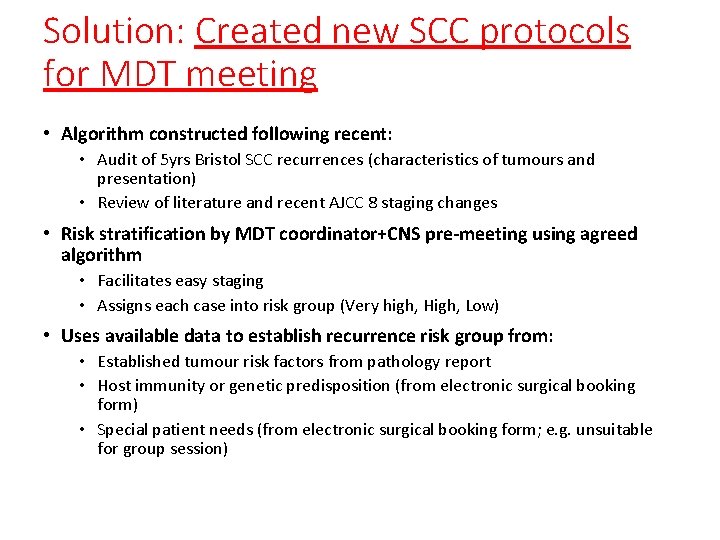
Solution: Created new SCC protocols for MDT meeting • Algorithm constructed following recent: • Audit of 5 yrs Bristol SCC recurrences (characteristics of tumours and presentation) • Review of literature and recent AJCC 8 staging changes • Risk stratification by MDT coordinator+CNS pre-meeting using agreed algorithm • Facilitates easy staging • Assigns each case into risk group (Very high, High, Low) • Uses available data to establish recurrence risk group from: • Established tumour risk factors from pathology report • Host immunity or genetic predisposition (from electronic surgical booking form) • Special patient needs (from electronic surgical booking form; e. g. unsuitable for group session)

Example section of SCC management algorithm
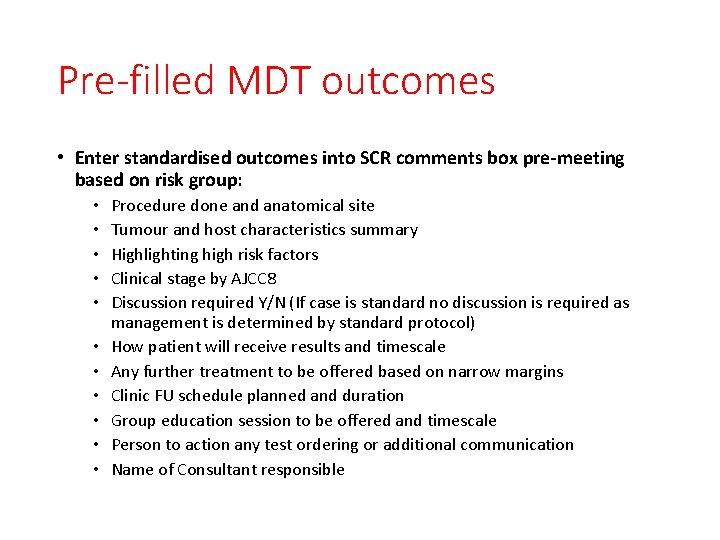
Pre-filled MDT outcomes • Enter standardised outcomes into SCR comments box pre-meeting based on risk group: • • • Procedure done and anatomical site Tumour and host characteristics summary Highlighting high risk factors Clinical stage by AJCC 8 Discussion required Y/N (If case is standard no discussion is required as management is determined by standard protocol) How patient will receive results and timescale Any further treatment to be offered based on narrow margins Clinic FU schedule planned and duration Group education session to be offered and timescale Person to action any test ordering or additional communication Name of Consultant responsible
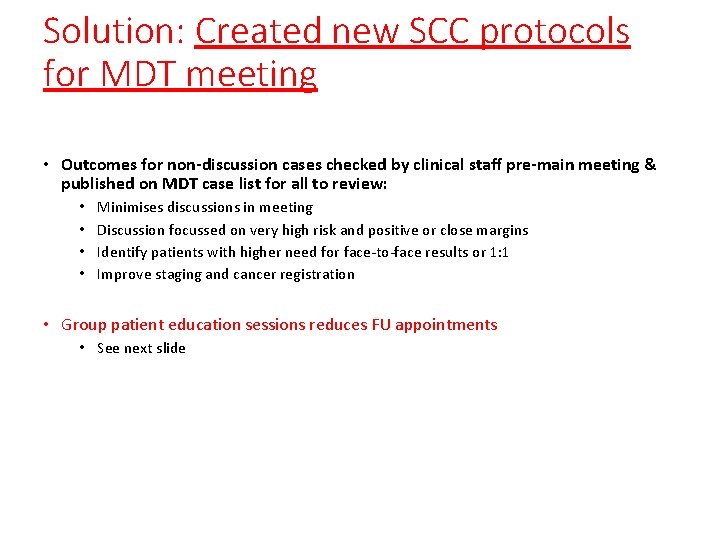
Solution: Created new SCC protocols for MDT meeting • Outcomes for non-discussion cases checked by clinical staff pre-main meeting & published on MDT case list for all to review: • • Minimises discussions in meeting Discussion focussed on very high risk and positive or close margins Identify patients with higher need for face-to-face results or 1: 1 Improve staging and cancer registration • Group patient education sessions reduces FU appointments • See next slide
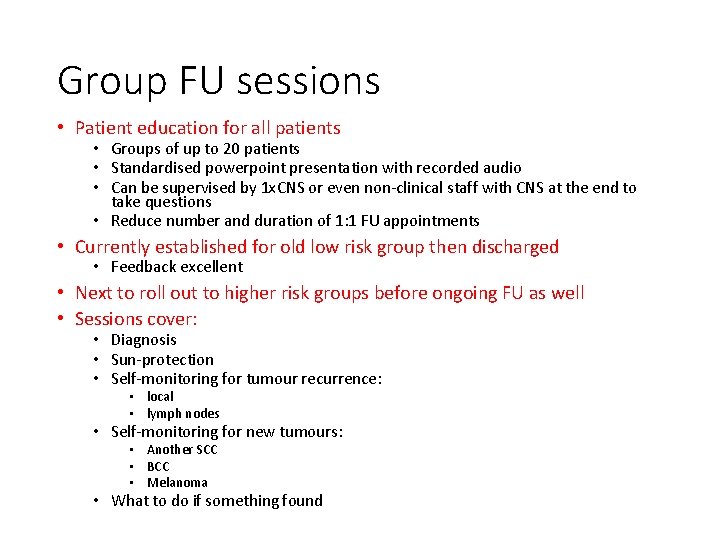
Group FU sessions • Patient education for all patients • Groups of up to 20 patients • Standardised powerpoint presentation with recorded audio • Can be supervised by 1 x. CNS or even non-clinical staff with CNS at the end to take questions • Reduce number and duration of 1: 1 FU appointments • Currently established for old low risk group then discharged • Feedback excellent • Next to roll out to higher risk groups before ongoing FU as well • Sessions cover: • Diagnosis • Sun-protection • Self-monitoring for tumour recurrence: • local • lymph nodes • Self-monitoring for new tumours: • Another SCC • BCC • Melanoma • What to do if something found
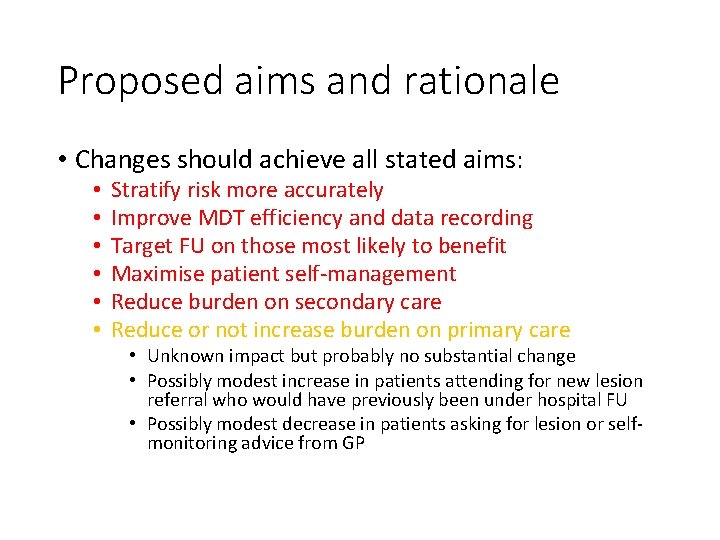
Proposed aims and rationale • Changes should achieve all stated aims: • • • Stratify risk more accurately Improve MDT efficiency and data recording Target FU on those most likely to benefit Maximise patient self-management Reduce burden on secondary care Reduce or not increase burden on primary care • Unknown impact but probably no substantial change • Possibly modest increase in patients attending for new lesion referral who would have previously been under hospital FU • Possibly modest decrease in patients asking for lesion or selfmonitoring advice from GP
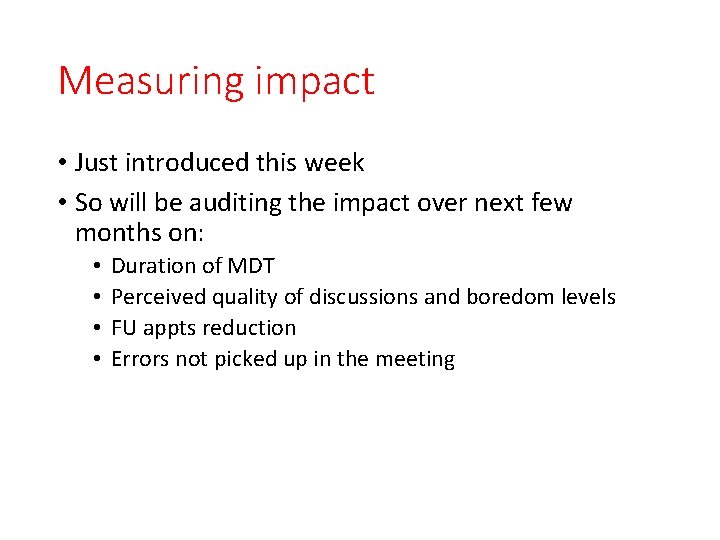
Measuring impact • Just introduced this week • So will be auditing the impact over next few months on: • • Duration of MDT Perceived quality of discussions and boredom levels FU appts reduction Errors not picked up in the meeting
- Slides: 9