
SQL Trace vs Extended Events David Barbarin Database
SQL Trace vs Extended Events David Barbarin Database Architect david. barbarin@insentia. ch http: //mikedavem. developpez. com http: //blog. developpez. com/mikedavem SQLSaturday#251––Paris 2013
Summary § Extended events and architecture § Demo SQLSaturday #251 – Paris 2013
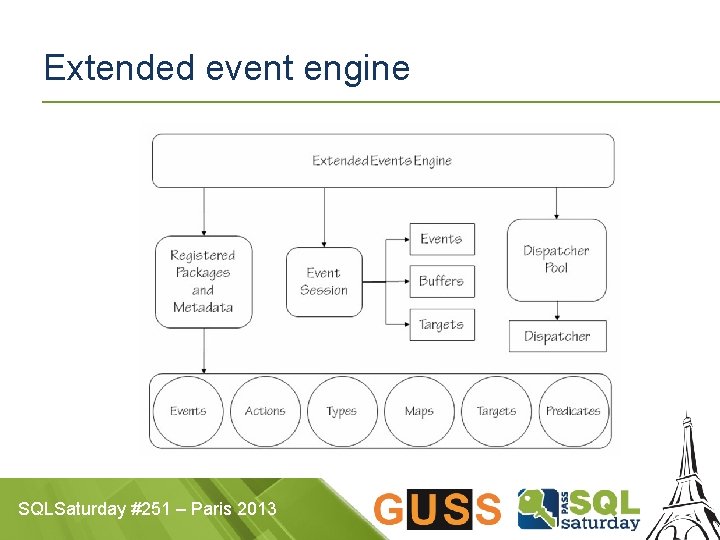
Extended event engine SQLSaturday #251 – Paris 2013
Pre versus Post processing § Post-processing : Collecting every event and then don't worry about reducing data set after you’ve collected the data § Pre-processing : Filtering events as part of the event generation code and therefore can “short-circuit” the event from firing. EXTENDED EVENTS SQLSaturday #251 – Paris 2013

Extended event execution life cycle Collect Pre-collect : Is enabled ? Collect Event data Collected Post-collect Predicate evalution Publish Actions executed Synchronous target served SQLSaturday #251 – Paris 2013 Event data buffered for async targets
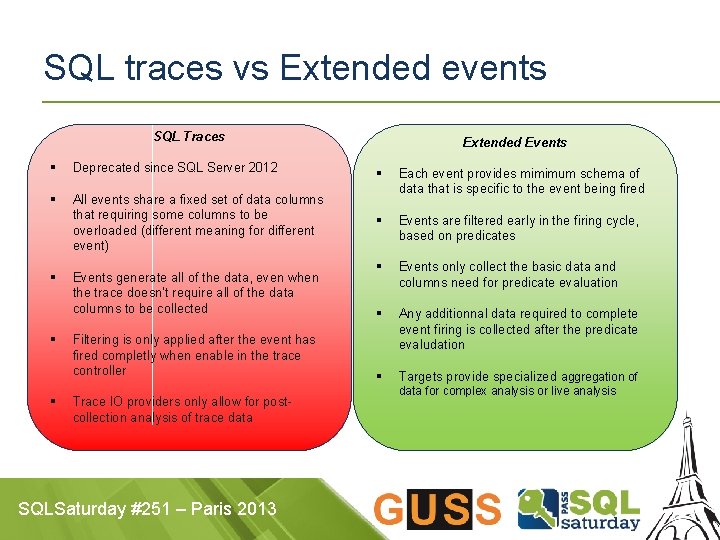
SQL traces vs Extended events SQL Traces Extended Events § Deprecated since SQL Server 2012 § § All events share a fixed set of data columns that requiring some columns to be overloaded (different meaning for different event) Each event provides mimimum schema of data that is specific to the event being fired § Events are filtered early in the firing cycle, based on predicates § Events only collect the basic data and columns need for predicate evaluation § Any additionnal data required to complete event firing is collected after the predicate evaludation § Targets provide specialized aggregation of § § § Events generate all of the data, even when the trace doesn’t require all of the data columns to be collected Filtering is only applied after the event has fired completly when enable in the trace controller Trace IO providers only allow for postcollection analysis of trace data SQLSaturday #251 – Paris 2013 data for complex analysis or live analysis
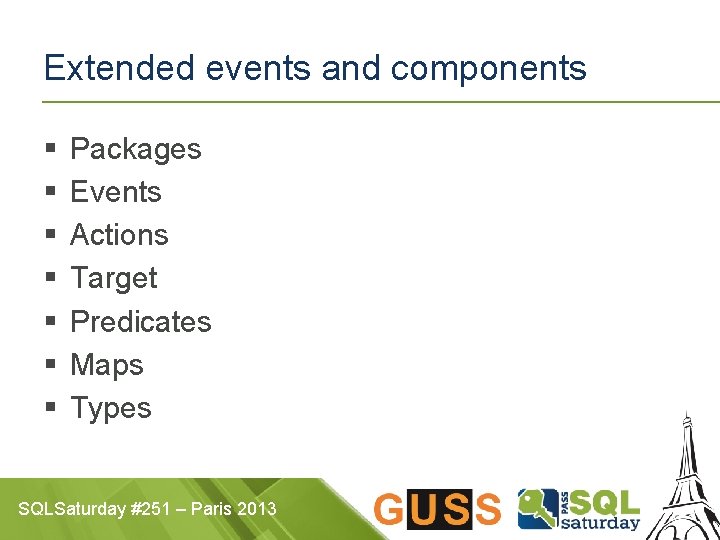
Extended events and components § § § § Packages Events Actions Target Predicates Maps Types SQLSaturday #251 – Paris 2013
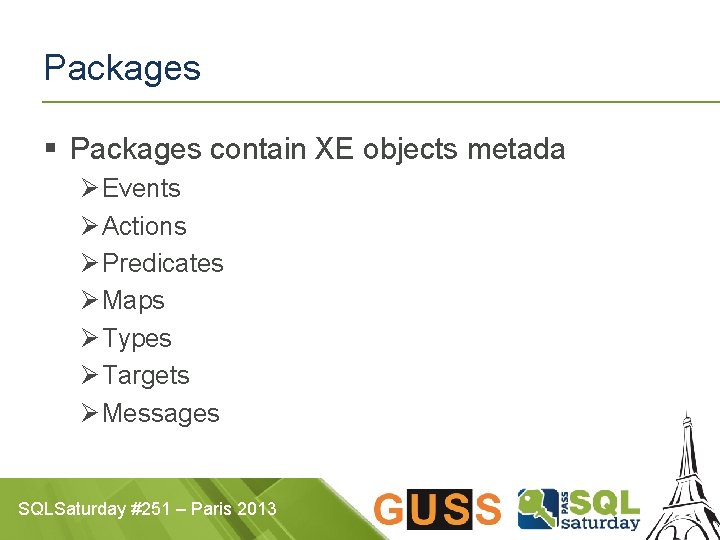
Packages § Packages contain XE objects metada Ø Events Ø Actions Ø Predicates Ø Maps Ø Types Ø Targets Ø Messages SQLSaturday #251 – Paris 2013
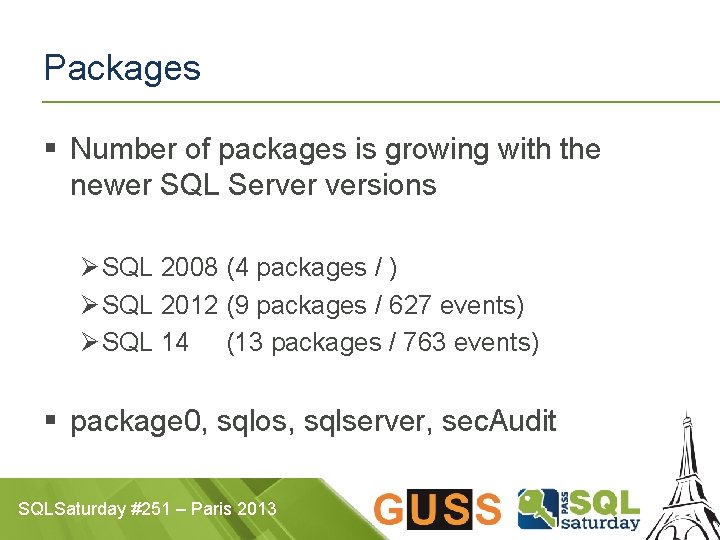
Packages § Number of packages is growing with the newer SQL Server versions Ø SQL 2008 (4 packages / ) Ø SQL 2012 (9 packages / 627 events) Ø SQL 14 (13 packages / 763 events) § package 0, sqlos, sqlserver, sec. Audit SQLSaturday #251 – Paris 2013
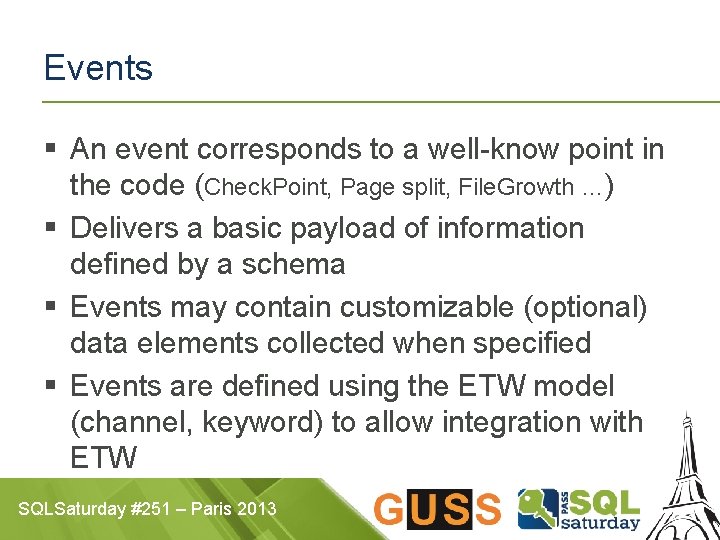
Events § An event corresponds to a well-know point in the code (Check. Point, Page split, File. Growth …) § Delivers a basic payload of information defined by a schema § Events may contain customizable (optional) data elements collected when specified § Events are defined using the ETW model (channel, keyword) to allow integration with ETW SQLSaturday #251 – Paris 2013
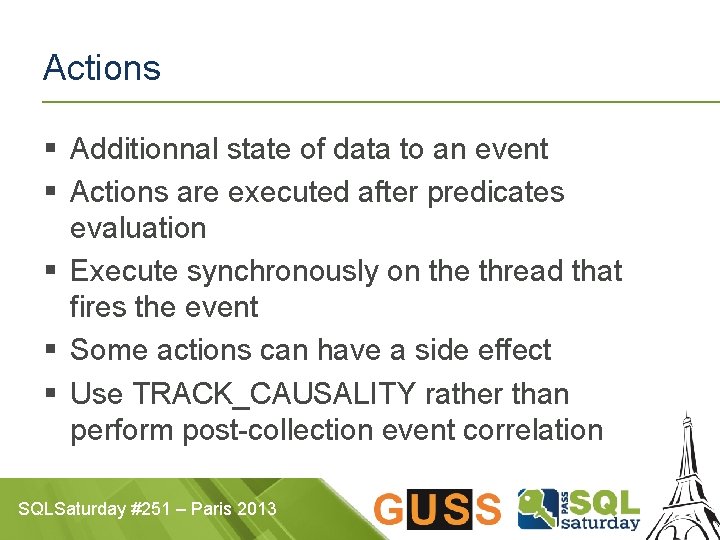
Actions § Additionnal state of data to an event § Actions are executed after predicates evaluation § Execute synchronously on the thread that fires the event § Some actions can have a side effect § Use TRACK_CAUSALITY rather than perform post-collection event correlation SQLSaturday #251 – Paris 2013
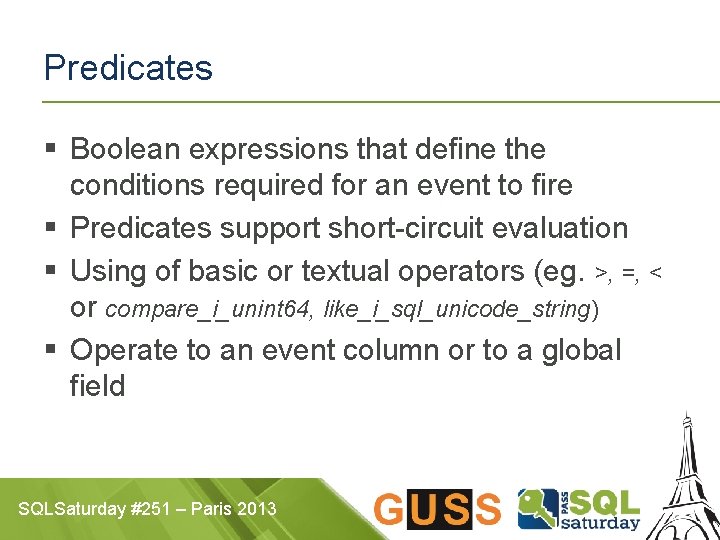
Predicates § Boolean expressions that define the conditions required for an event to fire § Predicates support short-circuit evaluation § Using of basic or textual operators (eg. >, =, < or compare_i_unint 64, like_i_sql_unicode_string) § Operate to an event column or to a global field SQLSaturday #251 – Paris 2013
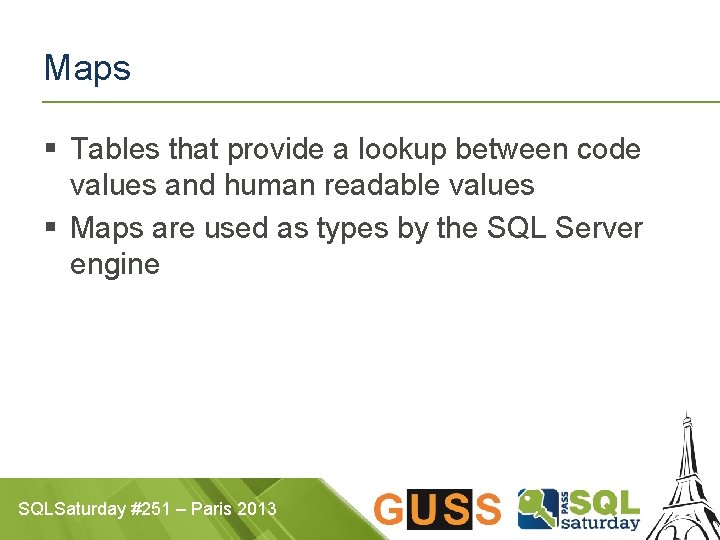
Maps § Tables that provide a lookup between code values and human readable values § Maps are used as types by the SQL Server engine SQLSaturday #251 – Paris 2013
Types § Define data type for an event, a predicate, a target or an action SQLSaturday #251 – Paris 2013
Targets § Consumers of events § Can be synchronous or asynchronous § Targets are memory based or file based consumers § Basic targets : ring buffer, target, event file § Specialize targets : histogram, pair matching, event counter, ETW, live data viewer SQLSaturday #251 – Paris 2013
Session options § § § § MAX_MEMORY_PARTITION_MODE EVENT_RETENTION_MODE MAX_DISPATCH_LATENCY MAX_EVENT_SIZE TRACK_CAUSALITY STARTUP_STATE SQLSaturday #251 – Paris 2013
Session option : MAX_MEMORY § Configures the relative maximum size of the event session buffer § Correlates directly to the MEMORY_PARTITION_MODE option § Control the size of the file writes to a file target for heavily event sessions § Default is 4 MB SQLSaturday #251 – Paris 2013
Session option : MEMORY_PARTITION_MODE § Determines the final number of buffers for an event session § NODE (default) = 3 buffers § PER_NODE = 3 buffers for each NUMA node § PER_CPU = 2. 5 buffers for each scheduler SQLSaturday #251 – Paris 2013
Session option : EVENT_RETENTION_MODE § Determines whether single event, entire buffer or no events can be lost by XE session § NO_EVENT_LOSS can impact performance under heavy event generation § NO_EVENT_LOSS can limit the number of events (eg. page_read) SQLSaturday #251 – Paris 2013
Session option : MAX_DISPATCH_LATENCY § Configures the maximum time an event will remain in a memory buffer before being dispatch to asynchronous target § Default is 30 secondes SQLSaturday #251 – Paris 2013
Session option : MAX_EVENT_SIZE § Etablishes the size of large buffers associated with an event for collection of events larger than the buffer standard size § MAX_EVENT_SIZE >= MAX_MEMORY § Necessary for event sessions that capture large events (collecting IOData, sql_text …) SQLSaturday #251 – Paris 2013
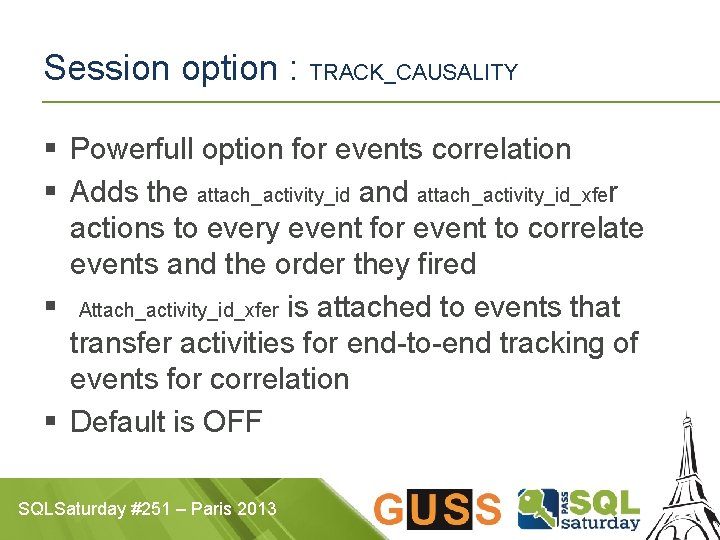
Session option : TRACK_CAUSALITY § Powerfull option for events correlation § Adds the attach_activity_id and attach_activity_id_xfer actions to every event for event to correlate events and the order they fired § Attach_activity_id_xfer is attached to events that transfer activities for end-to-end tracking of events for correlation § Default is OFF SQLSaturday #251 – Paris 2013
Session option : STARTUP_STATE § Configures the event session to start automatically when SQL Server starts § Default is OFF SQLSaturday #251 – Paris 2013
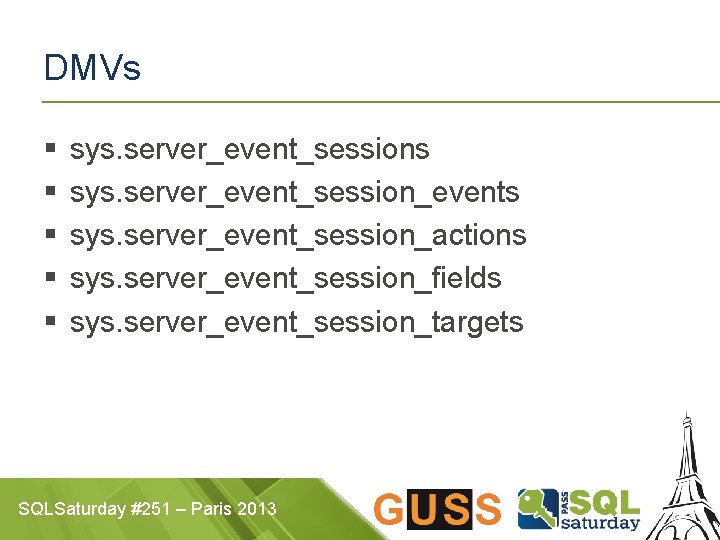
DMVs § § § sys. server_event_sessions sys. server_event_session_events sys. server_event_session_actions sys. server_event_session_fields sys. server_event_session_targets SQLSaturday #251 – Paris 2013
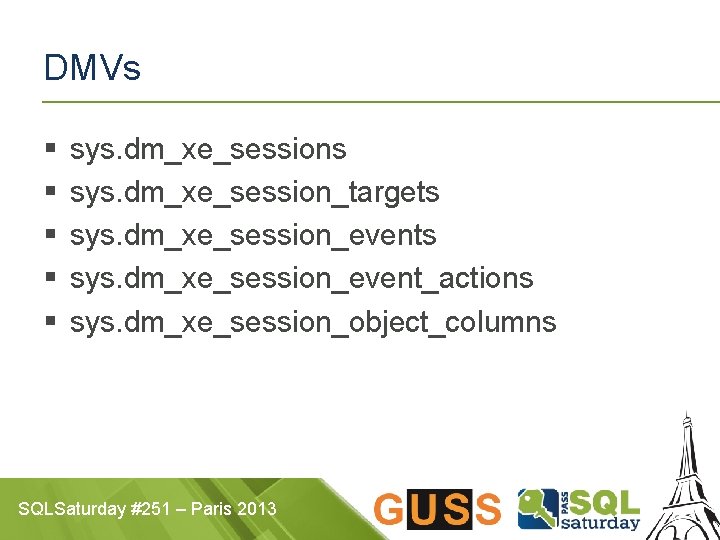
DMVs § § § sys. dm_xe_sessions sys. dm_xe_session_targets sys. dm_xe_session_event_actions sys. dm_xe_session_object_columns SQLSaturday #251 – Paris 2013
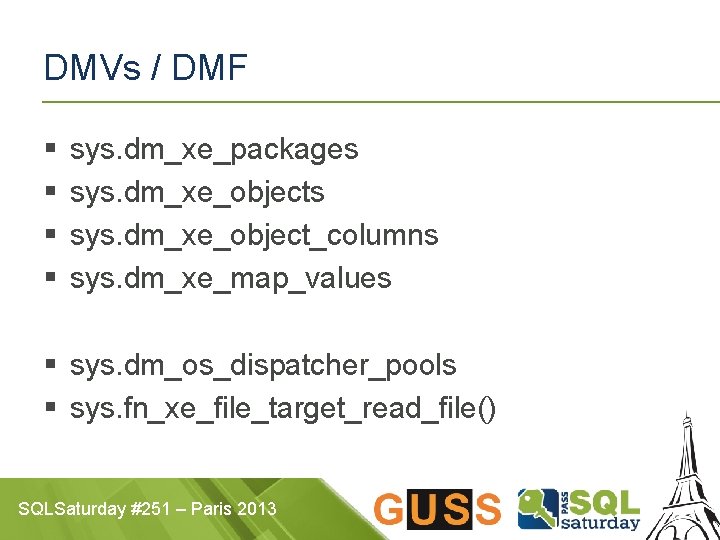
DMVs / DMF § § sys. dm_xe_packages sys. dm_xe_object_columns sys. dm_xe_map_values § sys. dm_os_dispatcher_pools § sys. fn_xe_file_target_read_file() SQLSaturday #251 – Paris 2013
SQLSaturday #251 – Paris 2013
SQLSaturday #251 – Paris 2013
Nos sponsors SQLSaturday #251 – Paris 2013
LINKS § Les événements étendus avec SQL Server 2008 (Nicolas Souquet) § Nouveaux événements étendus avec SQL Server 2012 (David Baffaleuf) § An Xevent a day (Jonathan Kehayias) SQLSaturday #251 – Paris 2013
- Slides: 30