
SQL Server 2012 Data Management Using Microsoft SQL
![SQL Server 2012 Insert Triggers 2 -4 Syntax: CREATE TRIGGER [schema_name. ] trigger_name ON](https://slidetodoc.com/presentation_image_h/dcf52ab3ad95dbde7384acfe49858a5c/image-11.jpg "SQL Server 2012 Insert Triggers 2 -4 Syntax: CREATE TRIGGER [schema_name. ] trigger_name ON")
![SQL Server 2012 Update Triggers 2 -5 Syntax: CREATE TRIGGER [schema_name. ] trigger_name ON](https://slidetodoc.com/presentation_image_h/dcf52ab3ad95dbde7384acfe49858a5c/image-15.jpg "SQL Server 2012 Update Triggers 2 -5 Syntax: CREATE TRIGGER [schema_name. ] trigger_name ON")
- Slides: 50
SQL Server 2012 Data Management Using Microsoft SQL Server Session: 12 Session: 1 Triggers Introduction to the Web
SQL Server 2012 ● ● ● ● Objectives Explain triggers Explain the different types of triggers Explain the procedure to create DML triggers Explain the procedure to alter DML triggers Describe nested triggers Describe update functions Explain the handling of multiple rows in a session Explain the performance implication of triggers © Aptech Ltd. Triggers / Session 12 2
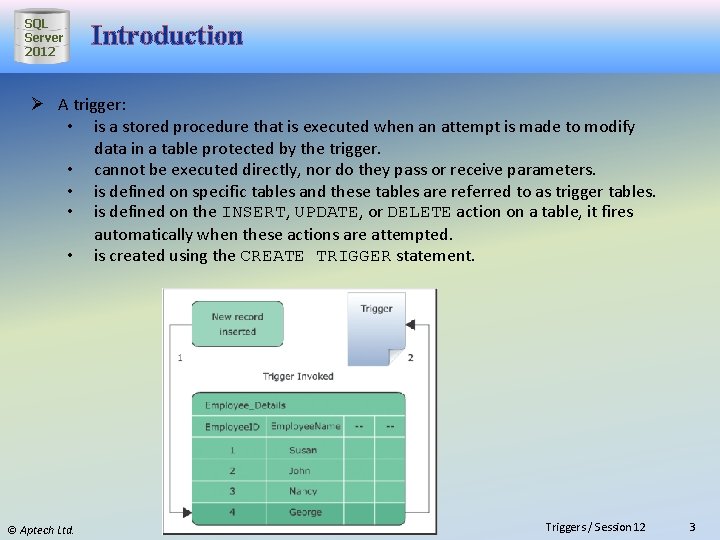
SQL Server 2012 Introduction Ø A trigger: • is a stored procedure that is executed when an attempt is made to modify data in a table protected by the trigger. • cannot be executed directly, nor do they pass or receive parameters. • is defined on specific tables and these tables are referred to as trigger tables. • is defined on the INSERT, UPDATE, or DELETE action on a table, it fires automatically when these actions are attempted. • is created using the CREATE TRIGGER statement. © Aptech Ltd. Triggers / Session 12 3
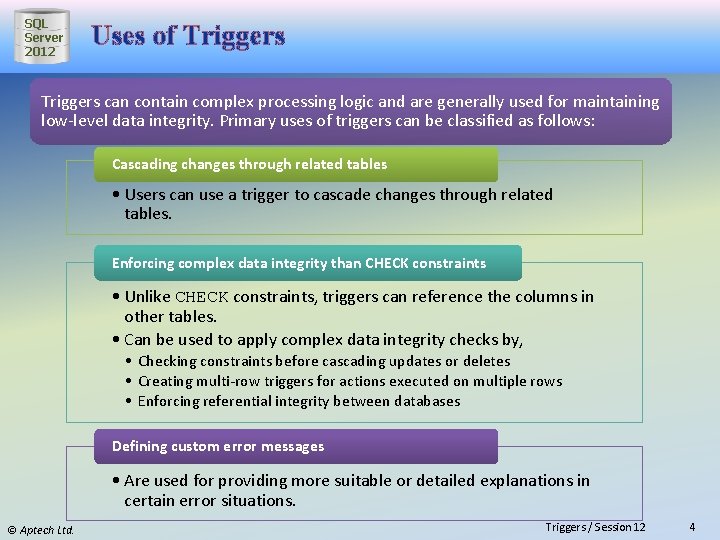
SQL Server 2012 Uses of Triggers can contain complex processing logic and are generally used for maintaining low-level data integrity. Primary uses of triggers can be classified as follows: Cascading changes through related tables • Users can use a trigger to cascade changes through related tables. Enforcing complex data integrity than CHECK constraints • Unlike CHECK constraints, triggers can reference the columns in other tables. • Can be used to apply complex data integrity checks by, • Checking constraints before cascading updates or deletes • Creating multi-row triggers for actions executed on multiple rows • Enforcing referential integrity between databases Defining custom error messages • Are used for providing more suitable or detailed explanations in certain error situations. © Aptech Ltd. Triggers / Session 12 4
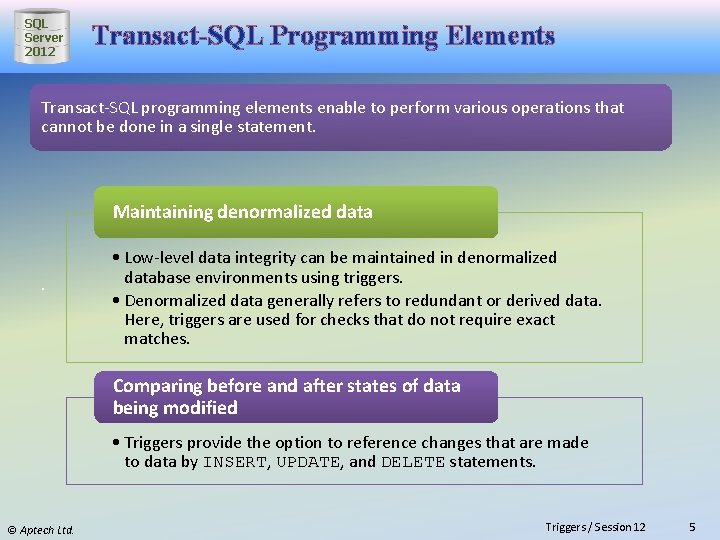
SQL Server 2012 Transact-SQL Programming Elements Transact-SQL programming elements enable to perform various operations that cannot be done in a single statement. Maintaining denormalized data. • Low-level data integrity can be maintained in denormalized database environments using triggers. • Denormalized data generally refers to redundant or derived data. Here, triggers are used for checks that do not require exact matches. Comparing before and after states of data being modified • Triggers provide the option to reference changes that are made to data by INSERT, UPDATE, and DELETE statements. © Aptech Ltd. Triggers / Session 12 5
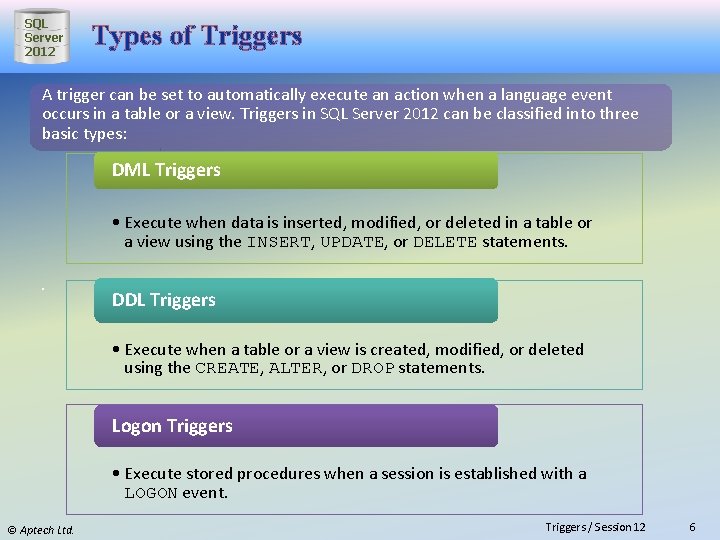
SQL Server 2012 Types of Triggers A trigger can be set to automatically execute an action when a language event occurs in a table or a view. Triggers in SQL Server 2012 can be classified into three basic types: DML Triggers • Execute when data is inserted, modified, or deleted in a table or a view using the INSERT, UPDATE, or DELETE statements. . DDL Triggers • Execute when a table or a view is created, modified, or deleted using the CREATE, ALTER, or DROP statements. Logon Triggers • Execute stored procedures when a session is established with a LOGON event. © Aptech Ltd. Triggers / Session 12 6
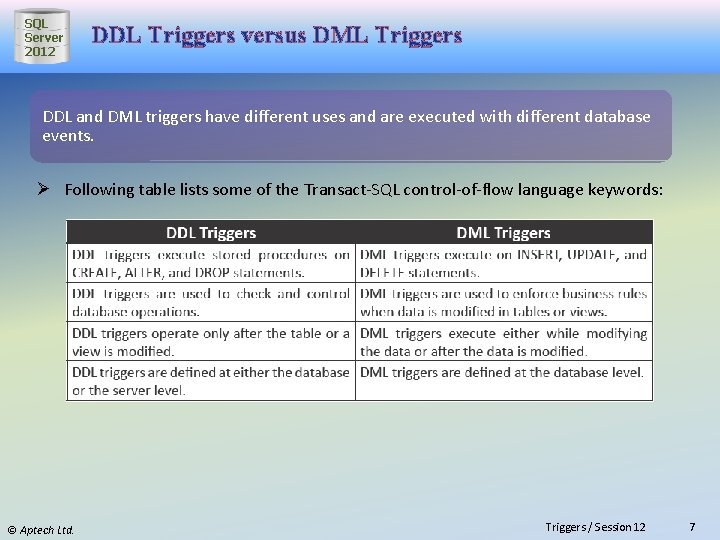
SQL Server 2012 DDL Triggers versus DML Triggers DDL and DML triggers have different uses and are executed with different database events. Ø Following table lists some of the Transact-SQL control-of-flow language keywords: © Aptech Ltd. Triggers / Session 12 7
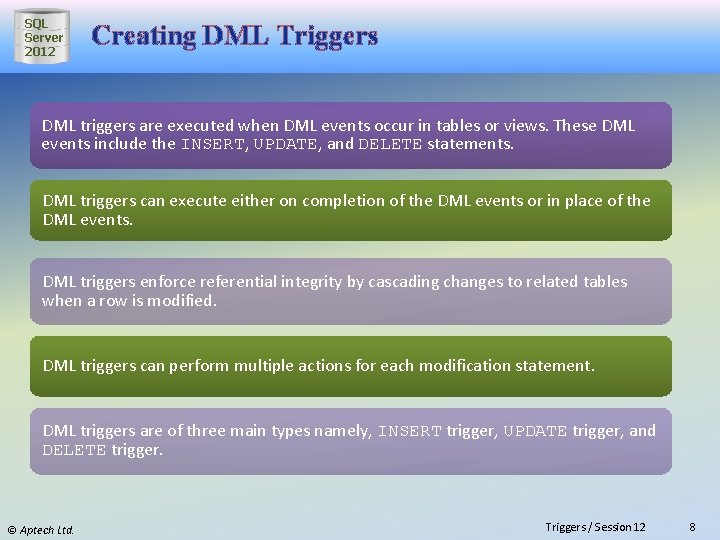
SQL Server 2012 Creating DML Triggers DML triggers are executed when DML events occur in tables or views. These DML events include the INSERT, UPDATE, and DELETE statements. DML triggers can execute either on completion of the DML events or in place of the DML events. DML triggers enforce referential integrity by cascading changes to related tables when a row is modified. DML triggers can perform multiple actions for each modification statement. DML triggers are of three main types namely, INSERT trigger, UPDATE trigger, and DELETE trigger. © Aptech Ltd. Triggers / Session 12 8
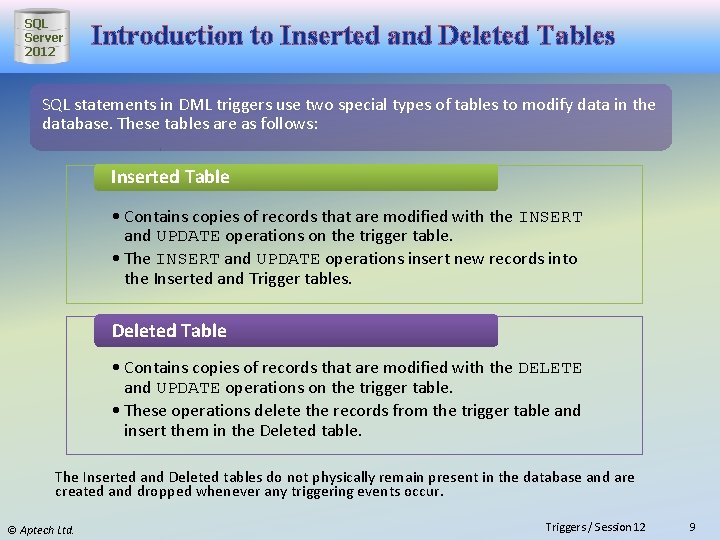
SQL Server 2012 Introduction to Inserted and Deleted Tables SQL statements in DML triggers use two special types of tables to modify data in the database. These tables are as follows: Inserted Table • Contains copies of records that are modified with the INSERT and UPDATE operations on the trigger table. • The INSERT and UPDATE operations insert new records into the Inserted and Trigger tables. Deleted Table • Contains copies of records that are modified with the DELETE and UPDATE operations on the trigger table. • These operations delete the records from the trigger table and insert them in the Deleted table. The Inserted and Deleted tables do not physically remain present in the database and are created and dropped whenever any triggering events occur. © Aptech Ltd. Triggers / Session 12 9
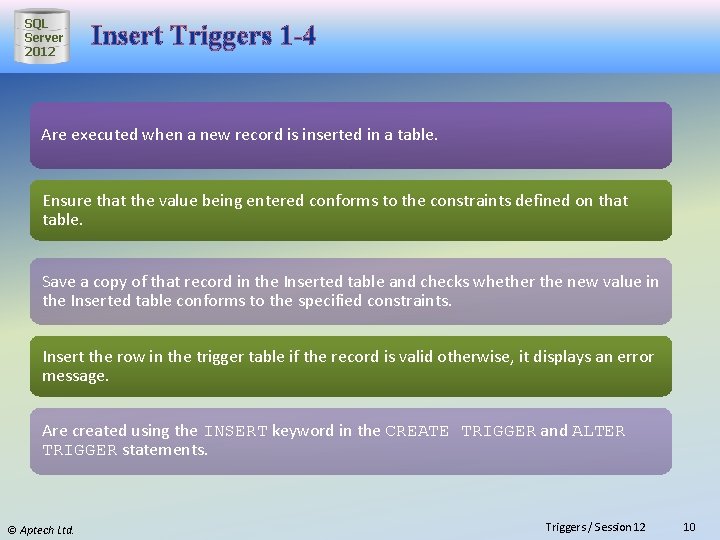
SQL Server 2012 Insert Triggers 1 -4 Are executed when a new record is inserted in a table. Ensure that the value being entered conforms to the constraints defined on that table. Save a copy of that record in the Inserted table and checks whether the new value in the Inserted table conforms to the specified constraints. Insert the row in the trigger table if the record is valid otherwise, it displays an error message. Are created using the INSERT keyword in the CREATE TRIGGER and ALTER TRIGGER statements. © Aptech Ltd. Triggers / Session 12 10
SQL Server 2012 Insert Triggers 2 -4 Syntax: CREATE TRIGGER [schema_name. ] trigger_name ON [schema_name. ] table_name [WITH ENCRYPTION] {FOR INSERT} AS [IF UPDATE (column_name). . . ] [{AND | OR} UPDATE (column_name). . . ] <sql_statements> where, schema_name: specifies the name of the schema to which the table/trigger belongs. trigger_name: specifies the name of the trigger. table_name: specifies the table on which the DML trigger is created. WITH ENCRYPTION: encrypts the text of the CREATE TRIGGER statement. FOR: specifies that the DML trigger executes after the modification operations are complete. INSERT: specifies that this DML trigger will be invoked by insert operations. UPDATE: Returns a Boolean value that indicates whether an INSERT or UPDATE attempt was made on a specified column. © Aptech Ltd. Triggers / Session 12 11
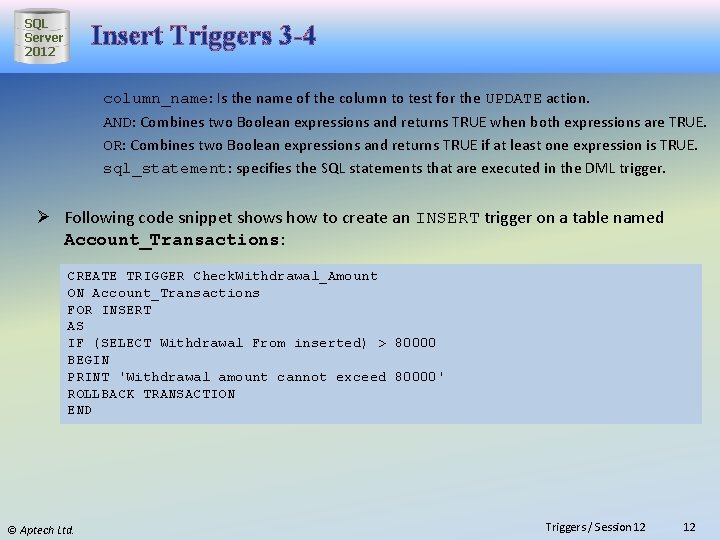
SQL Server 2012 Insert Triggers 3 -4 column_name: Is the name of the column to test for the UPDATE action. AND: Combines two Boolean expressions and returns TRUE when both expressions are TRUE. OR: Combines two Boolean expressions and returns TRUE if at least one expression is TRUE. sql_statement: specifies the SQL statements that are executed in the DML trigger. Ø Following code snippet shows how to create an INSERT trigger on a table named Account_Transactions: CREATE TRIGGER Check. Withdrawal_Amount ON Account_Transactions FOR INSERT AS IF (SELECT Withdrawal From inserted) > 80000 BEGIN PRINT 'Withdrawal amount cannot exceed 80000' ROLLBACK TRANSACTION END © Aptech Ltd. Triggers / Session 12 12
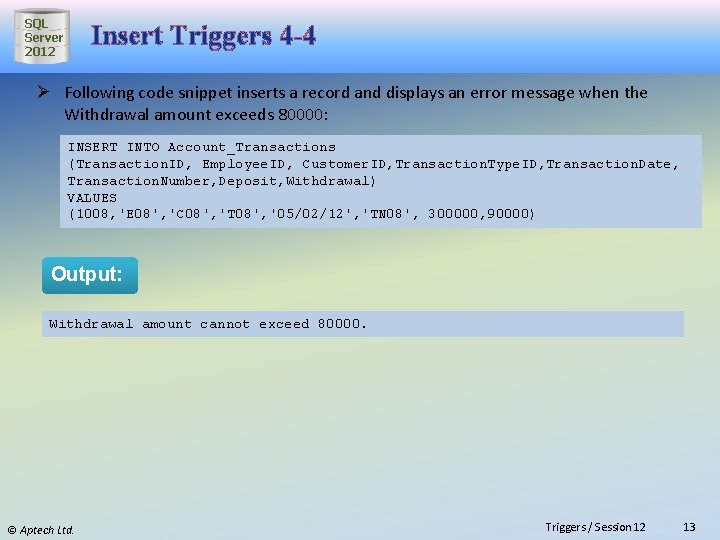
SQL Server 2012 Insert Triggers 4 -4 Ø Following code snippet inserts a record and displays an error message when the Withdrawal amount exceeds 80000: INSERT INTO Account_Transactions (Transaction. ID, Employee. ID, Customer. ID, Transaction. Type. ID, Transaction. Date, Transaction. Number, Deposit, Withdrawal) VALUES (1008, 'E 08', 'C 08', 'T 08', '05/02/12', 'TN 08', 300000, 90000) Output: Withdrawal amount cannot exceed 80000. © Aptech Ltd. Triggers / Session 12 13
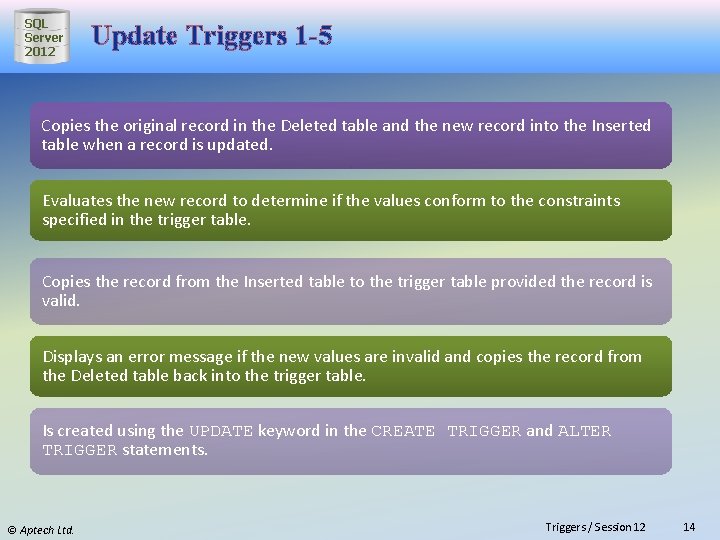
SQL Server 2012 Update Triggers 1 -5 Copies the original record in the Deleted table and the new record into the Inserted table when a record is updated. Evaluates the new record to determine if the values conform to the constraints specified in the trigger table. Copies the record from the Inserted table to the trigger table provided the record is valid. Displays an error message if the new values are invalid and copies the record from the Deleted table back into the trigger table. Is created using the UPDATE keyword in the CREATE TRIGGER and ALTER TRIGGER statements. © Aptech Ltd. Triggers / Session 12 14
SQL Server 2012 Update Triggers 2 -5 Syntax: CREATE TRIGGER [schema_name. ] trigger_name ON [schema_name. ] table_name [WITH ENCRYPTION] {FOR UPDATE} AS [IF UPDATE (column_name). . . ] [{AND | OR} UPDATE (column_name). . . ] <sql_statements> where, schema_name: specifies the name of the schema to which the table/trigger belongs. trigger_name: specifies the name of the trigger. table_name: specifies the table on which the DML trigger is created. WITH ENCRYPTION: encrypts the text of the CREATE TRIGGER statement. FOR: specifies that the DML trigger executes after the modification operations are complete. INSERT: specifies that this DML trigger will be invoked after the update operations. UPDATE: Returns a Boolean value that indicates whether an INSERT or UPDATE attempt was made on a specified column. © Aptech Ltd. Triggers / Session 12 15
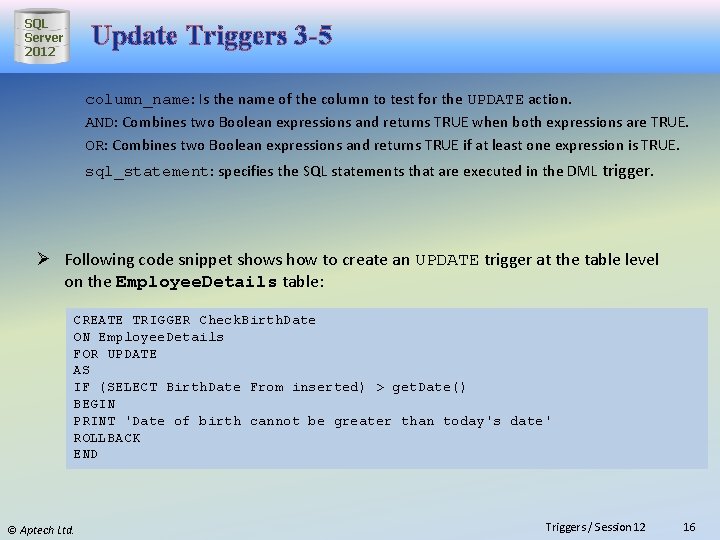
SQL Server 2012 Update Triggers 3 -5 column_name: Is the name of the column to test for the UPDATE action. AND: Combines two Boolean expressions and returns TRUE when both expressions are TRUE. OR: Combines two Boolean expressions and returns TRUE if at least one expression is TRUE. sql_statement: specifies the SQL statements that are executed in the DML trigger. Ø Following code snippet shows how to create an UPDATE trigger at the table level on the Employee. Details table: CREATE TRIGGER Check. Birth. Date ON Employee. Details FOR UPDATE AS IF (SELECT Birth. Date From inserted) > get. Date() BEGIN PRINT 'Date of birth cannot be greater than today's date' ROLLBACK END © Aptech Ltd. Triggers / Session 12 16
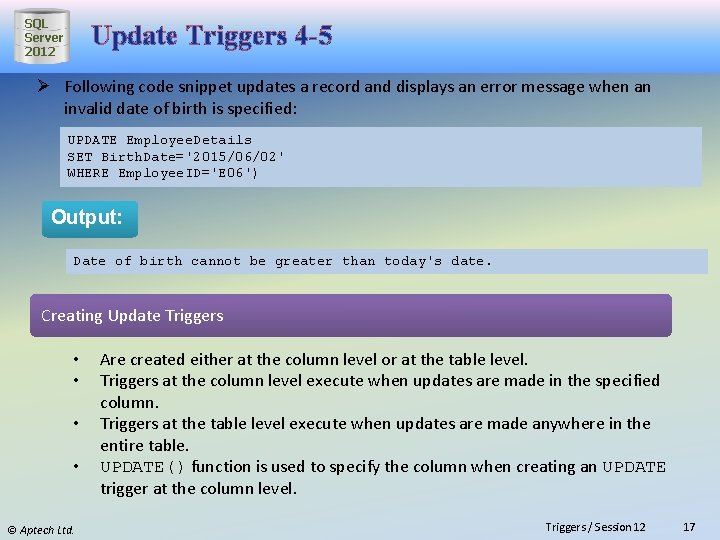
SQL Server 2012 Update Triggers 4 -5 Ø Following code snippet updates a record and displays an error message when an invalid date of birth is specified: UPDATE Employee. Details SET Birth. Date='2015/06/02' WHERE Employee. ID='E 06') Output: Date of birth cannot be greater than today's date. Creating Update Triggers • • © Aptech Ltd. Are created either at the column level or at the table level. Triggers at the column level execute when updates are made in the specified column. Triggers at the table level execute when updates are made anywhere in the entire table. UPDATE() function is used to specify the column when creating an UPDATE trigger at the column level. Triggers / Session 12 17
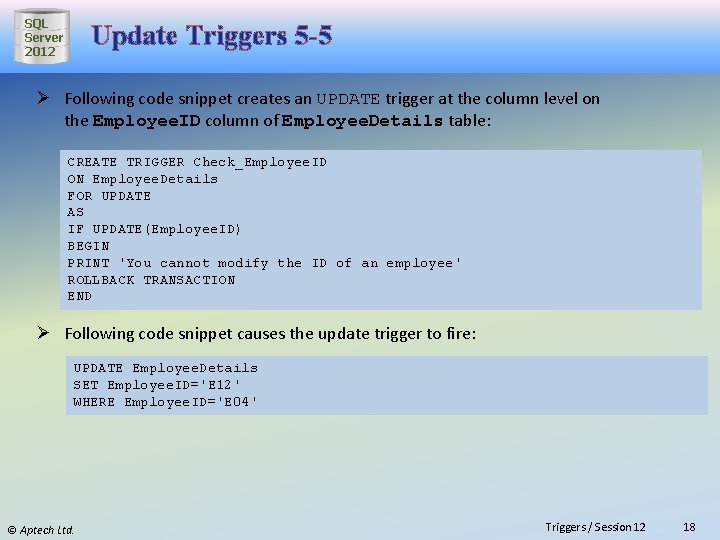
SQL Server 2012 Update Triggers 5 -5 Ø Following code snippet creates an UPDATE trigger at the column level on the Employee. ID column of Employee. Details table: CREATE TRIGGER Check_Employee. ID ON Employee. Details FOR UPDATE AS IF UPDATE(Employee. ID) BEGIN PRINT 'You cannot modify the ID of an employee' ROLLBACK TRANSACTION END Ø Following code snippet causes the update trigger to fire: UPDATE Employee. Details SET Employee. ID='E 12' WHERE Employee. ID='E 04' © Aptech Ltd. Triggers / Session 12 18
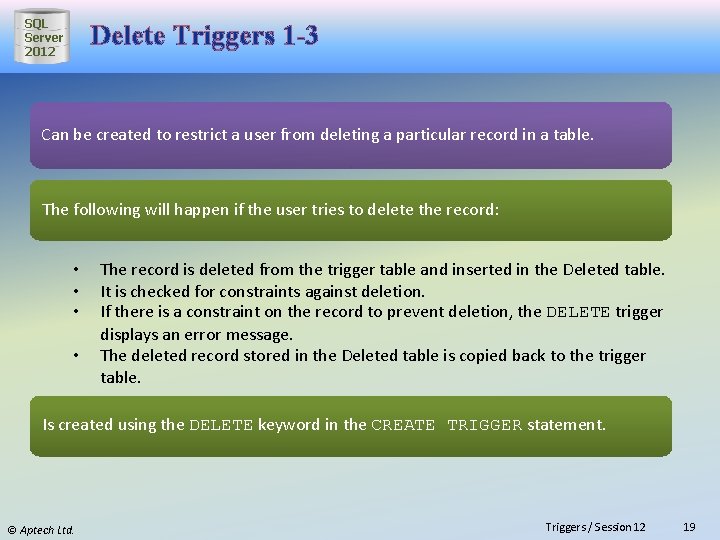
SQL Server 2012 Delete Triggers 1 -3 Can be created to restrict a user from deleting a particular record in a table. The following will happen if the user tries to delete the record: • • The record is deleted from the trigger table and inserted in the Deleted table. It is checked for constraints against deletion. If there is a constraint on the record to prevent deletion, the DELETE trigger displays an error message. The deleted record stored in the Deleted table is copied back to the trigger table. Is created using the DELETE keyword in the CREATE TRIGGER statement. © Aptech Ltd. Triggers / Session 12 19
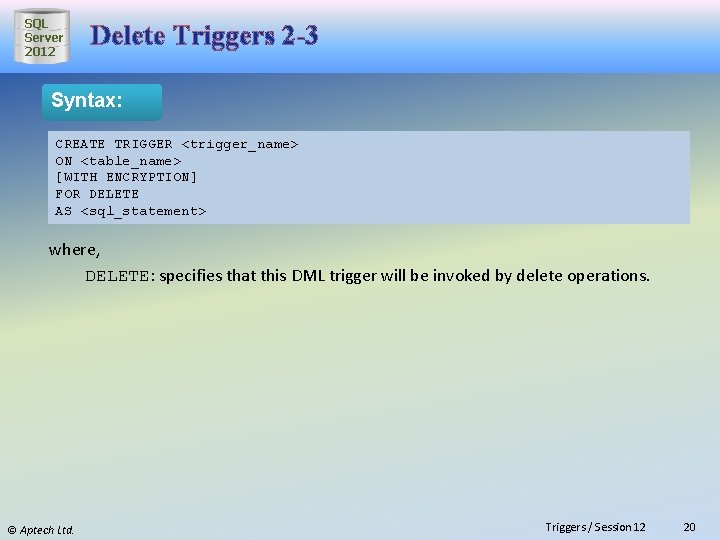
SQL Server 2012 Delete Triggers 2 -3 Syntax: CREATE TRIGGER <trigger_name> ON <table_name> [WITH ENCRYPTION] FOR DELETE AS <sql_statement> where, DELETE: specifies that this DML trigger will be invoked by delete operations. © Aptech Ltd. Triggers / Session 12 20
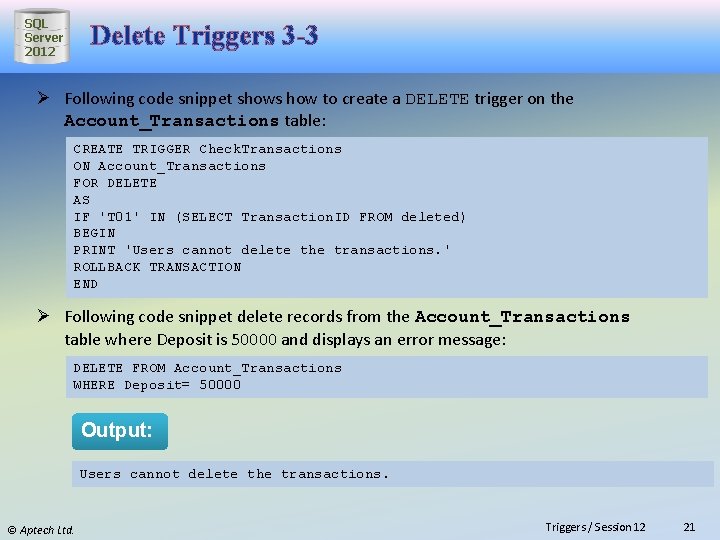
SQL Server 2012 Delete Triggers 3 -3 Ø Following code snippet shows how to create a DELETE trigger on the Account_Transactions table: CREATE TRIGGER Check. Transactions ON Account_Transactions FOR DELETE AS IF 'T 01' IN (SELECT Transaction. ID FROM deleted) BEGIN PRINT 'Users cannot delete the transactions. ' ROLLBACK TRANSACTION END Ø Following code snippet delete records from the Account_Transactions table where Deposit is 50000 and displays an error message: DELETE FROM Account_Transactions WHERE Deposit= 50000 Output: Users cannot delete the transactions. © Aptech Ltd. Triggers / Session 12 21
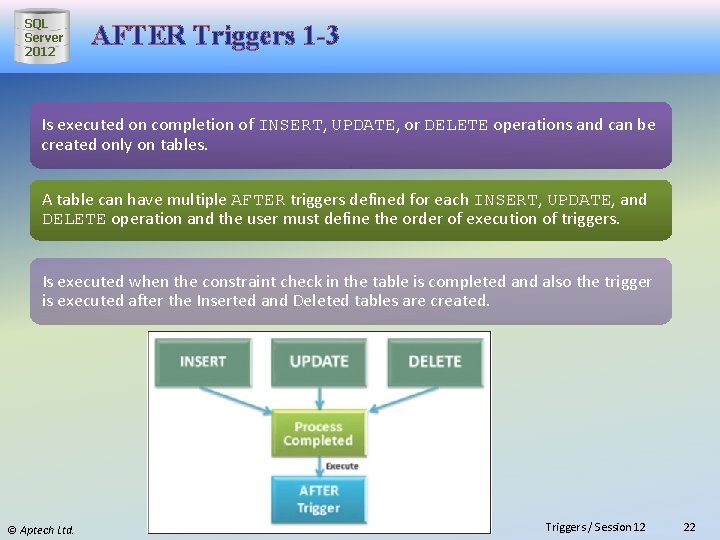
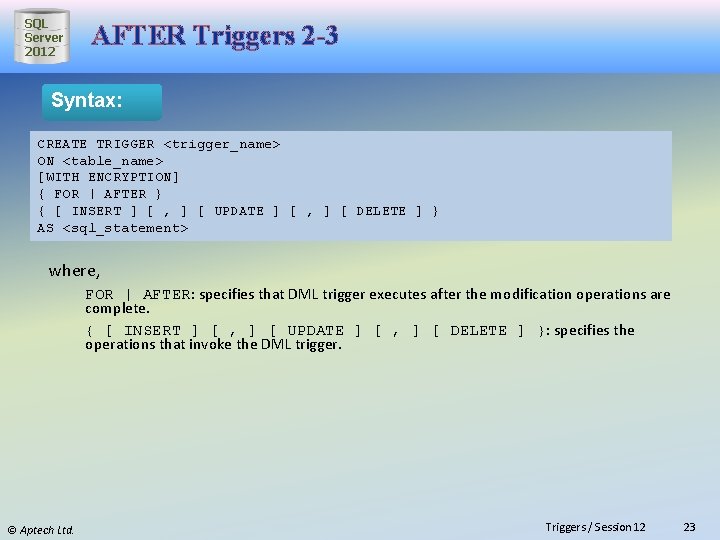
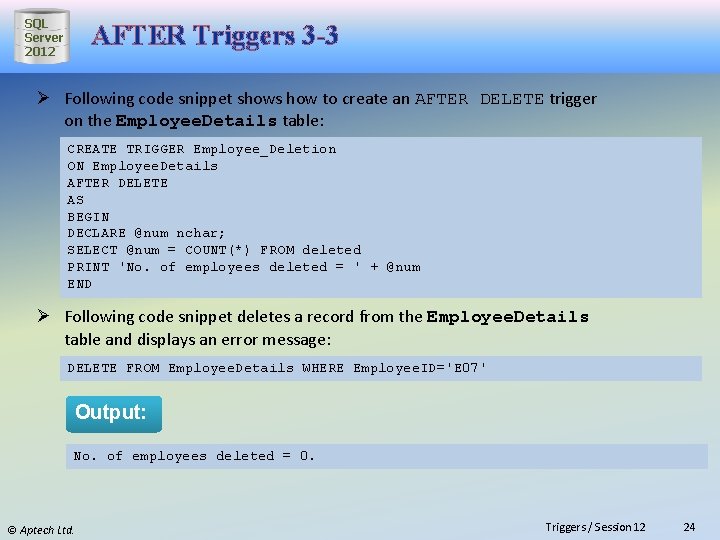
SQL Server 2012 AFTER Triggers 1 -3 Is executed on completion of INSERT, UPDATE, or DELETE operations and can be created only on tables. A table can have multiple AFTER triggers defined for each INSERT, UPDATE, and DELETE operation and the user must define the order of execution of triggers. Is executed when the constraint check in the table is completed and also the trigger is executed after the Inserted and Deleted tables are created. © Aptech Ltd. Triggers / Session 12 22
SQL Server 2012 AFTER Triggers 2 -3 Syntax: CREATE TRIGGER <trigger_name> ON <table_name> [WITH ENCRYPTION] { FOR | AFTER } { [ INSERT ] [ , ] [ UPDATE ] [ , ] [ DELETE ] } AS <sql_statement> where, FOR | AFTER: specifies that DML trigger executes after the modification operations are complete. { [ INSERT ] [ , ] [ UPDATE ] [ , ] [ DELETE ] }: specifies the operations that invoke the DML trigger. © Aptech Ltd. Triggers / Session 12 23
SQL Server 2012 AFTER Triggers 3 -3 Ø Following code snippet shows how to create an AFTER DELETE trigger on the Employee. Details table: CREATE TRIGGER Employee_Deletion ON Employee. Details AFTER DELETE AS BEGIN DECLARE @num nchar; SELECT @num = COUNT(*) FROM deleted PRINT 'No. of employees deleted = ' + @num END Ø Following code snippet deletes a record from the Employee. Details table and displays an error message: DELETE FROM Employee. Details WHERE Employee. ID='E 07' Output: No. of employees deleted = 0. © Aptech Ltd. Triggers / Session 12 24
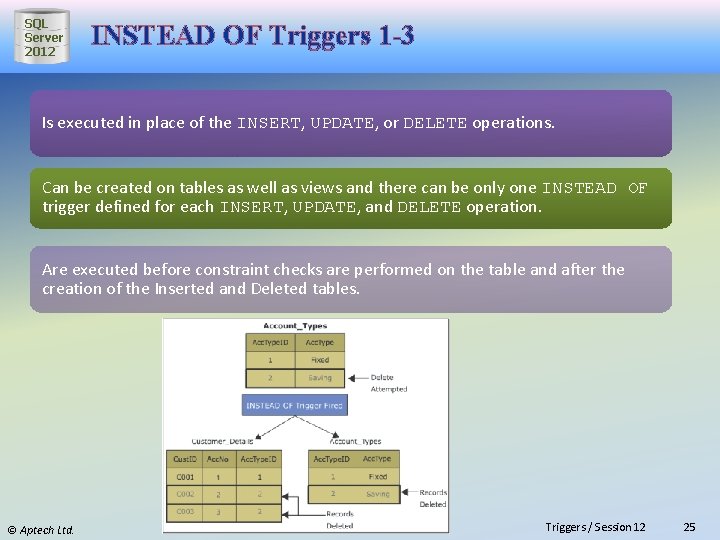
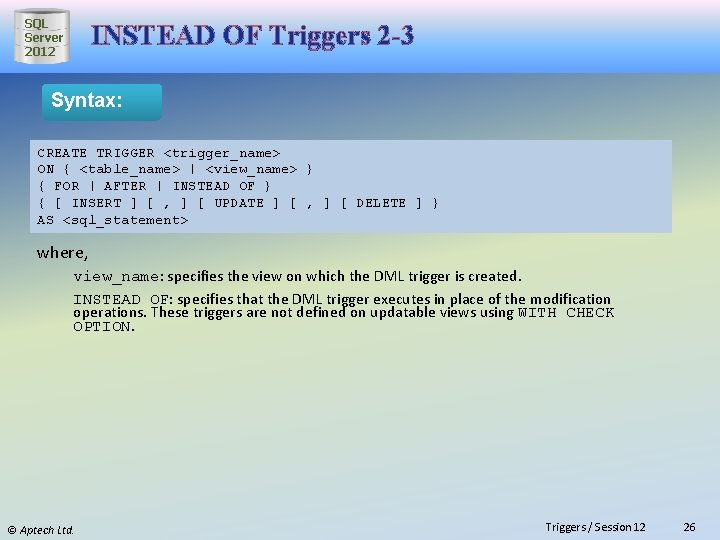
SQL Server 2012 INSTEAD OF Triggers 1 -3 Is executed in place of the INSERT, UPDATE, or DELETE operations. Can be created on tables as well as views and there can be only one INSTEAD OF trigger defined for each INSERT, UPDATE, and DELETE operation. Are executed before constraint checks are performed on the table and after the creation of the Inserted and Deleted tables. © Aptech Ltd. Triggers / Session 12 25
SQL Server 2012 INSTEAD OF Triggers 2 -3 Syntax: CREATE TRIGGER <trigger_name> ON { <table_name> | <view_name> } { FOR | AFTER | INSTEAD OF } { [ INSERT ] [ , ] [ UPDATE ] [ , ] [ DELETE ] } AS <sql_statement> where, view_name: specifies the view on which the DML trigger is created. INSTEAD OF: specifies that the DML trigger executes in place of the modification operations. These triggers are not defined on updatable views using WITH CHECK OPTION. © Aptech Ltd. Triggers / Session 12 26
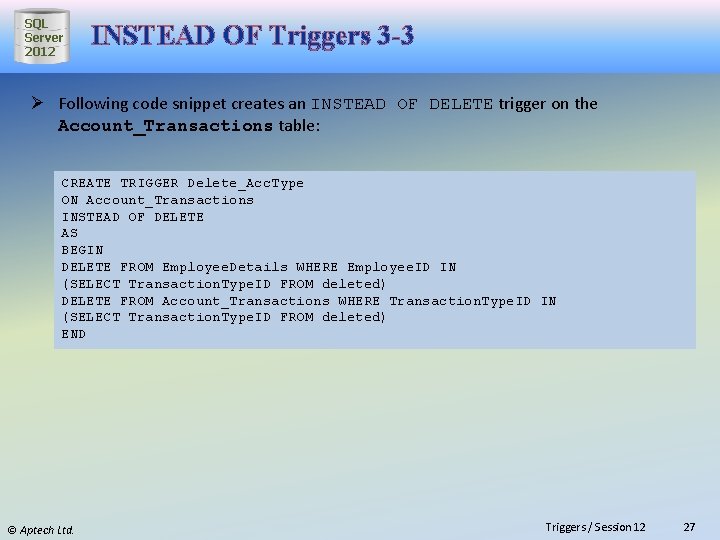
SQL Server 2012 INSTEAD OF Triggers 3 -3 Ø Following code snippet creates an INSTEAD OF DELETE trigger on the Account_Transactions table: CREATE TRIGGER Delete_Acc. Type ON Account_Transactions INSTEAD OF DELETE AS BEGIN DELETE FROM Employee. Details WHERE Employee. ID IN (SELECT Transaction. Type. ID FROM deleted) DELETE FROM Account_Transactions WHERE Transaction. Type. ID IN (SELECT Transaction. Type. ID FROM deleted) END © Aptech Ltd. Triggers / Session 12 27
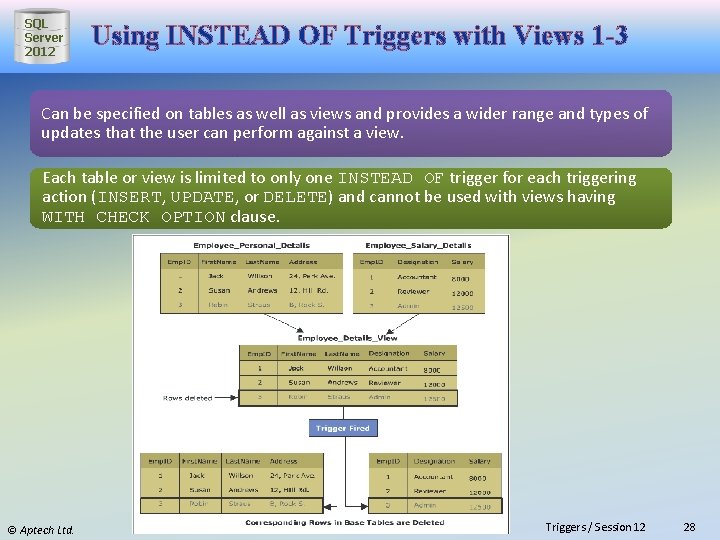
SQL Server 2012 Using INSTEAD OF Triggers with Views 1 -3 Can be specified on tables as well as views and provides a wider range and types of updates that the user can perform against a view. Each table or view is limited to only one INSTEAD OF trigger for each triggering action (INSERT, UPDATE, or DELETE) and cannot be used with views having WITH CHECK OPTION clause. © Aptech Ltd. Triggers / Session 12 28
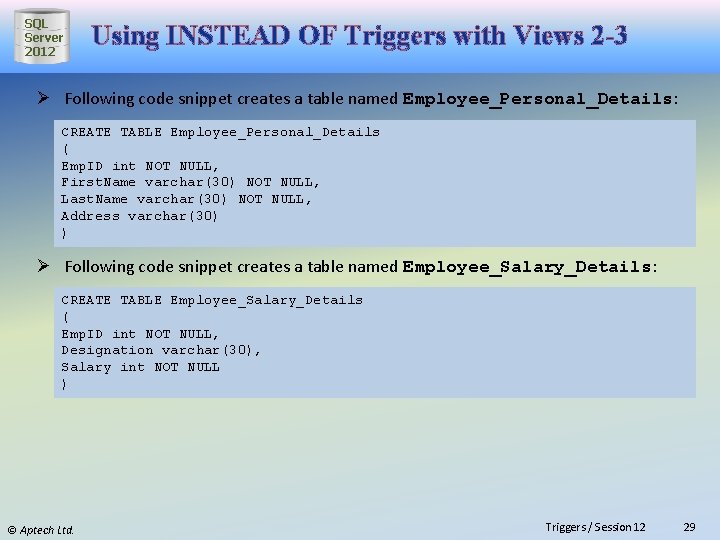
SQL Server 2012 Using INSTEAD OF Triggers with Views 2 -3 Ø Following code snippet creates a table named Employee_Personal_Details: CREATE TABLE Employee_Personal_Details ( Emp. ID int NOT NULL, First. Name varchar(30) NOT NULL, Last. Name varchar(30) NOT NULL, Address varchar(30) ) Ø Following code snippet creates a table named Employee_Salary_Details: CREATE TABLE Employee_Salary_Details ( Emp. ID int NOT NULL, Designation varchar(30), Salary int NOT NULL ) © Aptech Ltd. Triggers / Session 12 29
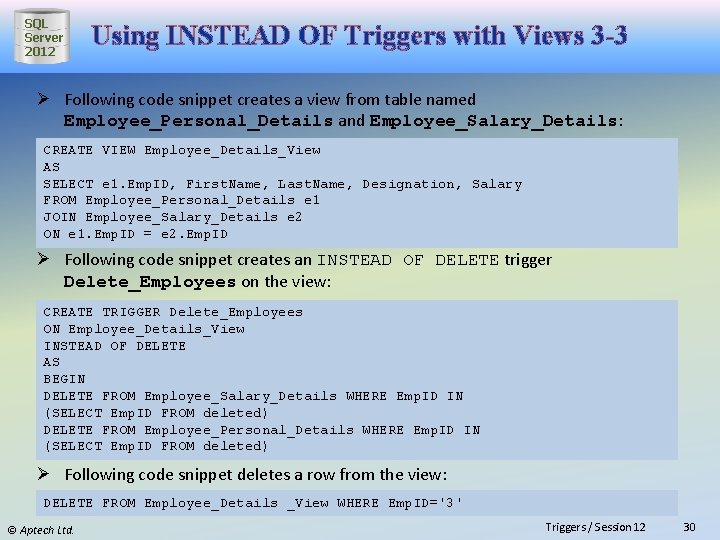
SQL Server 2012 Using INSTEAD OF Triggers with Views 3 -3 Ø Following code snippet creates a view from table named Employee_Personal_Details and Employee_Salary_Details: CREATE VIEW Employee_Details_View AS SELECT e 1. Emp. ID, First. Name, Last. Name, Designation, Salary FROM Employee_Personal_Details e 1 JOIN Employee_Salary_Details e 2 ON e 1. Emp. ID = e 2. Emp. ID Ø Following code snippet creates an INSTEAD OF DELETE trigger Delete_Employees on the view: CREATE TRIGGER Delete_Employees ON Employee_Details_View INSTEAD OF DELETE AS BEGIN DELETE FROM Employee_Salary_Details WHERE Emp. ID IN (SELECT Emp. ID FROM deleted) DELETE FROM Employee_Personal_Details WHERE Emp. ID IN (SELECT Emp. ID FROM deleted) Ø Following code snippet deletes a row from the view: DELETE FROM Employee_Details _View WHERE Emp. ID='3' © Aptech Ltd. Triggers / Session 12 30
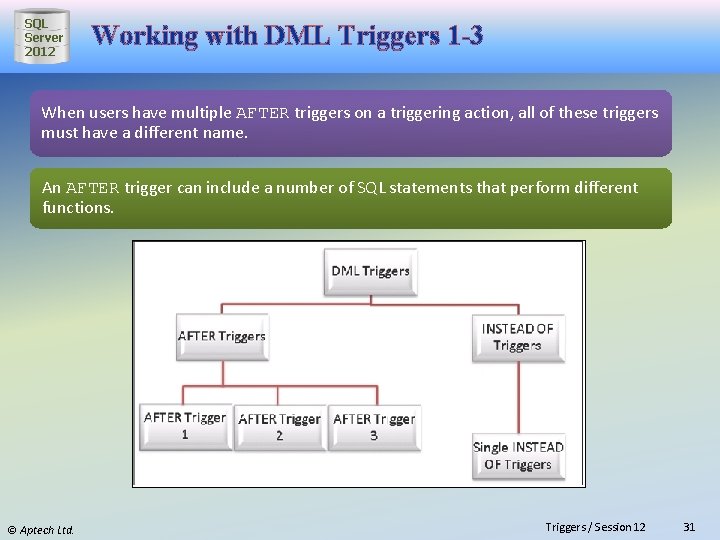
SQL Server 2012 Working with DML Triggers 1 -3 When users have multiple AFTER triggers on a triggering action, all of these triggers must have a different name. An AFTER trigger can include a number of SQL statements that perform different functions. © Aptech Ltd. Triggers / Session 12 31
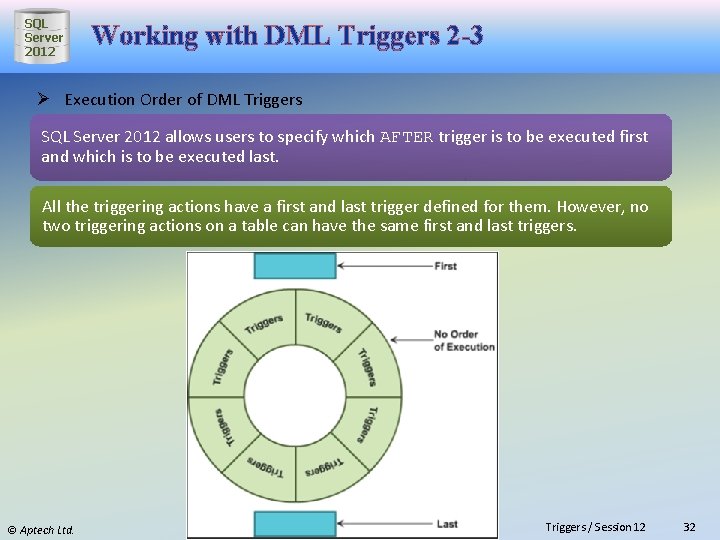
SQL Server 2012 Working with DML Triggers 2 -3 Ø Execution Order of DML Triggers SQL Server 2012 allows users to specify which AFTER trigger is to be executed first and which is to be executed last. All the triggering actions have a first and last trigger defined for them. However, no two triggering actions on a table can have the same first and last triggers. © Aptech Ltd. Triggers / Session 12 32
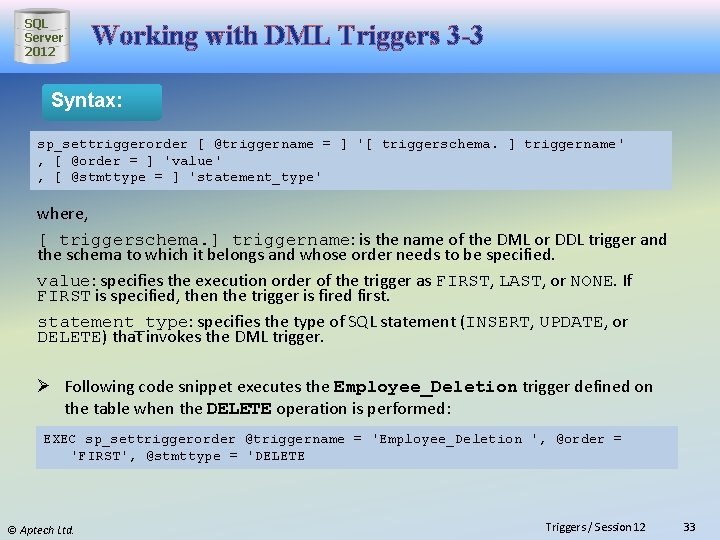
SQL Server 2012 Working with DML Triggers 3 -3 Syntax: sp_settriggerorder [ @triggername = ] '[ triggerschema. ] triggername' , [ @order = ] 'value' , [ @stmttype = ] 'statement_type' where, [ triggerschema. ] triggername: is the name of the DML or DDL trigger and the schema to which it belongs and whose order needs to be specified. value: specifies the execution order of the trigger as FIRST, LAST, or NONE. If FIRST is specified, then the trigger is fired first. statement_type: specifies the type of SQL statement (INSERT, UPDATE, or DELETE) that invokes the DML trigger. Ø Following code snippet executes the Employee_Deletion trigger defined on the table when the DELETE operation is performed: EXEC sp_settriggerorder @triggername = 'Employee_Deletion ', @order = 'FIRST', @stmttype = 'DELETE © Aptech Ltd. Triggers / Session 12 33
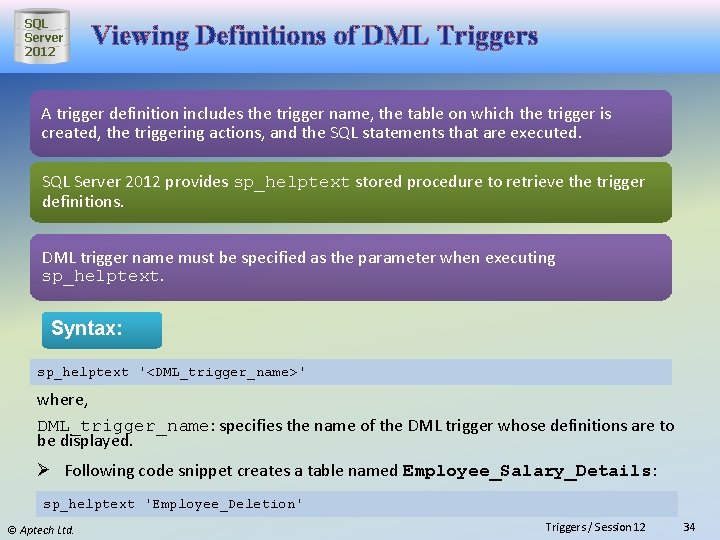
SQL Server 2012 Viewing Definitions of DML Triggers A trigger definition includes the trigger name, the table on which the trigger is created, the triggering actions, and the SQL statements that are executed. SQL Server 2012 provides sp_helptext stored procedure to retrieve the trigger definitions. DML trigger name must be specified as the parameter when executing sp_helptext. Syntax: sp_helptext '<DML_trigger_name>' where, DML_trigger_name: specifies the name of the DML trigger whose definitions are to be displayed. Ø Following code snippet creates a table named Employee_Salary_Details: sp_helptext 'Employee_Deletion' © Aptech Ltd. Triggers / Session 12 34
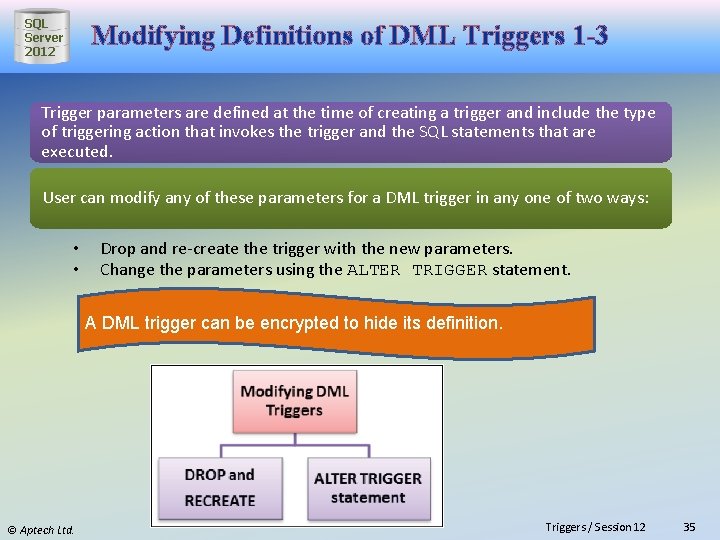
SQL Server 2012 Modifying Definitions of DML Triggers 1 -3 Trigger parameters are defined at the time of creating a trigger and include the type of triggering action that invokes the trigger and the SQL statements that are executed. User can modify any of these parameters for a DML trigger in any one of two ways: • • Drop and re-create the trigger with the new parameters. Change the parameters using the ALTER TRIGGER statement. A DML trigger can be encrypted to hide its definition. © Aptech Ltd. Triggers / Session 12 35
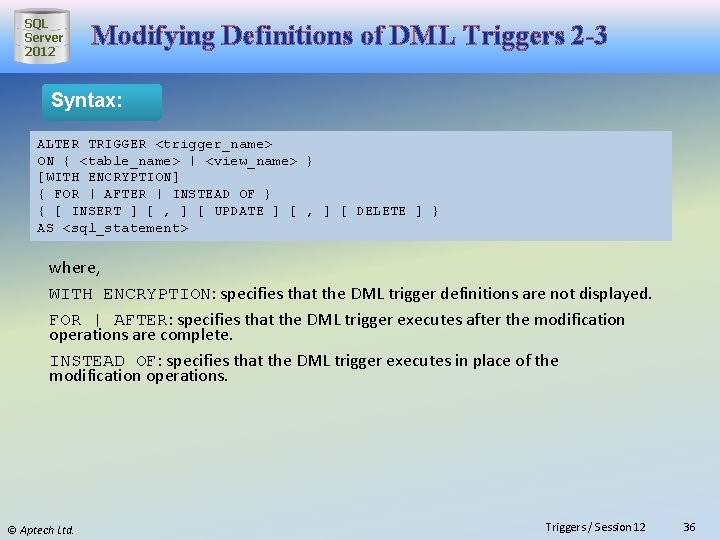
SQL Server 2012 Modifying Definitions of DML Triggers 2 -3 Syntax: ALTER TRIGGER <trigger_name> ON { <table_name> | <view_name> } [WITH ENCRYPTION] { FOR | AFTER | INSTEAD OF } { [ INSERT ] [ , ] [ UPDATE ] [ , ] [ DELETE ] } AS <sql_statement> where, WITH ENCRYPTION: specifies that the DML trigger definitions are not displayed. FOR | AFTER: specifies that the DML trigger executes after the modification operations are complete. INSTEAD OF: specifies that the DML trigger executes in place of the modification operations. © Aptech Ltd. Triggers / Session 12 36
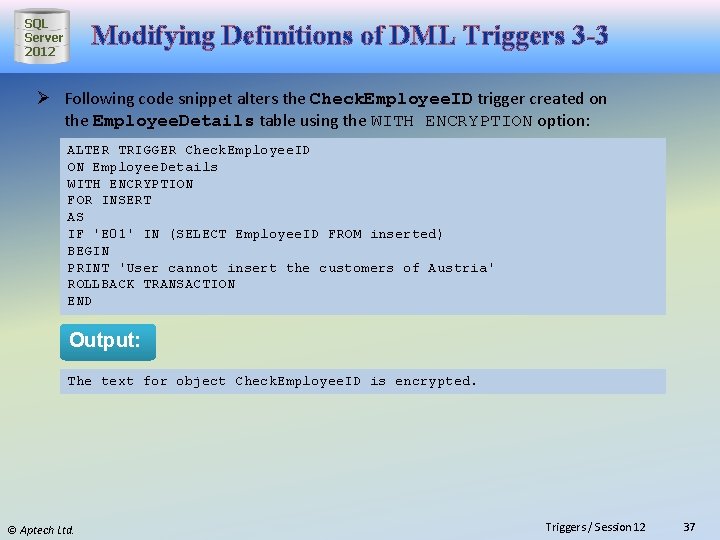
SQL Server 2012 Modifying Definitions of DML Triggers 3 -3 Ø Following code snippet alters the Check. Employee. ID trigger created on the Employee. Details table using the WITH ENCRYPTION option: ALTER TRIGGER Check. Employee. ID ON Employee. Details WITH ENCRYPTION FOR INSERT AS IF 'E 01' IN (SELECT Employee. ID FROM inserted) BEGIN PRINT 'User cannot insert the customers of Austria' ROLLBACK TRANSACTION END Output: The text for object Check. Employee. ID is encrypted. © Aptech Ltd. Triggers / Session 12 37
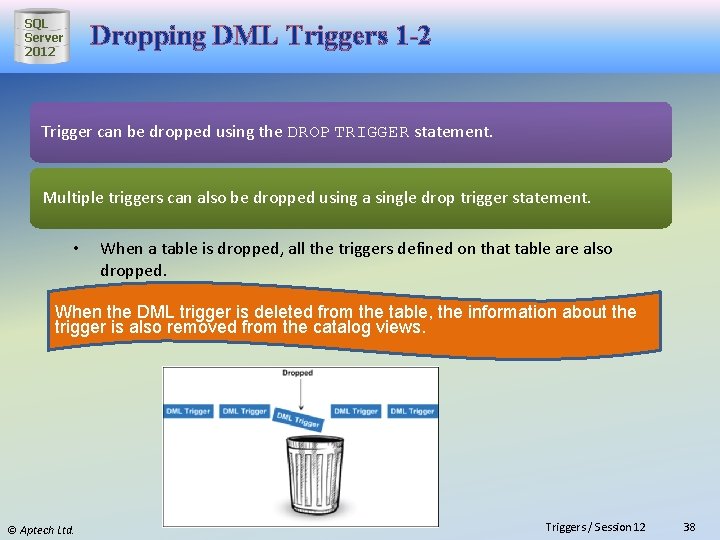
SQL Server 2012 Dropping DML Triggers 1 -2 Trigger can be dropped using the DROP TRIGGER statement. Multiple triggers can also be dropped using a single drop trigger statement. • When a table is dropped, all the triggers defined on that table are also dropped. When the DML trigger is deleted from the table, the information about the trigger is also removed from the catalog views. © Aptech Ltd. Triggers / Session 12 38
SQL Server 2012 Dropping DML Triggers 2 -2 Syntax: DROP TRIGGER <DML_trigger_name> [ , . . . n ] where, DML_trigger_name: specifies the name of the DML trigger to be dropped. [ , . . . n ]: specifies that multiple DML triggers can be dropped. Ø Following code snippet drops the Check. Employee. ID trigger created on the Employee. Details table: DROP TRIGGER Check. Employee. ID © Aptech Ltd. Triggers / Session 12 39
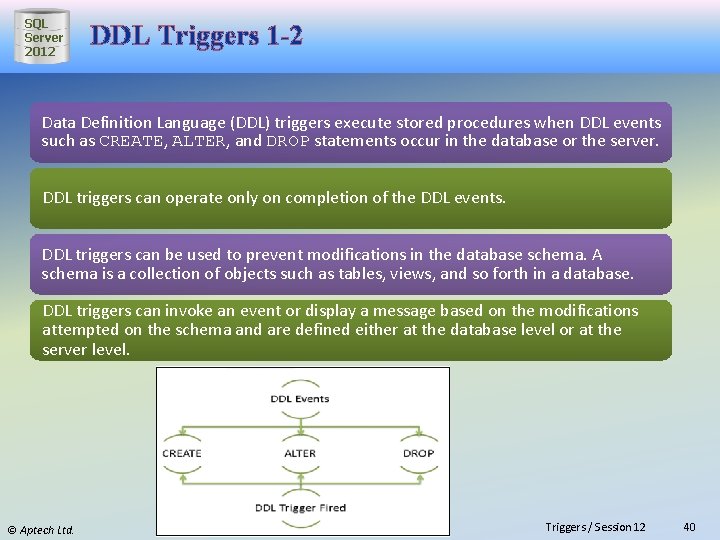
SQL Server 2012 DDL Triggers 1 -2 Data Definition Language (DDL) triggers execute stored procedures when DDL events such as CREATE, ALTER, and DROP statements occur in the database or the server. DDL triggers can operate only on completion of the DDL events. DDL triggers can be used to prevent modifications in the database schema. A schema is a collection of objects such as tables, views, and so forth in a database. DDL triggers can invoke an event or display a message based on the modifications attempted on the schema and are defined either at the database level or at the server level. © Aptech Ltd. Triggers / Session 12 40
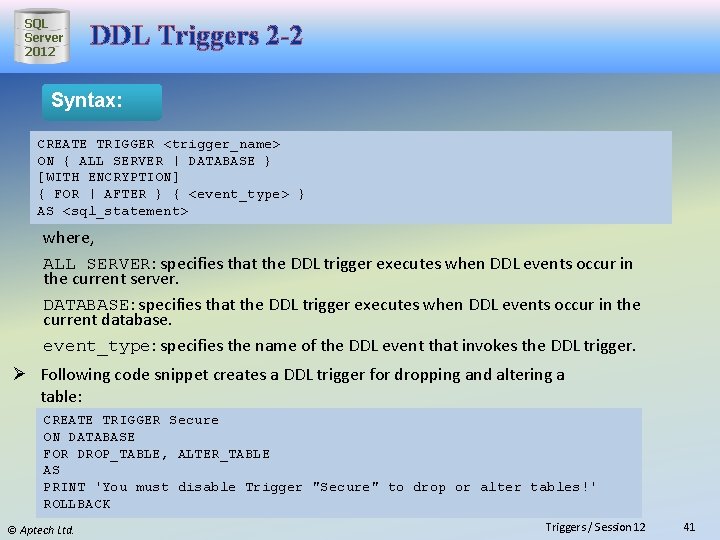
SQL Server 2012 DDL Triggers 2 -2 Syntax: CREATE TRIGGER <trigger_name> ON { ALL SERVER | DATABASE } [WITH ENCRYPTION] { FOR | AFTER } { <event_type> } AS <sql_statement> where, ALL SERVER: specifies that the DDL trigger executes when DDL events occur in the current server. DATABASE: specifies that the DDL trigger executes when DDL events occur in the current database. event_type: specifies the name of the DDL event that invokes the DDL trigger. Ø Following code snippet creates a DDL trigger for dropping and altering a table: CREATE TRIGGER Secure ON DATABASE FOR DROP_TABLE, ALTER_TABLE AS PRINT 'You must disable Trigger "Secure" to drop or alter tables!' ROLLBACK © Aptech Ltd. Triggers / Session 12 41
SQL Server 2012 Scope of DDL Triggers 1 -2 DDL triggers are invoked by SQL statements executed either in the current database or on the current server. A DDL trigger created for a CREATE LOGIN statement executes on the CREATE LOGIN event in the server. Scope of the DDL trigger depends on whether the trigger executes for database events or server events. © Aptech Ltd. Triggers / Session 12 42
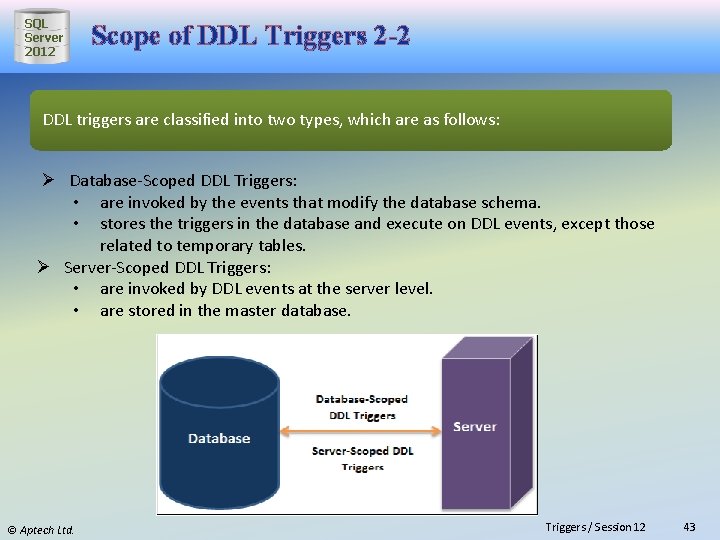
SQL Server 2012 Scope of DDL Triggers 2 -2 DDL triggers are classified into two types, which are as follows: Ø Database-Scoped DDL Triggers: • are invoked by the events that modify the database schema. • stores the triggers in the database and execute on DDL events, except those related to temporary tables. Ø Server-Scoped DDL Triggers: • are invoked by DDL events at the server level. • are stored in the master database. © Aptech Ltd. Triggers / Session 12 43
SQL Server 2012 Nested Triggers 1 -2 Both DDL and DML triggers are nested when a trigger implements an action that initiates another trigger. DDL and DML triggers can be nested up to 32 levels. Nested triggers can be used to perform the functions such as storing the backup of the rows that are affected by the previous actions. A Transact-SQL trigger executes the managed code through referencing a CLR routine, aggregate, or type, that references the counts as one level against the 32 level nesting limit. Users can disable nested triggers, by setting the nested triggers option of sp_configure to 0 or off. © Aptech Ltd. Triggers / Session 12 44
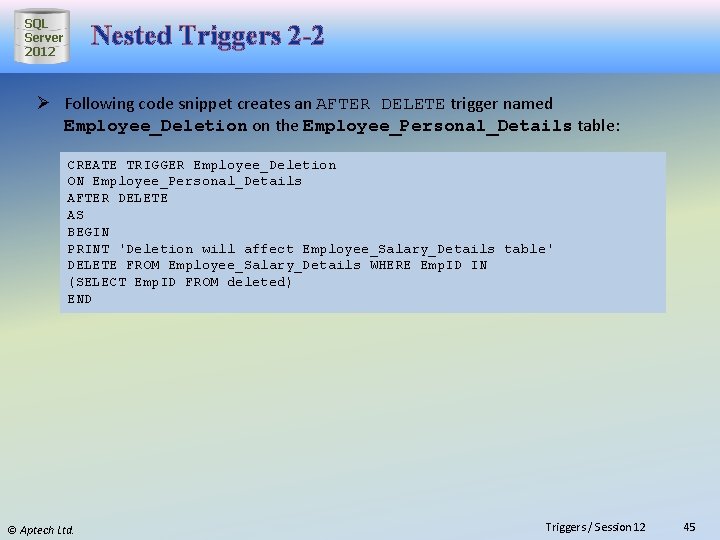
SQL Server 2012 Nested Triggers 2 -2 Ø Following code snippet creates an AFTER DELETE trigger named Employee_Deletion on the Employee_Personal_Details table: CREATE TRIGGER Employee_Deletion ON Employee_Personal_Details AFTER DELETE AS BEGIN PRINT 'Deletion will affect Employee_Salary_Details table' DELETE FROM Employee_Salary_Details WHERE Emp. ID IN (SELECT Emp. ID FROM deleted) END © Aptech Ltd. Triggers / Session 12 45
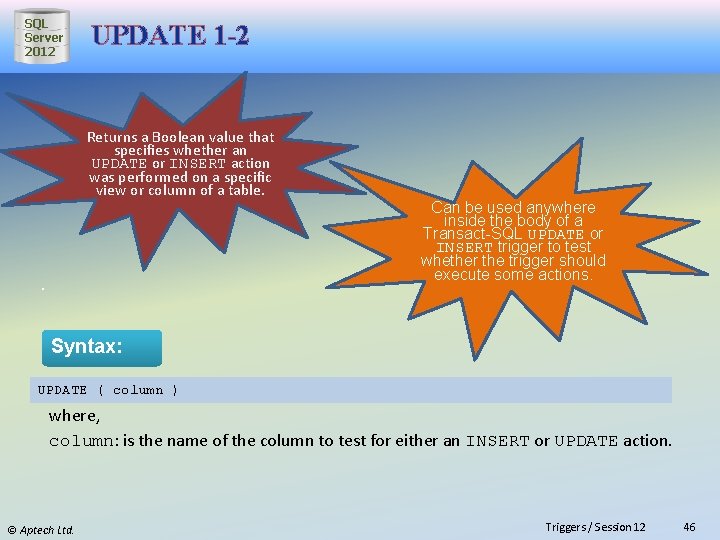
SQL Server 2012 UPDATE 1 -2 Returns a Boolean value that specifies whether an UPDATE or INSERT action was performed on a specific view or column of a table. . Can be used anywhere inside the body of a Transact-SQL UPDATE or INSERT trigger to test whether the trigger should execute some actions. Syntax: UPDATE ( column ) where, column: is the name of the column to test for either an INSERT or UPDATE action. © Aptech Ltd. Triggers / Session 12 46
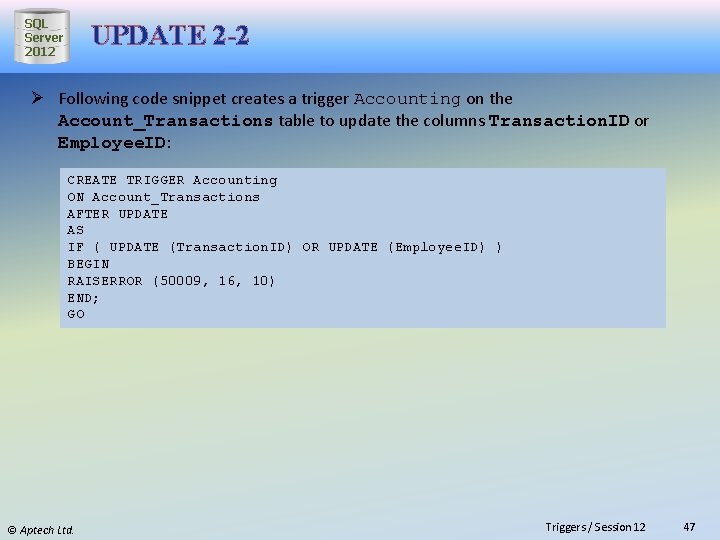
SQL Server 2012 UPDATE 2 -2 Ø Following code snippet creates a trigger Accounting on the Account_Transactions table to update the columns Transaction. ID or Employee. ID: CREATE TRIGGER Accounting ON Account_Transactions AFTER UPDATE AS IF ( UPDATE (Transaction. ID) OR UPDATE (Employee. ID) ) BEGIN RAISERROR (50009, 16, 10) END; GO © Aptech Ltd. Triggers / Session 12 47
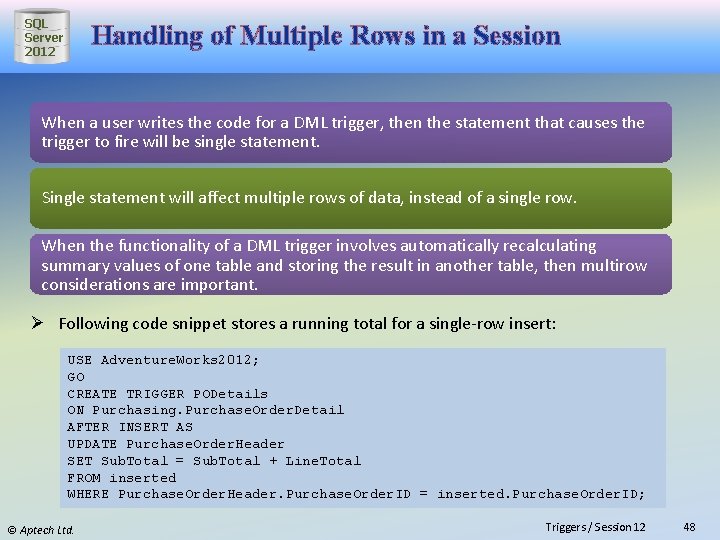
SQL Server 2012 Handling of Multiple Rows in a Session When a user writes the code for a DML trigger, then the statement that causes the trigger to fire will be single statement. Single statement will affect multiple rows of data, instead of a single row. When the functionality of a DML trigger involves automatically recalculating summary values of one table and storing the result in another table, then multirow considerations are important. Ø Following code snippet stores a running total for a single-row insert: USE Adventure. Works 2012; GO CREATE TRIGGER PODetails ON Purchasing. Purchase. Order. Detail AFTER INSERT AS UPDATE Purchase. Order. Header SET Sub. Total = Sub. Total + Line. Total FROM inserted WHERE Purchase. Order. Header. Purchase. Order. ID = inserted. Purchase. Order. ID; © Aptech Ltd. Triggers / Session 12 48
SQL Server 2012 Performance Implication of Triggers do not carry overheads, rather they are quite responsive. Many performance issues can occur because of the logic present inside the trigger. A good rule will be to keep the logic simple within the triggers and avoid using cursors while executing statements against another table and different tasks that cause performance slowdown. © Aptech Ltd. Triggers / Session 12 49
SQL Server 2012 Summary ● A trigger is a stored procedure that is executed when an attempt is made to modify data in a table that is protected by the trigger. ● Logon triggers execute stored procedures when a session is established with a LOGON event. ● DML triggers are executed when DML events occur in tables or views. ● The INSERT trigger is executed when a new record is inserted in a table. ● The UPDATE trigger copies the original record in the Deleted table and the new record into the Inserted table when a record is updated. ● The DELETE trigger can be created to restrict a user from deleting a particular record in a table. ● The AFTER trigger is executed on completion of INSERT, UPDATE, or DELETE operations. © Aptech Ltd. Triggers / Session 12 50