
SQL Queries Constraints Triggers Chapter 5 Database Management
SQL: Queries, Constraints, Triggers Chapter 5 Database Management Systems 3 ed, R. Ramakrishnan and J. Gehrke 1
R 1 Example Instances v v We will use these instances of the Sailors and Reserves relations in our examples. If the key for the Reserves relation contained only the attributes sid and bid, how would the semantics differ? S 1 S 2 Database Management Systems 3 ed, R. Ramakrishnan and J. Gehrke 2
![Basic SQL Query SELECT [DISTINCT] target- list FROM WHERE relation-list qualification relation-list A list](http://slidetodoc.com/presentation_image_h/15429948d27e1a6bf4bc1170cf0da8b5/image-3.jpg "Basic SQL Query SELECT [DISTINCT] target- list FROM WHERE relation-list qualification relation-list A list")
Basic SQL Query SELECT [DISTINCT] target- list FROM WHERE relation-list qualification relation-list A list of relation names (possibly with a range-variable after each name). v target-list A list of attributes of relations in relation-list v qualification Comparisons (Attr op const or Attr 1 op Attr 2, where op is one of ) combined using AND, OR and NOT. v DISTINCT is an optional keyword indicating that the answer should not contain duplicates. Default is that duplicates are not eliminated! v Database Management Systems 3 ed, R. Ramakrishnan and J. Gehrke 3
Conceptual Evaluation Strategy v Semantics of an SQL query defined in terms of the following conceptual evaluation strategy: § § v Compute the cross-product of relation-list. Discard resulting tuples if they fail qualifications. Delete attributes that are not in target-list. If DISTINCT is specified, eliminate duplicate rows. This strategy is probably the least efficient way to compute a query! An optimizer will find more efficient strategies to compute the same answers. Database Management Systems 3 ed, R. Ramakrishnan and J. Gehrke 4

Example of Conceptual Evaluation SELECT FROM WHERE S. sname Sailors S, Reserves R S. sid=R. sid AND R. bid=103 Database Management Systems 3 ed, R. Ramakrishnan and J. Gehrke 5
A Note on Range Variables v OR Really needed only if the same relation appears twice in the FROM clause. The previous query can also be written as: SELECT FROM WHERE S. sname Sailors S, Reserves R S. sid=R. sid AND bid=103 SELECT FROM WHERE sname Sailors, Reserves Sailors. sid=Reserves. sid AND bid=103 Database Management Systems 3 ed, R. Ramakrishnan and J. Gehrke It is good style, however, to use range variables always! 6
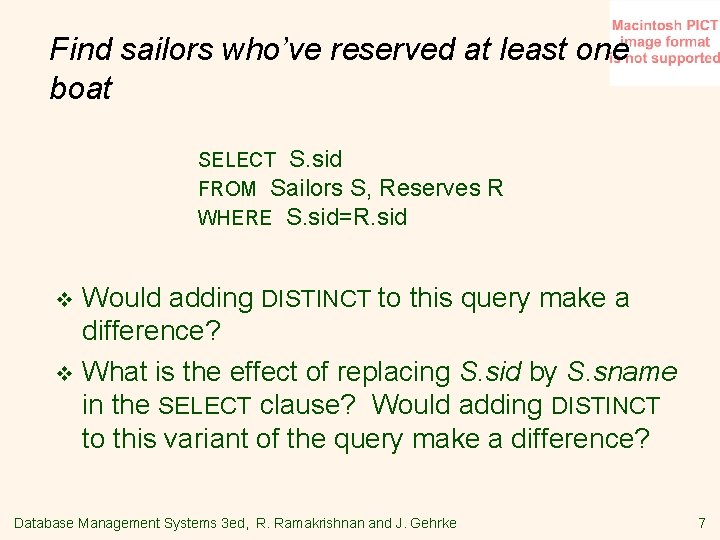
Find sailors who’ve reserved at least one boat SELECT S. sid FROM Sailors S, Reserves WHERE S. sid=R. sid R Would adding DISTINCT to this query make a difference? v What is the effect of replacing S. sid by S. sname in the SELECT clause? Would adding DISTINCT to this variant of the query make a difference? v Database Management Systems 3 ed, R. Ramakrishnan and J. Gehrke 7
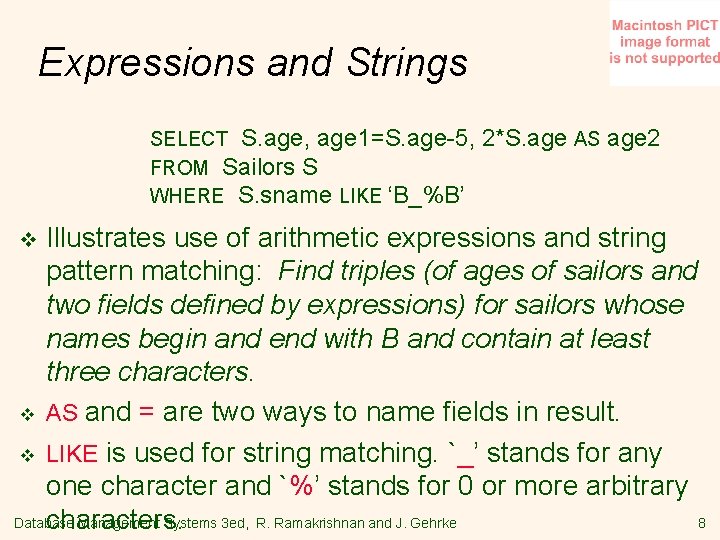
Expressions and Strings SELECT S. age, age 1=S. age-5, FROM Sailors S WHERE S. sname LIKE ‘B_%B’ 2*S. age AS age 2 Illustrates use of arithmetic expressions and string pattern matching: Find triples (of ages of sailors and two fields defined by expressions) for sailors whose names begin and end with B and contain at least three characters. v AS and = are two ways to name fields in result. v LIKE is used for string matching. `_’ stands for any one character and `%’ stands for 0 or more arbitrary Database Management Systems 3 ed, R. Ramakrishnan and J. Gehrke 8 characters. v
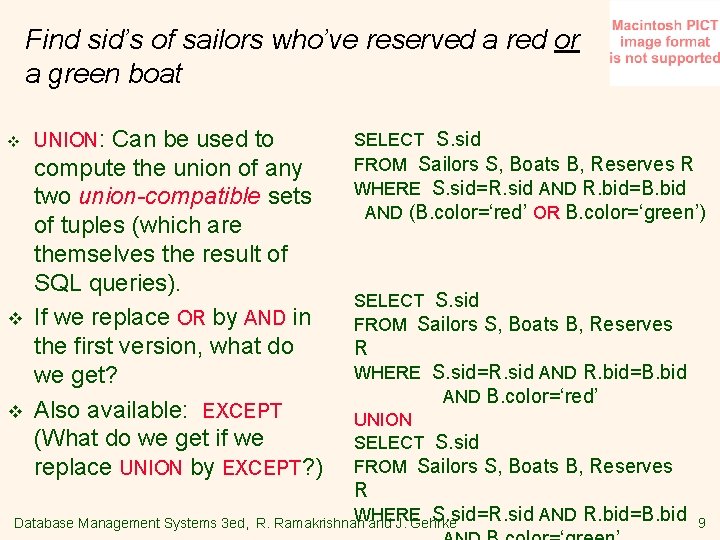
Find sid’s of sailors who’ve reserved a red or a green boat v v v UNION: Can be used to compute the union of any two union-compatible sets of tuples (which are themselves the result of SQL queries). If we replace OR by AND in the first version, what do we get? Also available: EXCEPT (What do we get if we replace UNION by EXCEPT? ) SELECT S. sid FROM Sailors S, Boats B, Reserves R WHERE S. sid=R. sid AND R. bid=B. bid AND (B. color=‘red’ OR B. color=‘green’) SELECT S. sid FROM Sailors S, Boats B, Reserves R WHERE S. sid=R. sid AND R. bid=B. bid AND B. color=‘red’ UNION SELECT S. sid FROM Sailors S, Boats B, Reserves R WHERE S. sid=R. sid Database Management Systems 3 ed, R. Ramakrishnan and J. Gehrke AND R. bid=B. bid 9
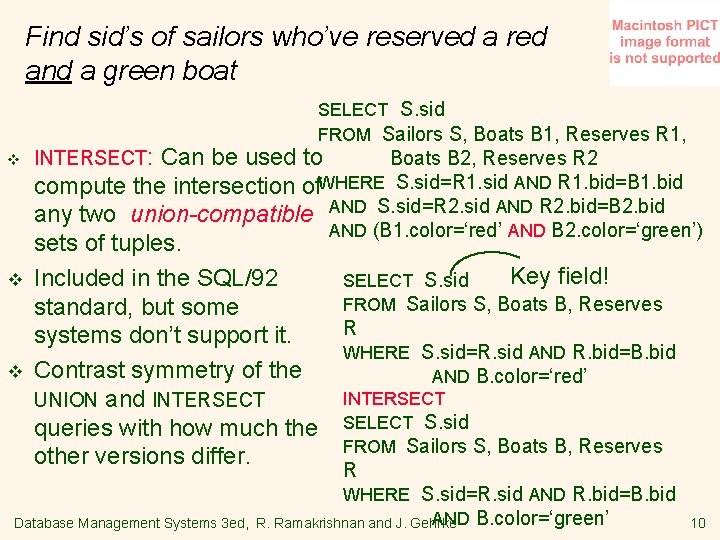
Find sid’s of sailors who’ve reserved a red and a green boat v v v INTERSECT: SELECT S. sid FROM Sailors S, Boats B 1, Reserves R 1, Boats B 2, Reserves R 2 Can be used to compute the intersection of. WHERE S. sid=R 1. sid AND R 1. bid=B 1. bid any two union-compatible AND S. sid=R 2. sid AND R 2. bid=B 2. bid AND (B 1. color=‘red’ AND B 2. color=‘green’) sets of tuples. Key field! Included in the SQL/92 SELECT S. sid FROM Sailors S, Boats B, Reserves standard, but some R systems don’t support it. WHERE S. sid=R. sid AND R. bid=B. bid Contrast symmetry of the AND B. color=‘red’ INTERSECT UNION and INTERSECT queries with how much the SELECT S. sid FROM Sailors S, Boats B, Reserves other versions differ. R Database Management Systems 3 ed, WHERE S. sid=R. sid AND R. bid=B. bid AND B. color=‘green’ R. Ramakrishnan and J. Gehrke 10
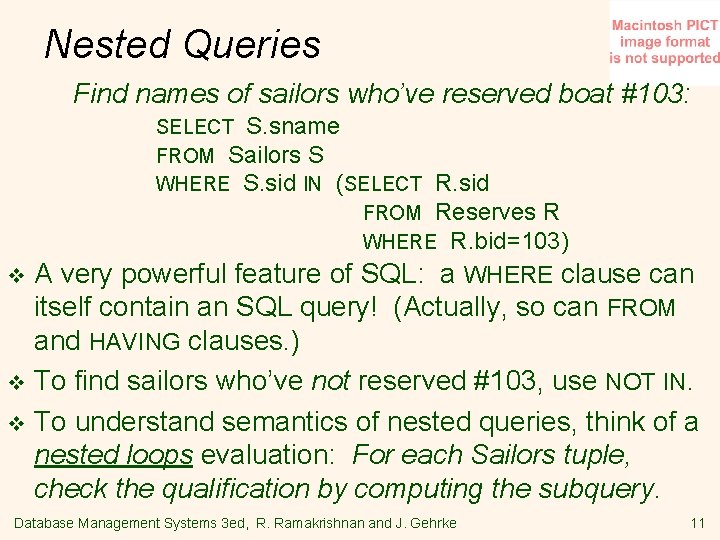
Nested Queries Find names of sailors who’ve reserved boat #103: SELECT S. sname FROM Sailors S WHERE S. sid IN (SELECT R. sid FROM Reserves R WHERE R. bid=103) A very powerful feature of SQL: a WHERE clause can itself contain an SQL query! (Actually, so can FROM and HAVING clauses. ) v To find sailors who’ve not reserved #103, use NOT IN. v To understand semantics of nested queries, think of a nested loops evaluation: For each Sailors tuple, check the qualification by computing the subquery. v Database Management Systems 3 ed, R. Ramakrishnan and J. Gehrke 11
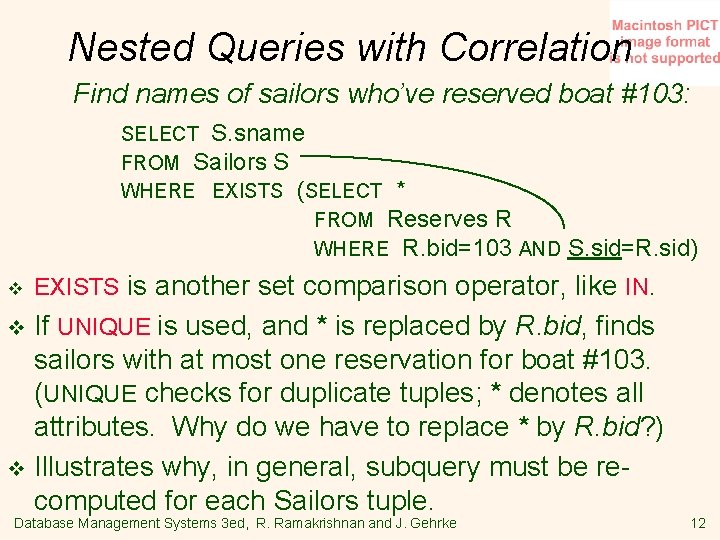
Nested Queries with Correlation Find names of sailors who’ve reserved boat #103: SELECT S. sname FROM Sailors S WHERE EXISTS (SELECT * FROM Reserves R WHERE R. bid=103 AND v S. sid=R. sid) EXISTS is another set comparison operator, like IN. If UNIQUE is used, and * is replaced by R. bid, finds sailors with at most one reservation for boat #103. (UNIQUE checks for duplicate tuples; * denotes all attributes. Why do we have to replace * by R. bid? ) v Illustrates why, in general, subquery must be recomputed for each Sailors tuple. v Database Management Systems 3 ed, R. Ramakrishnan and J. Gehrke 12
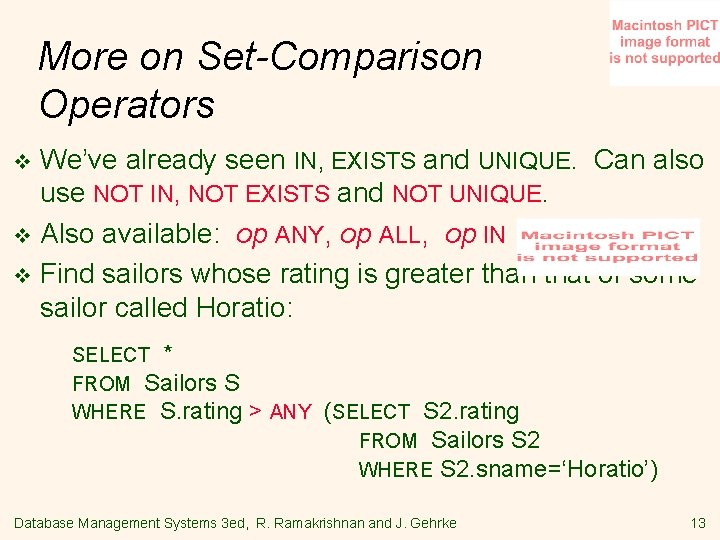
More on Set-Comparison Operators We’ve already seen IN, EXISTS and UNIQUE. Can also use NOT IN, NOT EXISTS and NOT UNIQUE. v Also available: op ANY, op ALL, op IN v Find sailors whose rating is greater than that of some sailor called Horatio: v SELECT * FROM Sailors S WHERE S. rating > ANY (SELECT S 2. rating FROM Sailors S 2 WHERE S 2. sname=‘Horatio’) Database Management Systems 3 ed, R. Ramakrishnan and J. Gehrke 13
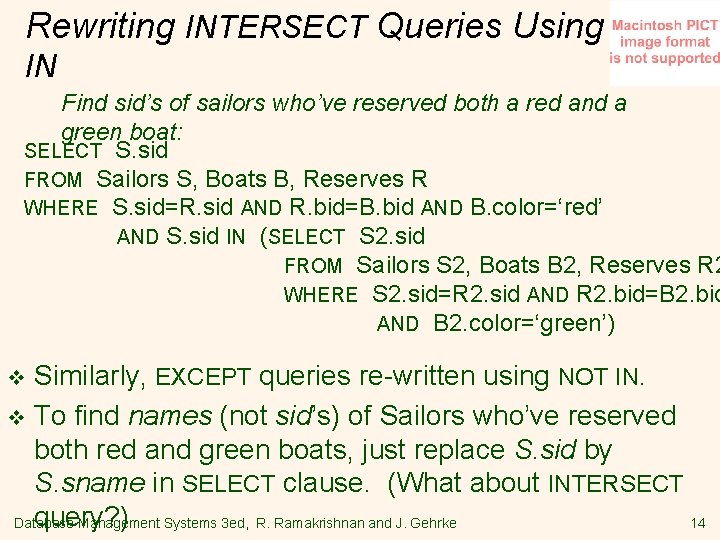
Rewriting INTERSECT Queries Using IN Find sid’s of sailors who’ve reserved both a red and a green boat: SELECT S. sid FROM Sailors S, Boats B, Reserves R WHERE S. sid=R. sid AND R. bid=B. bid AND B. color=‘red’ AND S. sid IN (SELECT S 2. sid FROM Sailors S 2, Boats B 2, Reserves R 2 WHERE S 2. sid=R 2. sid AND R 2. bid=B 2. bid AND B 2. color=‘green’) Similarly, EXCEPT queries re-written using NOT IN. v To find names (not sid’s) of Sailors who’ve reserved both red and green boats, just replace S. sid by S. sname in SELECT clause. (What about INTERSECT query? ) Database Management Systems 3 ed, R. Ramakrishnan and J. Gehrke 14 v
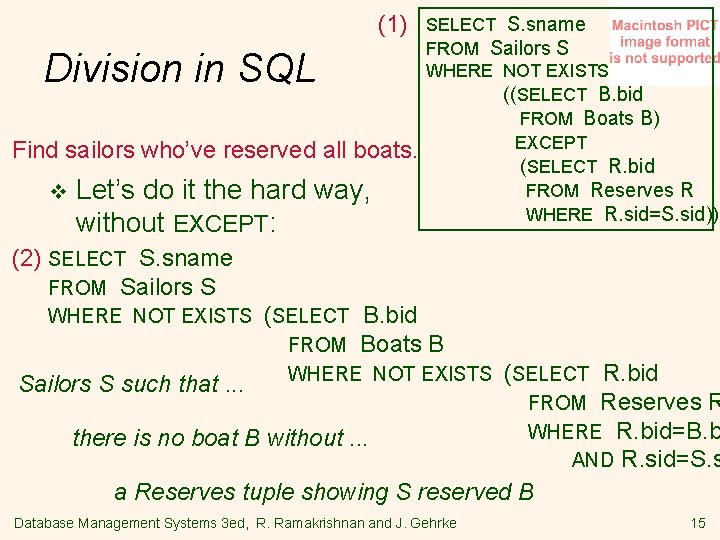
(1) Division in SQL Find sailors who’ve reserved all boats. v Let’s do it the hard way, without EXCEPT: SELECT S. sname FROM Sailors S WHERE NOT EXISTS ((SELECT B. bid FROM Boats B) EXCEPT (SELECT R. bid FROM Reserves R WHERE R. sid=S. sid)) (2) SELECT S. sname FROM Sailors S WHERE NOT EXISTS (SELECT B. bid FROM Boats B WHERE NOT EXISTS (SELECT R. bid Sailors S such that. . . FROM Reserves R WHERE R. bid=B. b there is no boat B without. . . AND R. sid=S. s a Reserves tuple showing S reserved B Database Management Systems 3 ed, R. Ramakrishnan and J. Gehrke 15
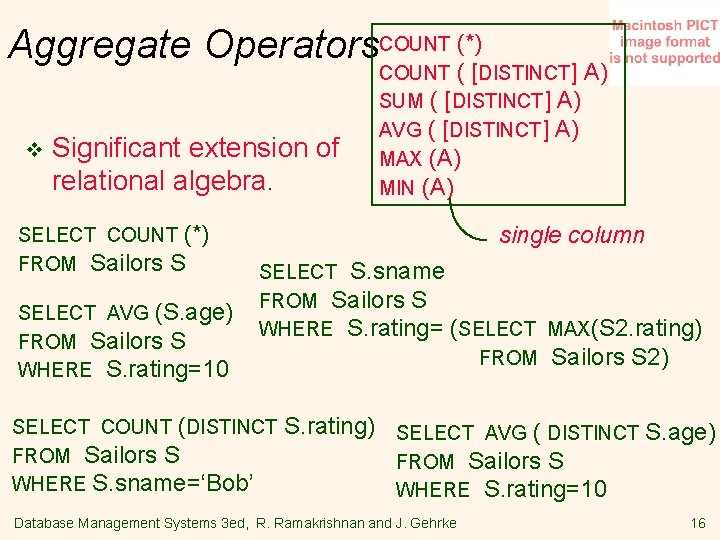
Aggregate Operators. COUNT (*) v Significant extension of relational algebra. SELECT COUNT (*) FROM Sailors S SELECT AVG (S. age) FROM Sailors S WHERE S. rating=10 COUNT ( [DISTINCT] A) SUM ( [DISTINCT] A) AVG ( [DISTINCT] A) MAX (A) MIN (A) single column SELECT S. sname FROM Sailors S WHERE S. rating= (SELECT MAX(S 2. rating) FROM Sailors S 2) SELECT COUNT (DISTINCT FROM Sailors S WHERE S. sname=‘Bob’ S. rating) SELECT AVG ( DISTINCT S. age) FROM Sailors S WHERE S. rating=10 Database Management Systems 3 ed, R. Ramakrishnan and J. Gehrke 16
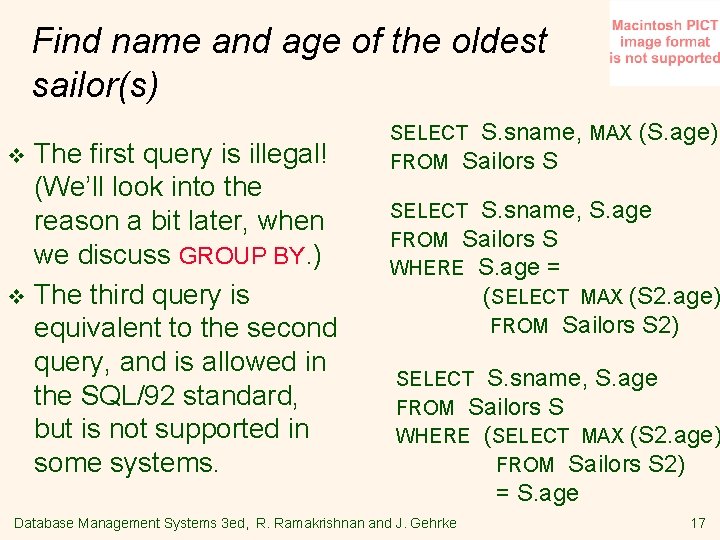
Find name and age of the oldest sailor(s) The first query is illegal! (We’ll look into the reason a bit later, when we discuss GROUP BY. ) v The third query is equivalent to the second query, and is allowed in the SQL/92 standard, but is not supported in some systems. v SELECT S. sname, MAX FROM Sailors S (S. age) SELECT S. sname, S. age FROM Sailors S WHERE S. age = (SELECT MAX (S 2. age) FROM Sailors S 2) SELECT S. sname, S. age FROM Sailors S WHERE (SELECT MAX (S 2. age) FROM Sailors S 2) = S. age Database Management Systems 3 ed, R. Ramakrishnan and J. Gehrke 17
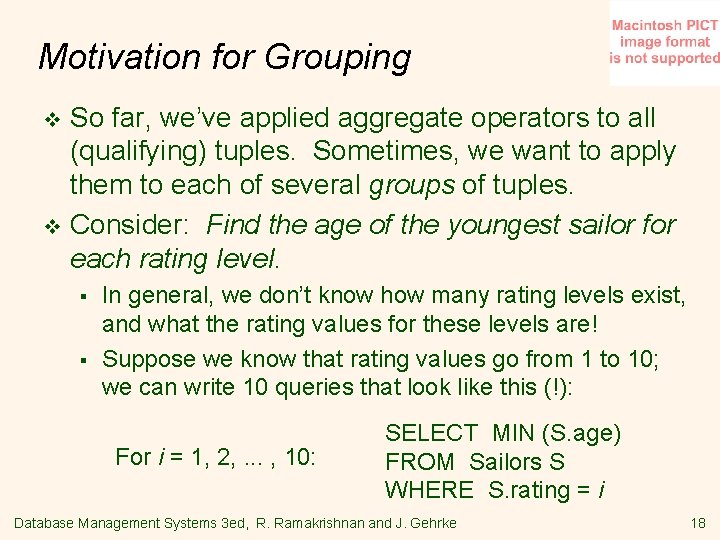
Motivation for Grouping So far, we’ve applied aggregate operators to all (qualifying) tuples. Sometimes, we want to apply them to each of several groups of tuples. v Consider: Find the age of the youngest sailor for each rating level. v § § In general, we don’t know how many rating levels exist, and what the rating values for these levels are! Suppose we know that rating values go from 1 to 10; we can write 10 queries that look like this (!): For i = 1, 2, . . . , 10: SELECT MIN (S. age) FROM Sailors S WHERE S. rating = i Database Management Systems 3 ed, R. Ramakrishnan and J. Gehrke 18
![Queries With GROUP BY and HAVING SELECT [DISTINCT] target- list FROM relation-list WHERE qualification](http://slidetodoc.com/presentation_image_h/15429948d27e1a6bf4bc1170cf0da8b5/image-19.jpg "Queries With GROUP BY and HAVING SELECT [DISTINCT] target- list FROM relation-list WHERE qualification")
Queries With GROUP BY and HAVING SELECT [DISTINCT] target- list FROM relation-list WHERE qualification GROUP BY grouping-list HAVING group-qualification v The target-list contains (i) attribute names (ii) terms with aggregate operations (e. g. , MIN (S. age)). § The attribute list (i) must be a subset of grouping-list. Intuitively, each answer tuple corresponds to a group, and these attributes must have a single value per group. (A group is a set of tuples that have the same value for all attributes in grouping-list. ) Database Management Systems 3 ed, R. Ramakrishnan and J. Gehrke 19
Conceptual Evaluation The cross-product of relation-list is computed, tuples that fail qualification are discarded, `unnecessary’ fields are deleted, and the remaining tuples are partitioned into groups by the value of attributes in grouping-list. v The group-qualification is then applied to eliminate some groups. Expressions in group-qualification must have a single value per group! v § In effect, an attribute in group-qualification that is not an argument of an aggregate op also appears in grouping-list. (SQL does not exploit primary key semantics here!) Database Management Systems 3 ed, R. is Ramakrishnan and J. Gehrke v One answer tuple generated per qualifying group. 20
Find age of the youngest sailor with age 18, for each rating with at least 2 such sailors S. rating, MIN (S. age) AS minage FROM Sailors S WHERE S. age >= 18 GROUP BY S. rating HAVING COUNT (*) > 1 SELECT Sailors instance: Answer relation: Database Management Systems 3 ed, R. Ramakrishnan and J. Gehrke 21
Find age of the youngest sailor with age 18, for each rating with at least 2 such sailors. Database Management Systems 3 ed, R. Ramakrishnan and J. Gehrke 22
Find age of the youngest sailor with age 18, for each rating with at least 2 such sailors and with every sailor under 60. HAVING COUNT (*) > 1 AND EVERY (S. age <=60) What is the result of changing EVERY to ANY? Database Management Systems 3 ed, R. Ramakrishnan and J. Gehrke 23
Find age of the youngest sailor with age 18, for each rating with at least 2 sailors between 18 and 60. Sailors instance: S. rating, MIN (S. age) AS minage FROM Sailors S WHERE S. age >= 18 AND S. age <= 60 GROUP BY S. rating HAVING COUNT (*) > 1 SELECT Answer relation: Database Management Systems 3 ed, R. Ramakrishnan and J. Gehrke 24
For each red boat, find the # of reservations for this boat (by an active sailor) SELECT B. bid, COUNT(*) (*)AS ASscount FROM S, Reserves Boats B, Reserves R FROM Sailors Boats B, R WHERE AND WHERE S. sid=R. sid R. bid=B. bid. ANDR. bid=B. bid B. color=‘red’ GROUPBY BY B. bid B. color=‘red’ Grouping over a join of three relations. v What do we get if we remove B. color=‘red’ from the WHERE clause and add a HAVING clause with this condition? v What if we drop Sailors and the condition involving S. sid? v Database Management Systems 3 ed, R. Ramakrishnan and J. Gehrke 25
Find age of the youngest sailor with age > 18, for each rating with at least 2 sailors (of any age) SELECT S. rating, MIN (S. age) FROM Sailors S WHERE S. age > 18 GROUP BY S. rating HAVING 1 < (SELECT COUNT (*) FROM Sailors S 2 WHERE S. rating=S 2. rating) Shows HAVING clause can also contain a subquery. v Compare this with the query where we considered only ratings with 2 sailors over 18! v What if HAVING clause is replaced by: v § HAVING COUNT(*) >1 Database Management Systems 3 ed, R. Ramakrishnan and J. Gehrke 26
Find those ratings for which the average is the minimum over all ratings v Aggregate operations cannot be nested! WRONG: SELECT S. rating, MIN (AVG FROM Sailors S GROUP BY S. rating v (S. age)) Correct solution (in SQL/92): SELECT Temp. rating, Temp. avgage FROM (SELECT S. rating, AVG (S. age) AS avgage FROM Sailors S GROUP BY S. rating) AS Temp WHERE Temp. avgage = (SELECT MIN (Temp. avgage) FROM Temp) Database Management Systems 3 ed, R. Ramakrishnan and J. Gehrke 27
Null Values v Field values in a tuple are sometimes unknown (e. g. , a rating has not been assigned) or inapplicable (e. g. , no spouse’s name). § v SQL provides a special value null for such situations. The presence of null complicates many issues. E. g. : § § § Special operators needed to check if value is/is not null. Is rating>8 true or false when rating is equal to null? What about AND, OR and NOT connectives? We need a 3 -valued logic (true, false and unknown). Meaning of constructs must be defined carefully. (e. g. , WHERE clause eliminates rows that don’t evaluate to true. ) New operators (in particular, outer joins) possible/needed. Database Management Systems 3 ed, R. Ramakrishnan and J. Gehrke 28
Integrity Constraints (Review) v An IC describes conditions that every legal instance of a relation must satisfy. § § v Inserts/deletes/updates that violate IC’s are disallowed. Can be used to ensure application semantics (e. g. , sid is a key), or prevent inconsistencies (e. g. , sname has to be a string, age must be < 200) Types of IC’s: Domain constraints, primary key constraints, foreign key constraints, general constraints. § Domain constraints: Field values must be of right type. Always enforced. Database Management Systems 3 ed, R. Ramakrishnan and J. Gehrke 29
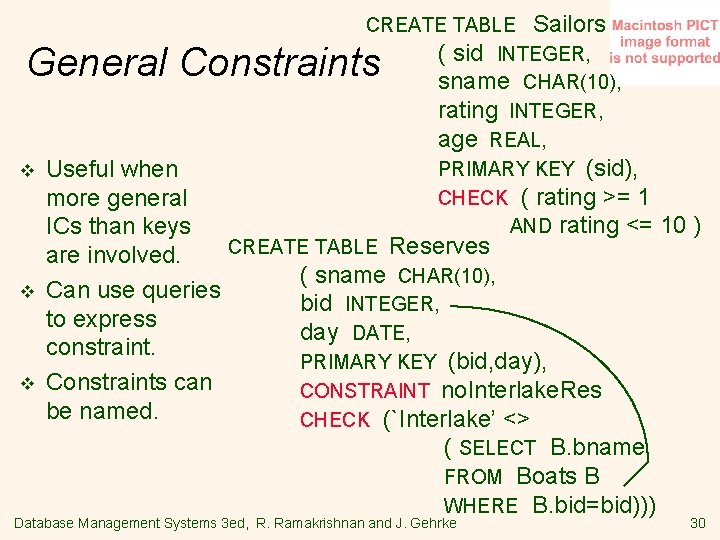
CREATE TABLE Sailors ( sid INTEGER, sname CHAR(10), rating INTEGER, age REAL, PRIMARY KEY (sid), CHECK ( rating >= 1 AND rating <= 10 CREATE TABLE Reserves ( sname CHAR(10), bid INTEGER, day DATE, PRIMARY KEY (bid, day), CONSTRAINT no. Interlake. Res CHECK (`Interlake’ <> ( SELECT B. bname FROM Boats B WHERE B. bid=bid))) General Constraints v v v Useful when more general ICs than keys are involved. Can use queries to express constraint. Constraints can be named. Database Management Systems 3 ed, R. Ramakrishnan and J. Gehrke ) 30
Triggers Trigger: procedure that starts automatically if specified changes occur to the DBMS v Three parts: v § § § Event (activates the trigger) Condition (tests whether the triggers should run) Action (what happens if the trigger runs) Database Management Systems 3 ed, R. Ramakrishnan and J. Gehrke 31
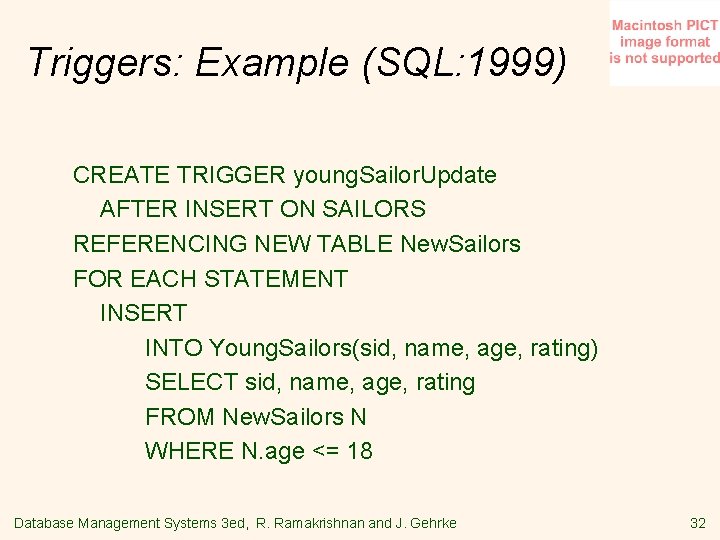
Triggers: Example (SQL: 1999) CREATE TRIGGER young. Sailor. Update AFTER INSERT ON SAILORS REFERENCING NEW TABLE New. Sailors FOR EACH STATEMENT INSERT INTO Young. Sailors(sid, name, age, rating) SELECT sid, name, age, rating FROM New. Sailors N WHERE N. age <= 18 Database Management Systems 3 ed, R. Ramakrishnan and J. Gehrke 32
Procedural Extensions and Stored Procedures v SQL provides a module language § Permits definition of procedures in SQL, with if-then-else statements, for and while loops, etc. v Stored Procedures § Can store procedures in the database § then execute them using the call statement § permit external applications to operate on the database without knowing about internal details Database Management Systems 3 ed, R. Ramakrishnan and J. Gehrke 33
Functions and Procedures v v v SQL supports functions and procedures § Functions/procedures can be written in SQL itself, or in an external programming language § Functions are particularly useful with specialized data types such as images and geometric objects • Example: functions to check if polygons overlap, or to compare images for similarity § Some database systems support table-valued functions, which can return a relation as a result SQL also supports a rich set of imperative constructs, including § Loops, if-then-else, assignment Many databases have proprietary procedural extensions to SQL Database Management Systems 3 ed, R. Ramakrishnan and J. Gehrke 34
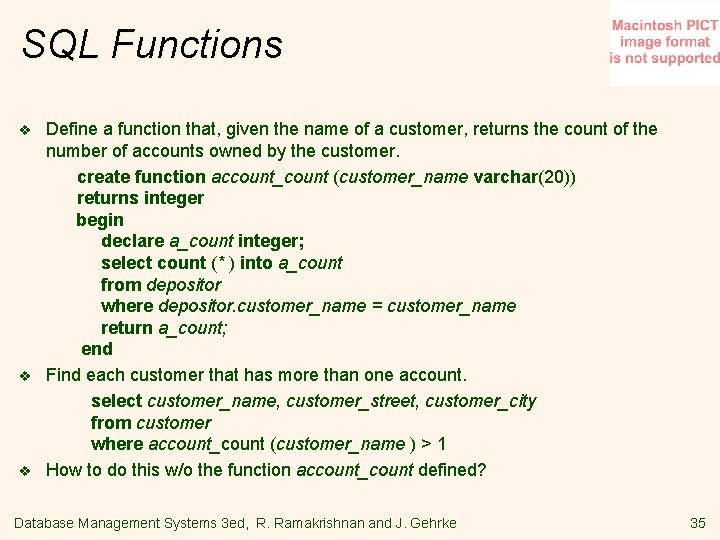
SQL Functions v v v Define a function that, given the name of a customer, returns the count of the number of accounts owned by the customer. create function account_count (customer_name varchar(20)) returns integer begin declare a_count integer; select count (* ) into a_count from depositor where depositor. customer_name = customer_name return a_count; end Find each customer that has more than one account. select customer_name, customer_street, customer_city from customer where account_count (customer_name ) > 1 How to do this w/o the function account_count defined? Database Management Systems 3 ed, R. Ramakrishnan and J. Gehrke 35
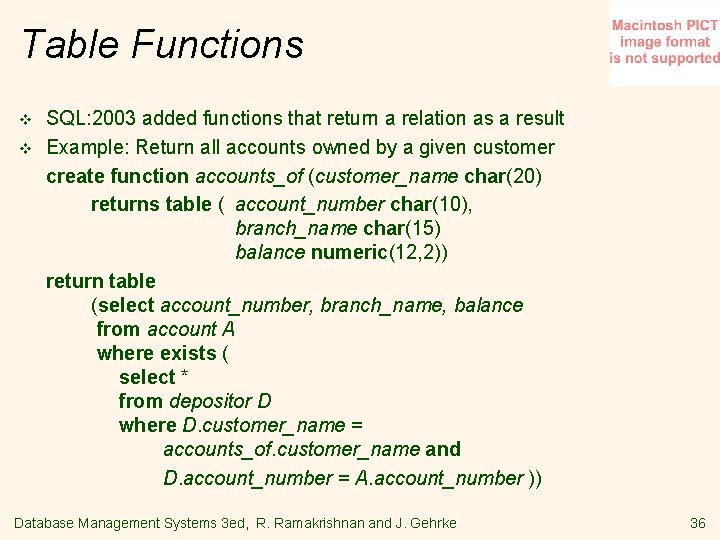
Table Functions v v SQL: 2003 added functions that return a relation as a result Example: Return all accounts owned by a given customer create function accounts_of (customer_name char(20) returns table ( account_number char(10), branch_name char(15) balance numeric(12, 2)) return table (select account_number, branch_name, balance from account A where exists ( select * from depositor D where D. customer_name = accounts_of. customer_name and D. account_number = A. account_number )) Database Management Systems 3 ed, R. Ramakrishnan and J. Gehrke 36
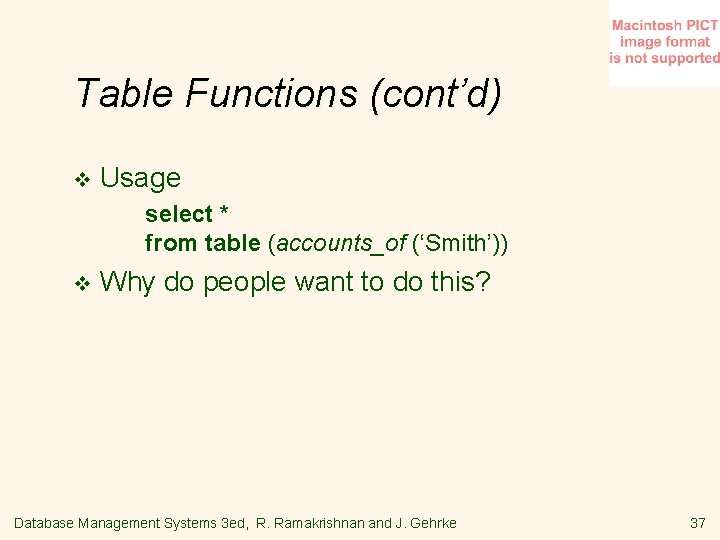
Table Functions (cont’d) v Usage select * from table (accounts_of (‘Smith’)) v Why do people want to do this? Database Management Systems 3 ed, R. Ramakrishnan and J. Gehrke 37
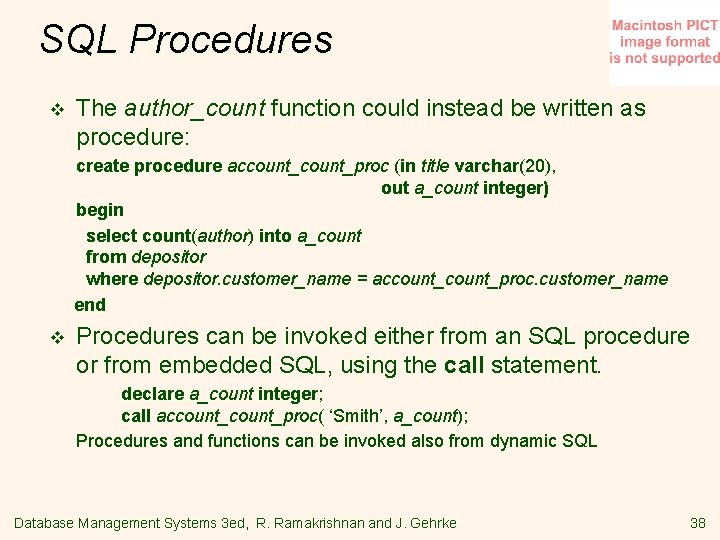
SQL Procedures v The author_count function could instead be written as procedure: create procedure account_proc (in title varchar(20), out a_count integer) begin select count(author) into a_count from depositor where depositor. customer_name = account_proc. customer_name end v Procedures can be invoked either from an SQL procedure or from embedded SQL, using the call statement. declare a_count integer; call account_proc( ‘Smith’, a_count); Procedures and functions can be invoked also from dynamic SQL Database Management Systems 3 ed, R. Ramakrishnan and J. Gehrke 38
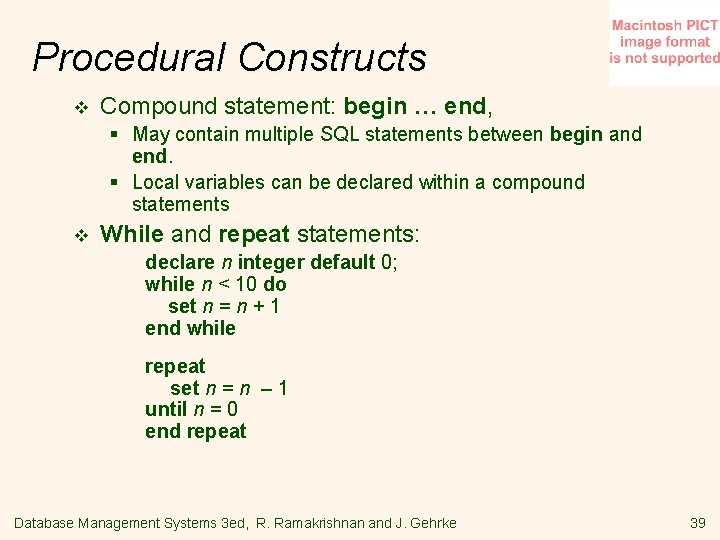
Procedural Constructs v Compound statement: begin … end, § May contain multiple SQL statements between begin and end. § Local variables can be declared within a compound statements v While and repeat statements: declare n integer default 0; while n < 10 do set n = n + 1 end while repeat set n = n – 1 until n = 0 end repeat Database Management Systems 3 ed, R. Ramakrishnan and J. Gehrke 39
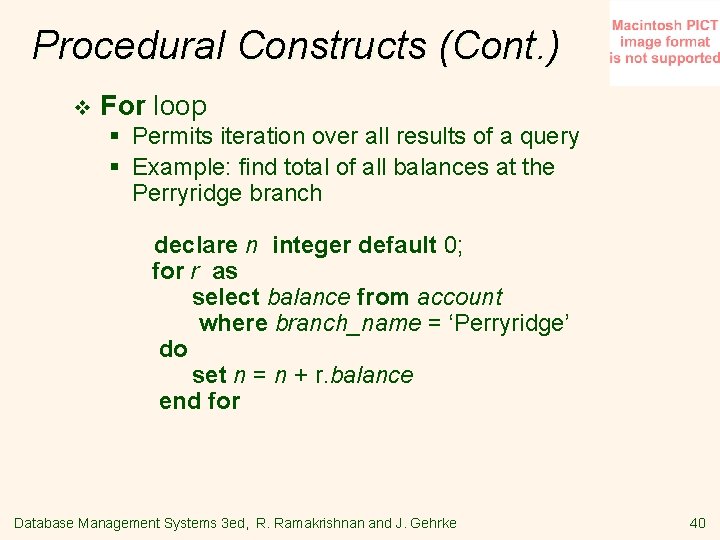
Procedural Constructs (Cont. ) v For loop § Permits iteration over all results of a query § Example: find total of all balances at the Perryridge branch declare n integer default 0; for r as select balance from account where branch_name = ‘Perryridge’ do set n = n + r. balance end for Database Management Systems 3 ed, R. Ramakrishnan and J. Gehrke 40
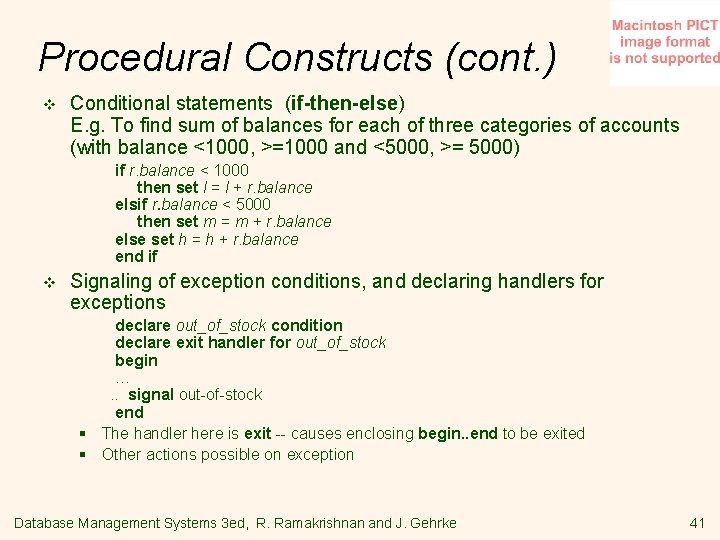
Procedural Constructs (cont. ) v Conditional statements (if-then-else) E. g. To find sum of balances for each of three categories of accounts (with balance <1000, >=1000 and <5000, >= 5000) if r. balance < 1000 then set l = l + r. balance elsif r. balance < 5000 then set m = m + r. balance else set h = h + r. balance end if v Signaling of exception conditions, and declaring handlers for exceptions declare out_of_stock condition declare exit handler for out_of_stock begin …. . signal out-of-stock end § The handler here is exit -- causes enclosing begin. . end to be exited § Other actions possible on exception Database Management Systems 3 ed, R. Ramakrishnan and J. Gehrke 41
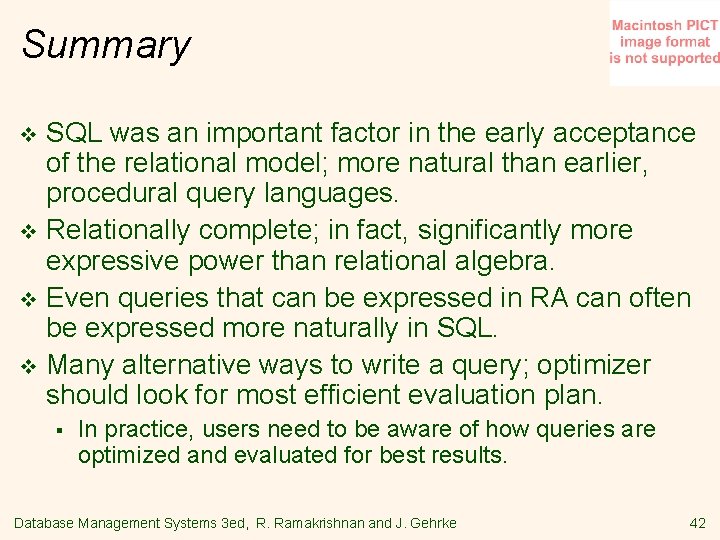
Summary SQL was an important factor in the early acceptance of the relational model; more natural than earlier, procedural query languages. v Relationally complete; in fact, significantly more expressive power than relational algebra. v Even queries that can be expressed in RA can often be expressed more naturally in SQL. v Many alternative ways to write a query; optimizer should look for most efficient evaluation plan. v § In practice, users need to be aware of how queries are optimized and evaluated for best results. Database Management Systems 3 ed, R. Ramakrishnan and J. Gehrke 42
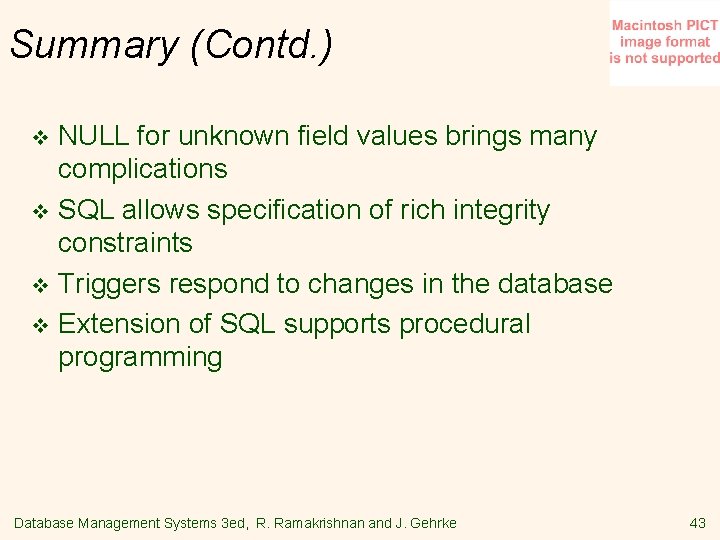
Summary (Contd. ) NULL for unknown field values brings many complications v SQL allows specification of rich integrity constraints v Triggers respond to changes in the database v Extension of SQL supports procedural programming v Database Management Systems 3 ed, R. Ramakrishnan and J. Gehrke 43
- Slides: 43