
SPS Upgrade plan and coating requirements AEC 09
- Slides: 23
SPS Upgrade plan and coating requirements AEC’ 09: anti e-cloud coating workshop 2009 (ACCNET) E. Shaposhnikova (CERN/BE/RF) for SPSU Study Team • SPS upgrade plan • e-cloud issues • coating requirements
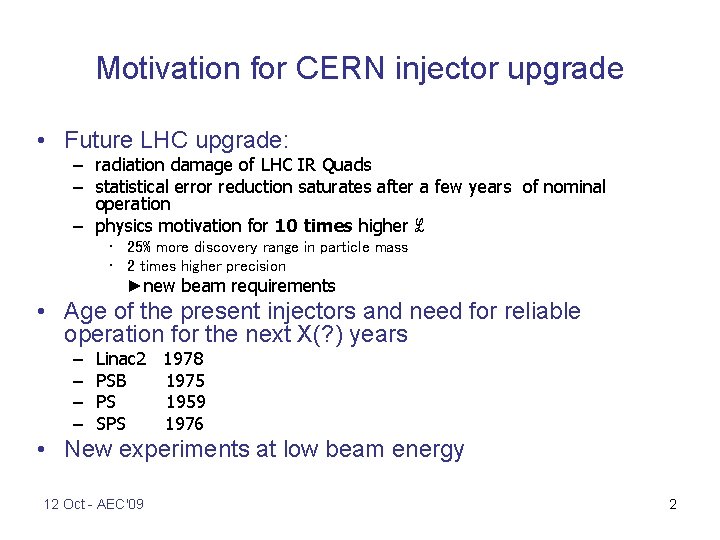
Motivation for CERN injector upgrade • Future LHC upgrade: – radiation damage of LHC IR Quads – statistical error reduction saturates after a few years of nominal operation – physics motivation for 10 times higher ℒ • 25% more discovery range in particle mass • 2 times higher precision ►new beam requirements • Age of the present injectors and need for reliable operation for the next X(? ) years – – Linac 2 1978 PSB 1975 PS 1959 SPS 1976 • New experiments at low beam energy 12 Oct - AEC'09 2
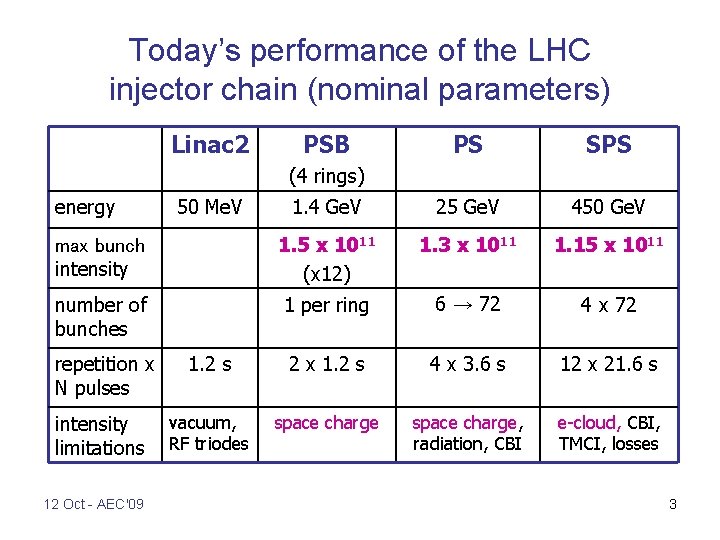
Today’s performance of the LHC injector chain (nominal parameters) Linac 2 PSB PS SPS 1. 4 Ge. V 25 Ge. V 450 Ge. V max bunch intensity 1. 5 x 10¹¹ (x 12) 1. 3 x 10¹¹ 1. 15 x 1011 number of bunches 1 per ring 6 → 72 4 x 72 (4 rings) energy 50 Me. V repetition x N pulses 1. 2 s 2 x 1. 2 s 4 x 3. 6 s 12 x 21. 6 s intensity limitations vacuum, RF triodes space charge, radiation, CBI e-cloud, CBI, TMCI, losses 12 Oct - AEC'09 3
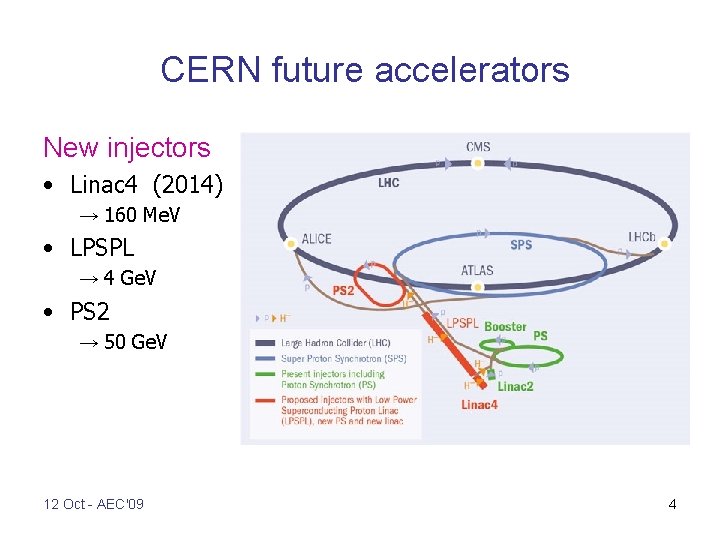
CERN future accelerators New injectors • Linac 4 (2014) → 160 Me. V • LPSPL → 4 Ge. V • PS 2 → 50 Ge. V 12 Oct - AEC'09 4
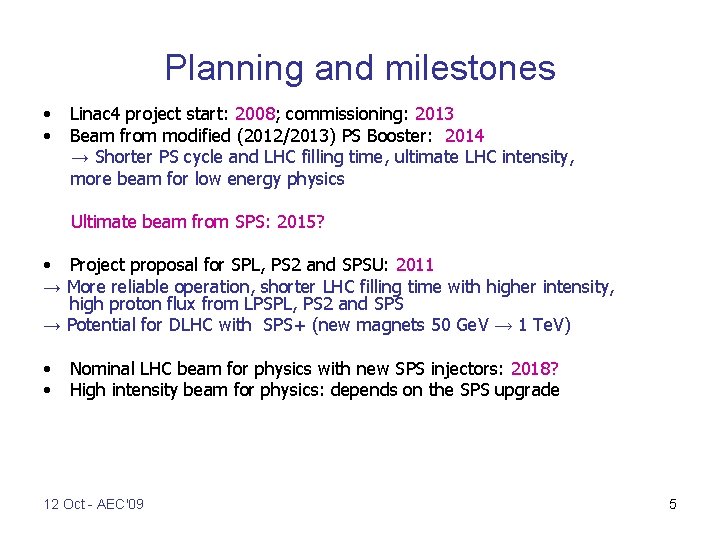
Planning and milestones • • Linac 4 project start: 2008; commissioning: 2013 Beam from modified (2012/2013) PS Booster: 2014 → Shorter PS cycle and LHC filling time, ultimate LHC intensity, more beam for low energy physics Ultimate beam from SPS: 2015? • Project proposal for SPL, PS 2 and SPSU: 2011 → More reliable operation, shorter LHC filling time with higher intensity, high proton flux from LPSPL, PS 2 and SPS → Potential for DLHC with SPS+ (new magnets 50 Ge. V → 1 Te. V) • • Nominal LHC beam for physics with new SPS injectors: 2018? High intensity beam for physics: depends on the SPS upgrade 12 Oct - AEC'09 5
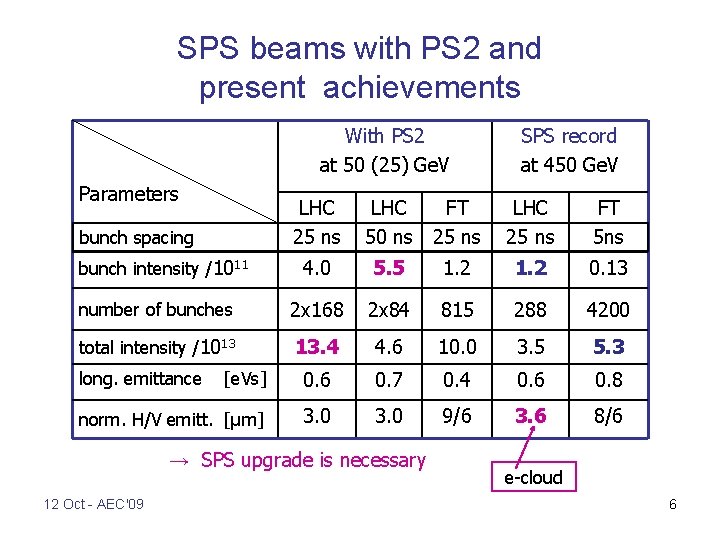
SPS beams with PS 2 and present achievements With PS 2 at 50 (25) Ge. V Parameters SPS record at 450 Ge. V LHC 25 ns LHC 50 ns FT 25 ns LHC 25 ns FT 5 ns 4. 0 5. 5 1. 2 0. 13 number of bunches 2 x 168 2 x 84 815 288 4200 total intensity /1013 13. 4 4. 6 10. 0 3. 5 5. 3 [e. Vs] 0. 6 0. 7 0. 4 0. 6 0. 8 norm. H/V emitt. [μm] 3. 0 9/6 3. 6 8/6 bunch spacing bunch intensity /1011 long. emittance → SPS upgrade is necessary 12 Oct - AEC'09 e-cloud 6
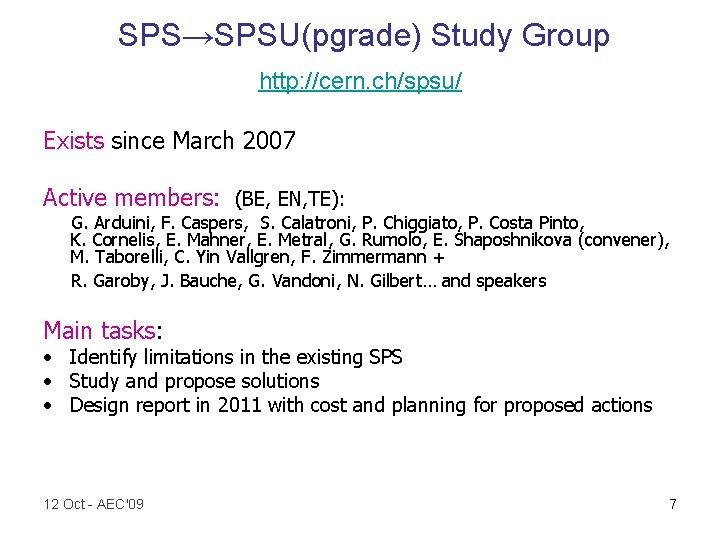
SPS→SPSU(pgrade) Study Group http: //cern. ch/spsu/ Exists since March 2007 Active members: (BE, EN, TE): G. Arduini, F. Caspers, S. Calatroni, P. Chiggiato, P. Costa Pinto, K. Cornelis, E. Mahner, E. Metral, G. Rumolo, E. Shaposhnikova (convener), M. Taborelli, C. Yin Vallgren, F. Zimmermann + R. Garoby, J. Bauche, G. Vandoni, N. Gilbert… and speakers Main tasks: • Identify limitations in the existing SPS • Study and propose solutions • Design report in 2011 with cost and planning for proposed actions 12 Oct - AEC'09 7
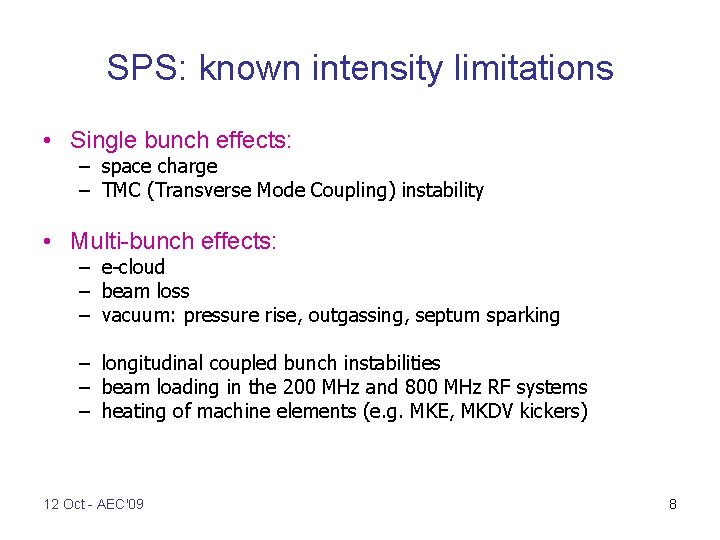
SPS: known intensity limitations • Single bunch effects: – space charge – TMC (Transverse Mode Coupling) instability • Multi-bunch effects: – e-cloud – beam loss – vacuum: pressure rise, outgassing, septum sparking – longitudinal coupled bunch instabilities – beam loading in the 200 MHz and 800 MHz RF systems – heating of machine elements (e. g. MKE, MKDV kickers) 12 Oct - AEC'09 8
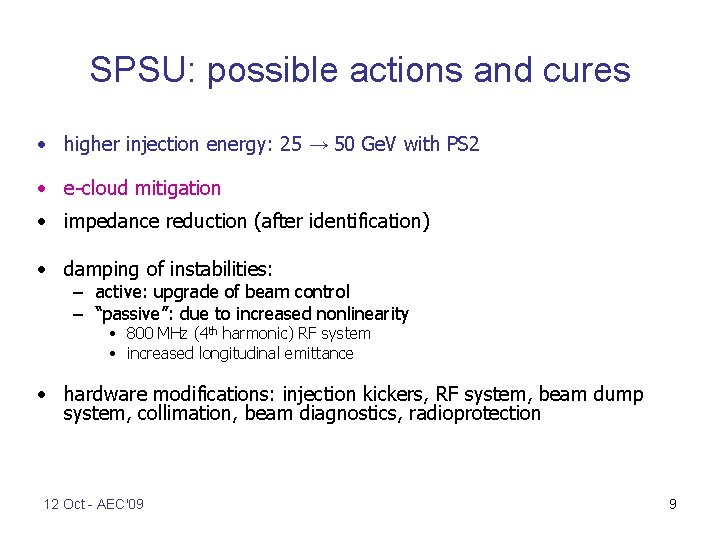
SPSU: possible actions and cures • higher injection energy: 25 → 50 Ge. V with PS 2 • e-cloud mitigation • impedance reduction (after identification) • damping of instabilities: – active: upgrade of beam control – “passive”: due to increased nonlinearity • 800 MHz (4 th harmonic) RF system • increased longitudinal emittance • hardware modifications: injection kickers, RF system, beam dump system, collimation, beam diagnostics, radioprotection 12 Oct - AEC'09 9
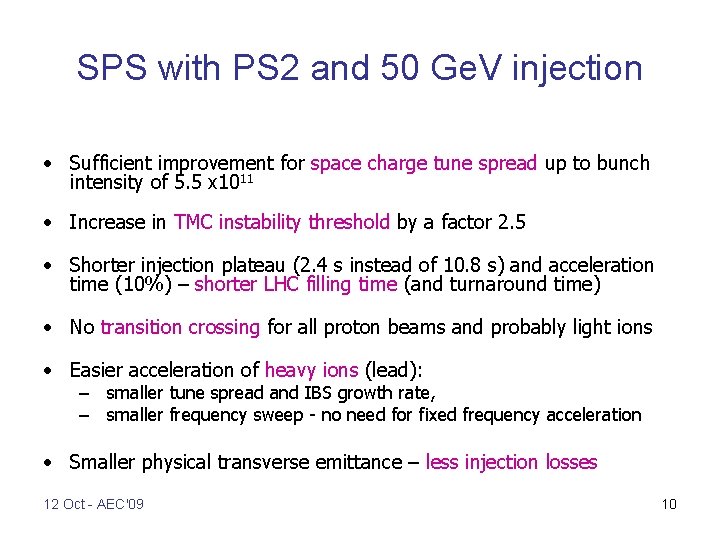
SPS with PS 2 and 50 Ge. V injection • Sufficient improvement for space charge tune spread up to bunch intensity of 5. 5 x 10¹¹ • Increase in TMC instability threshold by a factor 2. 5 • Shorter injection plateau (2. 4 s instead of 10. 8 s) and acceleration time (10%) – shorter LHC filling time (and turnaround time) • No transition crossing for all proton beams and probably light ions • Easier acceleration of heavy ions (lead): – smaller tune spread and IBS growth rate, – smaller frequency sweep - no need for fixed frequency acceleration • Smaller physical transverse emittance – less injection losses 12 Oct - AEC'09 10
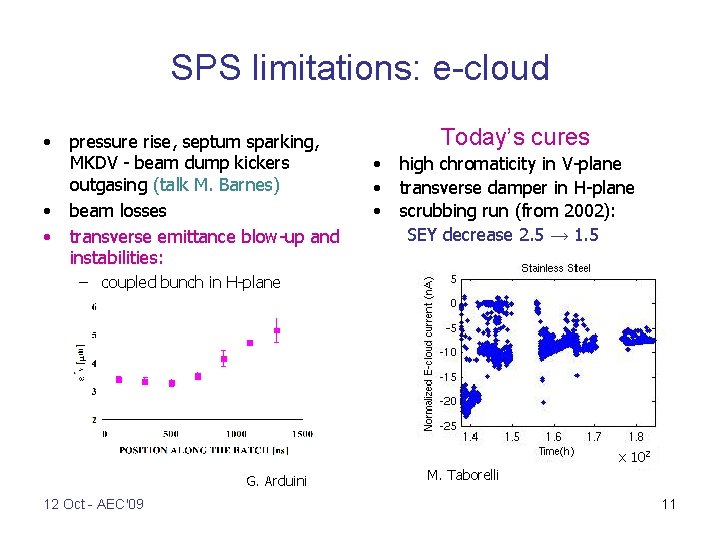
SPS limitations: e-cloud • • • pressure rise, septum sparking, MKDV - beam dump kickers outgasing (talk M. Barnes) beam losses transverse emittance blow-up and instabilities: Today’s cures • • • high chromaticity in V-plane transverse damper in H-plane scrubbing run (from 2002): SEY decrease 2. 5 → 1. 5 – coupled bunch in H-plane – single bunch in V-plane x 102 G. Arduini 12 Oct - AEC'09 M. Taborelli 11
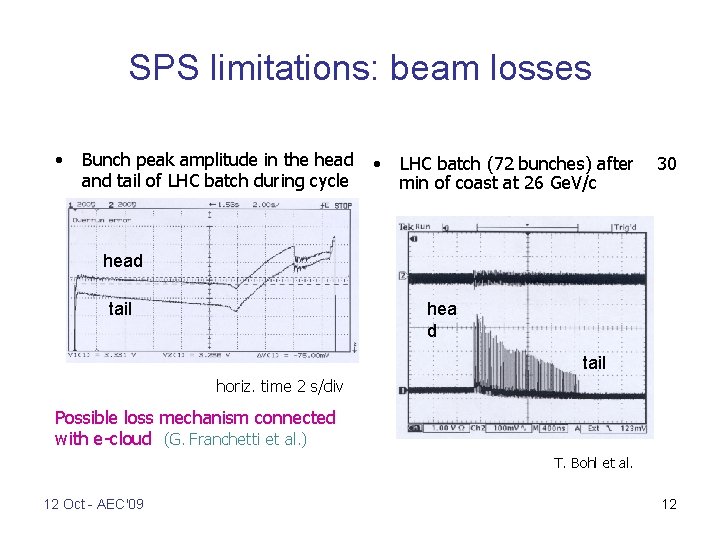
SPS limitations: beam losses • Bunch peak amplitude in the head and tail of LHC batch during cycle • LHC batch (72 bunches) after min of coast at 26 Ge. V/c 30 head tail hea d tail horiz. time 2 s/div Possible loss mechanism connected with e-cloud (G. Franchetti et al. ) T. Bohl et al. 12 Oct - AEC'09 12
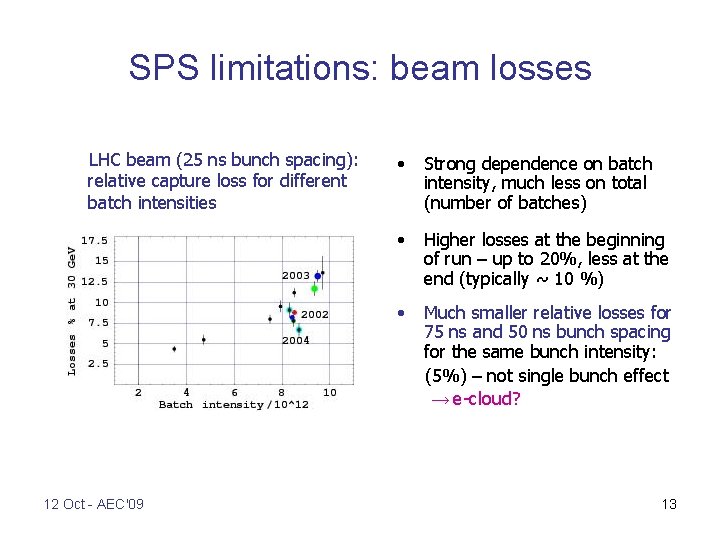
SPS limitations: beam losses LHC beam (25 ns bunch spacing): relative capture loss for different batch intensities 12 Oct - AEC'09 • Strong dependence on batch intensity, much less on total (number of batches) • Higher losses at the beginning of run – up to 20%, less at the end (typically ~ 10 %) • Much smaller relative losses for 75 ns and 50 ns bunch spacing for the same bunch intensity: (5%) – not single bunch effect → e-cloud? 13
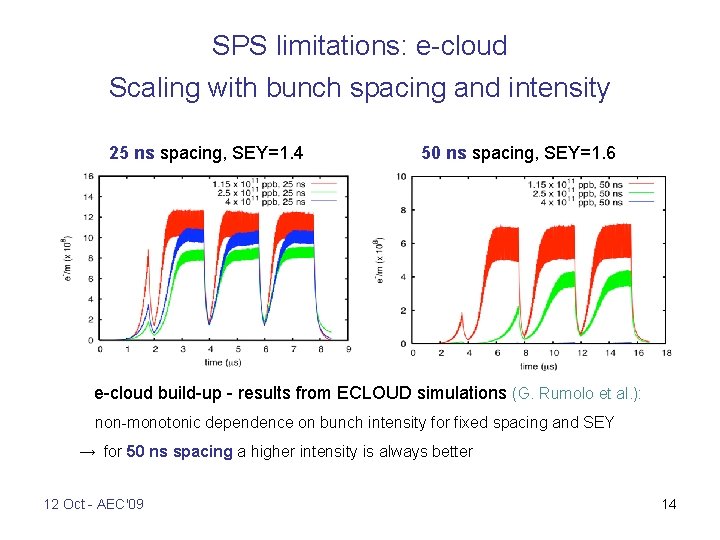
SPS limitations: e-cloud Scaling with bunch spacing and intensity 25 ns spacing, SEY=1. 4 50 ns spacing, SEY=1. 6 e-cloud build-up - results from ECLOUD simulations (G. Rumolo et al. ): non-monotonic dependence on bunch intensity for fixed spacing and SEY → for 50 ns spacing a higher intensity is always better 12 Oct - AEC'09 14
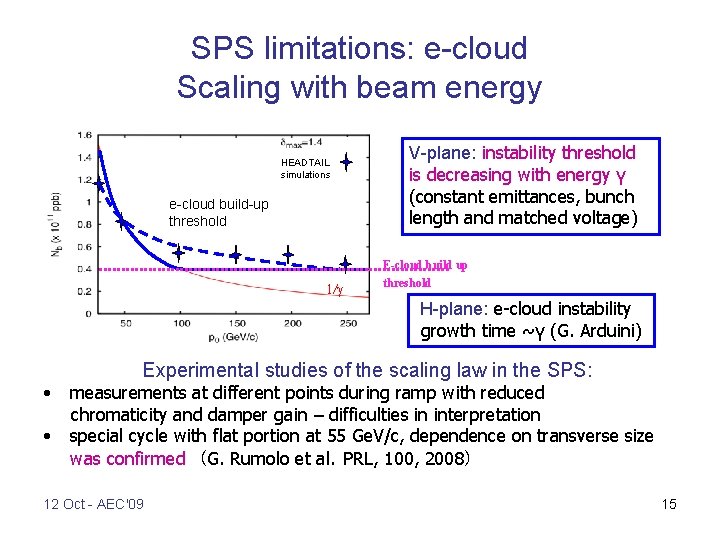
SPS limitations: e-cloud Scaling with beam energy HEADTAIL simulations e-cloud build-up threshold 1/g V-plane: instability threshold is decreasing with energy γ (constant emittances, bunch length and matched voltage) E-cloud build up threshold H-plane: e-cloud instability growth time ~γ (G. Arduini) • • Experimental studies of the scaling law in the SPS: measurements at different points during ramp with reduced chromaticity and damper gain – difficulties in interpretation special cycle with flat portion at 55 Ge. V/c, dependence on transverse size was confirmed (G. Rumolo et al. PRL, 100, 2008) 12 Oct - AEC'09 15
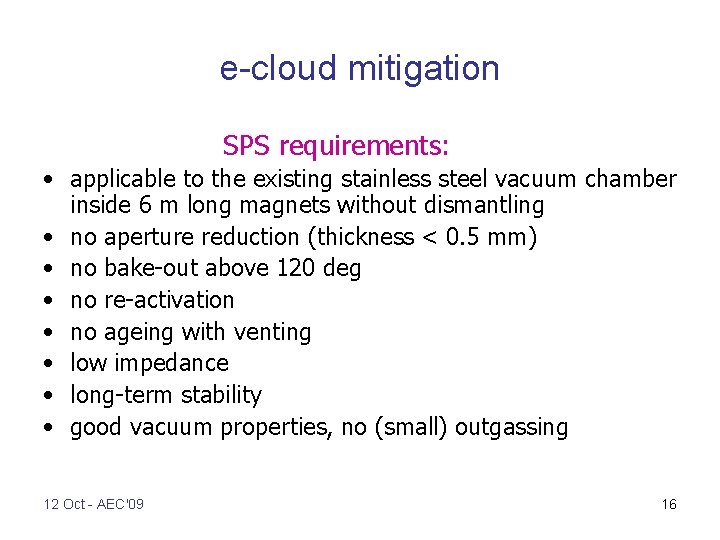
e-cloud mitigation SPS requirements: • applicable to the existing stainless steel vacuum chamber inside 6 m long magnets without dismantling • no aperture reduction (thickness < 0. 5 mm) • no bake-out above 120 deg • no re-activation • no ageing with venting • low impedance • long-term stability • good vacuum properties, no (small) outgassing 12 Oct - AEC'09 16
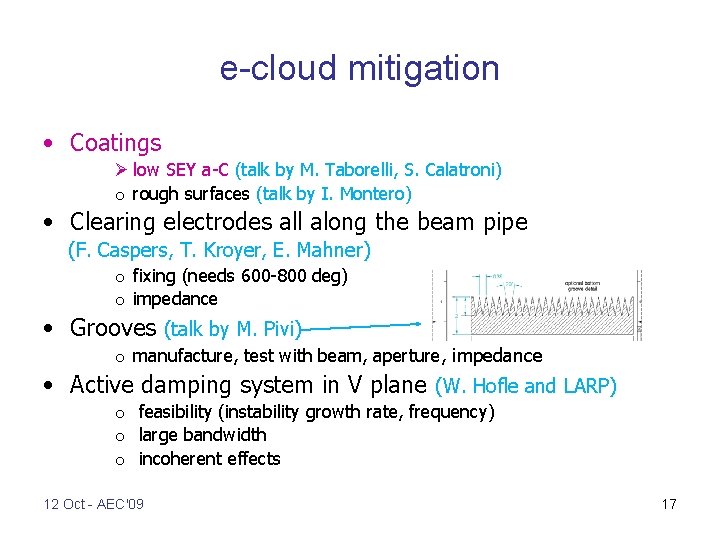
e-cloud mitigation • Coatings Ø low SEY a-C (talk by M. Taborelli, S. Calatroni) o rough surfaces (talk by I. Montero) • Clearing electrodes all along the beam pipe (F. Caspers, T. Kroyer, E. Mahner) o fixing (needs 600 -800 deg) o impedance • Grooves (talk by M. Pivi) o manufacture, test with beam, aperture, impedance • Active damping system in V plane (W. Hofle and LARP) o feasibility (instability growth rate, frequency) o large bandwidth o incoherent effects 12 Oct - AEC'09 17
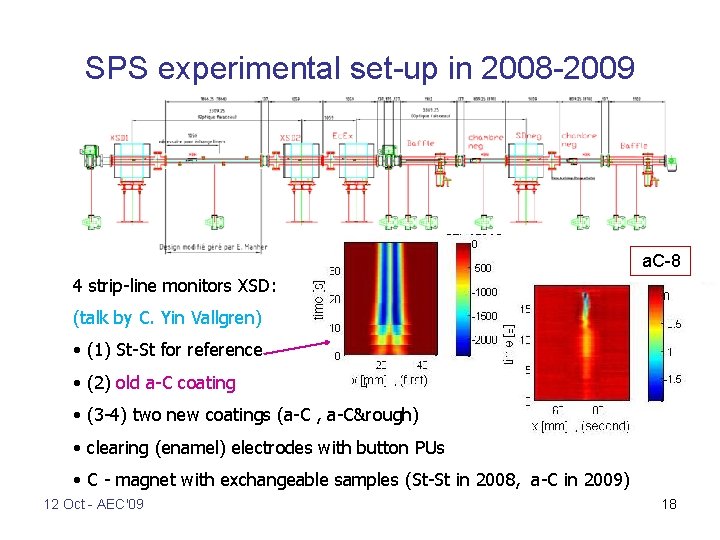
SPS experimental set-up in 2008 -2009 a. C-8 4 strip-line monitors XSD: (talk by C. Yin Vallgren) • (1) St-St for reference • (2) old a-C coating • (3 -4) two new coatings (a-C , a-C&rough) • clearing (enamel) electrodes with button PUs • C - magnet with exchangeable samples (St-St in 2008, a-C in 2009) 12 Oct - AEC'09 18
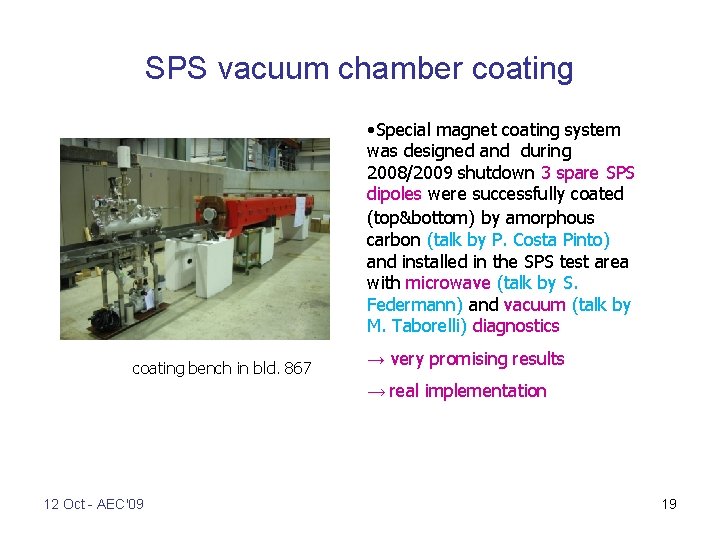
SPS vacuum chamber coating • Special magnet coating system was designed and during 2008/2009 shutdown 3 spare SPS dipoles were successfully coated (top&bottom) by amorphous carbon (talk by P. Costa Pinto) and installed in the SPS test area with microwave (talk by S. Federmann) and vacuum (talk by M. Taborelli) diagnostics coating bench in bld. 867 → very promising results → real implementation 12 Oct - AEC'09 19
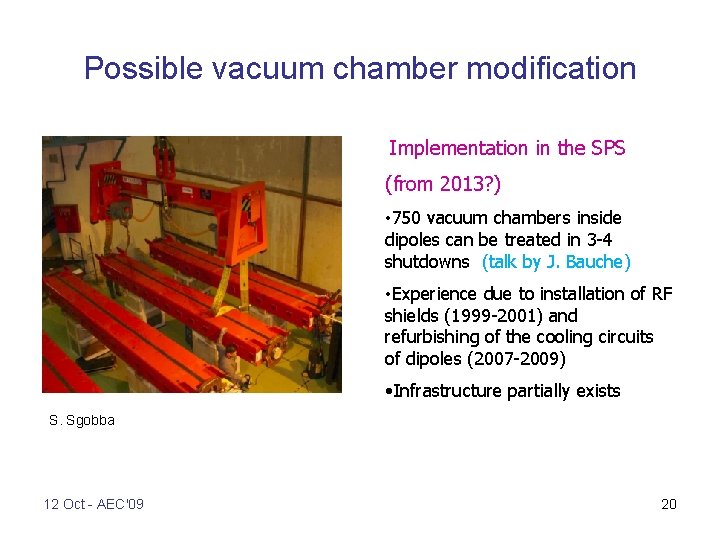
Possible vacuum chamber modification Implementation in the SPS (from 2013? ) • 750 vacuum chambers inside dipoles can be treated in 3 -4 shutdowns (talk by J. Bauche) • Experience due to installation of RF shields (1999 -2001) and refurbishing of the cooling circuits of dipoles (2007 -2009) • Infrastructure partially exists S. Sgobba 12 Oct - AEC'09 20
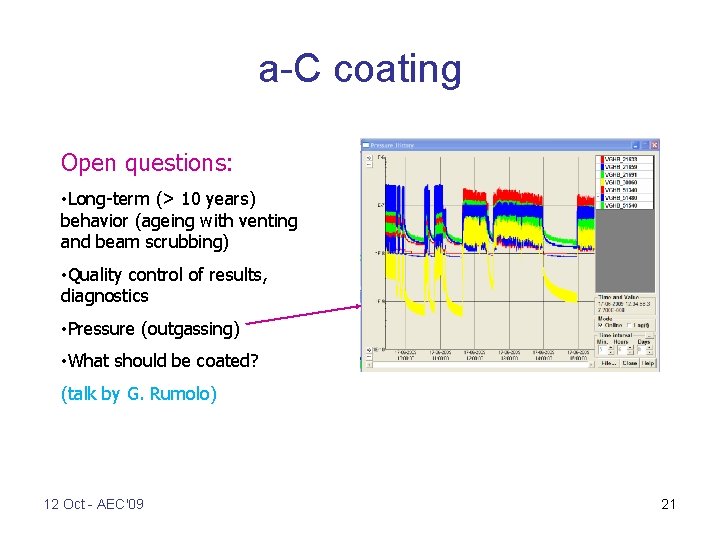
a-C coating Open questions: • Long-term (> 10 years) behavior (ageing with venting and beam scrubbing) • Quality control of results, diagnostics • Pressure (outgassing) • What should be coated? (talk by G. Rumolo) 12 Oct - AEC'09 21
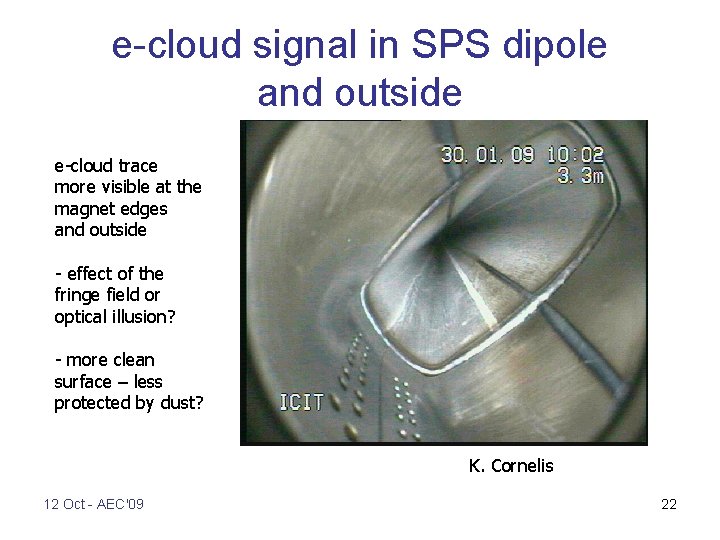
e-cloud signal in SPS dipole and outside e-cloud trace more visible at the magnet edges and outside - effect of the fringe field or optical illusion? - more clean surface – less protected by dust? K. Cornelis 12 Oct - AEC'09 22
Summary • In the present CERN upgrade scenario (under discussion) all machines in the LHC injector chain will be replaced by new ones except the SPS, which will have a higher injection energy • The SPS upgrade is a key element for the LHC to benefit fully from new upstream machines • E-cloud is one of the main SPS limitations even for the present performance and it will not be improved at higher injection energy • At the moment amorphous carbon coating seems to be the most promising solution for e-cloud mitigation in the SPS and can be implemented earlier (from 2013? ) to improve machine performance for nominal and ultimate LHC beams 12 Oct - AEC'09 23