
Spring 2020 Virtual AEC Qatar University Foundation Program
- Slides: 22
Spring 2020 / Virtual AEC Qatar University – Foundation Program May 13, 2020 Intercultural communication: Teaching and Learning Pragmatics Using Movies Zohreh R. Eslami Professor, Texas A&M University
Pragmatic and Sociolinguistic Rules of Language Use Language that is appropriate to situation Possibility of communication failure based on cultural differences (Thomas 1983, Wolfson, 1989) Scientific study of communication and miscommunication across cultures holds much promise in terms of language learning and intercultural communication
Authentic Language Use Inadequacy of textbooks (Vallegna, 2004, Bardovi-Harlig et al. 1991) Film has great potential as a source for both research and teaching (Rose, 1997)
Food Offerings: My Big Greek Wedding: 55: 40 Voula: Here, eat some rice. Toula: I don’t want any rice, I am good. Voula: No, ‘I’m good. ” I could snap you like a chicken. 1: 00: 30 Maria: Ian, are you hungry? Ian: No, I’ve already eaten. Maria: Ok, I will make you something. …… Ian, eat.
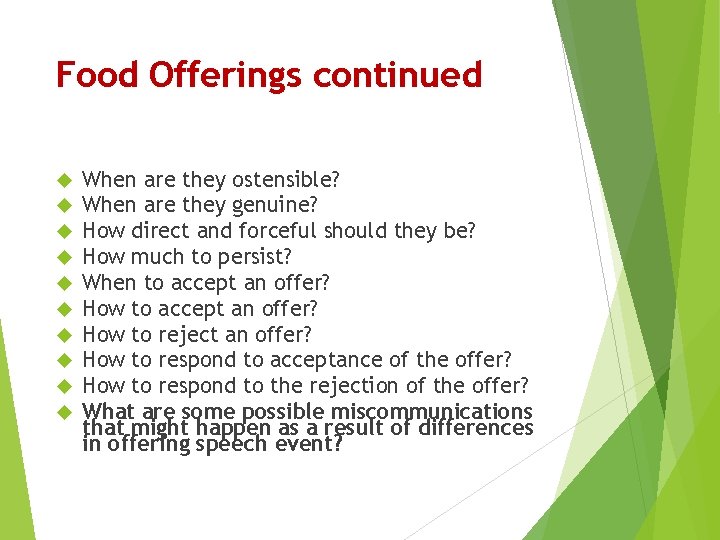
Food Offerings continued When are they ostensible? When are they genuine? How direct and forceful should they be? How much to persist? When to accept an offer? How to reject an offer? How to respond to acceptance of the offer? How to respond to the rejection of the offer? What are some possible miscommunications that might happen as a result of differences in offering speech event?
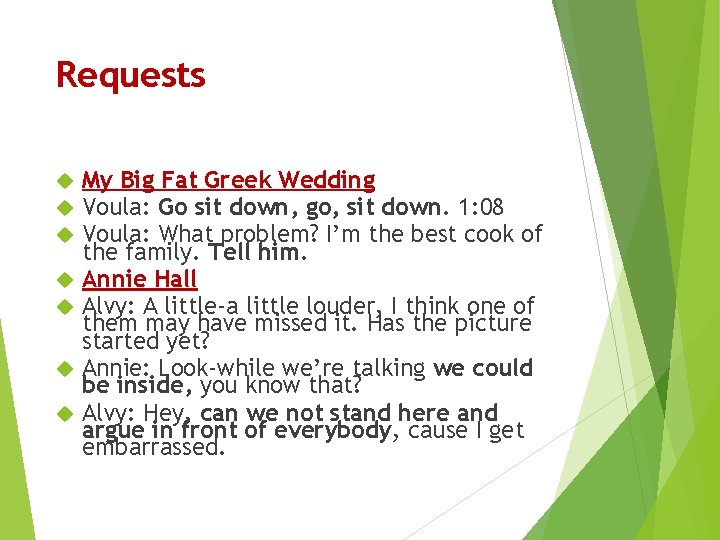
Requests My Big Fat Greek Wedding Voula: Go sit down, go, sit down. 1: 08 Voula: What problem? I’m the best cook of the family. Tell him. Annie Hall Alvy: A little-a little louder, I think one of them may have missed it. Has the picture started yet? Annie: Look-while we’re talking we could be inside, you know that? Alvy: Hey, can we not stand here and argue in front of everybody, cause I get embarrassed.
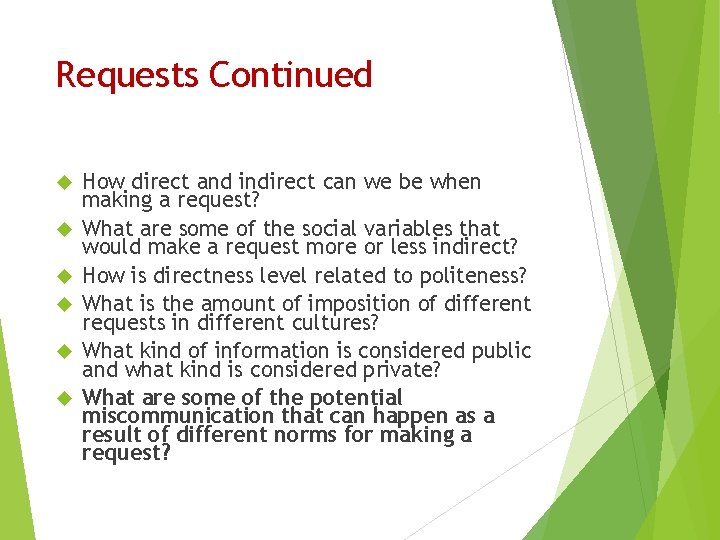
Requests Continued How direct and indirect can we be when making a request? What are some of the social variables that would make a request more or less indirect? How is directness level related to politeness? What is the amount of imposition of different requests in different cultures? What kind of information is considered public and what kind is considered private? What are some of the potential miscommunication that can happen as a result of different norms for making a request?
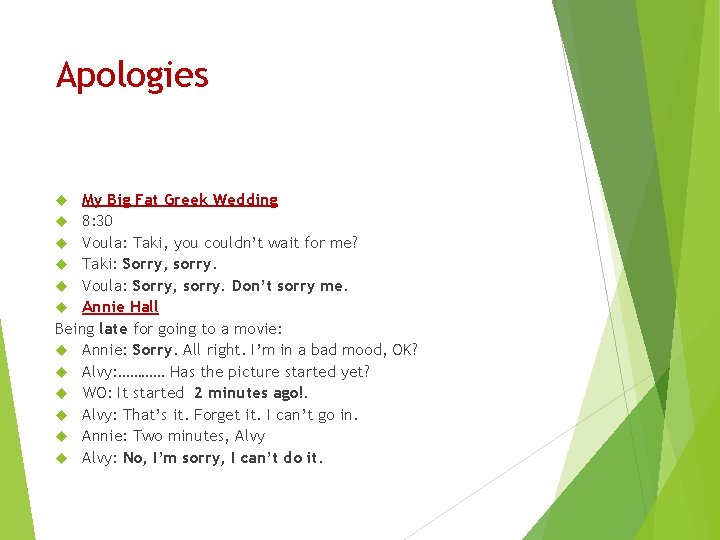
Apologies My Big Fat Greek Wedding 8: 30 Voula: Taki, you couldn’t wait for me? Taki: Sorry, sorry. Voula: Sorry, sorry. Don’t sorry me. Annie Hall Being late for going to a movie: Annie: Sorry. All right. I’m in a bad mood, OK? Alvy: ………… Has the picture started yet? WO: It started 2 minutes ago!. Alvy: That’s it. Forget it. I can’t go in. Annie: Two minutes, Alvy: No, I’m sorry, I can’t do it.
Apologies Continued When do you apologize? How do you apologize? To whom do you apologize? What are the variables affecting the use of apology and degree of its intensity? What are some of the potential miscommunications that can result because of different norms?
Compliment and Compliment Response My Big Fat Greek Wedding 13: 20 Ian: Cool place. Ian’s friend: Yeah. Adorable. Annie Hall ALVY : You-you play. . . very well. ANNIE: Oh, yeah? So do you. Oh, God, whatta(Making sounds and laughing) whatta dumb thing to say, right? I mean, you say it, "You play well, " and right away. . . I have to say well. Oh, oh. . . God, Annie. (She gestures with her hand) well. . . oh, well. . . la-de-da, la-la.
Compliments Continued ANNIE: I was awful. I'm so ashamed! I can't sing. ALVY: Oh, listen, so the audience was a tad restless. ANNIE: Whatta you mean, a tad restless? Oh, my God, I mean, they hated me. ALVY: No, they didn't. You have a wonderful voice. ANNIE: No, I'm gonna quit! Students mill around Alvy handing him pens and paper for autographs. Annie is next to him, talking over the chattering fans. ANNIE: Alvy, you were. . . Alvy, you were just great, I'm not kidding. It was- You were so neat. ALVY: C-c-coll- College audiences are so wonderful. TONY: I though it was. . . very musical, and I liked it a lot. ANNIE: Oh, neat. . . oh, that's very nice, gosh, thanks a lot.
Compliments Continued When do you compliment someone? What can be the topic of compliment (possession, belonging, accomplishments, looks, appearances)? Is gender a variable to consider? Is power and relationship a variable to consider (Bossemployee, teacher-student, friend-friend)?
Compliment Responses Acceptance (Thanks), agreement (I like it, too), disagreement (No, it’s not really that nice), self-praise avoidance (Anyone can do this), return compliment (You look good, too), and comment history (My mother gave it to me). What are some of the potential miscommunications that can result because of different norms?
IC and Pragmatics: Example Pragmatic language use § What a lovely baby you have! – Thanks. § She is an angel. – But she looks like a monkey, doesn’t she? Underlining cultural themes § Gracefully accepting compliments § In-group vs. out-group distinction, avoidance of self-praise (Mizutani, 1986; Pomerantz, 1978) § Compliments as solidarity builder vs. distance creator (Daikuhara, 1986)
Films as a Valuable Teaching Tool Big and small screen attraction Active, on-task viewing Provides opportunities to address all aspects of language use in a variety of contexts EFL contexts (relative lack of native speakers) Can be used with a variety of teaching approaches (inductive, deductive, explicit, implicit)
Eating Rituals Annie Hall: Woody Allen goes to a family dinner at his girlfriend’s mother’s house, and compares it to his own family dinners. We see a split-screen shot of each family’s interaction. My Stepmother is an Alien: Kim Basinger decides to make breakfast for her new family. She does not know which foods are typically eaten for breakfast, though, and makes several inappropriate dishes such as hamburgers and martinis. The Joy Luck Club: Waverly brings her fiancé to a family dinner for the first time. She’s nervous about the dinner because of the cultural differences, and has given him a crash-course in Chinese/Chinese-American etiquette; her fiancé, nonetheless, offends the family numerous times.
Cultural Identity Thunderheart The Milargo Beanfield War Babe Dances with Wolves
Gender Roles Dances with Wolves Jungle Fever My Big Fat Greek Wedding The Joy Luck Club
IC and Pragmatics: Application to Pedagogy Learners as ethnographers (Bardovi-Harlig, 1996; Eslami, 2005; Tarone & Yule, 1986; Roberts, Byram, Barro, Jordan, & Street, 2001; Wolfson, 1989) § Establishing questions § Creating hypotheses § Collecting and analyzing data § Reflecting and re-investigating
Conclusion: Going back to the Basics “It is not the responsibility of the language teacher qua linguist to enforce Anglo-Saxon standards of behaviour, linguistic or otherwise. Rather, it is the teacher’s job to equip the student to express her/himself in exactly the way s/he chooses to do so – rudely, tactfully, or in an elaborately polite manner. What we want to prevent is her/his being unintentionally rude or subservient. It may, of course, behoove the teacher to point out the likely consequences of certain types of linguistic behavior (emphasis hers, Thomas, 1983, p. 96). ”
Selected References Bardovi-Harlig, K. (1996). Pragmatics and language teaching: Bringing pragmatics and pedagogy together. In L. Bouton (Ed. ), Pragmatics and language learning (Vol. 7, pp. 21 -39). University of Illinois, Urbana-Campaign: Division of English as an International Language. Byram, M. , & Morgan, C. (1994). Teaching and learning language and culture. Clevedon, U. K. : Multilingual Matters. Daikuhara, M. (1986). A study of compliments from a cross-cultural perspective: Japanese vs. American English. Working Papers in Educational Linguistics, 2(2), 103 -134. Eslami-Rasekh, Z. (2005). Raising the pragmatic awareness of language learners. ELT Journal, 59(2), 199 -208. Holliday, A. , Hyde, M. , & Kellman, J. (2004). Intercultural communication: An advanced resource book. London: Routledge. Horibe, H. (2008). The place of culture in teaching English as an international language (eil). JALT Journal, 30(2), 241253. Ishihara, N. (in press). Teacher-based assessment foreign language pragmatics. TESOL Quarterly, 43(3). Ishihara, N. (in press, b). Teacher-based assessment foreign language pragmatics. TESOL Quarterly, 43(3). Ishihara, N. (under review). The pragmatics of identity negotiation: What is the relevance of native-speaker norms for L 2 use? Meier, A. J. (2003). Posting the banns: A marriage of pragmatics and culture in foreign and second language pedagogy and beyond. In A. Martinez, E. Uso & A. Femandez (Eds. ), Pragmatic competence and foreign language teaching. Castellon: Servicio de publicaciones de la Universidad Jaume I. Ohara, Y. , Saft, S. , & Crookes, G. (2001). Toward a feminist critical pedagogy in a beginning Japanese-as-a-foreignlanguage class. Japanese Language and Literature, 35(2), 105 -133. Pennycook, A. (2001). Critical applied linguistics: A critical introduction. Mahwah, NJ: Lawrence Erlbaum Associates. Roberts, C. , Byram, M. , Barro, A. , Jordan, S. , & Street, B. (2001). Language learners as ethnographers. Buffalo, N. Y. : Multilingual Matters. Siegal, M. , & Okamoto, S. (2003). Toward reconceptualizing the teaching and learning of gendered speech styles in Japanese as a foreign language. Japanese language and literature, 37(1), 49 -66. Spencer-Oatey, H. (2007). Theories of identity and the analysis of face. Journal of Pragmatics, 39(4), 639 -656. Thomas, J. (1983). Cross-cultural pragmatic failure. Applied linguistics, 4(2), 91 -109.