
SPRING 2015 BIOLOGY COLLOQUIUM MARSHAK ROOM 801 1
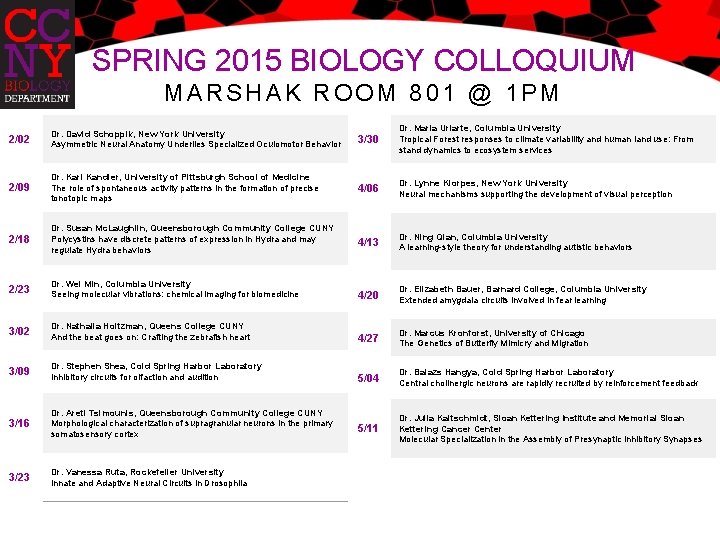
SPRING 2015 BIOLOGY COLLOQUIUM MARSHAK ROOM 801 @ 1 PM 2/02 Dr. David Schoppik, New York University Asymmetric Neural Anatomy Underlies Specialized Oculomotor Behavior 3/30 Dr. Maria Uriarte, Columbia University Tropical Forest responses to climate variability and human land use: From stand dynamics to ecosystem services 2/09 Dr. Karl Kandler, University of Pittsburgh School of Medicine The role of spontaneous activity patterns in the formation of precise tonotop. Ic maps 4/06 Dr. Lynne Kiorpes, New York University Neural mechanisms supporting the development of visual perception 2/18 Dr. Susan Mc. Laughlin, Queensborough Community College CUNY Polycystins have discrete patterns of expression in Hydra and may regulate Hydra behaviors 4/13 Dr. Ning Qian, Columbia University A learning-style theory for understanding autistic behaviors 2/23 Dr. Wei Min, Columbia University Seeing molecular vibrations: chemical imaging for biomedicine 4/20 Dr. Elizabeth Bauer, Barnard College, Columbia University Extended amygdala circuits involved in fear learning 3/02 Dr. Nathalia Holtzman, Queens College CUNY And the beat goes on: Crafting the zebrafish heart 4/27 Dr. Marcus Kronforst, University of Chicago The Genetics of Butterfly Mimicry and Migration 3/09 Dr. Stephen Shea, Cold Spring Harbor Laboratory Inhibitory circuits for olfaction and audition 5/04 Dr. Balazs Hangya, Cold Spring Harbor Laboratory Central cholinergic neurons are rapidly recruited by reinforcement feedback 3/16 Dr. Areti Tsimounis, Queensborough Community College CUNY Morphological characterization of supragranular neurons in the primary somatosensory cortex 5/11 Dr. Julia Kaltschmidt, Sloan Kettering Institute and Memorial Sloan Kettering Cancer Center Molecular Specialization in the Assembly of Presynaptic Inhibitory Synapses 3/23 Dr. Vanessa Ruta, Rockefeller University Innate and Adaptive Neural Circuits in Drosophila
- Slides: 1