
Spring 2009 CS 155 Access Control and Operating
![Access control matrix [Lampson] Objects File 1 Subjects File 2 File 3 … File](https://slidetodoc.com/presentation_image/a41f0dbca15fec1f45ae60d8234328e1/image-8.jpg "Access control matrix [Lampson] Objects File 1 Subjects File 2 File 3 … File")

- Slides: 59
Spring 2009 CS 155 Access Control and Operating System Security John Mitchell
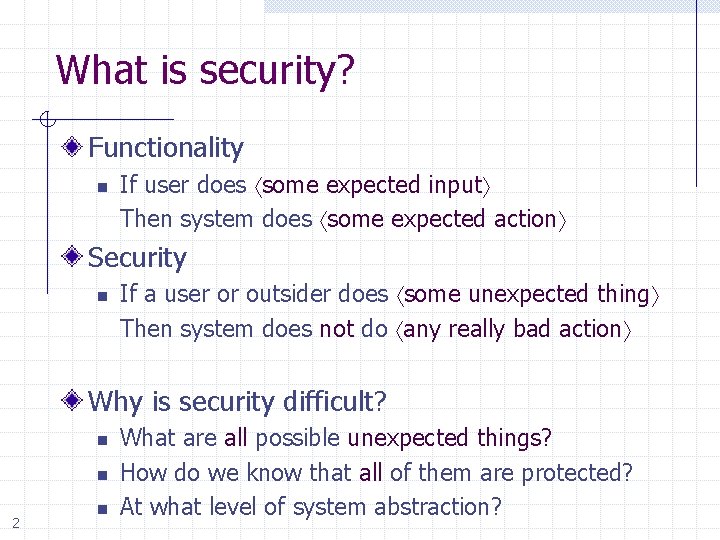
What is security? Functionality n If user does some expected input Then system does some expected action Security n If a user or outsider does some unexpected thing Then system does not do any really bad action Why is security difficult? n n 2 n What are all possible unexpected things? How do we know that all of them are protected? At what level of system abstraction?
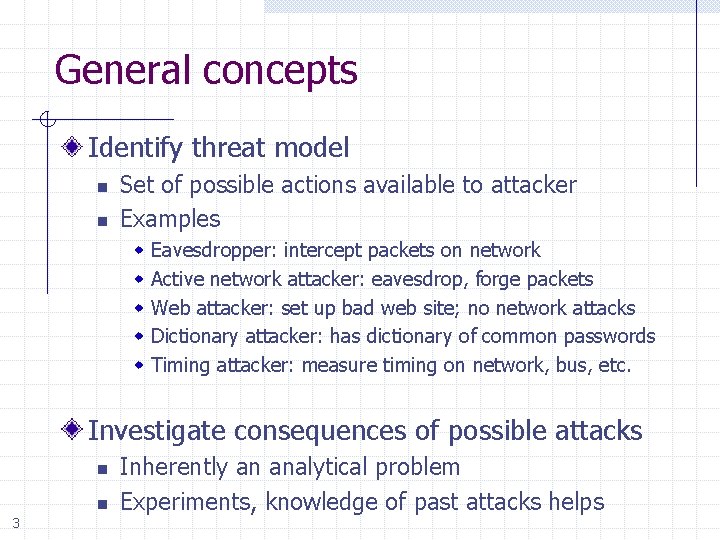
General concepts Identify threat model n n Set of possible actions available to attacker Examples w w w Eavesdropper: intercept packets on network Active network attacker: eavesdrop, forge packets Web attacker: set up bad web site; no network attacks Dictionary attacker: has dictionary of common passwords Timing attacker: measure timing on network, bus, etc. Investigate consequences of possible attacks n n 3 Inherently an analytical problem Experiments, knowledge of past attacks helps
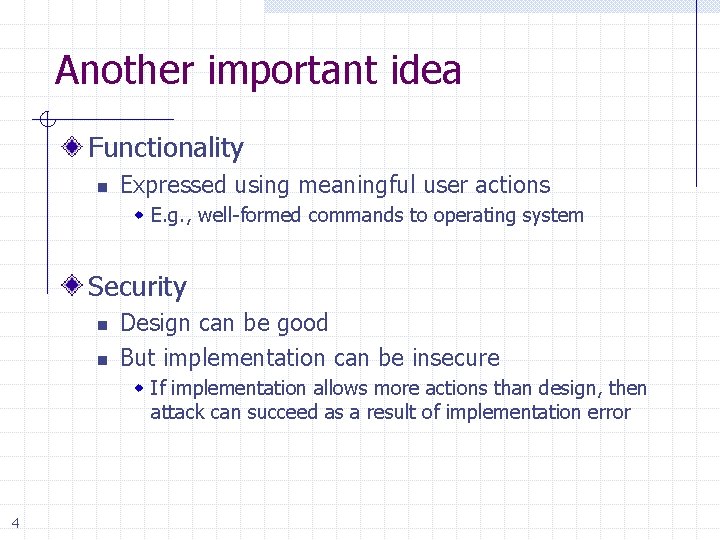
Another important idea Functionality n Expressed using meaningful user actions w E. g. , well-formed commands to operating system Security n n Design can be good But implementation can be insecure w If implementation allows more actions than design, then attack can succeed as a result of implementation error 4
This lecture Operating system security n Examples of design features meant to provide security w User gets access to resource only if policy allows it n 5 Next few lectures: implementation attacks
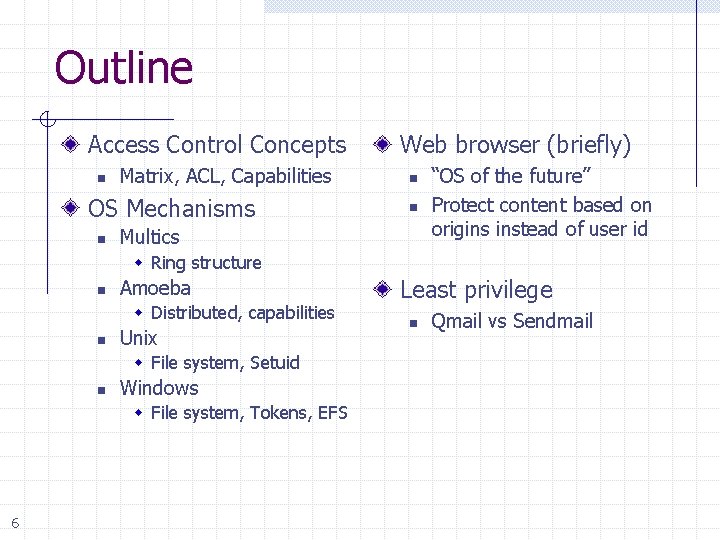
Outline Access Control Concepts n Matrix, ACL, Capabilities OS Mechanisms n Web browser (briefly) n n Multics “OS of the future” Protect content based on origins instead of user id w Ring structure n Amoeba w Distributed, capabilities n Unix w File system, Setuid n Windows w File system, Tokens, EFS 6 Least privilege n Qmail vs Sendmail
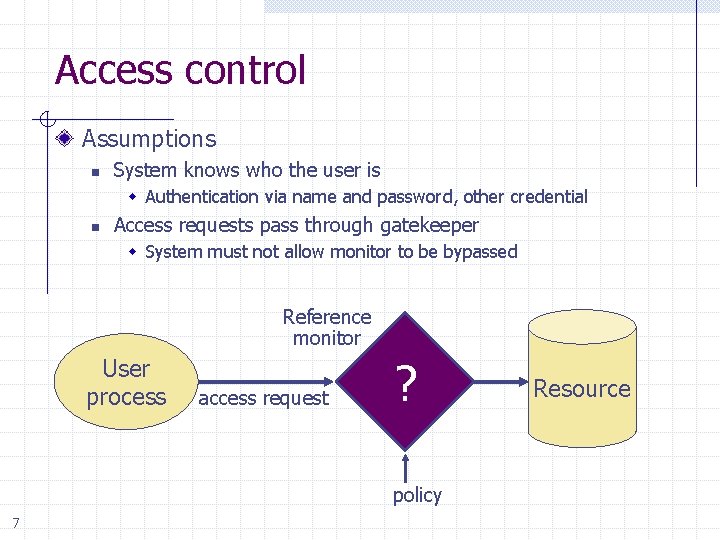
Access control Assumptions n System knows who the user is w Authentication via name and password, other credential n Access requests pass through gatekeeper w System must not allow monitor to be bypassed Reference monitor User process access request ? policy 7 Resource
Access control matrix [Lampson] Objects File 1 Subjects File 2 File 3 … File n User 1 read write - - read User 2 write - - User 3 - - - read write read … User m read 8
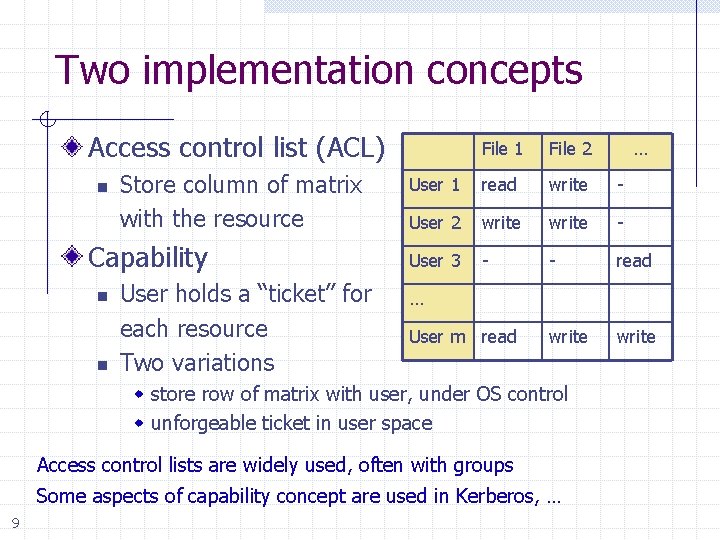
Two implementation concepts Access control list (ACL) n Store column of matrix with the resource Capability n n User holds a “ticket” for each resource Two variations File 1 File 2 User 1 read write - User 2 write - User 3 - - read write … User m read w store row of matrix with user, under OS control w unforgeable ticket in user space Access control lists are widely used, often with groups Some aspects of capability concept are used in Kerberos, … 9 …
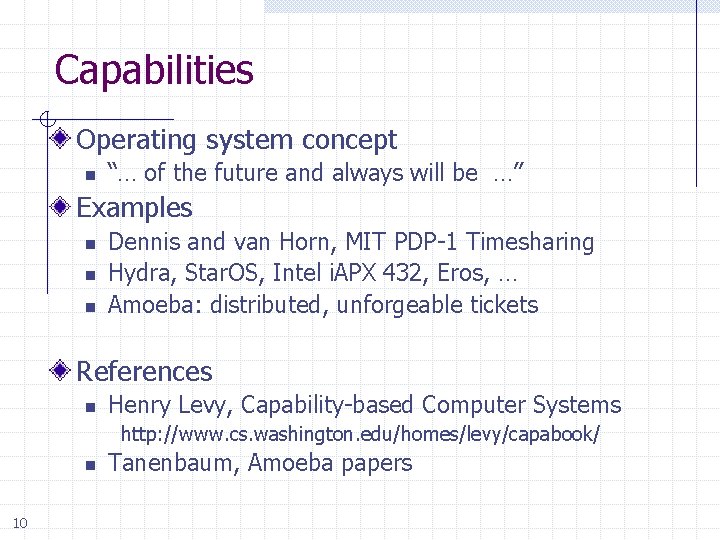
Capabilities Operating system concept n “… of the future and always will be …” Examples n n n Dennis and van Horn, MIT PDP-1 Timesharing Hydra, Star. OS, Intel i. APX 432, Eros, … Amoeba: distributed, unforgeable tickets References n Henry Levy, Capability-based Computer Systems http: //www. cs. washington. edu/homes/levy/capabook/ n 10 Tanenbaum, Amoeba papers
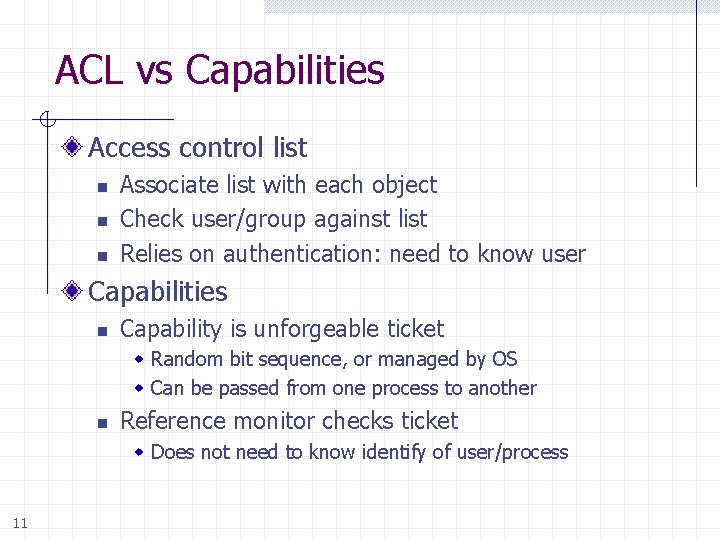
ACL vs Capabilities Access control list n n n Associate list with each object Check user/group against list Relies on authentication: need to know user Capabilities n Capability is unforgeable ticket w Random bit sequence, or managed by OS w Can be passed from one process to another n Reference monitor checks ticket w Does not need to know identify of user/process 11
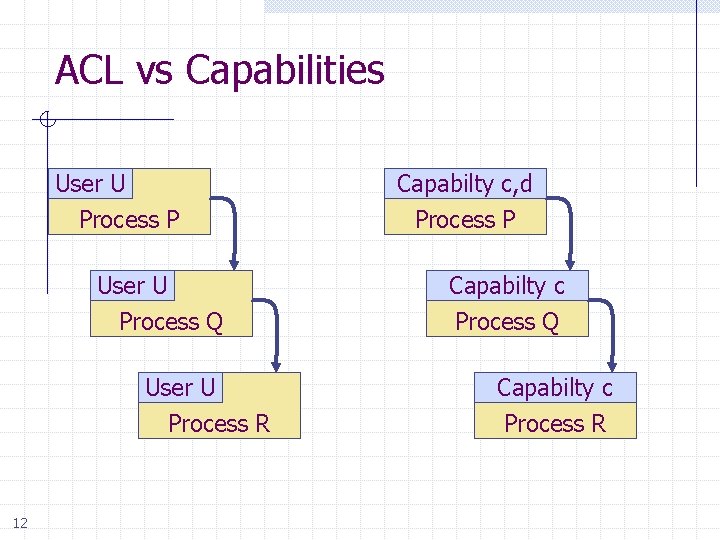
ACL vs Capabilities User U Process P User U Process Q User U Process R 12 Capabilty c, d Process P Capabilty c Process Q Capabilty c Process R
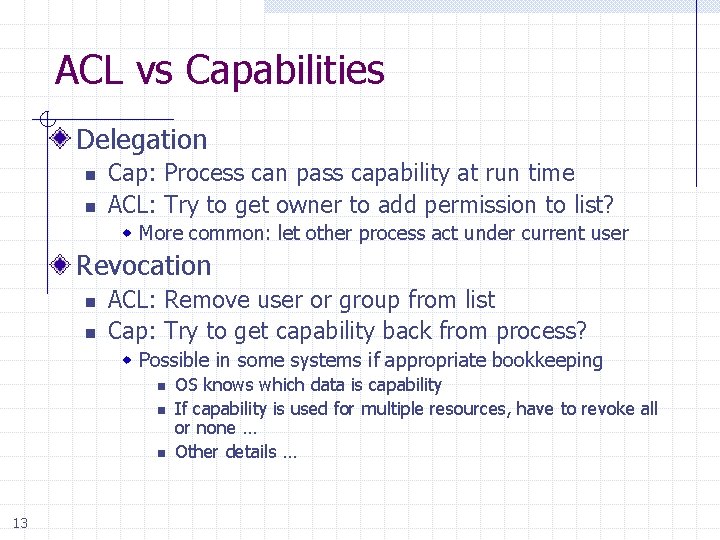
ACL vs Capabilities Delegation n n Cap: Process can pass capability at run time ACL: Try to get owner to add permission to list? w More common: let other process act under current user Revocation n n ACL: Remove user or group from list Cap: Try to get capability back from process? w Possible in some systems if appropriate bookkeeping n n n 13 OS knows which data is capability If capability is used for multiple resources, have to revoke all or none … Other details …
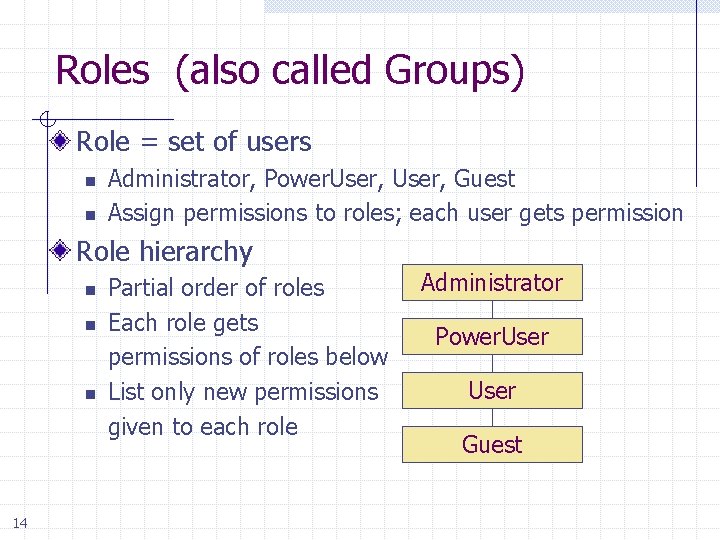
Roles (also called Groups) Role = set of users n n Administrator, Power. User, Guest Assign permissions to roles; each user gets permission Role hierarchy n n n 14 Partial order of roles Each role gets permissions of roles below List only new permissions given to each role Administrator Power. User Guest
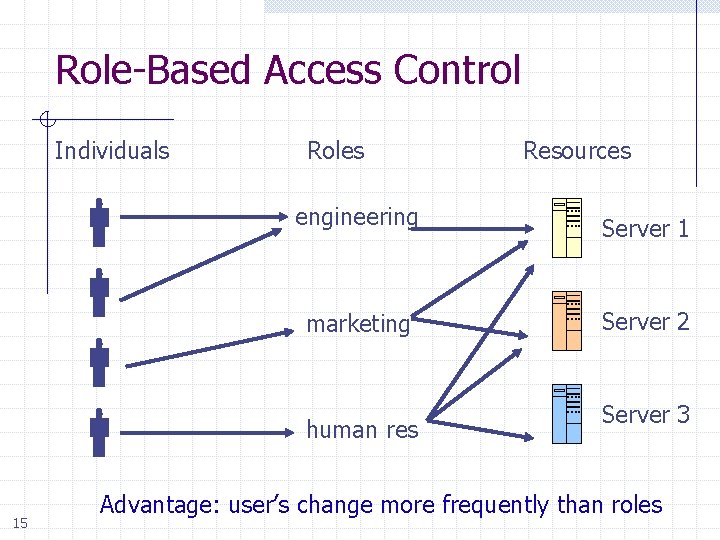
Role-Based Access Control Individuals Roles engineering Server 1 marketing Server 2 human res 15 Resources Server 3 Advantage: user’s change more frequently than roles
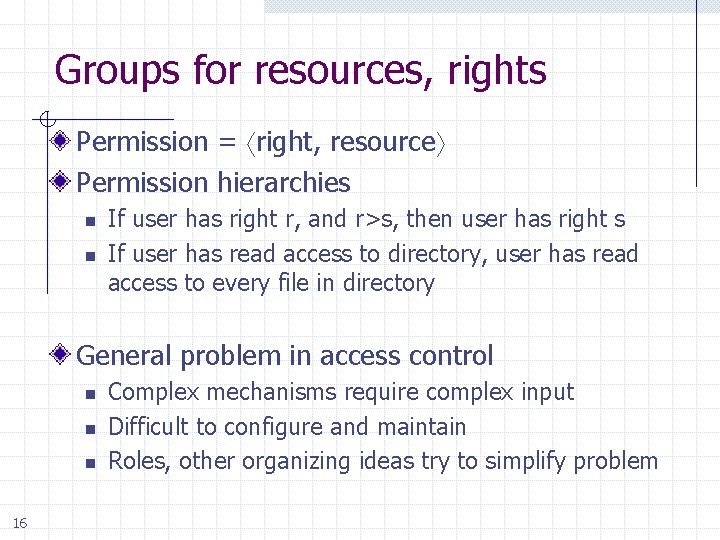
Groups for resources, rights Permission = right, resource Permission hierarchies n n If user has right r, and r>s, then user has right s If user has read access to directory, user has read access to every file in directory General problem in access control n n n 16 Complex mechanisms require complex input Difficult to configure and maintain Roles, other organizing ideas try to simplify problem
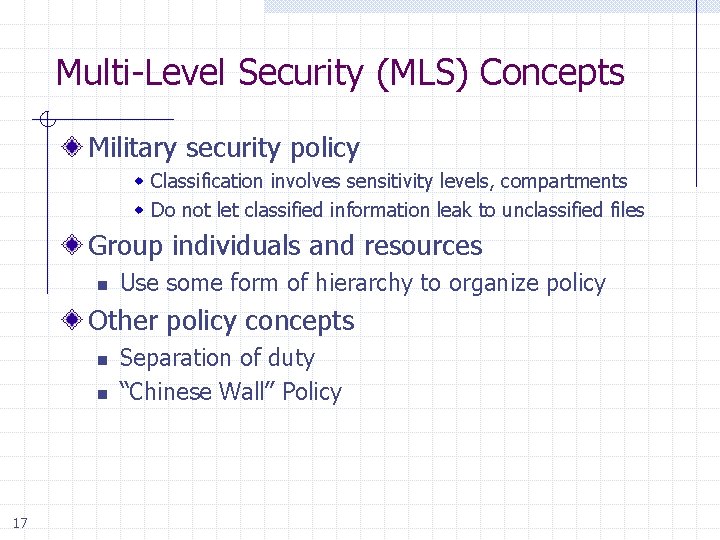
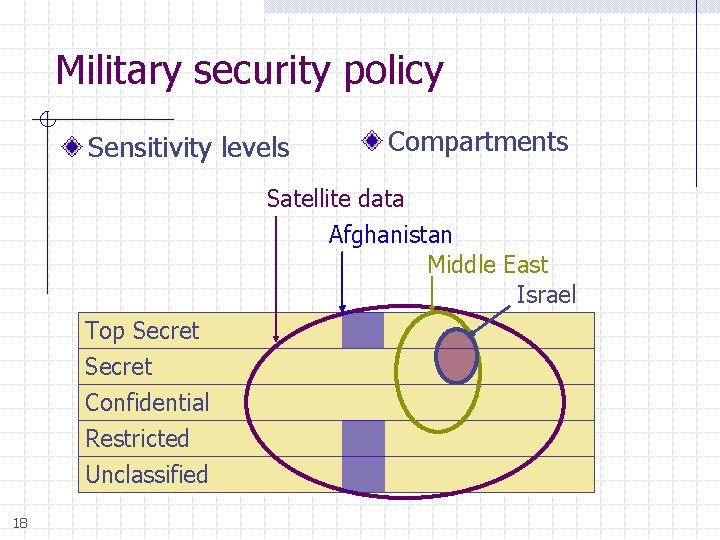
Multi-Level Security (MLS) Concepts Military security policy w Classification involves sensitivity levels, compartments w Do not let classified information leak to unclassified files Group individuals and resources n Use some form of hierarchy to organize policy Other policy concepts n n 17 Separation of duty “Chinese Wall” Policy
Military security policy Sensitivity levels Compartments Satellite data Afghanistan Middle East Israel Top Secret Confidential Restricted Unclassified 18
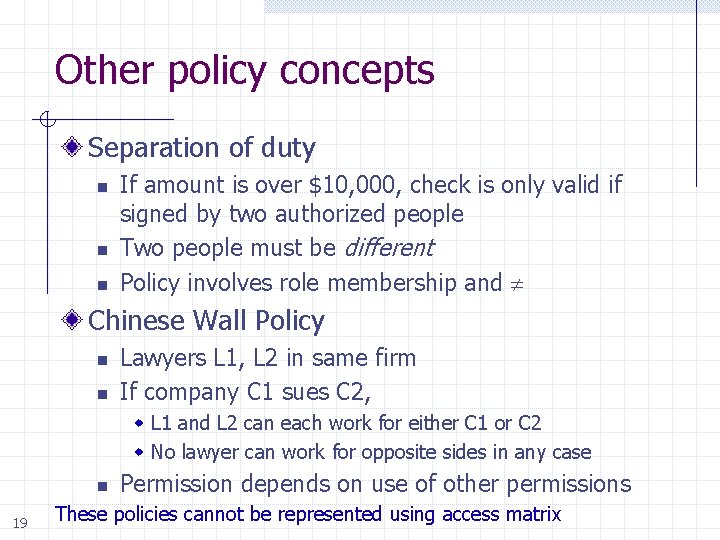
Other policy concepts Separation of duty n n n If amount is over $10, 000, check is only valid if signed by two authorized people Two people must be different Policy involves role membership and Chinese Wall Policy n n Lawyers L 1, L 2 in same firm If company C 1 sues C 2, w L 1 and L 2 can each work for either C 1 or C 2 w No lawyer can work for opposite sides in any case n 19 Permission depends on use of other permissions These policies cannot be represented using access matrix
Example OS Mechanisms Multics Amoeba Unix Windows 20
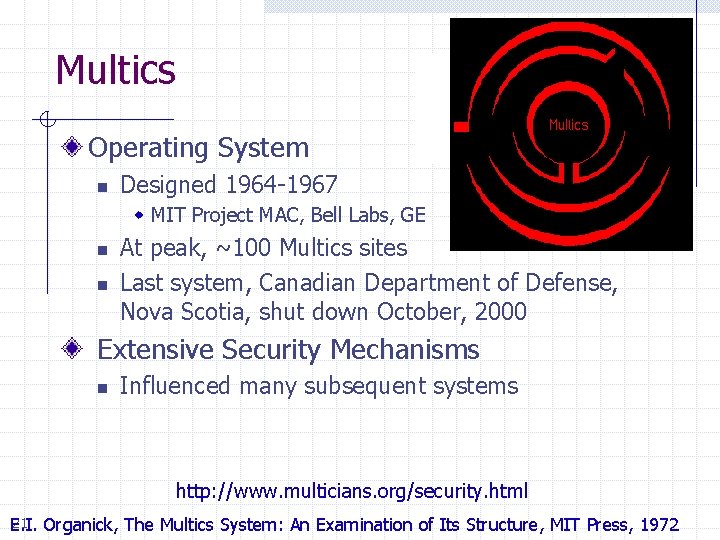
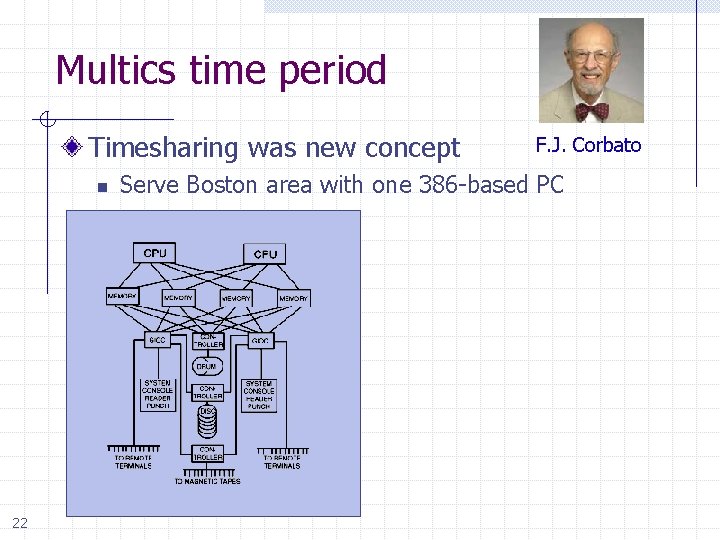
Multics Operating System n Designed 1964 -1967 w MIT Project MAC, Bell Labs, GE n n At peak, ~100 Multics sites Last system, Canadian Department of Defense, Nova Scotia, shut down October, 2000 Extensive Security Mechanisms n Influenced many subsequent systems http: //www. multicians. org/security. html 21 Organick, The Multics System: An Examination of Its Structure, MIT Press, 1972 E. I.
Multics time period Timesharing was new concept n 22 F. J. Corbato Serve Boston area with one 386 -based PC
Multics Innovations Segmented, Virtual memory n Hardware translates virtual address to real address High-level language implementation n Written in PL/1, only small part in assembly lang Shared memory multiprocessor n Multiple CPUs share same physical memory Relational database n Multics Relational Data Store (MRDS) in 1978 Security n n 23 Designed to be secure from the beginning First B 2 security rating (1980 s), only one for years
Multics Access Model Ring structure n n n A ring is a domain in which a process executes Numbered 0, 1, 2, … ; Kernel is ring 0 Graduated privileges w Processes at ring i have privileges of every ring j > i Segments n n Each data area or procedure is called a segment Segment protection b 1, b 2, b 3 with b 1 b 2 b 3 w Process/data can be accessed from rings b 1 … b 2 w A process from rings b 2 … b 3 can only call segment at restricted entry points 24
Multics process Multiple segments n n n Segments are dynamically linked Linking process uses file system to find segment A segment may be shared by several processes Multiple rings n n Procedure, data segments each in specific ring Access depends on two mechanisms w Per-Segment Access Control n File author specifies the users that have access to it w Concentric Rings of Protection n n Call or read/write segments in outer rings To access inner ring, go through a “gatekeeper” Interprocess communication through “channels” 25
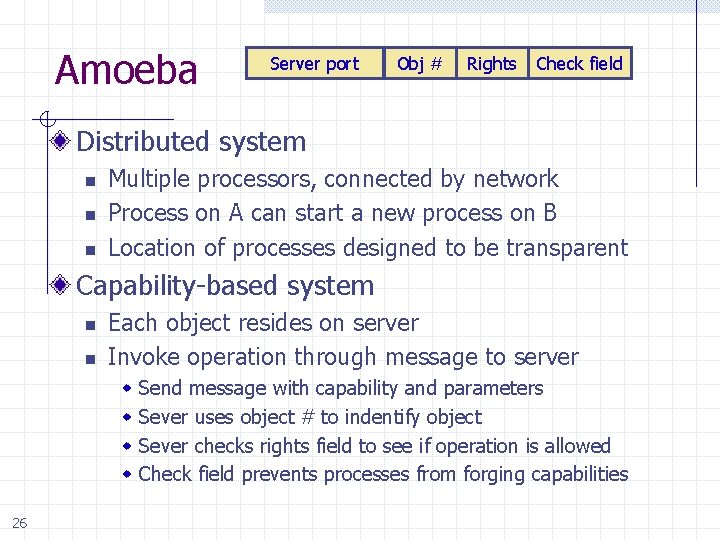
Amoeba Server port Obj # Rights Check field Distributed system n n n Multiple processors, connected by network Process on A can start a new process on B Location of processes designed to be transparent Capability-based system n n Each object resides on server Invoke operation through message to server w w 26 Send message with capability and parameters Sever uses object # to indentify object Sever checks rights field to see if operation is allowed Check field prevents processes from forging capabilities
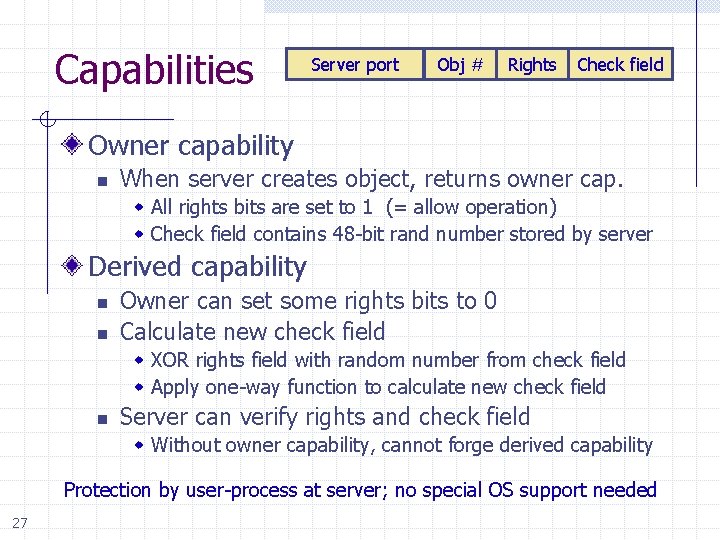
Capabilities Server port Obj # Rights Check field Owner capability n When server creates object, returns owner cap. w All rights bits are set to 1 (= allow operation) w Check field contains 48 -bit rand number stored by server Derived capability n n Owner can set some rights bits to 0 Calculate new check field w XOR rights field with random number from check field w Apply one-way function to calculate new check field n Server can verify rights and check field w Without owner capability, cannot forge derived capability Protection by user-process at server; no special OS support needed 27
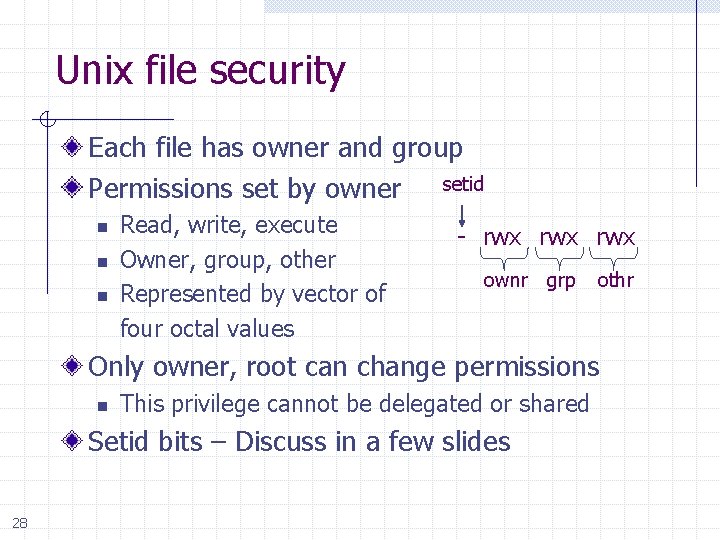
Unix file security Each file has owner and group Permissions set by owner setid n n n Read, write, execute Owner, group, other Represented by vector of four octal values - rwx rwx ownr grp othr Only owner, root can change permissions n This privilege cannot be delegated or shared Setid bits – Discuss in a few slides 28
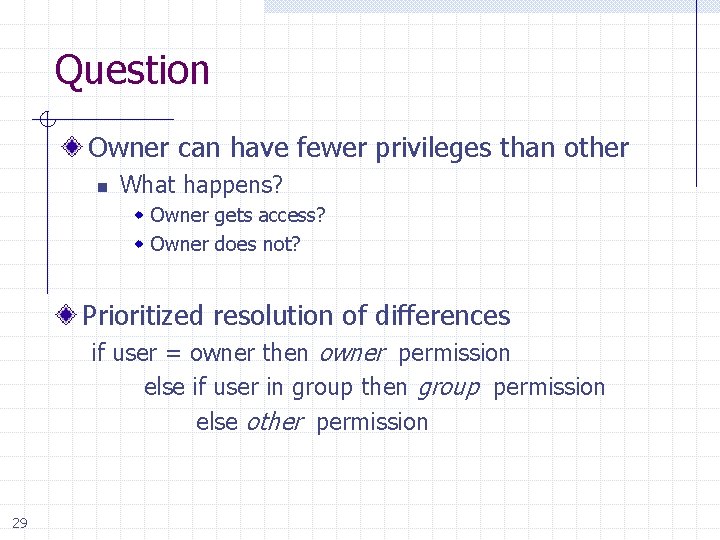
Question Owner can have fewer privileges than other n What happens? w Owner gets access? w Owner does not? Prioritized resolution of differences if user = owner then owner permission else if user in group then group permission else other permission 29
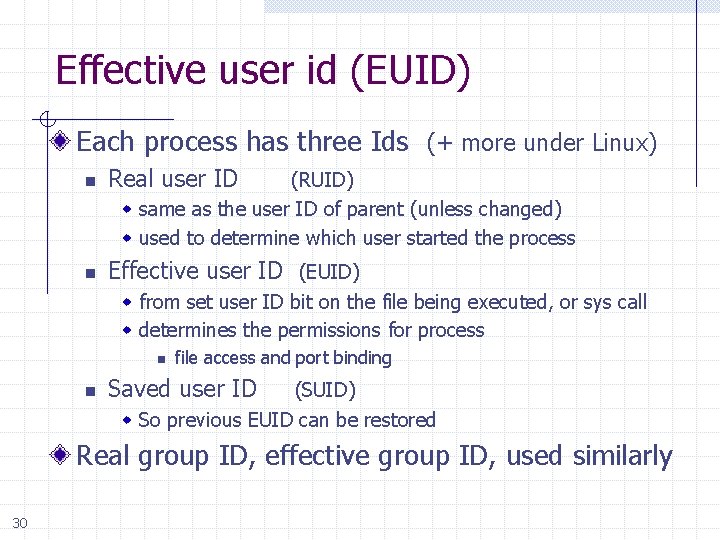
Effective user id (EUID) Each process has three Ids (+ more under Linux) n Real user ID n Effective user ID (EUID) (RUID) w same as the user ID of parent (unless changed) w used to determine which user started the process w from set user ID bit on the file being executed, or sys call w determines the permissions for process n n file access and port binding Saved user ID (SUID) w So previous EUID can be restored Real group ID, effective group ID, used similarly 30
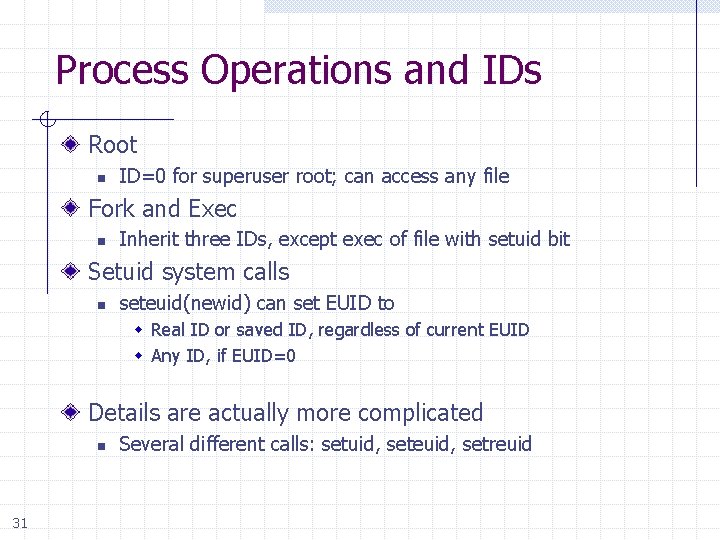
Process Operations and IDs Root n ID=0 for superuser root; can access any file Fork and Exec n Inherit three IDs, except exec of file with setuid bit Setuid system calls n seteuid(newid) can set EUID to w Real ID or saved ID, regardless of current EUID w Any ID, if EUID=0 Details are actually more complicated n 31 Several different calls: setuid, seteuid, setreuid
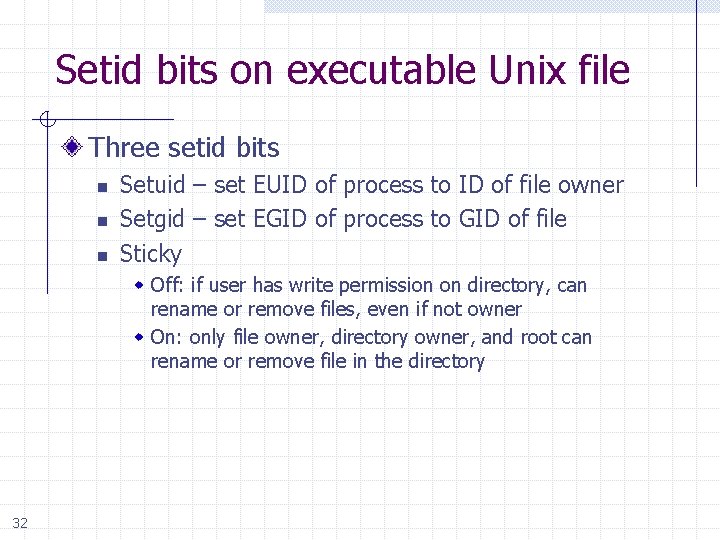
Setid bits on executable Unix file Three setid bits n n n Setuid – set EUID of process to ID of file owner Setgid – set EGID of process to GID of file Sticky w Off: if user has write permission on directory, can rename or remove files, even if not owner w On: only file owner, directory owner, and root can rename or remove file in the directory 32
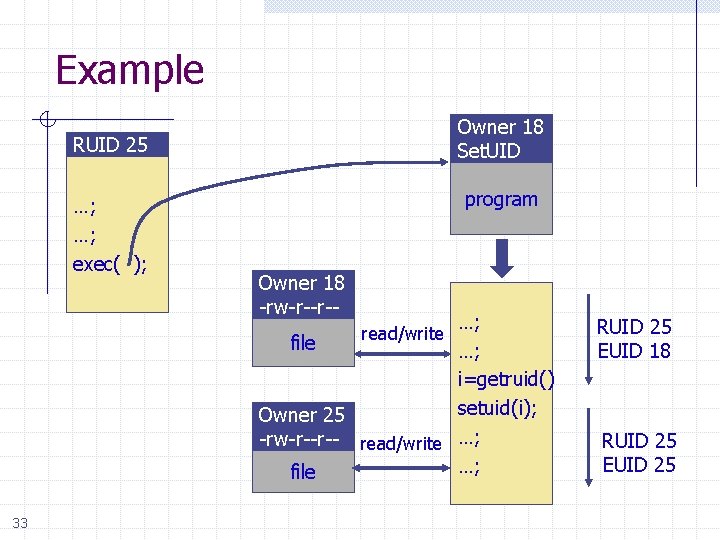
Example Owner 18 Set. UID RUID 25 …; …; exec( ); program Owner 18 -rw-r--r-- …; file …; i=getruid() setuid(i); Owner 25 -rw-r--r-- read/write …; …; file read/write 33 RUID 25 EUID 18 RUID 25 EUID 25
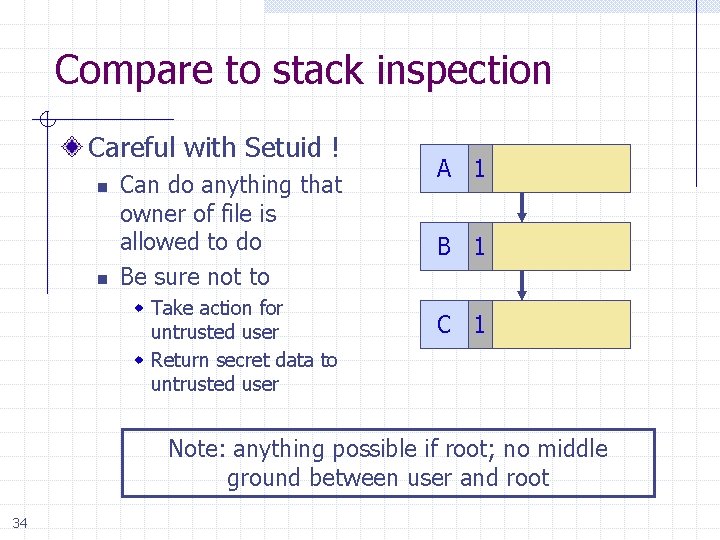
Compare to stack inspection Careful with Setuid ! n n Can do anything that owner of file is allowed to do Be sure not to w Take action for untrusted user w Return secret data to untrusted user A 1 B 1 C 1 Note: anything possible if root; no middle ground between user and root 34
Setuid programming Be Careful! n n Root can do anything; don’ t get tricked Principle of least privilege – change EUID when root privileges no longer needed Setuid scripts n n This is a bad idea Historically, race conditions w Begin executing setuid program; change contents of program before it loads and is executed 35
Unix summary Good things n n Some protection from most users Flexible enough to make things possible Main bad thing n n 36 Too tempting to use root privileges No way to assume some root privileges without all root privileges
Access control in Windows (NTFS) Some basic functionality similar to Unix n Specify access for groups and users w Read, modify, change owner, delete Some additional concepts n n Tokens Security attributes Generally n More flexibility than Unix w Can define new permissions w Can give some but not all administrator privileges 37
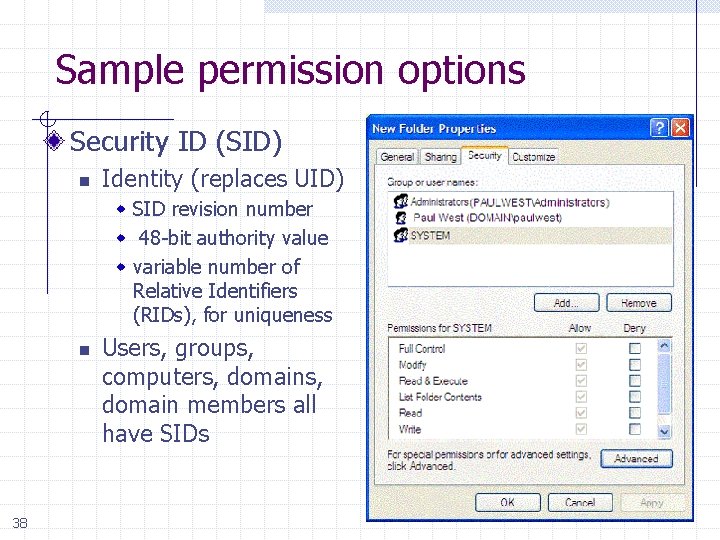
Sample permission options Security ID (SID) n Identity (replaces UID) w SID revision number w 48 -bit authority value w variable number of Relative Identifiers (RIDs), for uniqueness n 38 Users, groups, computers, domain members all have SIDs
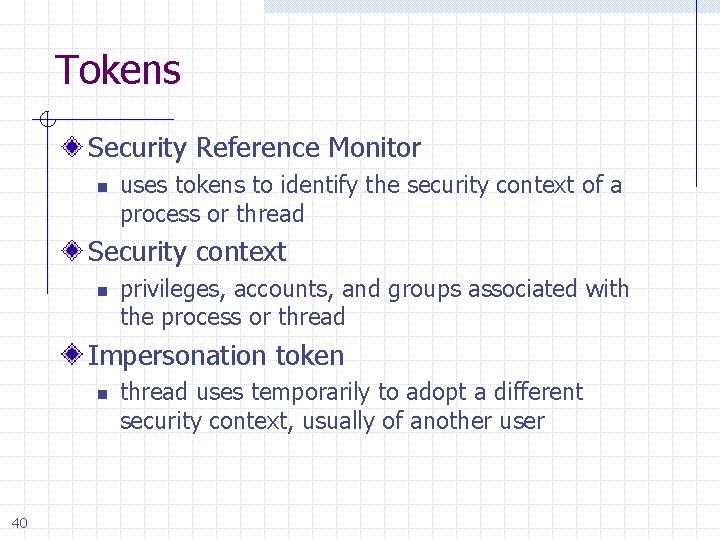
Tokens Security Reference Monitor n uses tokens to identify the security context of a process or thread Security context n privileges, accounts, and groups associated with the process or thread Impersonation token n 40 thread uses temporarily to adopt a different security context, usually of another user
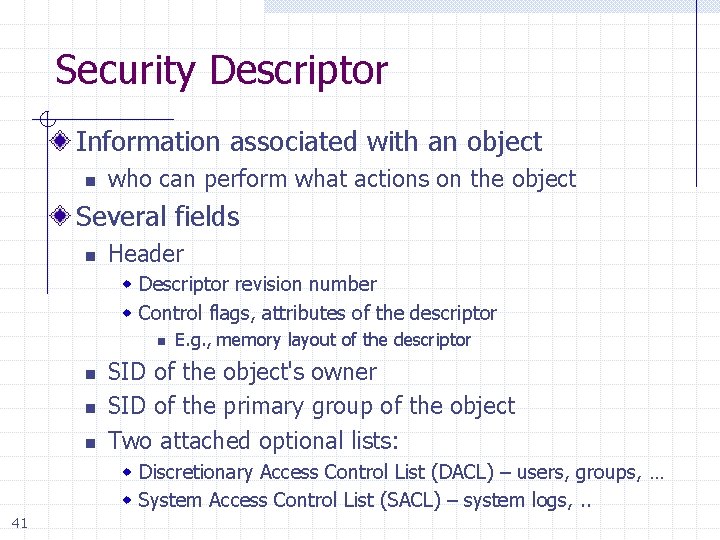
Security Descriptor Information associated with an object n who can perform what actions on the object Several fields n Header w Descriptor revision number w Control flags, attributes of the descriptor n n E. g. , memory layout of the descriptor SID of the object's owner SID of the primary group of the object Two attached optional lists: w Discretionary Access Control List (DACL) – users, groups, … w System Access Control List (SACL) – system logs, . . 41
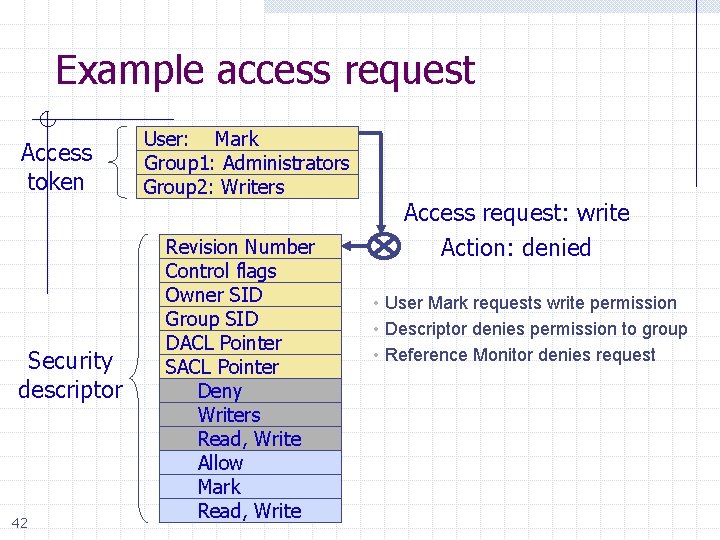
Example access request Access token Security descriptor 42 User: Mark Group 1: Administrators Group 2: Writers Revision Number Control flags Owner SID Group SID DACL Pointer SACL Pointer Deny Writers Read, Write Allow Mark Read, Write Access request: write Action: denied • User Mark requests write permission • Descriptor denies permission to group • Reference Monitor denies request
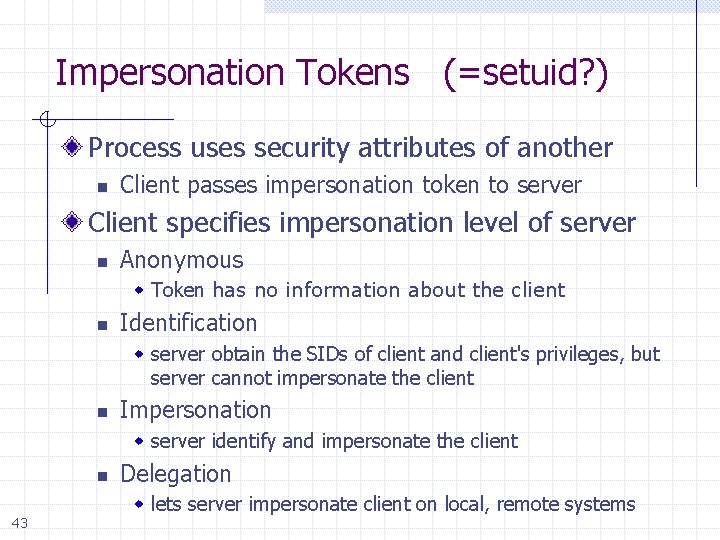
Impersonation Tokens (=setuid? ) Process uses security attributes of another n Client passes impersonation token to server Client specifies impersonation level of server n Anonymous w Token has no information about the client n Identification w server obtain the SIDs of client and client's privileges, but server cannot impersonate the client n Impersonation w server identify and impersonate the client n 43 Delegation w lets server impersonate client on local, remote systems
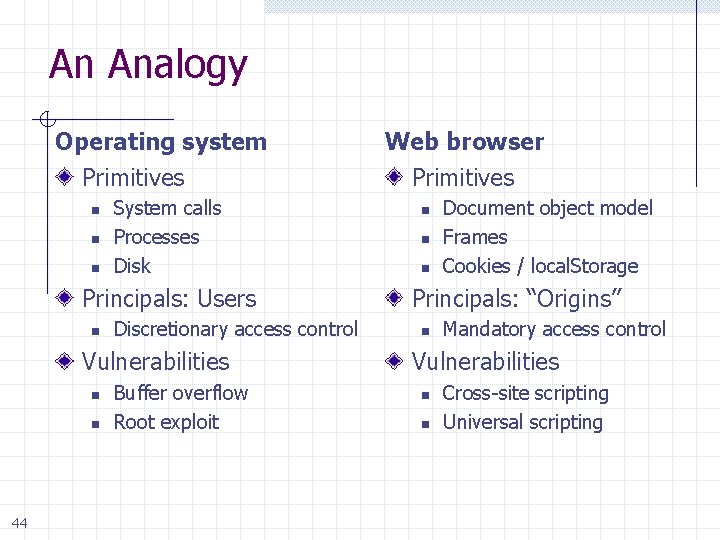
An Analogy Operating system Primitives n n n System calls Processes Disk Principals: Users n Discretionary access control Vulnerabilities n n 44 Buffer overflow Root exploit Web browser Primitives n n n Document object model Frames Cookies / local. Storage Principals: “Origins” n Mandatory access control Vulnerabilities n n Cross-site scripting Universal scripting
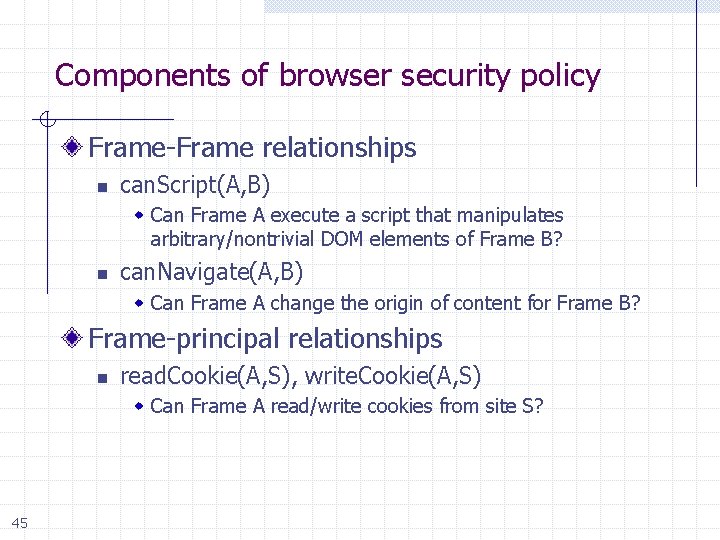
Components of browser security policy Frame-Frame relationships n can. Script(A, B) w Can Frame A execute a script that manipulates arbitrary/nontrivial DOM elements of Frame B? n can. Navigate(A, B) w Can Frame A change the origin of content for Frame B? Frame-principal relationships n read. Cookie(A, S), write. Cookie(A, S) w Can Frame A read/write cookies from site S? 45
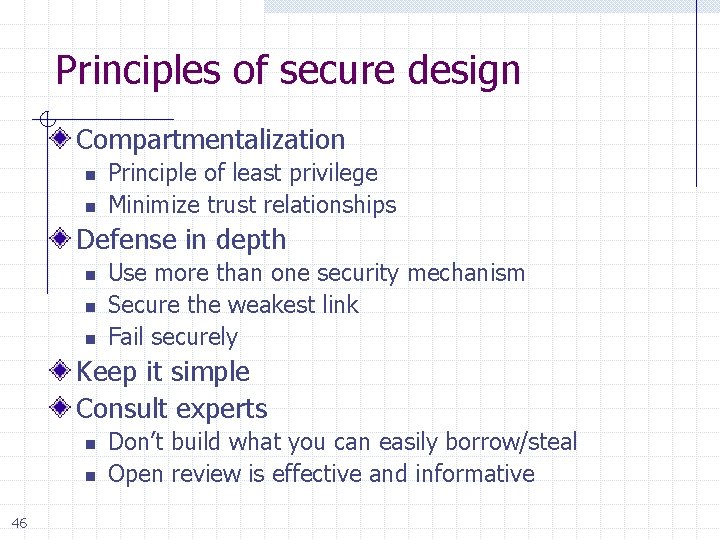
Principles of secure design Compartmentalization n n Principle of least privilege Minimize trust relationships Defense in depth n n n Use more than one security mechanism Secure the weakest link Fail securely Keep it simple Consult experts n n 46 Don’t build what you can easily borrow/steal Open review is effective and informative
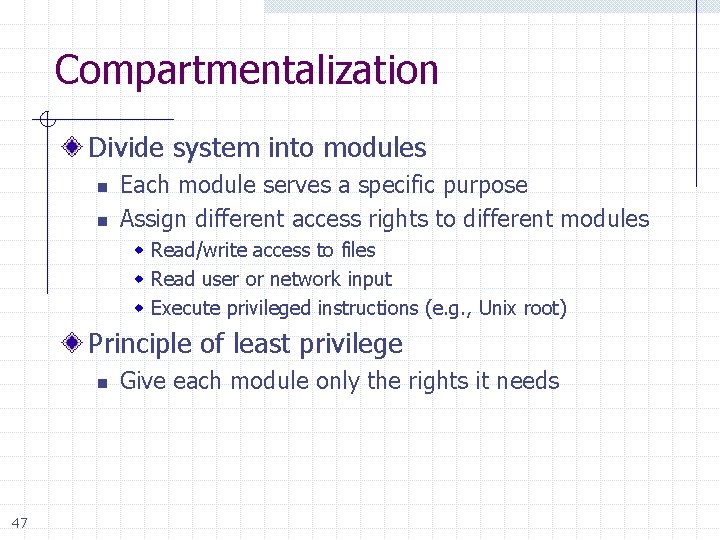
Compartmentalization Divide system into modules n n Each module serves a specific purpose Assign different access rights to different modules w Read/write access to files w Read user or network input w Execute privileged instructions (e. g. , Unix root) Principle of least privilege n 47 Give each module only the rights it needs
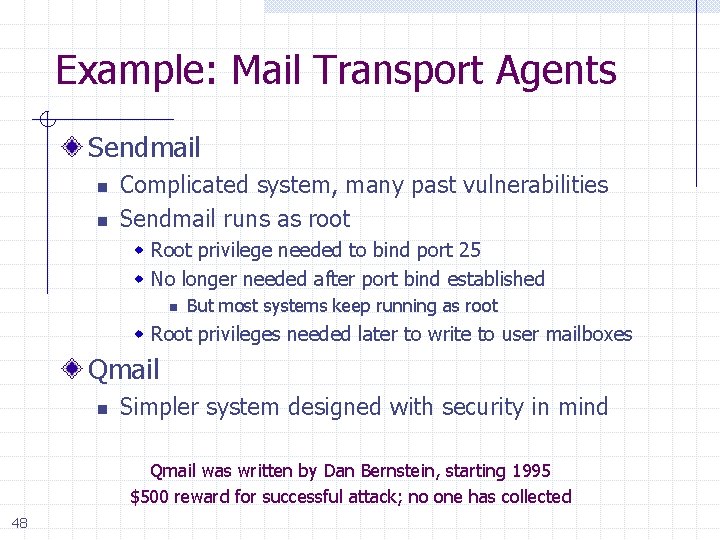
Example: Mail Transport Agents Sendmail n n Complicated system, many past vulnerabilities Sendmail runs as root w Root privilege needed to bind port 25 w No longer needed after port bind established n But most systems keep running as root w Root privileges needed later to write to user mailboxes Qmail n Simpler system designed with security in mind Qmail was written by Dan Bernstein, starting 1995 $500 reward for successful attack; no one has collected 48
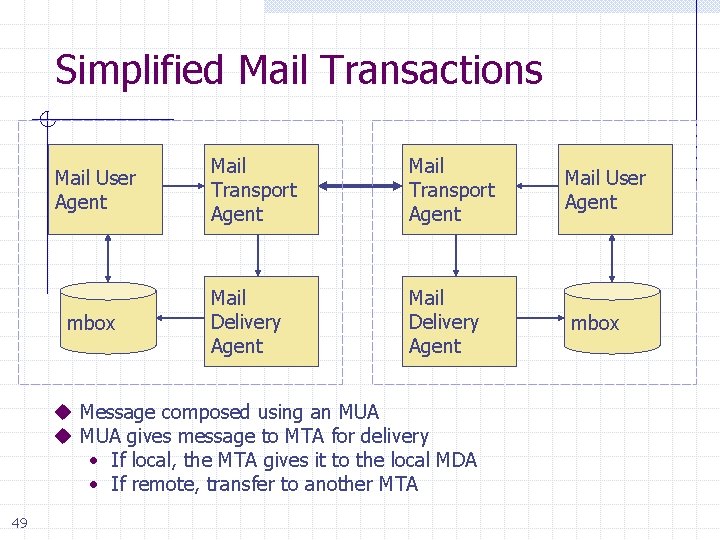
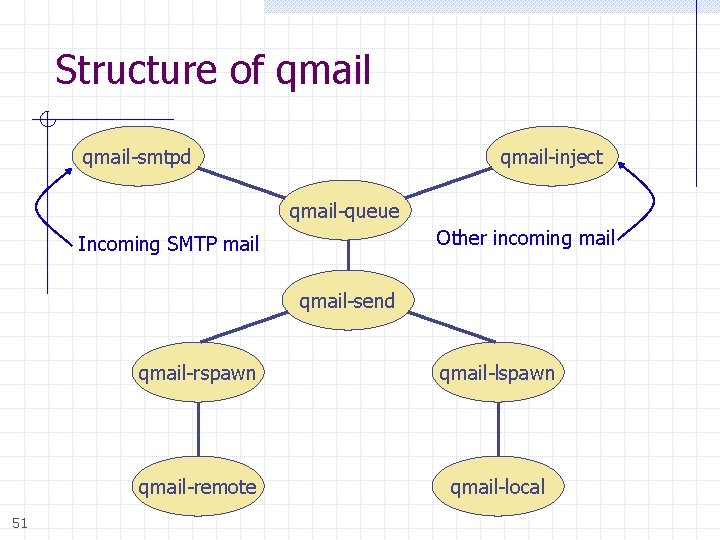
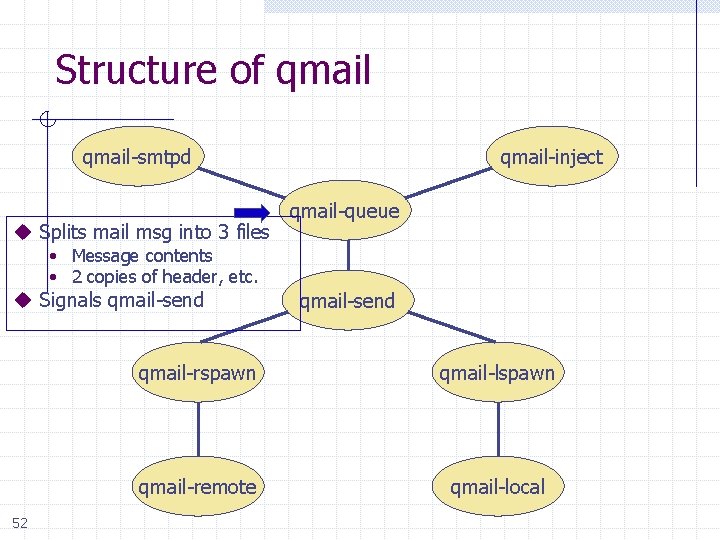
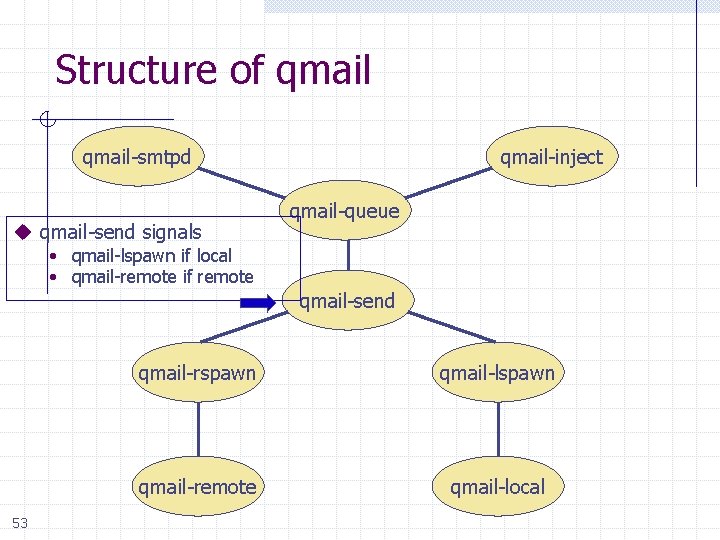
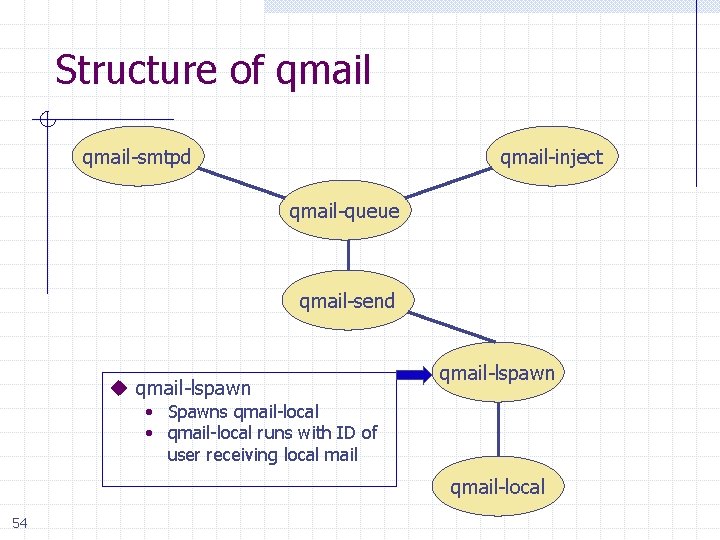
Simplified Mail Transactions Mail User Agent mbox Mail Transport Agent Mail User Agent Mail Delivery Agent mbox u Message composed using an MUA u MUA gives message to MTA for delivery • If local, the MTA gives it to the local MDA • If remote, transfer to another MTA 49
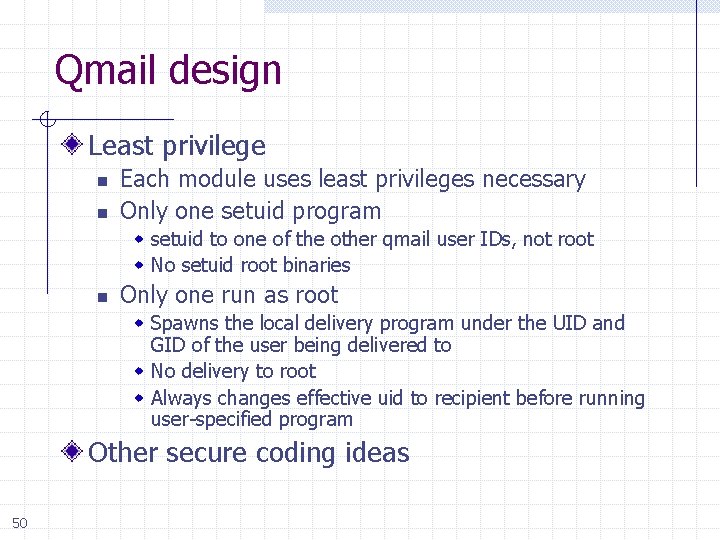
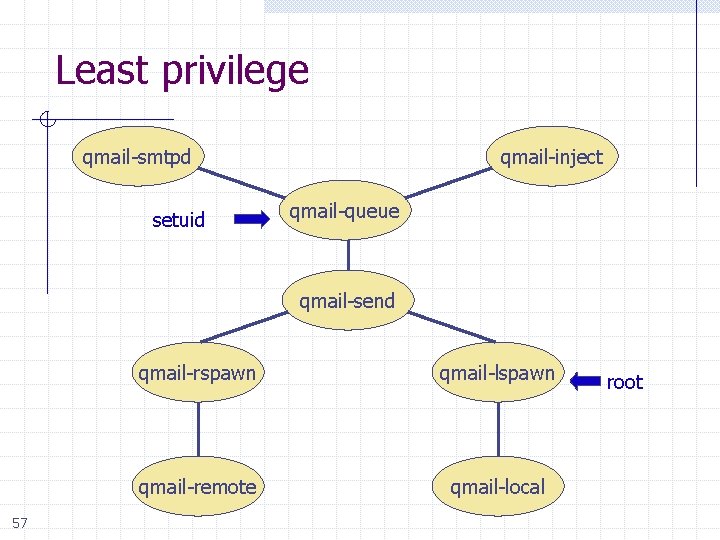
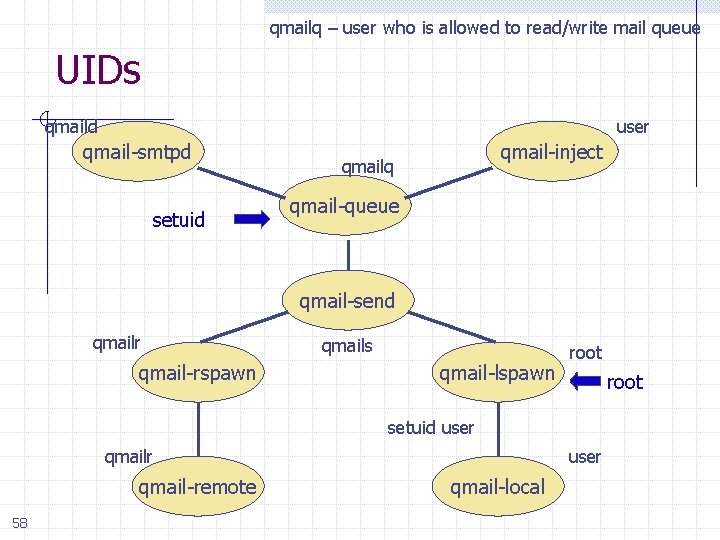
Qmail design Least privilege n n Each module uses least privileges necessary Only one setuid program w setuid to one of the other qmail user IDs, not root w No setuid root binaries n Only one run as root w Spawns the local delivery program under the UID and GID of the user being delivered to w No delivery to root w Always changes effective uid to recipient before running user-specified program Other secure coding ideas 50
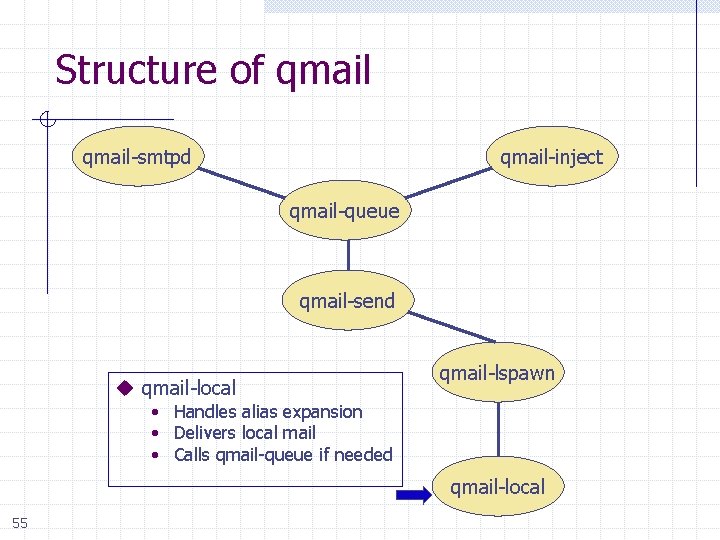
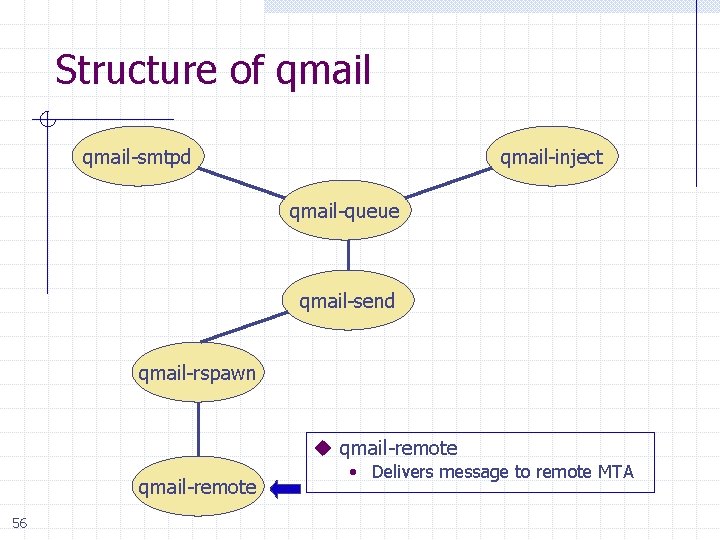
Structure of qmail-smtpd qmail-inject qmail-queue Other incoming mail Incoming SMTP mail qmail-send 51 qmail-rspawn qmail-lspawn qmail-remote qmail-local
Structure of qmail-smtpd u Splits mail msg into 3 files qmail-inject qmail-queue • Message contents • 2 copies of header, etc. u Signals qmail-send 52 qmail-send qmail-rspawn qmail-lspawn qmail-remote qmail-local
Structure of qmail-smtpd u qmail-send signals qmail-inject qmail-queue • qmail-lspawn if local • qmail-remote if remote qmail-send 53 qmail-rspawn qmail-lspawn qmail-remote qmail-local
Structure of qmail-smtpd qmail-inject qmail-queue qmail-send u qmail-lspawn • Spawns qmail-local • qmail-local runs with ID of user receiving local mail qmail-local 54
Structure of qmail-smtpd qmail-inject qmail-queue qmail-send u qmail-local qmail-lspawn • Handles alias expansion • Delivers local mail • Calls qmail-queue if needed qmail-local 55
Structure of qmail-smtpd qmail-inject qmail-queue qmail-send qmail-rspawn u qmail-remote 56 • Delivers message to remote MTA
Least privilege qmail-smtpd setuid qmail-inject qmail-queue qmail-send 57 qmail-rspawn qmail-lspawn qmail-remote qmail-local root
qmailq – user who is allowed to read/write mail queue UIDs qmaild user qmail-smtpd setuid qmail-inject qmailq qmail-queue qmail-send qmailr qmail-rspawn qmails qmail-lspawn root setuid user qmail-remote 58 user qmail-local
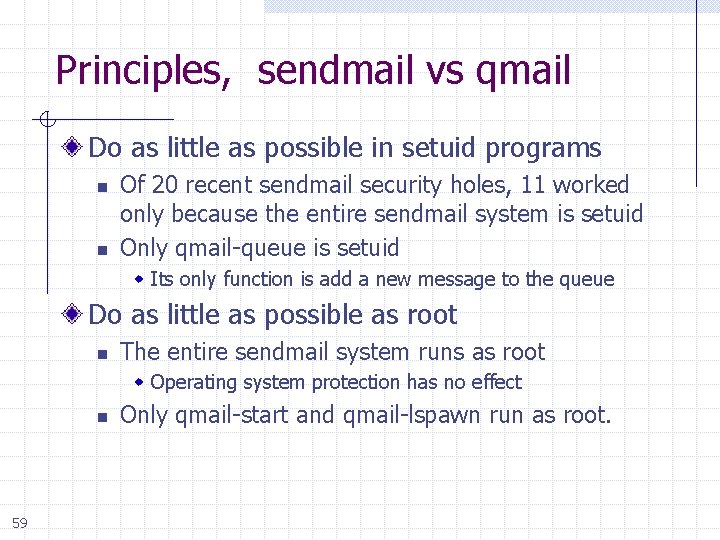
Principles, sendmail vs qmail Do as little as possible in setuid programs n n Of 20 recent sendmail security holes, 11 worked only because the entire sendmail system is setuid Only qmail-queue is setuid w Its only function is add a new message to the queue Do as little as possible as root n The entire sendmail system runs as root w Operating system protection has no effect n 59 Only qmail-start and qmail-lspawn run as root.
60