
Spring 2008 Chap 10 NonRadical Addition Polymerization Anionic
- Slides: 34
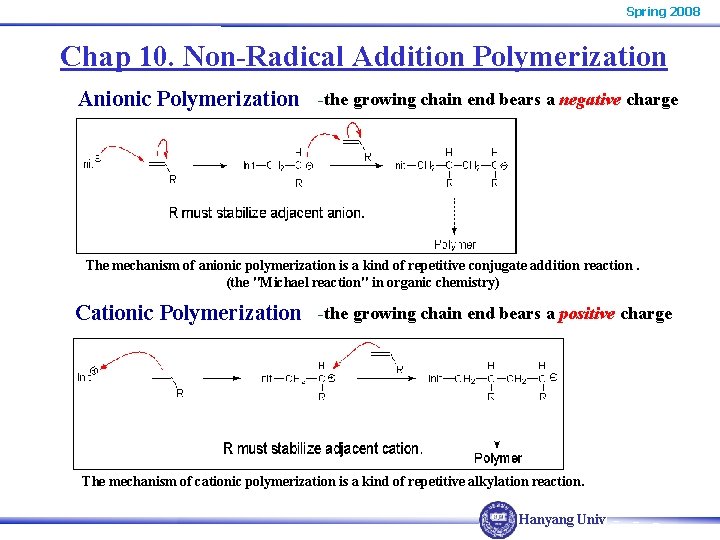
Spring 2008 Chap 10. Non-Radical Addition Polymerization Anionic Polymerization -the growing chain end bears a negative charge The mechanism of anionic polymerization is a kind of repetitive conjugate addition reaction. (the "Michael reaction" in organic chemistry) Cationic Polymerization -the growing chain end bears a positive charge The mechanism of cationic polymerization is a kind of repetitive alkylation reaction. Hanyang Univ.
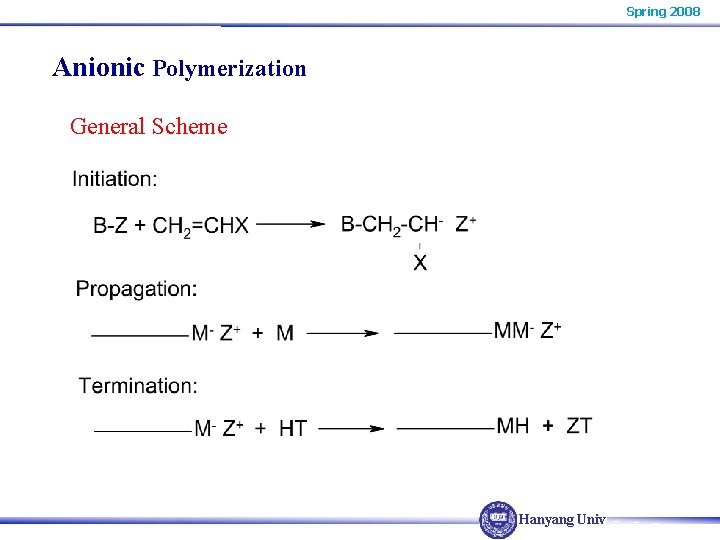
Spring 2008 Anionic Polymerization General Scheme Hanyang Univ.
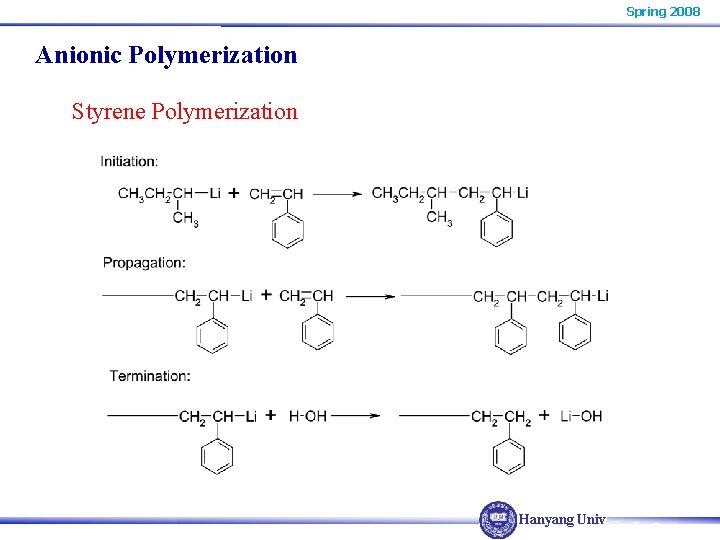
Spring 2008 Anionic Polymerization Styrene Polymerization Hanyang Univ.
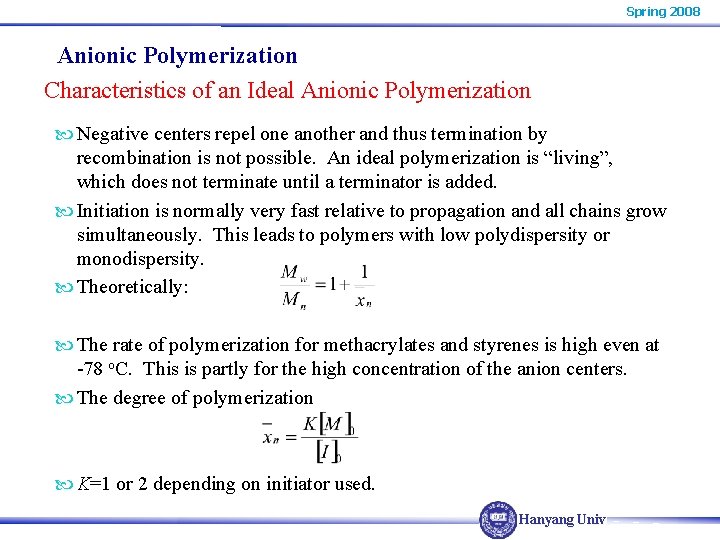
Spring 2008 Anionic Polymerization Characteristics of an Ideal Anionic Polymerization Negative centers repel one another and thus termination by recombination is not possible. An ideal polymerization is “living”, which does not terminate until a terminator is added. Initiation is normally very fast relative to propagation and all chains grow simultaneously. This leads to polymers with low polydispersity or monodispersity. Theoretically: The rate of polymerization for methacrylates and styrenes is high even at -78 o. C. This is partly for the high concentration of the anion centers. The degree of polymerization K=1 or 2 depending on initiator used. Hanyang Univ.
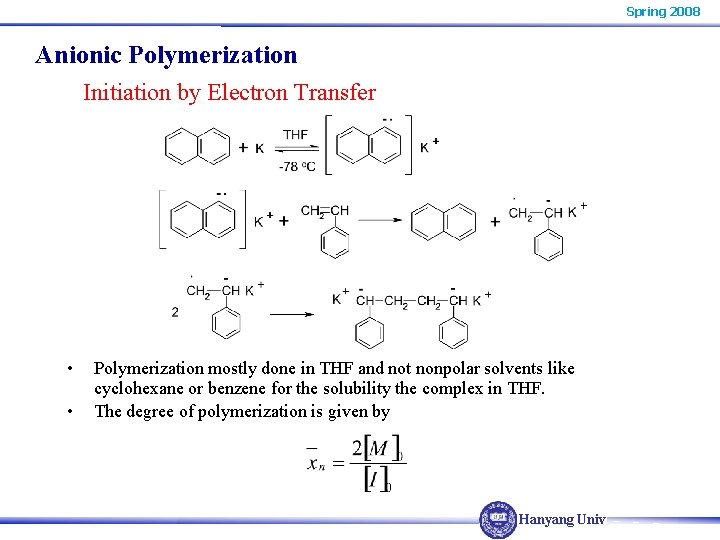
Spring 2008 Anionic Polymerization Initiation by Electron Transfer • • Polymerization mostly done in THF and not nonpolar solvents like cyclohexane or benzene for the solubility the complex in THF. The degree of polymerization is given by Hanyang Univ.
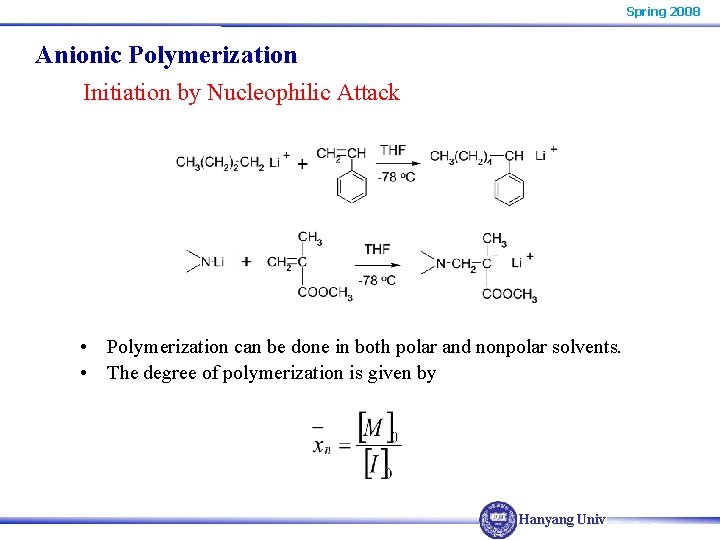
Spring 2008 Anionic Polymerization Initiation by Nucleophilic Attack • Polymerization can be done in both polar and nonpolar solvents. • The degree of polymerization is given by Hanyang Univ.
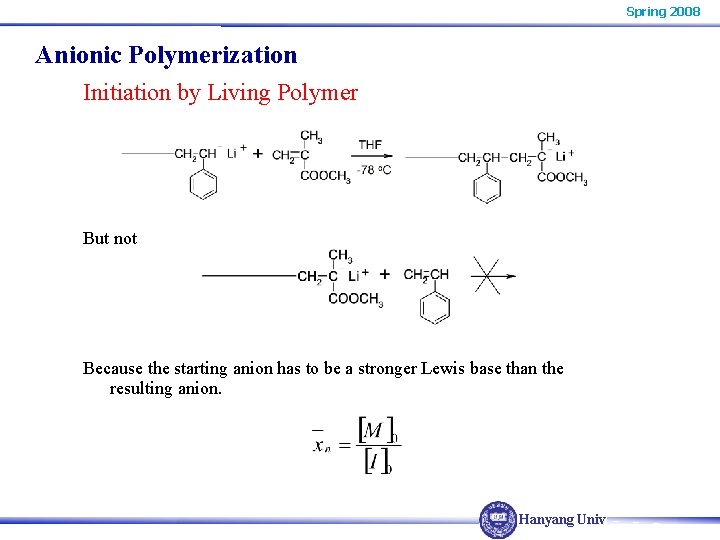
Spring 2008 Anionic Polymerization Initiation by Living Polymer But not Because the starting anion has to be a stronger Lewis base than the resulting anion. Hanyang Univ.
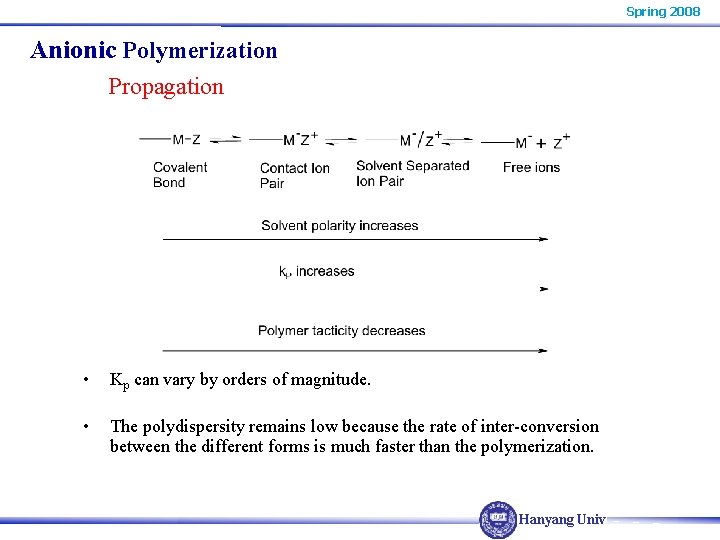
Spring 2008 Anionic Polymerization Propagation • Kp can vary by orders of magnitude. • The polydispersity remains low because the rate of inter-conversion between the different forms is much faster than the polymerization. Hanyang Univ.
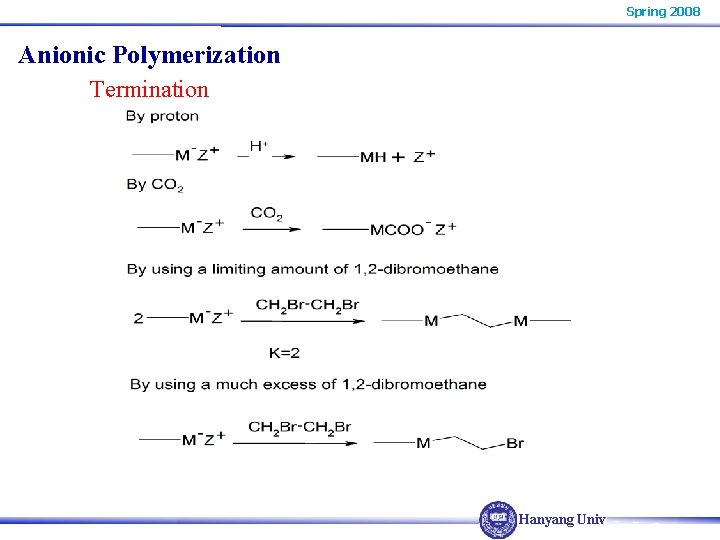
Spring 2008 Anionic Polymerization Termination Hanyang Univ.
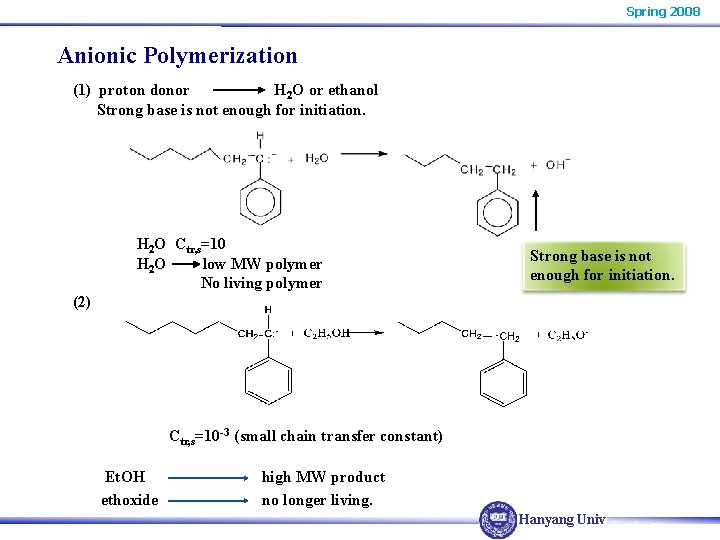
Spring 2008 Anionic Polymerization (1) proton donor H 2 O or ethanol Strong base is not enough for initiation. H 2 O Ctr, s=10 H 2 O low MW polymer No living polymer Strong base is not enough for initiation. (2) Ctr, s=10 -3 (small chain transfer constant) Et. OH ethoxide high MW product no longer living. Hanyang Univ.
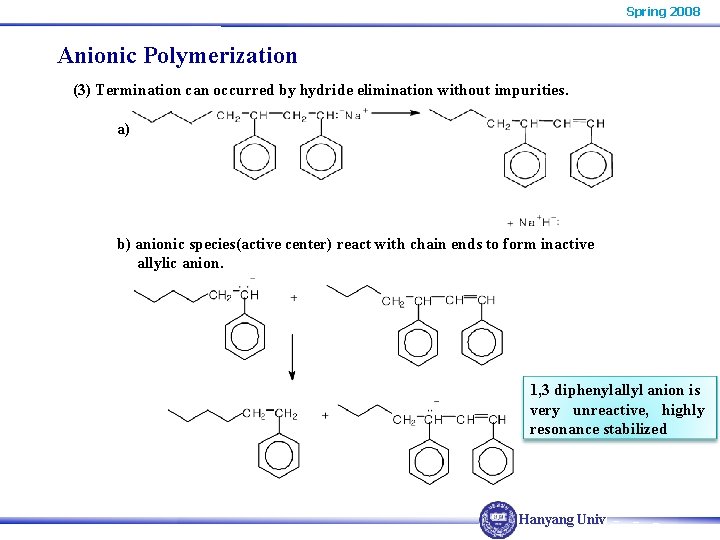
Spring 2008 Anionic Polymerization (3) Termination can occurred by hydride elimination without impurities. a) b) anionic species(active center) react with chain ends to form inactive allylic anion. 1, 3 diphenylallyl anion is very unreactive, highly resonance stabilized Hanyang Univ.
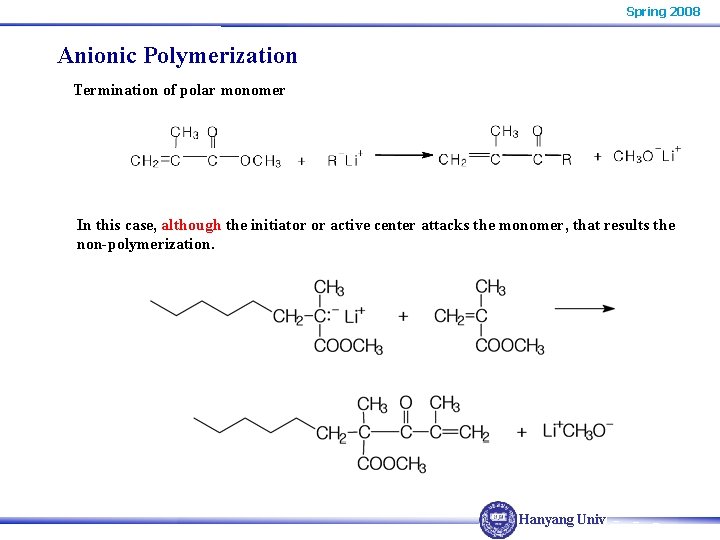
Spring 2008 Anionic Polymerization Termination of polar monomer In this case, although the initiator or active center attacks the monomer, that results the non-polymerization. Hanyang Univ.
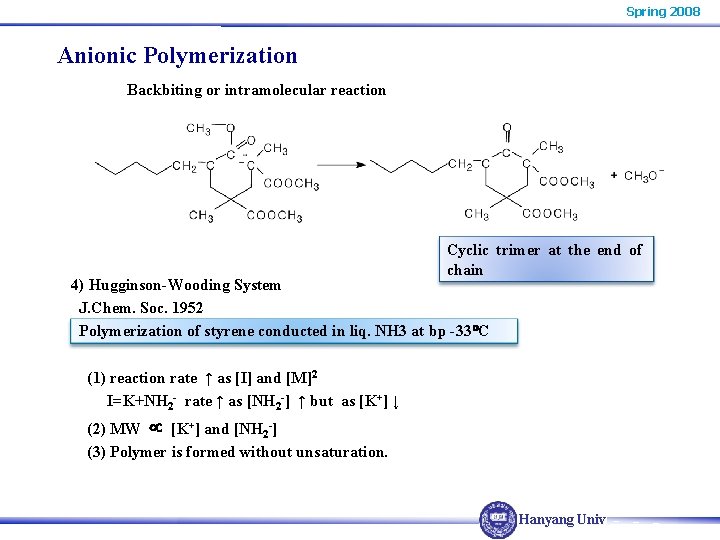
Spring 2008 Anionic Polymerization Backbiting or intramolecular reaction Cyclic trimer at the end of chain 4) Hugginson-Wooding System J. Chem. Soc. 1952 Polymerization of styrene conducted in liq. NH 3 at bp -33 C (1) reaction rate ↑ as [I] and [M]2 I=K+NH 2 - rate ↑ as [NH 2 -] ↑ but as [K+] ↓ (2) MW [K+] and [NH 2 -] (3) Polymer is formed without unsaturation. Hanyang Univ.
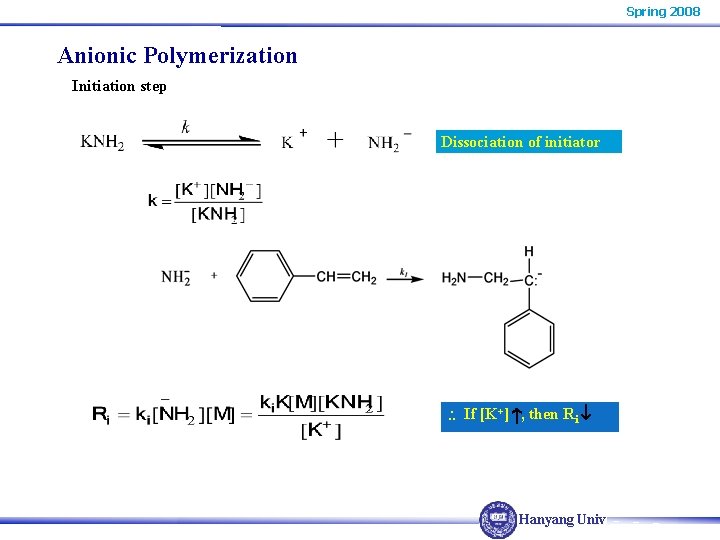
Spring 2008 Anionic Polymerization Initiation step Dissociation of initiator If [K+] , then Ri Hanyang Univ.
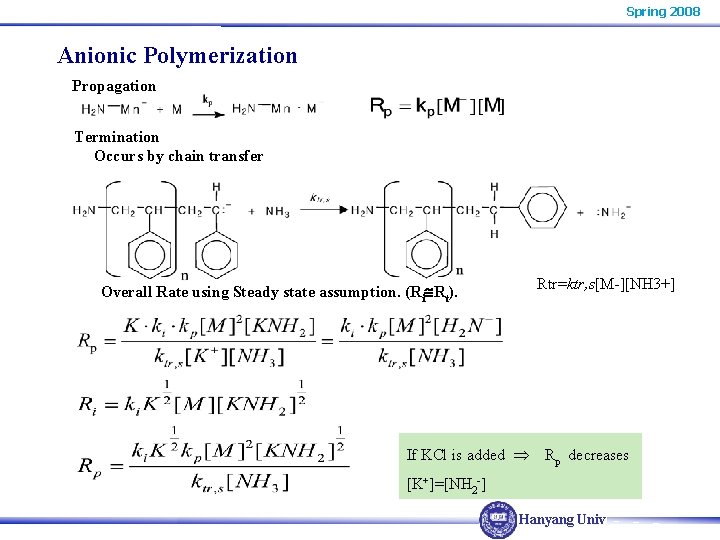
Spring 2008 Anionic Polymerization Propagation Termination Occurs by chain transfer Rtr=ktr, s[M-][NH 3+] Overall Rate using Steady state assumption. (Ri Rt). If KCl is added Rp decreases [K+]=[NH 2 -] Hanyang Univ.
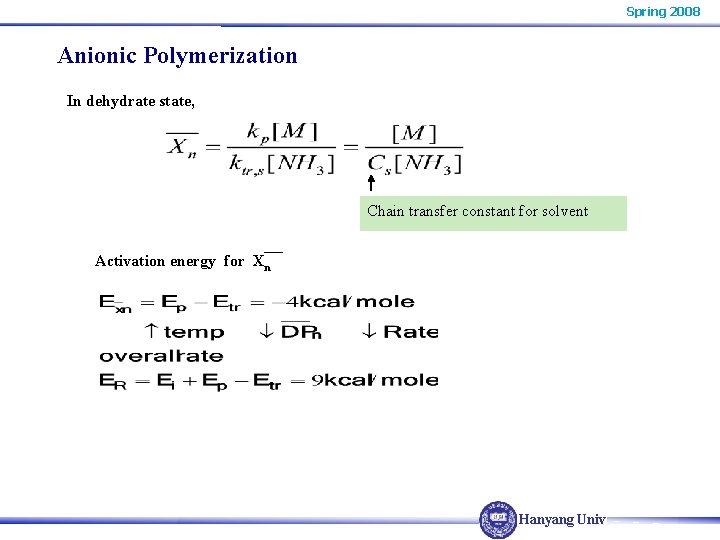
Spring 2008 Anionic Polymerization In dehydrate state, Chain transfer constant for solvent Activation energy for Xn Hanyang Univ.
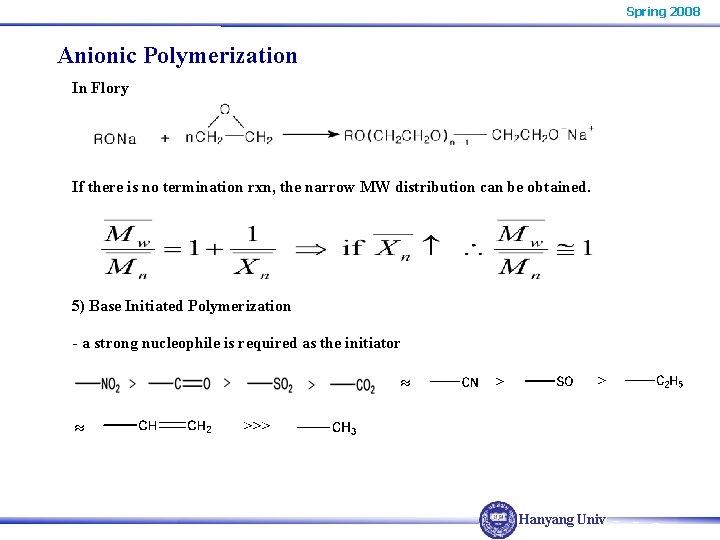
Spring 2008 Anionic Polymerization In Flory If there is no termination rxn, the narrow MW distribution can be obtained. 5) Base Initiated Polymerization - a strong nucleophile is required as the initiator Hanyang Univ.
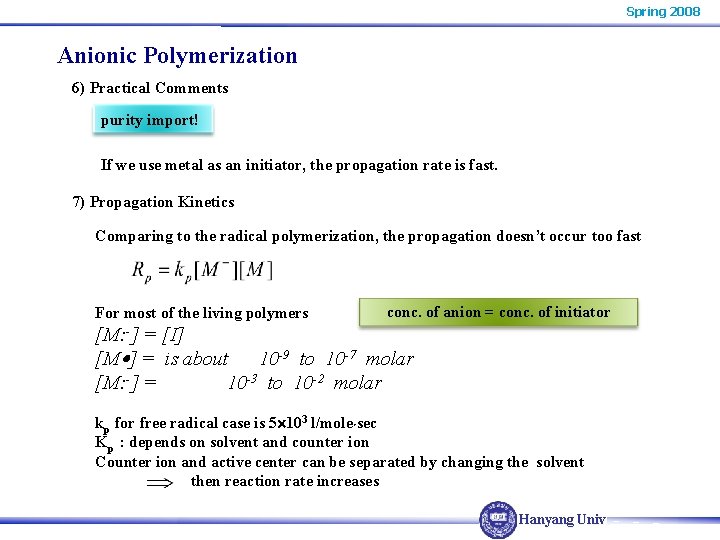
Spring 2008 Anionic Polymerization 6) Practical Comments purity import! If we use metal as an initiator, the propagation rate is fast. 7) Propagation Kinetics Comparing to the radical polymerization, the propagation doesn’t occur too fast For most of the living polymers conc. of anion = conc. of initiator [M: -] = [I] [M ] = is about 10 -9 to 10 -7 molar [M: -] = 10 -3 to 10 -2 molar kp for free radical case is 5 103 l/mole sec Kp : depends on solvent and counter ion Counter ion and active center can be separated by changing the solvent then reaction rate increases Hanyang Univ.
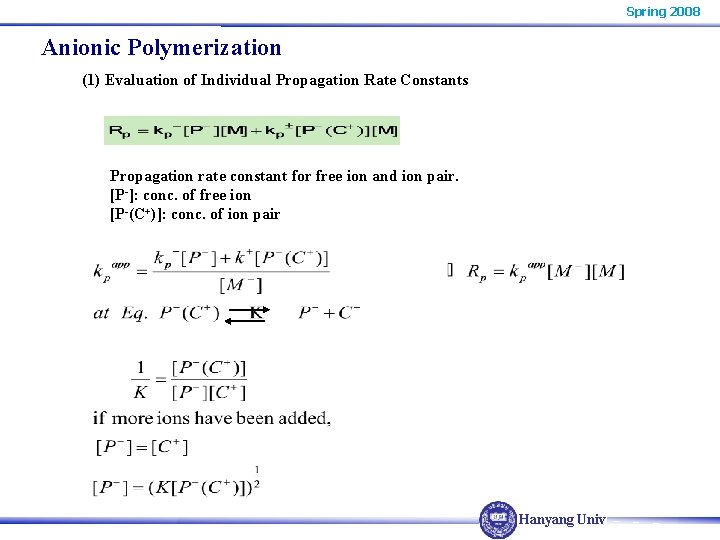
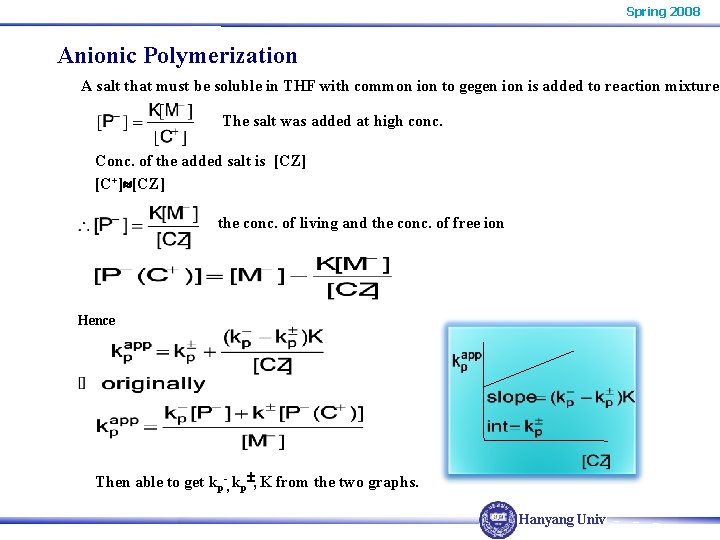
Spring 2008 Anionic Polymerization (1) Evaluation of Individual Propagation Rate Constants Propagation rate constant for free ion and ion pair. [P-]: conc. of free ion [P-(C+)]: conc. of ion pair Hanyang Univ.
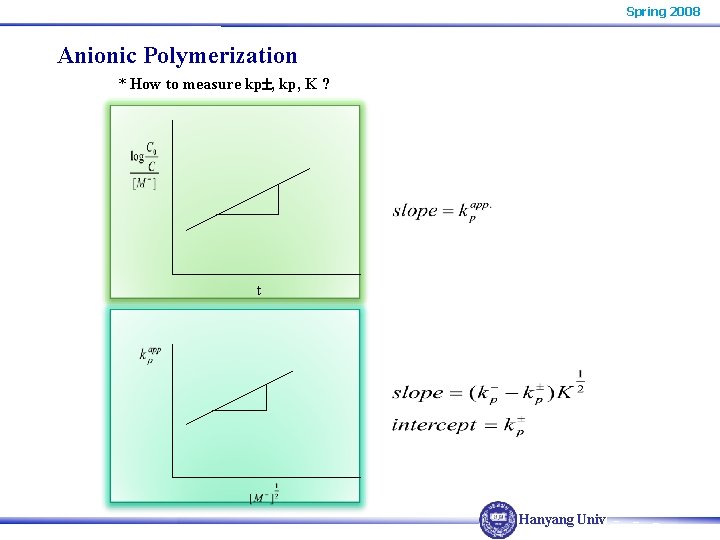
Spring 2008 Anionic Polymerization * How to measure kp , kp, K ? t Hanyang Univ.
Spring 2008 Anionic Polymerization A salt that must be soluble in THF with common ion to gegen ion is added to reaction mixture. The salt was added at high conc. Conc. of the added salt is [CZ] [C+] [CZ] the conc. of living and the conc. of free ion Hence Then able to get kp-, kp , K from the two graphs. Hanyang Univ.
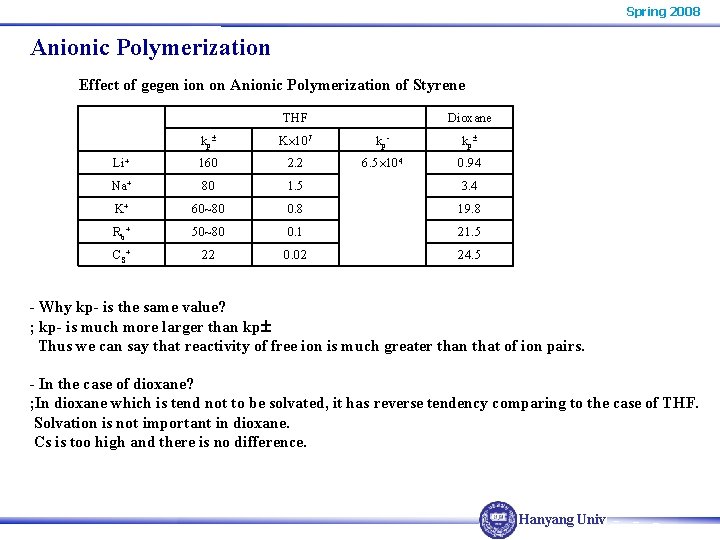
Spring 2008 Anionic Polymerization Effect of gegen ion on Anionic Polymerization of Styrene THF Dioxane kp K 107 kp- kp Li+ 160 2. 2 6. 5 104 0. 94 Na+ 80 1. 5 3. 4 K+ 60~80 0. 8 19. 8 Rb+ 50~80 0. 1 21. 5 CS+ 22 0. 02 24. 5 - Why kp- is the same value? ; kp- is much more larger than kp Thus we can say that reactivity of free ion is much greater than that of ion pairs. - In the case of dioxane? ; In dioxane which is tend not to be solvated, it has reverse tendency comparing to the case of THF. Solvation is not important in dioxane. Cs is too high and there is no difference. Hanyang Univ.
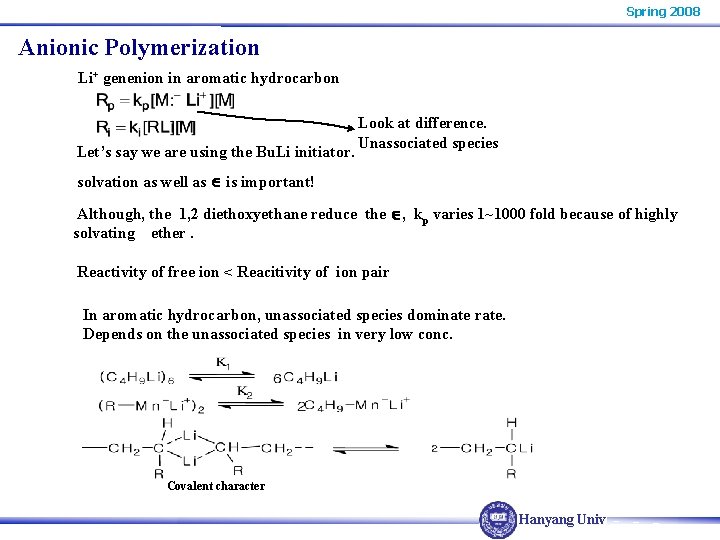
Spring 2008 Anionic Polymerization Li+ genenion in aromatic hydrocarbon Let’s say we are using the Bu. Li initiator. Look at difference. Unassociated species solvation as well as is important! Although, the 1, 2 diethoxyethane reduce the , kp varies 1~1000 fold because of highly solvating ether. Reactivity of free ion < Reacitivity of ion pair In aromatic hydrocarbon, unassociated species dominate rate. Depends on the unassociated species in very low conc. Covalent character Hanyang Univ.
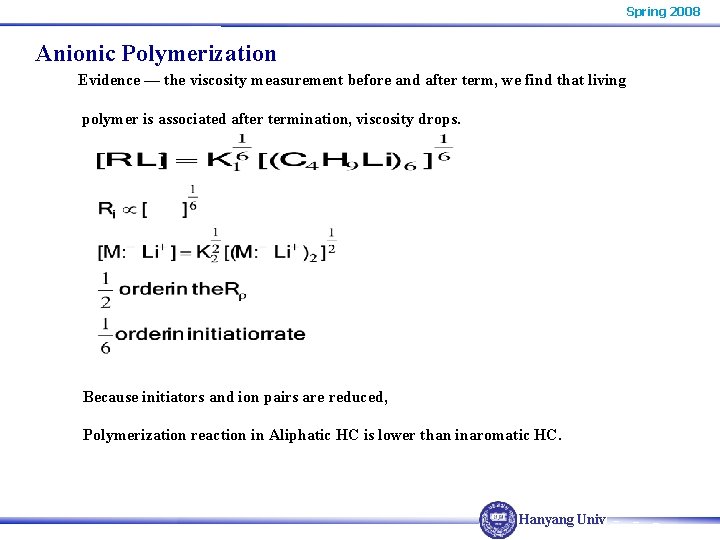
Spring 2008 Anionic Polymerization Evidence — the viscosity measurement before and after term, we find that living polymer is associated after termination, viscosity drops. Because initiators and ion pairs are reduced, Polymerization reaction in Aliphatic HC is lower than inaromatic HC. Hanyang Univ.
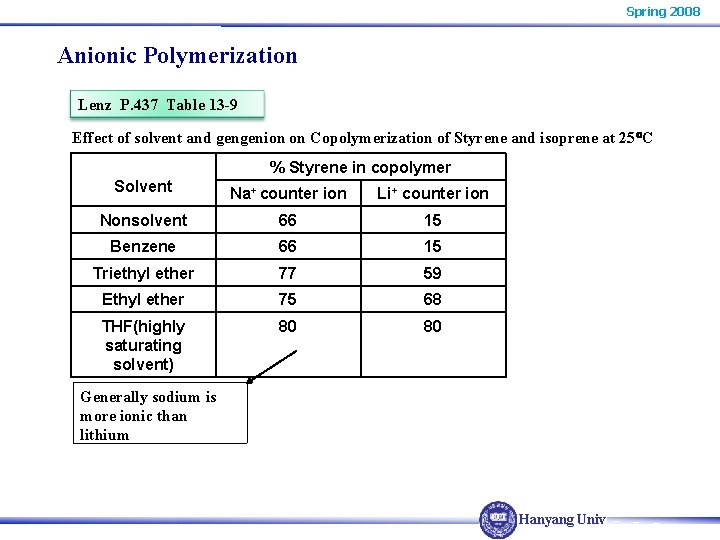
Spring 2008 Anionic Polymerization Lenz P. 437 Table 13 -9 Effect of solvent and gengenion on Copolymerization of Styrene and isoprene at 25 C % Styrene in copolymer Solvent Na+ counter ion Li+ counter ion Nonsolvent 66 15 Benzene 66 15 Triethyl ether 77 59 Ethyl ether 75 68 THF(highly saturating solvent) 80 80 Generally sodium is more ionic than lithium Hanyang Univ.
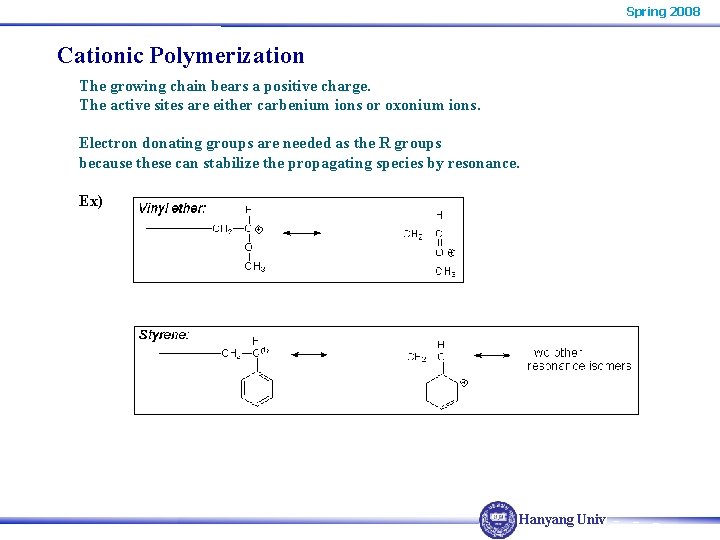
Spring 2008 Cationic Polymerization The growing chain bears a positive charge. The active sites are either carbenium ions or oxonium ions. Electron donating groups are needed as the R groups because these can stabilize the propagating species by resonance. Ex) Hanyang Univ.
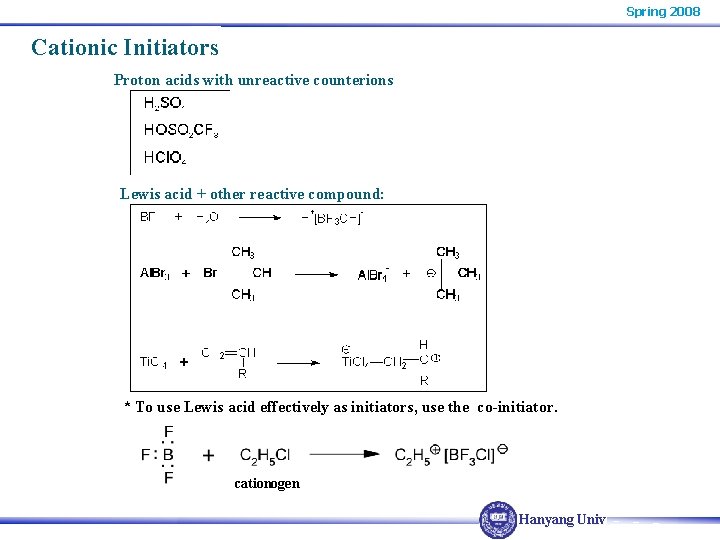
Spring 2008 Cationic Initiators Proton acids with unreactive counterions Lewis acid + other reactive compound: * To use Lewis acid effectively as initiators, use the co-initiator. cationogen Hanyang Univ.
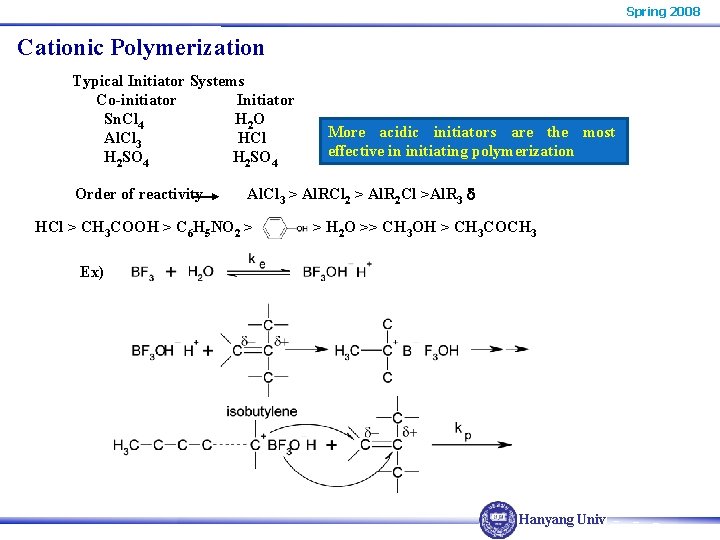
Spring 2008 Cationic Polymerization Typical Initiator Systems Co-initiator Initiator Sn. Cl 4 H 2 O Al. Cl 3 HCl H 2 SO 4 Order of reactivity More acidic initiators are the most effective in initiating polymerization Al. Cl 3 > Al. RCl 2 > Al. R 2 Cl >Al. R 3 HCl > CH 3 COOH > C 6 H 5 NO 2 > > H 2 O >> CH 3 OH > CH 3 COCH 3 Ex) Hanyang Univ.
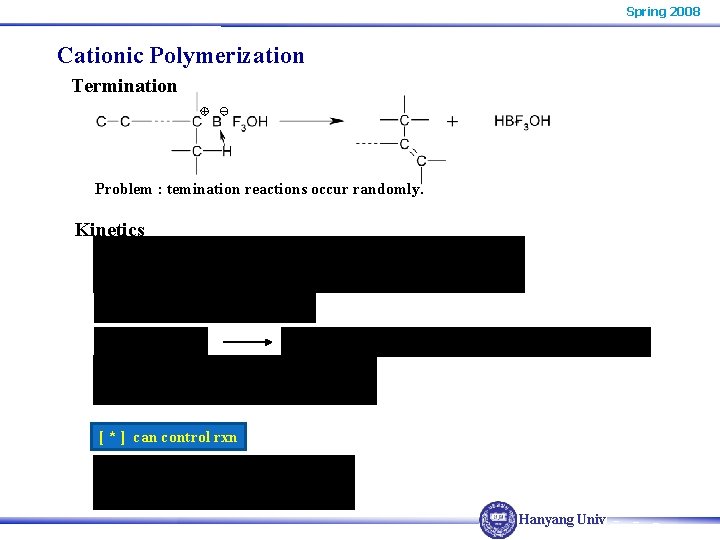
Spring 2008 Cationic Polymerization Termination Problem : temination reactions occur randomly. Kinetics [ * ] can control rxn Hanyang Univ.
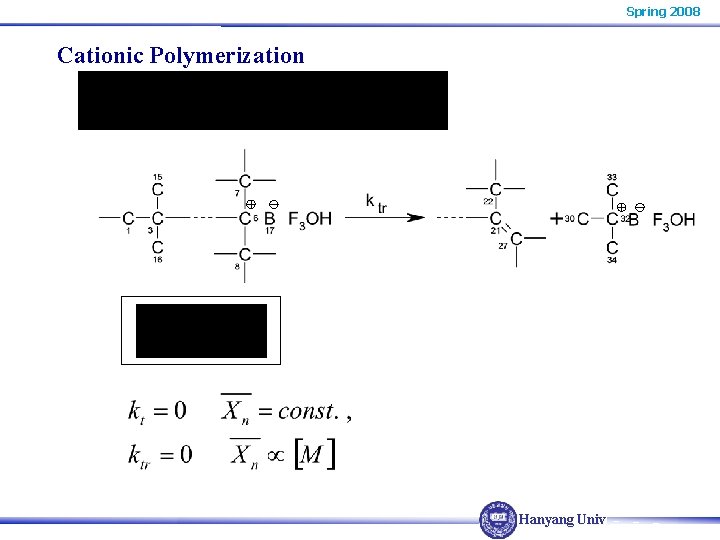
Spring 2008 Cationic Polymerization Hanyang Univ.
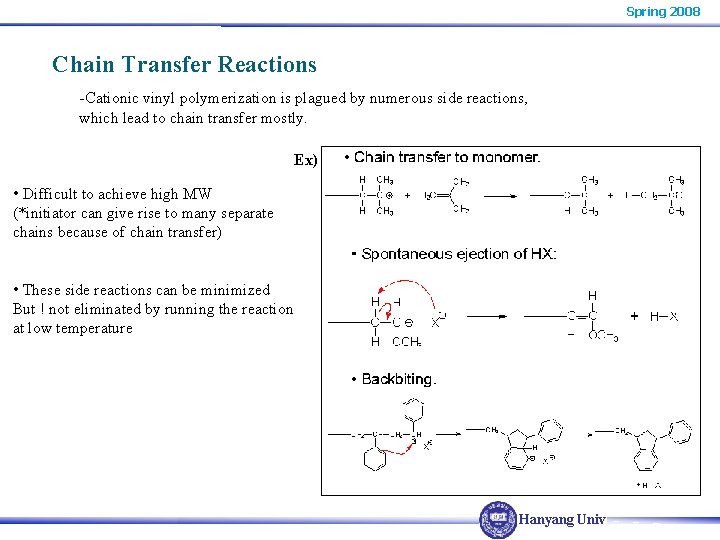
Spring 2008 Chain Transfer Reactions -Cationic vinyl polymerization is plagued by numerous side reactions, which lead to chain transfer mostly. Ex) • Difficult to achieve high MW (*initiator can give rise to many separate chains because of chain transfer) • These side reactions can be minimized But ! not eliminated by running the reaction at low temperature Hanyang Univ.
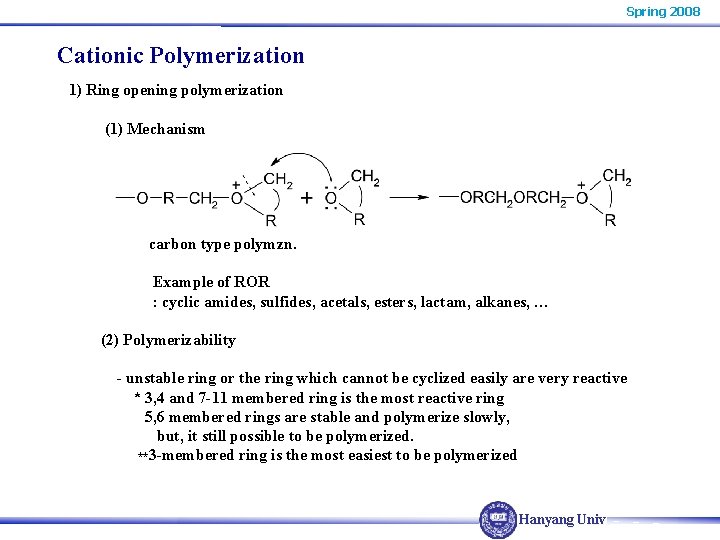
Spring 2008 Cationic Polymerization 1) Ring opening polymerization (1) Mechanism carbon type polymzn. Example of ROR : cyclic amides, sulfides, acetals, esters, lactam, alkanes, … (2) Polymerizability - unstable ring or the ring which cannot be cyclized easily are very reactive * 3, 4 and 7 -11 membered ring is the most reactive ring 5, 6 membered rings are stable and polymerize slowly, but, it still possible to be polymerized. **3 -membered ring is the most easiest to be polymerized Hanyang Univ.
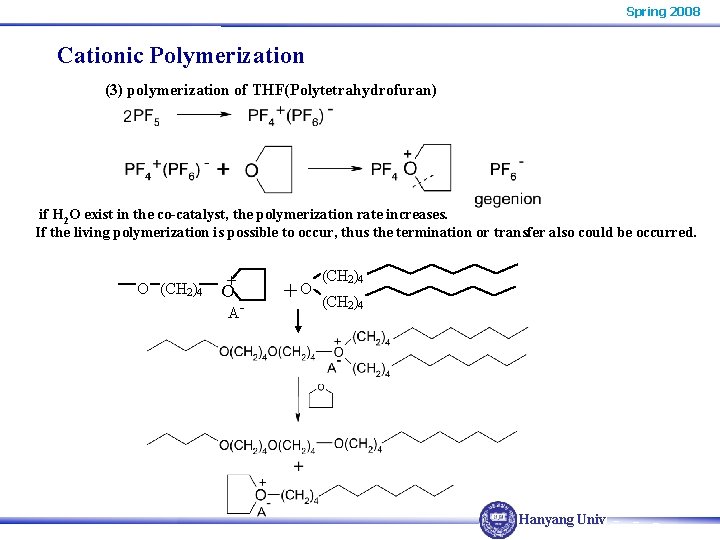
Spring 2008 Cationic Polymerization (3) polymerization of THF(Polytetrahydrofuran) if H 2 O exist in the co-catalyst, the polymerization rate increases. If the living polymerization is possible to occur, thus the termination or transfer also could be occurred. O (CH 2)4 + O A- +O (CH 2)4 Hanyang Univ.
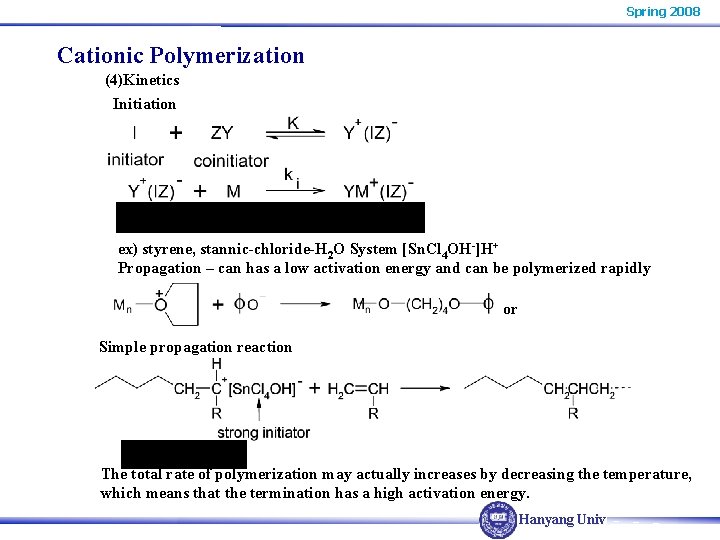
Spring 2008 Cationic Polymerization (4)Kinetics Initiation ex) styrene, stannic-chloride-H 2 O System [Sn. Cl 4 OH-]H+ Propagation – can has a low activation energy and can be polymerized rapidly or Simple propagation reaction The total rate of polymerization may actually increases by decreasing the temperature, which means that the termination has a high activation energy. Hanyang Univ.