
Spring 2007 Chap 8 Polycondensation Reactions Classification by
Spring 2007 Chap 8. Polycondensation Reactions Classification by Mechanism Step – Growth Chain – Growth Classification by Type Condensation Addition Classification by Bond Radical Ion Surfing to the internet For further details, Click next homepage. http: //www. pslc. ws/mactest/synth. ht m Hanyang Univ.
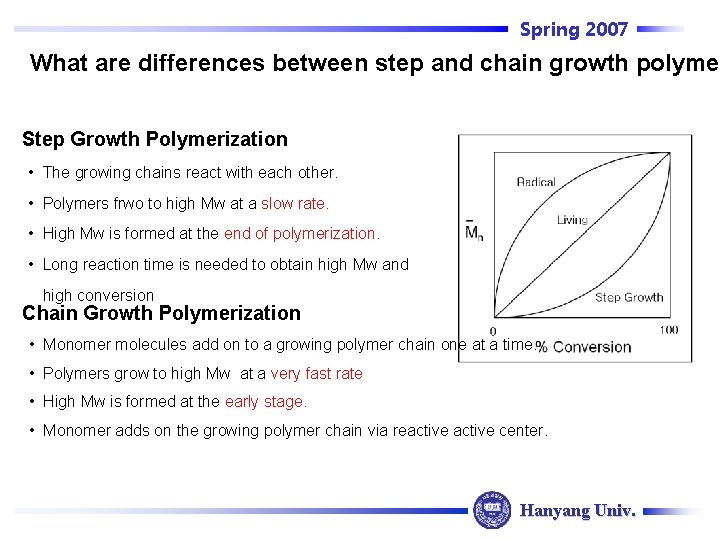
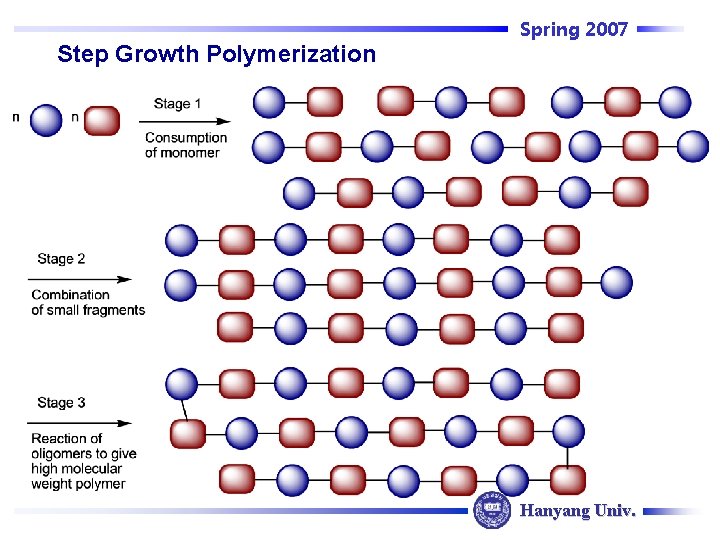
Spring 2007 What are differences between step and chain growth polymer Step Growth Polymerization • The growing chains react with each other. • Polymers frwo to high Mw at a slow rate. • High Mw is formed at the end of polymerization. • Long reaction time is needed to obtain high Mw and high conversion Chain Growth Polymerization • Monomer molecules add on to a growing polymer chain one at a time. • Polymers grow to high Mw at a very fast rate • High Mw is formed at the early stage. • Monomer adds on the growing polymer chain via reactive center. Hanyang Univ.
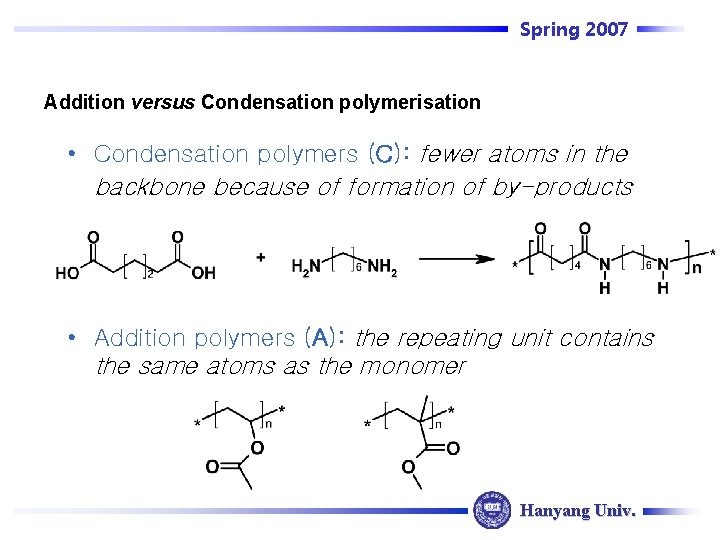
Spring 2007 Addition versus Condensation polymerisation • Condensation polymers (C): fewer atoms in the backbone because of formation of by-products • Addition polymers (A): the repeating unit contains the same atoms as the monomer Hanyang Univ.
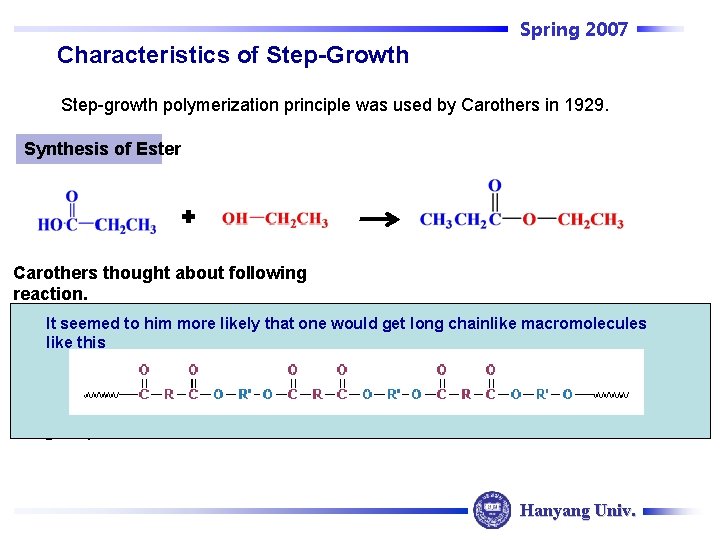
Spring 2007 Characteristics of Step-Growth Step-growth polymerization principle was used by Carothers in 1929. Synthesis of Ester Carothers thought about following reaction. It seemed to him more likely that one would get long chainlike macromolecules Many scientists were sure like this that one would get a ring-like molecule But, if more acid and alcohol were used, ring would not form because of unstability of ring-shaped molecules more than six atom. Hanyang Univ.
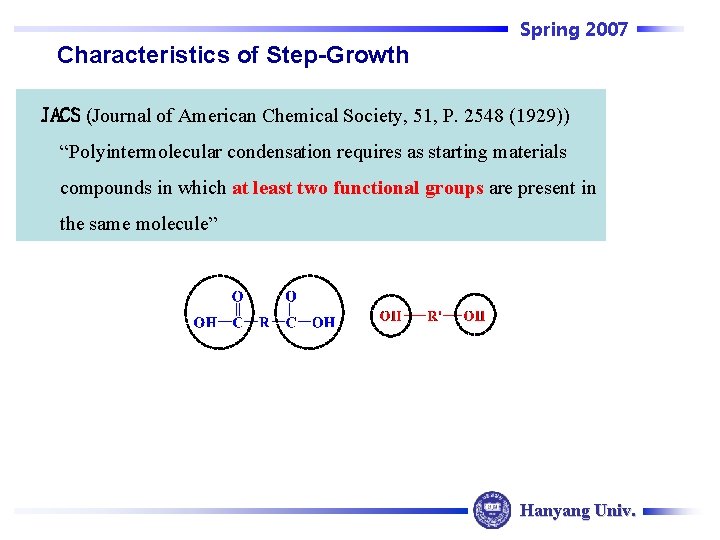
Spring 2007 Characteristics of Step-Growth JACS (Journal of American Chemical Society, 51, P. 2548 (1929)) “Polyintermolecular condensation requires as starting materials compounds in which at least two functional groups are present in the same molecule” Hanyang Univ.
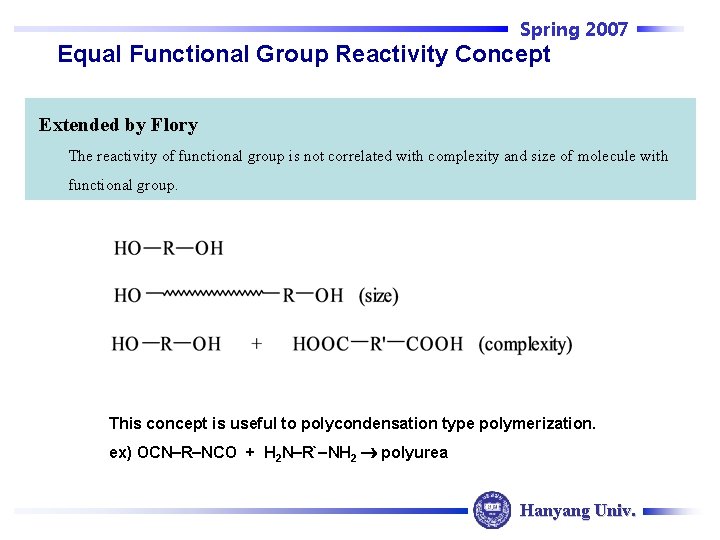
Spring 2007 Equal Functional Group Reactivity Concept Extended by Flory The reactivity of functional group is not correlated with complexity and size of molecule with functional group. This concept is useful to polycondensation type polymerization. ex) OCN R NCO + H 2 N R` NH 2 polyurea Hanyang Univ.
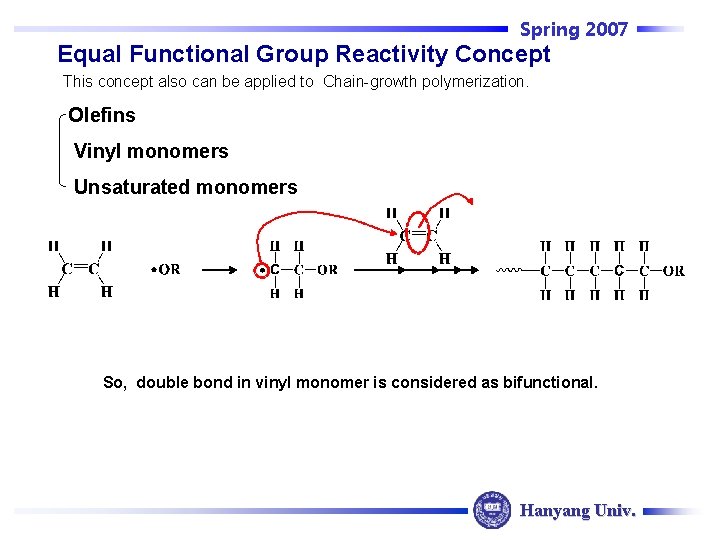
Spring 2007 Equal Functional Group Reactivity Concept This concept also can be applied to Chain-growth polymerization. Olefins Vinyl monomers Unsaturated monomers So, double bond in vinyl monomer is considered as bifunctional. Hanyang Univ.
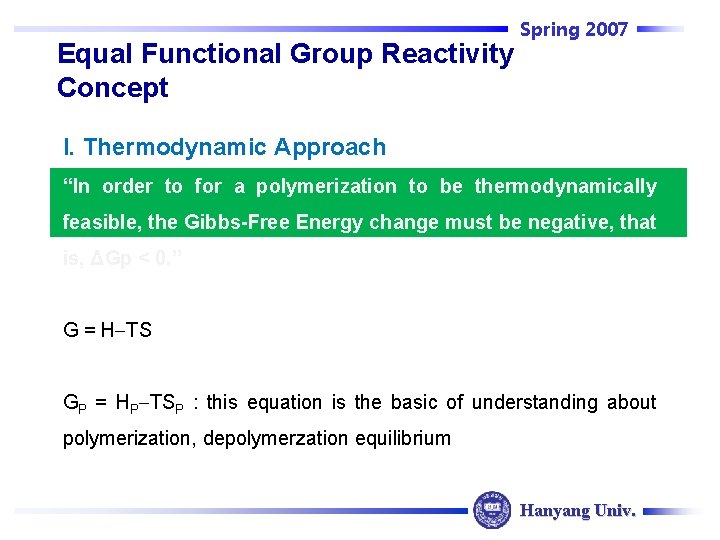
Spring 2007 Equal Functional Group Reactivity Concept I. Thermodynamic Approach “In order to for a polymerization to be thermodynamically feasible, the Gibbs-Free Energy change must be negative, that is, ΔGp < 0. ” G = H TS GP = HP TSP : this equation is the basic of understanding about polymerization, depolymerzation equilibrium Hanyang Univ.
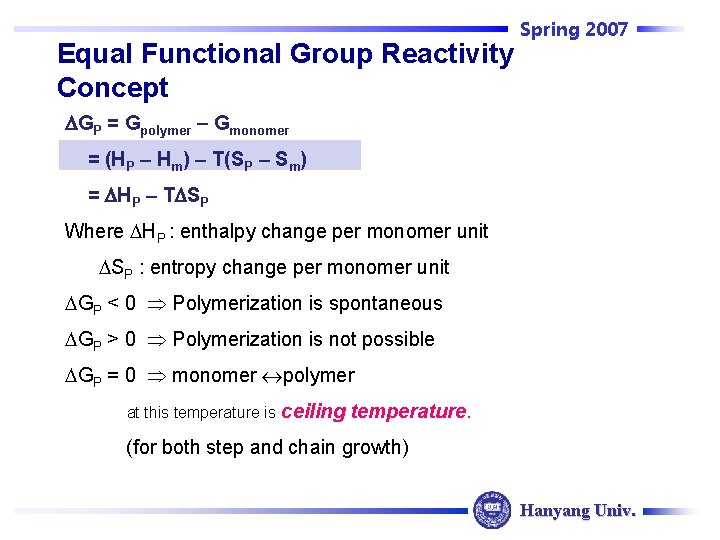
Spring 2007 Equal Functional Group Reactivity Concept GP = Gpolymer Gmonomer = (HP – Hm) – T(SP – Sm) = HP – T SP Where HP : enthalpy change per monomer unit SP : entropy change per monomer unit GP < 0 Polymerization is spontaneous GP > 0 Polymerization is not possible GP = 0 monomer polymer at this temperature is ceiling temperature. (for both step and chain growth) Hanyang Univ.
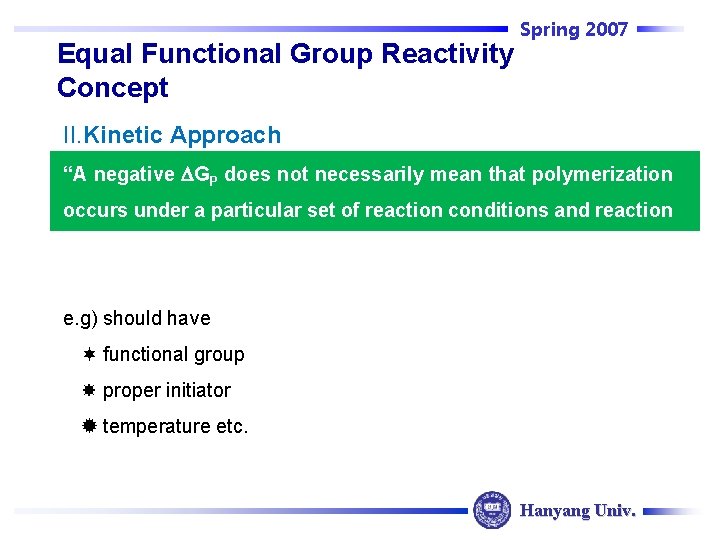
Spring 2007 Equal Functional Group Reactivity Concept II. Kinetic Approach “A negative GP does not necessarily mean that polymerization occurs under a particular set of reaction conditions and reaction sites” e. g) should have functional group proper initiator temperature etc. Hanyang Univ.
Spring 2007 Step Growth Polymerization Hanyang Univ.
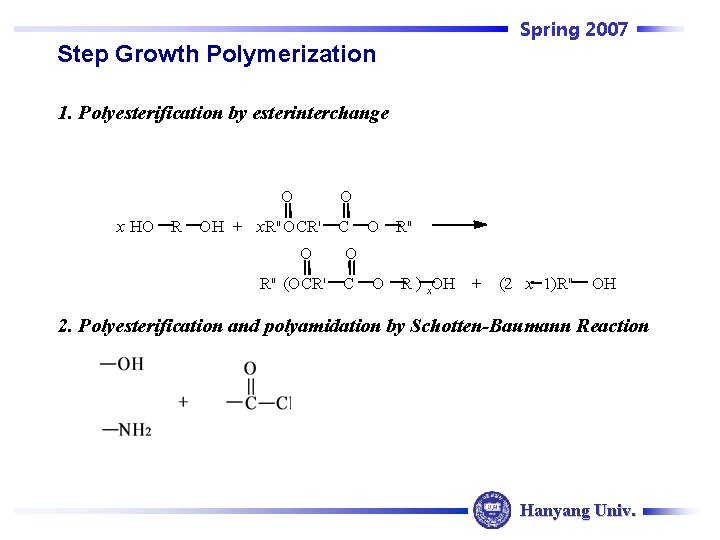
Spring 2007 Step Growth Polymerization 1. Polyesterification by esterinterchange O O x HO R OH + x. R"OCR' C O R" O O R" (OCR' C O R ) OH + (2 x 1)R" OH x 2. Polyesterification and polyamidation by Schotten-Baumann Reaction Hanyang Univ.
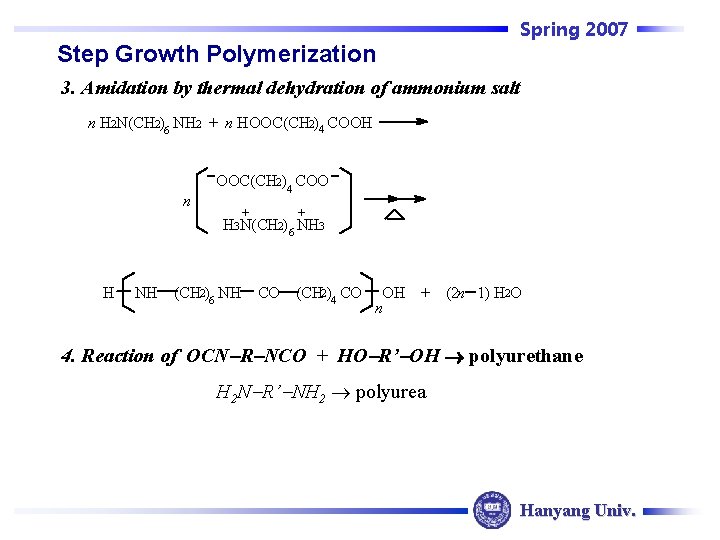
Spring 2007 Step Growth Polymerization 3. Amidation by thermal dehydration of ammonium salt 2 + n HOOC(CH 2) COOH n H 2 N(CH 2) NH 4 6 n OOC(CH 2) COO 4 + + 3 H 3 N(CH 2) NH 6 2) CO OH + (2 n 1) H 2 O H NH (CH 2) NH CO (CH 6 4 n 4. Reaction of OCN R NCO + HO R’ OH polyurethane H 2 N R’ NH 2 polyurea Hanyang Univ.
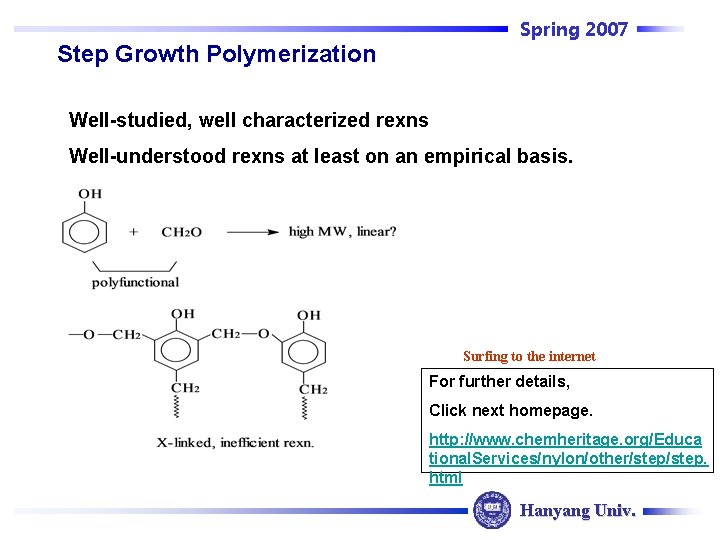
Spring 2007 Step Growth Polymerization Well-studied, well characterized rexns Well-understood rexns at least on an empirical basis. Surfing to the internet For further details, Click next homepage. http: //www. chemheritage. org/Educa tional. Services/nylon/other/step. html Hanyang Univ.

Spring 2007 Carother’s Equation W. Carothers In step-growth polymerization, Carother's equation gives the numberaverage degree of polymerization, Xn, for a given fractional monomer conversion, p. P = extent of reaction [M]= concentaration of monomer P 0 0. 5 0. 8 0. 95 0. 999 DPn 1 2 5 50 1000 When P = 0. 995 DPn = 200. Hanyang Univ.

Spring 2007 Carother’s Equation f = number of average functional group per monomer N 0 = number of initial monomers N 0 f = number of initial functional group N = number of final molecules (monomer, dimer, polymer) Generalized Carother's Eq. Hanyang Univ.
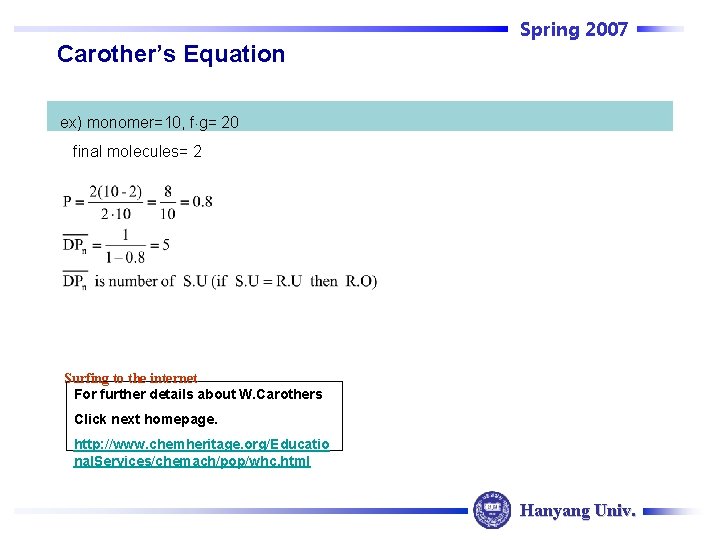
Spring 2007 Carother’s Equation ex) monomer=10, f g= 20 final molecules= 2 Surfing to the internet For further details about W. Carothers Click next homepage. http: //www. chemheritage. org/Educatio nal. Services/chemach/pop/whc. html Hanyang Univ.
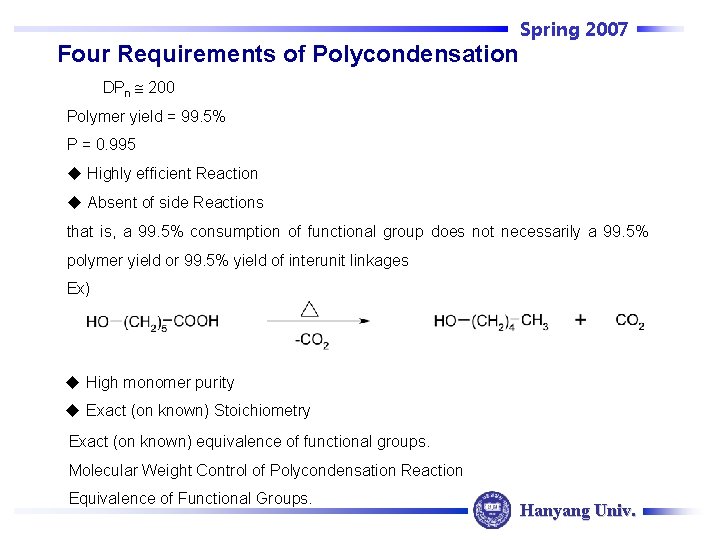
Spring 2007 Four Requirements of Polycondensation DPn 200 Polymer yield = 99. 5% P = 0. 995 u Highly efficient Reaction u Absent of side Reactions that is, a 99. 5% consumption of functional group does not necessarily a 99. 5% polymer yield or 99. 5% yield of interunit linkages Ex) u High monomer purity u Exact (on known) Stoichiometry Exact (on known) equivalence of functional groups. Molecular Weight Control of Polycondensation Reaction Equivalence of Functional Groups. Hanyang Univ.
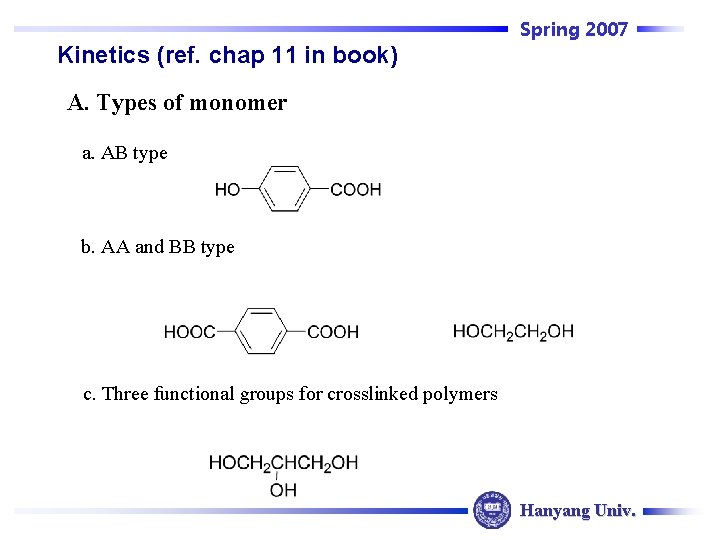
Spring 2007 Kinetics (ref. chap 11 in book) A. Types of monomer a. AB type b. AA and BB type c. Three functional groups for crosslinked polymers Hanyang Univ.
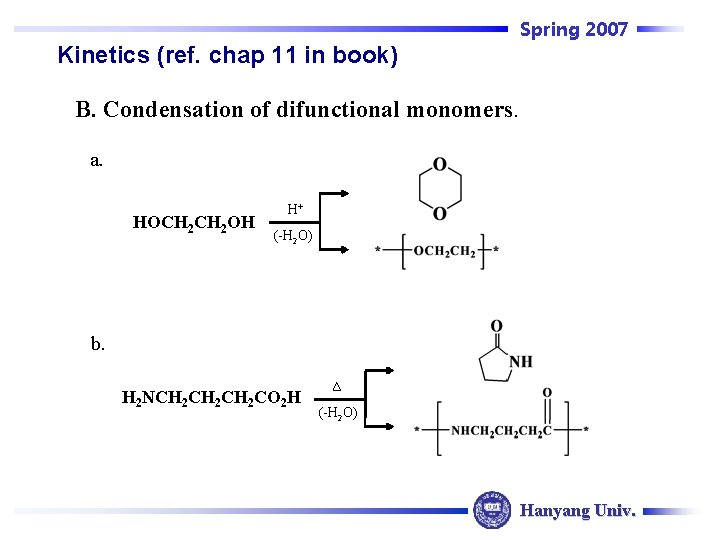
Spring 2007 Kinetics (ref. chap 11 in book) B. Condensation of difunctional monomers. a. HOCH 2 OH H+ (-H 2 O) b. H 2 NCH 2 CH 2 CO 2 H ∆ (-H 2 O) Hanyang Univ.
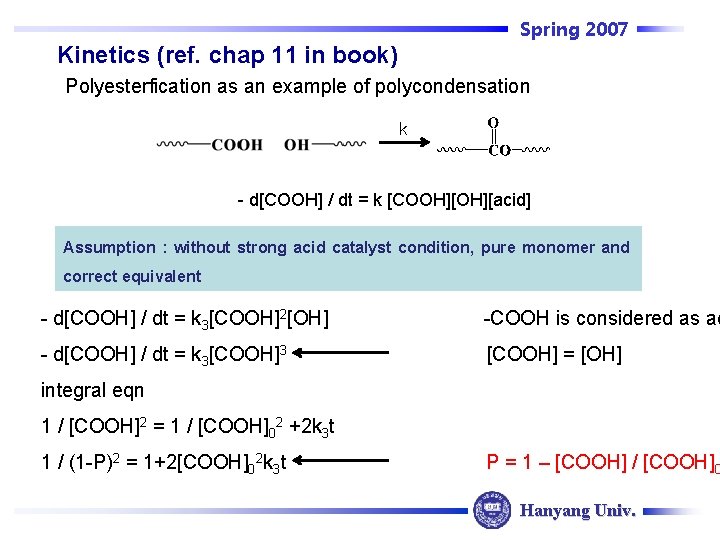
Spring 2007 Kinetics (ref. chap 11 in book) Polyesterfication as an example of polycondensation k - d[COOH] / dt = k [COOH][acid] Assumption : without strong acid catalyst condition, pure monomer and correct equivalent - d[COOH] / dt = k 3[COOH]2[OH] -COOH is considered as ac - d[COOH] / dt = k 3[COOH]3 [COOH] = [OH] integral eqn 1 / [COOH]2 = 1 / [COOH]02 +2 k 3 t 1 / (1 -P)2 = 1+2[COOH]02 k 3 t P = 1 – [COOH] / [COOH]0 Hanyang Univ.
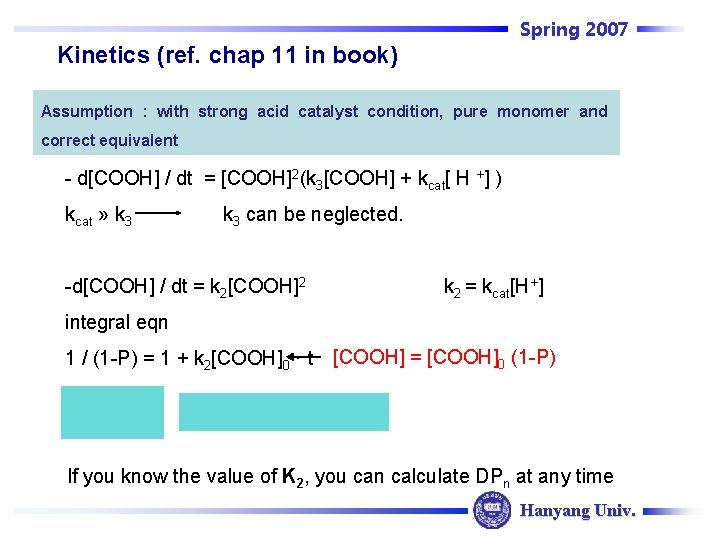
Spring 2007 Kinetics (ref. chap 11 in book) Assumption : with strong acid catalyst condition, pure monomer and correct equivalent - d[COOH] / dt = [COOH]2(k 3[COOH] + kcat[ H +] ) kcat » k 3 k 3 can be neglected. -d[COOH] / dt = k 2[COOH]2 k 2 = kcat[H+] integral eqn 1 / (1 -P) = 1 + k 2[COOH]0 · t [COOH] = [COOH]0 (1 -P) If you know the value of K 2, you can calculate DPn at any time Hanyang Univ.
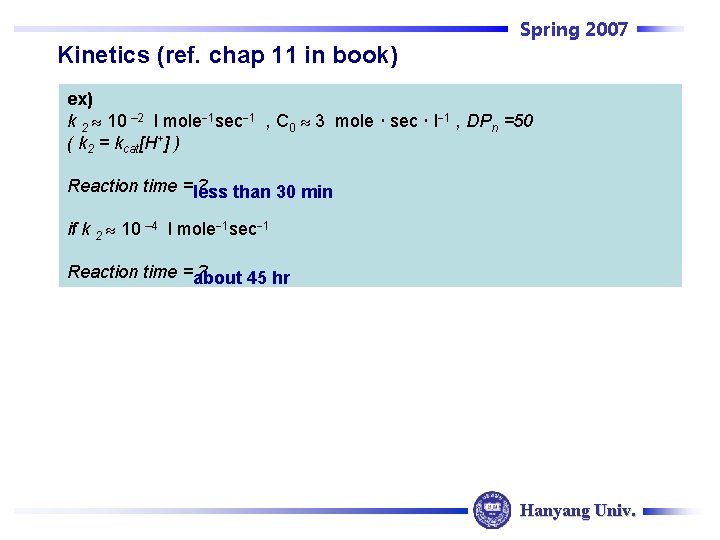
Spring 2007 Kinetics (ref. chap 11 in book) ex) k 2 10 – 2 l mole 1 sec 1 , C 0 3 mole sec l 1 , DPn =50 ( k 2 = kcat[H+] ) Reaction time = less than 30 min ? if k 2 10 – 4 l mole 1 sec 1 Reaction time = about 45 hr ? Hanyang Univ.
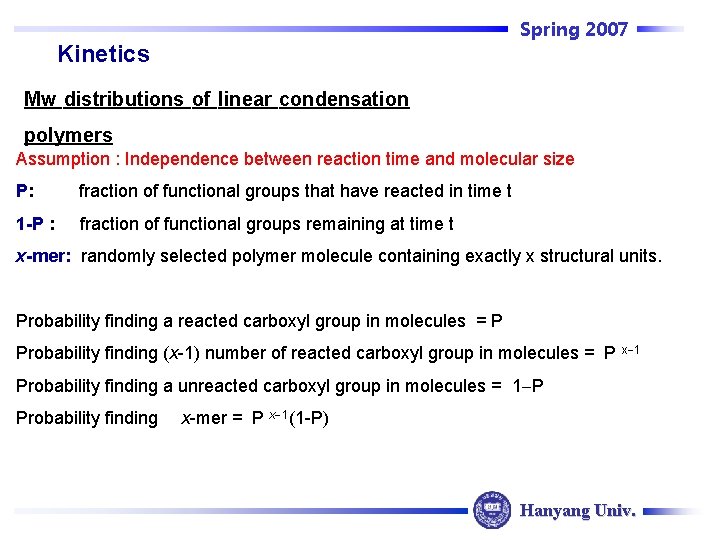
Spring 2007 Kinetics Mw distributions of linear condensation polymers Assumption : Independence between reaction time and molecular size P: fraction of functional groups that have reacted in time t 1 -P : fraction of functional groups remaining at time t x-mer: randomly selected polymer molecule containing exactly x structural units. Probability finding a reacted carboxyl group in molecules = P Probability finding (x-1) number of reacted carboxyl group in molecules = P x 1 Probability finding a unreacted carboxyl group in molecules = 1 P Probability finding x-mer = P x 1(1 -P) Hanyang Univ.
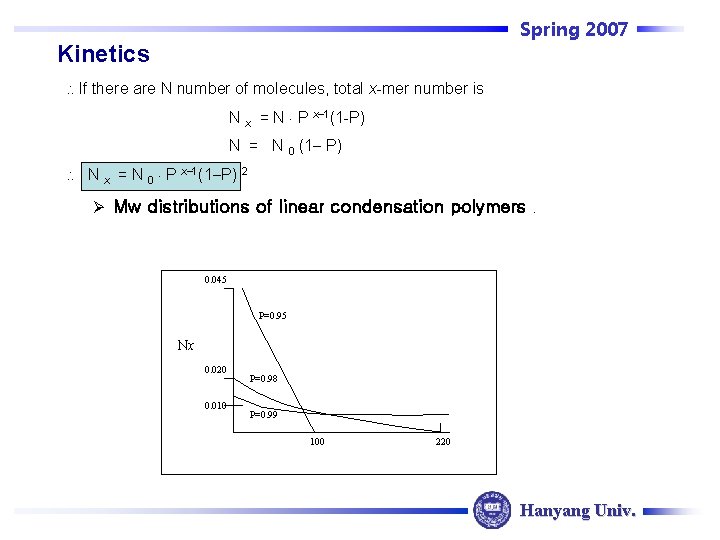
Spring 2007 Kinetics If there are N number of molecules, total x-mer number is N x = N P x 1(1 -P) N = N 0 (1 P) N x = N 0 P x 1(1 P) 2 Mw distributions of linear condensation polymers. 0. 045 P=0. 95 Nx 0. 020 0. 010 P=0. 98 P=0. 99 100 220 Hanyang Univ.
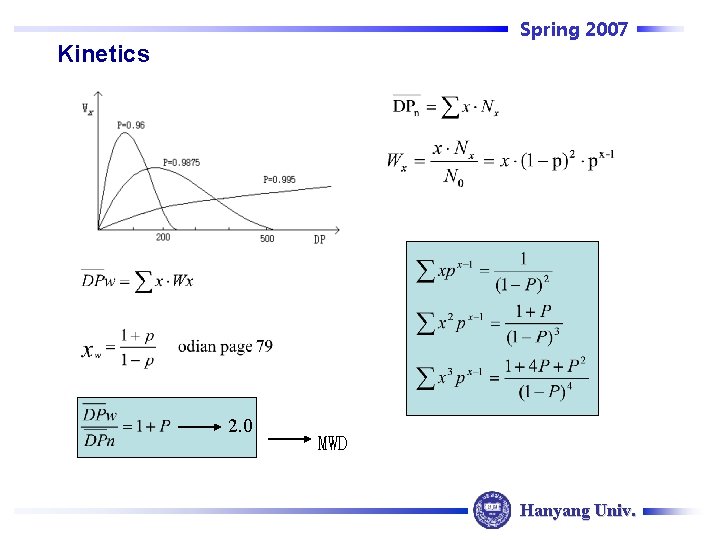
Spring 2007 Kinetics 2. 0 MWD Hanyang Univ.
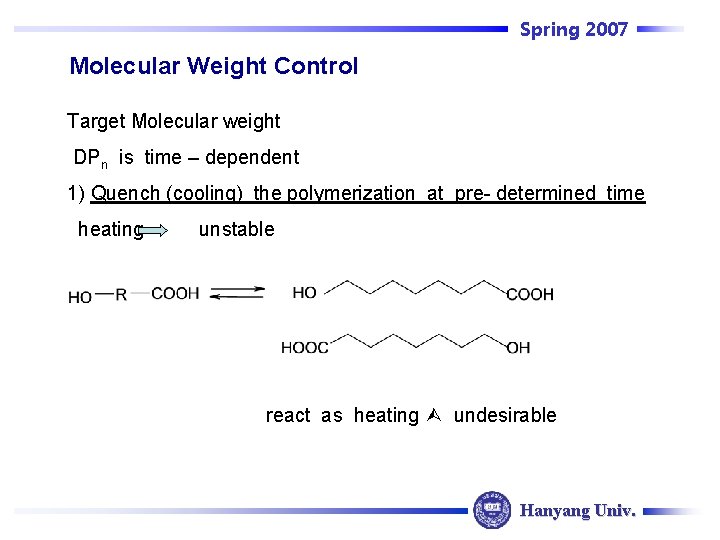
Spring 2007 Molecular Weight Control Target Molecular weight DPn is time – dependent 1) Quench (cooling) the polymerization at pre- determined time heating unstable react as heating undesirable Hanyang Univ.
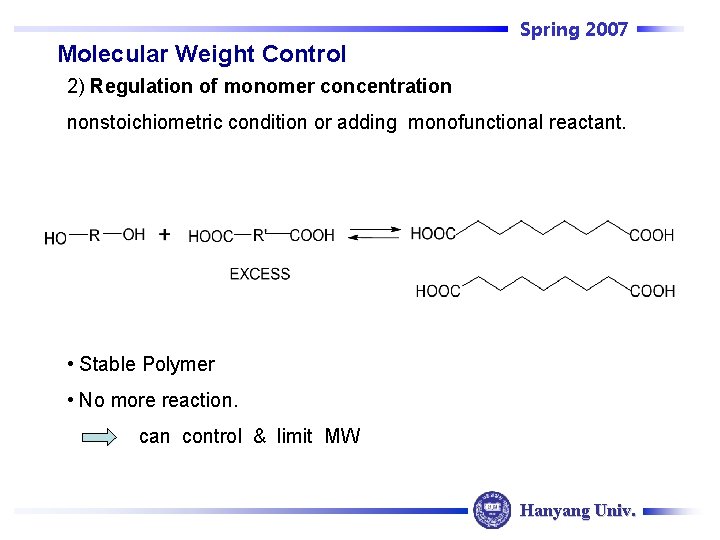
Spring 2007 Molecular Weight Control 2) Regulation of monomer concentration nonstoichiometric condition or adding monofunctional reactant. • Stable Polymer • No more reaction. can control & limit MW Hanyang Univ.
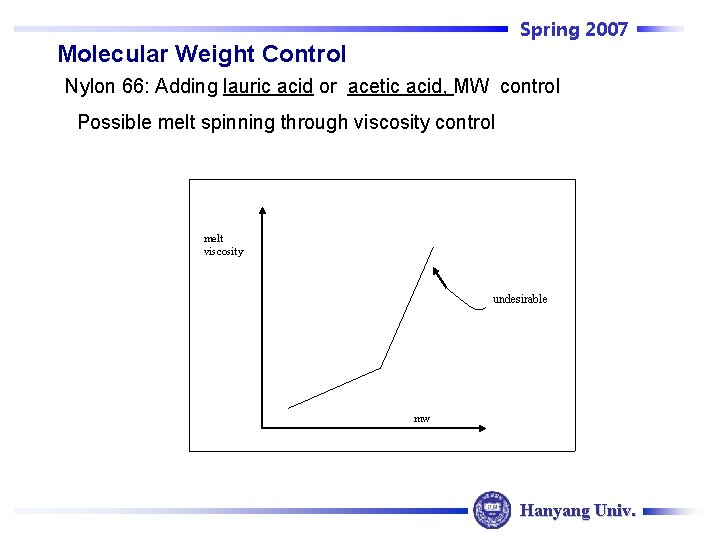
Spring 2007 Molecular Weight Control Nylon 66: Adding lauric acid or acetic acid, MW control Possible melt spinning through viscosity control melt viscosity undesirable mw Hanyang Univ.
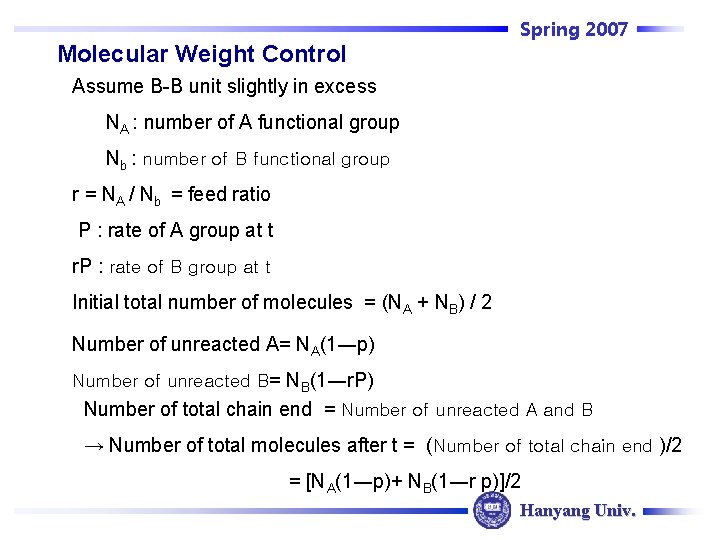
Spring 2007 Molecular Weight Control Assume B-B unit slightly in excess NA : number of A functional group Nb : number of B functional group r = NA / Nb = feed ratio P : rate of A group at t r. P : rate of B group at t Initial total number of molecules = (NA + NB) / 2 Number of unreacted A= NA(1―p) Number of unreacted B= NB(1―r. P) Number of total chain end = Number of unreacted A and B → Number of total molecules after t = (Number of total chain end )/2 = [N A(1―p)+ NB(1―r p)]/2 Hanyang Univ.
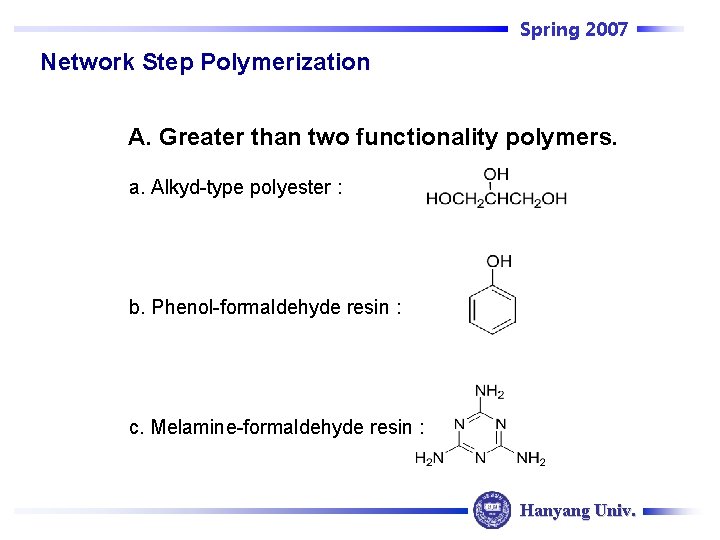
Spring 2007 Network Step Polymerization A. Greater than two functionality polymers. a. Alkyd-type polyester : b. Phenol-formaldehyde resin : c. Melamine-formaldehyde resin : Hanyang Univ.
Spring 2007 Network Step Polymerization B. Gelatin : High conversion of greater than two functionality a. Gel point : onset of gelatin. sudden increase in viscosity. change from liquid to gel. bubbles no longer rising. impossible stirring. Hanyang Univ.

Spring 2007 Network Step Polymerization C. Gel point conversion. : critical reaction conversion. : average functionality. Hanyang Univ.
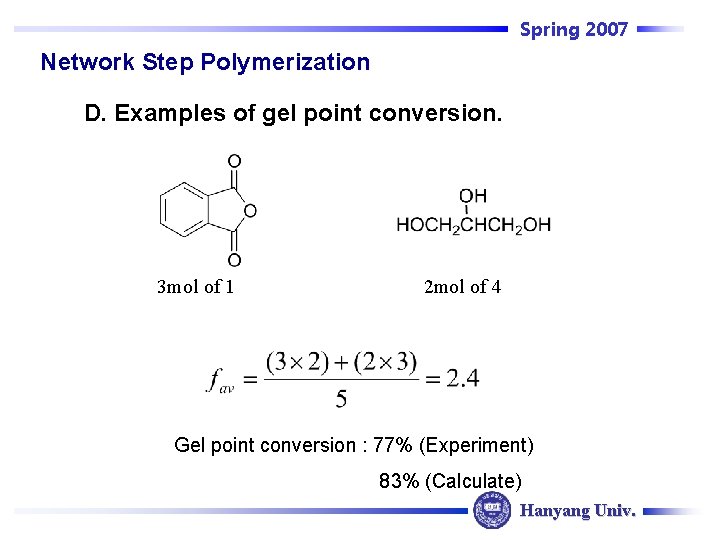
Spring 2007 Network Step Polymerization D. Examples of gel point conversion. 3 mol of 1 2 mol of 4 Gel point conversion : 77% (Experiment) 83% (Calculate) Hanyang Univ.
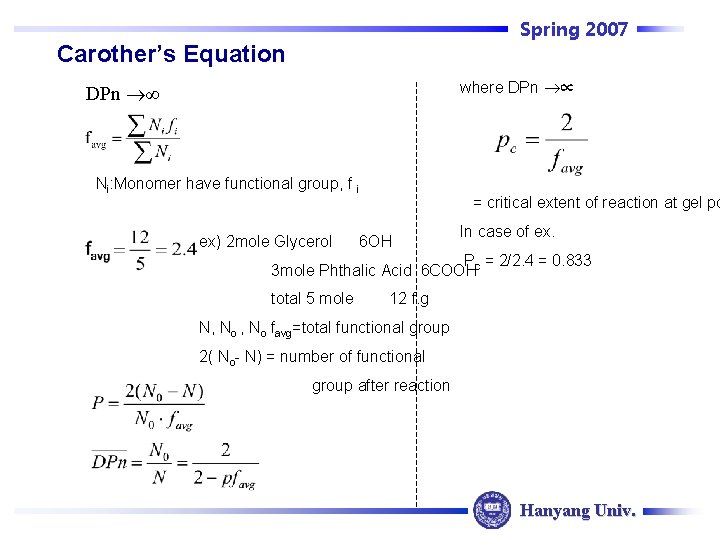
Spring 2007 Carother’s Equation where DPn ∝ DPn ∞ Ni: Monomer have functional group, f i ex) 2 mole Glycerol 6 OH = critical extent of reaction at gel po In case of ex. P = 2/2. 4 = 0. 833 3 mole Phthalic Acid 6 COOHc total 5 mole 12 f. g N, No favg=total functional group 2( No- N) = number of functional group after reaction Hanyang Univ.
Spring 2007 Example of condensation polymerization A. Polyester (Dacron, Mylar) ester interchange rexn is faster than direct esterification. It is difficult to purify diacid. Methyl ester is used commonly. For termination, alcohol is removed by distillation of reaction mixture. Surfing to the internet For further details about Polyester Click next homepage. http: //www. pslc. ws/mactest/pet. htm Hanyang Univ.
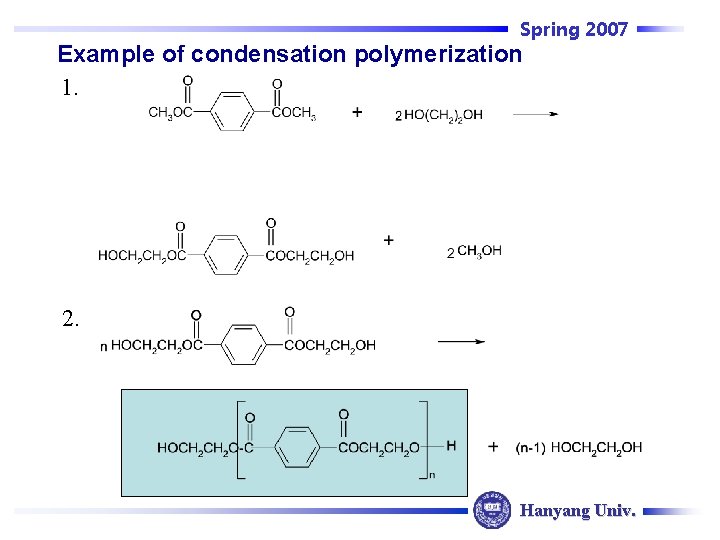
Spring 2007 Example of condensation polymerization 1. 2. Hanyang Univ.
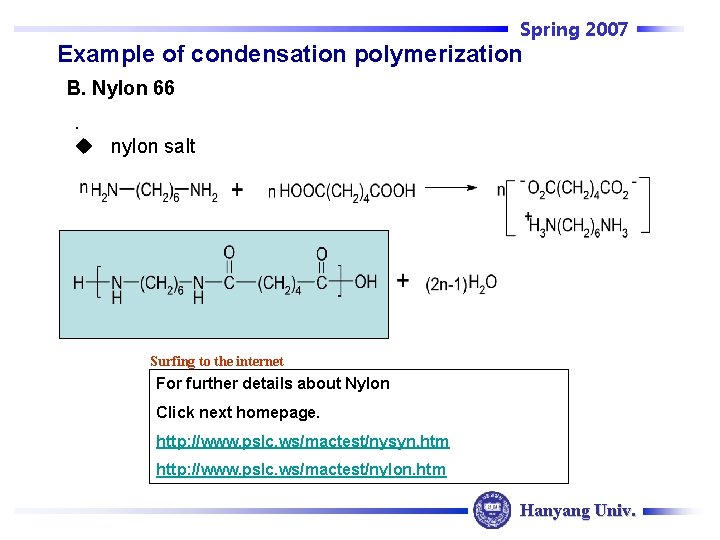
Spring 2007 Example of condensation polymerization B. Nylon 66. u nylon salt Surfing to the internet For further details about Nylon Click next homepage. http: //www. pslc. ws/mactest/nysyn. htm http: //www. pslc. ws/mactest/nylon. htm Hanyang Univ.
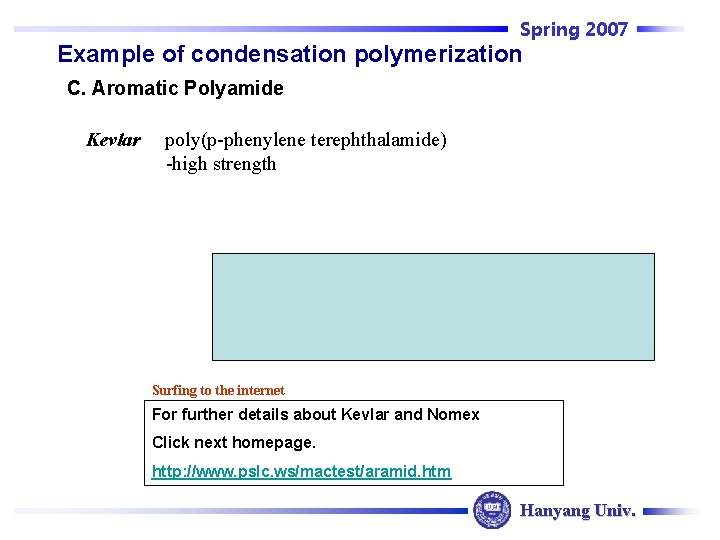
Spring 2007 Example of condensation polymerization C. Aromatic Polyamide Kevlar poly(p-phenylene terephthalamide) -high strength Surfing to the internet For further details about Kevlar and Nomex Click next homepage. http: //www. pslc. ws/mactest/aramid. htm Hanyang Univ.
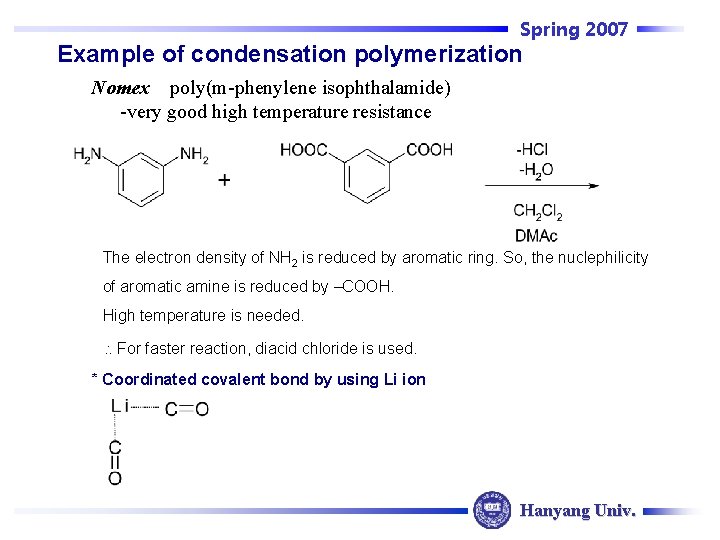
Spring 2007 Example of condensation polymerization Nomex poly(m-phenylene isophthalamide) -very good high temperature resistance The electron density of NH 2 is reduced by aromatic ring. So, the nuclephilicity of aromatic amine is reduced by –COOH. High temperature is needed. For faster reaction, diacid chloride is used. * Coordinated covalent bond by using Li ion Hanyang Univ.
Spring 2007 Example of condensation polymerization D. Aromatic Polyimides Hanyang Univ.
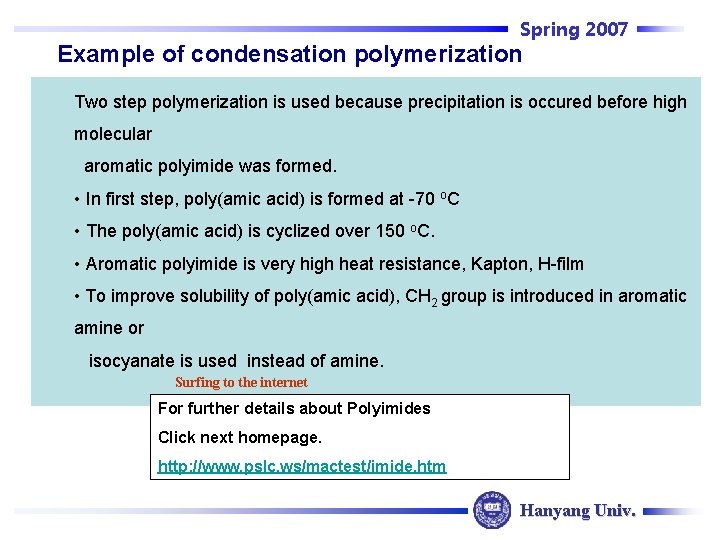
Spring 2007 Example of condensation polymerization Two step polymerization is used because precipitation is occured before high molecular aromatic polyimide was formed. • In first step, poly(amic acid) is formed at -70 o. C • The poly(amic acid) is cyclized over 150 o. C. • Aromatic polyimide is very high heat resistance, Kapton, H-film • To improve solubility of poly(amic acid), CH 2 group is introduced in aromatic amine or isocyanate is used instead of amine. Surfing to the internet For further details about Polyimides Click next homepage. http: //www. pslc. ws/mactest/imide. htm Hanyang Univ.
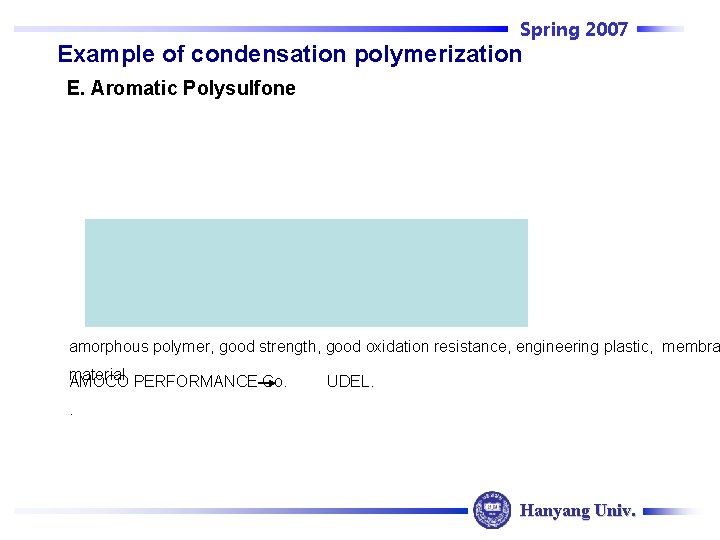
Spring 2007 Example of condensation polymerization E. Aromatic Polysulfone amorphous polymer, good strength, good oxidation resistance, engineering plastic, membra material AMOCO PERFORMANCE Co. UDEL. . Hanyang Univ.
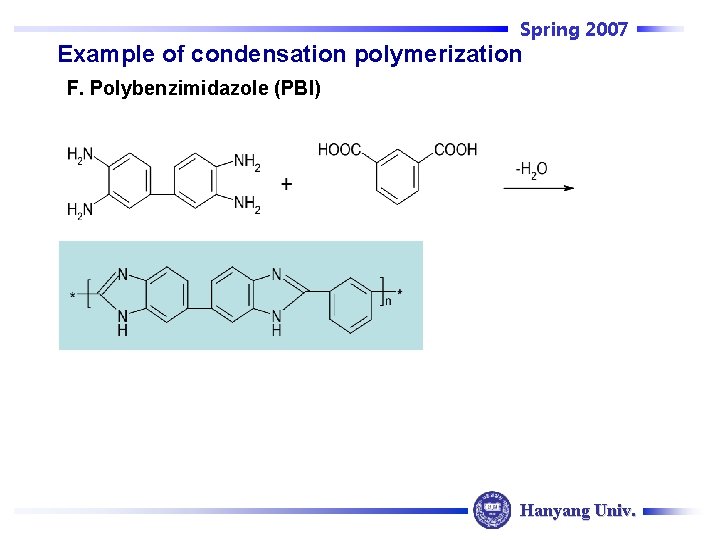
Spring 2007 Example of condensation polymerization F. Polybenzimidazole (PBI) Hanyang Univ.
Spring 2007 Example of condensation polymerization Hanyang Univ.
Spring 2007 1961 Synthesized by Marvel Some problems : stoichiometric problems, side reactions, oxidatio, … Celanese Co. (http: //www. celanese. com) not burn easily, self-extinguishing, but still expensive $45/lb in 1985 Hanyang Univ.
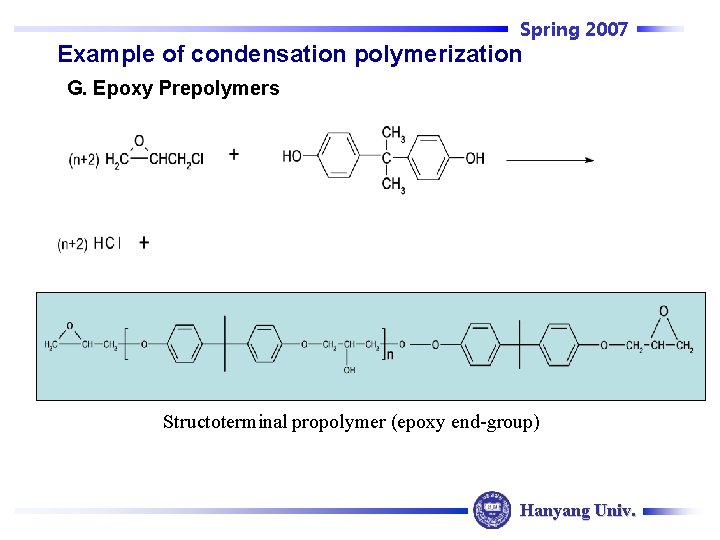
Spring 2007 Example of condensation polymerization G. Epoxy Prepolymers Structoterminal propolymer (epoxy end-group) Hanyang Univ.
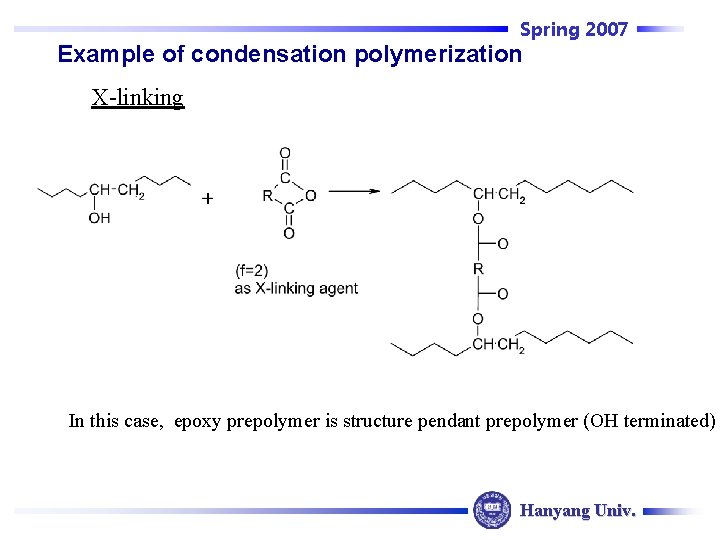
Spring 2007 Example of condensation polymerization X-linking In this case, epoxy prepolymer is structure pendant prepolymer (OH terminated) Hanyang Univ.
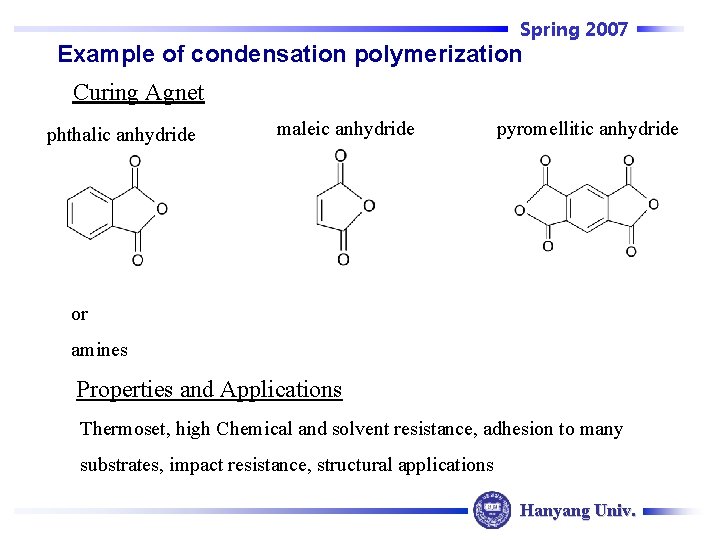
Spring 2007 Example of condensation polymerization Curing Agnet phthalic anhydride maleic anhydride pyromellitic anhydride or amines Properties and Applications Thermoset, high Chemical and solvent resistance, adhesion to many substrates, impact resistance, structural applications Hanyang Univ.
Spring 2007 Example of condensation polymerization H. Unsaturated Polyesters Hanyang Univ.
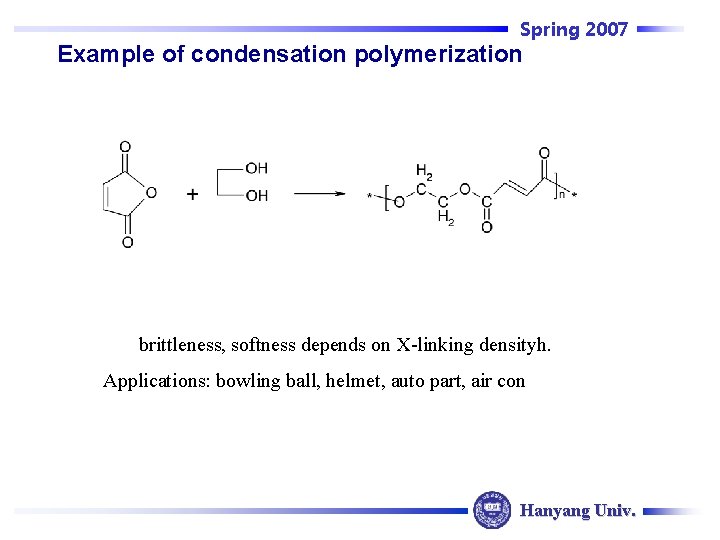
Spring 2007 Example of condensation polymerization brittleness, softness depends on X-linking densityh. Applications: bowling ball, helmet, auto part, air con Hanyang Univ.
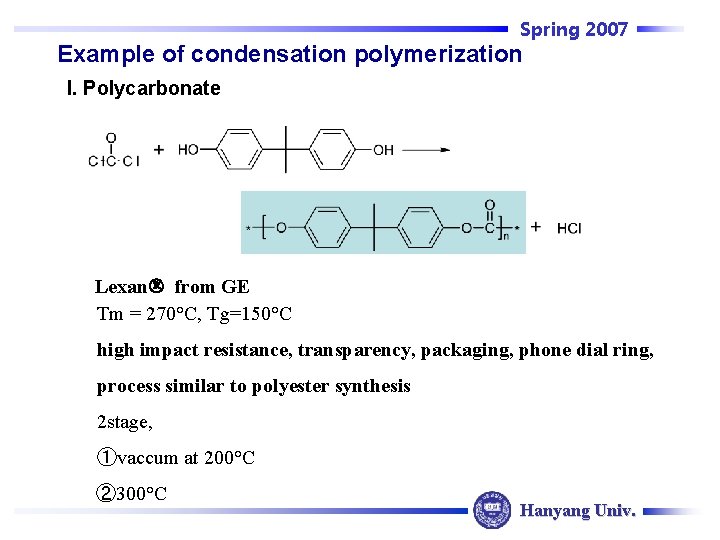
Spring 2007 Example of condensation polymerization I. Polycarbonate Lexan from GE Tm = 270°C, Tg=150°C high impact resistance, transparency, packaging, phone dial ring, process similar to polyester synthesis 2 stage, ①vaccum at 200°C ② 300°C Hanyang Univ.
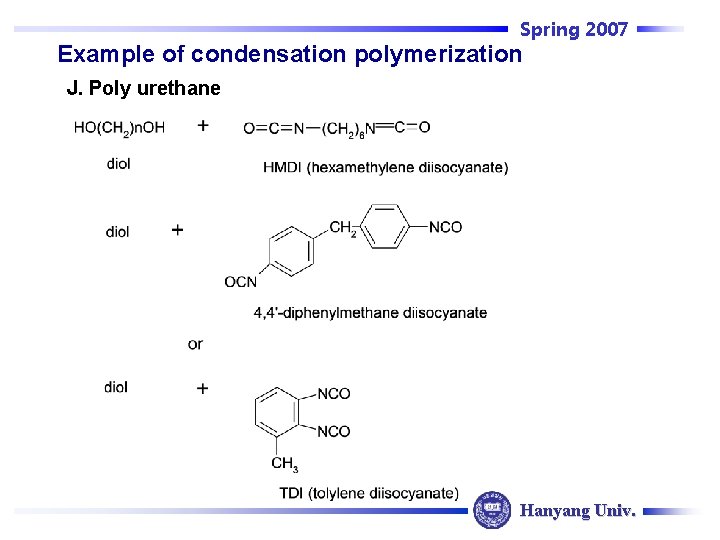
Spring 2007 Example of condensation polymerization J. Poly urethane Hanyang Univ.
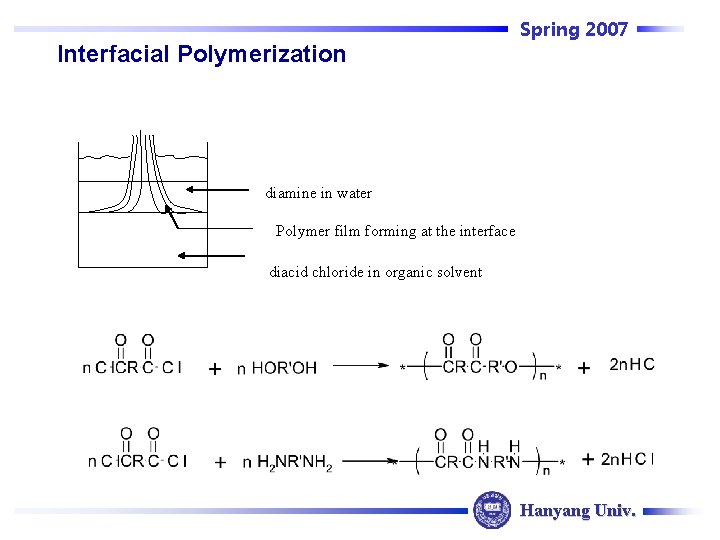
Spring 2007 Interfacial Polymerization diamine in water Polymer film forming at the interface diacid chloride in organic solvent Hanyang Univ.
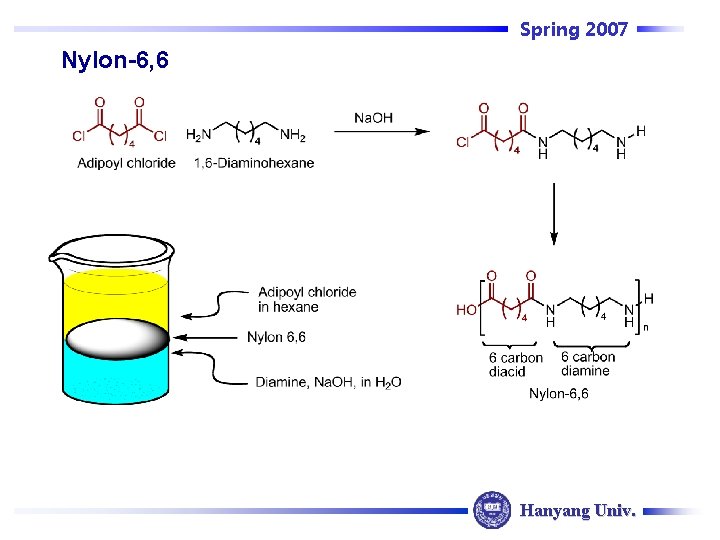
Spring 2007 Nylon-6, 6 Hanyang Univ.
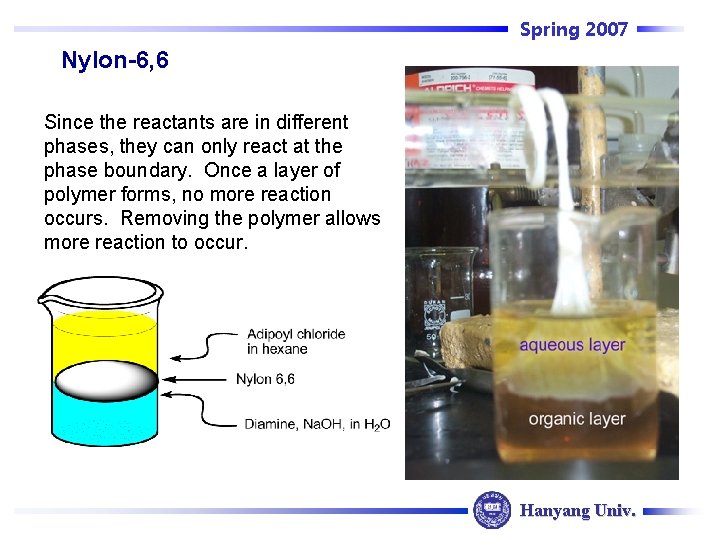
Spring 2007 Nylon-6, 6 Since the reactants are in different phases, they can only react at the phase boundary. Once a layer of polymer forms, no more reaction occurs. Removing the polymer allows more reaction to occur. Hanyang Univ.
- Slides: 56