
Spring 2007 Chap 5 Characterization of MW Unlike
- Slides: 30
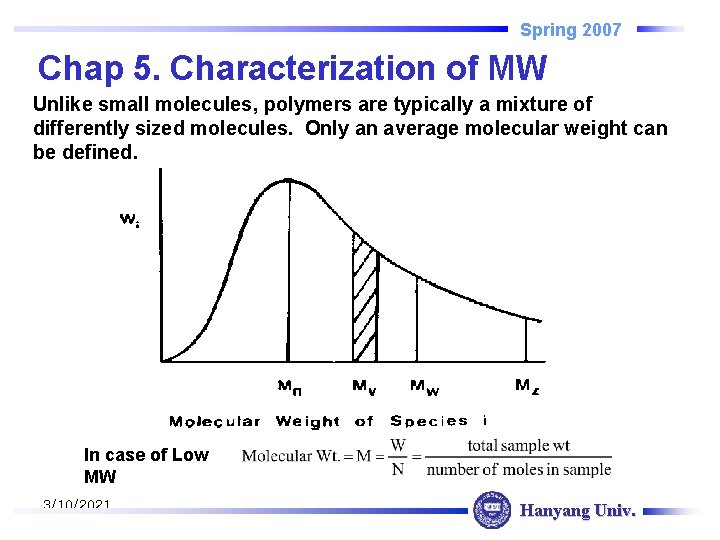
Spring 2007 Chap 5. Characterization of MW Unlike small molecules, polymers are typically a mixture of differently sized molecules. Only an average molecular weight can be defined. In case of Low MW 3/10/2021 Hanyang Univ.
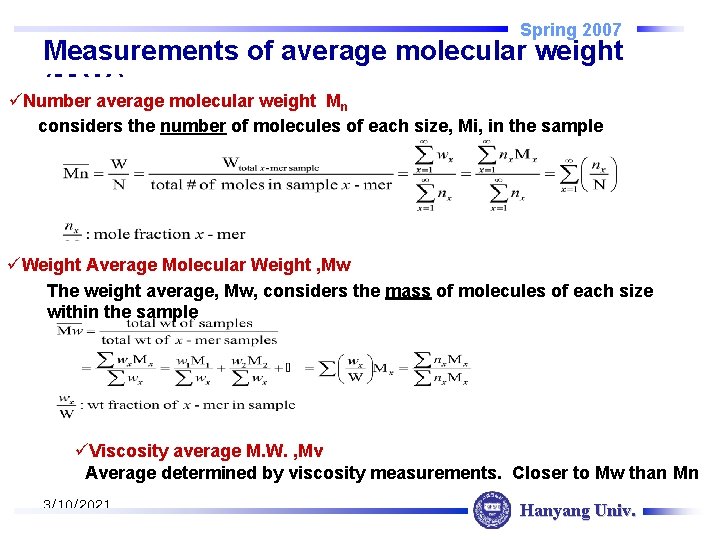
Spring 2007 Measurements of average molecular weight (M. W. ) üNumber average molecular weight M n considers the number of molecules of each size, Mi, in the sample üWeight Average Molecular Weight , Mw The weight average, Mw, considers the mass of molecules of each size within the sample üViscosity average M. W. , Mv Average determined by viscosity measurements. Closer to Mw than Mn 3/10/2021 Hanyang Univ.
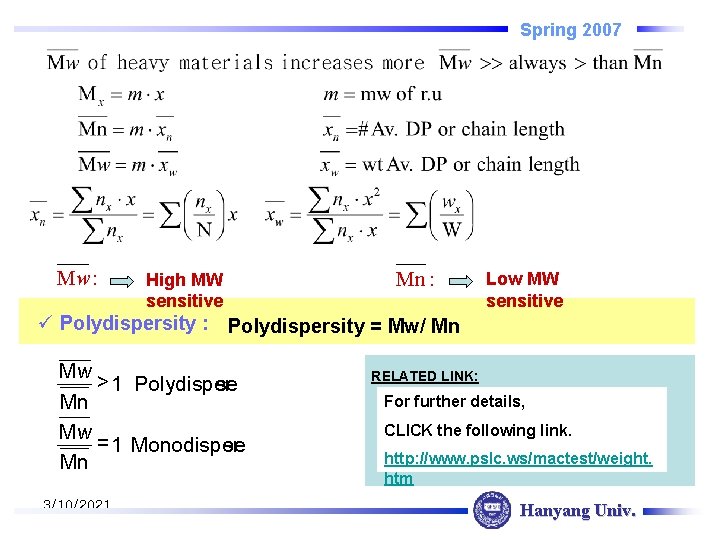
Spring 2007 Mw : High MW sensitive Mn : Low MW sensitive ü Polydispersity : Polydispersity = Mw/ Mn Mw > 1 Polydisper se Mn Mw = 1 Monodisper se Mn 3/10/2021 RELATED LINK: For further details, CLICK the following link. http: //www. pslc. ws/mactest/weight. htm Hanyang Univ.
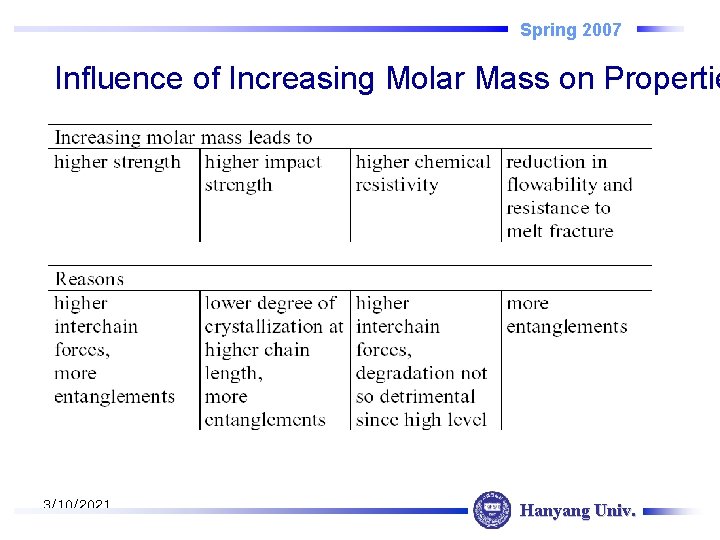
Spring 2007 Influence of Increasing Molar Mass on Propertie 3/10/2021 Hanyang Univ.
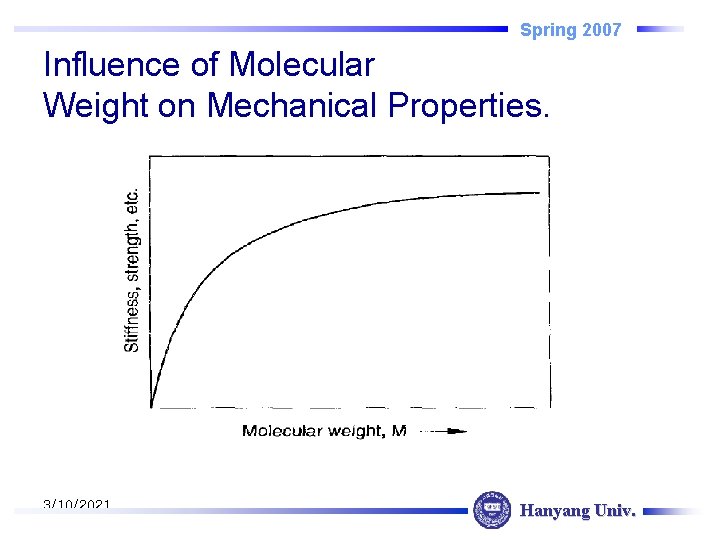
Spring 2007 Influence of Molecular Weight on Mechanical Properties. 3/10/2021 Hanyang Univ.
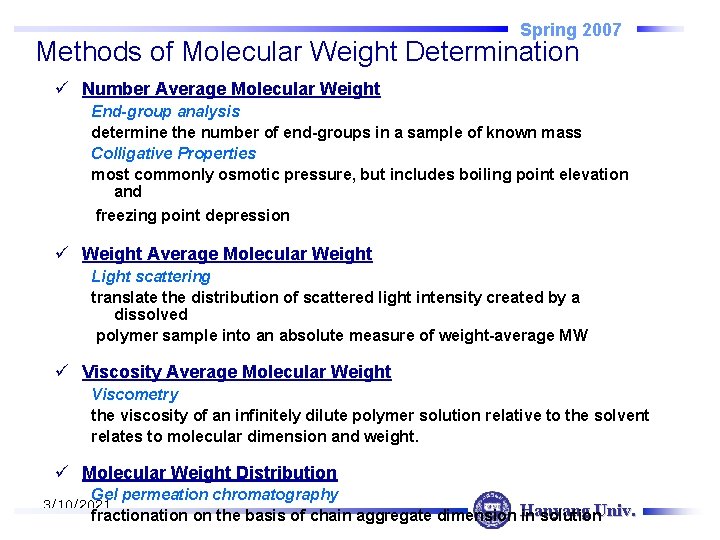
Spring 2007 Methods of Molecular Weight Determination ü Number Average Molecular Weight End-group analysis determine the number of end-groups in a sample of known mass Colligative Properties most commonly osmotic pressure, but includes boiling point elevation and freezing point depression ü Weight Average Molecular Weight Light scattering translate the distribution of scattered light intensity created by a dissolved polymer sample into an absolute measure of weight-average MW ü Viscosity Average Molecular Weight Viscometry the viscosity of an infinitely dilute polymer solution relative to the solvent relates to molecular dimension and weight. ü Molecular Weight Distribution Gel permeation chromatography fractionation on the basis of chain aggregate dimension Hanyang in solution. Univ. 3/10/2021
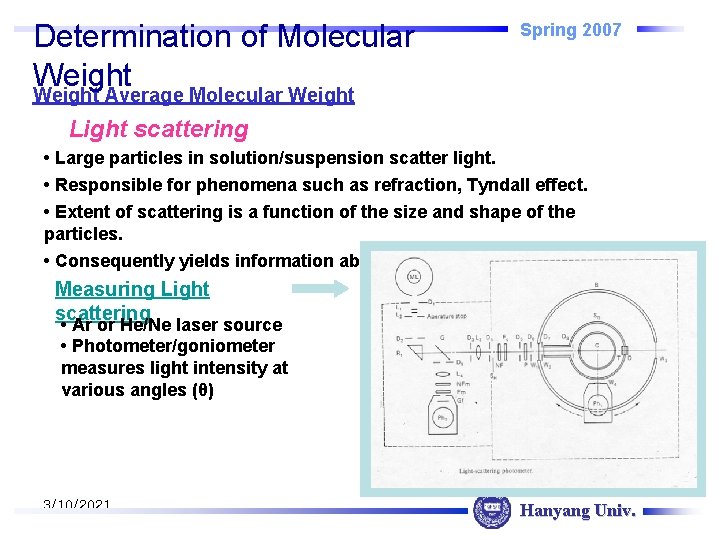
Determination of Molecular Weight Spring 2007 Weight Average Molecular Weight Light scattering • Large particles in solution/suspension scatter light. • Responsible for phenomena such as refraction, Tyndall effect. • Extent of scattering is a function of the size and shape of the particles. • Consequently yields information about Mw. Measuring Light scattering • Ar or He/Ne laser source • Photometer/goniometer measures light intensity at various angles (θ) 3/10/2021 Hanyang Univ.
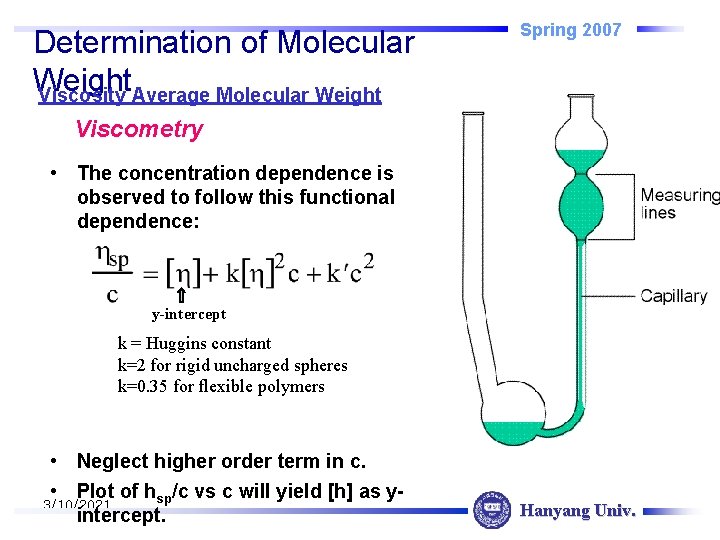
Determination of Molecular Weight Viscosity Average Molecular Weight Spring 2007 Viscometry • The concentration dependence is observed to follow this functional dependence: y-intercept k = Huggins constant k=2 for rigid uncharged spheres k=0. 35 for flexible polymers • Neglect higher order term in c. • Plot of hsp/c vs c will yield [h] as y 3/10/2021 intercept. Hanyang Univ.
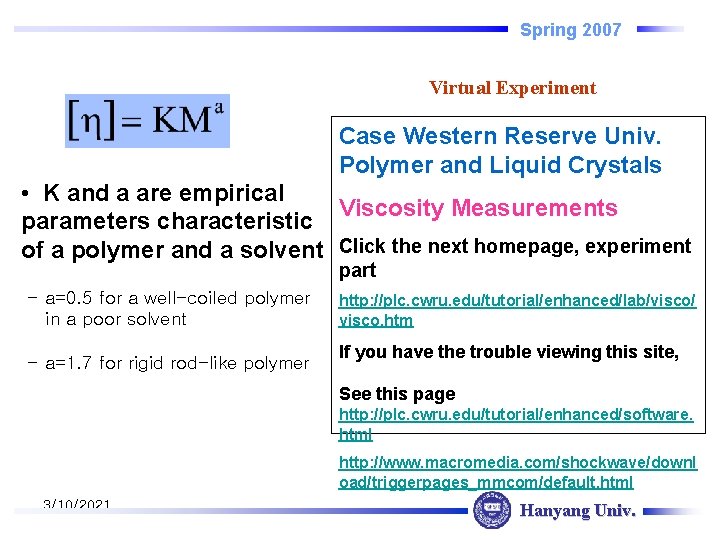
Spring 2007 Virtual Experiment Case Western Reserve Univ. Polymer and Liquid Crystals • K and a are empirical Viscosity Measurements parameters characteristic of a polymer and a solvent Click the next homepage, experiment part - a=0. 5 for a well-coiled polymer in a poor solvent - a=1. 7 for rigid rod-like polymer http: //plc. cwru. edu/tutorial/enhanced/lab/visco/ visco. htm If you have the trouble viewing this site, See this page http: //plc. cwru. edu/tutorial/enhanced/software. html http: //www. macromedia. com/shockwave/downl oad/triggerpages_mmcom/default. html 3/10/2021 Hanyang Univ.
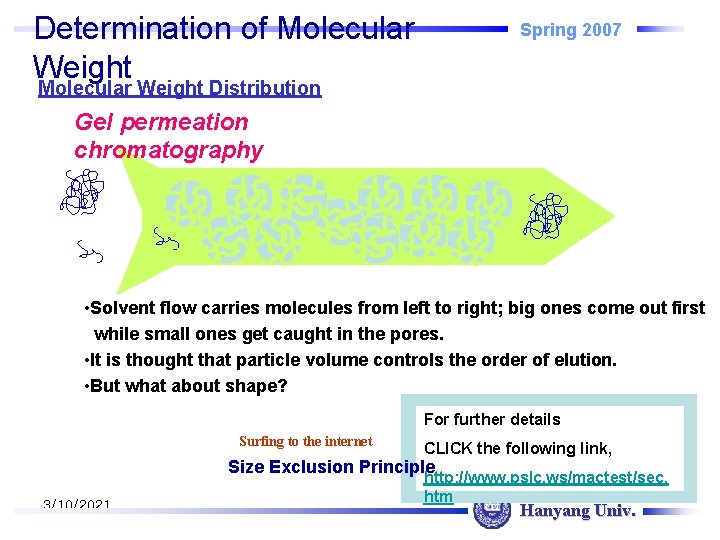
Determination of Molecular Weight Spring 2007 Molecular Weight Distribution Gel permeation chromatography • Solvent flow carries molecules from left to right; big ones come out first while small ones get caught in the pores. • It is thought that particle volume controls the order of elution. • But what about shape? For further details Surfing to the internet CLICK the following link, Size Exclusion Principle 3/10/2021 http: //www. pslc. ws/mactest/sec. htm Hanyang Univ.
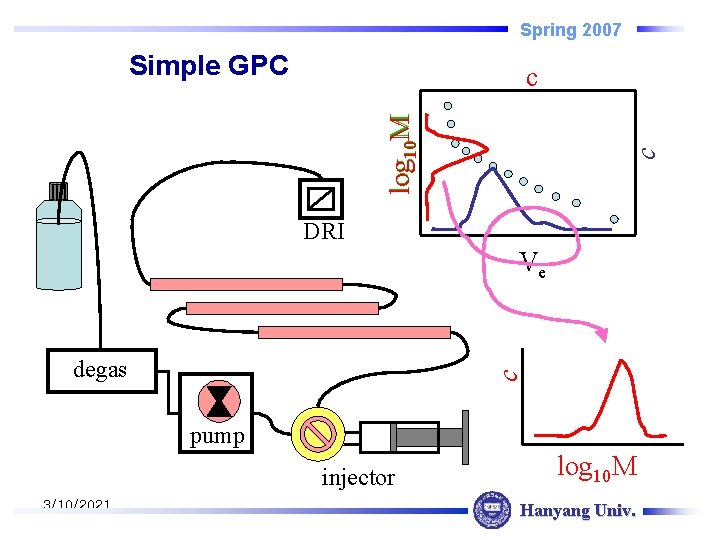
Spring 2007 Simple GPC c log 10 M c DRI Ve c degas pump injector 3/10/2021 log 10 M Hanyang Univ.
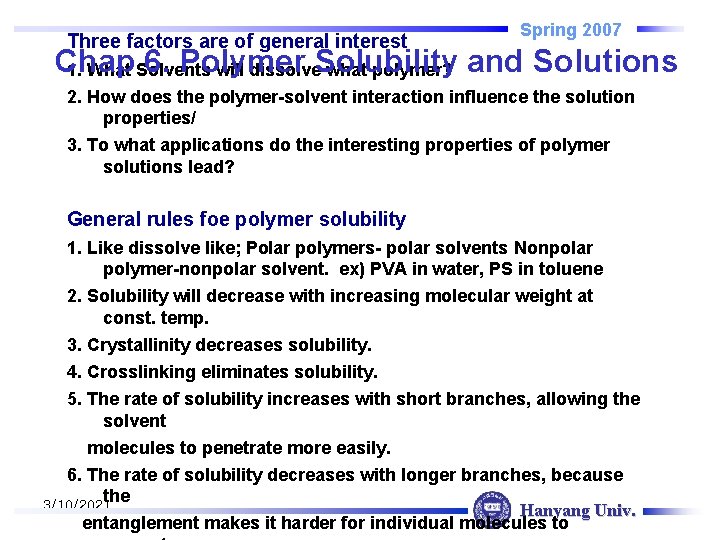
Three factors are of general interest Spring 2007 Chap 6. Polymer 1. What Solvents will dissolve. Solubility what polymer? and Solutions 2. How does the polymer-solvent interaction influence the solution properties/ 3. To what applications do the interesting properties of polymer solutions lead? General rules foe polymer solubility 1. Like dissolve like; Polar polymers- polar solvents Nonpolar polymer-nonpolar solvent. ex) PVA in water, PS in toluene 2. Solubility will decrease with increasing molecular weight at const. temp. 3. Crystallinity decreases solubility. 4. Crosslinking eliminates solubility. 5. The rate of solubility increases with short branches, allowing the solvent molecules to penetrate more easily. 6. The rate of solubility decreases with longer branches, because the 3/10/2021 Hanyang Univ. entanglement makes it harder for individual molecules to
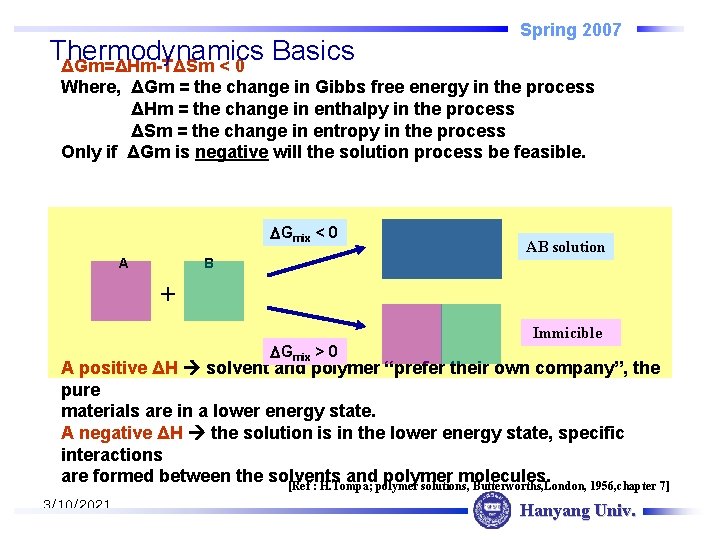
Thermodynamics Basics ΔGm=ΔHm-TΔSm < 0 Spring 2007 Where, ΔGm = the change in Gibbs free energy in the process ΔHm = the change in enthalpy in the process ΔSm = the change in entropy in the process Only if ΔGm is negative will the solution process be feasible. Gmix < 0 A B AB solution + Gmix > 0 Immicible A positive ΔH solvent and polymer “prefer their own company”, the pure materials are in a lower energy state. A negative ΔH the solution is in the lower energy state, specific interactions are formed between the solvents and polymer molecules. [Ref : H. Tompa; polymer solutions, Butterworths, London, 1956, chapter 7] 3/10/2021 Hanyang Univ.
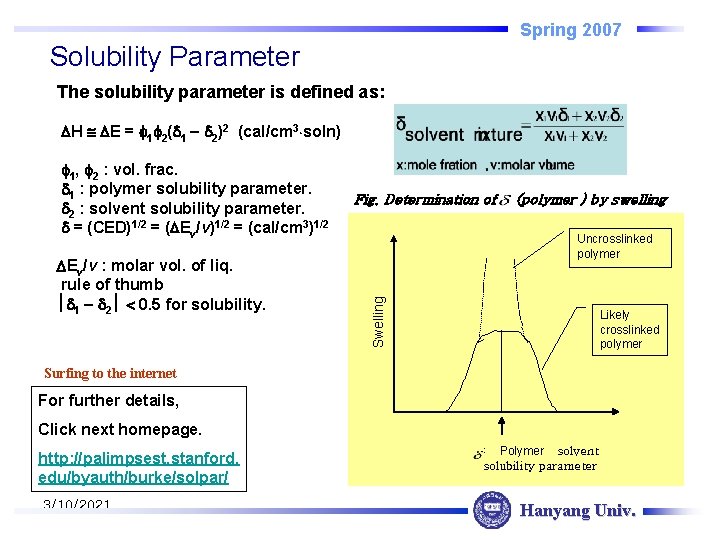
Spring 2007 Solubility Parameter The solubility parameter is defined as: H E = 1 2( 1 2)2 (cal/cm 3 soln) Ev/v : molar vol. of liq. rule of thumb 1 2 0. 5 for solubility. Fig. Determination of (polymer ) by swelling Uncrosslinked polymer Swelling 1, 2 : vol. frac. 1 : polymer solubility parameter. 2 : solvent solubility parameter. = (CED)1/2 = ( Ev/v)1/2 = (cal/cm 3)1/2 Likely crosslinked polymer Surfing to the internet For further details, Click next homepage. http: //palimpsest. stanford. edu/byauth/burke/solpar/ 3/10/2021 : Polymer solvent solubility parameter Hanyang Univ.
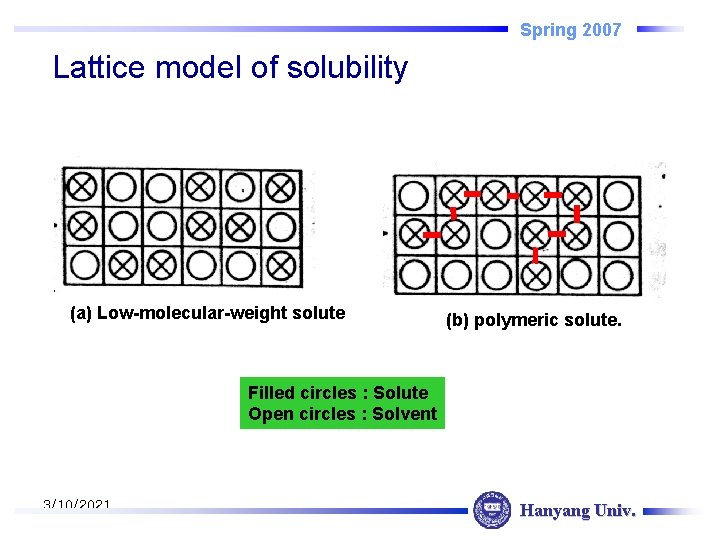
Spring 2007 Lattice model of solubility (a) Low-molecular-weight solute (b) polymeric solute. Filled circles : Solute Open circles : Solvent 3/10/2021 Hanyang Univ.
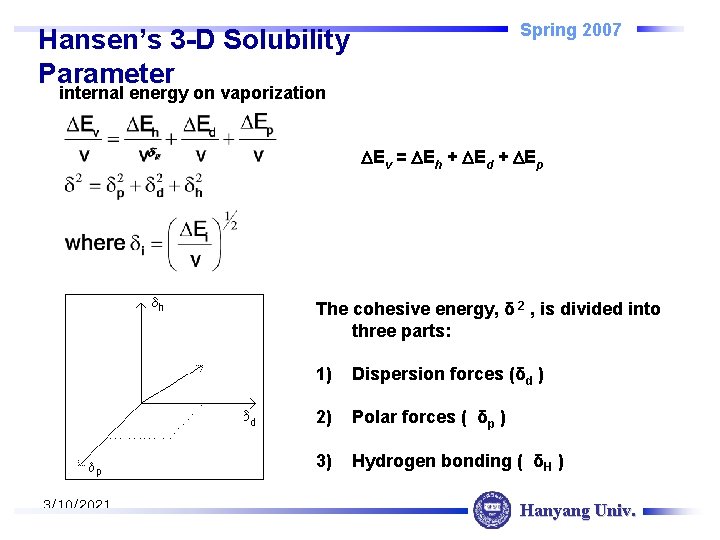
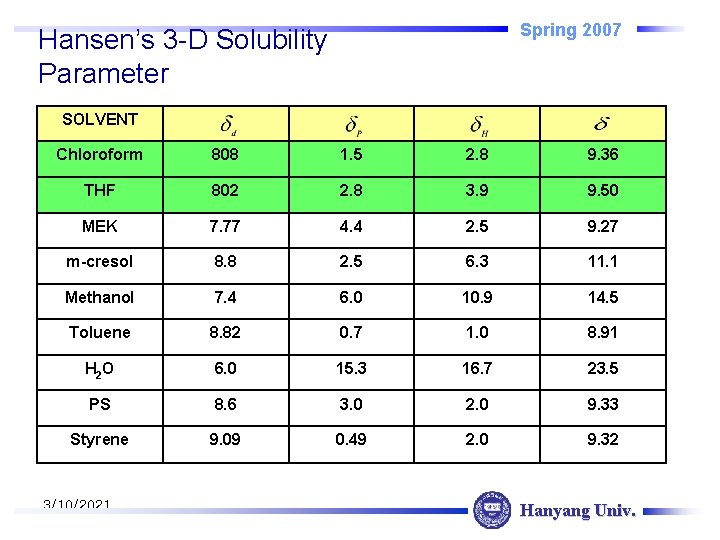
Spring 2007 Hansen’s 3 -D Solubility Parameter internal energy on vaporization Ev = Eh + Ed + Ep The cohesive energy, δ 2 , is divided into three parts: 3/10/2021 1) Dispersion forces (δd ) 2) Polar forces ( δp ) 3) Hydrogen bonding ( δH ) Hanyang Univ.
Spring 2007 Hansen’s 3 -D Solubility Parameter SOLVENT Chloroform 808 1. 5 2. 8 9. 36 THF 802 2. 8 3. 9 9. 50 MEK 7. 77 4. 4 2. 5 9. 27 m-cresol 8. 8 2. 5 6. 3 11. 1 Methanol 7. 4 6. 0 10. 9 14. 5 Toluene 8. 82 0. 7 1. 0 8. 91 H 2 O 6. 0 15. 3 16. 7 23. 5 PS 8. 6 3. 0 2. 0 9. 33 Styrene 9. 09 0. 49 2. 0 9. 32 3/10/2021 Hanyang Univ.
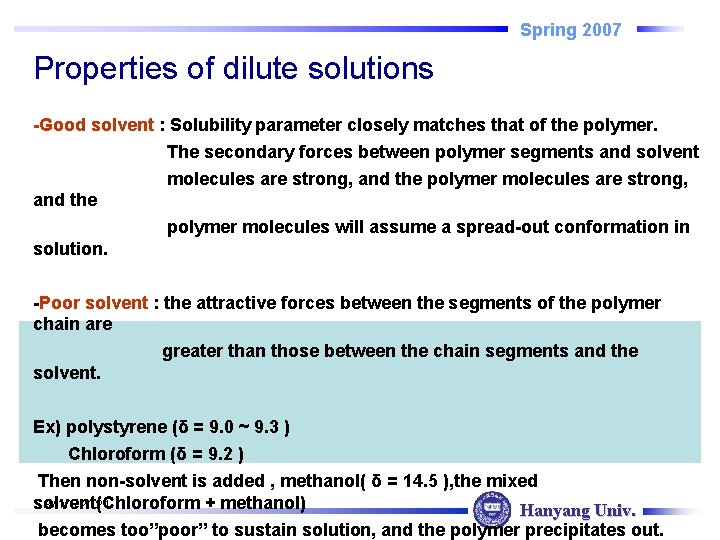
Spring 2007 Properties of dilute solutions -Good solvent : Solubility parameter closely matches that of the polymer. The secondary forces between polymer segments and solvent molecules are strong, and the polymer molecules will assume a spread-out conformation in solution. -Poor solvent : the attractive forces between the segments of the polymer chain are greater than those between the chain segments and the solvent. Ex) polystyrene (δ = 9. 0 ~ 9. 3 ) Chloroform (δ = 9. 2 ) Then non-solvent is added , methanol( δ = 14. 5 ), the mixed solvent(Chloroform + methanol) 3/10/2021 Hanyang Univ. becomes too”poor” to sustain solution, and the polymer precipitates out.
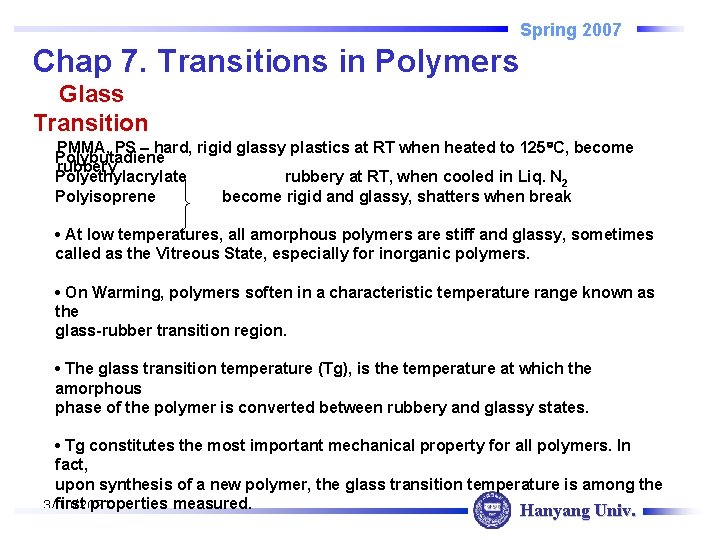
Spring 2007 Chap 7. Transitions in Polymers Glass Transition PMMA, PS hard, rigid glassy plastics at RT when heated to 125 C, become Polybutadiene rubbery Polyethylacrylate rubbery at RT, when cooled in Liq. N 2 Polyisoprene become rigid and glassy, shatters when break • At low temperatures, all amorphous polymers are stiff and glassy, sometimes called as the Vitreous State, especially for inorganic polymers. • On Warming, polymers soften in a characteristic temperature range known as the glass-rubber transition region. • The glass transition temperature (Tg), is the temperature at which the amorphous phase of the polymer is converted between rubbery and glassy states. • Tg constitutes the most important mechanical property for all polymers. In fact, upon synthesis of a new polymer, the glass transition temperature is among the first properties measured. 3/10/2021 Hanyang Univ.
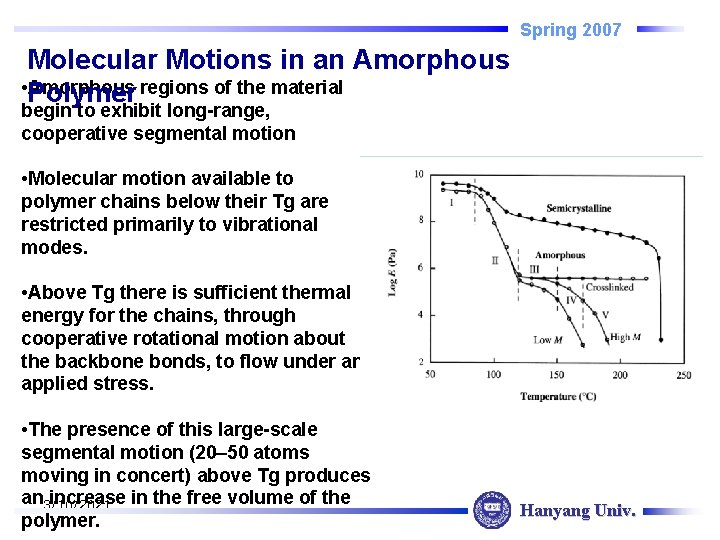
Spring 2007 Molecular Motions in an Amorphous • Polymer Amorphous regions of the material begin to exhibit long-range, cooperative segmental motion • Molecular motion available to polymer chains below their Tg are restricted primarily to vibrational modes. • Above Tg there is sufficient thermal energy for the chains, through cooperative rotational motion about the backbone bonds, to flow under an applied stress. • The presence of this large-scale segmental motion (20– 50 atoms moving in concert) above Tg produces an 3/10/2021 increase in the free volume of the polymer. Hanyang Univ.
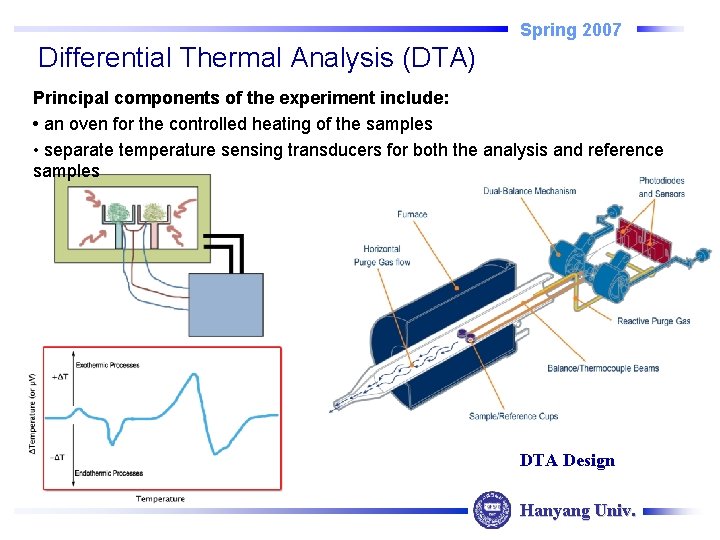
Spring 2007 Differential Thermal Analysis (DTA) Principal components of the experiment include: • an oven for the controlled heating of the samples • separate temperature sensing transducers for both the analysis and reference samples DTA Design 3/10/2021 Hanyang Univ.
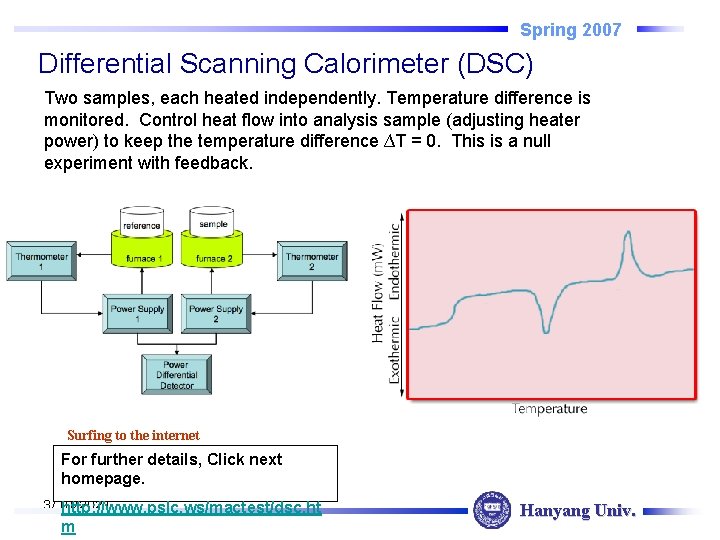
Spring 2007 Differential Scanning Calorimeter (DSC) Two samples, each heated independently. Temperature difference is monitored. Control heat flow into analysis sample (adjusting heater power) to keep the temperature difference ∆T = 0. This is a null experiment with feedback. Surfing to the internet For further details, Click next homepage. 3/10/2021 http: //www. pslc. ws/mactest/dsc. ht m Hanyang Univ.
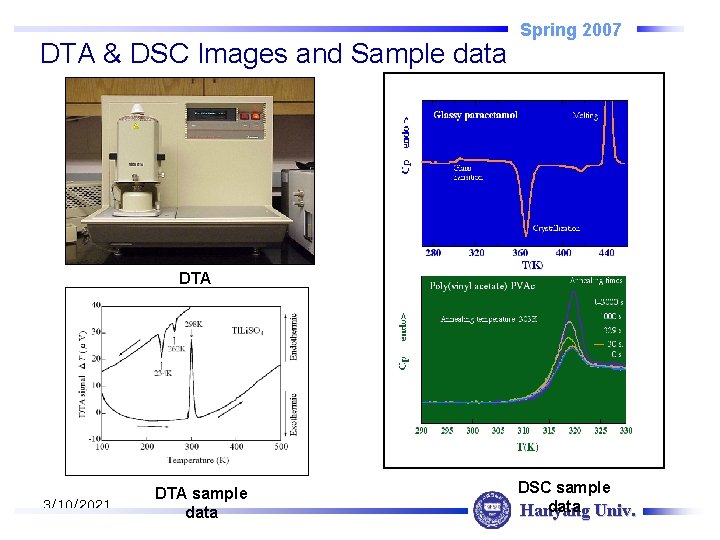
DTA & DSC Images and Sample data Spring 2007 DTA 3/10/2021 DTA sample data DSC sample data Univ. Hanyang
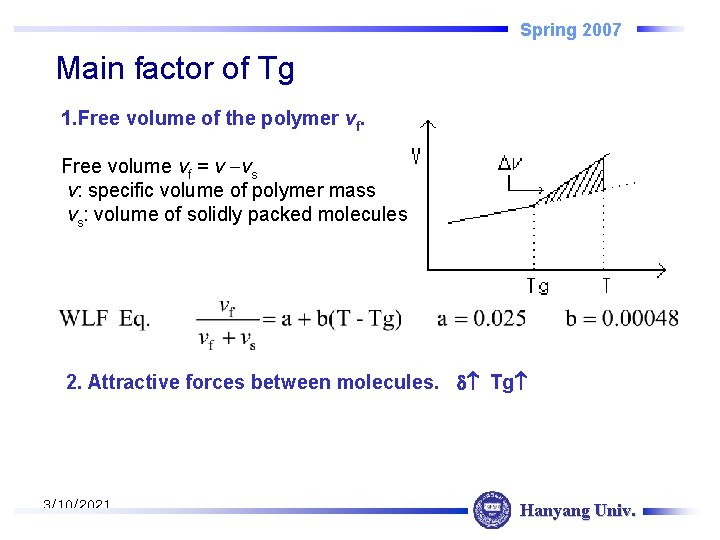
Spring 2007 Main factor of Tg 1. Free volume of the polymer vf. Free volume vf = v vs v: specific volume of polymer mass vs: volume of solidly packed molecules 2. Attractive forces between molecules. Tg 3/10/2021 Hanyang Univ.
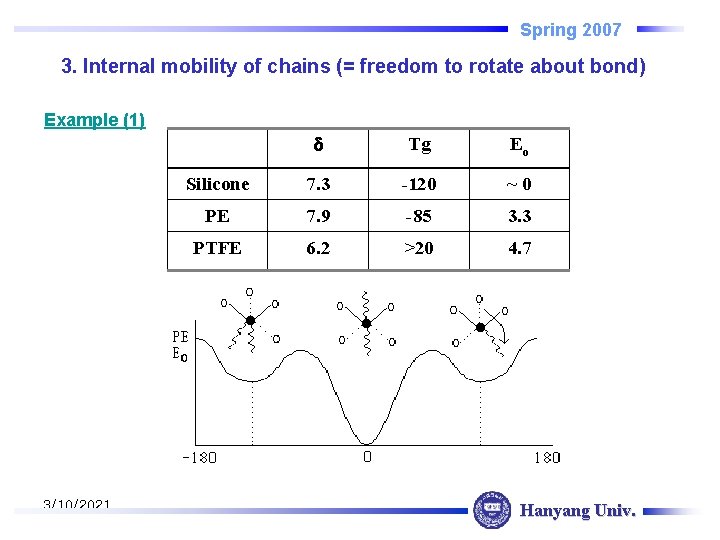
Spring 2007 3. Internal mobility of chains (= freedom to rotate about bond) Example (1) 3/10/2021 Tg Eo Silicone 7. 3 -120 ~0 PE 7. 9 -85 3. 3 PTFE 6. 2 >20 4. 7 Hanyang Univ.
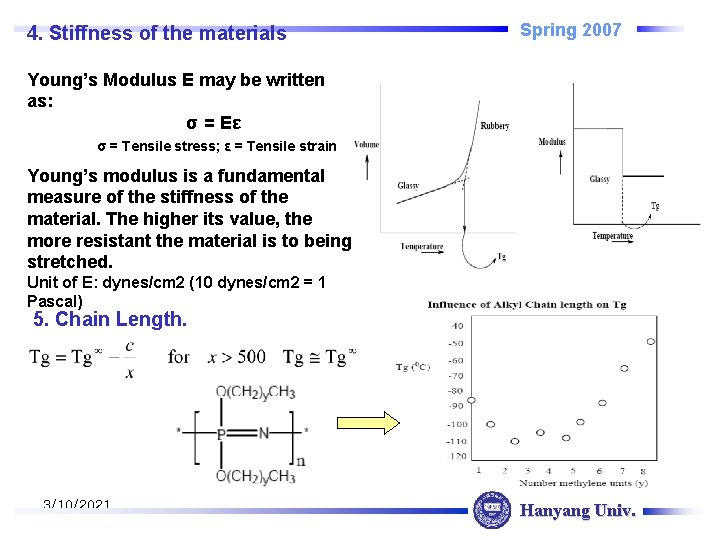
4. Stiffness of the materials Spring 2007 Young’s Modulus E may be written as: σ = Eε σ = Tensile stress; ε = Tensile strain Young’s modulus is a fundamental measure of the stiffness of the material. The higher its value, the more resistant the material is to being stretched. Unit of E: dynes/cm 2 (10 dynes/cm 2 = 1 Pascal) 5. Chain Length. 3/10/2021 Hanyang Univ.
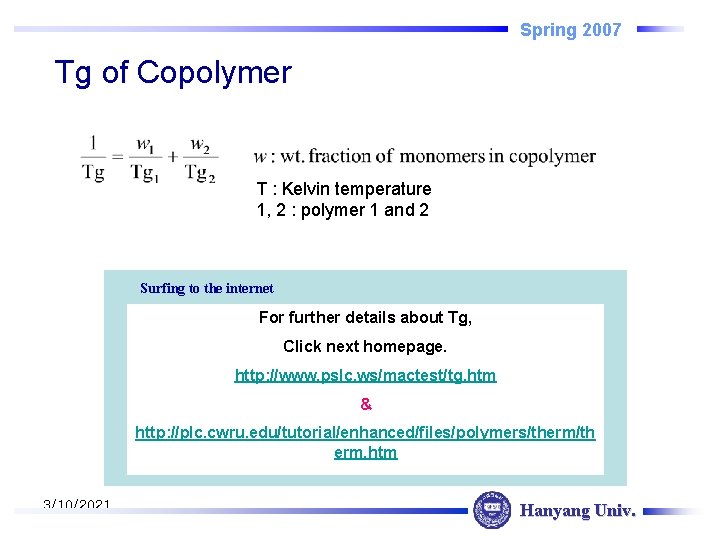
Spring 2007 Tg of Copolymer T : Kelvin temperature 1, 2 : polymer 1 and 2 Surfing to the internet For further details about Tg, Click next homepage. http: //www. pslc. ws/mactest/tg. htm & http: //plc. cwru. edu/tutorial/enhanced/files/polymers/therm/th erm. htm 3/10/2021 Hanyang Univ.
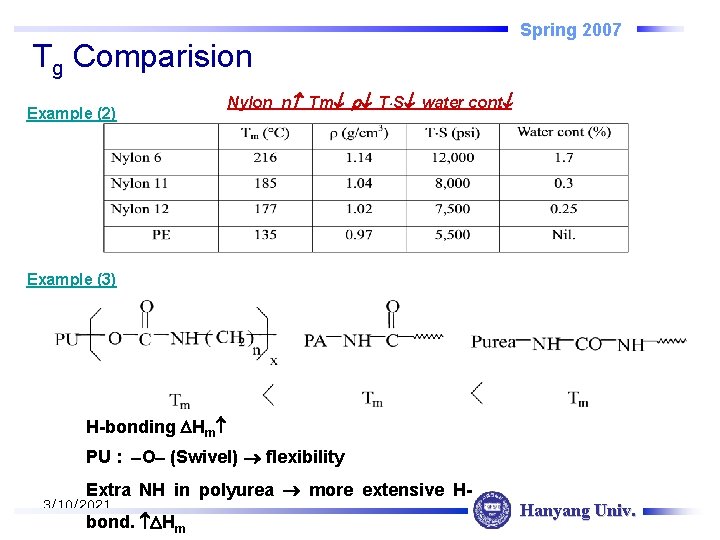
Tg Comparision Example (2) Spring 2007 Nylon n Tm T S water cont Example (3) H-bonding Hm PU : O (Swivel) flexibility Extra NH in polyurea more extensive H- 3/10/2021 bond. Hm Hanyang Univ.
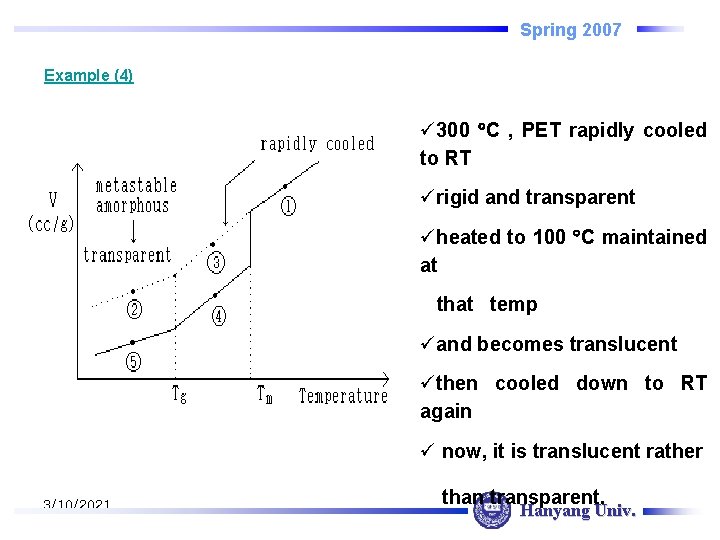
Spring 2007 Example (4) ü 300 C , PET rapidly cooled to RT ürigid and transparent üheated to 100 C maintained at that temp üand becomes translucent üthen cooled down to RT again ü now, it is translucent rather 3/10/2021 than transparent. Hanyang Univ.
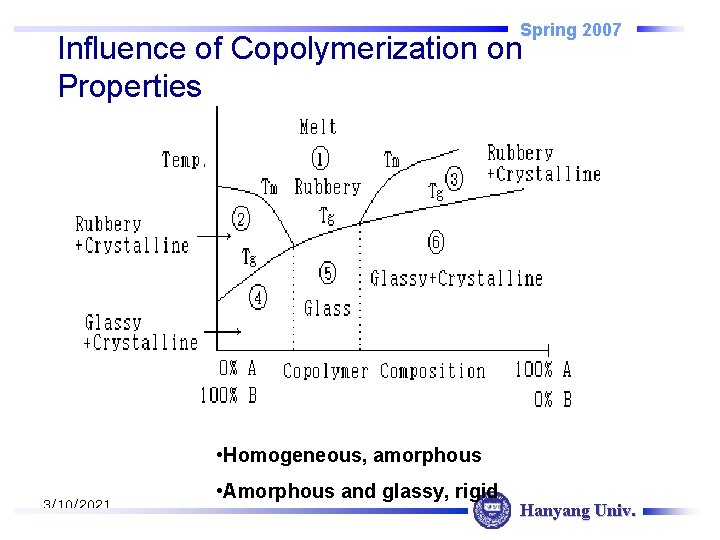
Spring 2007 Influence of Copolymerization on Properties • Homogeneous, amorphous 3/10/2021 • Amorphous and glassy, rigid Hanyang Univ.