
Spread Spectrum System Military RF considerations Highpower fixedfrequency



- Slides: 71
Spread Spectrum System
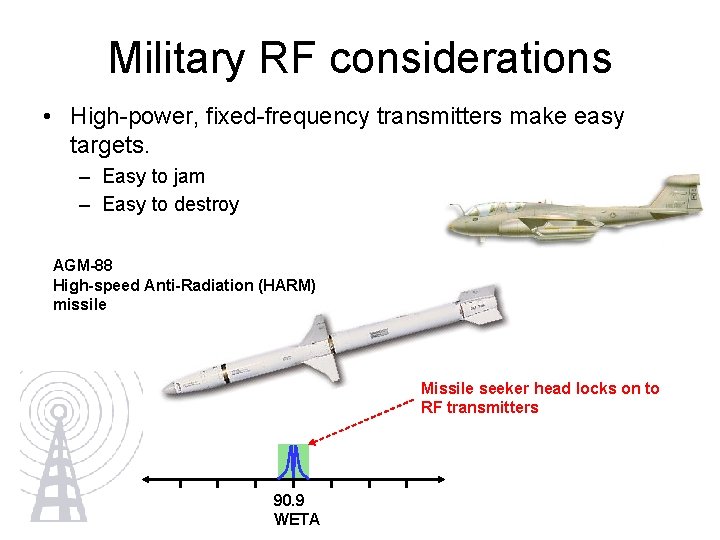
Military RF considerations • High-power, fixed-frequency transmitters make easy targets. – Easy to jam – Easy to destroy AGM-88 High-speed Anti-Radiation (HARM) missile Missile seeker head locks on to RF transmitters 90. 9 WETA
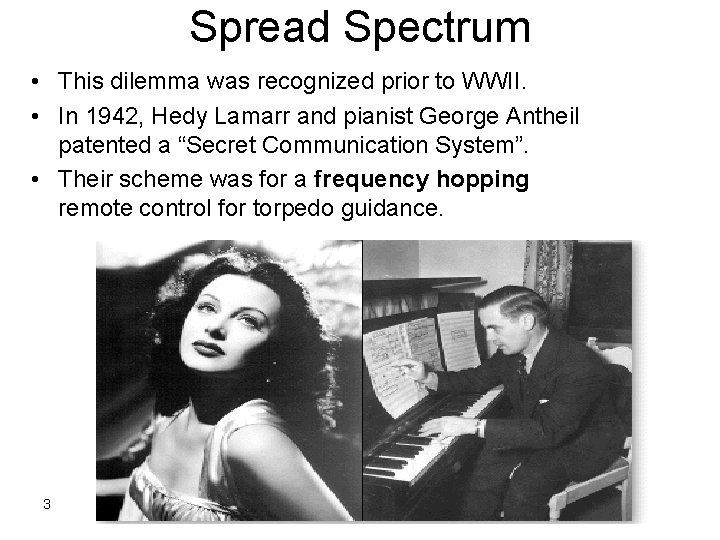
Spread Spectrum • This dilemma was recognized prior to WWII. • In 1942, Hedy Lamarr and pianist George Antheil patented a “Secret Communication System”. • Their scheme was for a frequency hopping remote control for torpedo guidance. 3
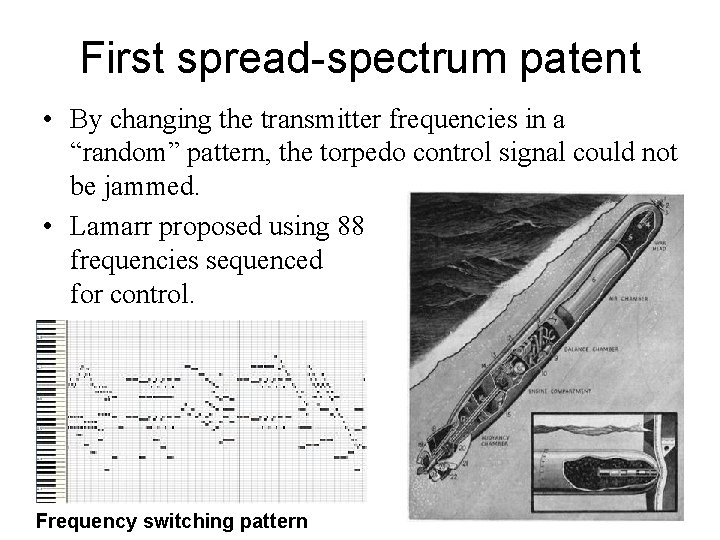
First spread-spectrum patent • By changing the transmitter frequencies in a “random” pattern, the torpedo control signal could not be jammed. • Lamarr proposed using 88 frequencies sequenced for control. Frequency switching pattern
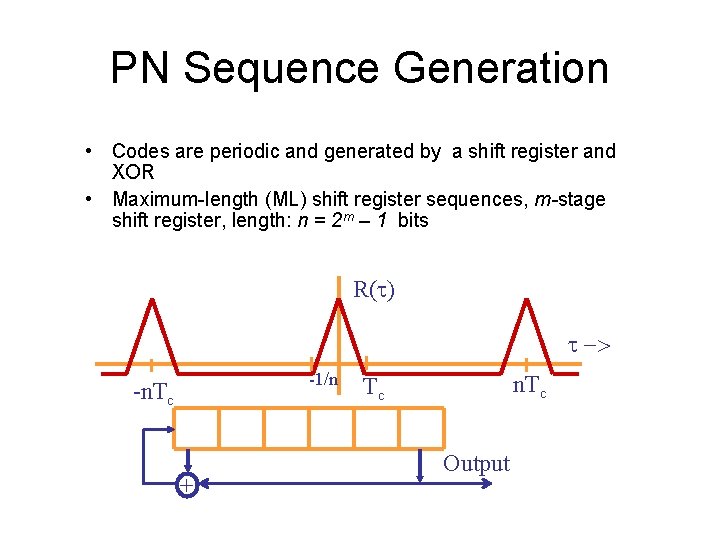
PN Sequence Generation • Codes are periodic and generated by a shift register and XOR • Maximum-length (ML) shift register sequences, m-stage shift register, length: n = 2 m – 1 bits R(t) t -> -1/n -n. Tc + n. Tc Tc Output
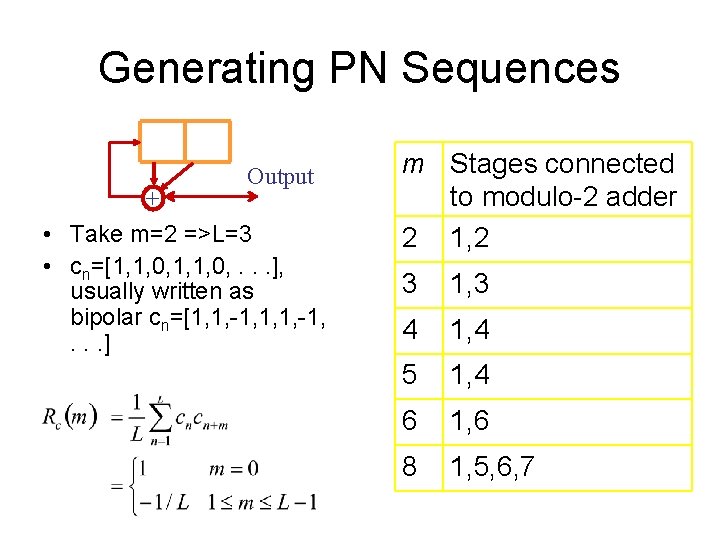
Generating PN Sequences Output + • Take m=2 =>L=3 • cn=[1, 1, 0, . . . ], usually written as bipolar cn=[1, 1, -1, . . . ] m Stages connected to modulo-2 adder 2 1, 2 3 1, 3 4 1, 4 5 1, 4 6 1, 6 8 1, 5, 6, 7
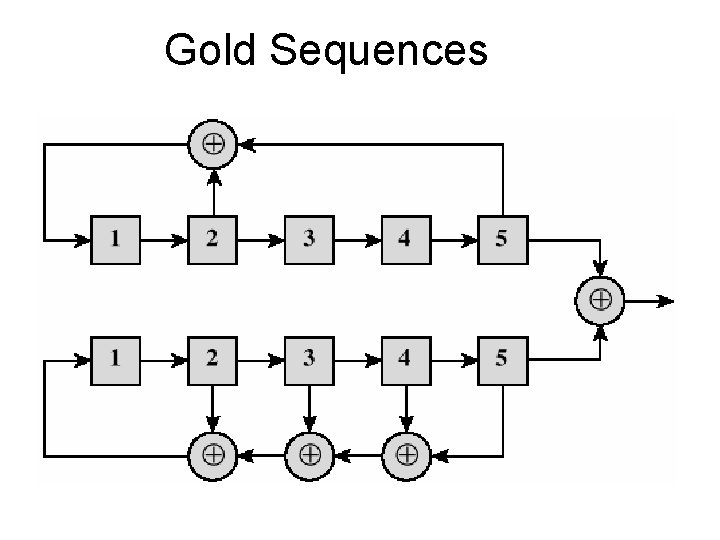
Problems with m-sequences • Cross-correlations with other m-sequences generated by different input sequences can be quite high • Easy to guess connection setup in 2 m samples so not too secure • In practice, Gold codes or Kasami sequences which combine the output of msequences are used.
Gold Sequences
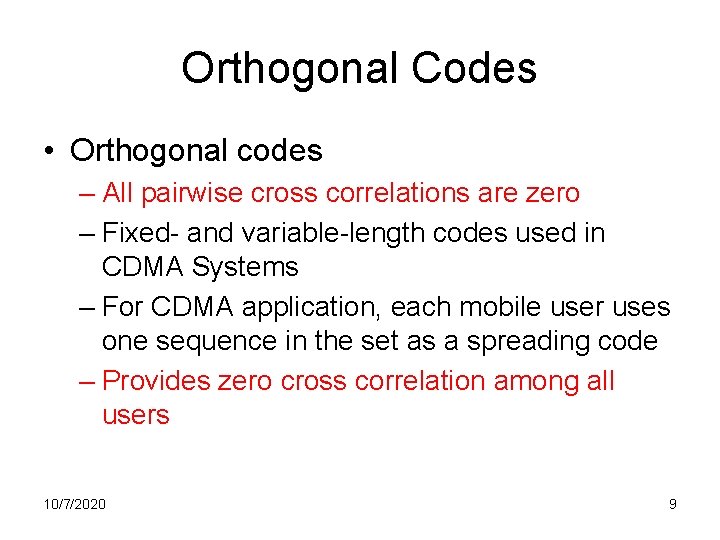
Orthogonal Codes • Orthogonal codes – All pairwise cross correlations are zero – Fixed- and variable-length codes used in CDMA Systems – For CDMA application, each mobile user uses one sequence in the set as a spreading code – Provides zero cross correlation among all users 10/7/2020 9
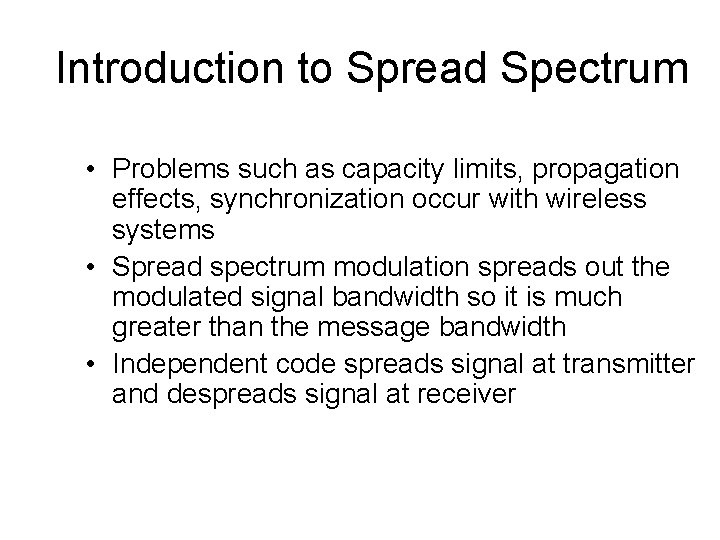
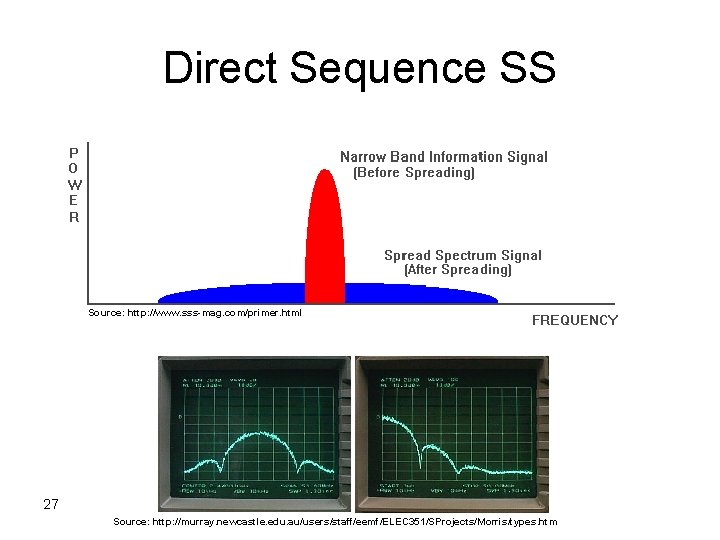
Introduction to Spread Spectrum • Problems such as capacity limits, propagation effects, synchronization occur with wireless systems • Spread spectrum modulation spreads out the modulated signal bandwidth so it is much greater than the message bandwidth • Independent code spreads signal at transmitter and despreads signal at receiver
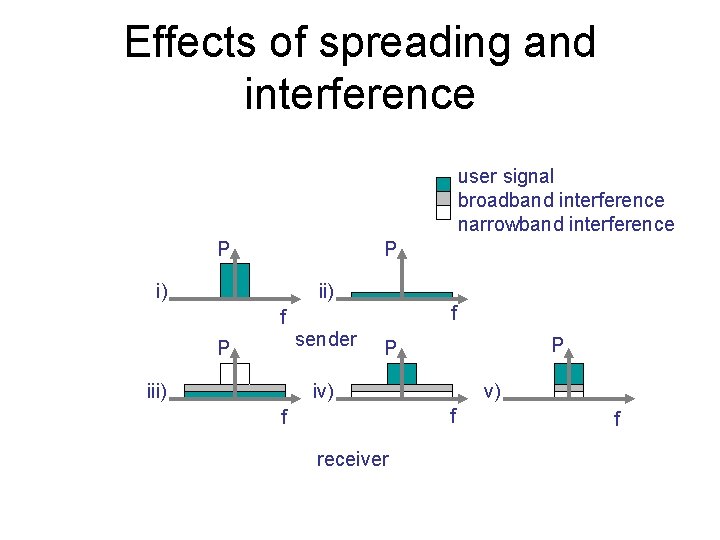
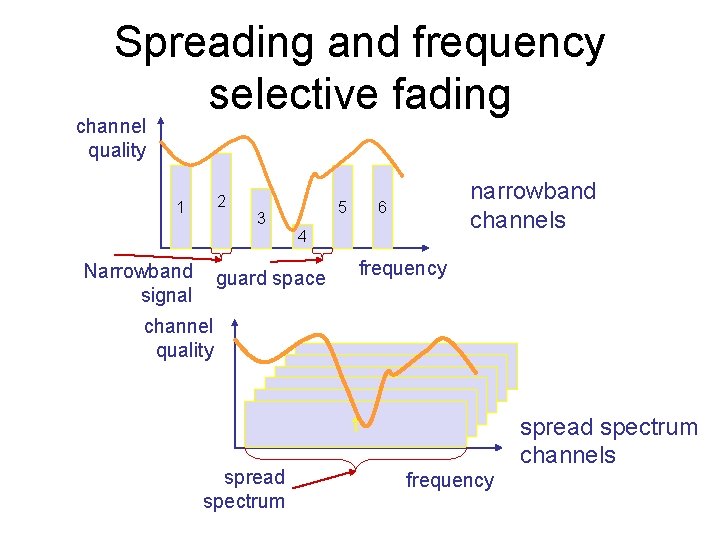
Spread Spectrum Technology • Problem of radio transmission: frequency dependent fading can wipe out narrow band signals for duration of the interference • Solution: spread the narrow band signal into a broad band signal using a special code interference power spread signal power detection at receiver f signal spread interference f
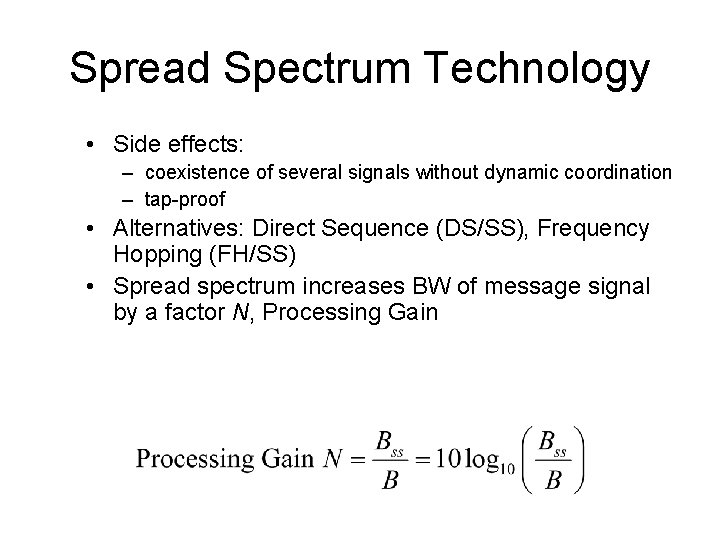
Spread Spectrum Technology • Side effects: – coexistence of several signals without dynamic coordination – tap-proof • Alternatives: Direct Sequence (DS/SS), Frequency Hopping (FH/SS) • Spread spectrum increases BW of message signal by a factor N, Processing Gain
Effects of spreading and interference user signal broadband interference narrowband interference P P i) ii) f P iii) sender f P P iv) v) f f receiver f
Spreading and frequency selective fading channel quality 2 1 Narrowband signal 3 5 spread spectrum 6 4 guard space channel quality narrowband channels frequency 2 2 2 1 frequency spread spectrum channels
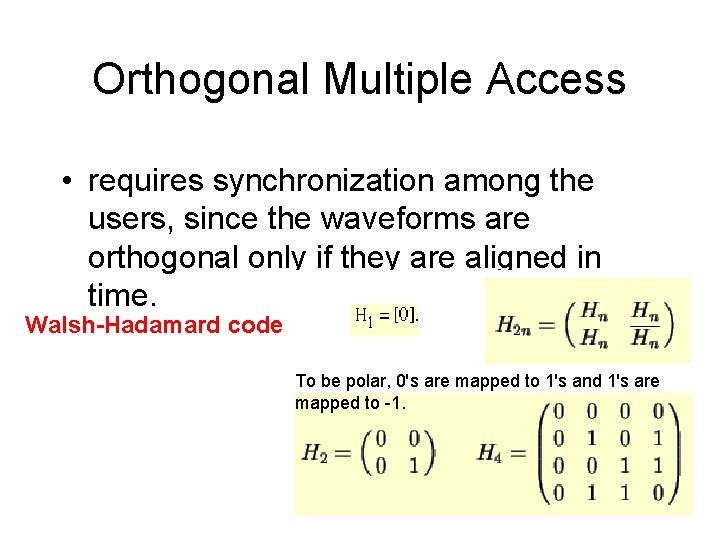
Orthogonal Multiple Access • requires synchronization among the users, since the waveforms are orthogonal only if they are aligned in time. Walsh-Hadamard code To be polar, 0's are mapped to 1's and 1's are mapped to -1.
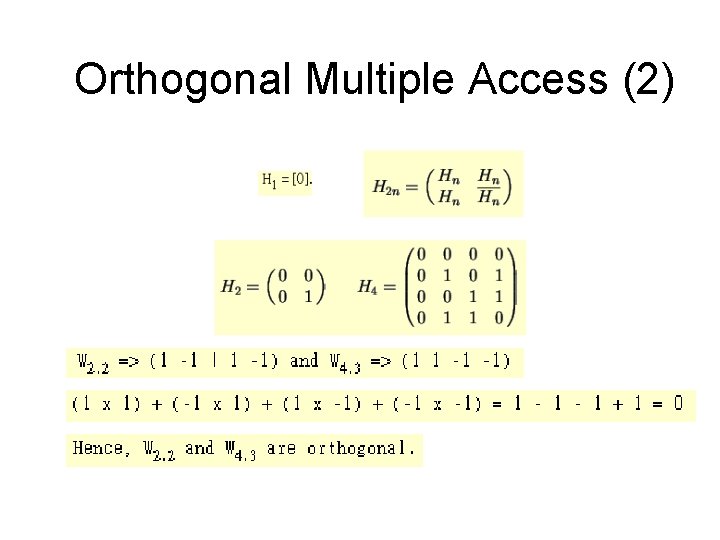
Orthogonal Multiple Access (2)
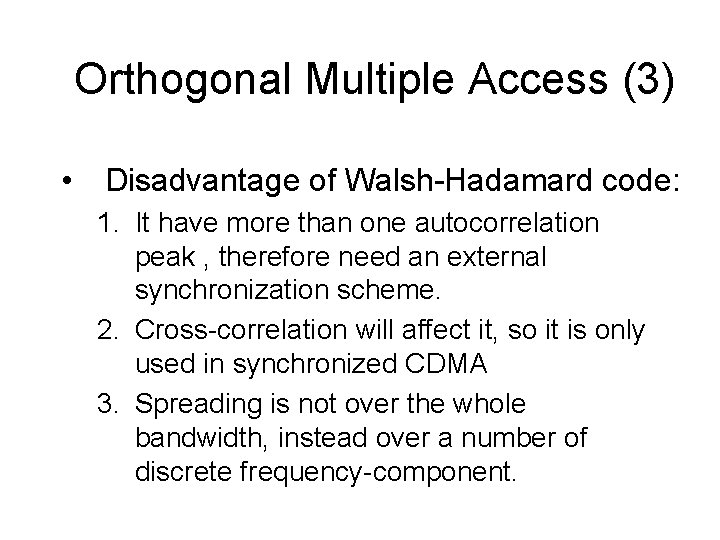
Orthogonal Multiple Access (3) • Disadvantage of Walsh-Hadamard code: 1. It have more than one autocorrelation peak , therefore need an external synchronization scheme. 2. Cross-correlation will affect it, so it is only used in synchronized CDMA 3. Spreading is not over the whole bandwidth, instead over a number of discrete frequency-component.
Non-orthogonal Multiple Access • Gold sequences are in particular popular for non-orthogonal CDMA. • By shifting one of the two PN sequence, we get a different Gold sequence. • Permits the transmission to be asynchronous. The receiver can synchronize using the auto-correlation property of the Gold sequence.
Spreading Spectrum Techniques 1. 2. 3. 4. 5. Direct Sequence (DS) Frequency Hopping (FH) Hybrid (DS/FH) Time Hopping (TH) Pulse FM System (Chirp)
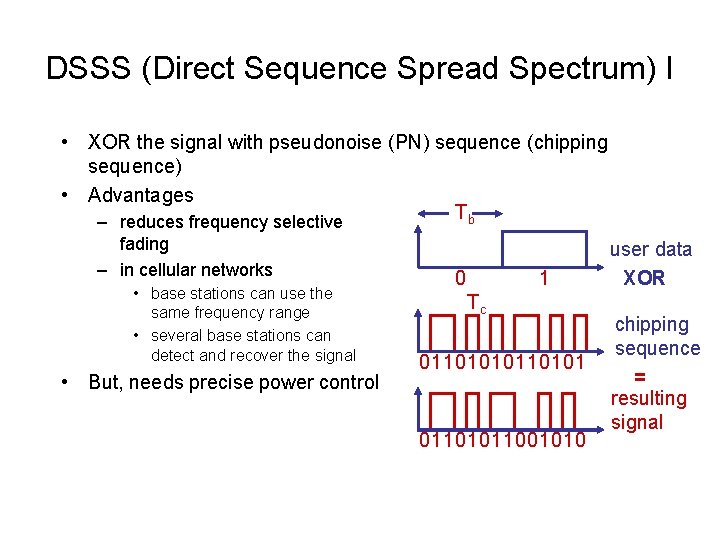
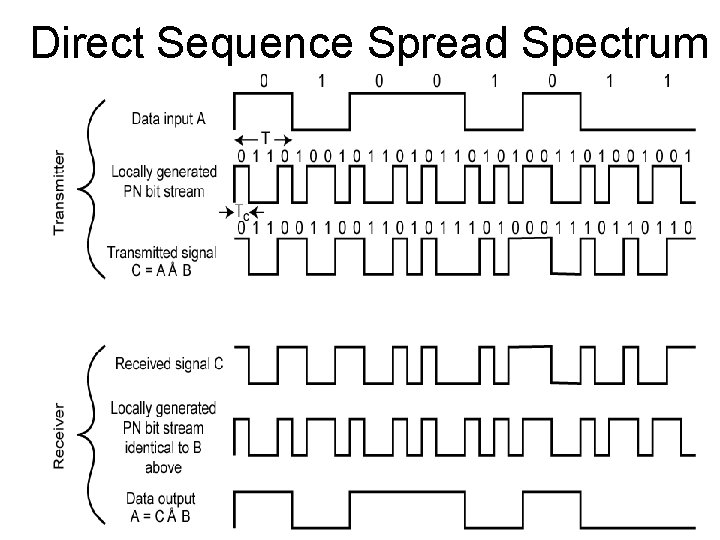
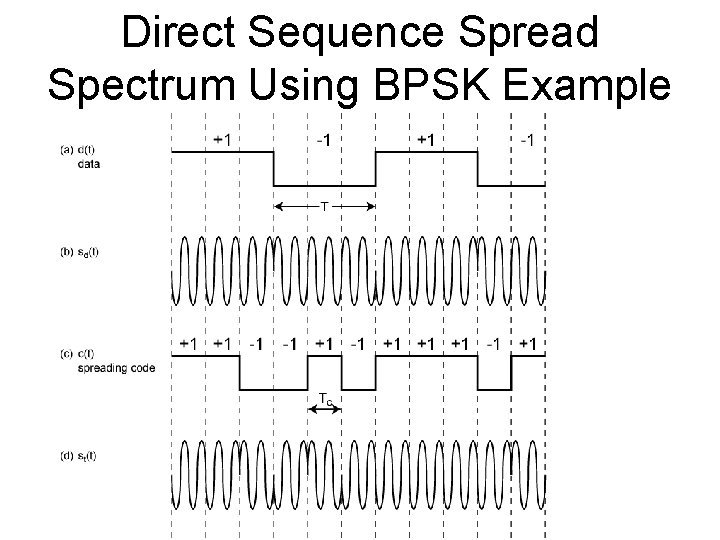
DSSS (Direct Sequence Spread Spectrum) I • XOR the signal with pseudonoise (PN) sequence (chipping sequence) • Advantages Tb – reduces frequency selective fading – in cellular networks • base stations can use the same frequency range • several base stations can detect and recover the signal • But, needs precise power control 0 1 Tc 0 1 1 0 10 1 1 0 0 101 0 user data XOR chipping sequence = resulting signal
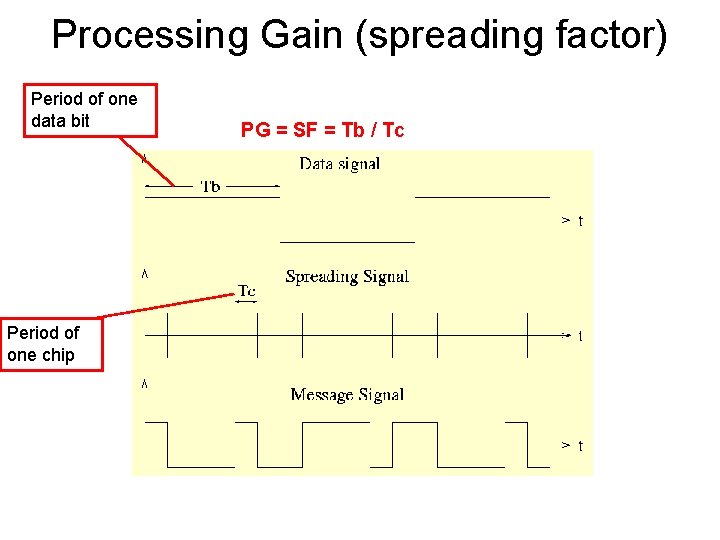
Processing Gain (spreading factor) Period of one data bit Period of one chip PG = SF = Tb / Tc
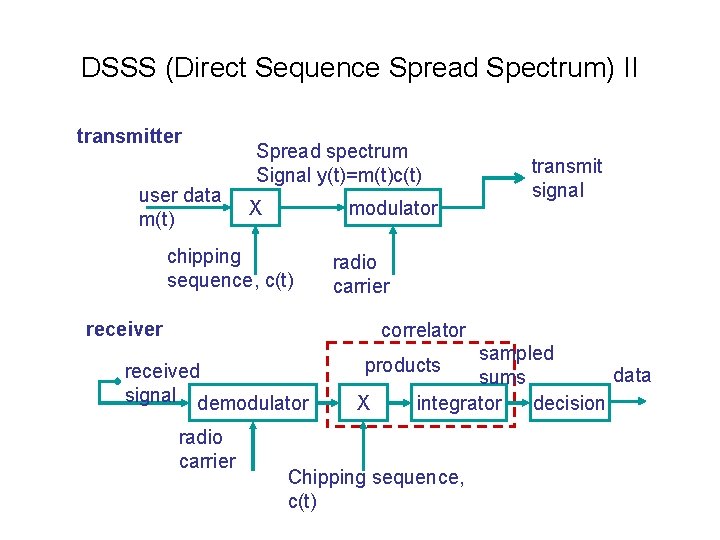
DSSS (Direct Sequence Spread Spectrum) II transmitter user data m(t) Spread spectrum Signal y(t)=m(t)c(t) X modulator chipping sequence, c(t) transmit signal radio carrier receiver correlator received signal demodulator radio carrier sampled data sums integrator decision products X Chipping sequence, c(t)
Direct Sequence Spread Spectrum
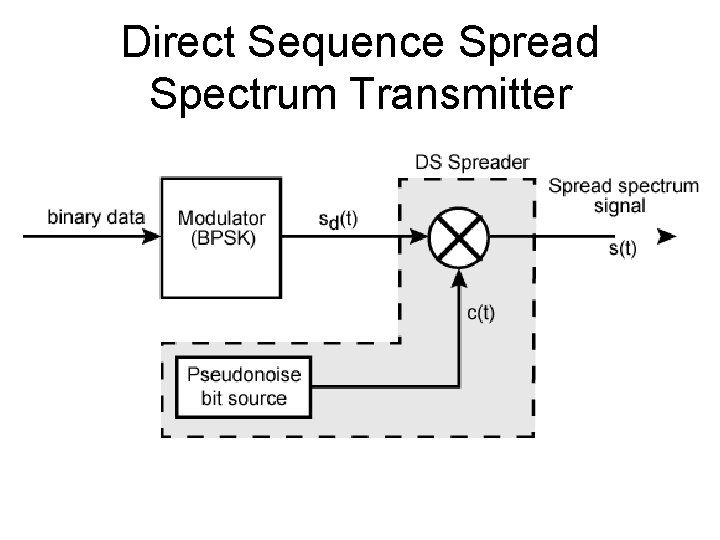
Direct Sequence Spread Spectrum Transmitter
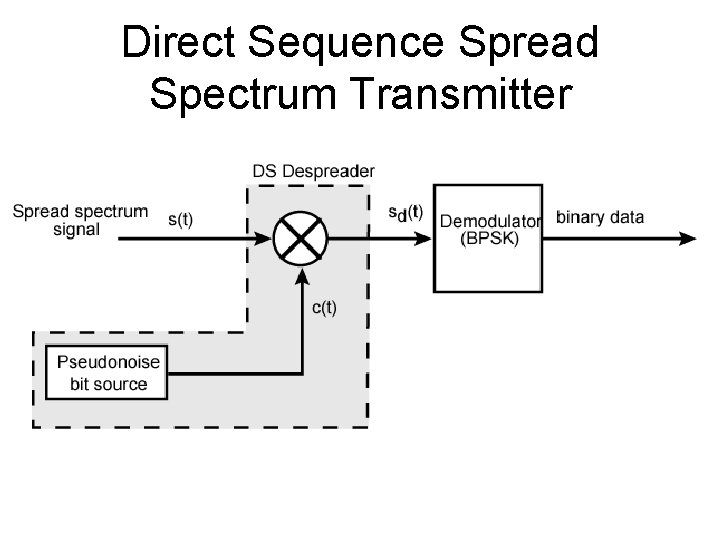
Direct Sequence Spread Spectrum Transmitter
Direct Sequence Spread Spectrum Using BPSK Example
Direct Sequence SS Source: http: //www. sss-mag. com/primer. html 27 Source: http: //murray. newcastle. edu. au/users/staff/eemf/ELEC 351/SProjects/Morris/types. htm
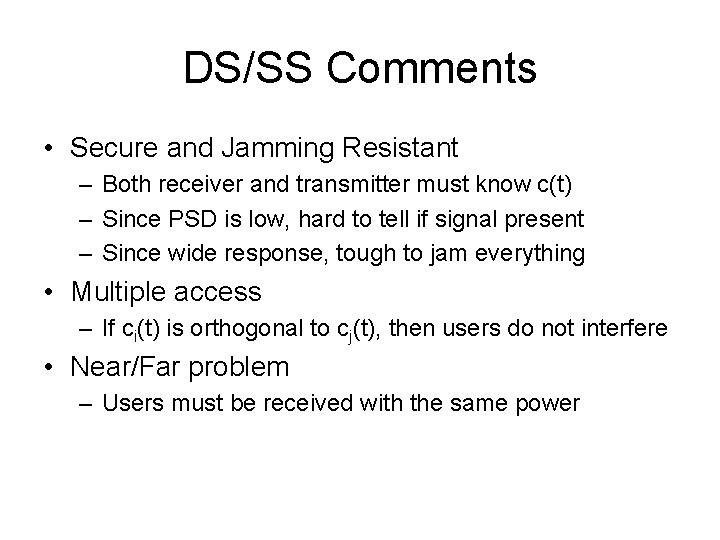
DS/SS Comments • Secure and Jamming Resistant – Both receiver and transmitter must know c(t) – Since PSD is low, hard to tell if signal present – Since wide response, tough to jam everything • Multiple access – If ci(t) is orthogonal to cj(t), then users do not interfere • Near/Far problem – Users must be received with the same power
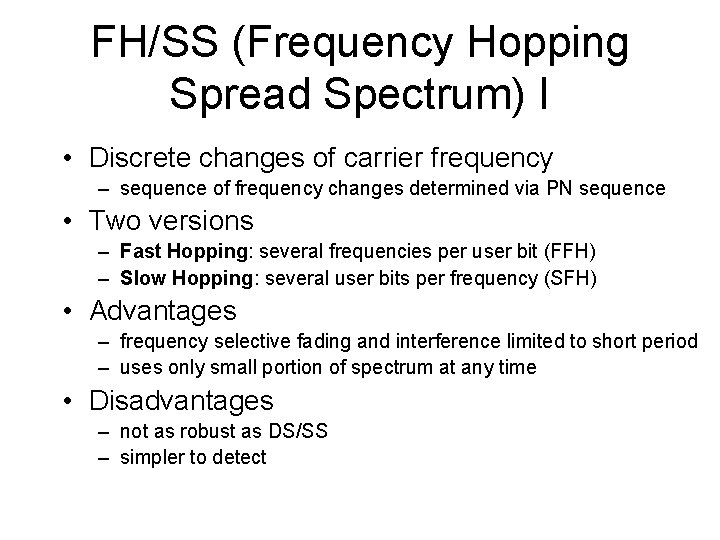
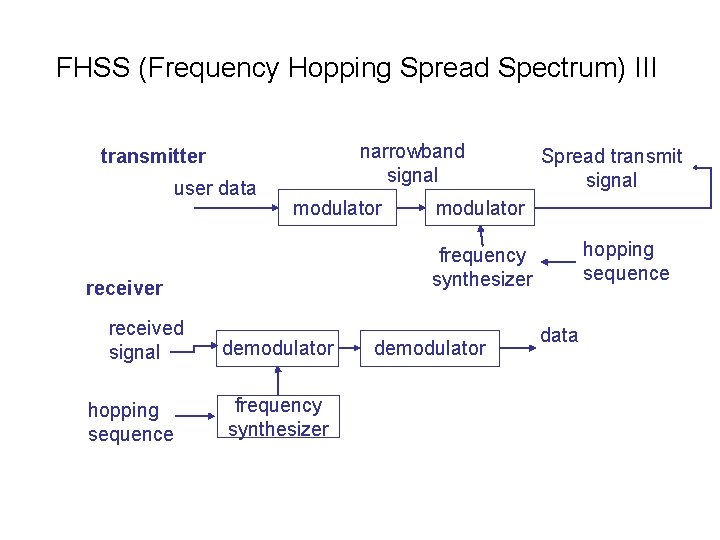
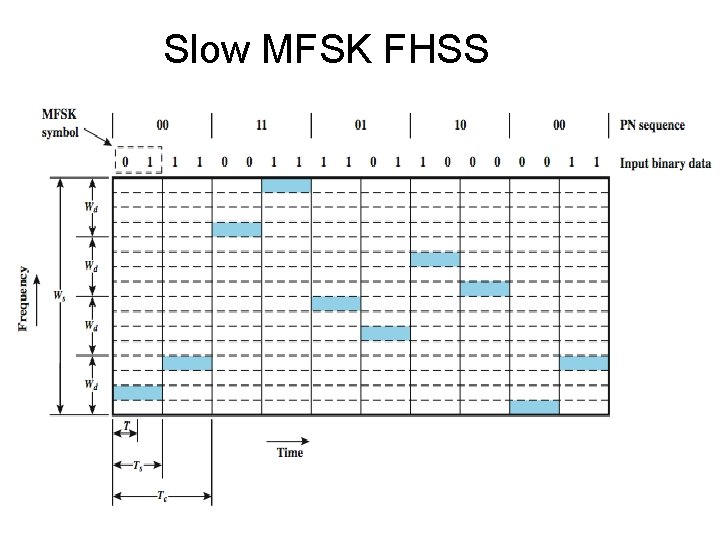
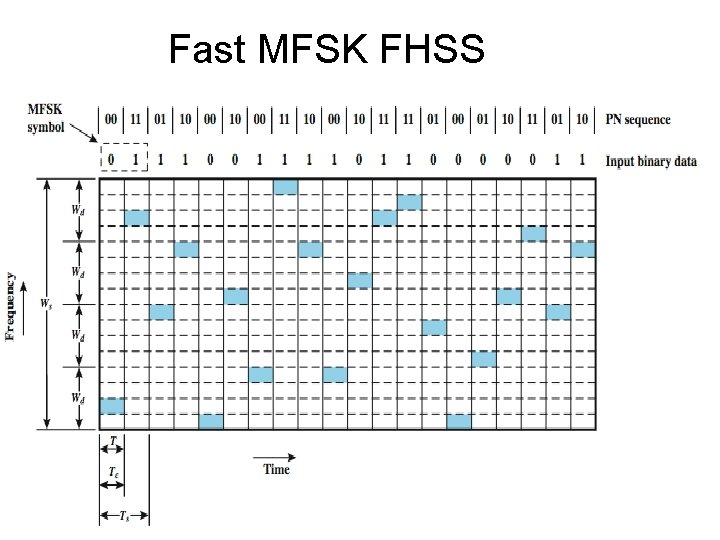
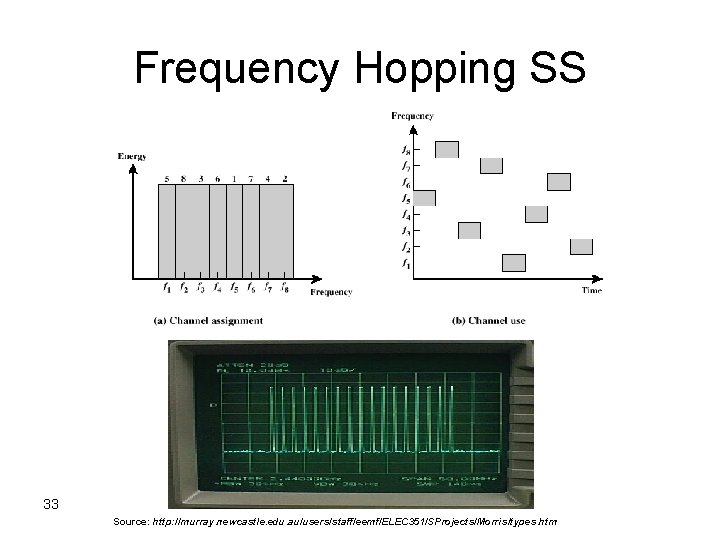
FH/SS (Frequency Hopping Spread Spectrum) I • Discrete changes of carrier frequency – sequence of frequency changes determined via PN sequence • Two versions – Fast Hopping: several frequencies per user bit (FFH) – Slow Hopping: several user bits per frequency (SFH) • Advantages – frequency selective fading and interference limited to short period – uses only small portion of spectrum at any time • Disadvantages – not as robust as DS/SS – simpler to detect
FHSS (Frequency Hopping Spread Spectrum) III narrowband signal transmitter user data modulator hopping sequence frequency synthesizer received signal Spread transmit signal demodulator frequency synthesizer demodulator data
Slow MFSK FHSS
Fast MFSK FHSS
Frequency Hopping SS 33 Source: http: //murray. newcastle. edu. au/users/staff/eemf/ELEC 351/SProjects/Morris/types. htm
TIME HOPPING SYSTEMS • • • A time hopping system is a spread spectrum system in which the period and duty cycle of a pulsed RF carrier are varied in a pseudorandom manner under the control of a coded sequence Time hopped spread spectrum systems have found no commercial application to date. However, the arrival of cheap random access memory (RAM) and fast micro-controller chips make time hopping a viable alternative spread spectrum technique for the future. Time hopping is a system in which burst signal are initiated at pseudo random rate. In this the transmitter is switched ON and OFF by a code sequence. The main difference between a frequency hopping and time hopping system is that in the former the transmitted frequency changes at each code chip time in the later the frequency changes occurs only at zero/ one transitions in the code sequence.
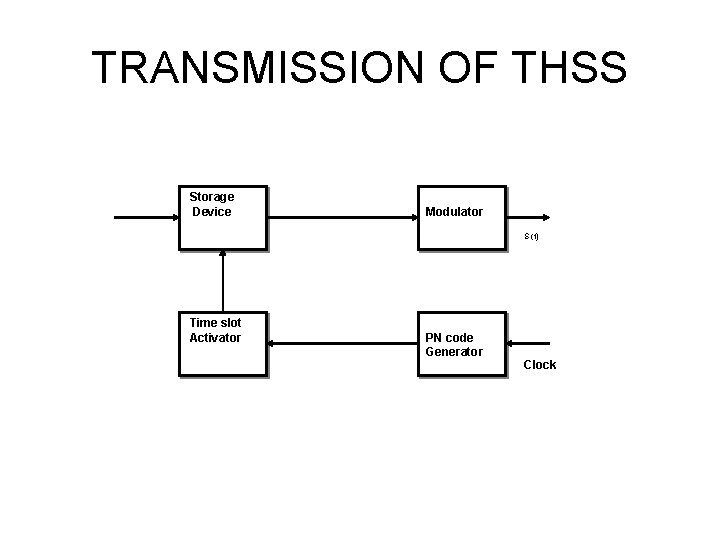
TRANSMISSION OF THSS Storage Device Modulator S (t) Time slot Activator PN code Generator Clock
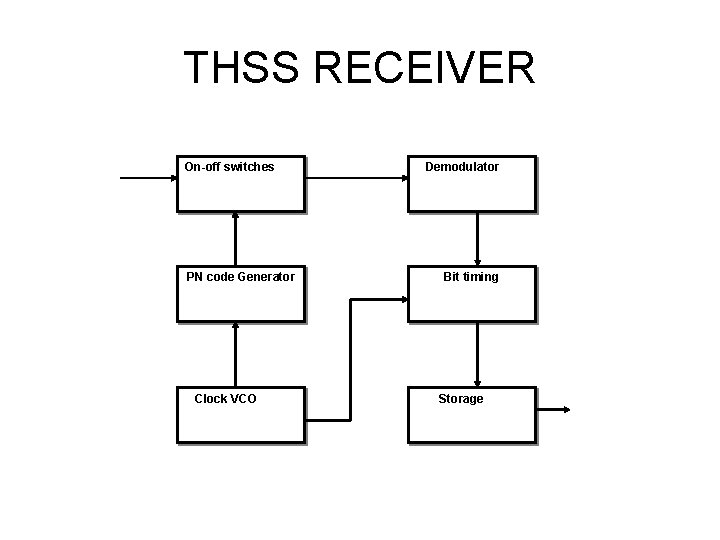
THSS RECEIVER On-off switches PN code Generator Clock VCO Demodulator Bit timing Storage
THSS (contd) • Advantages – Has a high bandwidth efficiency as compared to FH and DSSS. – Its implementation is simpler than that of FHSS – Near-far problem can be avoided in a coordinated system • Disadvantages – Has a very long acquisition time. – Also requires error correction
Hybrid System: DS/(F)FH
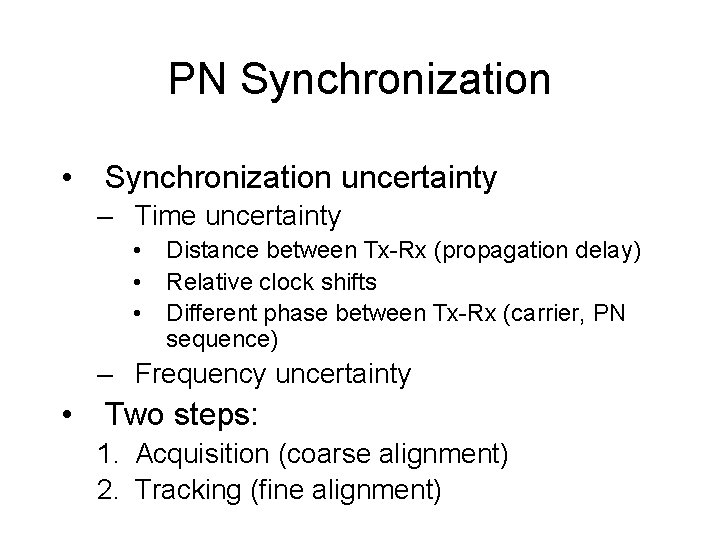
PN Synchronization • Synchronization uncertainty – Time uncertainty • Distance between Tx-Rx (propagation delay) • Relative clock shifts • Different phase between Tx-Rx (carrier, PN sequence) – Frequency uncertainty • Two steps: 1. Acquisition (coarse alignment) 2. Tracking (fine alignment)
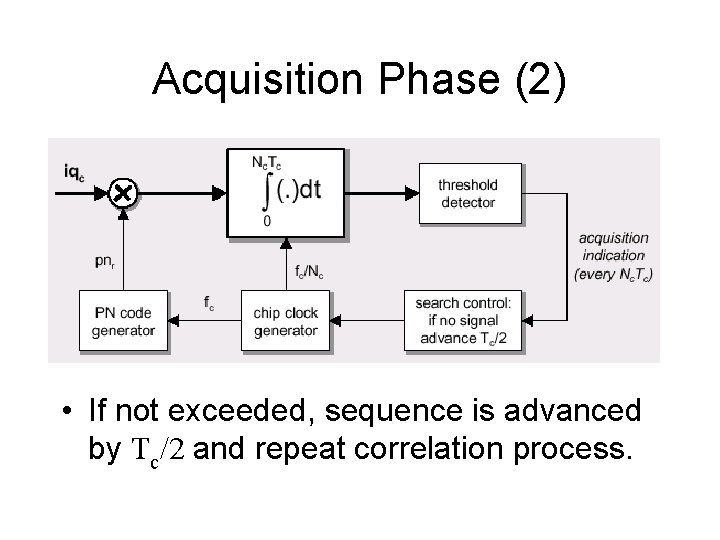
Acquisition Phase • Received signal and the locally generated PN sequence are correlated with a coarse time step to produce a measure of similarity between the two.
Acquisition Phase (2) • If not exceeded, sequence is advanced by Tc/2 and repeat correlation process.
Applications of Spread Spectrum • Cell phones – IS-95 (DS/SS) – GSM • Global Positioning System (GPS) • Wireless LANs – 802. 11 b
Performance of DS/SS Systems • Pseudonoise (PN) codes – Spread signal at the transmitter – Despread signal at the receiver • Ideal PN sequences should be – Orthogonal (no interference) – Random (security) – Autocorrelation similar to white noise (high at t=0 and low for t not equal 0)
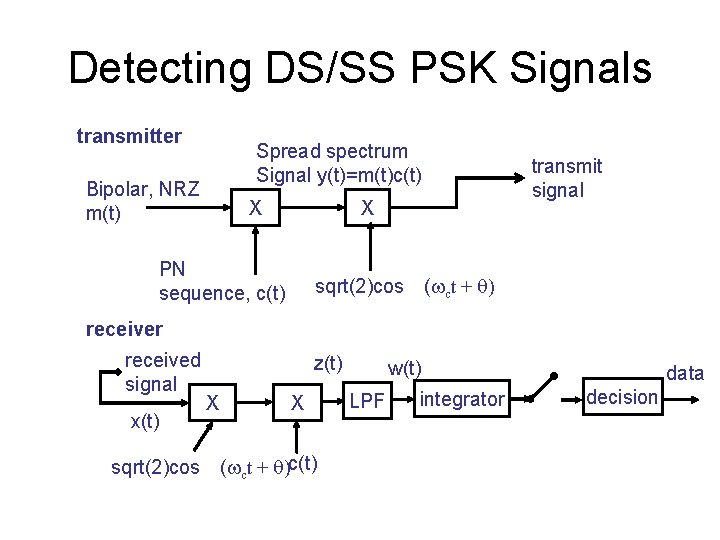
Detecting DS/SS PSK Signals transmitter Spread spectrum Signal y(t)=m(t)c(t) Bipolar, NRZ m(t) X transmit signal X PN sequence, c(t) (wct + q) sqrt(2)cos receiver received signal x(t) sqrt(2)cos z(t) X X (wct + q)c(t) w(t) LPF integrator data decision
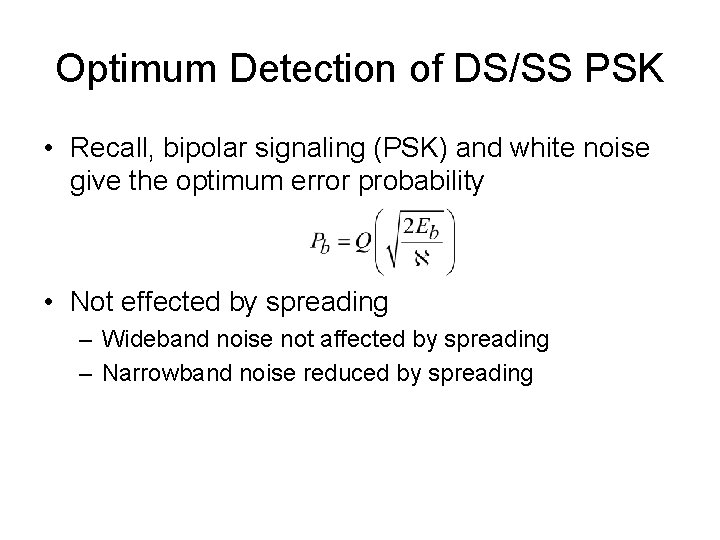
Optimum Detection of DS/SS PSK • Recall, bipolar signaling (PSK) and white noise give the optimum error probability • Not effected by spreading – Wideband noise not affected by spreading – Narrowband noise reduced by spreading
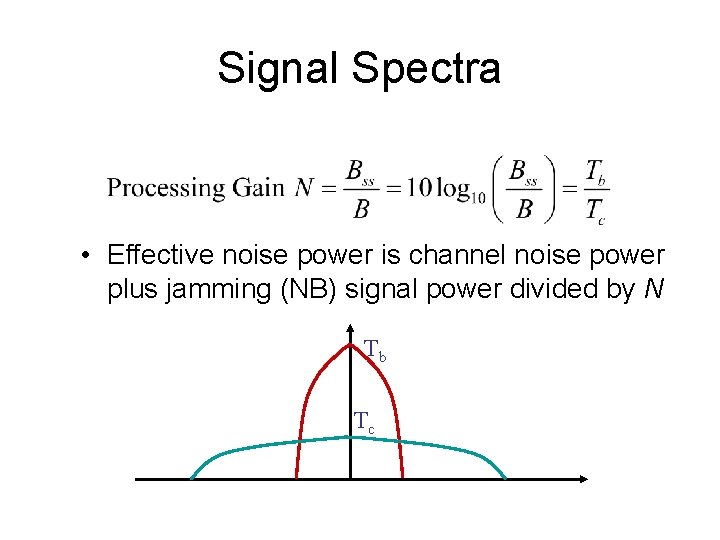
Signal Spectra • Effective noise power is channel noise power plus jamming (NB) signal power divided by N Tb Tc
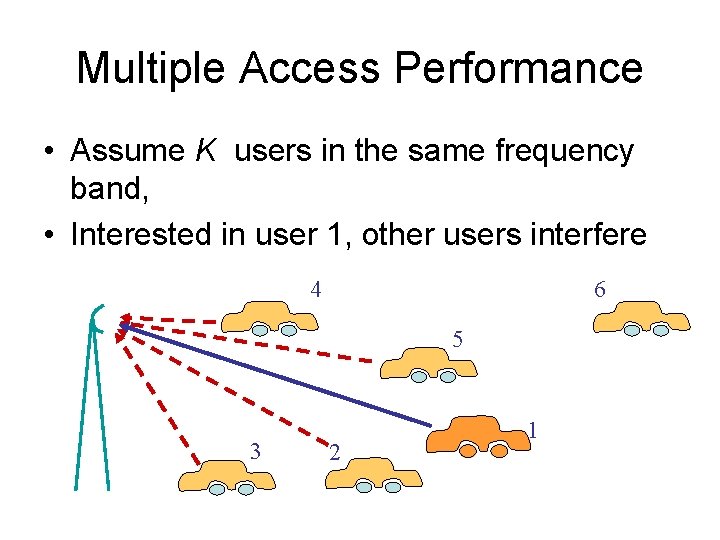
Multiple Access Performance • Assume K users in the same frequency band, • Interested in user 1, other users interfere 4 6 5 3 2 1
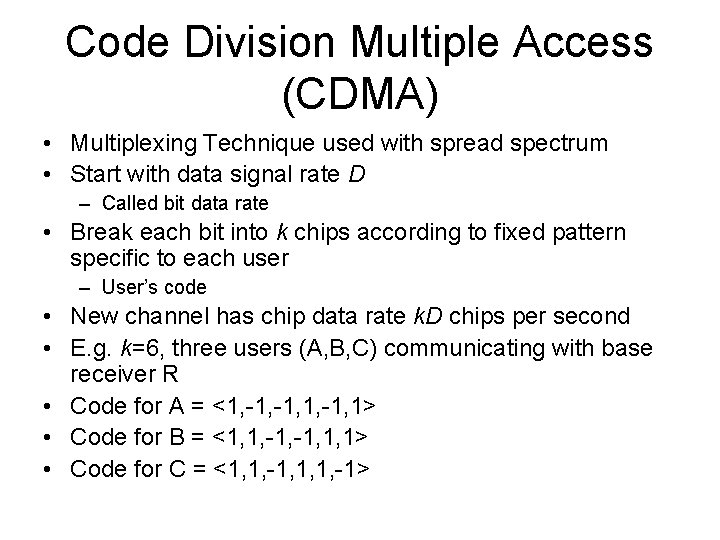
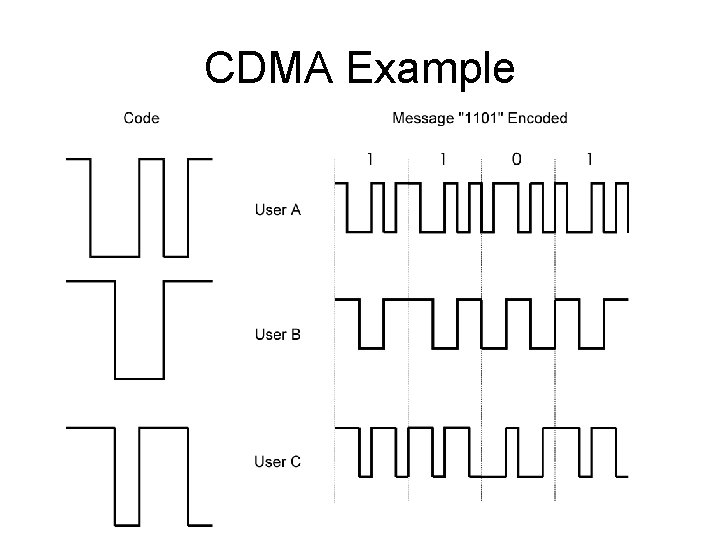
Code Division Multiple Access (CDMA) • Multiplexing Technique used with spread spectrum • Start with data signal rate D – Called bit data rate • Break each bit into k chips according to fixed pattern specific to each user – User’s code • New channel has chip data rate k. D chips per second • E. g. k=6, three users (A, B, C) communicating with base receiver R • Code for A = <1, -1, 1> • Code for B = <1, 1, -1, 1, 1> • Code for C = <1, 1, -1, 1, 1, -1>
CDMA Example
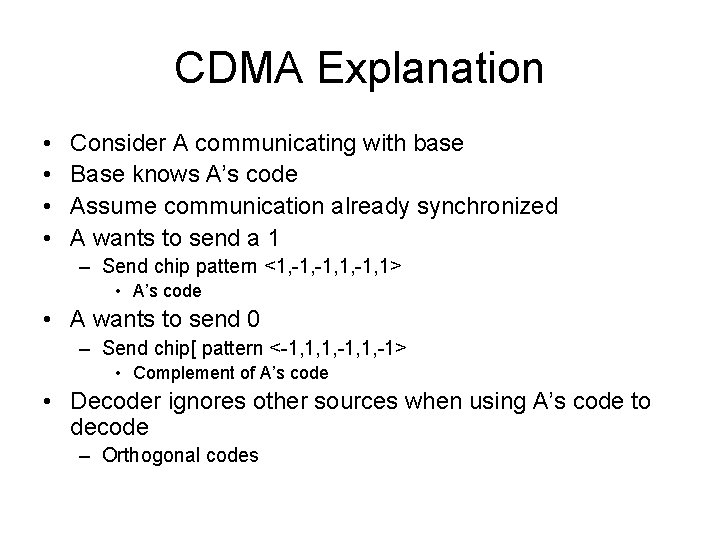
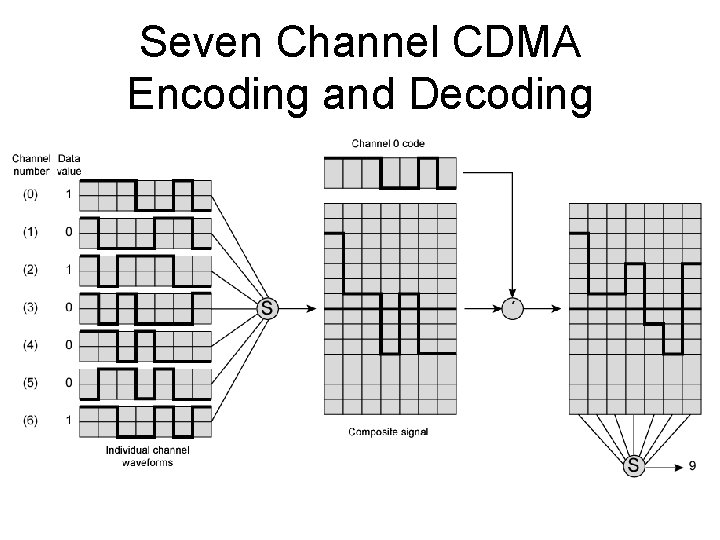
CDMA Explanation • • Consider A communicating with base Base knows A’s code Assume communication already synchronized A wants to send a 1 – Send chip pattern <1, -1, 1> • A’s code • A wants to send 0 – Send chip[ pattern <-1, 1, 1, -1> • Complement of A’s code • Decoder ignores other sources when using A’s code to decode – Orthogonal codes
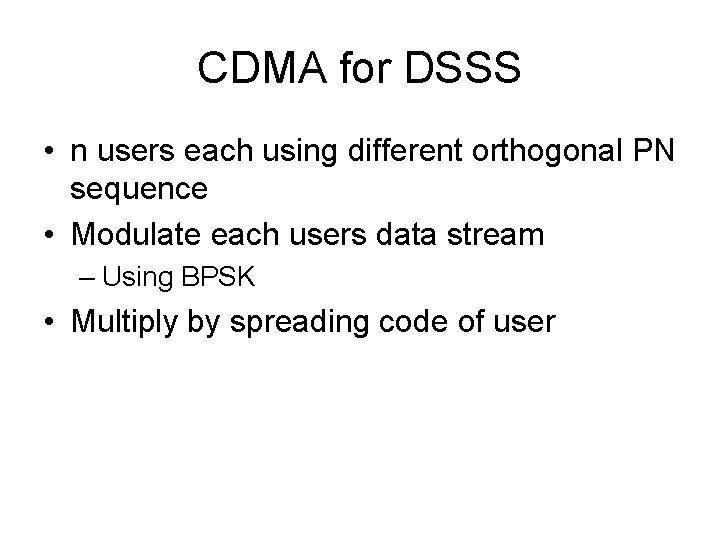
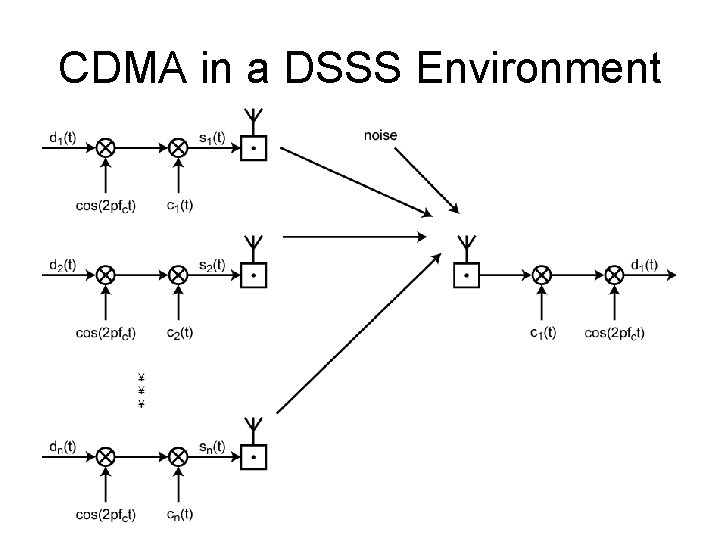
CDMA for DSSS • n users each using different orthogonal PN sequence • Modulate each users data stream – Using BPSK • Multiply by spreading code of user
CDMA in a DSSS Environment
Seven Channel CDMA Encoding and Decoding
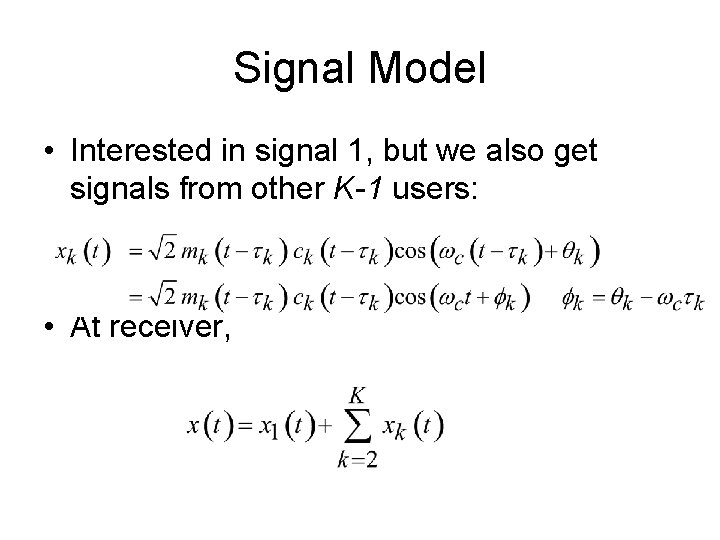
Signal Model • Interested in signal 1, but we also get signals from other K-1 users: • At receiver,
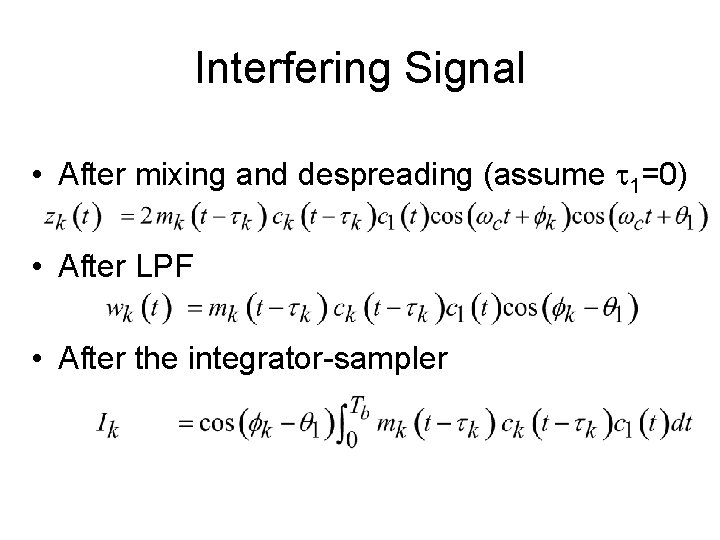
Interfering Signal • After mixing and despreading (assume t 1=0) • After LPF • After the integrator-sampler
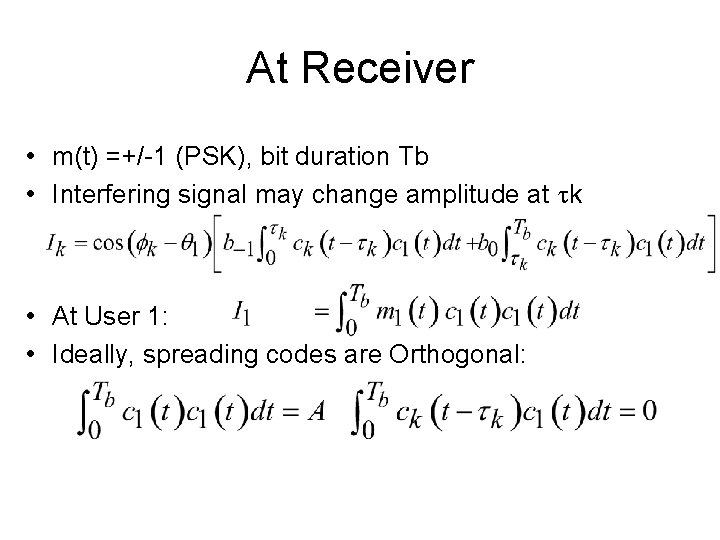
At Receiver • m(t) =+/-1 (PSK), bit duration Tb • Interfering signal may change amplitude at tk • At User 1: • Ideally, spreading codes are Orthogonal:
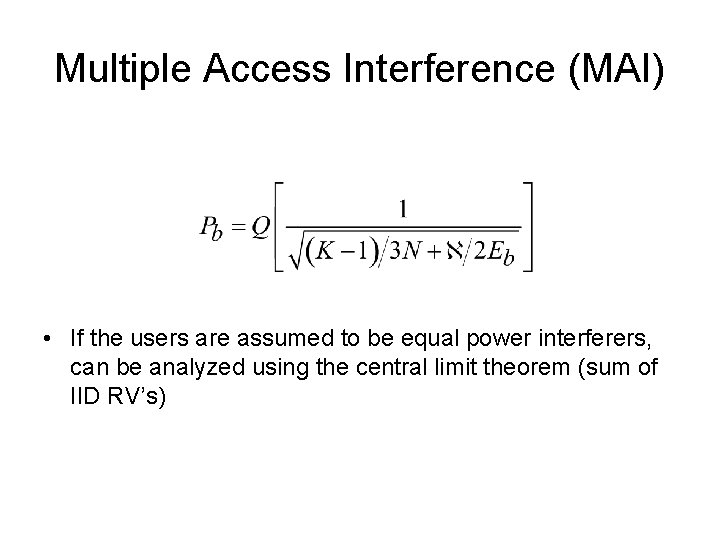
Multiple Access Interference (MAI) • If the users are assumed to be equal power interferers, can be analyzed using the central limit theorem (sum of IID RV’s)
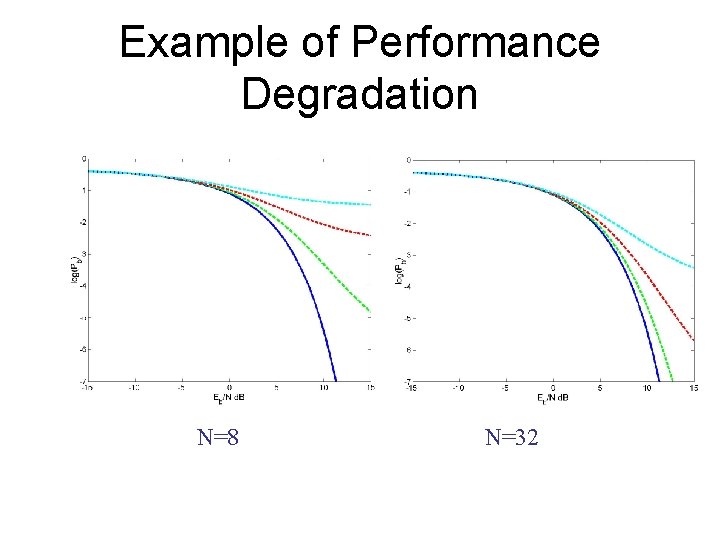
Example of Performance Degradation N=8 N=32
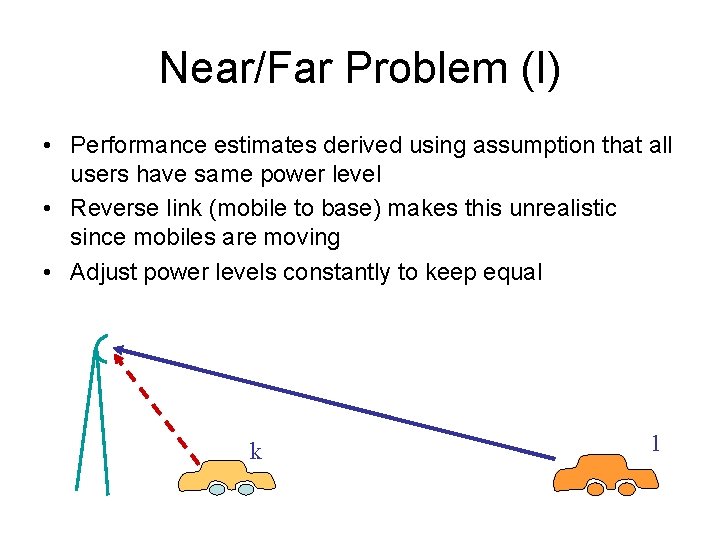
Near/Far Problem (I) • Performance estimates derived using assumption that all users have same power level • Reverse link (mobile to base) makes this unrealistic since mobiles are moving • Adjust power levels constantly to keep equal k 1
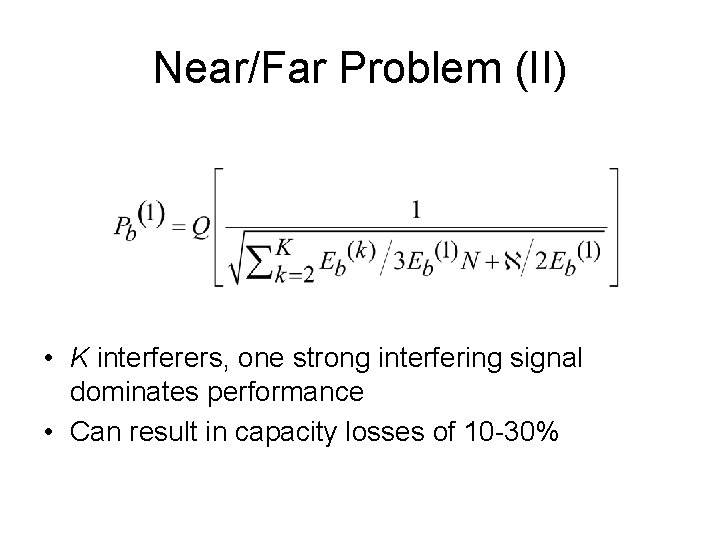
Near/Far Problem (II) • K interferers, one strong interfering signal dominates performance • Can result in capacity losses of 10 -30%
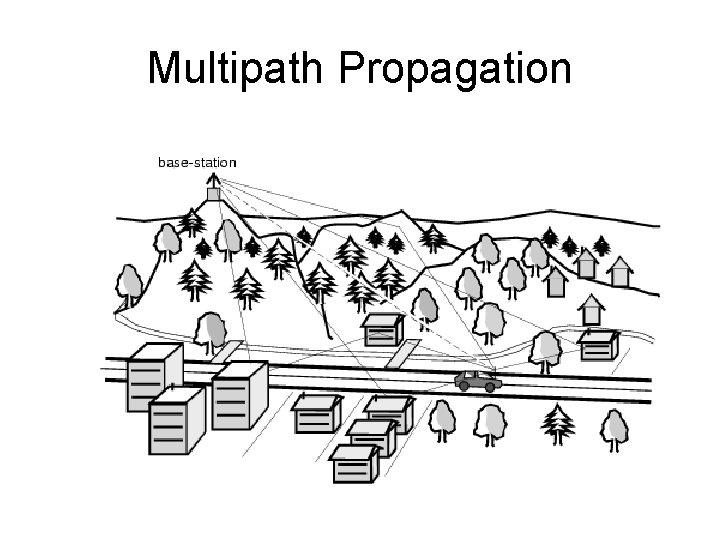
Multipath Propagation
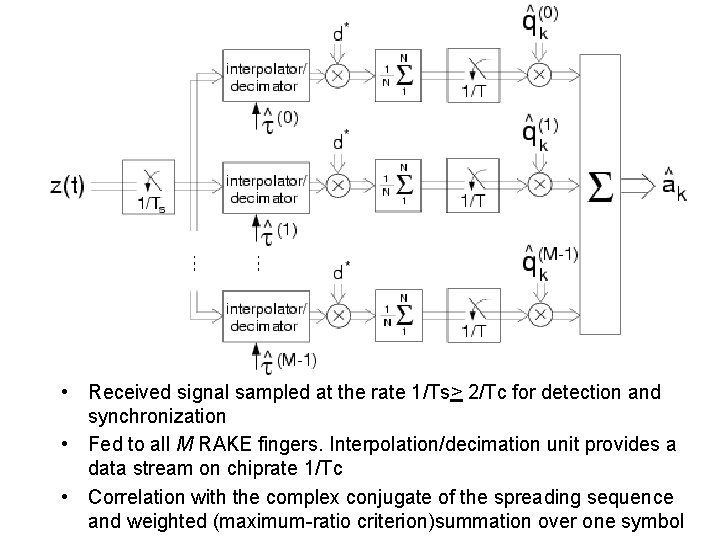
RAKE Receiver • Received signal sampled at the rate 1/Ts> 2/Tc for detection and synchronization • Fed to all M RAKE fingers. Interpolation/decimation unit provides a data stream on chiprate 1/Tc • Correlation with the complex conjugate of the spreading sequence and weighted (maximum-ratio criterion)summation over one symbol
RAKE Receiver • RAKE Receiver has to estimate: – – Multipath delays Phase of multipath components Amplitude of multipath components Number of multipath components • Main challenge is receiver synchronization in fading channels
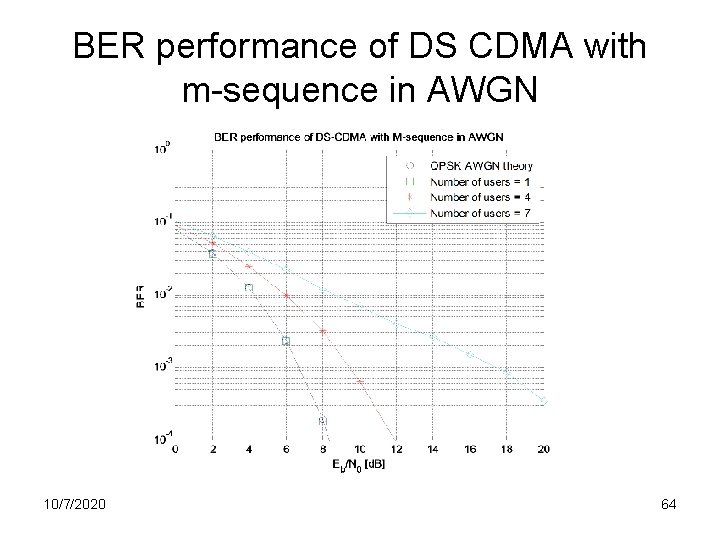
BER performance of DS CDMA with m-sequence in AWGN 10/7/2020 64
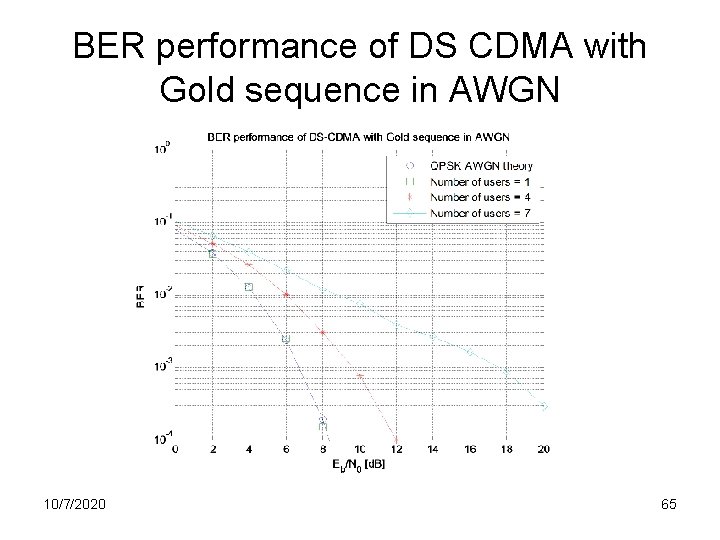
BER performance of DS CDMA with Gold sequence in AWGN 10/7/2020 65
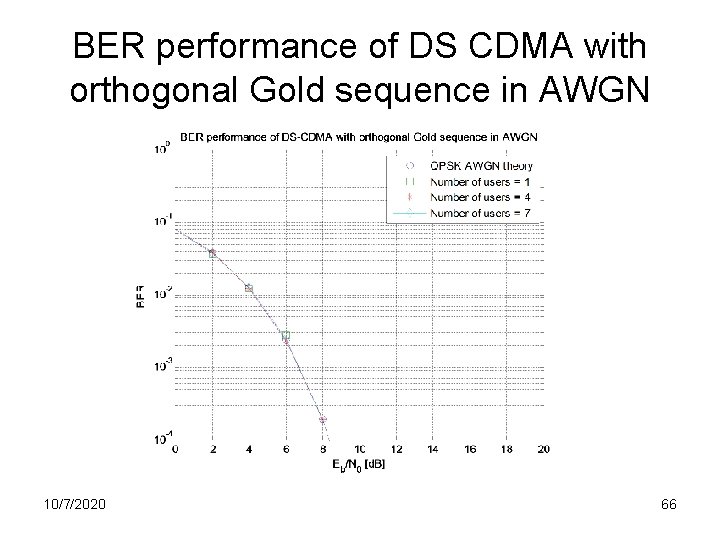
BER performance of DS CDMA with orthogonal Gold sequence in AWGN 10/7/2020 66
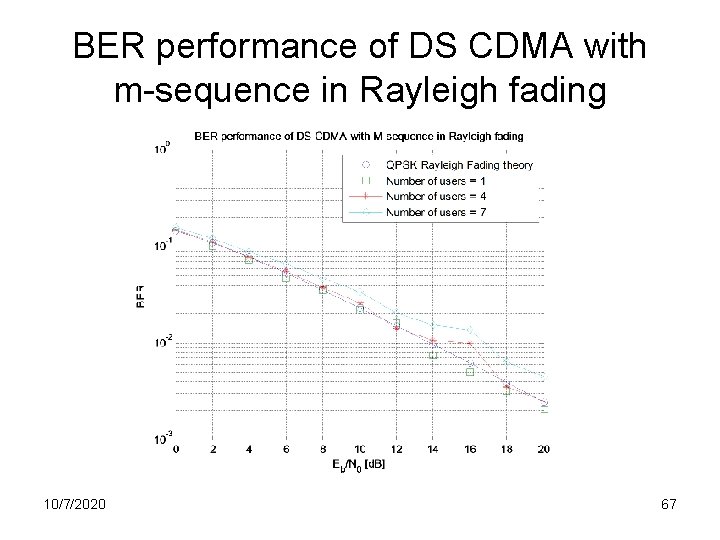
BER performance of DS CDMA with m-sequence in Rayleigh fading 10/7/2020 67
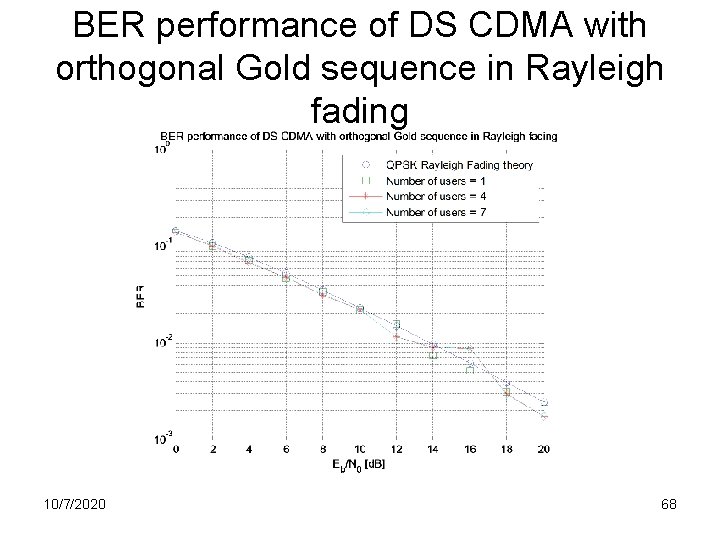
BER performance of DS CDMA with orthogonal Gold sequence in Rayleigh fading 10/7/2020 68
Practical Example: Bluetooth • 2. 4 GHz – 2. 4835 GHz Operating Range • 79 Different Radio Channels • Hops 1600 times per second for data/voice links • Hops 3200 times per second for page and inquiry scanning • 1 Mbps = Rb for Bluetooth Ver 1. 1/1. 2 • 3 Mbps = Rb for Bluetooth Ver 2. 1 • Gaussian Frequency Shift Keying (GFSK)
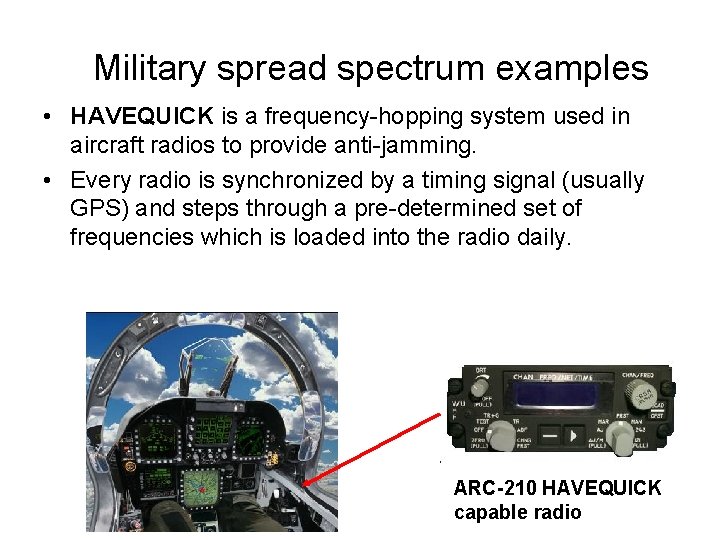
Military spread spectrum examples • HAVEQUICK is a frequency-hopping system used in aircraft radios to provide anti-jamming. • Every radio is synchronized by a timing signal (usually GPS) and steps through a pre-determined set of frequencies which is loaded into the radio daily. ARC-210 HAVEQUICK capable radio
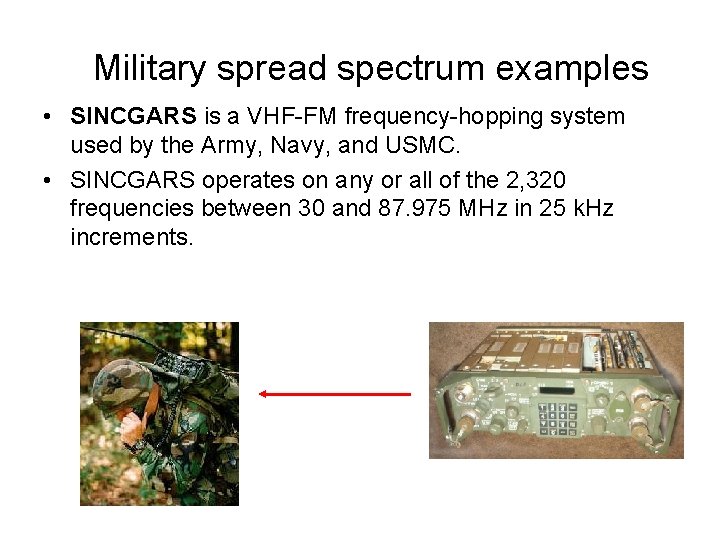
Military spread spectrum examples • SINCGARS is a VHF-FM frequency-hopping system used by the Army, Navy, and USMC. • SINCGARS operates on any or all of the 2, 320 frequencies between 30 and 87. 975 MHz in 25 k. Hz increments.