
Spread Spectrum Introduction to Spread Spectrum Problems such
Spread Spectrum
Introduction to Spread Spectrum • Problems such as capacity limits, propagation effects, synchronization occur with wireless systems • Spread spectrum modulation spreads out the modulated signal bandwidth so it is much greater than the message bandwidth • Independent code spreads signal at transmitter and despreads signal at receiver
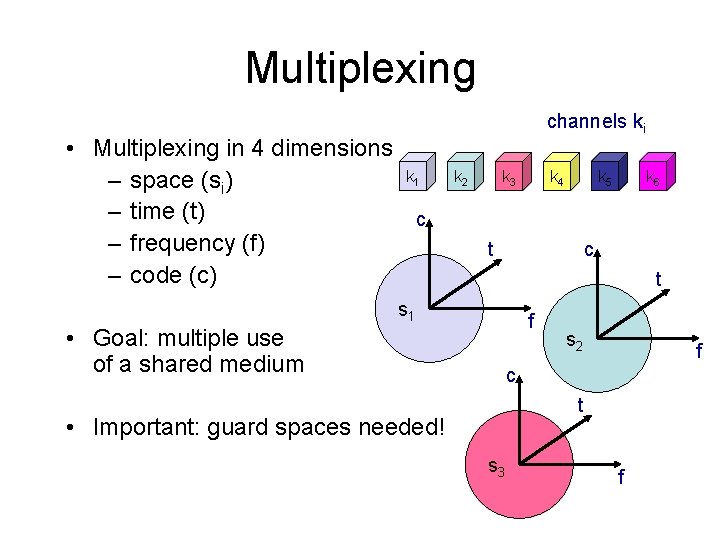
Multiplexing • Multiplexing in 4 dimensions k 1 – space (si) – time (t) c – frequency (f) – code (c) channels ki k 2 k 3 k 4 k 5 t k 6 c t s 1 f • Goal: multiple use of a shared medium s 2 f c t • Important: guard spaces needed! s 3 f
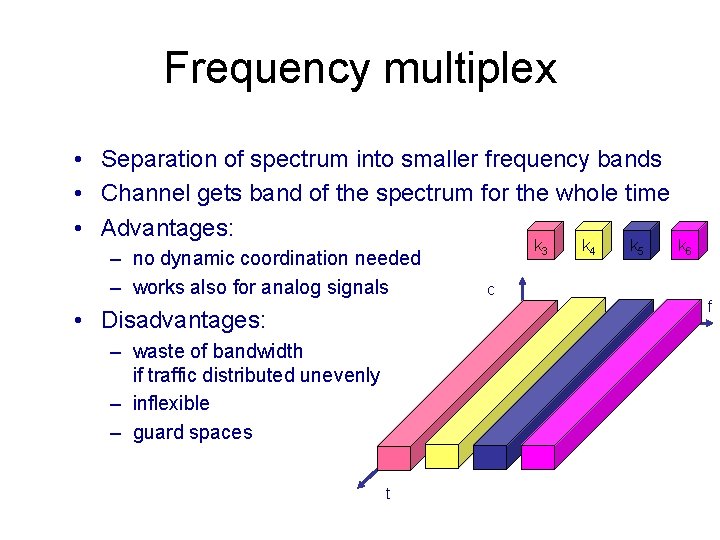
Frequency multiplex • Separation of spectrum into smaller frequency bands • Channel gets band of the spectrum for the whole time • Advantages: – no dynamic coordination needed – works also for analog signals • Disadvantages: – waste of bandwidth if traffic distributed unevenly – inflexible – guard spaces t k 3 c k 4 k 5 k 6 f
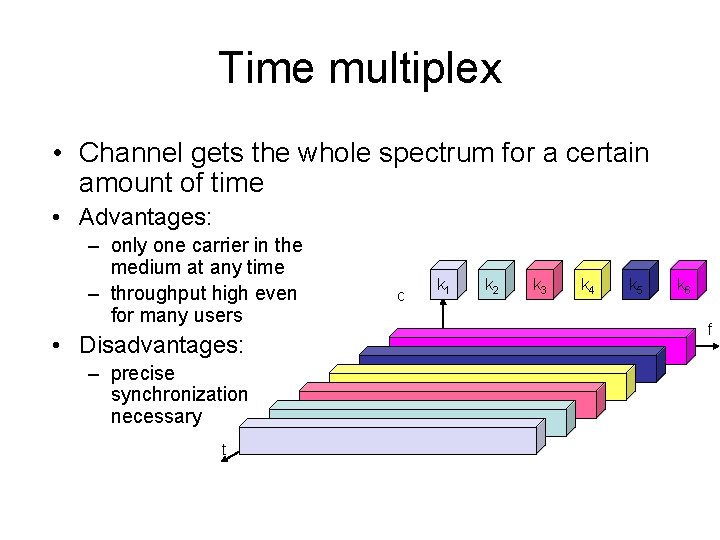
Time multiplex • Channel gets the whole spectrum for a certain amount of time • Advantages: – only one carrier in the medium at any time – throughput high even for many users • Disadvantages: – precise synchronization necessary t c k 1 k 2 k 3 k 4 k 5 k 6 f

Time and frequency multiplex • A channel gets a certain frequency band for a certain amount of time (e. g. GSM) • Advantages: – better protection against tapping – protection against frequency selective interference – higher data rates compared to c code multiplex • Precise coordination required t k 1 k 2 k 3 k 4 k 5 k 6 f
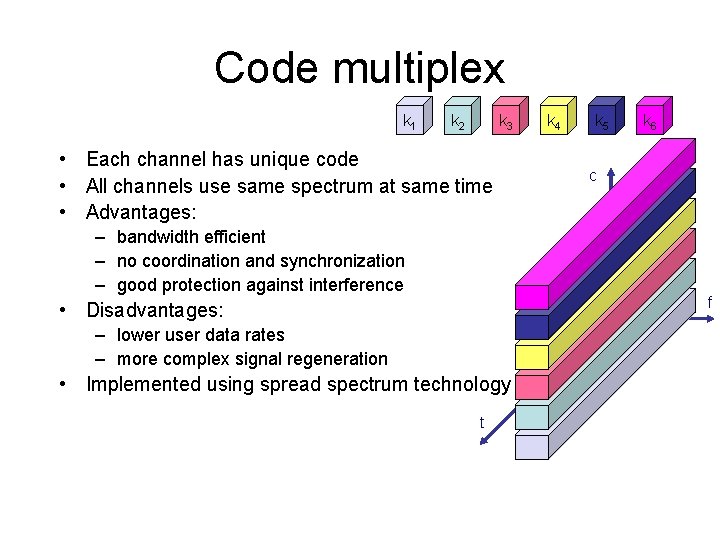
Code multiplex k 1 k 2 k 3 • Each channel has unique code • All channels use same spectrum at same time • Advantages: – bandwidth efficient – no coordination and synchronization – good protection against interference k 4 k 5 k 6 c f • Disadvantages: – lower user data rates – more complex signal regeneration • Implemented using spread spectrum technology t
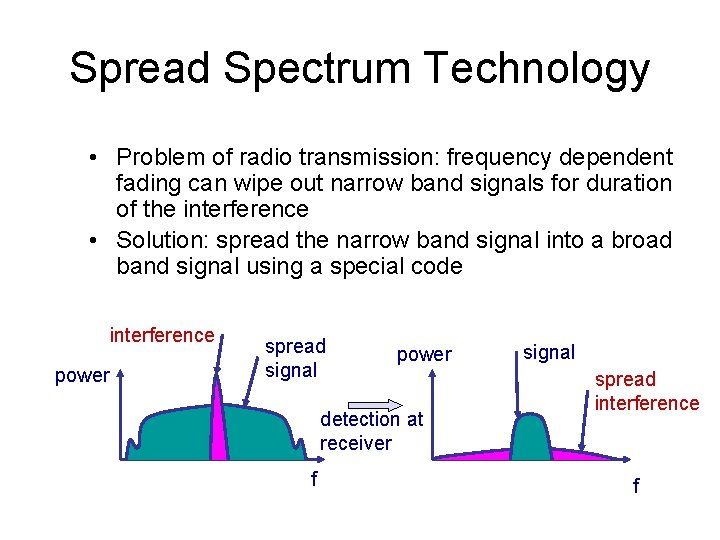
Spread Spectrum Technology • Problem of radio transmission: frequency dependent fading can wipe out narrow band signals for duration of the interference • Solution: spread the narrow band signal into a broad band signal using a special code interference power spread signal power detection at receiver f signal spread interference f
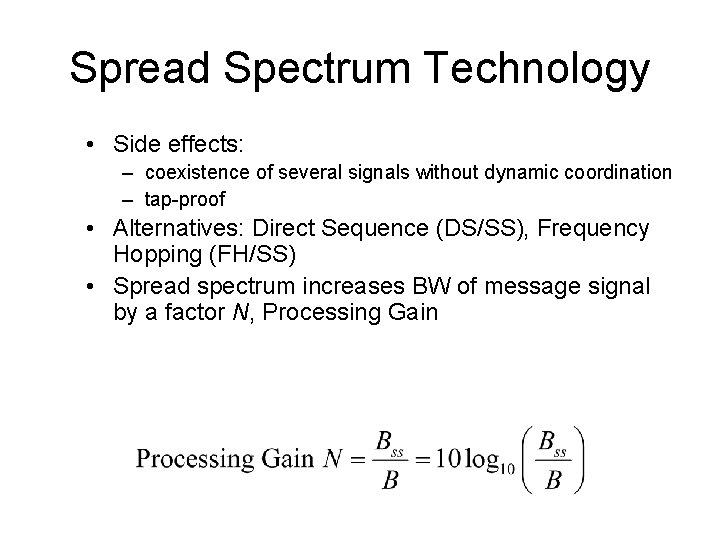
Spread Spectrum Technology • Side effects: – coexistence of several signals without dynamic coordination – tap-proof • Alternatives: Direct Sequence (DS/SS), Frequency Hopping (FH/SS) • Spread spectrum increases BW of message signal by a factor N, Processing Gain
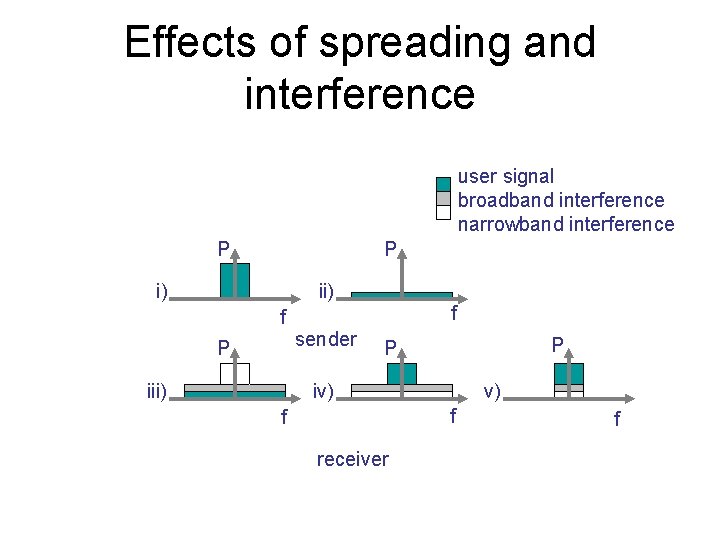
Effects of spreading and interference user signal broadband interference narrowband interference P P i) ii) f P iii) sender f P P iv) v) f f receiver f
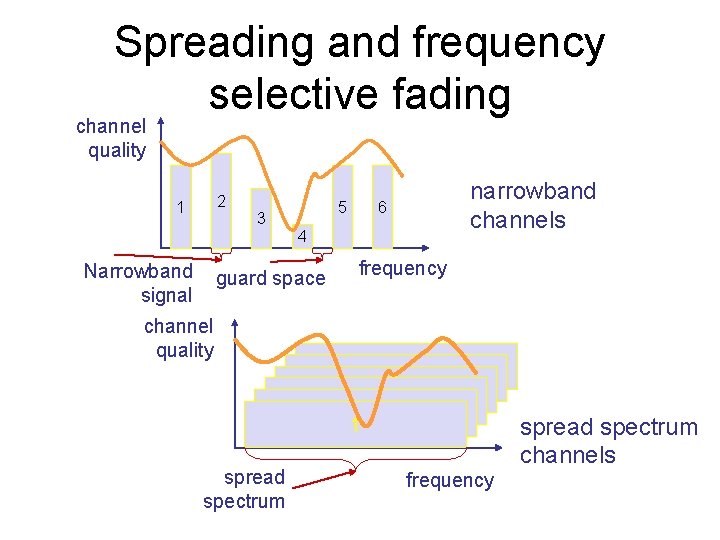
Spreading and frequency selective fading channel quality 2 1 Narrowband signal 3 5 spread spectrum 6 4 guard space channel quality narrowband channels frequency 2 2 2 1 frequency spread spectrum channels
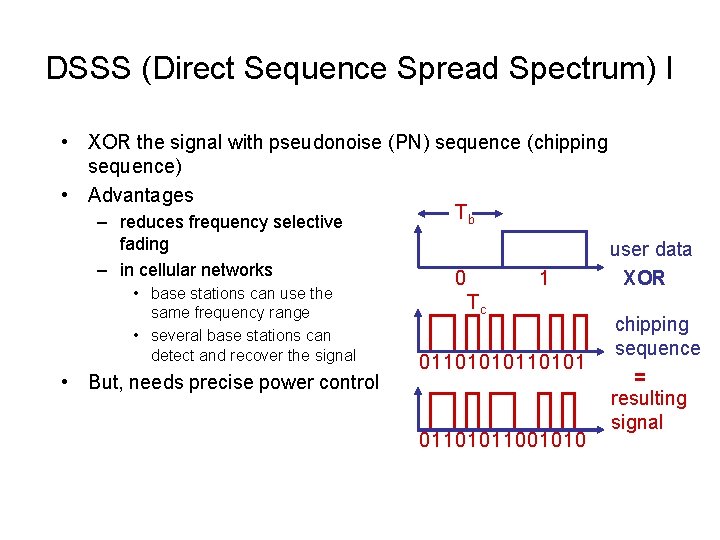
DSSS (Direct Sequence Spread Spectrum) I • XOR the signal with pseudonoise (PN) sequence (chipping sequence) • Advantages Tb – reduces frequency selective fading – in cellular networks • base stations can use the same frequency range • several base stations can detect and recover the signal • But, needs precise power control 0 1 Tc 0 1 1 0 10 1 1 0 0 101 0 user data XOR chipping sequence = resulting signal
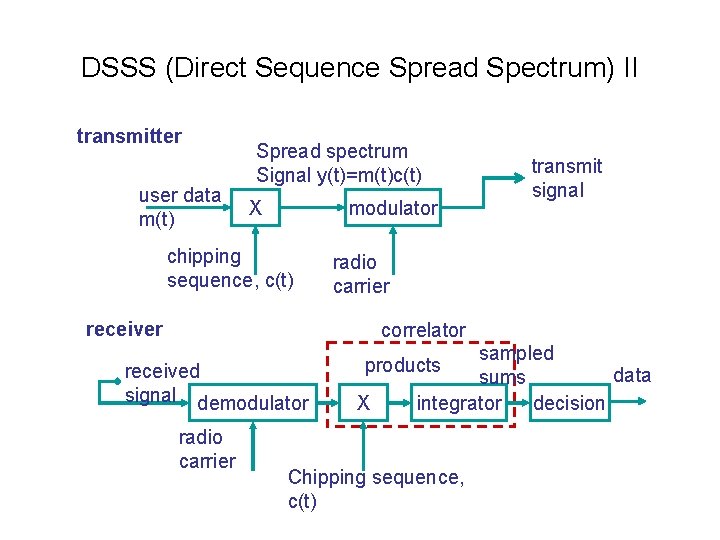
DSSS (Direct Sequence Spread Spectrum) II transmitter user data m(t) Spread spectrum Signal y(t)=m(t)c(t) X modulator chipping sequence, c(t) transmit signal radio carrier receiver correlator received signal demodulator radio carrier sampled data sums integrator decision products X Chipping sequence, c(t)
DS/SS Comments III • Pseudonoise(PN) sequence chosen so that its autocorrelation is very narrow => PSD is very wide – Concentrated around t < Tc – Cross-correlation between two user’s codes is very small
DS/SS Comments IV • Secure and Jamming Resistant – Both receiver and transmitter must know c(t) – Since PSD is low, hard to tell if signal present – Since wide response, tough to jam everything • Multiple access – If ci(t) is orthogonal to cj(t), then users do not interfere • Near/Far problem – Users must be received with the same power
FH/SS (Frequency Hopping Spread Spectrum) I • Discrete changes of carrier frequency – sequence of frequency changes determined via PN sequence • Two versions – Fast Hopping: several frequencies per user bit (FFH) – Slow Hopping: several user bits per frequency (SFH) • Advantages – frequency selective fading and interference limited to short period – uses only small portion of spectrum at any time • Disadvantages – not as robust as DS/SS – simpler to detect

FHSS (Frequency Hopping Spread Spectrum) II Tb user data 0 1 f 0 1 1 t Td f 3 slow hopping (3 bits/hop) f 2 f 1 f t Td f 3 fast hopping (3 hops/bit) f 2 f 1 t Tb: bit period Td: dwell time
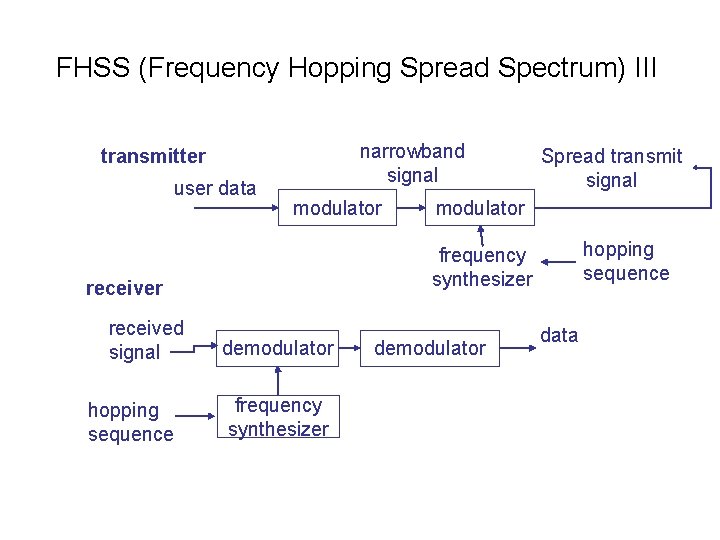
FHSS (Frequency Hopping Spread Spectrum) III narrowband signal transmitter user data modulator hopping sequence frequency synthesizer received signal Spread transmit signal demodulator frequency synthesizer demodulator data
Applications of Spread Spectrum • Cell phones – IS-95 (DS/SS) – GSM • Global Positioning System (GPS) • Wireless LANs – 802. 11 b
Performance of DS/SS Systems • Pseudonoise (PN) codes – Spread signal at the transmitter – Despread signal at the receiver • Ideal PN sequences should be – Orthogonal (no interference) – Random (security) – Autocorrelation similar to white noise (high at t=0 and low for t not equal 0)
- Slides: 20