
SPRAY DRYING BASIC CONCEPT SPRAY DRYING Spray drying
SPRAY DRYING

BASIC CONCEPT – SPRAY DRYING � Spray drying - formation of droplets from the bulk liquid – moisture removal � liquid droplets - sprayed –drying chamber � the low-humidity hot gas or drying medium is mixed with the dispersed droplets � individual droplets –atomized - by atomizers � Spray drying –referred as a suspended droplet/particle processing technique.

� rotary wheel/disc atomizers � pressure nozzle or pneumatic-type atomizers. � The atomizer is generally located at the top centre of the drying chamber for most spray drying operations. � The moisture, in the form of vapor, quickly evaporates from the suspended droplets � due to simultaneous and fast heat and mass transfer processes.
�Drying of the droplets continues inside the drying chamber - desired particle characteristics are achieved. �The final dried product is produced using a single stage drying process �Separation of the dried particles from the drying gas - cyclones and/or bagfilter houses.

SINGLE STAGE SPRAY DRYER
� To produce a hot drying medium, the ambient air ( Tambient) is heated to the desired temperature (Tinlet ). � In modern spray driers, the hot air stream + cooling air stream - to keep the atomizer temperature at a low value � the temperature of the hot air stream is usually kept slightly higher than the temperature required at the atomizer zone. � During this heating, the absolute humidity of the air remains constant while its vapor pressure (RH) is reduced to a very low value
� the water activity of the dried product is normally reduced to less than 0. 2; � therefore the RH of the air is maintained below 20% RH to reach the desired level of water activity � The outlet air temperature (Toutlet ), which is controlled by the liquid flow, - keep the water activity at the desired level. � At the end of the drying, the drying gas & dried product can approach an equilibrium state.
� The rate of evaporation - temperature & vapor pressure differences - surface of the droplets & the drying gas � other important factors: diffusivity of water in air relative velocity of droplet with respect to drying gas kinematic viscosity conductivity & heat capacity of air � conversion of the liquid droplet to the dried particle �weight loss of 50% (due to loss of water) �volume loss of 25% (due to shrinkage).

COMPONENTS OF A SPRAY DRYING SYSTEM � drying gas supply and heating system � atomization system � drying chamber � powder separators � Additional/Optional �the number of stages �drying mode - fluidized-bed drier or belt drier
DRYING GAS SUPPLY AND HEATING SYSTEM �ambient air �Superheated steam �Air – drawn – filtered - heated from 150◦C to 270◦C �Hot air with higher humidity - may result in a dried product with a slightly higher moisture content. �air dehumidification unit – may be installed
�The air can be heated using a directcontact or an indirect-contact system �Electrical, steam, oil-fired or gas heaters �combination of heating methods such as steam and electrical heating �The air pressure inside - slightly lower than the atmospheric pressure �A lower pressure helps to avoid leakage of product/air from the drier
ATOMIZATION SYSTEM � large surface area between the moist droplets and the drying medium � heat and mass transfer processes � 1 cubic metre of liquid forms approximately 2 × 10¹² uniform droplets of 100 μm diameter � powder properties and powder collection efficiency – depends on type of atomizer � The atomization process influences droplet’s size, size distribution, trajectory and velocity, the overall product quality, the drying chamber design energy requirement to form the spray of droplets.
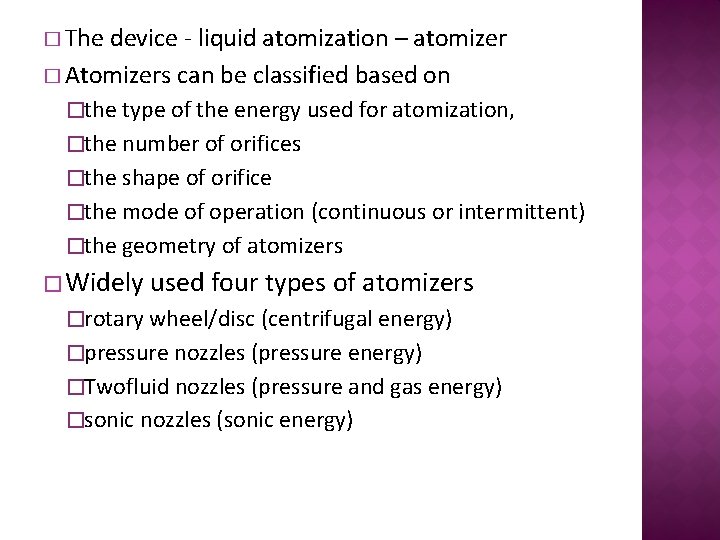
� The device - liquid atomization – atomizer � Atomizers can be classified based on �the type of the energy used for atomization, �the number of orifices �the shape of orifice �the mode of operation (continuous or intermittent) �the geometry of atomizers � Widely used four types of atomizers �rotary wheel/disc (centrifugal energy) �pressure nozzles (pressure energy) �Twofluid nozzles (pressure and gas energy) �sonic nozzles (sonic energy)
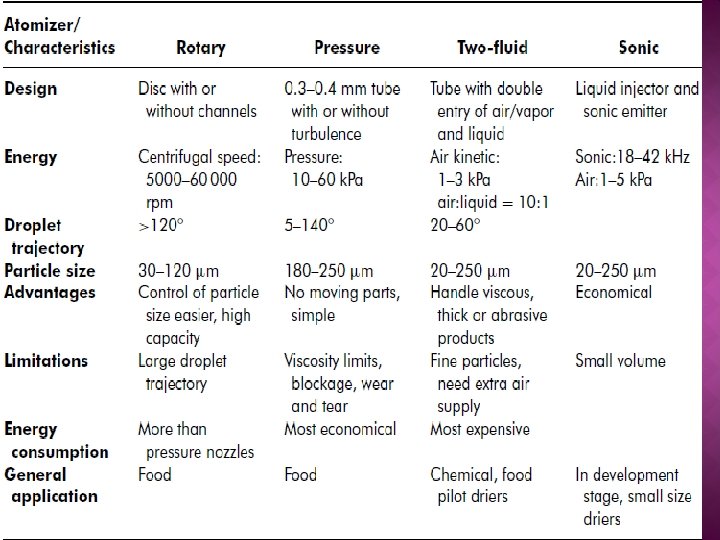
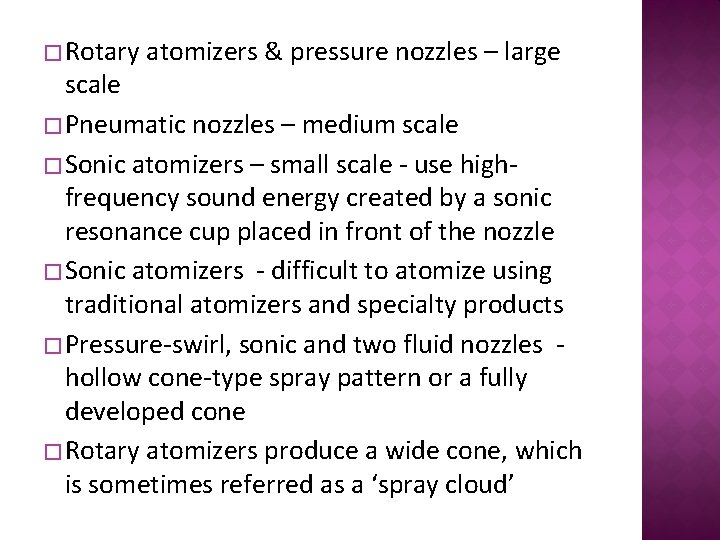
� Rotary atomizers & pressure nozzles – large scale � Pneumatic nozzles – medium scale � Sonic atomizers – small scale - use highfrequency sound energy created by a sonic resonance cup placed in front of the nozzle � Sonic atomizers - difficult to atomize using traditional atomizers and specialty products � Pressure-swirl, sonic and two fluid nozzles hollow cone-type spray pattern or a fully developed cone � Rotary atomizers produce a wide cone, which is sometimes referred as a ‘spray cloud’
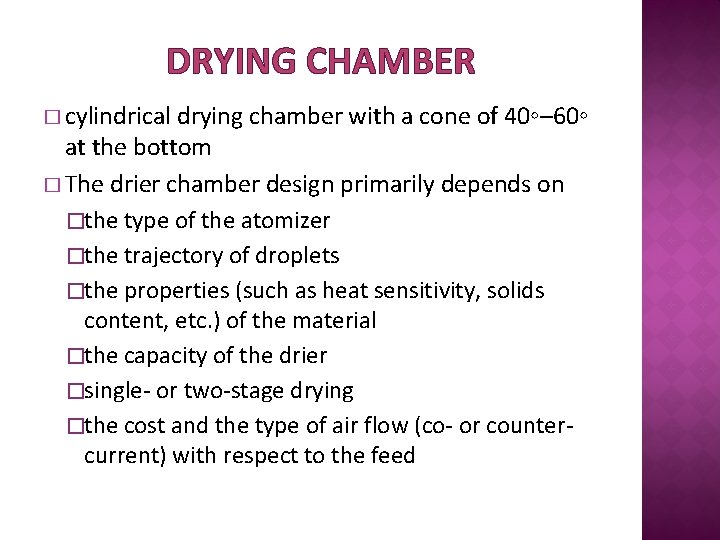
DRYING CHAMBER � cylindrical drying chamber with a cone of 40◦– 60◦ at the bottom � The drier chamber design primarily depends on �the type of the atomizer �the trajectory of droplets �the properties (such as heat sensitivity, solids content, etc. ) of the material �the capacity of the drier �single- or two-stage drying �the cost and the type of air flow (co- or countercurrent) with respect to the feed

� To facilitate powder removal and minimize the wall deposition, the drier chambers are usually equipped with an air or mechanical sweeping system � spray driers are mostly operated with a co-current mode - the drying gas and the atomized droplets move in the same direction � When rotary-type atomizers -a rotational airflow is commonly used � provides more uniform temperatures in the drying chamber compared to that of the non-rotational airflow.
POWDER SEPARATORS � the air stream from the drying chamber usually contains about 10– 50% of the total powder � Powder recovery �economy purposes �pollution problems � Gravity separators (e. g. cyclones) only or by a combination of gravity and filter separators

SINGLE STAGE SPRAY DRYER

TWO STAGE SPRAY DRYER
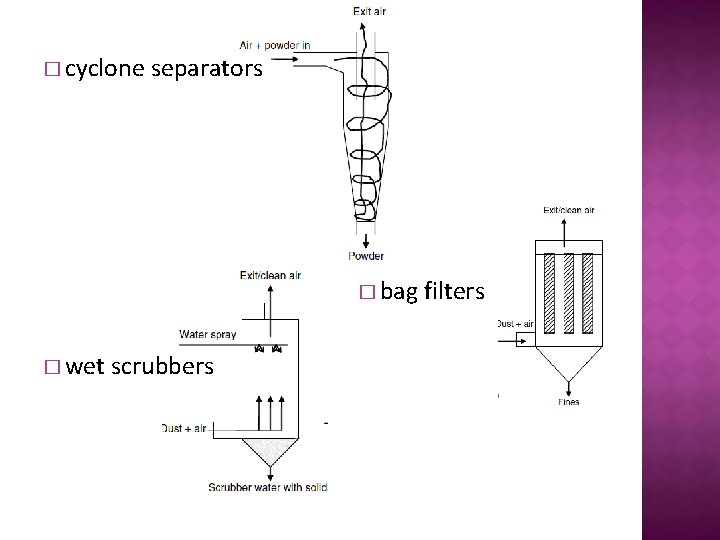
� cyclone separators � bag � wet scrubbers filters
DRYING OF DROPLETS � Drying starts with evaporation of ‘free’ moisture � on the droplet surface � droplet surface is fully covered with water -the drying rate = rate for pure water evaporation � a droplet that has dissolved or a suspended solid is being dried - vapor pressure smaller � the mass transfer rate gradually becomes lower
� drying of the wet ‘porous’ droplets � liquid diffusion caused by the liquid density gradient � Vapor diffusion caused by the vapor density gradient � capillary flow caused by the capillary force � moisture transfer caused by the internal pressure gradient � moisture transfer caused by evaporation and condensation in pores
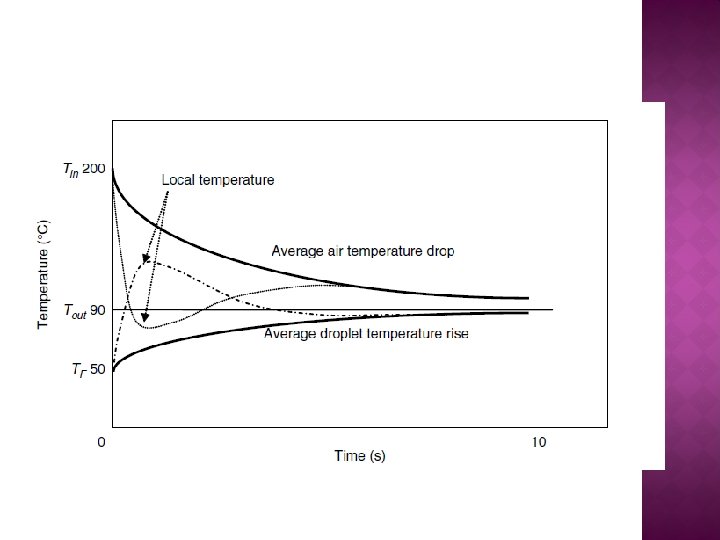
� the majority of the free water is removed in a short period of time, leading to a very short (most times negligible) constant-rate drying period � relatively longer falling rate period during drying of small droplets. � spray drying, the maximum water evaporation takes place in a fraction of a second and within a short distance from the atomizer.
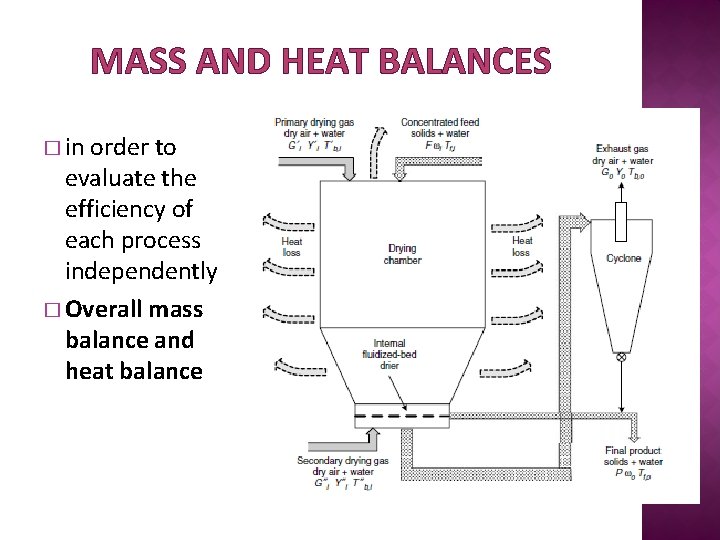
MASS AND HEAT BALANCES � in order to evaluate the efficiency of each process independently � Overall mass balance and heat balance
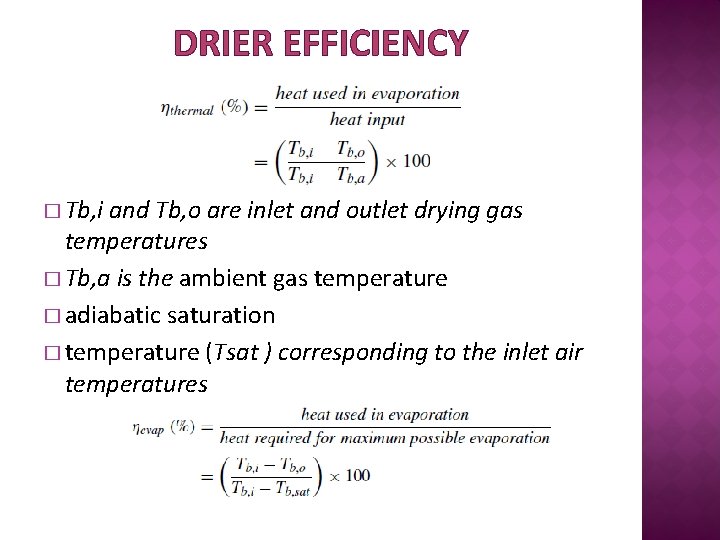
DRIER EFFICIENCY � Tb, i and Tb, o are inlet and outlet drying gas temperatures � Tb, a is the ambient gas temperature � adiabatic saturation � temperature (Tsat ) corresponding to the inlet air temperatures

- Slides: 28