
Spotter Training Pipe Space Sub Fab Fabs Ground
Spotter Training Pipe Space, Sub Fab, Fabs & Ground Floor Tecton Services Employees
During Pre-Assessment q Take time to ensure the JHA/Task Review is properly completed for the work about to be performed q Assess alternatives to working upwards in Piperack § Is the work accessible from the fab floor/floor tiles? q Visually inspect work area before beginning work § A visual inspection from more than one vantage point is usually needed in order to assess all safety/reliability hazards q Communicate with those you are working with, and with others in the area § Review your assessment of possible hazards with your spotter § Receive verbal confirmation from your coworker(s) that they understand the work and possible hazards § Let anyone else in the area know what you are doing
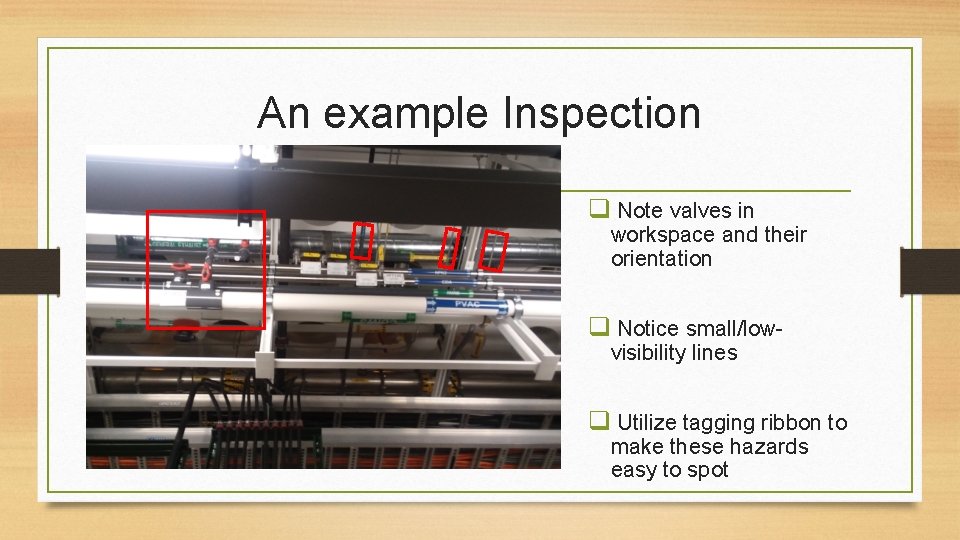
An example Inspection q Note valves in workspace and their orientation q Notice small/lowvisibility lines q Utilize tagging ribbon to make these hazards easy to spot
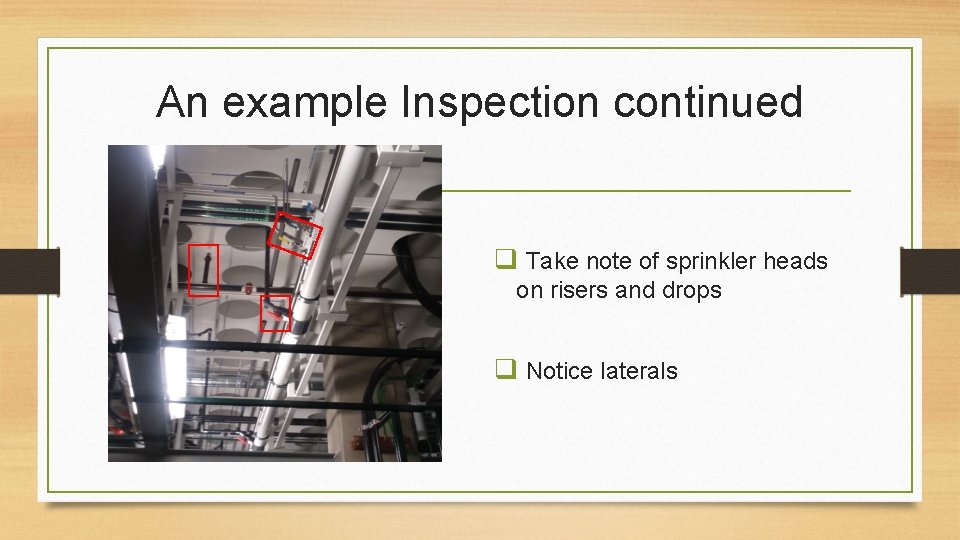
An example Inspection continued q Take note of sprinkler heads on risers and drops q Notice laterals
While working in pipe space/pipe rack q Maintain constant line of site with your spotter § If at any point the spotter’s line-of-sight to you is obscured, immediately stop work until it is restored q Communicate with your spotter § Explain your intentions out-loud to your spotter § Ask your spotter for verbal confirmation before entering new workspace § If your spotter at any time instructs you to stop, cease movement and wait for further instruction q Utilize proper PPE and anchor points § Anchor points must be rated to withstand 5000 lbs. of force. Never tie off on pipelines!
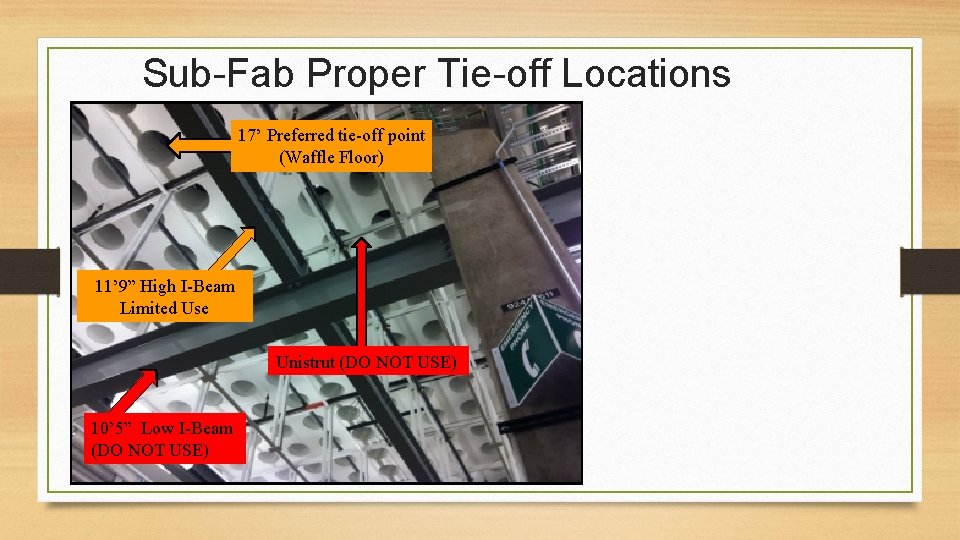
Sub-Fab Proper Tie-off Locations 17’ Preferred tie-off point (Waffle Floor) 11’ 9” High I-Beam Limited Use Unistrut (DO NOT USE) 10’ 5” Low I-Beam (DO NOT USE)
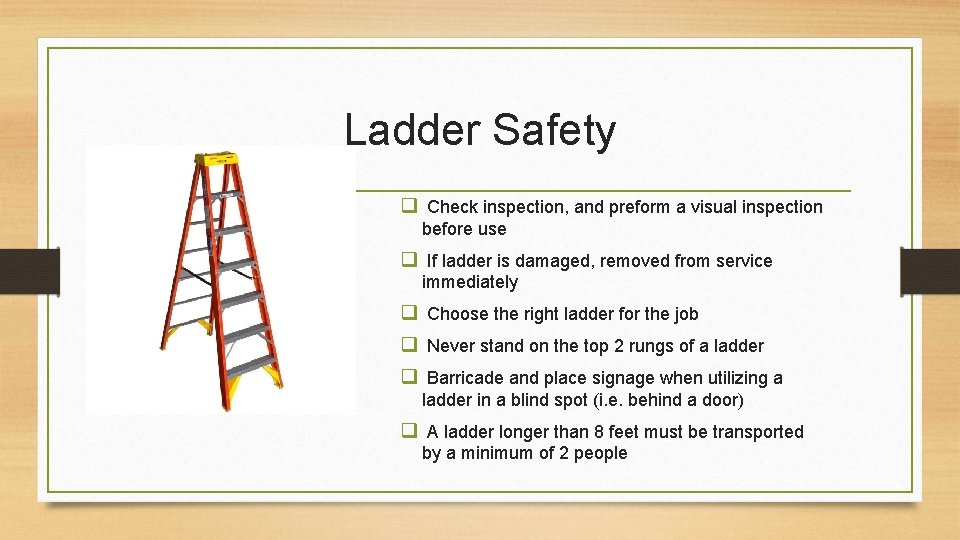
Ladder Safety q Check inspection, and preform a visual inspection before use q If ladder is damaged, removed from service immediately q Choose the right ladder for the job q Never stand on the top 2 rungs of a ladder q Barricade and place signage when utilizing a ladder in a blind spot (i. e. behind a door) q A ladder longer than 8 feet must be transported by a minimum of 2 people
While working as a spotter q Be attentive to all possible hazards, and direct work to minimize risk § If performing the work appears to present a safety or reliability risk, immediately instruct work to STOP and reassess how work will be performed q Never leave a worker alone in the pipe space for any reason
After completing work q Take time to disassemble and properly store equipment, ensuring workspace(s) are left in the proper 5 S compliant. q Ensure that preemptive reliability measures (EMO covers, zip-tied valves, barricades, signs, ribbons, etc. ) are properly and carefully removed
Other things to remember q When installing EMO covers, ensure that the cover is properly labeled, and that it has been recorded in the checklist q. When installing a ladder at least 1 person should be watching the top of the ladder to ensure it does not hit or bump anything q The 2 man rule: any piece of equipment over 8 feet in length must be carried by a minimum of 2 people, to ensure nothing is bumped or hit q If at any moment you are unsure about the action you are about to take, PAUSE and ask for help if needed
- Slides: 10