
SPOTTED HANDFISH Daniela Benguria Justin Morales Marine Science

SPOTTED HANDFISH Daniela Benguria & Justin Morales Marine Science Period 2
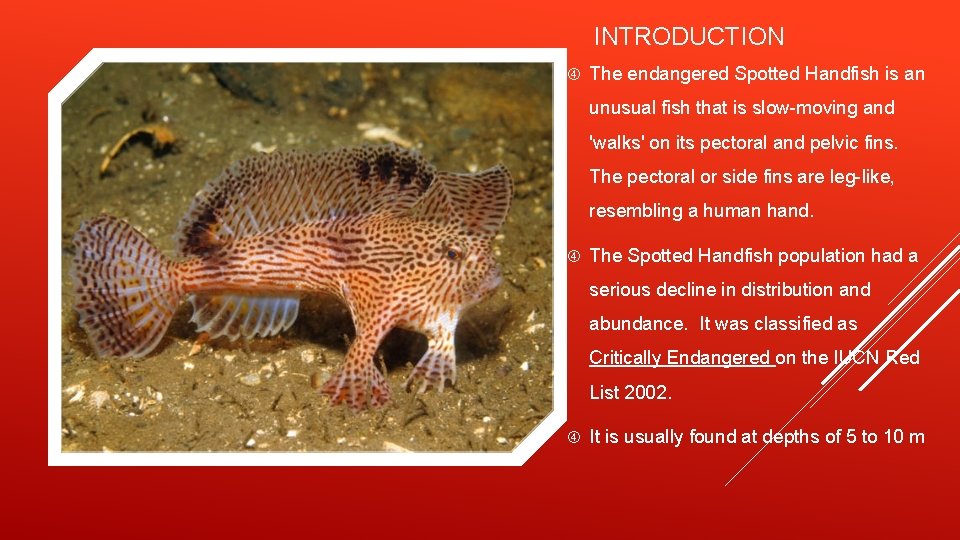
INTRODUCTION The endangered Spotted Handfish is an unusual fish that is slow-moving and 'walks' on its pectoral and pelvic fins. The pectoral or side fins are leg-like, resembling a human hand. The Spotted Handfish population had a serious decline in distribution and abundance. It was classified as Critically Endangered on the IUCN Red List 2002. It is usually found at depths of 5 to 10 m
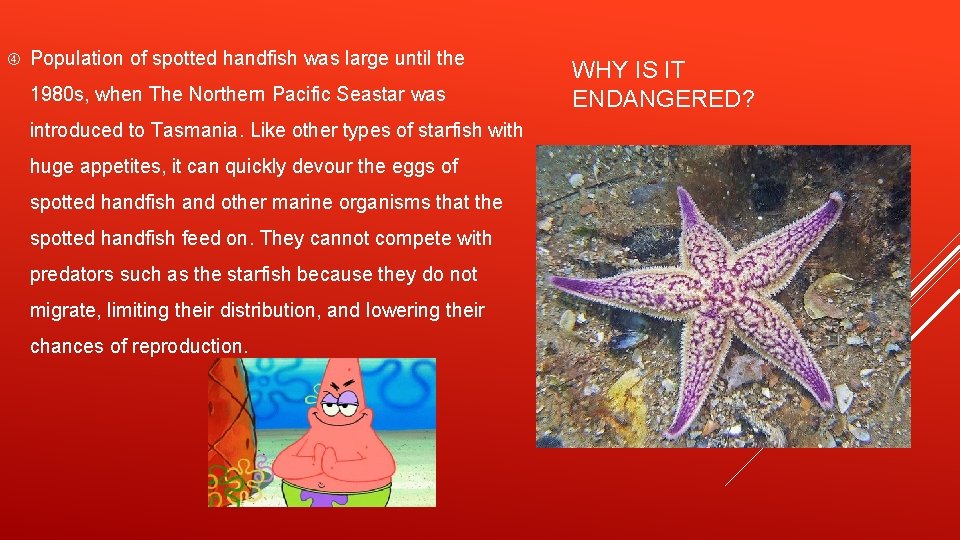
Population of spotted handfish was large until the 1980 s, when The Northern Pacific Seastar was introduced to Tasmania. Like other types of starfish with huge appetites, it can quickly devour the eggs of spotted handfish and other marine organisms that the spotted handfish feed on. They cannot compete with predators such as the starfish because they do not migrate, limiting their distribution, and lowering their chances of reproduction. WHY IS IT ENDANGERED?
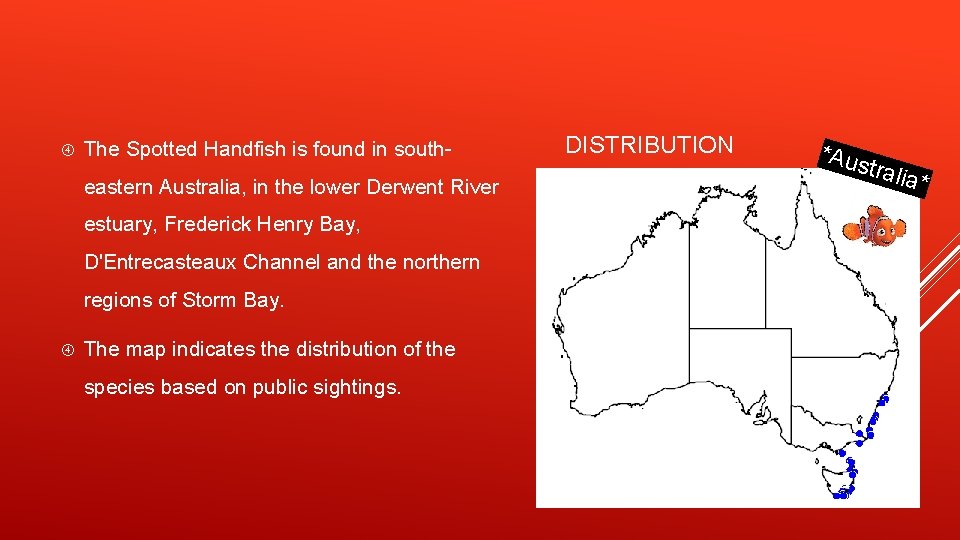
The Spotted Handfish is found in southeastern Australia, in the lower Derwent River estuary, Frederick Henry Bay, D'Entrecasteaux Channel and the northern regions of Storm Bay. The map indicates the distribution of the species based on public sightings. DISTRIBUTION *Aus tralia *
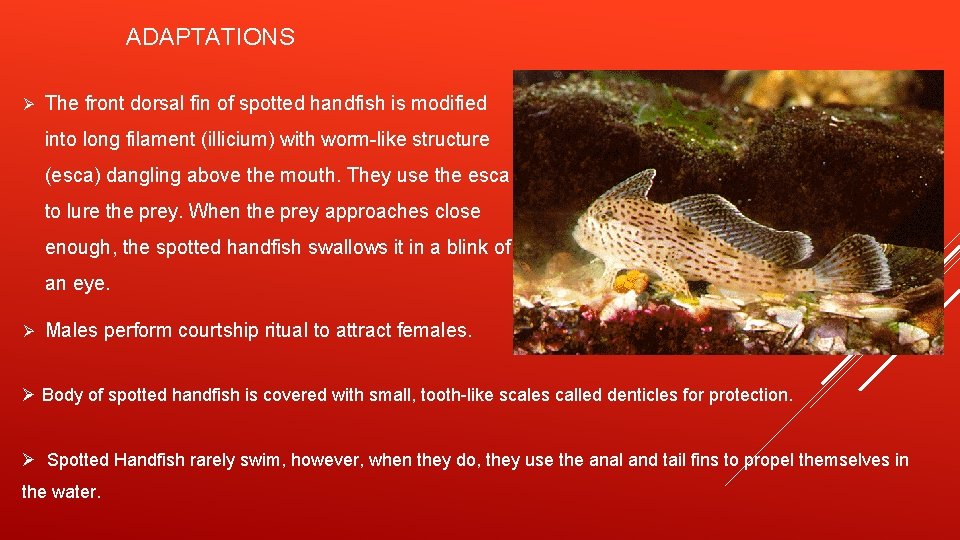
ADAPTATIONS Ø The front dorsal fin of spotted handfish is modified into long filament (illicium) with worm-like structure (esca) dangling above the mouth. They use the esca to lure the prey. When the prey approaches close enough, the spotted handfish swallows it in a blink of an eye. Ø Males perform courtship ritual to attract females. Ø Body of spotted handfish is covered with small, tooth-like scales called denticles for protection. Ø Spotted Handfish rarely swim, however, when they do, they use the anal and tail fins to propel themselves in the water.
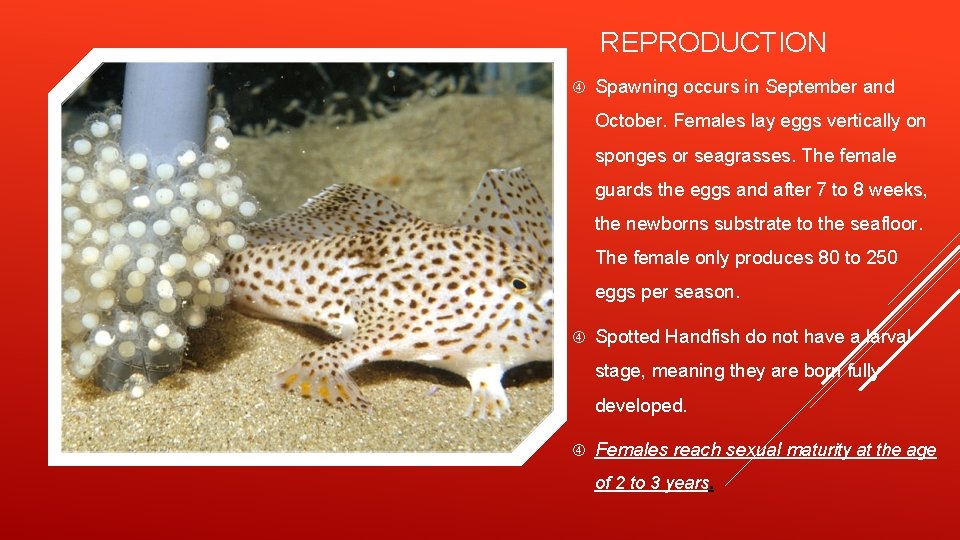
REPRODUCTION Spawning occurs in September and October. Females lay eggs vertically on sponges or seagrasses. The female guards the eggs and after 7 to 8 weeks, the newborns substrate to the seafloor. The female only produces 80 to 250 eggs per season. Spotted Handfish do not have a larval stage, meaning they are born fully developed. Females reach sexual maturity at the age of 2 to 3 years.
The Spotted Handfish is a carnivore with a diet based on shrimps, amphipods, worms and small fish. Exact lifespan of spotted handfish is unknown. Spotted handfish can reach up to 6 inches in length. Scientific Phylum: name: Brachionichthys hirsutus Chordate Class: Actinopterygii Order: Anglerfish FUN FACTS
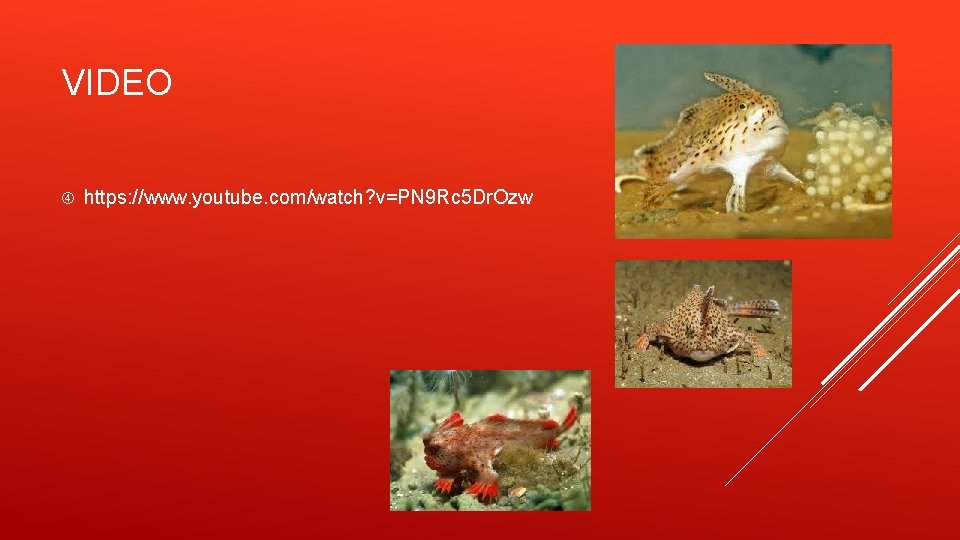
VIDEO https: //www. youtube. com/watch? v=PN 9 Rc 5 Dr. Ozw
Questions 1 1. At what age does the female Spotted handfish reach sexual maturity? A. 1 -2 years B. 2 -3 years C. 3 -4 years D. 4 -5 years Question 2 2. How does the Spotted handfish walk? _________________________________ _

References http: //www. environment. gov. au/biodiversity/threatened/publications/spotted-hand-fishbrachionichthys-hirsutus https: //australianmuseum. net. au/learn/animals/fishes/spotted-handfish-brachionichthyshirsutus-lacepede-1804/ http: //www. softschools. com/facts/animals/spotted_handfish_facts/1935/ http: //fishesofaustralia. net. au/home/species/2842 https: //www. iucnredlist. org/species/2958/9502144
- Slides: 10