
Spotlight on DDA ATO and profiling Topics Ebook
Spotlight on DDA, ATO, and profiling
Topics Ebook Acquisition Models • Demand Driven Acquisition • via Pro. Quest • Access-to-Own Managing Profiles in Lib. Central Chris Posa Product Marketing, Books Email: chris. posa@proquest. com Jael Edwards Collection & Workflow Consultant Email: CWCsupport@proquest. com 4
Demand Driven Acquisition What libraries are saying “DDA is our main collection tool. . . we’re letting our users decide what it is our collection needs to be because they’re the ones who use it and know what they require. ” - Arlene O’Sullivan, Manager, Collections & Access, La Trobe University Library “Using DDA allows us to understand patron needs more directly, which means we are spending our funds on content that better fills their needs. ” Elizabeth Mengel, Associate Director of Library Services, Scholarly Resources & Special Collections, Libraries John Hopkins University 5
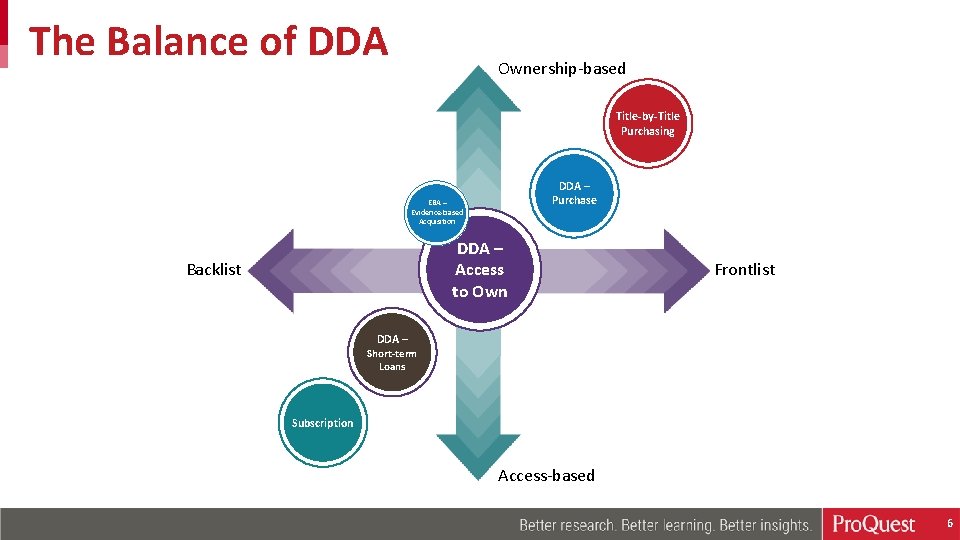
The Balance of DDA Ownership-based Title-by-Title Purchasing DDA – Purchase EBA – Evidence-based Acquisition DDA – Access to Own Backlist Frontlist DDA – Short-term Loans Subscription Access-based 6
10 years of DDA. Where are we now? DDA is important to libraries, with 92% using DDA – Purchase and 21% using DDA – Short-term loan. Among libraries who use Short -term loan (STL), 56% choose it to offer widest selection of content based on demand; another 30% choose it to make the most of their budget. Some publishers removed frontlist titles from STL and/or raised prices for STLs. This increased the complexity of managing DDA and the importance of maintaining profiles. Source: Academic Library Book Purchasing Trends sponsored by Pro. Quest; global survey conducted with 460 academic librarians. January 2016. Download here: http: //go. proquest. com/acquisition-whitepaper 7
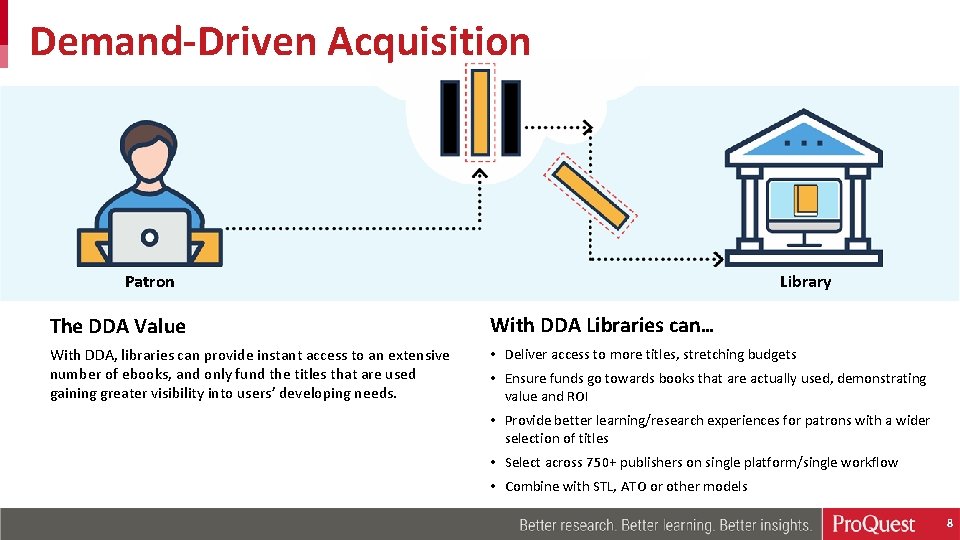
Demand-Driven Acquisition Patron Library The DDA Value With DDA Libraries can… With DDA, libraries can provide instant access to an extensive number of ebooks, and only fund the titles that are used gaining greater visibility into users’ developing needs. • Deliver access to more titles, stretching budgets • Ensure funds go towards books that are actually used, demonstrating value and ROI • Provide better learning/research experiences for patrons with a wider selection of titles • Select across 750+ publishers on single platform/single workflow • Combine with STL, ATO or other models 8
DDA with Pro. Quest • Workflow efficiencies including time-savers like automated holdings updates, MARC record syncing, etc. • Dynamic profiling with unique criteria such as subject, publisher, pub date, pricing • Smart tools to control spending • Real-time expenditure reports and expenditure tracker • Customizable alerts • Best usage reports – granular and summary • Largest selection available—~940, 000 titles for DDA and ~750, 000 for STL 9
DDA Triggers • 5 -minute free browsing period – unlimited page views • Print • 40%; resets every 24 hours • Download • Copy • 20%; resent every 24 hours 10
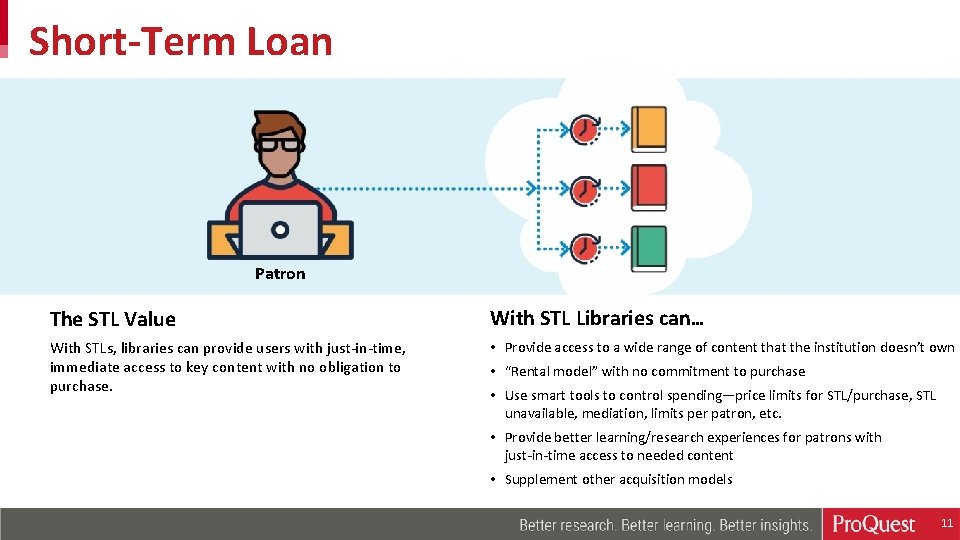
Short-Term Loan Patron The STL Value With STL Libraries can… With STLs, libraries can provide users with just-in-time, immediate access to key content with no obligation to purchase. • Provide access to a wide range of content that the institution doesn’t own • “Rental model” with no commitment to purchase • Use smart tools to control spending—price limits for STL/purchase, STL unavailable, mediation, limits per patron, etc. • Provide better learning/research experiences for patrons with just-in-time access to needed content • Supplement other acquisition models 11
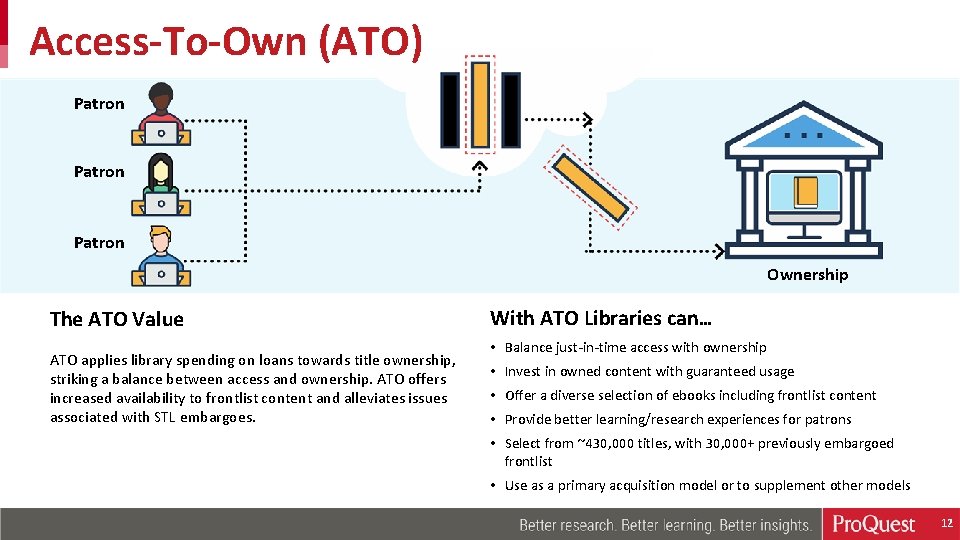
Access-To-Own (ATO) Patron Ownership The ATO Value ATO applies library spending on loans towards title ownership, striking a balance between access and ownership. ATO offers increased availability to frontlist content and alleviates issues associated with STL embargoes. With ATO Libraries can… • Balance just-in-time access with ownership • Invest in owned content with guaranteed usage • Offer a diverse selection of ebooks including frontlist content • Provide better learning/research experiences for patrons • Select from ~430, 000 titles, with 30, 000+ previously embargoed frontlist • Use as a primary acquisition model or to supplement other models 12
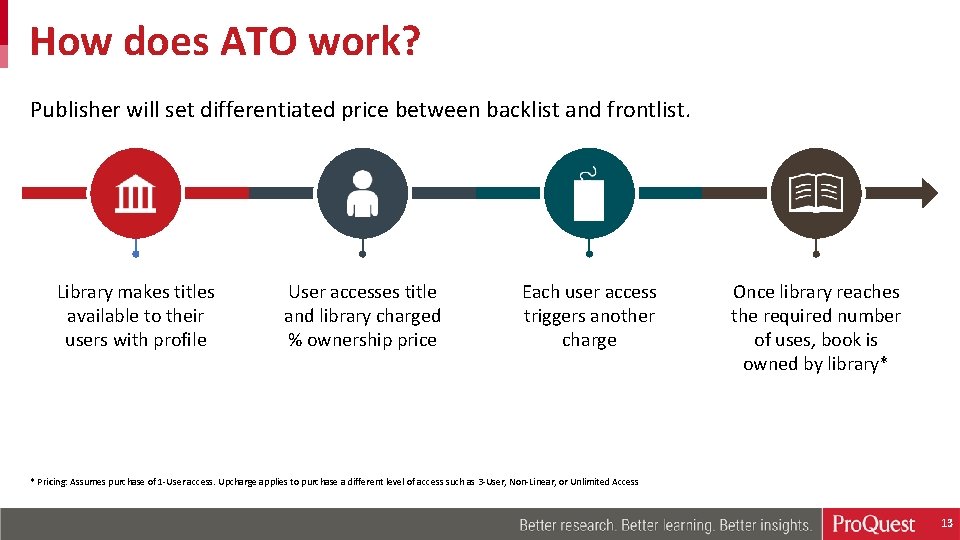
How does ATO work? Publisher will set differentiated price between backlist and frontlist. Library makes titles available to their users with profile User accesses title and library charged % ownership price Each user access triggers another charge Once library reaches the required number of uses, book is owned by library* * Pricing: Assumes purchase of 1 -User access. Upcharge applies to purchase a different level of access such as 3 -User, Non-Linear, or Unlimited Access 13
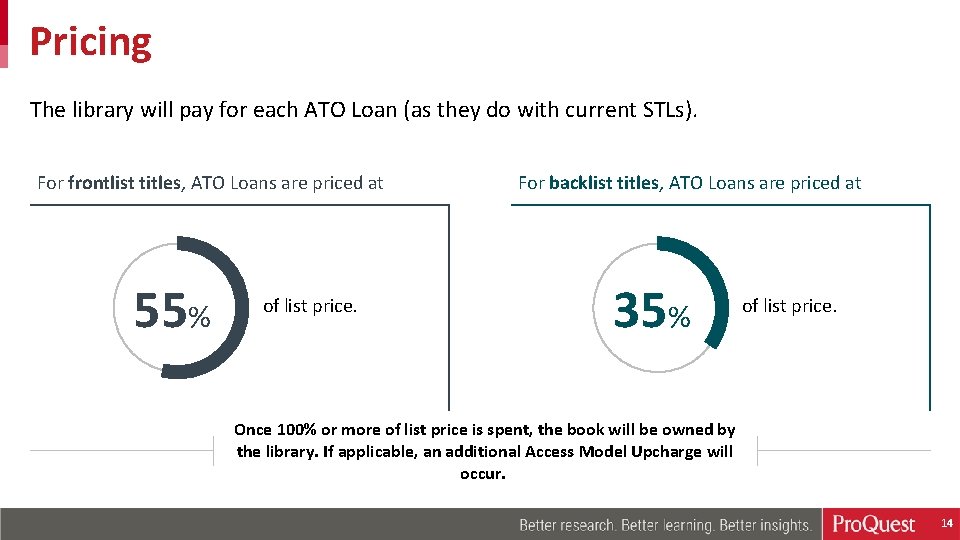
Pricing The library will pay for each ATO Loan (as they do with current STLs). For frontlist titles, ATO Loans are priced at 55% of list price. For backlist titles, ATO Loans are priced at 35% of list price. Once 100% or more of list price is spent, the book will be owned by the library. If applicable, an additional Access Model Upcharge will occur. 14
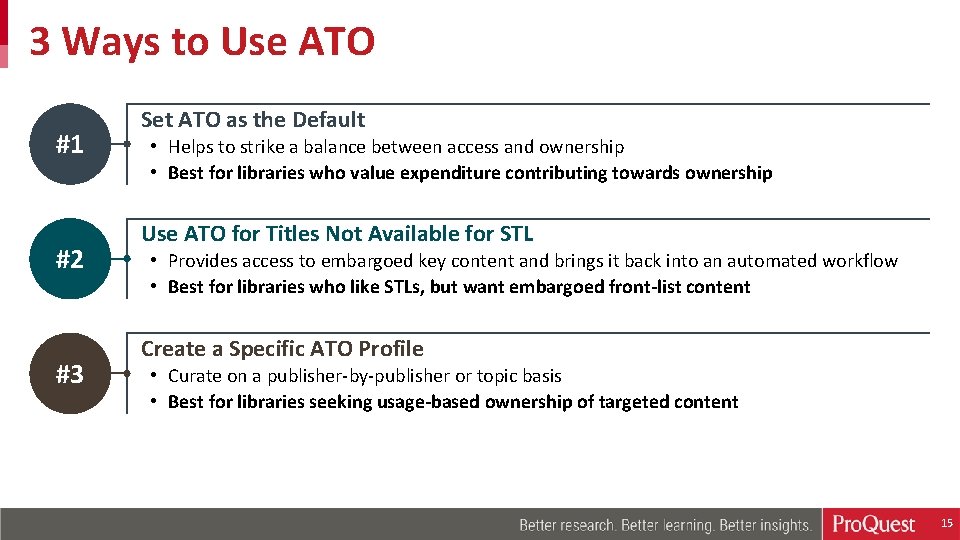
3 Ways to Use ATO #1 #2 #3 Set ATO as the Default • Helps to strike a balance between access and ownership • Best for libraries who value expenditure contributing towards ownership Use ATO for Titles Not Available for STL • Provides access to embargoed key content and brings it back into an automated workflow • Best for libraries who like STLs, but want embargoed front-list content Create a Specific ATO Profile • Curate on a publisher-by-publisher or topic basis • Best for libraries seeking usage-based ownership of targeted content 15
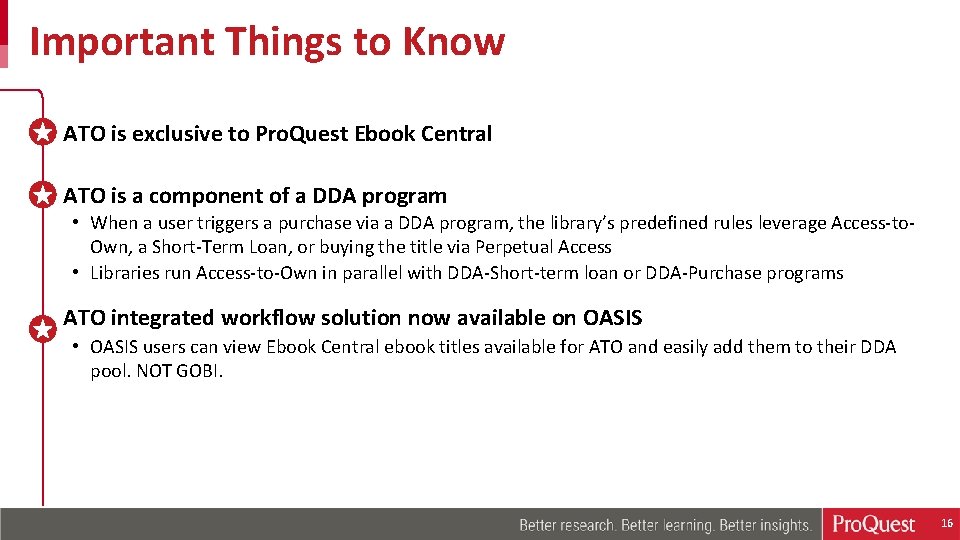
Important Things to Know ATO is exclusive to Pro. Quest Ebook Central ATO is a component of a DDA program • When a user triggers a purchase via a DDA program, the library’s predefined rules leverage Access-to. Own, a Short-Term Loan, or buying the title via Perpetual Access • Libraries run Access-to-Own in parallel with DDA-Short-term loan or DDA-Purchase programs ATO integrated workflow solution now available on OASIS • OASIS users can view Ebook Central ebook titles available for ATO and easily add them to their DDA pool. NOT GOBI. 16
DDA Profiles “Profiles should be as broad as possible relative to the budget of the program. The goal of profiling for DDA should be to make available as much content as possible that meets the broad curricular and research needs of the institution. Therefore, unlike a traditional profile that attempts to narrow the universe of scholarly academic publishing, a DDA profile should be expansive. ” USC Libraries 17
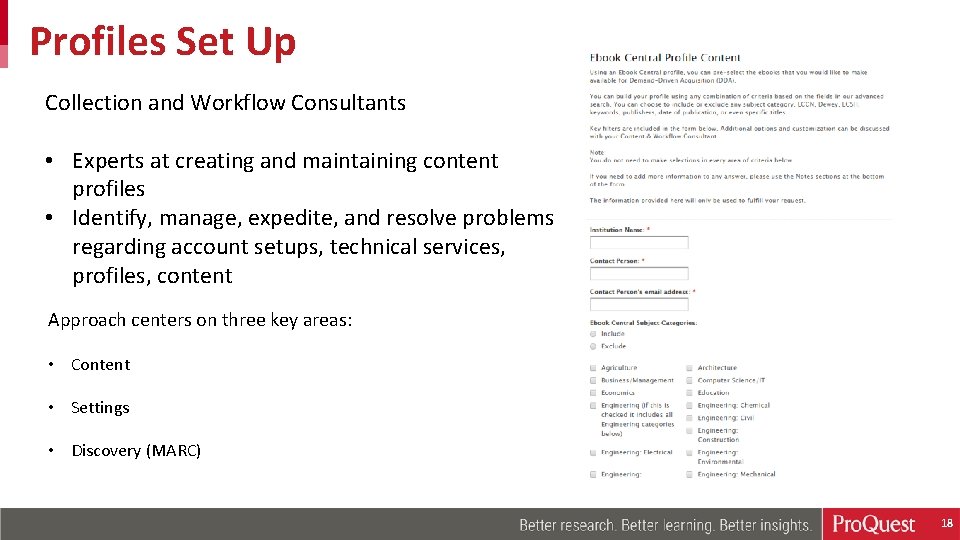
Profiles Set Up Collection and Workflow Consultants • Experts at creating and maintaining content profiles • Identify, manage, expedite, and resolve problems regarding account setups, technical services, profiles, content Approach centers on three key areas: • Content • Settings • Discovery (MARC) 18
DEMO
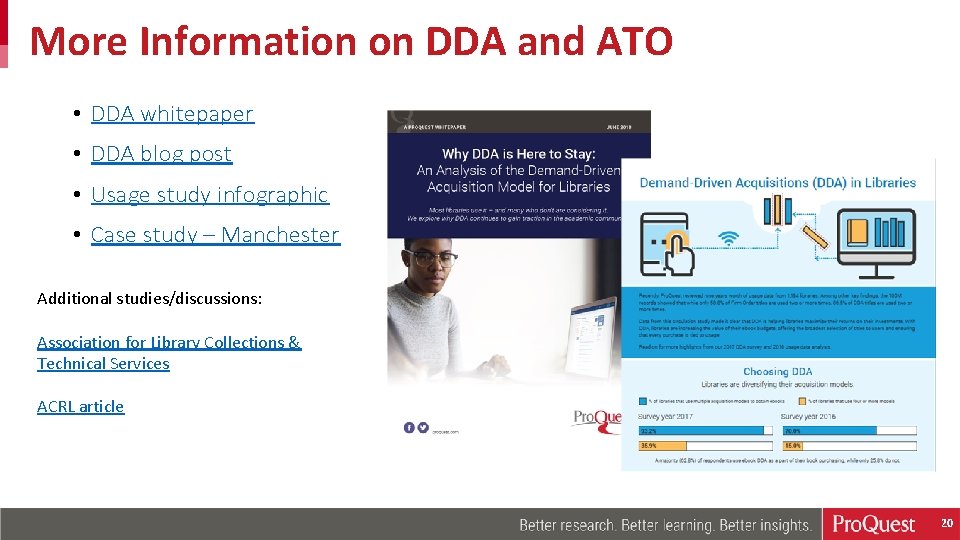
More Information on DDA and ATO • DDA whitepaper • DDA blog post • Usage study infographic • Case study – Manchester Additional studies/discussions: Association for Library Collections & Technical Services ACRL article 20
Pro. Quest Resources Ebook Central Lib. Guide Ebook Central Website Ebook Sales Specialist Collections Workflow Consultants – CWCsupport@proquest. com Customer Support – ebooksupport@proquest. com Knowledge Center – support. proquest. com 21
Ebook Central Academy: Upcoming Sessions Visit the Ebook Central Academy information page to sign up and download additional resources. The librarian’s guide to access permissions – September DRM-free and Ebook Central – September Making the most of MARC records - October How to manage ebook budgets like a pro - November Gain better insights through analytics and reporting - December 22
- Slides: 20