
Spot Urine ProteinCreatinin Ratio to Predict the Magnitude
- Slides: 1
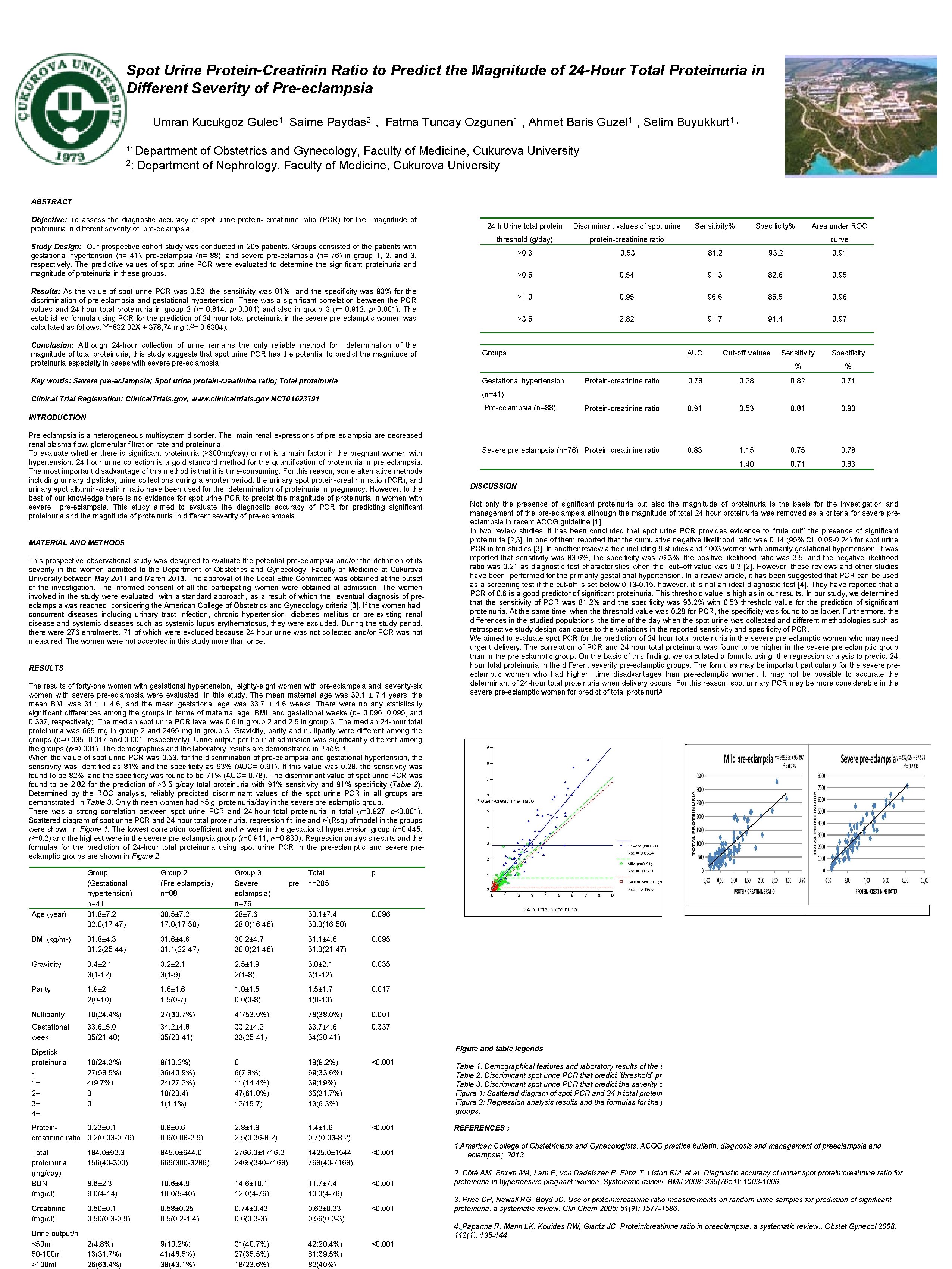
Spot Urine Protein-Creatinin Ratio to Predict the Magnitude of 24 -Hour Total Proteinuria in Different Severity of Pre-eclampsia Umran Kucukgoz Gulec 1 , Saime Paydas 2 , Fatma Tuncay Ozgunen 1 , Ahmet Baris Guzel 1 , Selim Buyukkurt 1 , 1: Department of Obstetrics and Gynecology, Faculty of Medicine, Cukurova University 2: Department of Nephrology, Faculty of Medicine, Cukurova University ABSTRACT Objective: To assess the diagnostic accuracy of spot urine protein- creatinine ratio (PCR) for the magnitude of proteinuria in different severity of pre-eclampsia. 24 h Urine total protein Discriminant values of spot urine threshold (g/day) protein-creatinine ratio >0. 3 0. 53 81. 2 93, 2 0. 91 >0. 54 91. 3 82. 6 0. 95 >1. 0 0. 95 96. 6 85. 5 0. 96 >3. 5 2. 82 91. 7 91. 4 0. 97 Study Design: Our prospective cohort study was conducted in 205 patients. Groups consisted of the patients with gestational hypertension (n= 41), pre-eclampsia (n= 88), and severe pre-eclampsia (n= 76) in group 1, 2, and 3, respectively. The predictive values of spot urine PCR were evaluated to determine the significant proteinuria and magnitude of proteinuria in these groups. Results: As the value of spot urine PCR was 0. 53, the sensitivity was 81% and the specificity was 93% for the discrimination of pre-eclampsia and gestational hypertension. There was a significant correlation between the PCR values and 24 hour total proteinuria in group 2 (r= 0. 814, p<0. 001) and also in group 3 (r= 0. 912, p<0. 001). The established formula using PCR for the prediction of 24 -hour total proteinuria in the severe pre-eclamptic women was calculated as follows: Y=832, 02 X + 378, 74 mg (r 2= 0. 8304). Conclusion: Although 24 -hour collection of urine remains the only reliable method for determination of the magnitude of total proteinuria, this study suggests that spot urine PCR has the potential to predict the magnitude of proteinuria especially in cases with severe pre-eclampsia. Groups Key words: Severe pre-eclampsia; Spot urine protein-creatinine ratio; Total proteinuria Gestational hypertension Sensitivity% Specificity% Area under ROC curve AUC Cut-off Values Sensitivity Specificity % % Protein-creatinine ratio 0. 78 0. 28 0. 82 0. 71 Protein-creatinine ratio 0. 91 0. 53 0. 81 0. 93 Severe pre-eclampsia (n=76) Protein-creatinine ratio 0. 83 1. 15 0. 78 1. 40 0. 71 0. 83 (n=41) Clinical Trial Registration: Clinical. Trials. gov, www. clinicaltrials. gov NCT 01623791 Pre-eclampsia (n=88) INTRODUCTION Pre-eclampsia is a heterogeneous multisystem disorder. The main renal expressions of pre-eclampsia are decreased renal plasma flow, glomerular filtration rate and proteinuria. To evaluate whethere is significant proteinuria (≥ 300 mg/day) or not is a main factor in the pregnant women with hypertension. 24 -hour urine collection is a gold standard method for the quantification of proteinuria in pre-eclampsia. The most important disadvantage of this method is that it is time-consuming. For this reason, some alternative methods including urinary dipsticks, urine collections during a shorter period, the urinary spot protein-creatinin ratio (PCR), and urinary spot albumin-creatinin ratio have been used for the determination of proteinuria in pregnancy. However, to the best of our knowledge there is no evidence for spot urine PCR to predict the magnitude of proteinuria in women with severe pre-eclampsia. This study aimed to evaluate the diagnostic accuracy of PCR for predicting significant proteinuria and the magnitude of proteinuria in different severity of pre-eclampsia. MATERIAL AND METHODS This prospective observational study was designed to evaluate the potential pre-eclampsia and/or the definition of its severity in the women admitted to the Department of Obstetrics and Gynecology, Faculty of Medicine at Cukurova University between May 2011 and March 2013. The approval of the Local Ethic Committee was obtained at the outset of the investigation. The informed consent of all the participating women were obtained at admission. The women involved in the study were evaluated with a standard approach, as a result of which the eventual diagnosis of preeclampsia was reached considering the American College of Obstetrics and Gynecology criteria [3]. If the women had concurrent diseases including urinary tract infection, chronic hypertension, diabetes mellitus or pre-existing renal disease and systemic diseases such as systemic lupus erythematosus, they were excluded. During the study period, there were 276 enrolments, 71 of which were excluded because 24 -hour urine was not collected and/or PCR was not measured. The women were not accepted in this study more than once. RESULTS The results of forty-one women with gestational hypertension, eighty-eight women with pre-eclampsia and seventy-six women with severe pre-eclampsia were evaluated in this study. The mean maternal age was 30. 1 ± 7. 4 years, the mean BMI was 31. 1 ± 4. 6, and the mean gestational age was 33. 7 ± 4. 6 weeks. There were no any statistically significant differences among the groups in terms of maternal age, BMI, and gestational weeks (p= 0. 096, 0. 095, and 0. 337, respectively). The median spot urine PCR level was 0. 6 in group 2 and 2. 5 in group 3. The median 24 -hour total proteinuria was 669 mg in group 2 and 2465 mg in group 3. Gravidity, parity and nulliparity were different among the groups (p=0. 035, 0. 017 and 0. 001, respectively). Urine output per hour at admission was significantly different among the groups (p<0. 001). The demographics and the laboratory results are demonstrated in Table 1. When the value of spot urine PCR was 0. 53, for the discrimination of pre-eclampsia and gestational hypertension, the sensitivity was identified as 81% and the specificity as 93% (AUC= 0. 91). If this value was 0. 28, the sensitivity was found to be 82%, and the specificity was found to be 71% (AUC= 0. 78). The discriminant value of spot urine PCR was found to be 2. 82 for the prediction of >3. 5 g/day total proteinuria with 91% sensitivity and 91% specificity (Table 2). Determined by the ROC analysis, reliably predicted discriminant values of the spot urine PCR in all groups are demonstrated in Table 3. Only thirteen women had >5 g proteinuria/day in the severe pre-eclamptic group. There was a strong correlation between spot urine PCR and 24 -hour total proteinuria in total (r=0. 927, p<0. 001). Scattered diagram of spot urine PCR and 24 -hour total proteinuria, regression fit line and r 2 (Rsq) of model in the groups were shown in Figure 1. The lowest correlation coefficient and r 2 were in the gestational hypertension group (r=0. 445, r 2=0. 2) and the highest were in the severe pre-eclampsia group (r=0. 911, r 2=0. 830). Regression analysis results and the formulas for the prediction of 24 -hour total proteinuria using spot urine PCR in the pre-eclamptic and severe preeclamptic groups are shown in Figure 2. Group 1 (Gestational hypertension) n=41 31. 8± 7. 2 32. 0(17 -47) Group 2 (Pre-eclampsia) n=88 30. 5± 7. 2 17. 0(17 -50) Group 3 Severe eclampsia) n=76 28± 7. 6 28. 0(16 -46) BMI (kg/m 2) 31. 8± 4. 3 31. 2(25 -44) 31. 6± 4. 6 31. 1(22 -47) Gravidity 3. 4± 2. 1 3(1 -12) Parity Age (year) Total pre- n=205 Not only the presence of significant proteinuria but also the magnitude of proteinuria is the basis for the investigation and management of the pre-eclampsia although the magnitude of total 24 hour proteinuria was removed as a criteria for severe preeclampsia in recent ACOG guideline [1]. In two review studies, it has been concluded that spot urine PCR provides evidence to ‘‘rule out’’ the presence of significant proteinuria [2, 3]. In one of them reported that the cumulative negative likelihood ratio was 0. 14 (95% CI, 0. 09 -0. 24) for spot urine PCR in ten studies [3]. In another review article including 9 studies and 1003 women with primarily gestational hypertension, it was reported that sensitivity was 83. 6%, the specificity was 76. 3%, the positive likelihood ratio was 3. 5, and the negative likelihood ratio was 0. 21 as diagnostic test characteristics when the cut–off value was 0. 3 [2]. However, these reviews and other studies have been performed for the primarily gestational hypertension. In a review article, it has been suggested that PCR can be used as a screening test if the cut-off is set below 0. 13 -0. 15, however, it is not an ideal diagnostic test [4]. They have reported that a PCR of 0. 6 is a good predictor of significant proteinuria. This threshold value is high as in our results. In our study, we determined that the sensitivity of PCR was 81. 2% and the specificity was 93. 2% with 0. 53 threshold value for the prediction of significant proteinuria. At the same time, when the threshold value was 0. 28 for PCR, the specificity was found to be lower. Furthermore, the differences in the studied populations, the time of the day when the spot urine was collected and different methodologies such as retrospective study design cause to the variations in the reported sensitivity and specificity of PCR. We aimed to evaluate spot PCR for the prediction of 24 -hour total proteinuria in the severe pre-eclamptic women who may need urgent delivery. The correlation of PCR and 24 -hour total proteinuria was found to be higher in the severe pre-eclamptic group than in the pre-eclamptic group. On the basis of this finding, we calculated a formula using the regression analysis to predict 24 hour total proteinuria in the different severity pre-eclamptic groups. The formulas may be important particularly for the severe preeclamptic women who had higher time disadvantages than pre-eclamptic women. It may not be possible to accurate the determinant of 24 -hour total proteinuria when delivery occurs. For this reason, spot urinary PCR may be more considerable in the severe pre-eclamptic women for predict of total proteinuri. A Fıgure 1 fıgure 2. . p 30. 1± 7. 4 30. 0(16 -50) 0. 096 30. 2± 4. 7 30. 0(21 -46) 31. 1± 4. 6 31. 0(21 -47) 0. 095 3. 2± 2. 1 3(1 -9) 2. 5± 1. 9 2(1 -8) 3. 0± 2. 1 3(1 -12) 0. 035 1. 9± 2 2(0 -10) 1. 6± 1. 6 1. 5(0 -7) 1. 0± 1. 5 0. 0(0 -8) 1. 5± 1. 7 1(0 -10) 0. 017 Nulliparity 10(24. 4%) 27(30. 7%) 41(53. 9%) 78(38. 0%) 0. 001 Gestational week 33. 6± 5. 0 35(21 -40) 34. 2± 4. 8 35(20 -41) 33. 2± 4. 2 33(25 -41) 33. 7± 4. 6 34(20 -41) 0. 337 Dipstick proteinuria 1+ 2+ 3+ 4+ DISCUSSION Figure and table legends 10(24. 3%) 27(58. 5%) 4(9. 7%) 0 0 9(10. 2%) 36(40. 9%) 24(27. 2%) 18(20. 4) 1(1. 1%) 0 6(7. 8%) 11(14. 4%) 47(61. 8%) 12(15. 7) 19(9. 2%) 69(33. 6%) 39(19%) 65(31. 7%) 13(6. 3%) <0. 001 Protein 0. 23± 0. 1 creatinine ratio 0. 2(0. 03 -0. 76) 0. 8± 0. 6(0. 08 -2. 9) 2. 8± 1. 8 2. 5(0. 36 -8. 2) 1. 4± 1. 6 0. 7(0. 03 -8. 2) <0. 001 REFERENCES : Total proteinuria (mg/day) BUN (mg/dl) 184. 0± 92. 3 156(40 -300) 845. 0± 644. 0 669(300 -3286) 2766. 0± 1716. 2 2465(340 -7168) 1425. 0± 1544 768(40 -7168) <0. 001 1. American College of Obstetricians and Gynecologists. ACOG practice bulletin: diagnosis and management of preeclampsia and eclampsia; 2013. 8. 6± 2. 3 9. 0(4 -14) 10. 6± 4. 9 10. 0(5 -40) 14. 6± 10. 1 12. 0(4 -76) 11. 7± 7. 4 10. 0(4 -76) <0. 001 2. Côté AM, Brown MA, Lam E, von Dadelszen P, Firoz T, Liston RM, et al. Diagnostic accuracy of urinar spot protein: creatinine ratio for proteinuria in hypertensive pregnant women. Systematic review. BMJ 2008; 336(7651): 1003 -1006. Creatinine (mg/dl) 0. 50± 0. 1 0. 50(0. 3 -0. 9) 0. 58± 0. 25 0. 5(0. 2 -1. 4) 0. 74± 0. 43 0. 6(0. 3 -3) 0. 62± 0. 33 0. 56(0. 2 -3) <0. 001 3. Price CP, Newall RG, Boyd JC. Use of protein: creatinine ratio measurements on random urine samples for prediction of significant proteinuria: a systematic review. Clin Chem 2005; 51(9): 1577 -1586. Urine output/h <50 ml 50 -100 ml >100 ml 2(4. 8%) 13(31. 7%) 26(63. 4%) 9(10. 2%) 41(46. 5%) 38(43. 1%) 31(40. 7%) 27(35. 5%) 18(23. 6%) 42(20. 4%) 81(39. 5%) 82(40%) <0. 001 Table 1: Demographical features and laboratory results of the studied groups. Table 2: Discriminant spot urine PCR that predict ‘threshold’ proteinuria at 0. 3, 0. 5, 1. 0 and 3. 5 g/day. Table 3: Discriminant spot urine PCR that predict the severity of the pre-eclampsia. Figure 1: Scattered diagram of spot PCR and 24 h total proteinuria in the groups. Figure 2: Regression analysis results and the formulas for the prediction of 24 -hour total proteinuria using spot urine PCR in the groups. 4. Papanna R, Mann LK, Kouides RW, Glantz JC. Protein/creatinine ratio in preeclampsia: a systematic review. . Obstet Gynecol 2008; 112(1): 135 -144.