
Sports Nutrition Energy Balance Kevin Browne Learning outcomes

Sports Nutrition Energy Balance Kevin Browne

Learning outcomes
Energy Balance • What does energy balance mean to you, in your own words individually write down what you understand by this term • Pair (agree and write down your new definition) • Share
Energy Balance • Energy balance is a term used to explain how kilocalorie intake and kilocalorie expenditure are related to each other, and in particular how they can affect a person's body weight. • If a person is at their ideal weight, then for that person to maintain their weight, they would need to ensure kilocalorie intake (through food and drink) was equal to kilocalorie use (through normal body functions and activity).
Energy balance equation • The energy balance equation is: • Energy Intake = Energy output • If energy balance was a see-saw, it would be at equal height on either side

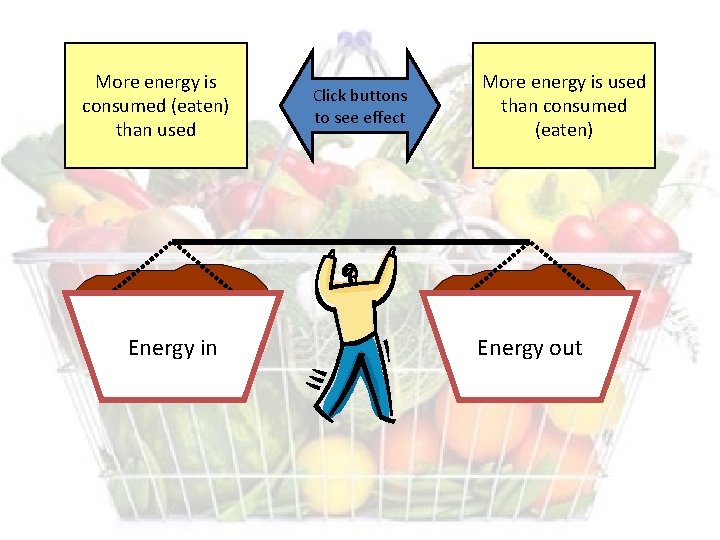
More energy is consumed (eaten) than used Energy in Click buttons to see effect More energy is used than consumed (eaten) Energy out
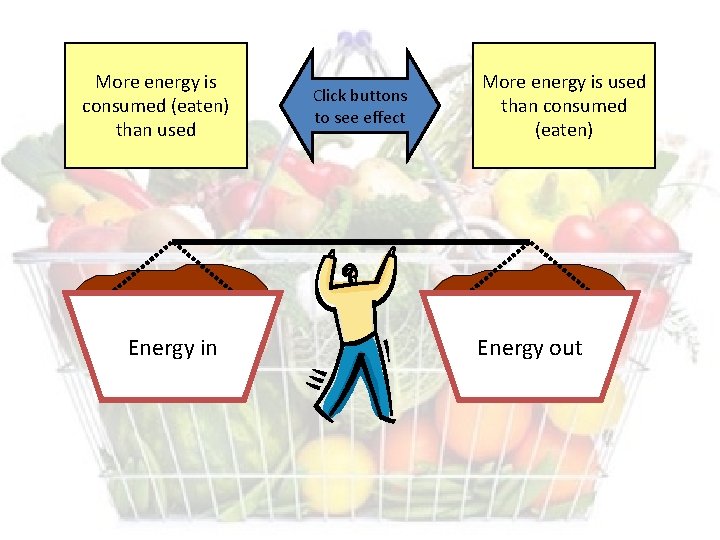
More energy is consumed (eaten) than used Energy in Click buttons to see effect More energy is used than consumed (eaten) Energy out
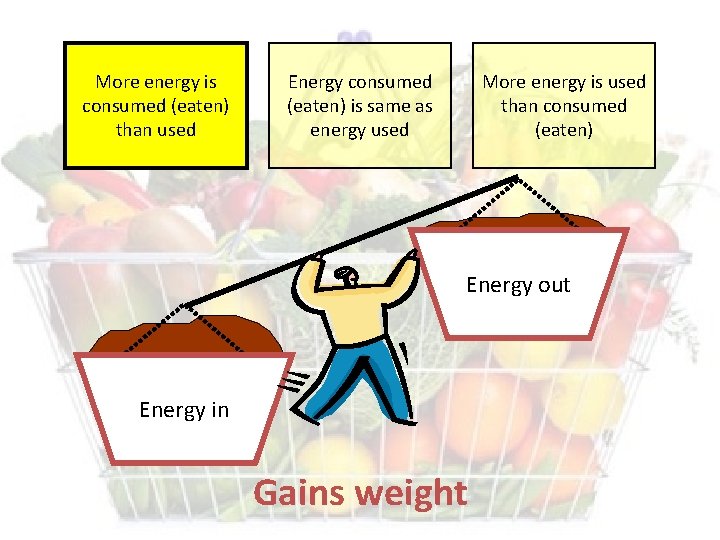
More energy is consumed (eaten) than used Energy consumed (eaten) is same as energy used More energy is used than consumed (eaten) Energy out Energy in Gains weight
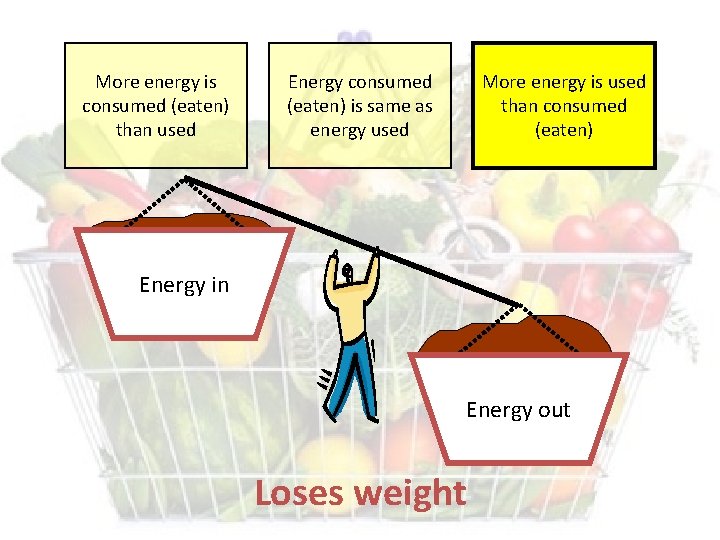
More energy is consumed (eaten) than used Energy consumed (eaten) is same as energy used More energy is used than consumed (eaten) Energy in Energy out Loses weight
Basal metabolic rate (BMR) The Basic Metabolic Rate (BMR) is a calculation of how many kilocalories a person needs for basic survival; this will have an impact on the energy balance and therefore the ability for a person to lose, gain or maintain body weight. The BMR of an individual is influenced by various factors such as: • Climate • Genetics • Body shape and size • Age • Gender • Metabolism • Physical activity level
TASK • Looking at all the factors that could effect BMR • I want you to come up with suggestions as to how they could effect BMR • Work in pairs • 10 mins
Climate • Environmental conditions around a place where a person lives, trains and competes will have an effect on their Basal Metabolic Rate (BMR). • Where the climate is cold the body will need to use more stored and consumed energy to help stay warm. Where the climate is very hot, the body will still need additional energy to help maintain a safe, cool core temperature

Genetics • Each person has a pre-programmed genetic make-up which determines how they look, feel, speak and perform. Part of the genetics of a person will determine how they use energy, and so this has a direct influence on how many kilocalories are needed to function

• Some people are naturally more athletic than others and so have a greater muscle mass. As muscle uses energy to work, it is logical that a person with a high muscle mass will need more kilocalories in their diet to function • A person who already has a large amount of body fat will need to eat less consumed kcal because of their fat stores.
Age • As a person becomes older, their need for kilocalories declines. This is particularly true once a person reaches 25 years of age. At this point, the body will have fully matured and so will not need kilocalories for development
Gender • Adult men usually have less body fat and more muscle than women of the same age and size. Muscle burns more calories than fat does, so men's need for energy is usually 5 -10% higher than women's
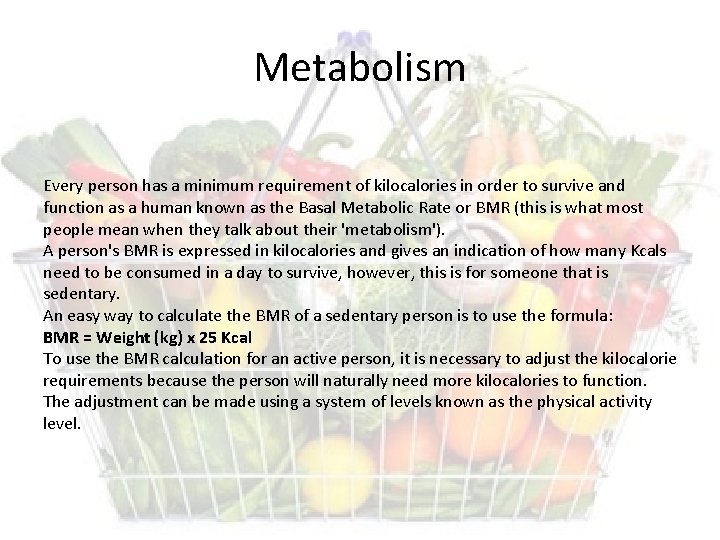
Metabolism Every person has a minimum requirement of kilocalories in order to survive and function as a human known as the Basal Metabolic Rate or BMR (this is what most people mean when they talk about their 'metabolism'). A person's BMR is expressed in kilocalories and gives an indication of how many Kcals need to be consumed in a day to survive, however, this is for someone that is sedentary. An easy way to calculate the BMR of a sedentary person is to use the formula: BMR = Weight (kg) x 25 Kcal To use the BMR calculation for an active person, it is necessary to adjust the kilocalorie requirements because the person will naturally need more kilocalories to function. The adjustment can be made using a system of levels known as the physical activity level.
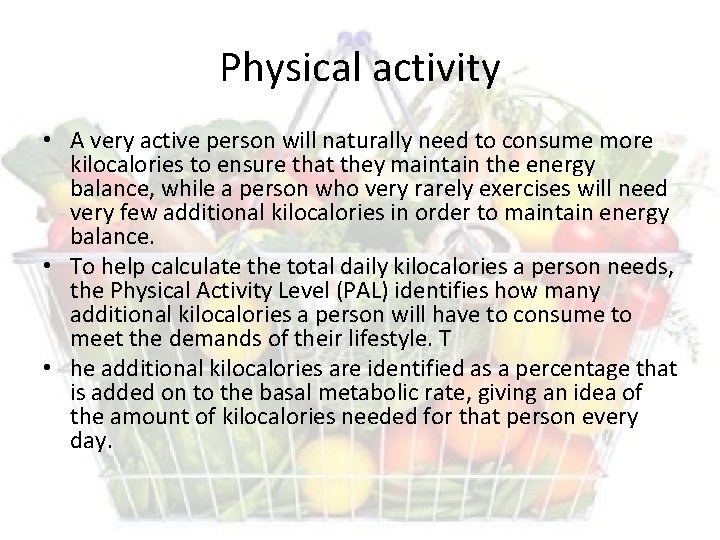
Physical activity • A very active person will naturally need to consume more kilocalories to ensure that they maintain the energy balance, while a person who very rarely exercises will need very few additional kilocalories in order to maintain energy balance. • To help calculate the total daily kilocalories a person needs, the Physical Activity Level (PAL) identifies how many additional kilocalories a person will have to consume to meet the demands of their lifestyle. T • he additional kilocalories are identified as a percentage that is added on to the basal metabolic rate, giving an idea of the amount of kilocalories needed for that person every day.
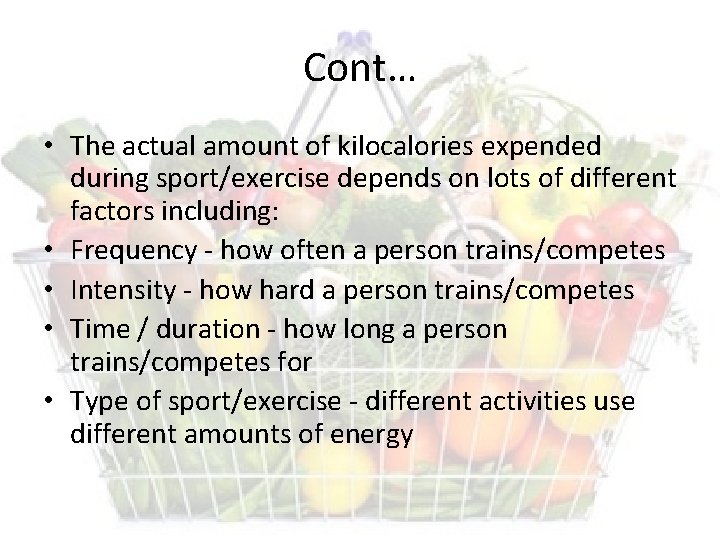
Cont… • The actual amount of kilocalories expended during sport/exercise depends on lots of different factors including: • Frequency - how often a person trains/competes • Intensity - how hard a person trains/competes • Time / duration - how long a person trains/competes for • Type of sport/exercise - different activities use different amounts of energy
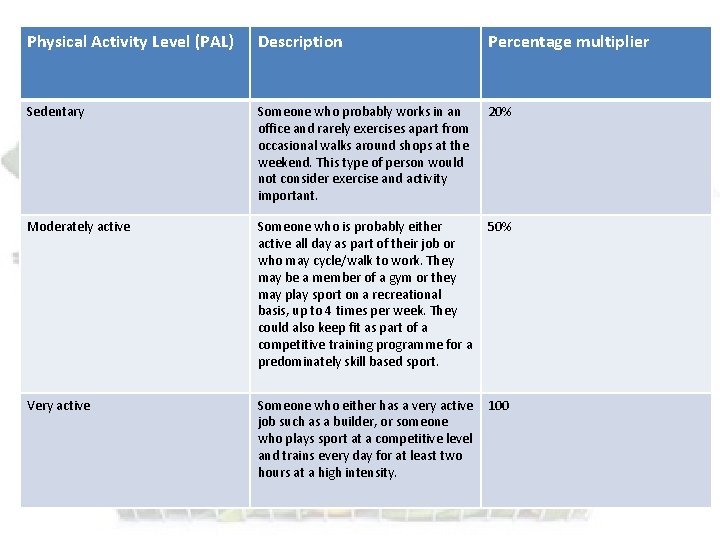
Physical Activity Level (PAL) Description Percentage multiplier Sedentary Someone who probably works in an office and rarely exercises apart from occasional walks around shops at the weekend. This type of person would not consider exercise and activity important. 20% Moderately active Someone who is probably either active all day as part of their job or who may cycle/walk to work. They may be a member of a gym or they may play sport on a recreational basis, up to 4 times per week. They could also keep fit as part of a competitive training programme for a predominately skill based sport. 50% Very active Someone who either has a very active job such as a builder, or someone who plays sport at a competitive level and trains every day for at least two hours at a high intensity. 100
Calculating BMR • So, to calculate a person's daily kilocalorie requirement who is moderately active and weight 70 kg: • BMR ( weight (Kg) x 25 Kcal • BMR ( 70 x 25 = 1750 Kcal • Daily Kilocalorie requirement ( 1750 Kcal + 50% (PAL) = 2625 Kcal
The Basal Metabolic Rate What is Basal metabolic rate? BMR: The rate at which the body uses energy for maintenance activities How is this calculated? Men = 1 calorie / kg of bodyweight / hr Women = 0. 9 calorie / kg of bodyweight / hr E. g: A man weighing 84 kg would calculate his BMR as: 1 x 84 kg x 24 hrs = 2016 basal caloric needs. N. B. This calculation is just an estimate.
How can we make the calculation more accurate? The Harris Benedict equation for BMR: For men: BMR = 66 + (13. 7 x wt [kg]) + (5 x ht [cm]) – (4. 7 x age [yrs]) For Women: BMR = 655 + (9. 6 x wt [kg]) + (1. 8 x ht [cm]) – (4. 7 x age [yrs]) E. g. A man weighing 84 kg, 180 cm in height, & 40 years old would calculate: BMR = 66 + (13. 7 x 84 [kg]) + (5 x 180 [cm]) – (4. 7 x 40 [yrs]) = 66 + 1150. 8 + 900 – 272 = 1844. 8 calories Task Calculate your BMR using this formula SBN May 2009 AS Physical Education
Questions 1. Calculate the BMR of an adult male weighing 90 kg 2. Calculate the BMR of an adult female weighing 65 kg 3. Calculate the BMR of an adult male who weighs 84 kg, is 32 years old and 184 cm tall 4. Calculate the BMR of an adult female who weighs 57 kg, is 27 years old and 165 cm SBN May 2009 AS Physical Education
Learning outcomes Review • To know and understand what Basal metabolic rate is • Identify factors that can effect BMR • Explain how these factors affect BMR • Calculate BMR using a simple equation
- Slides: 26