
Sport Education and Inclusion LGLGB 513 Pedagogy in

Sport Education and Inclusion LGLGB 513 Pedagogy in PE and Sport. Image by Press Association Images
Learning Objectives To be able to critically reflect on this in light of your own personal learning experiences. To be able to use research to support the idea that an SE model may provide opportunities for inclusivity To be able to suggest ways in which an SE model may provide an environment for more inclusive learning
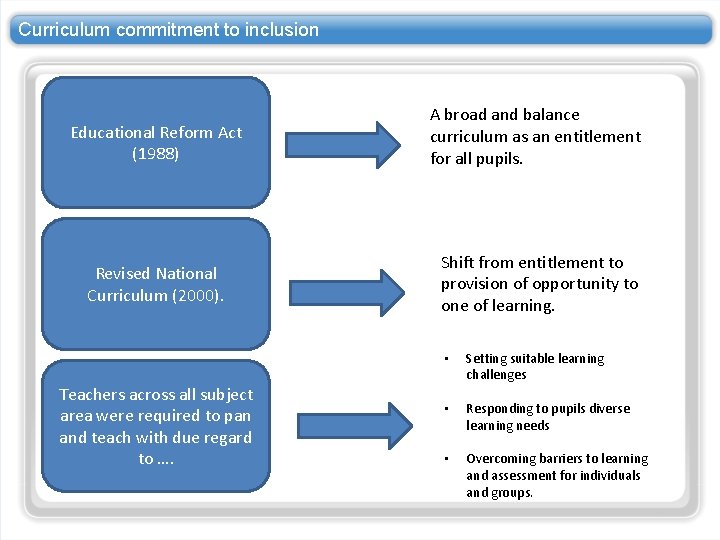
Curriculum commitment to inclusion Educational Reform Act (1988) A broad and balance curriculum as an entitlement for all pupils. Revised National Curriculum (2000). Shift from entitlement to provision of opportunity to one of learning. Teachers across all subject area were required to pan and teach with due regard to …. • Setting suitable learning challenges • Responding to pupils diverse learning needs • Overcoming barriers to learning and assessment for individuals and groups.
However…. . Schools are judged in league tables based on examination results, and there is, it is suggested, a danger of that the needs of students are increasingly focused on narrow performance measures over the educational process (Penney and Clarke, 2005). A focus on patterns in performance measures tells us little about myriad of factors affecting this achievement (Penney and Clarke, 2005).
Can Sport Education make a difference? Argued that different aspects of SE (for example, keeping teams and taken on different roles) can provide a more inclusive environment for students (Penney and Clarke, 2005). Issues of inequity and inequalities in Physical Education – marginalization of particular groups for example, gender “low” ability and ethnicity. Placing some students at a notable disadvantage to others (Evans, 1993; Penney, 2002). Generally there is a lack of consideration of pupils multiple identities and assumptions about learning are often still based on simplistic characteristics of learners (Penney and Clarke, 2005). Evans and Davies (1993) suggest that often there still prevails a “deficit” view of differences between pupils as opposed to one that celebrates difference as a resource.
Can Sport Education make a difference? Does Sport Education provide the sense of personal relevance and purpose and a sense of belonging and achievement which is suggested to be absent from traditional Physical Education lessons (Penney and Clarke, 2005). Can Sport Education contribute to a shift in the way Physical Educators think about differences amongst their pupils. Swain (2002) suggested that within Physical Education lessons divisions are regularly drawn that categorize children as either “us” or “them” with perceived deficiencies being at the heart of these judgements.
Can Sport Education make a difference? Flintoff and Scratton (2001) suggest that in challenging the destructive nature of the macho culture of sport may benefit many young girls but also a number of young boys. SE-Introduces roles other than performer which may mean that other types of learners and learning become more valued. Moreover, the selection of different formats of the game allow a variety of pupils the opportunity to fully participate in a team.

Carlson (1995)
References and directed reading. References Kirk, D and Mac. Donald, D. (1998). Situated Learning in Physical Education. Journal of Teaching in Physical Education (17) pp. 376 -387 Lave, J and Wegner, E (1991). Situatedlearning: Legitimate Peripheral Participation. New York: Cambridge University Press. Directed Reading: Kirk, D and Mac. Donald, D. (1998). Situated Learning in Physical Education. Journal of Teaching in Physical Education (17) pp. 376387 Mac. Phail, A , Kirk, D and Griffin, L (2008). Throwing and catching as relational skills in. game play: Situated Learning in a modified game unit. Journal of Teaching in Physical Education 27 pp. 100 -115 Image by See-ming Lee
- Slides: 9