
Spontaneous vs stimulated brain activity A statistical physics
Spontaneous vs. stimulated brain activity: A statistical physics approach Lucilla de Arcangelis University of Campania “Luigi Vanvitelli” INFN SM&FT 2019 Challenges in Computational Theoretical Physics Bari, December 11 -13 2019
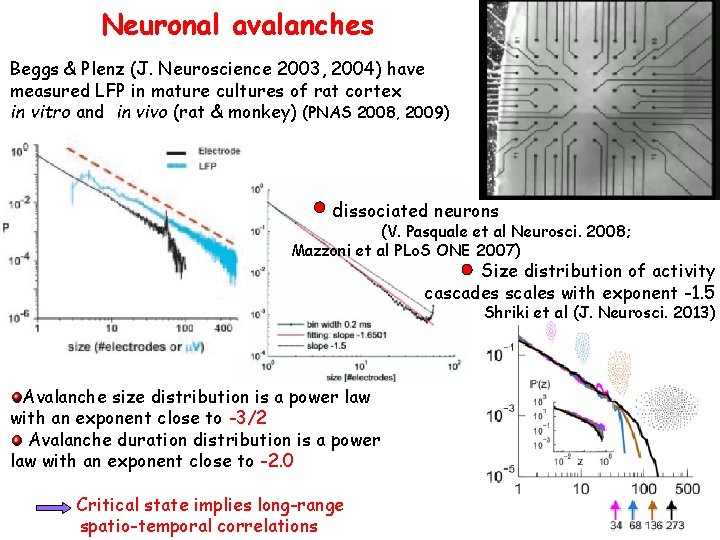
Neuronal avalanches Beggs & Plenz (J. Neuroscience 2003, 2004) have measured LFP in mature cultures of rat cortex in vitro and in vivo (rat & monkey) (PNAS 2008, 2009) d issociated neurons (V. Pasquale et al Neurosci. 2008; Mazzoni et al PLo. S ONE 2007) Size distribution of activity cascades scales with exponent -1. 5 Shriki et al (J. Neurosci. 2013) Avalanche size distribution is a power law with an exponent close to -3/2 Avalanche duration distribution is a power law with an exponent close to -2. 0 Critical state implies long-range spatio-temporal correlations
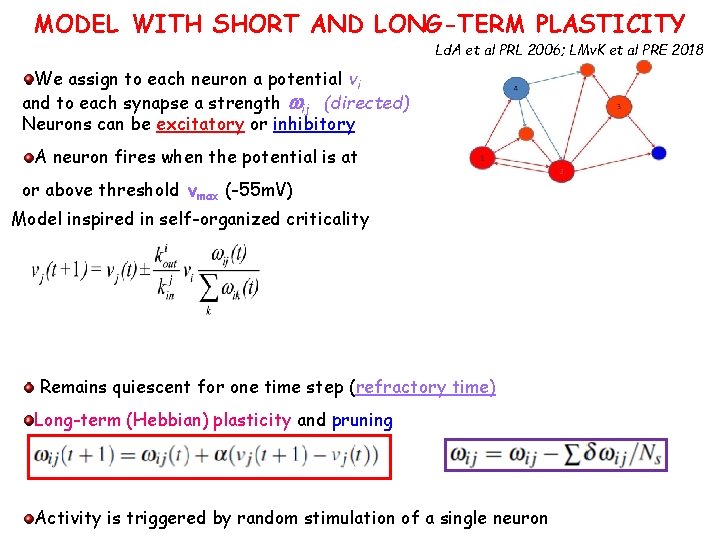
MODEL WITH SHORT AND LONG-TERM PLASTICITY Ld. A et al PRL 2006; LMv. K et al PRE 2018 We assign to each neuron a potential vi and to each synapse a strength wij (directed) Neurons can be excitatory or inhibitory A neuron fires when the potential is at or above threshold vmax (-55 m. V) Model inspired in self-organized criticality available neurotransmitter recovers by after each avalanche tunes the system at criticality Remains quiescent for one time step (refractory time) Long-term (Hebbian) plasticity and pruning Activity is triggered by random stimulation of a single neuron
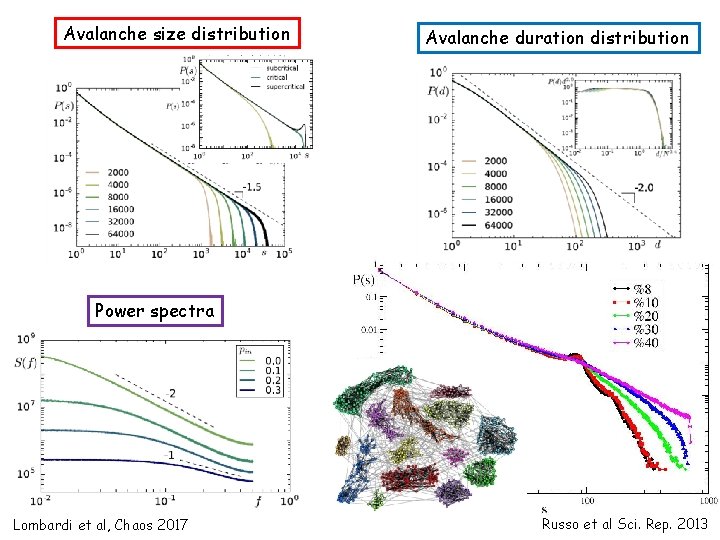
Avalanche size distribution Avalanche duration distribution Power spectra Lombardi et al, Chaos 2017 Russo et al Sci. Rep. 2013
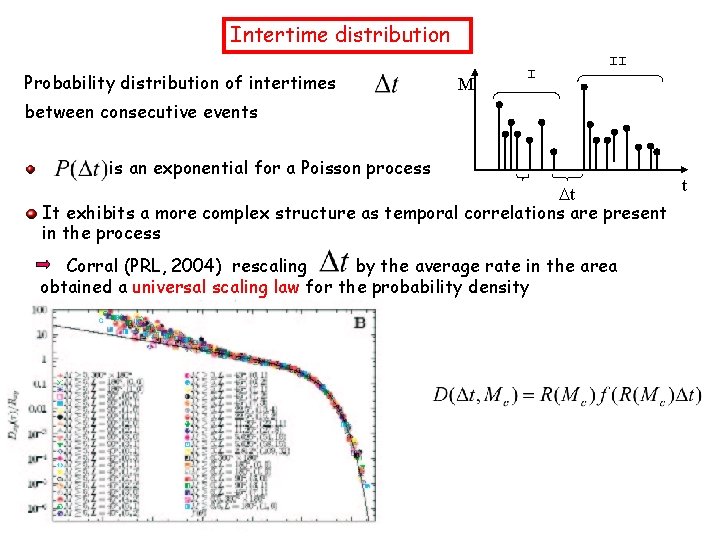
Intertime distribution Probability distribution of intertimes M I II between consecutive events is an exponential for a Poisson process Dt It exhibits a more complex structure as temporal correlations are present in the process Corral (PRL, 2004) rescaling by the average rate in the area obtained a universal scaling law for the probability density t
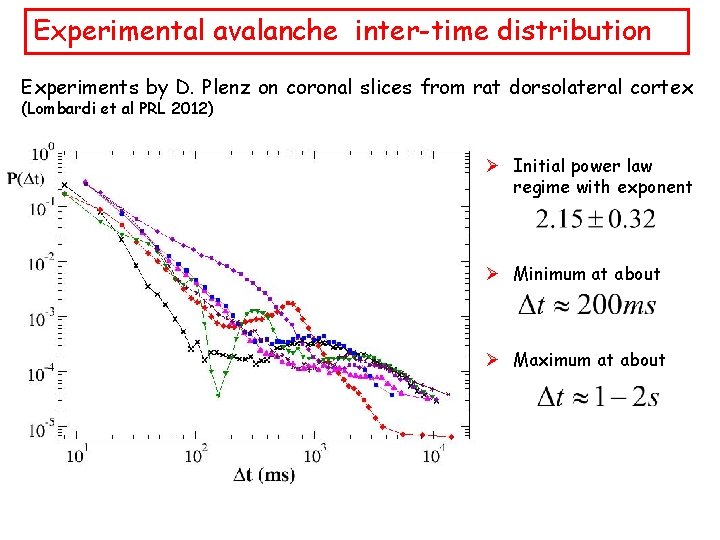
Experimental avalanche inter-time distribution Experiments by D. Plenz on coronal slices from rat dorsolateral cortex (Lombardi et al PRL 2012) Ø Initial power law regime with exponent Ø Minimum at about Ø Maximum at about
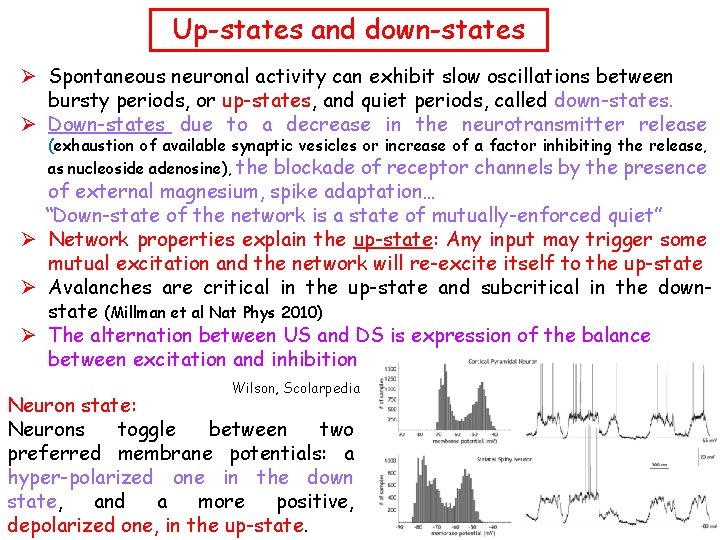
Up-states and down-states Ø Spontaneous neuronal activity can exhibit slow oscillations between bursty periods, or up-states, and quiet periods, called down-states. Ø Down-states due to a decrease in the neurotransmitter release (exhaustion of available synaptic vesicles or increase of a factor inhibiting the release, as nucleoside adenosine), the blockade of receptor channels by the presence of external magnesium, spike adaptation… “Down-state of the network is a state of mutually-enforced quiet” Ø Network properties explain the up-state: Any input may trigger some mutual excitation and the network will re-excite itself to the up-state Ø Avalanches are critical in the up-state and subcritical in the downstate (Millman et al Nat Phys 2010) Ø The alternation between US and DS is expression of the balance between excitation and inhibition Wilson, Scolarpedia Neuron state: Neurons toggle between two preferred membrane potentials: a hyper-polarized one in the down state, and a more positive, depolarized one, in the up-state.
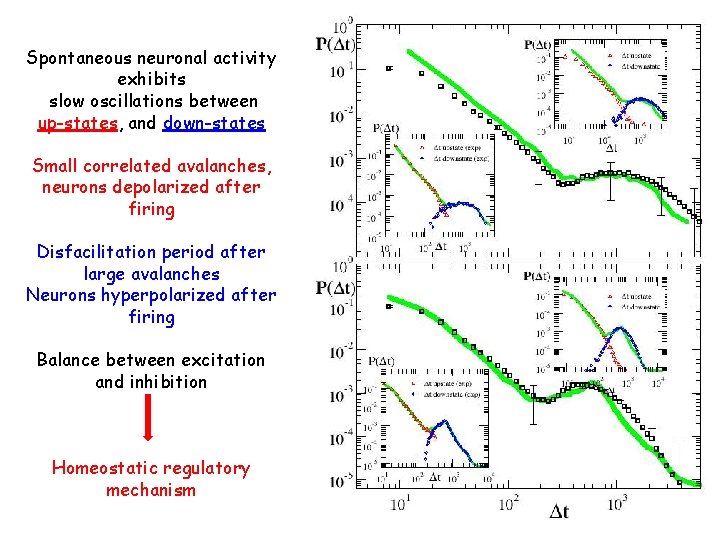
Spontaneous neuronal activity exhibits slow oscillations between up-states, and down-states Small correlated avalanches, neurons depolarized after firing Disfacilitation period after large avalanches Neurons hyperpolarized after firing Balance between excitation and inhibition Homeostatic regulatory mechanism
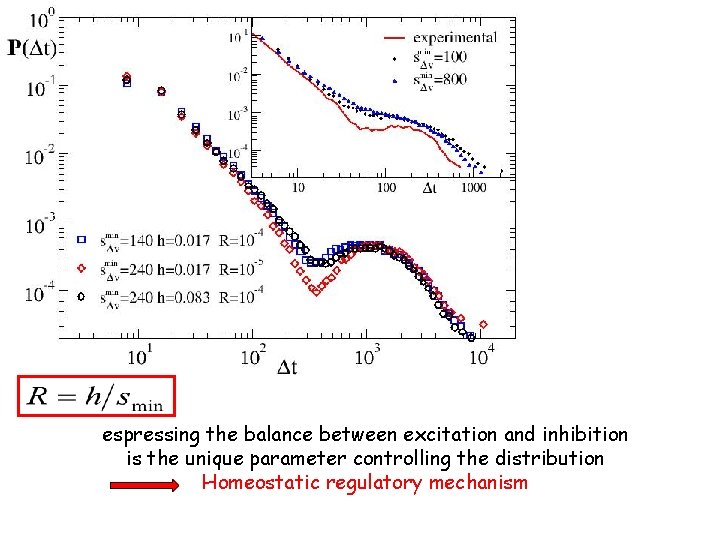
espressing the balance between excitation and inhibition is the unique parameter controlling the distribution Homeostatic regulatory mechanism
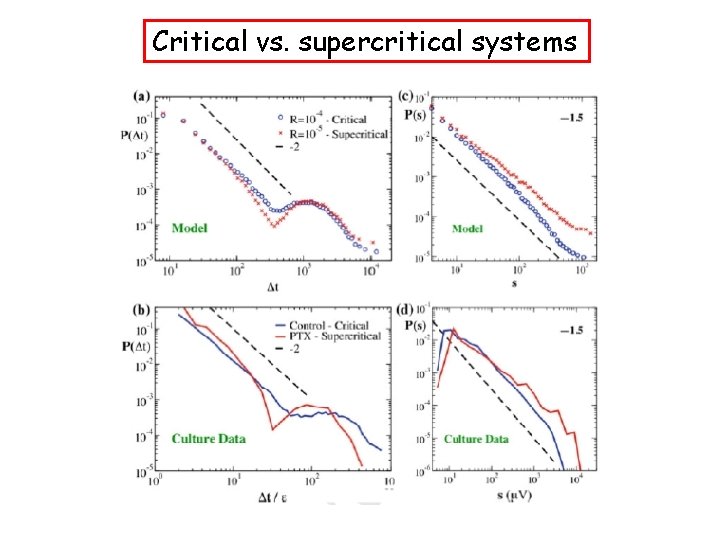
Critical vs. supercritical systems
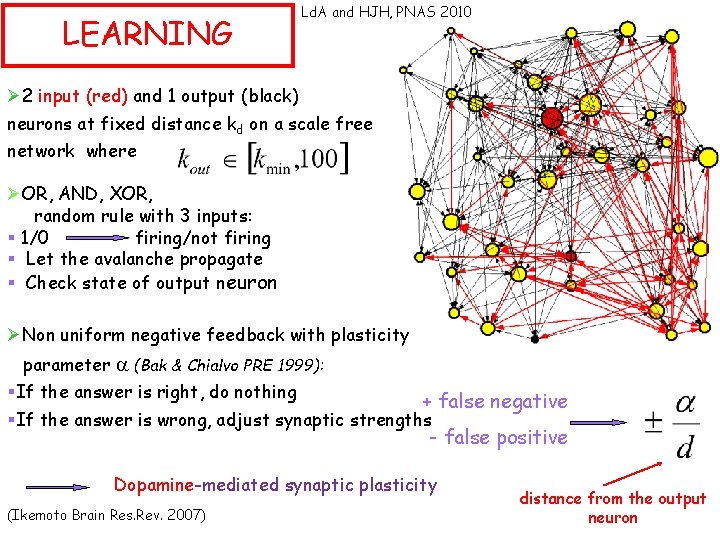
LEARNING Ld. A and HJH, PNAS 2010 Ø 2 input (red) and 1 output (black) neurons at fixed distance kd on a scale free network where ØOR, AND, XOR, random rule with 3 inputs: § 1/0 firing/not firing § Let the avalanche propagate § Check state of output neuron ØNon uniform negative feedback with plasticity parameter a (Bak & Chialvo PRE 1999): §If the answer is right, do nothing + false negative §If the answer is wrong, adjust synaptic strengths - false positive Dopamine-mediated synaptic plasticity (Ikemoto Brain Res. Rev. 2007) distance from the output neuron
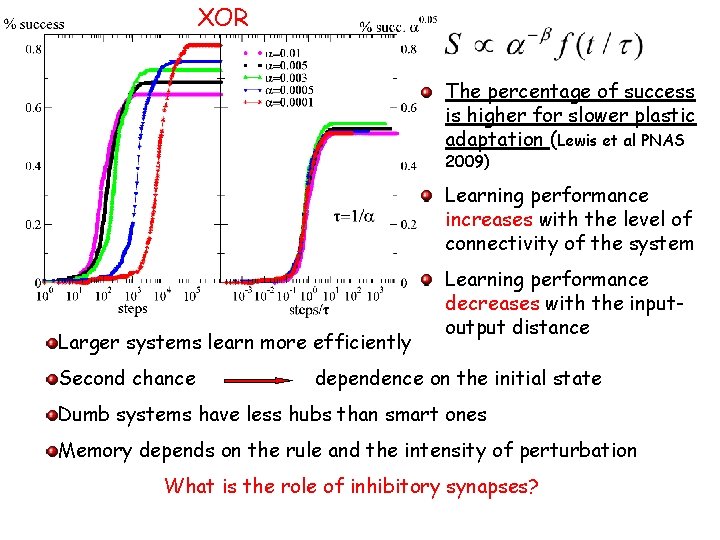
XOR The percentage of success is higher for slower plastic adaptation (Lewis et al PNAS 2009) Learning performance increases with the level of connectivity of the system Larger systems learn more efficiently Second chance Learning performance decreases with the inputoutput distance dependence on the initial state Dumb systems have less hubs than smart ones Memory depends on the rule and the intensity of perturbation What is the role of inhibitory synapses?
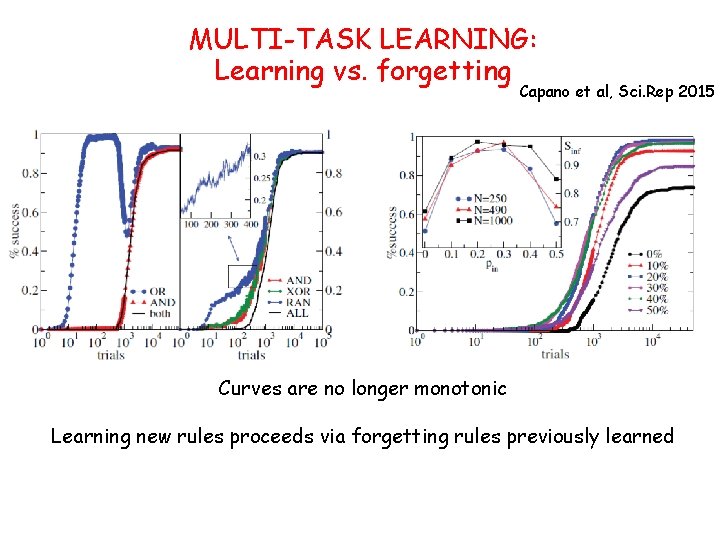
MULTI-TASK LEARNING: Learning vs. forgetting Capano et al, Sci. Rep 2015 Curves are no longer monotonic Learning new rules proceeds via forgetting rules previously learned
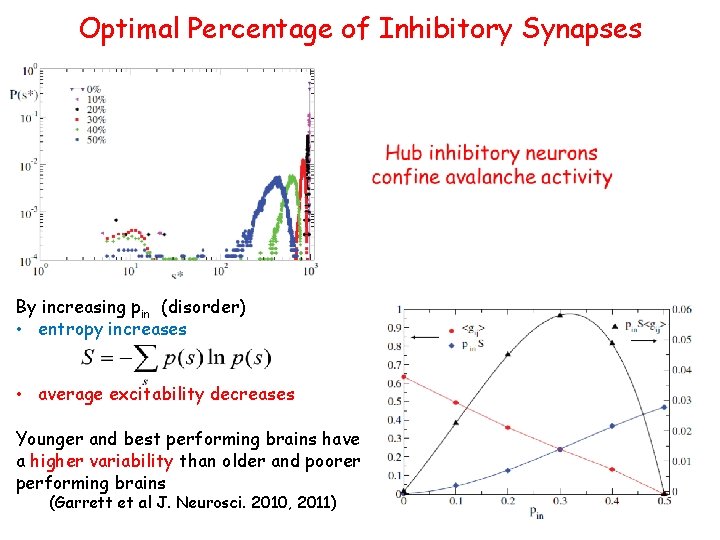
Optimal Percentage of Inhibitory Synapses By increasing pin (disorder) • entropy increases • average excitability decreases Younger and best performing brains have a higher variability than older and poorer performing brains (Garrett et al J. Neurosci. 2010, 2011)
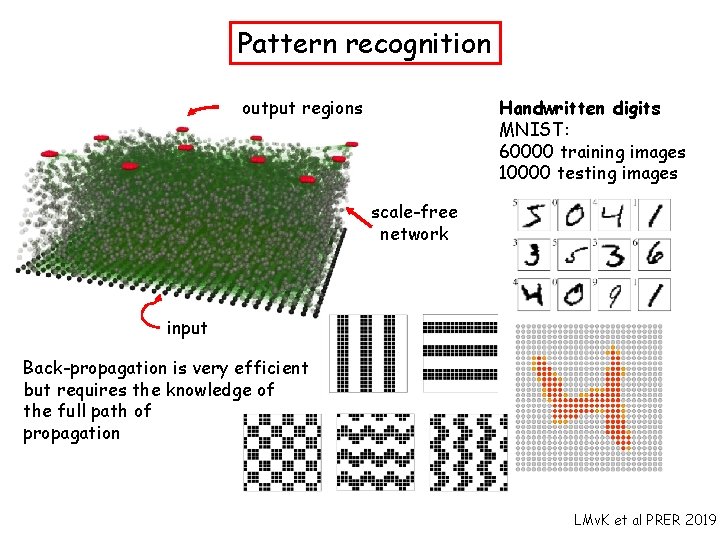
Pattern recognition output regions Handwritten digits MNIST: 60000 training images 10000 testing images scale-free network input Back-propagation is very efficient but requires the knowledge of the full path of propagation LMv. K et al PRER 2019
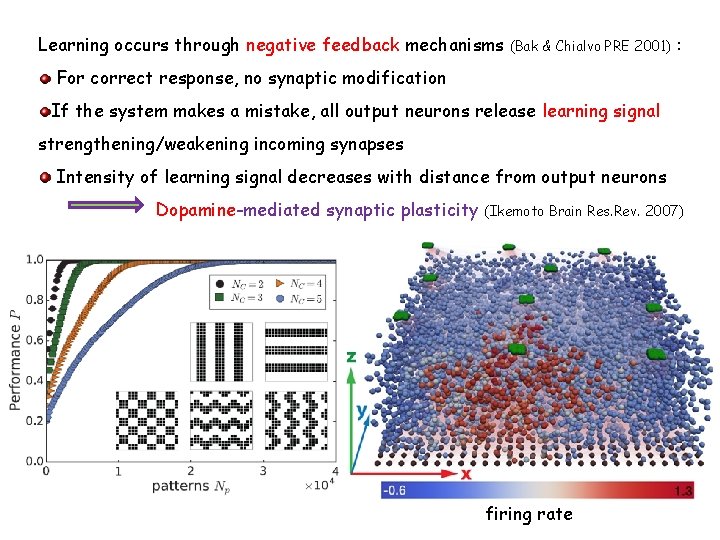
Learning occurs through negative feedback mechanisms (Bak & Chialvo PRE 2001) : For correct response, no synaptic modification If the system makes a mistake, all output neurons release learning signal strengthening/weakening incoming synapses Intensity of learning signal decreases with distance from output neurons Dopamine-mediated synaptic plasticity (Ikemoto Brain Res. Rev. 2007) firing rate
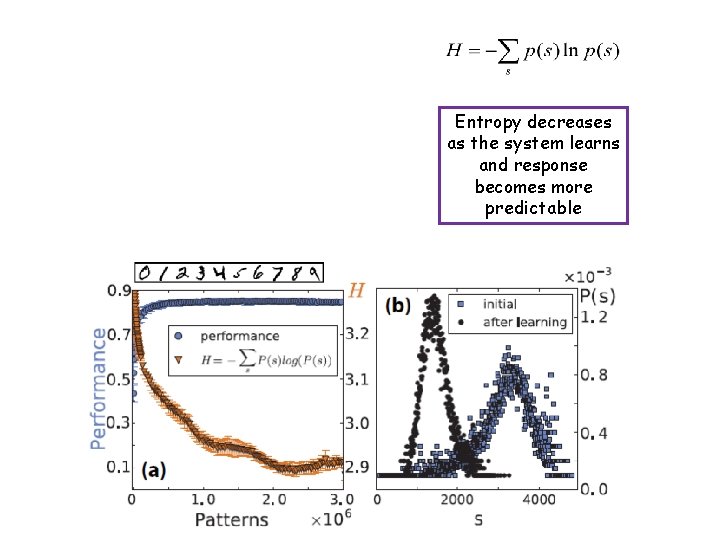
Entropy decreases as the system learns and response becomes more predictable
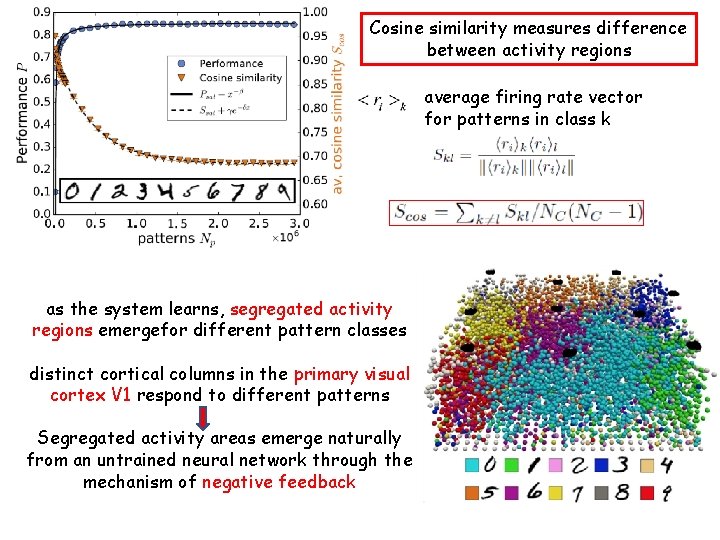
Cosine similarity measures difference between activity regions average firing rate vector for patterns in class k as the system learns, segregated activity regions emergefor different pattern classes distinct cortical columns in the primary visual cortex V 1 respond to different patterns Segregated activity areas emerge naturally from an untrained neural network through the mechanism of negative feedback
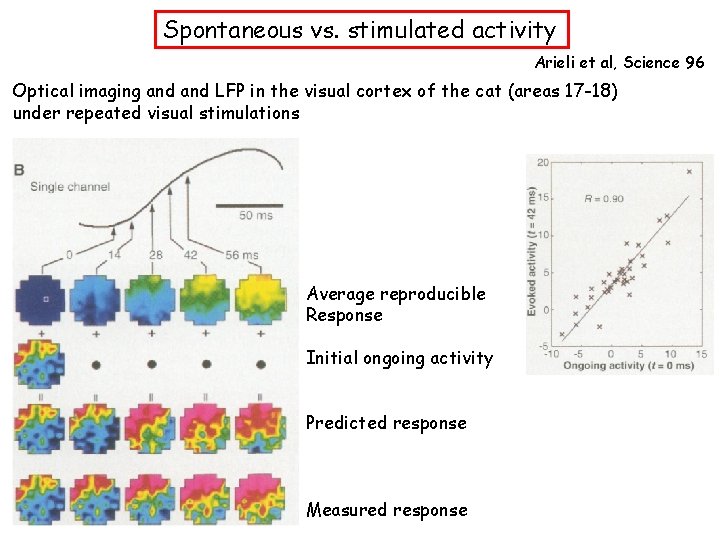
Spontaneous vs. stimulated activity Arieli et al, Science 96 Optical imaging and LFP in the visual cortex of the cat (areas 17 -18) under repeated visual stimulations Average reproducible Response Initial ongoing activity Predicted response Measured response
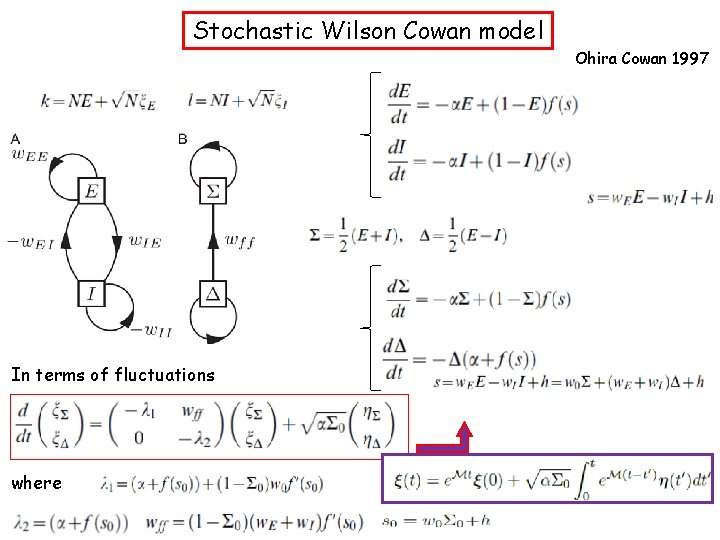
Stochastic Wilson Cowan model In terms of fluctuations where Ohira Cowan 1997
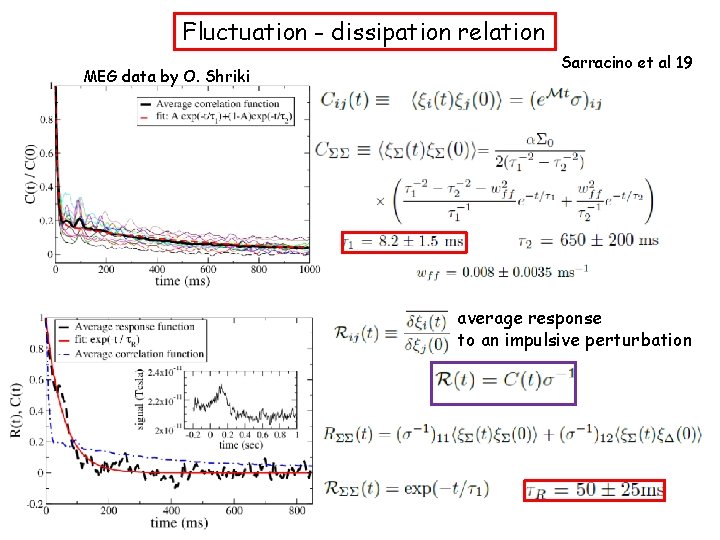
Fluctuation - dissipation relation MEG data by O. Shriki Sarracino et al 19 average response to an impulsive perturbation
Collaborations Hans J. Herrmann, ETH Zurich Alessandro Sarracino, Unicampania Carla Perrone Capano, University of Naples Laurens Michiels von Kessenich, ETH Zurich Damian Berger, ETH Zurich Fabrizio Lombardi, ETH Zurich, Boston. U Emanuele Varriale, University of Naples Vittorio Capano, University of Naples Gianluca Pellegrini, University of Naples Roberta Russo, University of Naples Dietmar Plenz, NIH Bethesda Oren Shriki, Ben-Gurion U
- Slides: 22