
Spontaneous Human Combustion Typical Situation Often described as
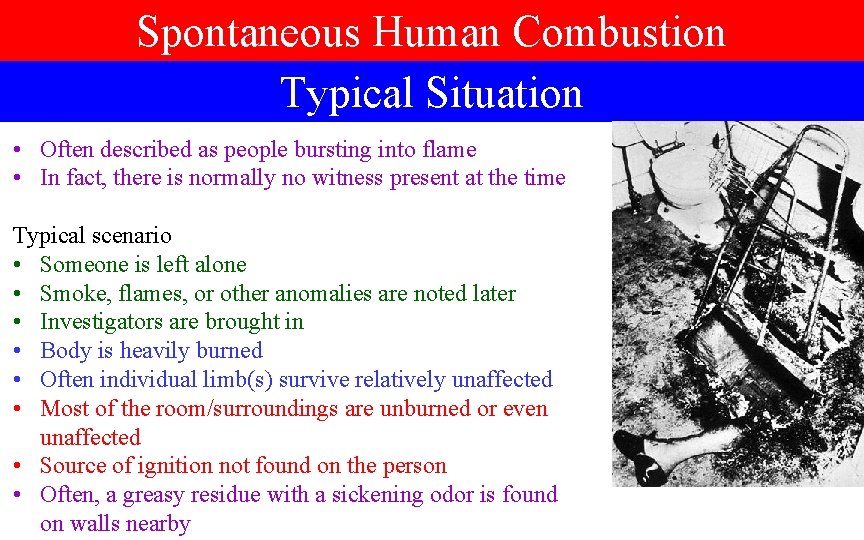
Spontaneous Human Combustion Typical Situation • Often described as people bursting into flame • In fact, there is normally no witness present at the time Typical scenario • Someone is left alone • Smoke, flames, or other anomalies are noted later • Investigators are brought in • Body is heavily burned • Often individual limb(s) survive relatively unaffected • Most of the room/surroundings are unburned or even unaffected • Source of ignition not found on the person • Often, a greasy residue with a sickening odor is found on walls nearby
The Alcohol Hypothesis • Early it was noted that many of the victims were alcoholics • It was suggested that consumption of alcohol made people flammable • This was also an era when there was a lot of push for prohibition • Pure alcohol is highly flammable • But not alcohol mixed with water! – You would need it to be mostly alcohol to make it very flammable • At 0. 4% blood alcohol content, you have about a 50% chance of dying • At 1%, almost anyone is dead • You would be dead long before you became flammable • Implausible explanation
Source of the Ignition Why is this hard to explain? • Human body is mostly made of water (and water doesn’t burn) • Nearby objects relatively unaffected • No obvious source of ignition Where is the source of ignition? • They moved away from it • It was destroyed In many cases, the possible source of fire is found, but not near them • In another room • In the same room, but not near them In other cases, it is possible to surmise the potential source of fire • Tobacco pipe found nearby • Known smoker
Who Are the Victims? Common features of victims: • Alcoholics • Elderly • Overweight • Women What do these features have in common? • Alcoholics, the elderly and overweight people all have low mobility – In a crisis, they may be less able to react quickly • Women genetically have a higher proportion of body fat than men – Obviously, so do overweight people
How it Might Start • How can you get something to burn that doesn’t burn easily? • First you need to have a source of ignition – Could be nothing more than a match • Then you need something that can easily burn in significant quantity – Clothing – Upholstered furniture • The fire starts, and spreads to the clothing or furniture • The person is inattentive at first, due to sleep, drugs, or alcohol • Once they realize they are on fire, they may be unable to get away • Or they may move some distance before being overcome • The clothing or upholstery burns partly, evaporating water from their bodies • This leaves fat, which does not evaporate
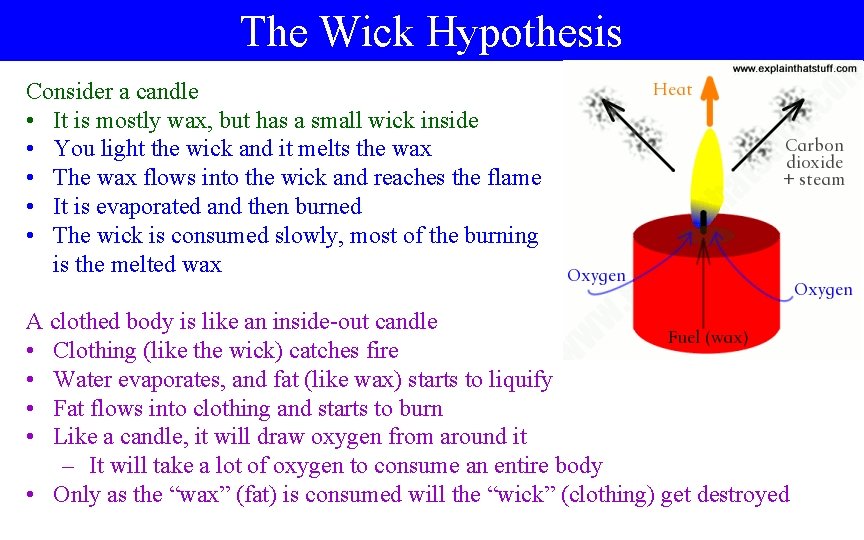
The Wick Hypothesis Consider a candle • It is mostly wax, but has a small wick inside • You light the wick and it melts the wax • The wax flows into the wick and reaches the flame • It is evaporated and then burned • The wick is consumed slowly, most of the burning is the melted wax A clothed body is like an inside-out candle • Clothing (like the wick) catches fire • Water evaporates, and fat (like wax) starts to liquify • Fat flows into clothing and starts to burn • Like a candle, it will draw oxygen from around it – It will take a lot of oxygen to consume an entire body • Only as the “wax” (fat) is consumed will the “wick” (clothing) get destroyed
How Can We Explain Other Facts? Why don’t they save themselves? • Often low mobility victims • In some rare cases, the initial cause could be a fatal heart attack Why is nothing else burned up? • In many cases, other things are burned up, but not the whole room • Under the wick hypothesis, the burning can be hot without being large • Fire spreads its heat mostly up, a little to the side, and very little down Legs or other extremities unaffected? • If not covered in clothing, the wick effect won’t work Strange smell and greasy residue? • Unlike candles, human bodies do not burn cleanly • Some of the incompletely burned residue will have odors • Some of the residue will adhere to walls – Sooty/greasy residue on walls
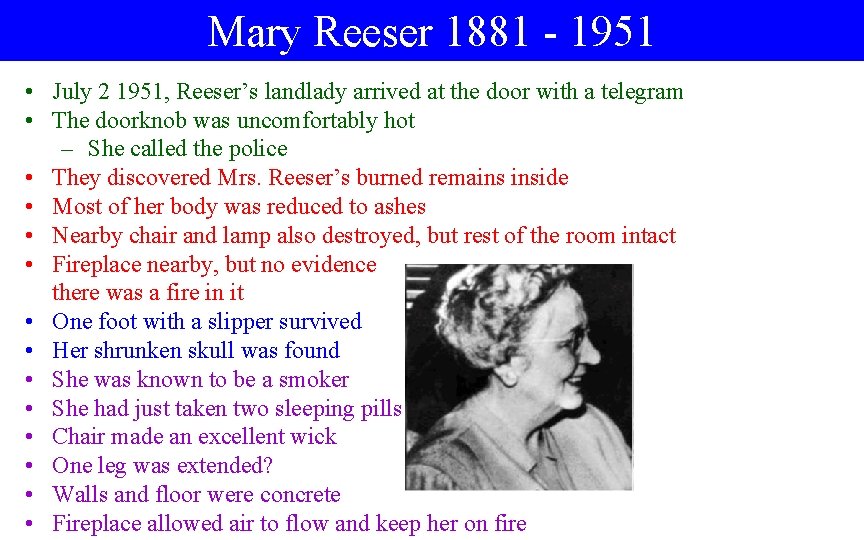
Mary Reeser 1881 - 1951 • July 2 1951, Reeser’s landlady arrived at the door with a telegram • The doorknob was uncomfortably hot – She called the police • They discovered Mrs. Reeser’s burned remains inside • Most of her body was reduced to ashes • Nearby chair and lamp also destroyed, but rest of the room intact • Fireplace nearby, but no evidence there was a fire in it • One foot with a slipper survived • Her shrunken skull was found • She was known to be a smoker • She had just taken two sleeping pills • Chair made an excellent wick • One leg was extended? • Walls and floor were concrete • Fireplace allowed air to flow and keep her on fire
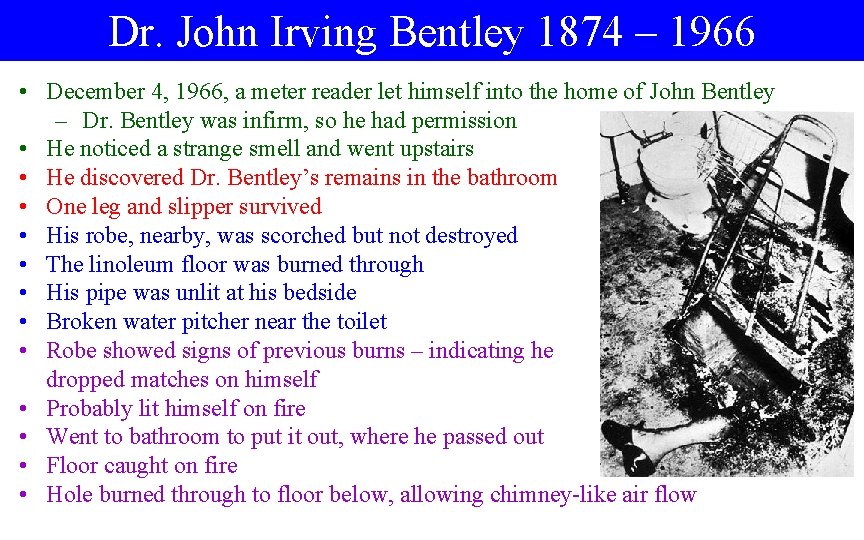
Dr. John Irving Bentley 1874 – 1966 • December 4, 1966, a meter reader let himself into the home of John Bentley – Dr. Bentley was infirm, so he had permission • He noticed a strange smell and went upstairs • He discovered Dr. Bentley’s remains in the bathroom • One leg and slipper survived • His robe, nearby, was scorched but not destroyed • The linoleum floor was burned through • His pipe was unlit at his bedside • Broken water pitcher near the toilet • Robe showed signs of previous burns – indicating he dropped matches on himself • Probably lit himself on fire • Went to bathroom to put it out, where he passed out • Floor caught on fire • Hole burned through to floor below, allowing chimney-like air flow
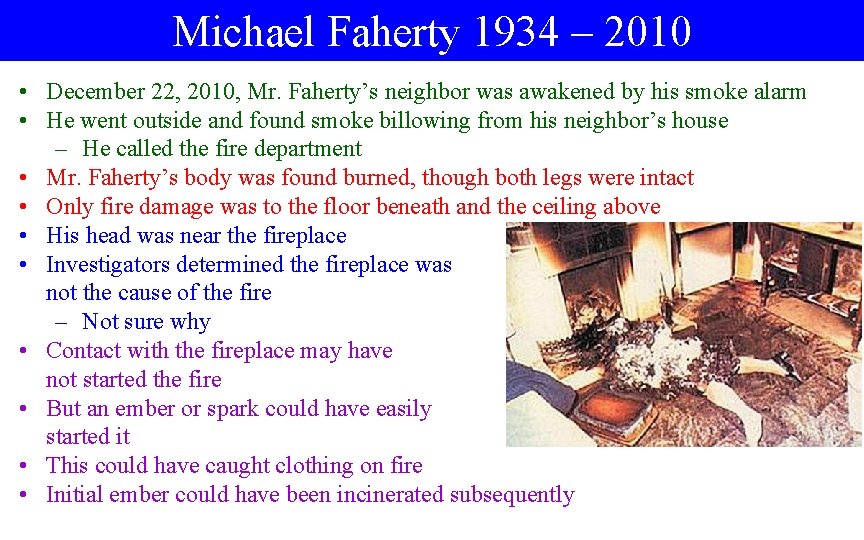
Michael Faherty 1934 – 2010 • December 22, 2010, Mr. Faherty’s neighbor was awakened by his smoke alarm • He went outside and found smoke billowing from his neighbor’s house – He called the fire department • Mr. Faherty’s body was found burned, though both legs were intact • Only fire damage was to the floor beneath and the ceiling above • His head was near the fireplace • Investigators determined the fireplace was not the cause of the fire – Not sure why • Contact with the fireplace may have not started the fire • But an ember or spark could have easily started it • This could have caught clothing on fire • Initial ember could have been incinerated subsequently
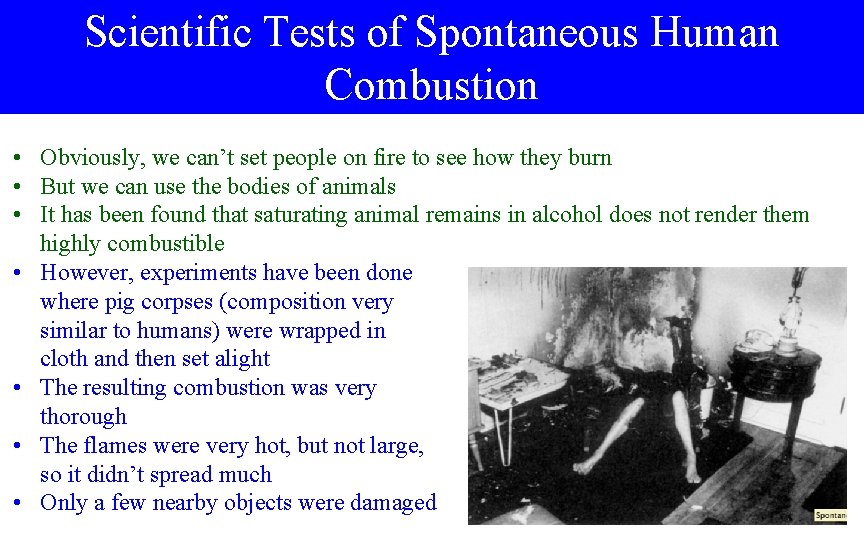
Scientific Tests of Spontaneous Human Combustion • Obviously, we can’t set people on fire to see how they burn • But we can use the bodies of animals • It has been found that saturating animal remains in alcohol does not render them highly combustible • However, experiments have been done where pig corpses (composition very similar to humans) were wrapped in cloth and then set alight • The resulting combustion was very thorough • The flames were very hot, but not large, so it didn’t spread much • Only a few nearby objects were damaged
- Slides: 11