
Sponsored by Supported by Professor Michael Doherty Law
Sponsored by Supported by Professor Michael Doherty Law Department, Maynooth University Individual Rights, Collective Bargaining, and Dispute Resolution
Individual Rights, Collective Bargaining, and Dispute Resolution Prof Michael Doherty Maynooth University Department of Law, New House, South Campus www. maynoothuniversity. ie/law 2
Outline • Collective Bargaining vs Individual Rights – The legislative explosion & implications for ADR – IR Act 2015 and collective bargaining • Dispute resolution where the employer and/or employee is in question – Freelancers – The ‘gig’/ ‘platform’ economy www. maynoothuniversity. ie/law 3
From Collective Bargaining. . . • Traditionally voluntarism and a suspicion of law • Duffy (2010); When I started in the practice of industrial relations, as a trade union official, in 1973 statute law had little bearing on the employment relationship. One was expected to be familiar with the Redundancy Payments Act 1967, the Holiday (Employees) Act 1961 and the newly enacted Minimum Notice & Terms of Employment Act 1973… 4
From Collective Bargaining. . . • The dominant non-contractual source of the rights of workers, particularly those in manual occupations, and the concomitant obligations of their employers, was the collective agreement • That was a time when employment law, as a discrete topic for students, or as a field of practice for lawyers, was unknown. 5
. . . to Law to. . . more Law. . . • 1990 to 2016: 38 major labour law Acts were passed; a “legislative explosion” • 0 from 2008 -2011; 10 from 2012 -2016 • 21 mandated/heavily shaped by EU law www. maynoothuniversity. ie/law 6
. . . and more Law. . . • Huge challenges for the institutions – Role of EU Court (and ECrt. HR; Committee on the Social Charter, etc) – Procedures (‘juridification’) • Hugely challenging for employers, workers, and trade unions www. maynoothuniversity. ie/law 7
The Irish Model • ‘Floor of rights’ (e. g. low EPL scores) • With union decline in the private sector, increasing focus on state policing of labour rights (labour inspectorate; criminal sanctions) • Dispute resolution: – increasingly individualised – No legal aid/ generally no costs/ no tribunal fees (yet…? ) • Constitutional protection for freedom of association, but… – Collective agreements voluntary – No statutory system to underpin collective bargaining/ union recognition www. maynoothuniversity. ie/law 8

Implications- A Police State? • New provisions in Workplace Relations 2015 Act- compliance notices/ fixed-payment notices • Resourcing of WRC? Labour inspectorate? Conciliation and mediation services? • Legal costs ww. maynoothuniversity. ie/law 9
Implications- ADR • Thrust of Act is to ensure disputes ‘resolved as close to the workplace as possible’ • Part 4 - emphasises role of mediation www. maynoothuniversity. ie/law 10
Implications: Collective Bargaining Rights: When IR meets the Law. . . • Industrial Relations (Amendment) Acts 2001 -2004 • Compromise between fully voluntarist model and mandatory legal recognition for union representation • Do not provide for union recognition or collective bargaining BUT a range of procedures to allow unions/worker representatives to have pay, terms and conditions of employment, and dispute resolution procedures addressed in non-union workplaces www. maynoothuniversity. ie/law 11
Collective Bargaining Rights: When IR meets the Law. . . • Labour Court can issue a legally binding determination on pay/terms of employment BUT collective bargaining cannot be imposed • Acts were controversial as they did allow for the Labour Court to ‘impose’ terms and conditions on employers
Collective Bargaining Rights: When IR meets the Law. . . • Doherty (2009) – Vast majority of cases involved relatively low-pay, low-skill groups of workers – Back door recognition? – 72% of cases involved indigenous firms – ‘neither the fears of employers nor the hopes of the unions seem to be borne out empirically’ (NB MNCs) – BUT Determinations on pay: generally sought to follow industry norms (‘model employer’)/national pay deals www. maynoothuniversity. ie/law 13

In-flight turbulence. . • Ryanair v Labour Court [2007] • ‘collective bargaining negotiations’ should be given simply an ordinary meaning and not any distinctive meaning as understood in trade union negotiations • non-union internal bargaining unit could be an ‘excepted body’ capable of collective bargaining with the employer • 2009 - no claims at all under the legislation www. maynoothuniversity. ie/law 14
The life-jacket is under your seat? • Industrial Relations (Amendment) Act 2015 – Definition of collective bargaining – Definition of non-union bargaining unit (‘excepted body’) • Labour Court must consider (inter alia): – Is the number of workers involved ‘not insignificant’? – Whether the “totality” of the remuneration and conditions of employment of the workers concerned provides a “lesser benefit” to them having regard to the “totality” of remuneration and conditions of employment of comparable workers in similar employments www. maynoothuniversity. ie/law 15
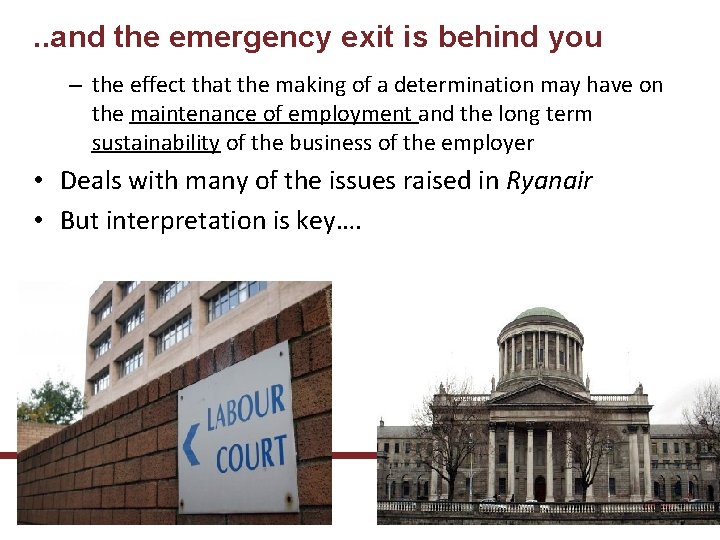
. . and the emergency exit is behind you – the effect that the making of a determination may have on the maintenance of employment and the long term sustainability of the business of the employer • Deals with many of the issues raised in Ryanair • But interpretation is key…. www. maynoothuniversity. ie/law 16
Collective Bargaining Rights: When IR meets the Law. . . • Freshways Food Company and SIPTU (LCR 21242) 3 June 2016 1. 250 workers, 170 GOs; 63 GOs in dispute- number of workers who are party to the dispute is not insignificant relative to the total number of general operatives employed by the employer

Collective Bargaining Rights: When IR meets the Law. . . 2. Co argued did engage in bargaining via its SRG (which, it argued was an ‘excepted body’), but Court rejected this: Ø no evidence produced of a ‘practice’ of bargaining (ongoing process) Ø No evidence of ‘negotiations’ (consultation body) Ø SRG did not only act in respect of its own members, but it purports to do so in respect of the generality of those employed by the employer (could not be an ‘excepted body’ under the Act) www. maynoothuniversity. ie/law 18
Collective Bargaining Rights: When IR meets the Law. . . 3. Evidence produced to Court on terms and conditions applicable in other named employments; detailed financial information in relation to the employer Ø There were ‘comparable workers’ (skills, responsibilities, physical/mental effort required) www. maynoothuniversity. ie/law 19
Collective Bargaining Rights: When IR meets the Law. . . Ø The other firms were ‘similar employments’ in the ‘Prepared Foods Sector’ Øgeneral line of business; Øthe size of the undertakings; Øwhether they are in competition with each other (i. e. is there ‘elasticity in demand’ for the goods/services in question) Øalthough slightly different products; differences in size/scale www. maynoothuniversity. ie/law 20

Collective Bargaining Rights: When IR meets the Law. . . 4. Totality of the remuneration and conditions of employment of those in dispute provides a lesser benefit than the totality of remuneration and conditions of employment of comparable workers in similar employment in making its recommendations the Court took into account the financial and commercial circumstances of the employer: Ø Pay: not the € 5 sought, but € 2. 12 staggered (18 mths) Ø Sick pay scheme/ additional leave for certain workers www. maynoothuniversity. ie/law 21
Collective Bargaining Rights: When IR meets the Law. . . Ø Code of Practice on Grievance and Disciplinary Procedures (S. I. 146 of 2000)- employer should provide for union representation in processing individual grievances and disciplinary matters, where an employee wishes to avail of such representation and provide for the full utilisation of the normal State dispute resolution machinery (incl WRC and Labour Court) 22
Collective Bargaining Rights: When IR meets the Law. . . Ø Robust interpretation of ‘collective bargaining’ (ongoing process; proof of intention to reach agreement) Ø ‘Excepted body’ must not be only representative of a wider group Ø ‘Similar employment’ (noting differences in undertakings named to the Court); await more Recs on this Ø Financial/ comparator evidence, and access to this, vital Ø TU representation- did the Court overstep? Ø Will employers be more likely to simply concede recognition? www. maynoothuniversity. ie/law 23
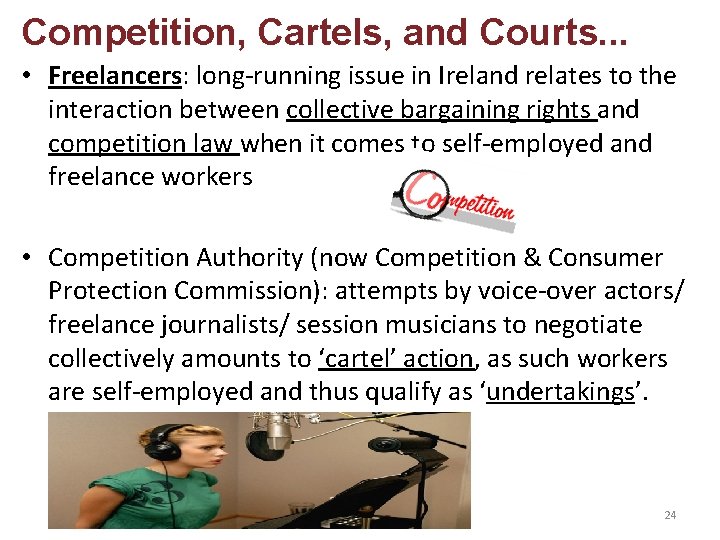
Competition, Cartels, and Courts. . . • Freelancers: long-running issue in Ireland relates to the interaction between collective bargaining rights and competition law when it comes to self-employed and freelance workers • Competition Authority (now Competition & Consumer Protection Commission): attempts by voice-over actors/ freelance journalists/ session musicians to negotiate collectively amounts to ‘cartel’ action, as such workers are self-employed and thus qualify as ‘undertakings’. 24
Competition, Cartels, and Courts. . . • Case C-413/13 FNV: collective agreements could legitimately cover the working conditions of service providers whose situation is comparable to that of employees (concern was with avoiding ‘false selfemployment’) • ‘vulnerable self-employed workers’ (e. g. media and entertainment sector, construction workers) but also professionals (health)) www. maynoothuniversity. ie/law 25
Competition, Cartels, and Courts. . . • Competition (Amendment) Bill 2016 - where an individual personally engages for gain under a contract with an undertaking to do any work or provide services, s/he should not be considered ‘an undertaking’ 26
‘False self-employed worker’ – (a) performs under a contract the same activity or service as an employee of the other person, – (b) has a relationship of subordination in relation to the other person for the duration of the contractual relationship, – (c) is required to follow the instructions of the other person regarding the time, place and content of his or her work, – (d) does not share in the other person’s commercial risk, – (e) has no independence as regards the determination of the time, schedule, place and manner of performing tasks – (f) for the duration of the contractual relationship, forms an integral part of the other person’s undertaking www. maynoothuniversity. ie/law 27
‘fully dependent self-employed worker’ – (a) performs services for another person under a contract (whether express or implied, and if express, whether orally or in writing), and – (b) main income in respect of the performance of such services under contract is derived from not more than 2 persons • Trade union can apply to the Minister to prescribe a class of workers for the purposes of the Act – must be no or minimal economic effect on the market in which the class of worker operates, – must not lead to or result in significant costs to the State, – and must not otherwise contravene laws relating to the prohibition on the prevention, restriction or distortion of competition) www. maynoothuniversity. ie/law 28
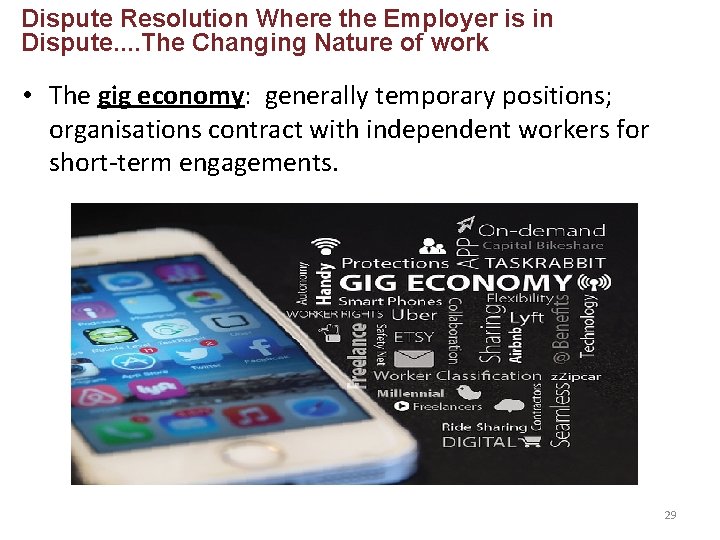
Dispute Resolution Where the Employer is in Dispute. . The Changing Nature of work • The gig economy: generally temporary positions; organisations contract with independent workers for short-term engagements. 29
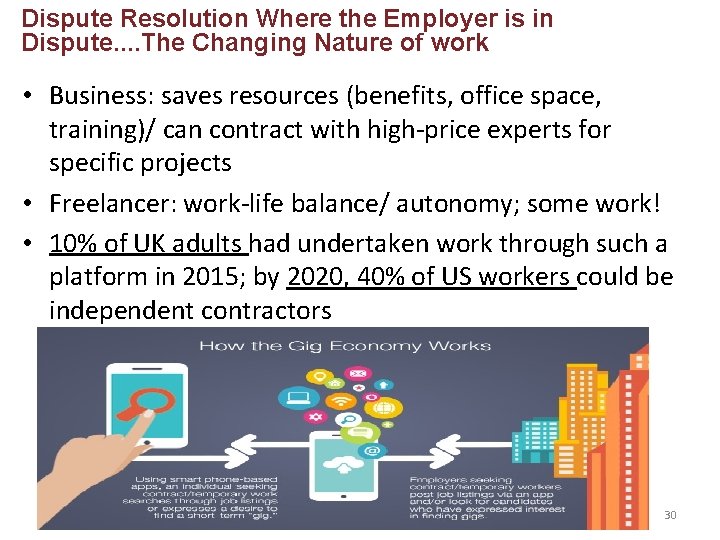
Dispute Resolution Where the Employer is in Dispute. . The Changing Nature of work • Business: saves resources (benefits, office space, training)/ can contract with high-price experts for specific projects • Freelancer: work-life balance/ autonomy; some work! • 10% of UK adults had undertaken work through such a platform in 2015; by 2020, 40% of US workers could be independent contractors 30
Dispute Resolution Where the Employer is in Dispute. . The Changing Nature of work • the dichotomy between ‘employee’ and ‘self-employed’ in Irish law is under stress • car hire platform that connects customers to drivers through a smartphone app; customers pay Uber and Uber pays a percentage to the driver • UK: ‘worker’ is entitled to protections incl national minimum wage, protection against unlawful deductions from wages, statutory annual leave, rest breaks, data protection rights and protection against unlawful discrimination and whistleblowing (but not unfair dismissal, redundancy pay, notice) 31
Dispute Resolution Where the Employer is in Dispute. . The Changing Nature of work • Aslam v Uber [2016]: Uber exerts a lot of control over drivers when their app is on: it sets the fee; it does not tell them where customers want to go until after they have been picked up; and it “deactivates” drivers whose average customer ratings drop too low • ET satisfied that the ‘supposed driver/passenger contract is a pure fiction which bears no relation to the real dealings and relationships between the parties’ www. maynoothuniversity. ie/law 32
Dispute Resolution Where the Employer is in Dispute. . The Changing Nature of work • The notion that Uber in London ‘is a mosaic of 30, 000 small businesses linked by a common “platform” is faintly ridiculous’ • any organisation that resorted in ‘its documentation to fictions, twisted language and even brand new terminology, merits, we think, a degree of scepticism’. www. maynoothuniversity. ie/law 33
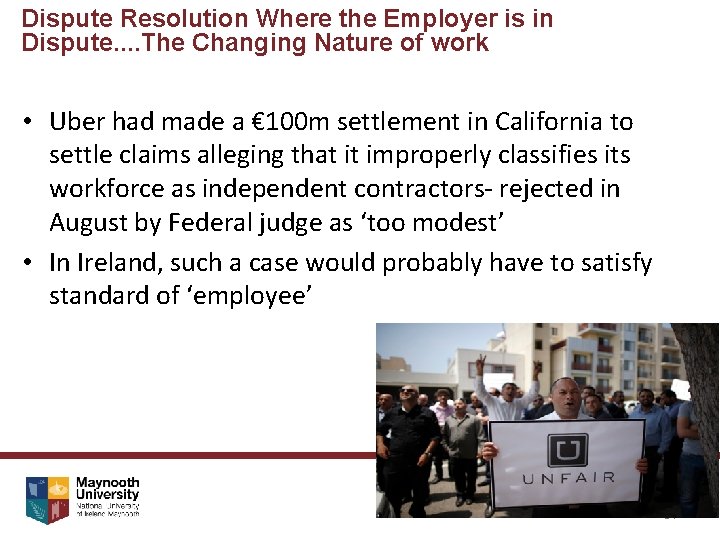
Dispute Resolution Where the Employer is in Dispute. . The Changing Nature of work • Uber had made a € 100 m settlement in California to settle claims alleging that it improperly classifies its workforce as independent contractors- rejected in August by Federal judge as ‘too modest’ • In Ireland, such a case would probably have to satisfy standard of ‘employee’ www. maynoothuniversity. ie/law 34
Conclusions • The traditional ‘employee- self-employed’ dichotomy may need to expand (what of the joint/ multiple employer? The 2016 Act definition? ) • The legislative explosion looks set to continue (e. g. CB for the ‘self-employed’; ‘if and when’ contracts; Joint Labour Committees, the ‘Clerys’ issue…) • Court intervention will inevitably follow – Is this desirable for employers, unions, and workers? – Will the state dispute resolution system be able to cope? www. maynoothuniversity. ie/law 35
Conclusions • And, of course, we need to resolve the question of public sector IR…. www. maynoothuniversity. ie/law 36
Thank you for listening @Maynooth. Law 37
- Slides: 37