
SPONSORED BY Economic Impacts The Graduation Effect If

SPONSORED BY:
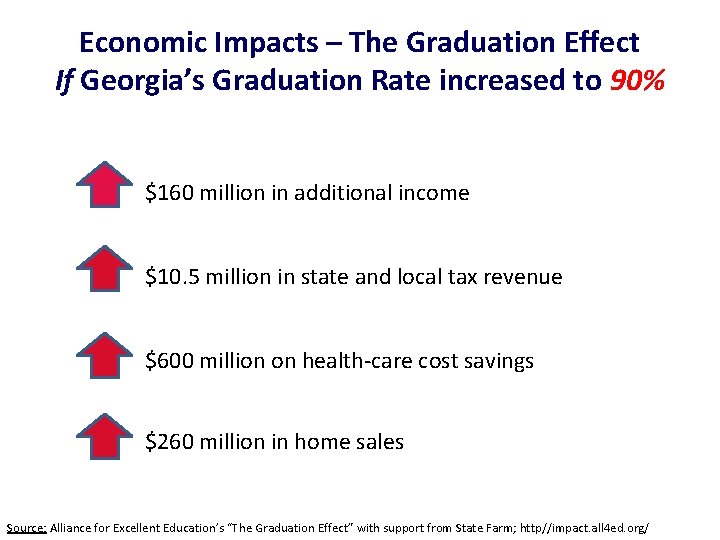
Economic Impacts – The Graduation Effect If Georgia’s Graduation Rate increased to 90% $160 million in additional income $10. 5 million in state and local tax revenue $600 million on health-care cost savings $260 million in home sales Source: Alliance for Excellent Education’s “The Graduation Effect” with support from State Farm; http//impact. all 4 ed. org/
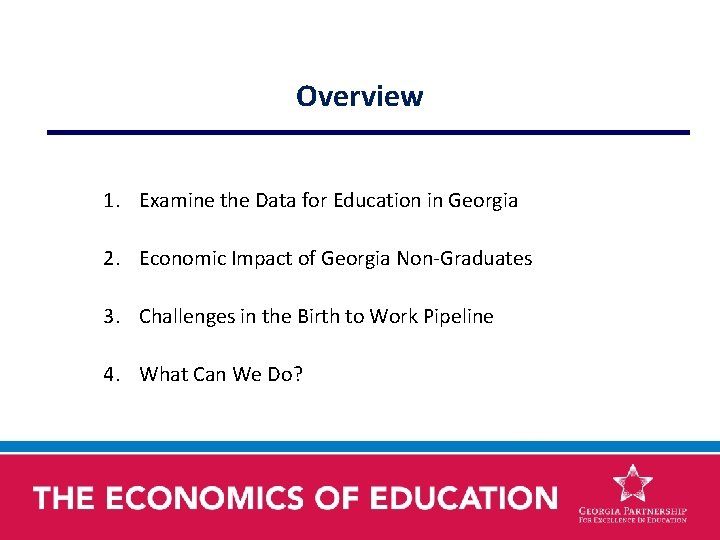
Overview 1. Examine the Data for Education in Georgia 2. Economic Impact of Georgia Non-Graduates 3. Challenges in the Birth to Work Pipeline 4. What Can We Do?
Examine the Data for Education in Georgia
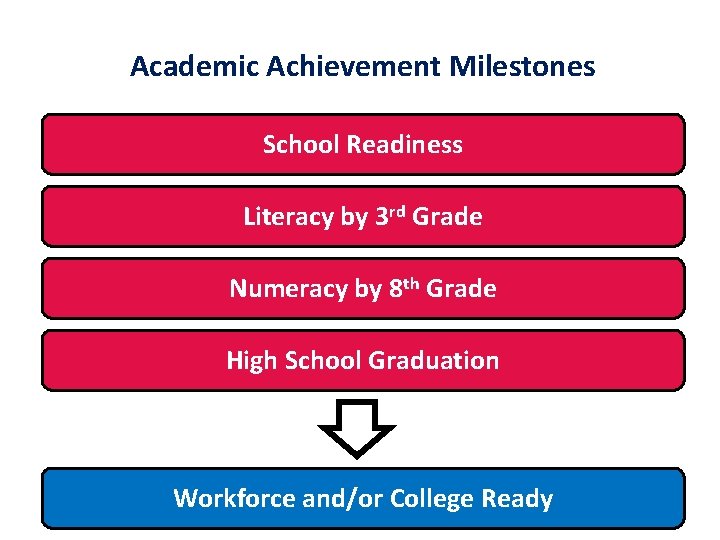
Academic Achievement Milestones School Readiness Literacy by 3 rd Grade Numeracy by 8 th Grade High School Graduation Workforce and/or College Ready
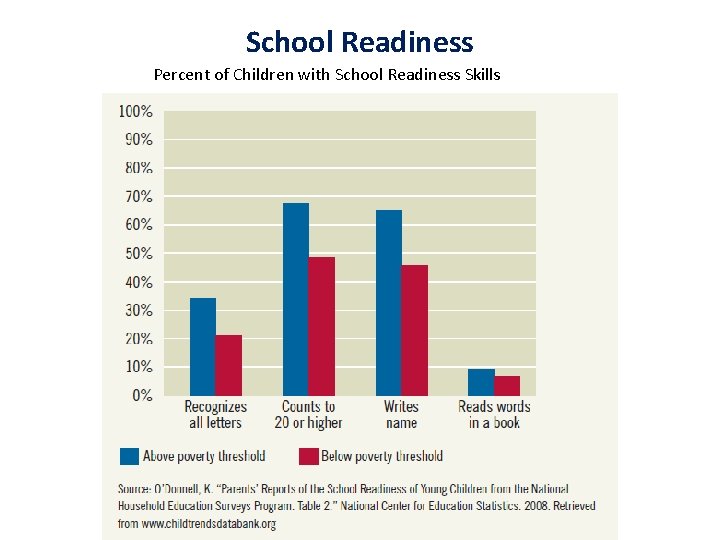
School Readiness Percent of Children with School Readiness Skills
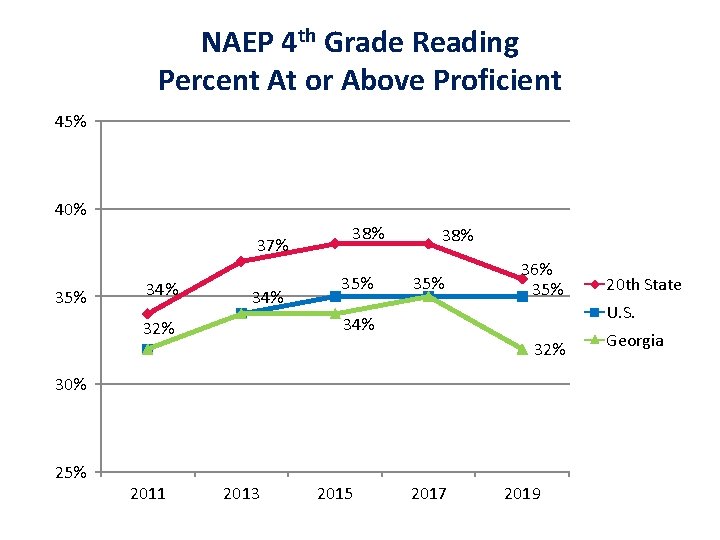
NAEP 4 th Grade Reading Percent At or Above Proficient 45% 40% 37% 35% 34% 38% 35% 36% 35% U. S. 34% 32% 30% 25% 2011 2013 2015 20 th State 2017 2019 Georgia
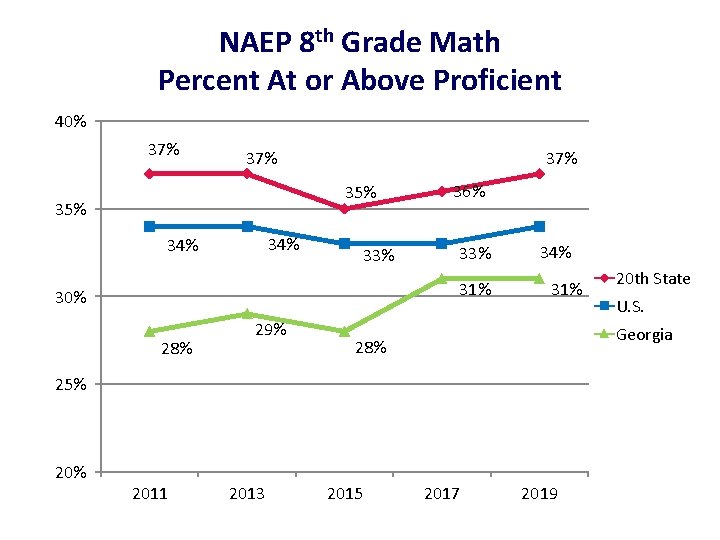
NAEP 8 th Grade Math Percent At or Above Proficient 40% 37% 37% 35% 34% 33% 36% 33% 31% 30% 28% 29% 34% 31% 2011 2013 28% 2015 U. S. Georgia 25% 20 th State 2017 2019
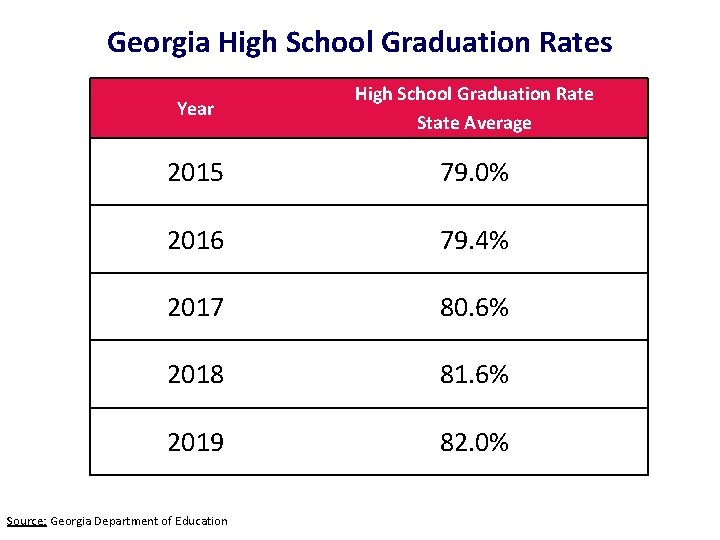
Georgia High School Graduation Rates Year High School Graduation Rate State Average 2015 79. 0% 2016 79. 4% 2017 80. 6% 2018 81. 6% 2019 82. 0% Source: Georgia Department of Education
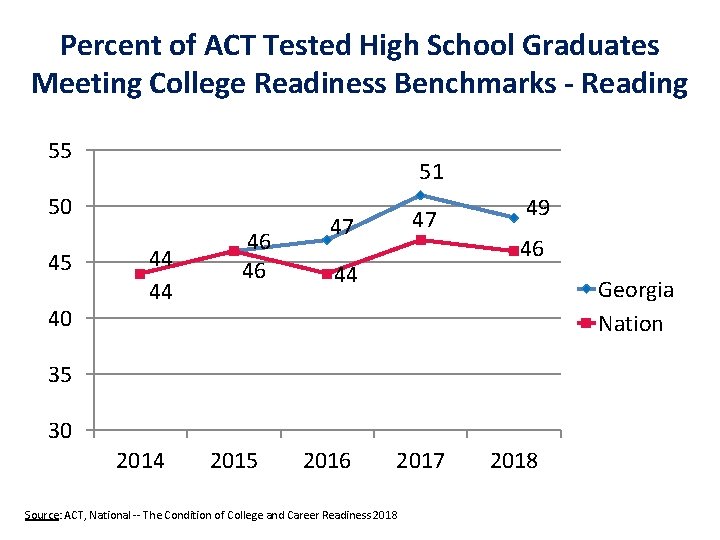
Percent of ACT Tested High School Graduates Meeting College Readiness Benchmarks - Reading 55 51 50 45 40 44 44 46 46 47 47 44 49 46 Georgia Nation 35 30 2014 2015 2016 2017 Source: ACT, National -- The Condition of College and Career Readiness 2018
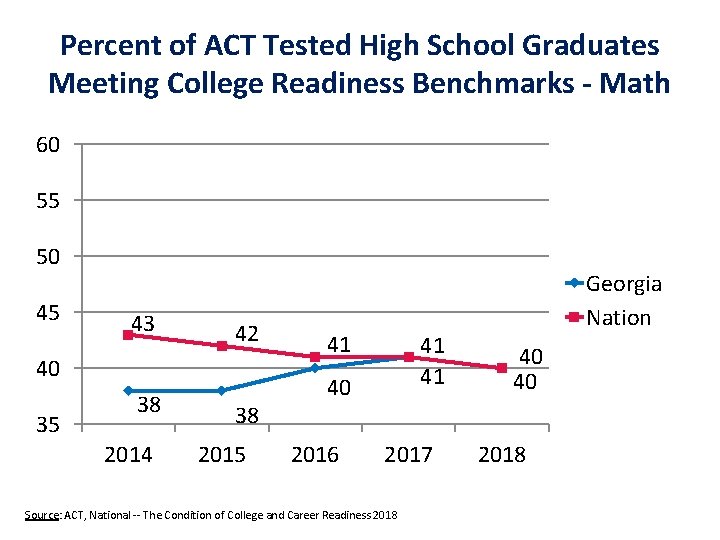
Percent of ACT Tested High School Graduates Meeting College Readiness Benchmarks - Math 60 55 50 45 43 42 40 35 38 2014 38 2015 41 41 41 40 2016 2017 Source: ACT, National -- The Condition of College and Career Readiness 2018 Georgia Nation 40 40 2018
Economic Impact of Georgia Non-Graduates
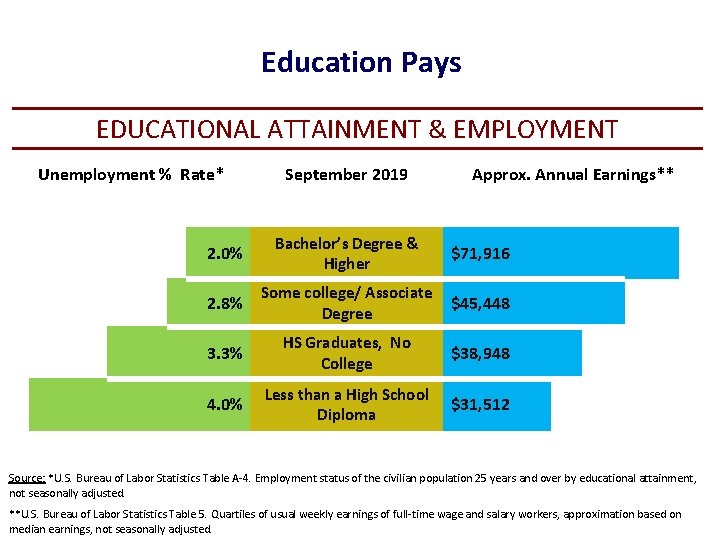
Education Pays EDUCATIONAL ATTAINMENT & EMPLOYMENT Unemployment % Rate* September 2019 Approx. Annual Earnings** 2. 0% Bachelor’s Degree & Higher $71, 916 2. 8% Some college/ Associate Degree $45, 448 3. 3% HS Graduates, No College $38, 948 4. 0% Less than a High School Diploma $31, 512 Source: *U. S. Bureau of Labor Statistics Table A-4. Employment status of the civilian population 25 years and over by educational attainment, not seasonally adjusted. **U. S. Bureau of Labor Statistics Table 5. Quartiles of usual weekly earnings of full-time wage and salary workers, approximation based on median earnings, not seasonally adjusted.
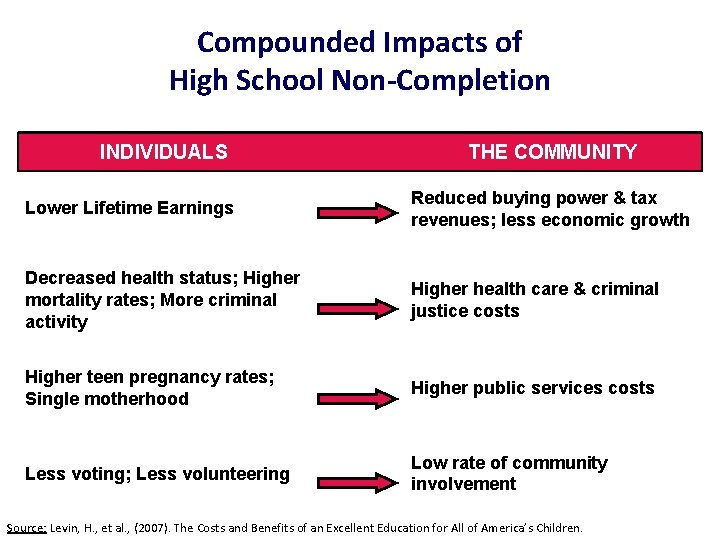
Compounded Impacts of High School Non-Completion INDIVIDUALS THE COMMUNITY Lower Lifetime Earnings Reduced buying power & tax revenues; less economic growth Decreased health status; Higher mortality rates; More criminal activity Higher health care & criminal justice costs Higher teen pregnancy rates; Single motherhood Higher public services costs Less voting; Less volunteering Low rate of community involvement Source: Levin, H. , et al. , (2007). The Costs and Benefits of an Excellent Education for All of America’s Children.
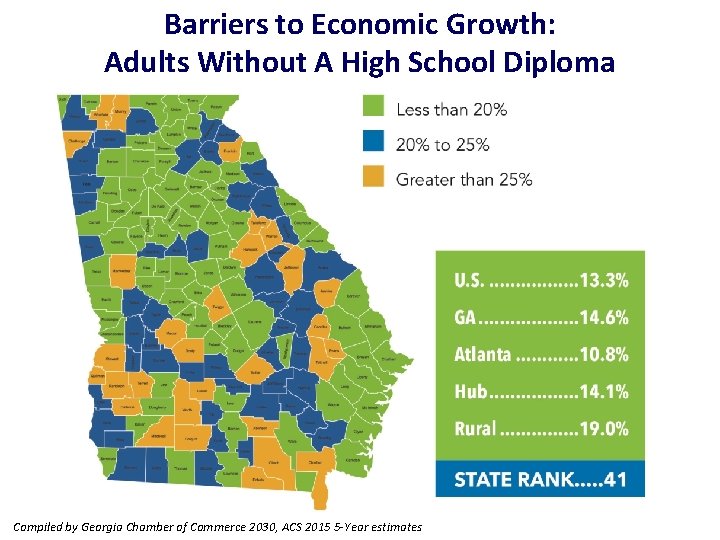
Barriers to Economic Growth: Adults Without A High School Diploma Compiled by Georgia Chamber of Commerce 2030, ACS 2015 5 -Year estimates
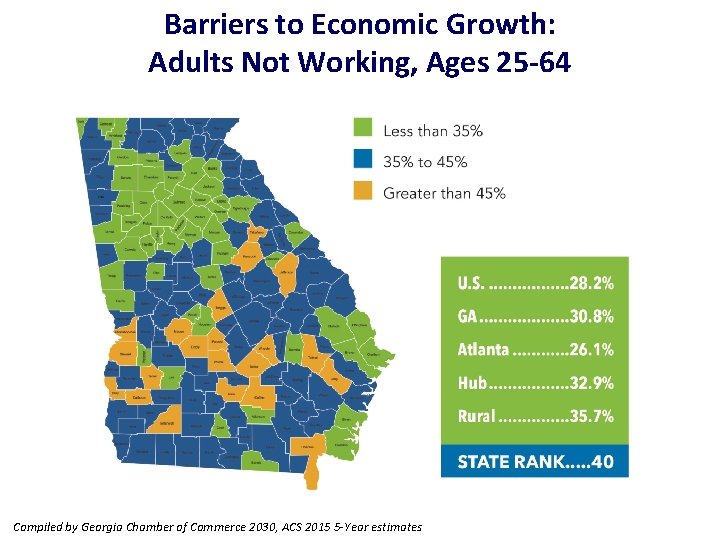
Barriers to Economic Growth: Adults Not Working, Ages 25 -64 Compiled by Georgia Chamber of Commerce 2030, ACS 2015 5 -Year estimates
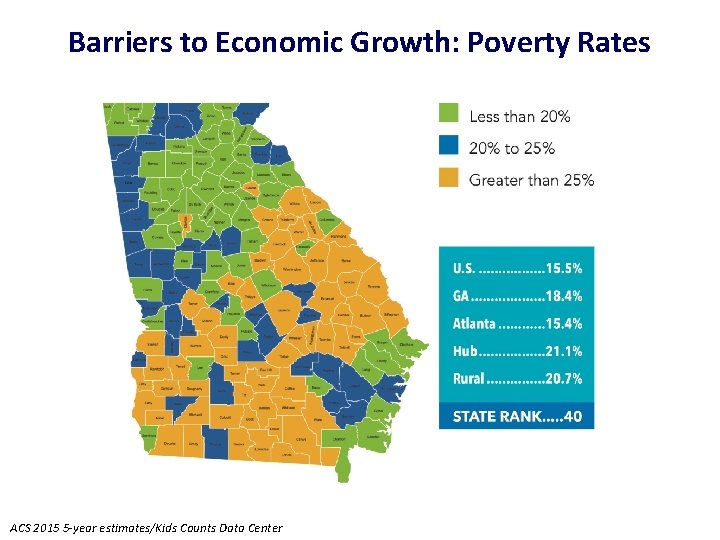
Barriers to Economic Growth: Poverty Rates ACS 2015 5 -year estimates/Kids Counts Data Center
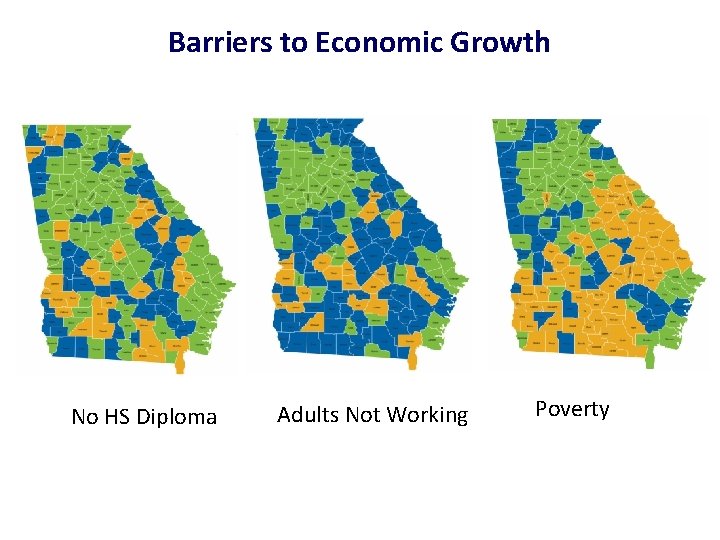
Barriers to Economic Growth No HS Diploma Adults Not Working Poverty
Challenges in the Birth to Work Pipeline
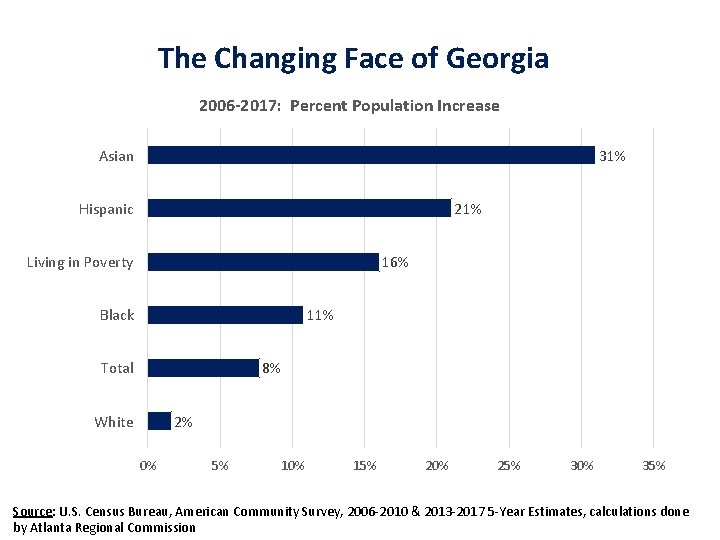
The Changing Face of Georgia 2006 -2017: Percent Population Increase Asian 31% Hispanic 21% Living in Poverty 16% Black 11% Total 8% White 2% 0% 5% 10% 15% 20% 25% 30% 35% Source: U. S. Census Bureau, American Community Survey, 2006 -2010 & 2013 -2017 5 -Year Estimates, calculations done by Atlanta Regional Commission
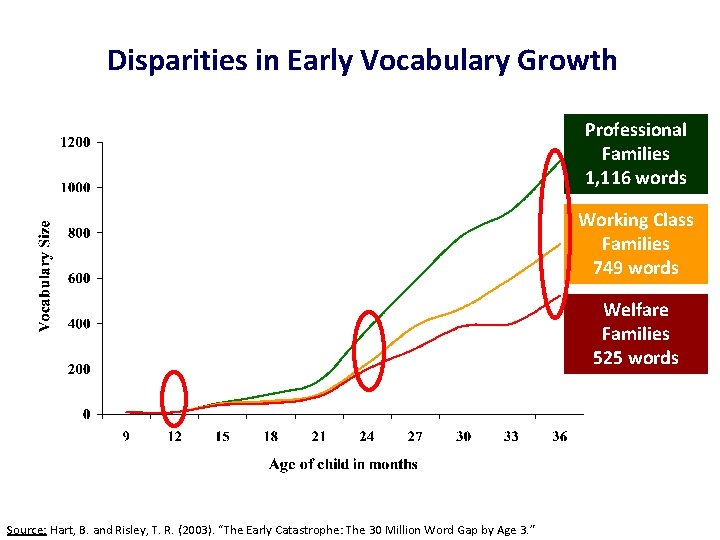
Disparities in Early Vocabulary Growth Professional Families 1, 116 words Working Class Families 749 words Welfare Families 525 words Source: Hart, B. and Risley, T. R. (2003). “The Early Catastrophe: The 30 Million Word Gap by Age 3. ”
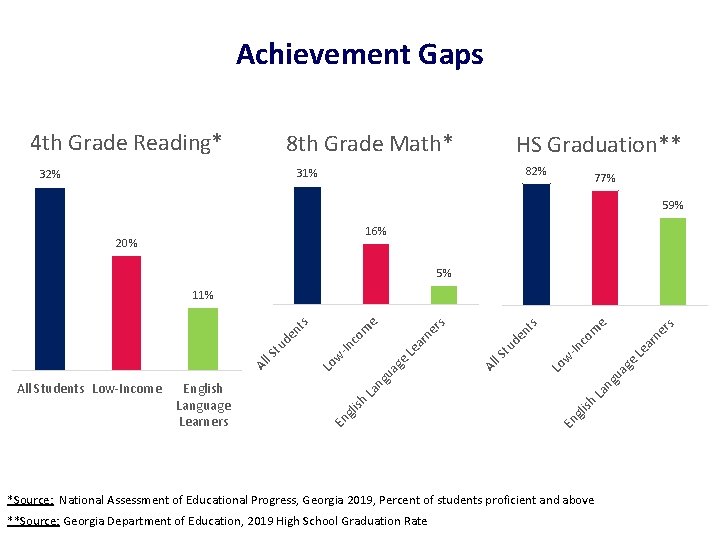
Achievement Gaps 4 th Grade Reading* 8 th Grade Math* HS Graduation** 82% 31% 32% 77% 59% 16% 20% 5% ar ne Le -In co ua ge Lo w ng La sh En gli *Source: National Assessment of Educational Progress, Georgia 2019, Percent of students proficient and above **Source: Georgia Department of Education, 2019 High School Graduation Rate rs e m nt tu de l. S Al Le ge ng ua s rs ar ne m -In co Lo w La English Language Learners sh All Students Low-Income En gli Al l. S tu de nt s e 11%
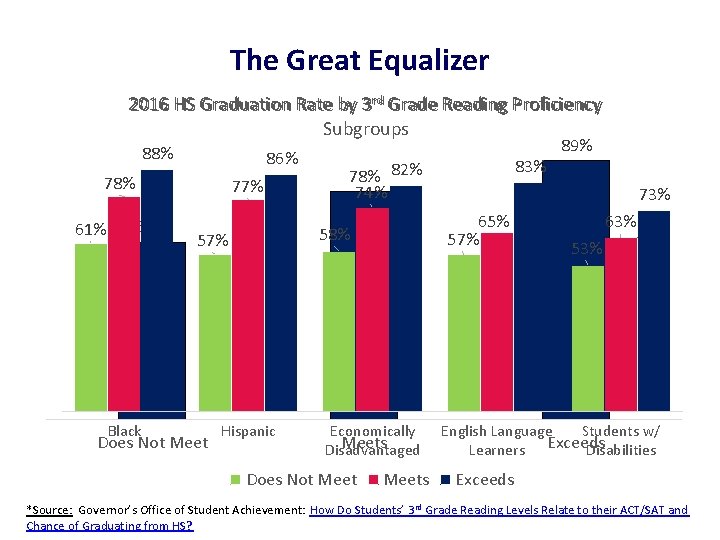
The Great Equalizer 2016 HS Graduation Rate by 3 rdrd Grade Reading Proficiency Subgroups 88% 86% 78% 61% 77% 61% Black Does Not Meet Hispanic Economically Meets Disadvantaged Does Not Meet 73% 65% 57% 58% 57% 83% 78% 82% 74% Meets 89% 63% 53% English Language Students w/ Exceeds Learners Disabilities Exceeds *Source: Governor’s Office of Student Achievement: How Do Students’ 3 rd Grade Reading Levels Relate to their ACT/SAT and Chance of Graduating from HS?
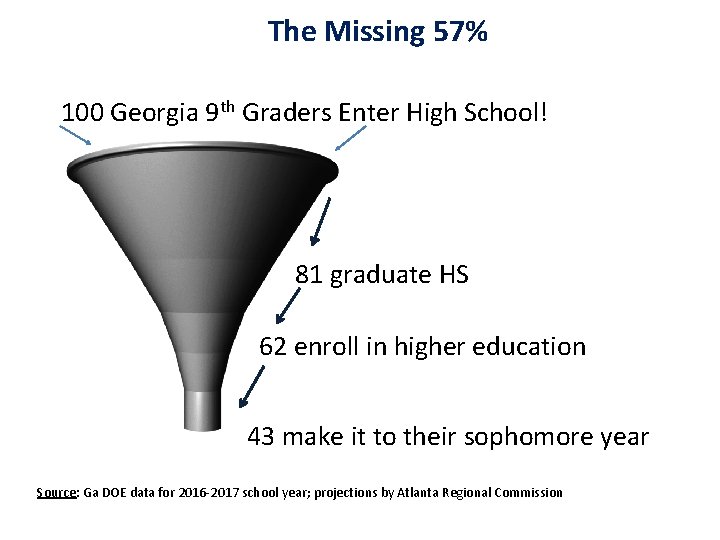
The Missing 57% 100 Georgia 9 th Graders Enter High School! 81 graduate HS 62 enroll in higher education 43 make it to their sophomore year Source: Ga DOE data for 2016 -2017 school year; projections by Atlanta Regional Commission
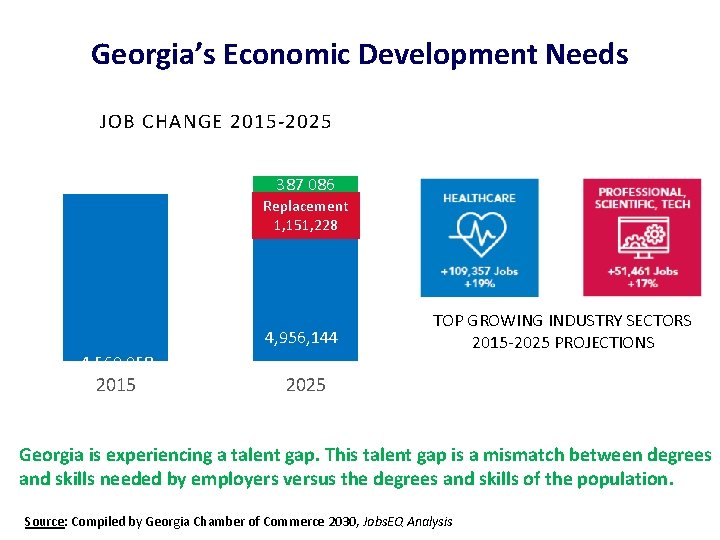
Georgia’s Economic Development Needs JOB CHANGE 2015 -2025 387 086 Replacement 1, 151, 228 4, 956, 144 4 569 058 2015 TOP GROWING INDUSTRY SECTORS 2015 -2025 PROJECTIONS 2025 Georgia is experiencing a talent gap. This talent gap is a mismatch between degrees and skills needed by employers versus the degrees and skills of the population. Source: Compiled by Georgia Chamber of Commerce 2030, Jobs. EQ Analysis
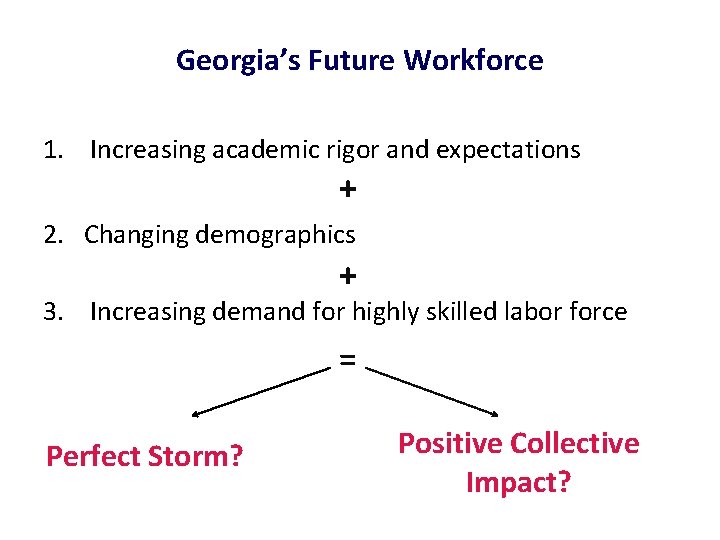
Georgia’s Future Workforce 1. Increasing academic rigor and expectations + 2. Changing demographics + 3. Increasing demand for highly skilled labor force = Perfect Storm? Positive Collective Impact?
What Can We Do?
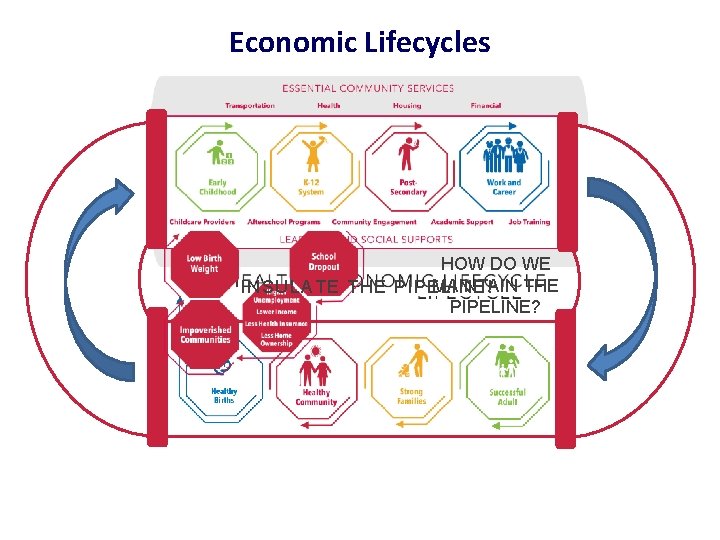
Economic Lifecycles HOW DO WE MAINTAIN THE INSULATE THE PIPELINE! PIPELINE?
Profile of Child Wellbeing and Academic Achievement 25% Cherokee Clayton Cobb Dekalb Douglas Fayette Fulton Gwinnett Henry Rockdale 20% 15% 10% 5% 0% 2014 2015 2016 2017 Source: Georgia Kids Count, Georgia Family Connection Partnership, http: //www. gafcp. org 2018
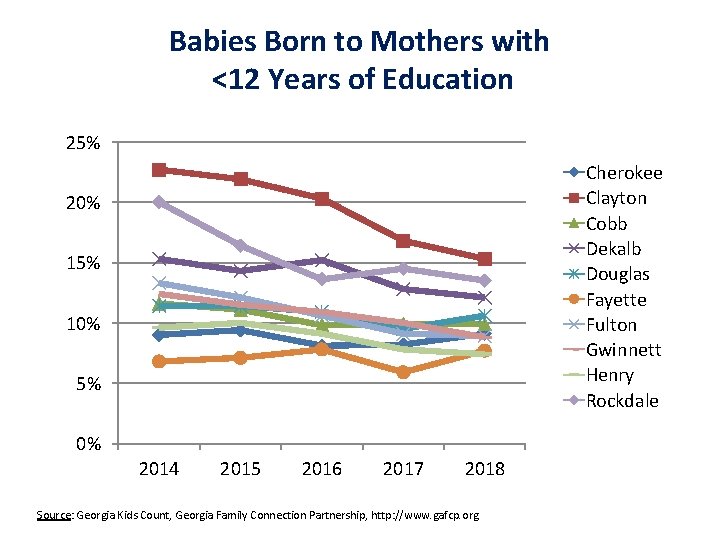
Babies Born to Mothers with <12 Years of Education 25% Cherokee Clayton Cobb Dekalb Douglas Fayette Fulton Gwinnett Henry Rockdale 20% 15% 10% 5% 0% 2014 2015 2016 2017 2018 Source: Georgia Kids Count, Georgia Family Connection Partnership, http: //www. gafcp. org
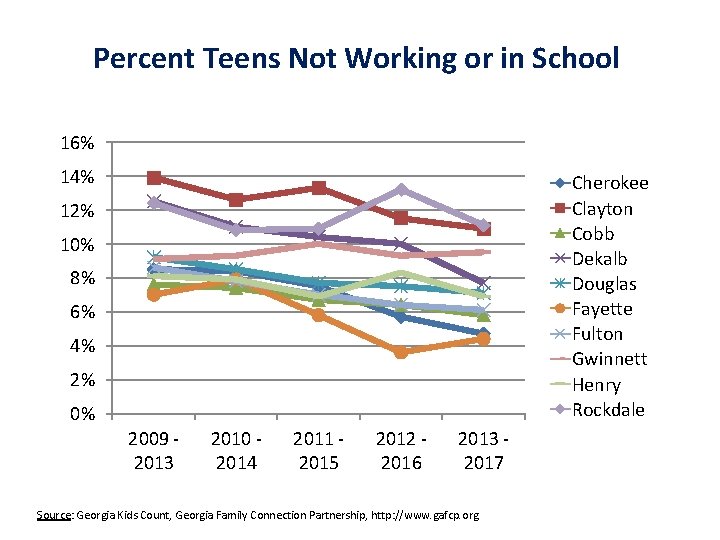
Percent Teens Not Working or in School 16% 14% Cherokee Clayton Cobb Dekalb Douglas Fayette Fulton Gwinnett Henry Rockdale 12% 10% 8% 6% 4% 2% 0% 2009 2013 2010 2014 2011 2015 2012 2016 2013 2017 Source: Georgia Kids Count, Georgia Family Connection Partnership, http: //www. gafcp. org
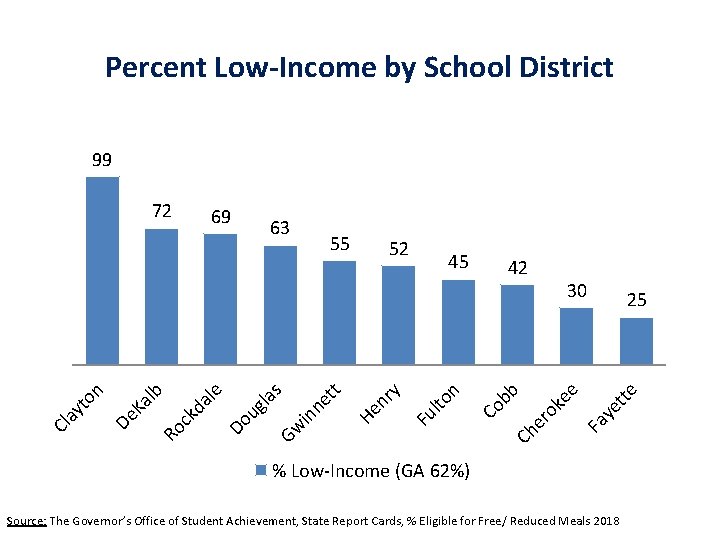
Percent Low-Income by School District 99 42 Ch ye tte 25 Fa ok ee 30 er bb n lto ry 45 Fu in Gw 52 Co 55 ne tt s gla Do u le da ck Ro 63 He n 69 b al De K Cl ay to n 72 % Low-Income (GA 62%) Source: The Governor’s Office of Student Achievement, State Report Cards, % Eligible for Free/ Reduced Meals 2018
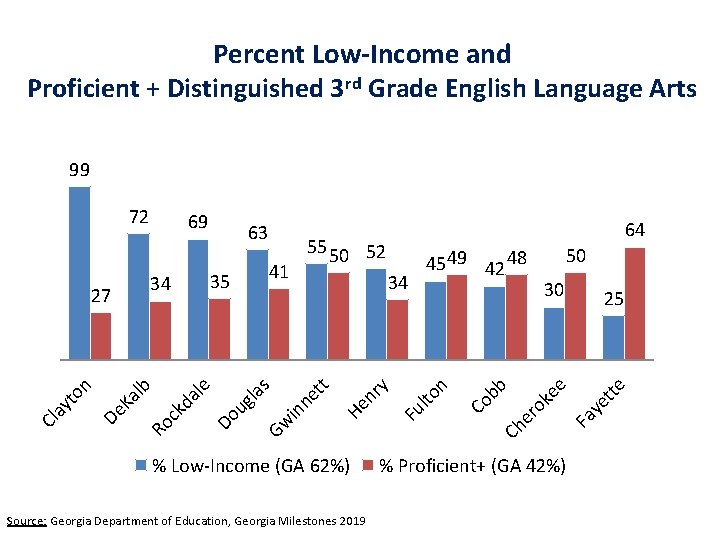
Percent Low-Income and Proficient + Distinguished 3 rd Grade English Language Arts 99 Source: Georgia Department of Education, Georgia Milestones 2019 tte Fa Ch 25 ye ok ee 30 er bb Co n lto Fu ry % Low-Income (GA 62%) 50 45 49 42 48 34 He n in la s ug 64 55 50 52 ne tt 41 Do Ro ck da le b al De K to n ay 63 35 34 27 Cl 69 Gw 72 % Proficient+ (GA 42%)
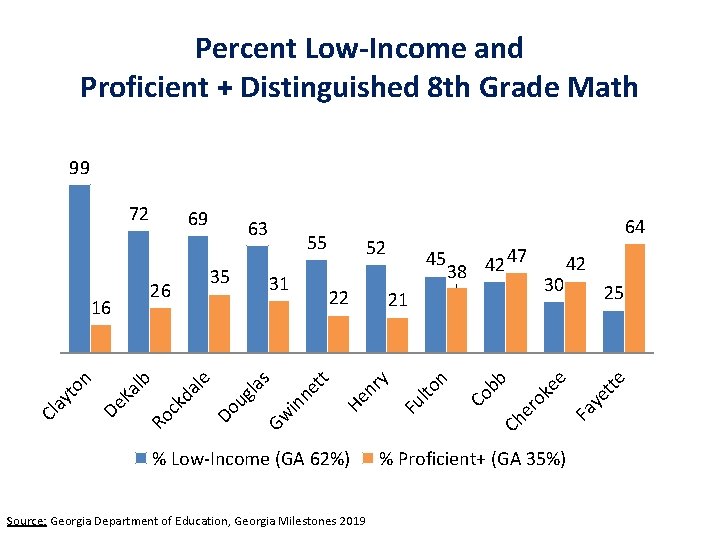
Percent Low-Income and Proficient + Distinguished 8 th Grade Math 99 30 % Low-Income (GA 62%) Source: Georgia Department of Education, Georgia Milestones 2019 ee 42 ok Ch er bb Co n lto Fu ry 21 Gw in 47 42 38 25 tte 22 45 ye 52 He n s gla 64 Fa 55 31 Do u Ro ck da le b al De K to n ay 63 35 26 16 Cl 69 ne tt 72 % Proficient+ (GA 35%)
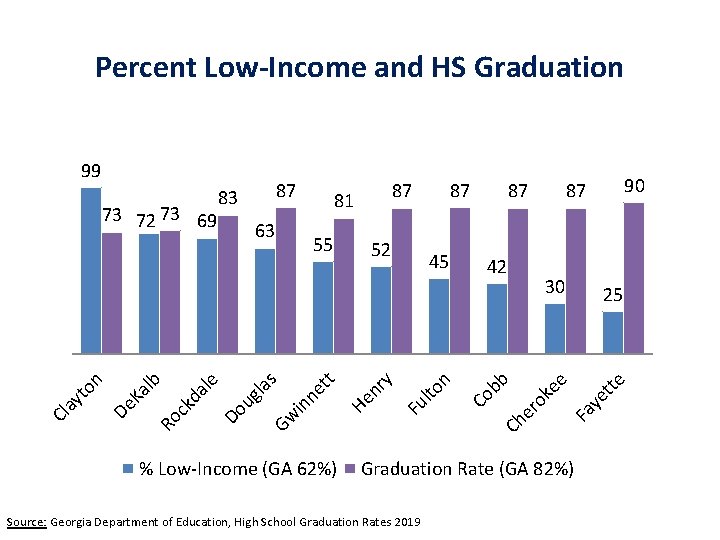
Percent Low-Income and HS Graduation % Low-Income (GA 62%) 42 tte Fa Ch 25 ye ok ee 30 Graduation Rate (GA 82%) Source: Georgia Department of Education, High School Graduation Rates 2019 90 87 er lto n 45 bb 52 Fu in ne tt 55 87 Co 81 Gw ug la s 63 87 87 ry 83 Do Ro ck da le b al De K Cl ay to n 73 72 73 69 87 He n 99
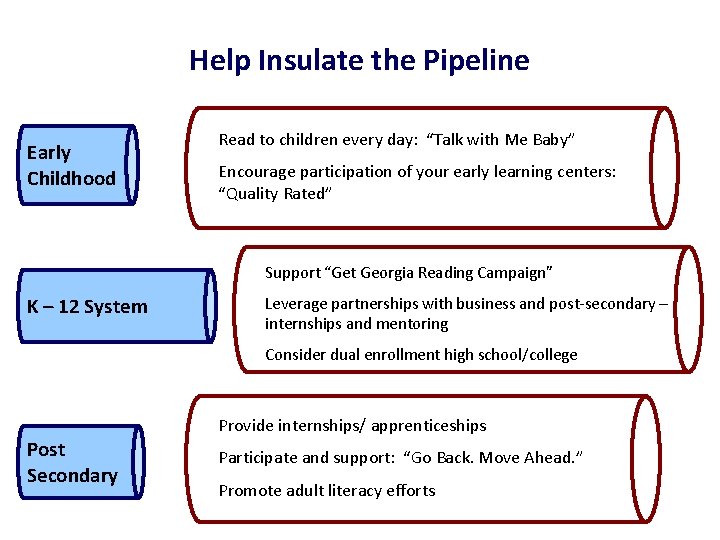
Help Insulate the Pipeline Early Childhood Read to children every day: “Talk with Me Baby” Encourage participation of your early learning centers: “Quality Rated” Support “Get Georgia Reading Campaign” K – 12 System Leverage partnerships with business and post-secondary – internships and mentoring Consider dual enrollment high school/college Provide internships/ apprenticeships Post Secondary Participate and support: “Go Back. Move Ahead. ” Promote adult literacy efforts
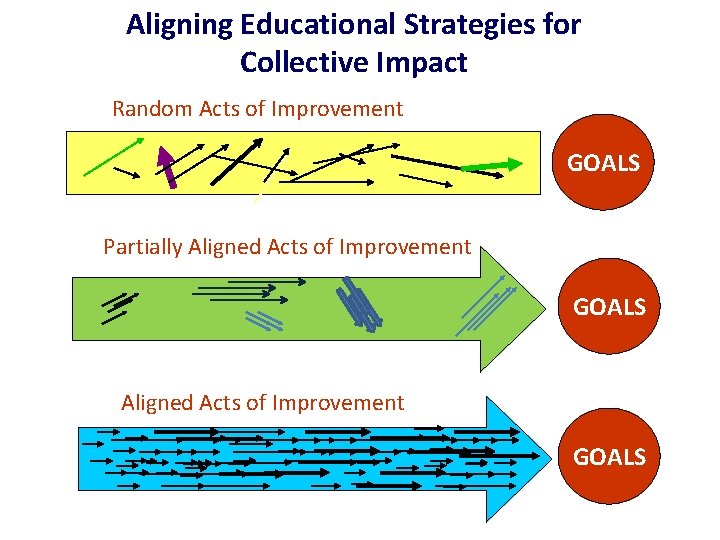
Aligning Educational Strategies for Collective Impact Random Acts of Improvement GOALS Partially Aligned Acts of Improvement GOALS
Connect with us Twitter: @GAPartnership Facebook: Georgia Partnership for Excellence in Education Instagram: @GAPARTNERSHIP PROGRAM SPONSOR: Linked. In: Georgia Partnership for Excellence in Education Website: www. gpee. org
- Slides: 39