
Spline Bezier BSpline Spline Drafting terminology Spline is
(Spline, Bezier, B-Spline)

Spline • Drafting terminology – Spline is a flexible strip that is easily flexed to pass through a series of design points (control points) to produce a smooth curve. • Spline curve – a piecewise polynomial (cubic) curve whose first and second derivatives are continuous across the various curve sections.
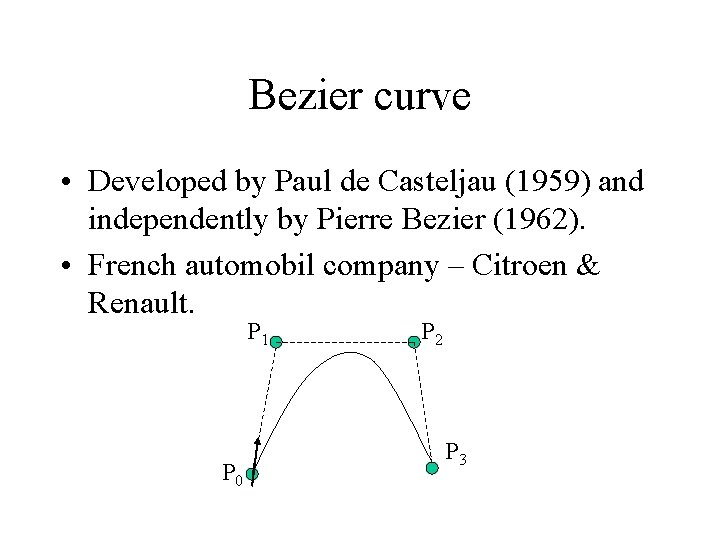
Bezier curve • Developed by Paul de Casteljau (1959) and independently by Pierre Bezier (1962). • French automobil company – Citroen & Renault. P 1 P 0 P 2 P 3

Parametric function n • P(u) = Bn, i(u)pi i=0 Where Bn, i(u) =. n!. ui(1 -u)n-i i!(n-i)! 0<= u<= 1 For 3 control points, n = 2 P(u) = (1 -u)2 p 0 + 2 u(1 -u) p 1+ u 2 p 2 For four control points, n = 3 P(u) = (1 -u)3 p 0 + 3 u(1 -u) 2 p 1 + 3 u 2 (1 -u)p 2 + u 3 p 3

algorithm • De Casteljau A – Basic concept C B • To choose a point C in line segment AB such that C divides the line segment AB in a ratio of u: 1 -u P 1 20 00 10 P 0 11 01 21 P 2 Let u = 0. 5 u=0. 25 u=0. 75

properties • The curve passes through the first, P 0 and last vertex points, Pn. • The tangent vector at the starting point P 0 must be given by P 1 – P 0 and the tangent Pn given by Pn – Pn-1 • This requirement is generalized for higher derivatives at the curve’s end points. E. g 2 nd derivative at P 0 can be determined by P 0 , P 1 , P 2 (to satisfy continuity) • The same curve is generated when the order of the control points is reversed

Properties (continued) • Convex hull – Convex polygon formed by connecting the control points of the curve. – Curve resides completely inside its convex hull

B-Spline • Motivation (recall bezier curve) – The degree of a Bezier Curve is determined by the number of control points – E. g. (bezier curve degree 11) – difficult to bend the "neck" toward the line segment P 4 P 5. – Of course, we can add more control points. – BUT this will increase the degree of the curve increase computational burden

B-Spline • Motivation (recall bezier curve) – Joint many bezier curves of lower degree together (right figure) – BUT maintaining continuity in the derivatives of the desired order at the connection point is not easy or may be tedious and undesirable.
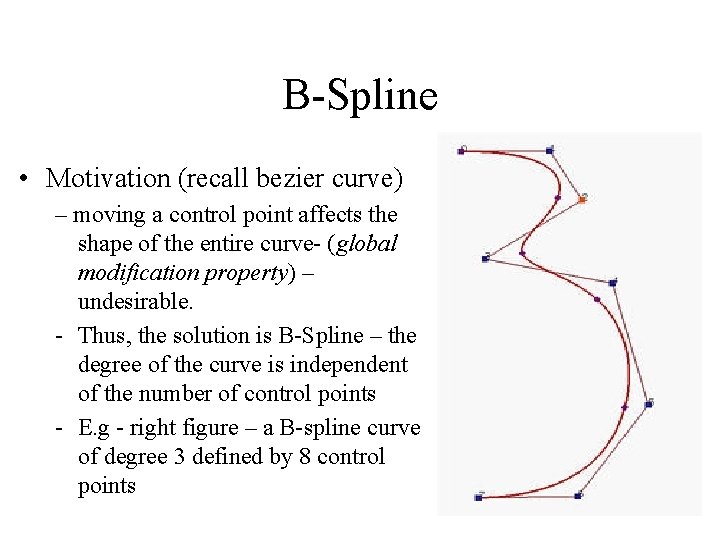
B-Spline • Motivation (recall bezier curve) – moving a control point affects the shape of the entire curve- (global modification property) – undesirable. - Thus, the solution is B-Spline – the degree of the curve is independent of the number of control points - E. g - right figure – a B-spline curve of degree 3 defined by 8 control points

B-Spline • In fact, there are five Bézier curve segments of degree 3 joining together to form the B-spline curve defined by the control points • little dots subdivide the B-spline curve into Bézier curve segments. • Subdividing the curve directly is difficult to do so, subdivide the domain of the curve by points called knots 0 u 1

B-Spline • In summary, to design a B-spline curve, we need a set of control points, a set of knots and a degree of curve.

B-Spline curve n • P(u) = Ni, k(u)pi (u 0 < um). . (1. 0) i=0 Where basis function = Ni, k(u) Degree of curve k-1 Control points, pi 0 < i < n Knot, u u 0 < um m=n+k

B-Spline : definition P(u) = Ni, k(u)pi (u 0 < um) ui knot [ui, ui+1) knot span (u 0, u 1, u 2, …. um ) knot vector The point on the curve that corresponds to a knot ui, knot point , P(ui) • If knots are equally space uniform (e. g, 0, 0. 2, 0. 4, 0. 6…) • Otherwise non uniform (e. g: 0, 0. 1, 0. 3, 0. 4, 0. 8 …) • • •

B-Spline : definition • Uniform knot vector – Individual knot value is evenly spaced – (0, 1, 2, 3, 4) – Then, normalized to the range [0, 1] – (0, 0. 25, 0. 75, 1. 0)

Type of B-Spline uniform knot vector Non-periodic knots (open knots) -First and last knots are duplicated k times. -E. g (0, 0, 0, 1, 2, 2, 2) -Curve pass through the first and last control points Periodic knots (non-open knots) -First and last knots are not duplicated – same contribution. -E. g (0, 1, 2, 3) -Curve doesn’t pass through end points. - used to generate closed curves (when first = last control points)

Type of B-Spline knot vector Non-periodic knots (open knots) Periodic knots (non-open knots) (Closed knots)

Non-periodic (open) uniform B-Spline • The knot spacing is evenly spaced except at the ends where knot values are repeated k times. n • E. g P(u) = Ni, k(u)pi (u 0 < um) i=0 • Degree = k-1, number of control points = n + 1 • Number of knots = m + 1 @ n+ k + 1 for degree = 1 and number of control points = 4 (k = 2, n = 3) Number of knots = n + k + 1 = 6 non periodic uniform knot vector (0, 0, 1, 2, 3, 3) * Knot value between 0 and 3 are equally spaced uniform

Non-periodic (open) uniform B-Spline • • • Example For curve degree = 3, number of control points = 5 k = 4, n = 4 number of knots = n+k+1 = 9 non periodic knots vector = (0, 0, 1, 2, 2, 2) For curve degree = 1, number of control points = 5 k = 2, n = 4 number of knots = n + k + 1 = 7 non periodic uniform knots vector = (0, 0, 1, 2, 3, 4, 4)

Non-periodic (open) uniform B-Spline • For any value of parameters k and n, non periodic knots are determined from ui = e. g 0 i–k+1 n–k+2 0 i < k k i n n < i n+k k=2, n = 3 ui = 0 i– 2+1 3– 2+2 u = (0, 0, 1, 2, 3, 3) 0 i < 2 2 i 3 3 < i 5 (1. 3)
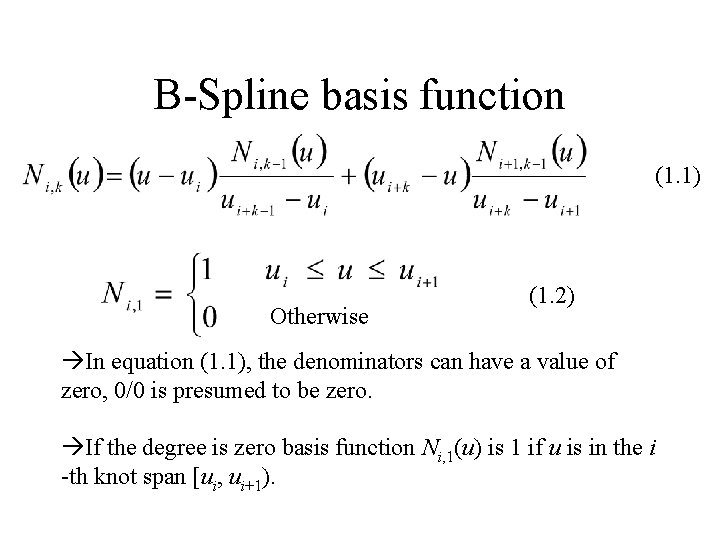
B-Spline basis function (1. 1) Otherwise (1. 2) In equation (1. 1), the denominators can have a value of zero, 0/0 is presumed to be zero. If the degree is zero basis function Ni, 1(u) is 1 if u is in the i -th knot span [ui, ui+1).
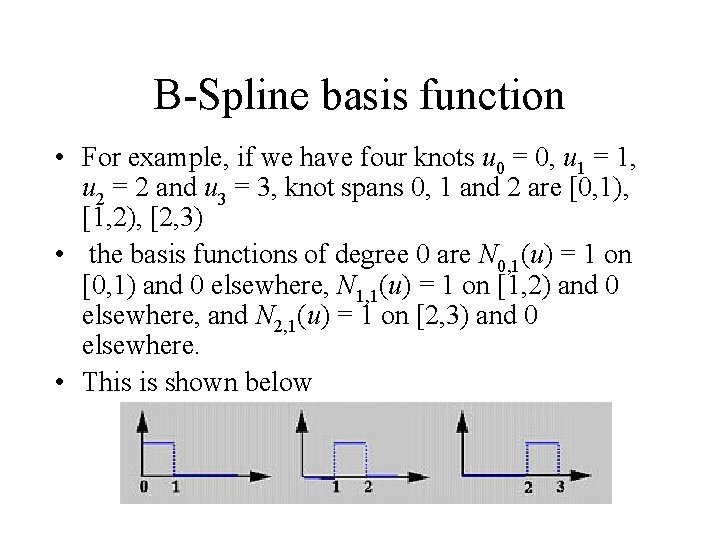
B-Spline basis function • For example, if we have four knots u 0 = 0, u 1 = 1, u 2 = 2 and u 3 = 3, knot spans 0, 1 and 2 are [0, 1), [1, 2), [2, 3) • the basis functions of degree 0 are N 0, 1(u) = 1 on [0, 1) and 0 elsewhere, N 1, 1(u) = 1 on [1, 2) and 0 elsewhere, and N 2, 1(u) = 1 on [2, 3) and 0 elsewhere. • This is shown below

B-Spline basis function • To understand the way of computing Ni, p(u) for p greater than 0, we use the triangular computation scheme
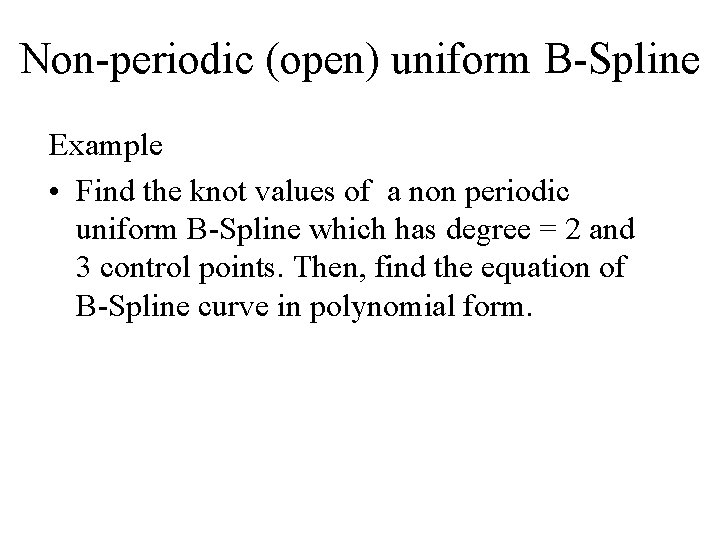
Non-periodic (open) uniform B-Spline Example • Find the knot values of a non periodic uniform B-Spline which has degree = 2 and 3 control points. Then, find the equation of B-Spline curve in polynomial form.
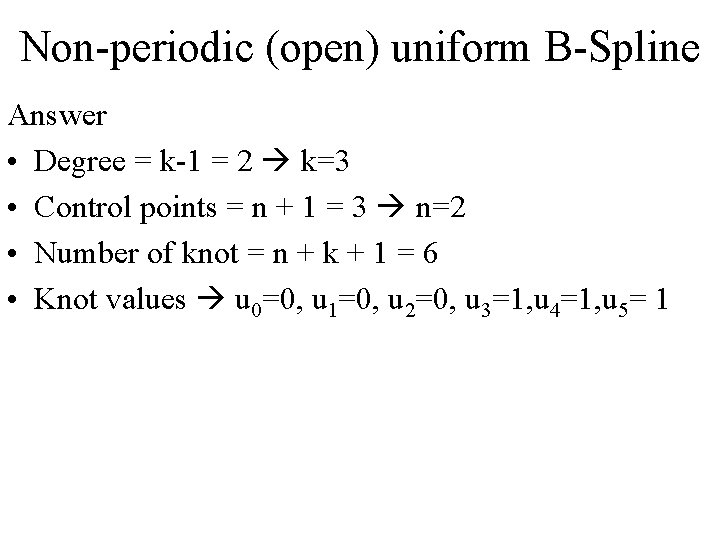
Non-periodic (open) uniform B-Spline Answer • Degree = k-1 = 2 k=3 • Control points = n + 1 = 3 n=2 • Number of knot = n + k + 1 = 6 • Knot values u 0=0, u 1=0, u 2=0, u 3=1, u 4=1, u 5= 1

Non-periodic (open) uniform B-Spline Answer(cont) • To obtain the polynomial equation, P(u) = Ni, k(u)pi • = Ni, 3(u)pi • = N 0, 3(u)p 0 + N 1, 3(u)p 1 + N 2, 3(u)p 2 n i=0 2 i=0 • firstly, find the Ni, k(u) using the knot value that shown above, start from k =1 to k=3
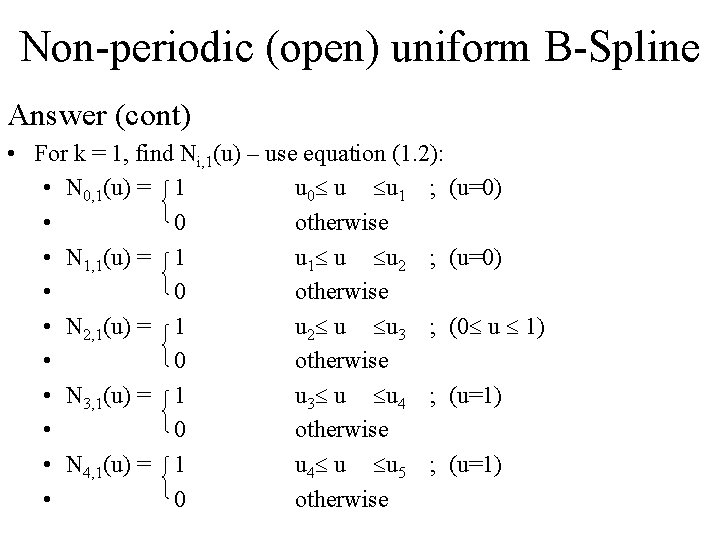
Non-periodic (open) uniform B-Spline Answer (cont) • For k = 1, find Ni, 1(u) – use equation (1. 2): • N 0, 1(u) = 1 u 0 u u 1 ; (u=0) • 0 otherwise • N 1, 1(u) = 1 u u 2 ; (u=0) • 0 otherwise • N 2, 1(u) = 1 u 2 u u 3 ; (0 u 1) • 0 otherwise • N 3, 1(u) = 1 u 3 u u 4 ; (u=1) • 0 otherwise • N 4, 1(u) = 1 u 4 u u 5 ; (u=1) • 0 otherwise

Non-periodic (open) uniform B-Spline Answer (cont) • For k = 2, find Ni, 2(u) – use equation (1. 1): • N 0, 2(u) = • • • N 1, 2(u) = • • u - u 0 N 0, 1 + u 2 – u N 1, 1 (u 0 =u 1 =u 2 = 0) u 1 - u 0 u 2 – u 1 u – 0 N 0, 1 + 0 – u N 1, 1 = 0 0– 0 u - u 1 N 1, 1 + u 3 – u N 2, 1 (u 1 =u 2 = 0, u 3 = 1) u 2 - u 1 u 3 – u 2 u – 0 N 1, 1 + 1 – u N 2, 1 = 1 - u 0– 0 1– 0
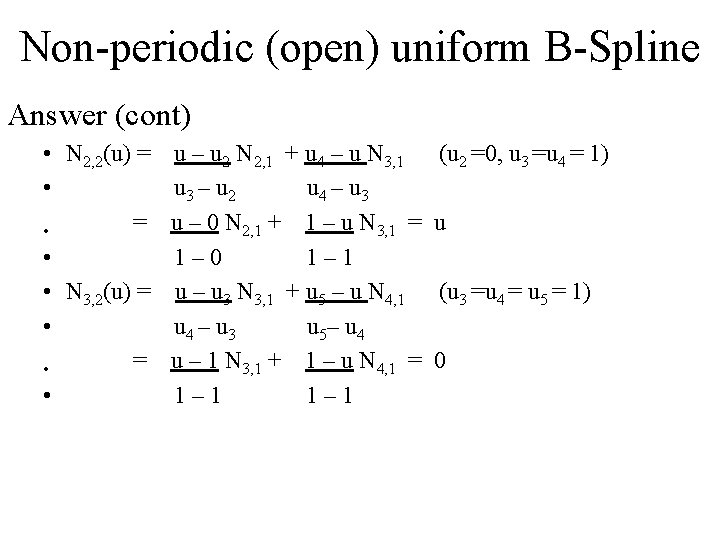
Non-periodic (open) uniform B-Spline Answer (cont) • N 2, 2(u) = • • • N 3, 2(u) = • • u – u 2 N 2, 1 + u 4 – u N 3, 1 u 3 – u 2 u 4 – u 3 u – 0 N 2, 1 + 1 – u N 3, 1 = 1– 0 1– 1 u – u 3 N 3, 1 + u 5 – u N 4, 1 u 4 – u 3 u 5– u 4 u – 1 N 3, 1 + 1 – u N 4, 1 = 1– 1 (u 2 =0, u 3 =u 4 = 1) u (u 3 =u 4 = u 5 = 1) 0
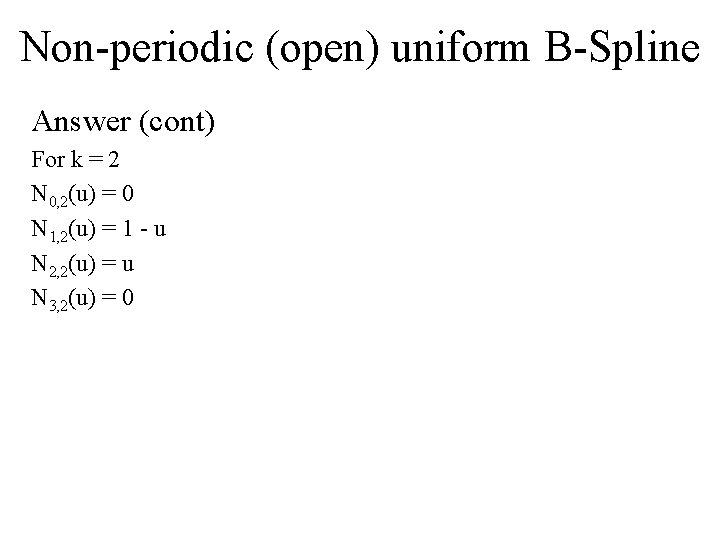
Non-periodic (open) uniform B-Spline Answer (cont) For k = 2 N 0, 2(u) = 0 N 1, 2(u) = 1 - u N 2, 2(u) = u N 3, 2(u) = 0
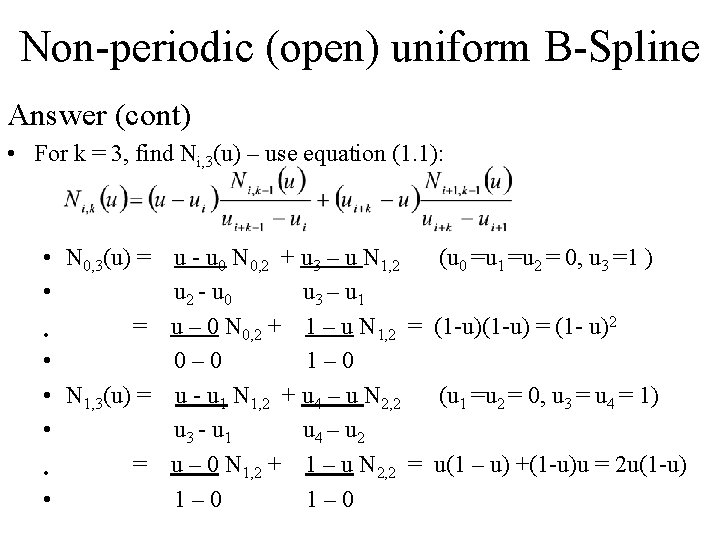
Non-periodic (open) uniform B-Spline Answer (cont) • For k = 3, find Ni, 3(u) – use equation (1. 1): • N 0, 3(u) = • • • N 1, 3(u) = • • u - u 0 N 0, 2 + u 3 – u N 1, 2 (u 0 =u 1 =u 2 = 0, u 3 =1 ) u 2 - u 0 u 3 – u 1 u – 0 N 0, 2 + 1 – u N 1, 2 = (1 -u) = (1 - u)2 0– 0 1– 0 u - u 1 N 1, 2 + u 4 – u N 2, 2 (u 1 =u 2 = 0, u 3 = u 4 = 1) u 3 - u 1 u 4 – u 2 u – 0 N 1, 2 + 1 – u N 2, 2 = u(1 – u) +(1 -u)u = 2 u(1 -u) 1– 0

Non-periodic (open) uniform B-Spline Answer (cont) • N 2, 3(u) = u – u 2 N 2, 2 + u 5 – u N 3, 2 (u 2 =0, u 3 =u 4 = u 5 =1) • u 4 – u 2 u 5 – u 3 2 = u – 0 N + 1 – u N = u 2, 2 3, 2 • • 1– 0 1– 1 N 0, 3(u) =(1 - u)2, N 1, 3(u) = 2 u(1 -u), N 2, 3(u) = u 2 n The polynomial equation, P(u) = Ni, k(u)pi • P(u) = N 0, 3(u)p 0 + N 1, 3(u)p 1 + N 2, 3(u)p 2 • i=0 = (1 - u)2 p 0 + 2 u(1 -u) p 1 + u 2 p 2 (0 <= u <= 1)
Non-periodic (open) uniform BSpline • Exercise • Find the polynomial equation for curve with degree = 1 and number of control points = 4

Non-periodic (open) uniform B-Spline • Answer • k = 2 , n = 3 number of knots = 6 • Knot vector = (0, 0, 1, 2, 3, 3) • For k = 1, find Ni, 1(u) – use equation (1. 2): • N 0, 1(u) = 1 u 0 u u 1 ; (u=0) • N 1, 1(u) = 1 u u 2 ; (0 u 1) N 2, 1(u) = 1 u 2 u u 3 ; (1 u 2) • N 3, 1(u) = 1 u 3 u u 4 ; (2 u 3) N 4, 1(u) = 1 u 4 u u 5 ; (u=3) •

Non-periodic (open) uniform B-Spline Answer (cont) • For k = 2, find Ni, 2(u) – use equation (1. 1): • N 0, 2(u) = • • • = u - u 0 N 0, 1 + u 2 – u N 1, 1 (u 0 =u 1 =0, u 2 = 1) u 1 - u 0 u 2 – u 1 u – 0 N 0, 1 + 1 – u N 1, 1 0– 0 1–u (0 u 1)
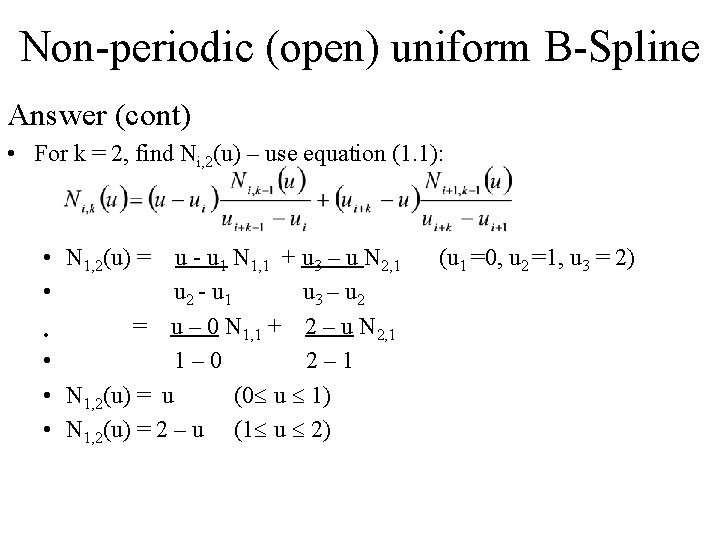
Non-periodic (open) uniform B-Spline Answer (cont) • For k = 2, find Ni, 2(u) – use equation (1. 1): • N 1, 2(u) = u - u 1 N 1, 1 + u 3 – u N 2, 1 • u 2 - u 1 u 3 – u 2 = u – 0 N 1, 1 + 2 – u N 2, 1 • • 1– 0 2– 1 • N 1, 2(u) = u (0 u 1) • N 1, 2(u) = 2 – u (1 u 2) (u 1 =0, u 2 =1, u 3 = 2)
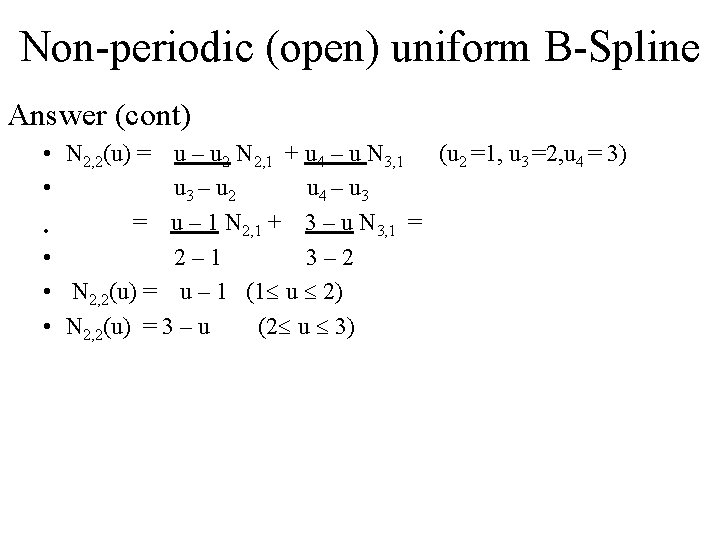
Non-periodic (open) uniform B-Spline Answer (cont) • N 2, 2(u) = u – u 2 N 2, 1 + u 4 – u N 3, 1 (u 2 =1, u 3 =2, u 4 = 3) • u 3 – u 2 u 4 – u 3 = u – 1 N 2, 1 + 3 – u N 3, 1 = • • 2– 1 3– 2 • N 2, 2(u) = u – 1 (1 u 2) • N 2, 2(u) = 3 – u (2 u 3)
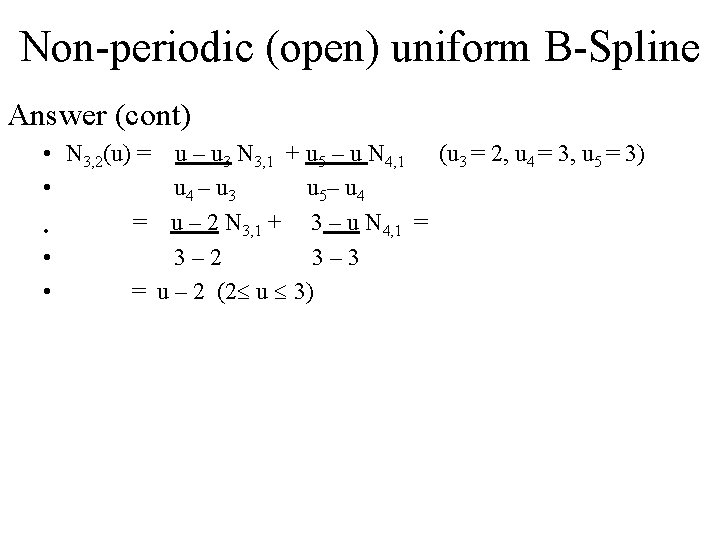
Non-periodic (open) uniform B-Spline Answer (cont) • N 3, 2(u) = u – u 3 N 3, 1 + u 5 – u N 4, 1 (u 3 = 2, u 4 = 3, u 5 = 3) • u 4 – u 3 u 5– u 4 = u – 2 N 3, 1 + 3 – u N 4, 1 = • • 3– 2 3– 3 • = u – 2 (2 u 3)

Non-periodic (open) uniform B-Spline Answer (cont) • The polynomial equation P(u) = Ni, k(u)pi • P(u) = N 0, 2(u)p 0 + N 1, 2(u)p 1 + N 2, 2(u)p 2 + N 3, 2(u)p 3 • P(u) = (1 – u) p 0 + u p 1 • P(u) = (2 – u) p 1 + (u – 1) p 2 • P(u) = (3 – u) p 2 + (u - 2) p 3 (0 u 1) (1 u 2) (2 u 3)

Periodic uniform knot • Periodic knots are determined from – Ui = i - k (0 i n+k) • Example – For curve with degree = 3 and number of control points = 4 (cubic B-spline) – (k = 4, n = 3) number of knots = 8 – (0, 1, 2, 3, 4, 5, 6, 8)
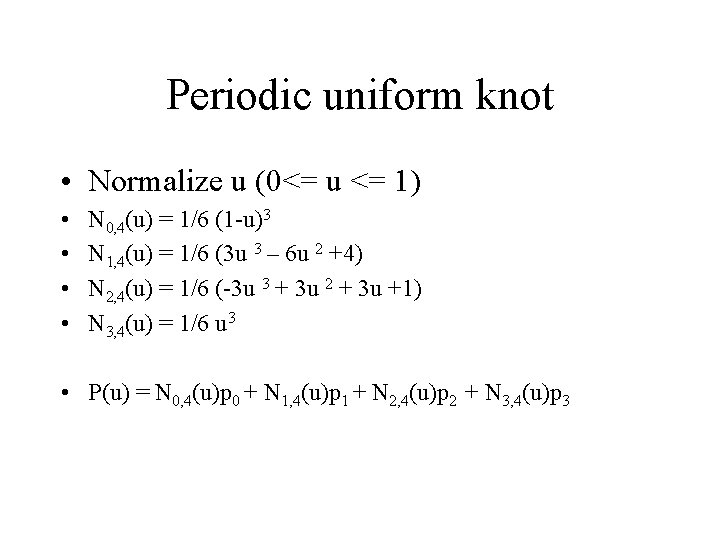
Periodic uniform knot • Normalize u (0<= u <= 1) • • N 0, 4(u) = 1/6 (1 -u)3 N 1, 4(u) = 1/6 (3 u 3 – 6 u 2 +4) N 2, 4(u) = 1/6 (-3 u 3 + 3 u 2 + 3 u +1) N 3, 4(u) = 1/6 u 3 • P(u) = N 0, 4(u)p 0 + N 1, 4(u)p 1 + N 2, 4(u)p 2 + N 3, 4(u)p 3
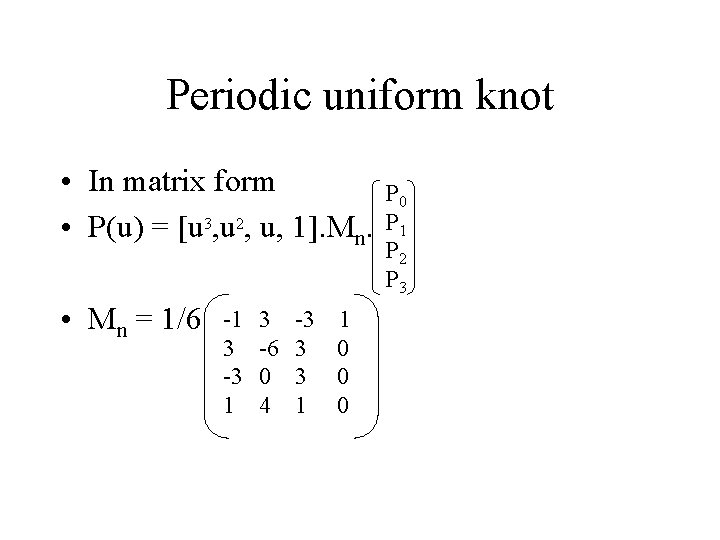
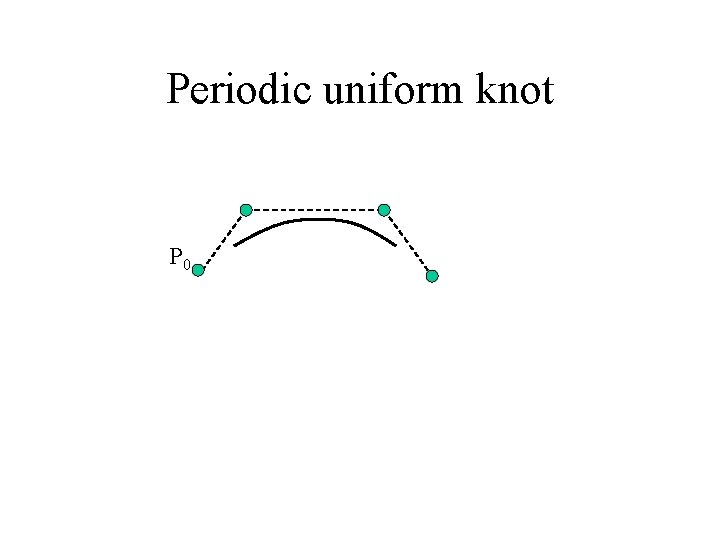
Periodic uniform knot • In matrix form • P(u) = [u 3, u 2, u, 1]. Mn. • Mn = 1/6 -1 3 -3 1 3 -6 0 4 -3 1 3 0 1 0 P 1 P 2 P 3
Periodic uniform knot P 0
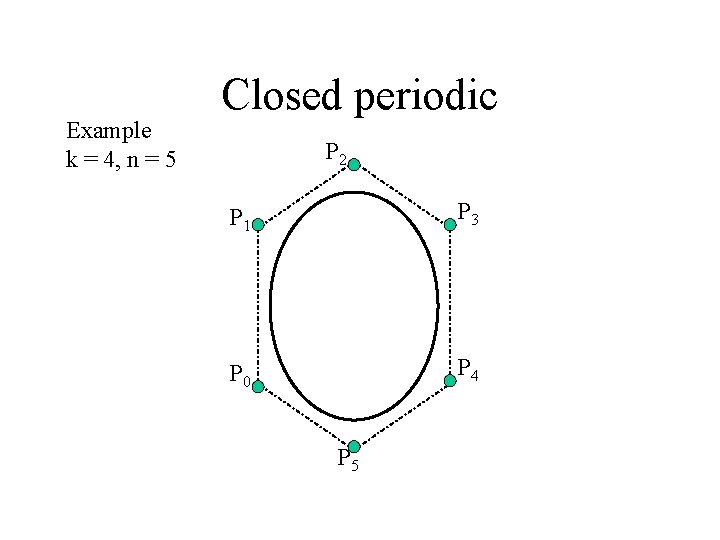
Example k = 4, n = 5 Closed periodic P 2 P 1 P 3 P 0 P 4 P 5
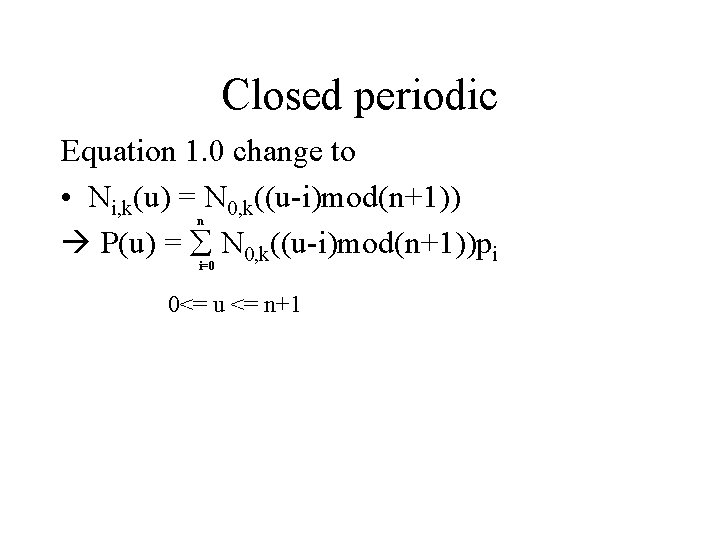
Closed periodic Equation 1. 0 change to • Ni, k(u) = N 0, k((u-i)mod(n+1)) P(u) = N 0, k((u-i)mod(n+1))pi n i=0 0<= u <= n+1
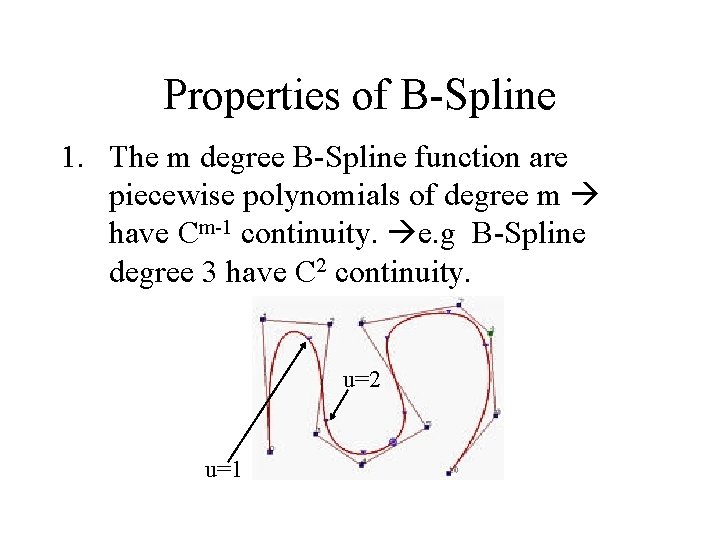
Properties of B-Spline 1. The m degree B-Spline function are piecewise polynomials of degree m have Cm-1 continuity. e. g B-Spline degree 3 have C 2 continuity. u=2 u=1
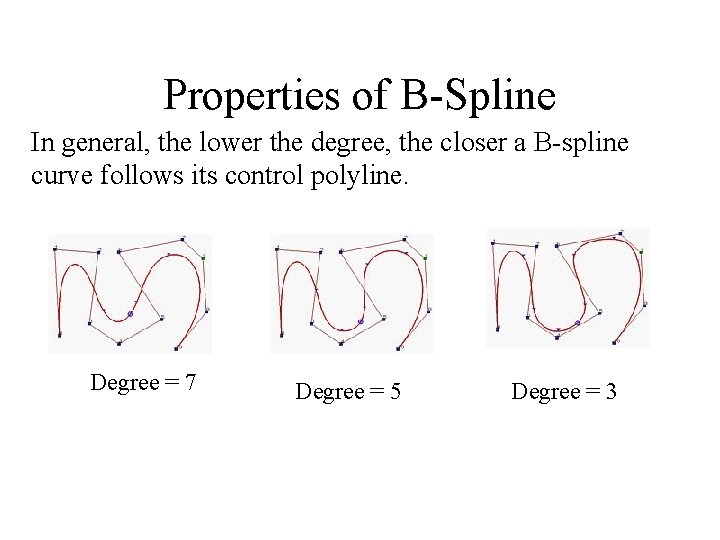
Properties of B-Spline In general, the lower the degree, the closer a B-spline curve follows its control polyline. Degree = 7 Degree = 5 Degree = 3
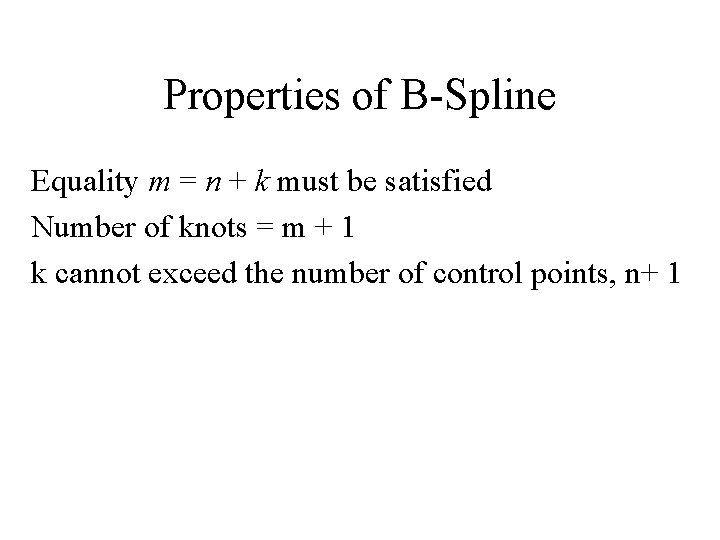
Properties of B-Spline Equality m = n + k must be satisfied Number of knots = m + 1 k cannot exceed the number of control points, n+ 1
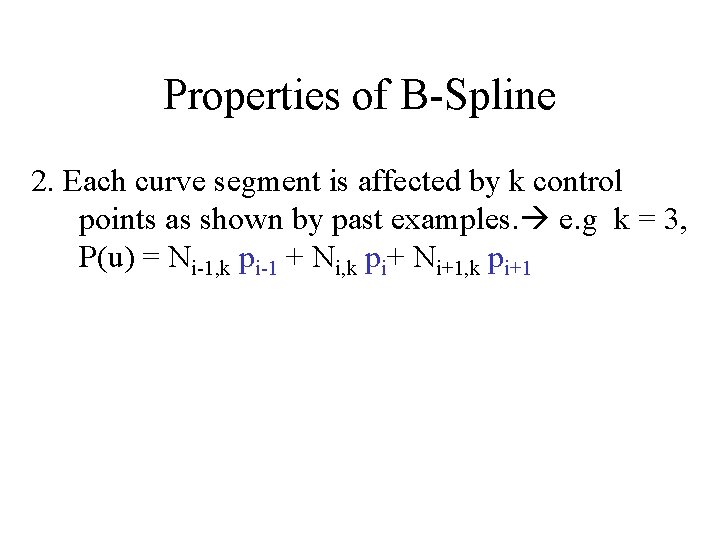
Properties of B-Spline 2. Each curve segment is affected by k control points as shown by past examples. e. g k = 3, P(u) = Ni-1, k pi-1 + Ni, k pi+ Ni+1, k pi+1
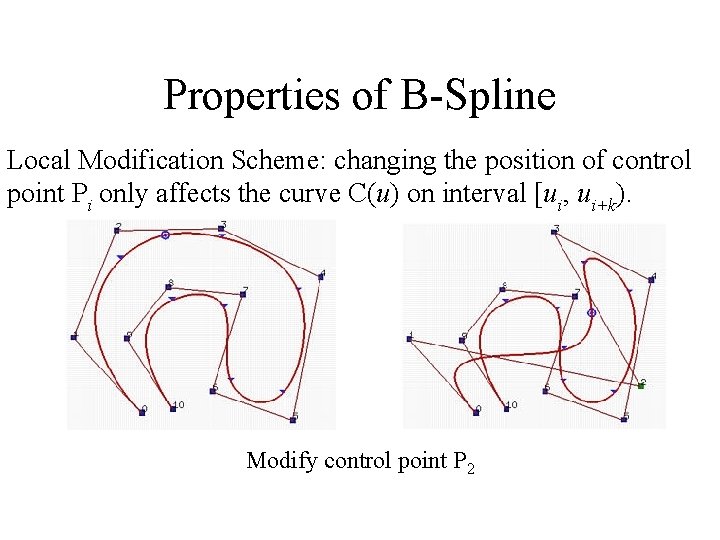
Properties of B-Spline Local Modification Scheme: changing the position of control point Pi only affects the curve C(u) on interval [ui, ui+k). Modify control point P 2

Properties of B-Spline 3. Strong Convex Hull Property: A B-spline curve is contained in the convex hull of its control polyline. More specifically, if u is in knot span [ui, ui+1), then C(u) is in the convex hull of control points Pi-p, Pi-p+1, . . . , Pi. Degree = 3, k = 4 Convex hull based on 4 control points
Properties of B-Spline 4. Non-periodic B-spline curve C(u) passes through the two end control points P 0 and Pn. 5. Each B-spline function Nk, m(t) is nonnegative for every t, and the family of such functions sums to unity, that is Ni, k (u) = 1 6. Affine Invariance to transform a B-Spline curve, we simply transform each control points. 7. Bézier Curves Are Special Cases of B-spline Curves n i=0
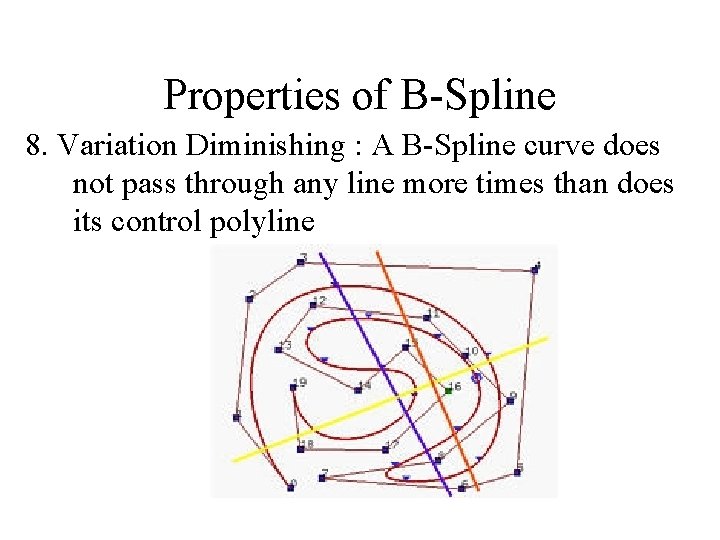
Properties of B-Spline 8. Variation Diminishing : A B-Spline curve does not pass through any line more times than does its control polyline
Knot Insertion : B-Spline • knot insertion is adding a new knot into the existing knot vector without changing the shape of the curve. • new knot may be equal to an existing knot the multiplicity of that knot is increased by one • Since, number of knots = k + n + 1 • If the number of knots is increased by 1 either degree or number of control points must also be increased by 1. • Maintain the curve shape maintain degree change the number of control points.
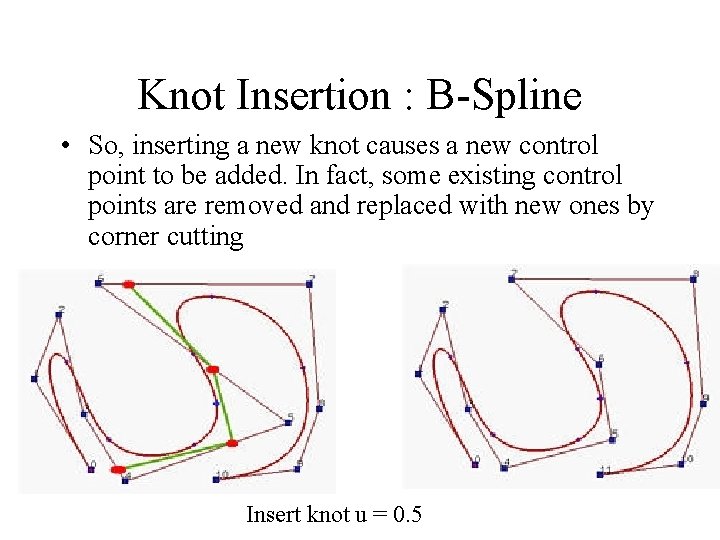
Knot Insertion : B-Spline • So, inserting a new knot causes a new control point to be added. In fact, some existing control points are removed and replaced with new ones by corner cutting Insert knot u = 0. 5
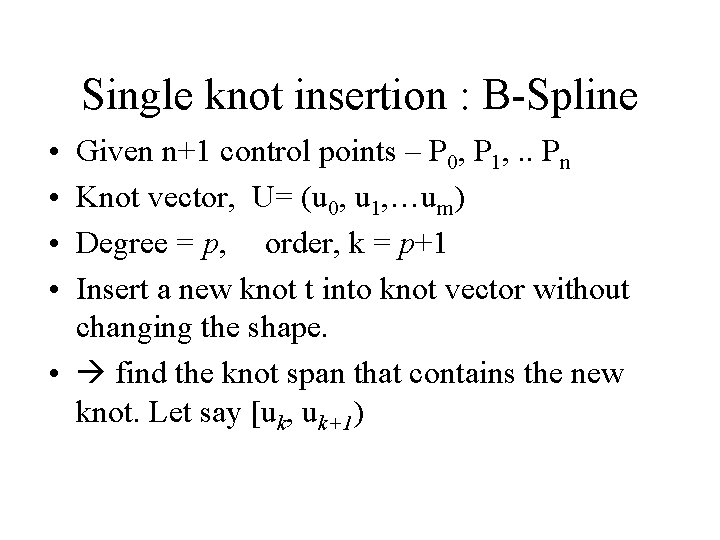
Single knot insertion : B-Spline • • Given n+1 control points – P 0, P 1, . . Pn Knot vector, U= (u 0, u 1, …um) Degree = p, order, k = p+1 Insert a new knot t into knot vector without changing the shape. • find the knot span that contains the new knot. Let say [uk, uk+1)
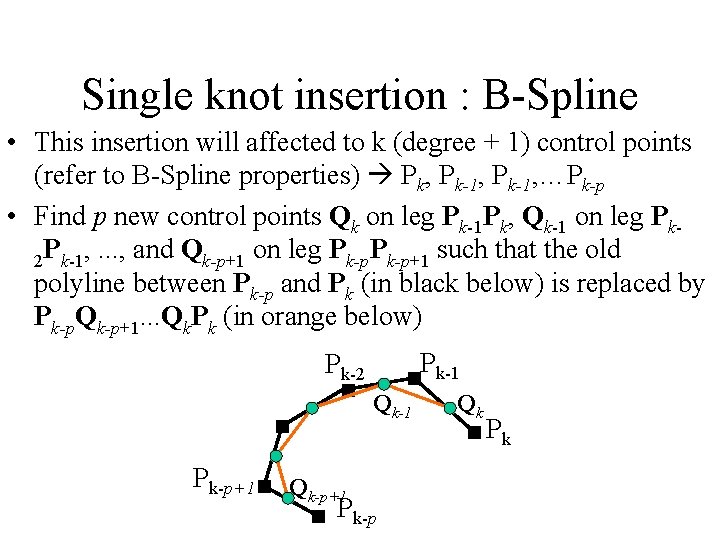
Single knot insertion : B-Spline • This insertion will affected to k (degree + 1) control points (refer to B-Spline properties) Pk, Pk-1, …Pk-p • Find p new control points Qk on leg Pk-1 Pk, Qk-1 on leg Pk 2 Pk-1, . . . , and Qk-p+1 on leg Pk-p+1 such that the old polyline between Pk-p and Pk (in black below) is replaced by Pk-p. Qk-p+1. . . Qk. Pk (in orange below) Pk-1 Pk-2 Qk-1 Pk-p+1 Qk-p+1 Pk-p Qk Pk
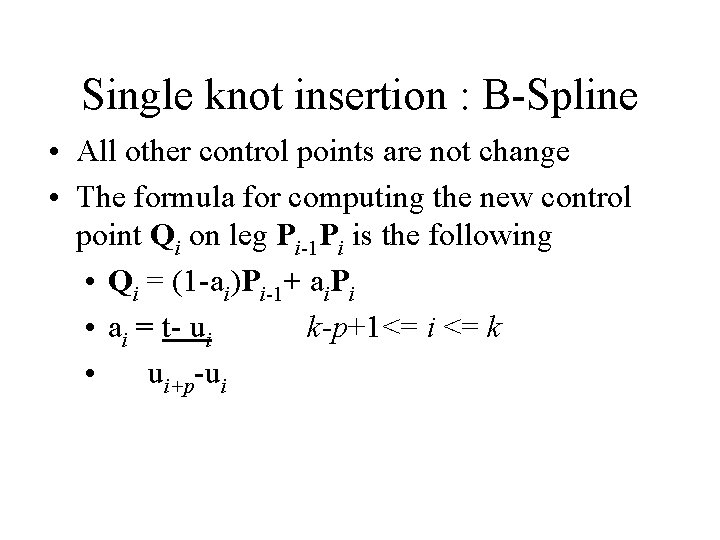
Single knot insertion : B-Spline • All other control points are not change • The formula for computing the new control point Qi on leg Pi-1 Pi is the following • Qi = (1 -ai)Pi-1+ ai. Pi • ai = t- ui k-p+1<= i <= k • ui+p-ui
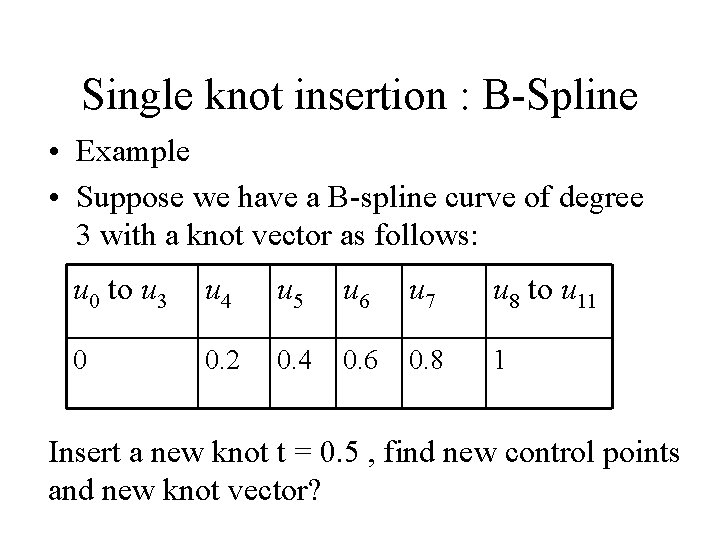
Single knot insertion : B-Spline • Example • Suppose we have a B-spline curve of degree 3 with a knot vector as follows: u 0 to u 3 u 4 u 5 u 6 u 7 u 8 to u 11 0 0. 2 0. 4 0. 6 0. 8 1 Insert a new knot t = 0. 5 , find new control points and new knot vector?
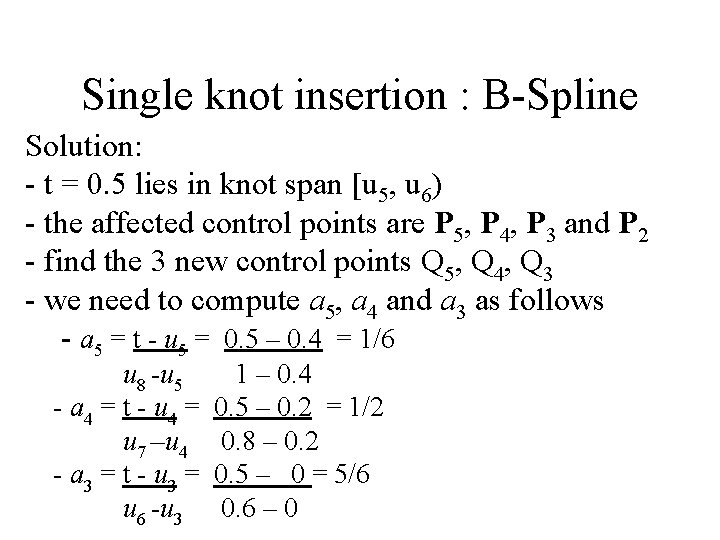
Single knot insertion : B-Spline Solution: - t = 0. 5 lies in knot span [u 5, u 6) - the affected control points are P 5, P 4, P 3 and P 2 - find the 3 new control points Q 5, Q 4, Q 3 - we need to compute a 5, a 4 and a 3 as follows - a 5 = t - u 5 = 0. 5 – 0. 4 = 1/6 u 8 -u 5 - a 4 = t - u 4 = u 7 –u 4 - a 3 = t - u 3 = u 6 -u 3 1 – 0. 4 0. 5 – 0. 2 = 1/2 0. 8 – 0. 2 0. 5 – 0 = 5/6 0. 6 – 0
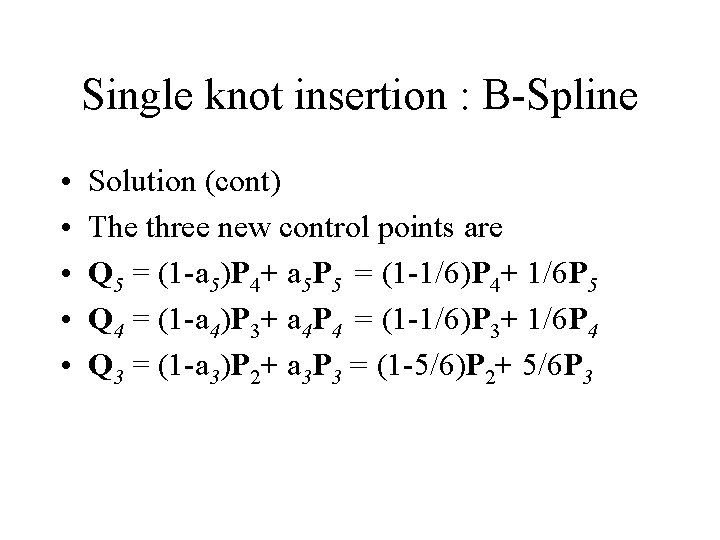
Single knot insertion : B-Spline • • • Solution (cont) The three new control points are Q 5 = (1 -a 5)P 4+ a 5 P 5 = (1 -1/6)P 4+ 1/6 P 5 Q 4 = (1 -a 4)P 3+ a 4 P 4 = (1 -1/6)P 3+ 1/6 P 4 Q 3 = (1 -a 3)P 2+ a 3 P 3 = (1 -5/6)P 2+ 5/6 P 3
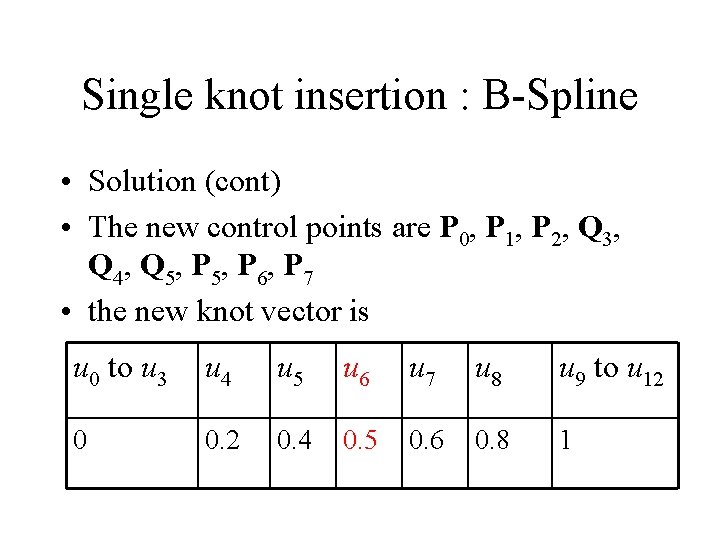
Single knot insertion : B-Spline • Solution (cont) • The new control points are P 0, P 1, P 2, Q 3, Q 4, Q 5, P 6, P 7 • the new knot vector is u 0 to u 3 u 4 u 5 u 6 u 7 u 8 u 9 to u 12 0 0. 2 0. 4 0. 5 0. 6 0. 8 1
- Slides: 62