
Spiroplasma DR SUDHA KUMARI Assistant Proffecer Department of

- Slides: 11
Spiroplasma DR. SUDHA KUMARI Assistant Proffecer Department of Veterinary Microbiology Bihar Veterinary College Unit –II VMC-602 13/11/2020
The bacteria are common in haematophagous arthropods: deerflies, horseflies, mosquitoes, and in ticks, where they may occur abundantly in salivary glands. The ability of spiroplasmas to propagate in rodents was experimentally proven, and Spiroplasma infections have been reported recently in humans. Some authors have purported an etiological role of Spiroplasma in causing transmissible spongiform encephalopathies (TSEs), but convincing proof is lacking.
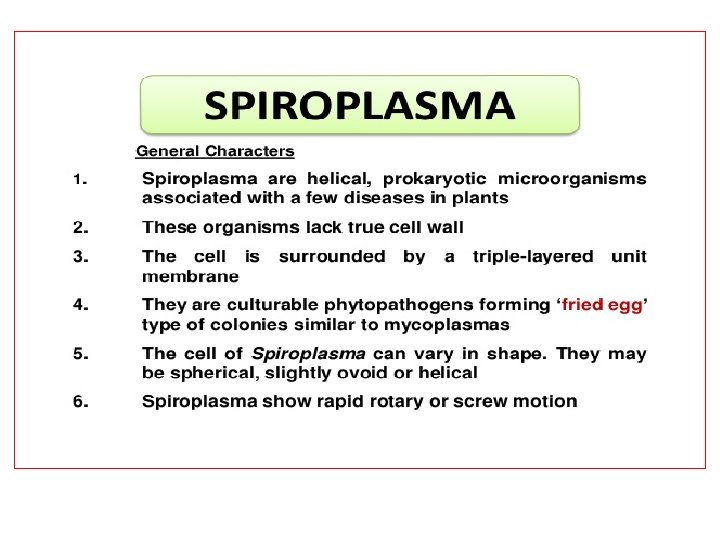
Spiroplasma is a genus of Mollicutes, a group of small bacteria without cell walls. Spiroplasma shares the simple metabolism, parasitic lifestyle, friedegg colony morphology and small genome of other Mollicutes, but has a distinctive helical morphology, unlike Mycoplasma. The name mollicutes – soft skin – reflects the major collective characteristic of these bacteria – the lack of a cell wall – which at the same time distinguishes them from all other bacteria with the exception of the chlamydiae. The lack of a cell wall is caused by the absence of genes encoding enzymes for peptidoglycan biosynthesis.
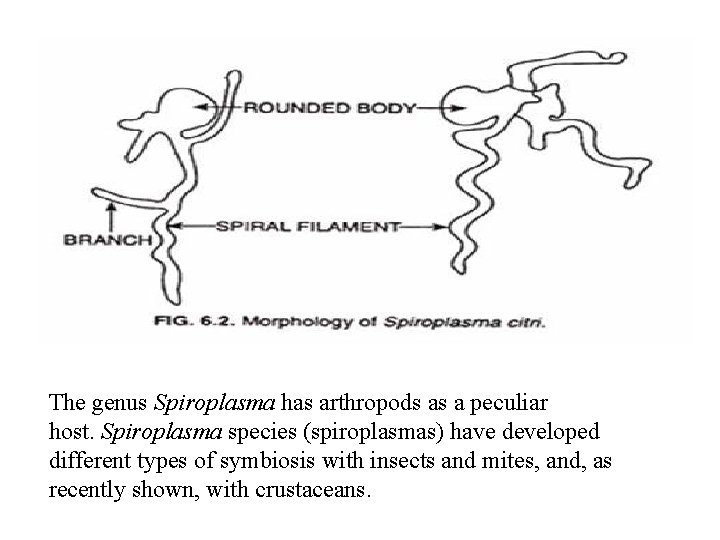
It has a spiral shape and moves in a corkscrew motion. Many Spiroplasma are found either in the gut or haemolymph of insects where they can act to manipulate host reproduction, or defend the host as endosymbionts. Spiroplasma are also disease-causing agents in the phloem of plants. Spiroplasmas are fastidious organisms, which require a rich culture medium. Typically they grow well at 30 °C, but not at 37 °C. A few species, notably Spiroplasma mirum, grow well at 37 °C (human body temperature), and cause cataracts and neurological damage in suckling mice.
The best studied species of spiroplasmas are Spiroplasma poulsonii, a reproductive manipulator and defensive insect symbiont, Spiroplasma citri, the causative agent of citrus stubborn disease, and Spiroplasma kunkelii, the causative agent of corn stunt disease. The lack of a cell wall is closely linked to another characteristic feature of the mollicutes – their cells are usually pleomorphic. Again, there is no rule without exception: the cells of the genus Spiroplasma have a helical shape.
Spiroplasma floricola Culture Spiroplasma floricola is grown at 34°C with the p. H kept constant at 7. 5 by automatic titration, in HEPES-buffered DSM 4 medium which contains, per 100 ml, 1. 5 g PPLO broth base (Difco, Detroit, MI), 8 g sucrose (Merck, Darmstadt, Germany), 2. 5 mg phenol red (Merck), 1. 32 g HEPES (Merck), 500 mg glucose, and 10 ml of inactivated (30 minutes, 56°C) horse serum [ICN (Flow) Costa Mesa, CA]. Shape and motility of the spiroplasmas are regularly monitored by dark-field microscopy (1250×). Spiroplasma species are mainly transmitted to plants by specific insect vectors; in order to achieve the transmission, they must cross the salivary gland barrier. S. citri and S. kunkelii invade the hemocoel through the gut epithelium of the insect host by a process of receptor-mediated cell endocytosis.
The genus Spiroplasma has arthropods as a peculiar host. Spiroplasma species (spiroplasmas) have developed different types of symbiosis with insects and mites, and, as recently shown, with crustaceans.