
Spirituality of Work 1 2 3 4 5
- Slides: 14
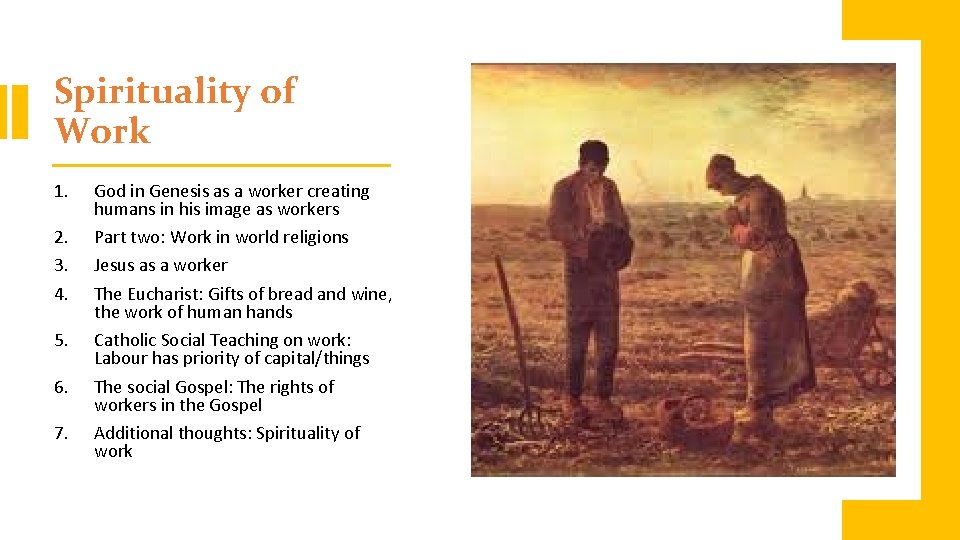
Spirituality of Work 1. 2. 3. 4. 5. 6. 7. God in Genesis as a worker creating humans in his image as workers Part two: Work in world religions Jesus as a worker The Eucharist: Gifts of bread and wine, the work of human hands Catholic Social Teaching on work: Labour has priority of capital/things The social Gospel: The rights of workers in the Gospel Additional thoughts: Spirituality of work
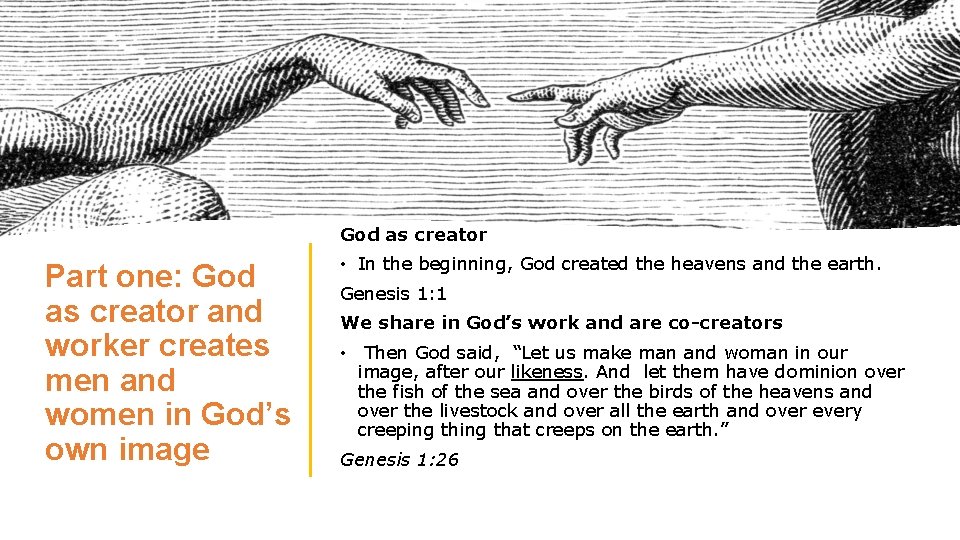
God as creator Part one: God as creator and worker creates men and women in God’s own image • In the beginning, God created the heavens and the earth. Genesis 1: 1 We share in God’s work and are co-creators • Then God said, “Let us make man and woman in our image, after our likeness. And let them have dominion over the fish of the sea and over the birds of the heavens and over the livestock and over all the earth and over every creeping that creeps on the earth. ” Genesis 1: 26
Part two: Work in world religions Islam …work is given special importance to the extent that it is considered as an act of worship in itself…. …Work is considered necessary to establish an equilibrium between one’s individuality and social life. The Qur’an instructs Muslims to persistently work whenever and wherever possible: “Disperse through the land seek of the Bounty of God” (62: 10). https: //musliminc. com/what-islam-teaches-about-hardwork-3943 Hinduism Krishna also tells Arjuna, “Whatever you do, make it an offering to me. ” In other words, do your work in a spirit of love and service. How can you apply this teaching at work? Kempton suggests, “before taking action ask yourself, ‘Who or what does this serve? ’” Whether you’re listening to your coworker, guiding your employees, working to improve human dignity, or doing something to help the planet, she says, “True service includes a sense that you serve the evolution of consciousness—that your work is at least incrementally helping to create a better world. ” http: //sydneycorporateyoga. com/finding-meaning-purpose-work-lessons-bhagavad-gita/ Buddhism We allow our consciousness to expand so everything we do becomes an opportunity to connect with the environment and the tasks as an extension of our self, where we ultimately become the work. https: //www. huffpost. com/entry/buddhist-work_b_9851542#: ~: text=With%20 the%20 Buddhist%20 approach%20 to, consider%20 the%20 most%20 efficient%20 methods
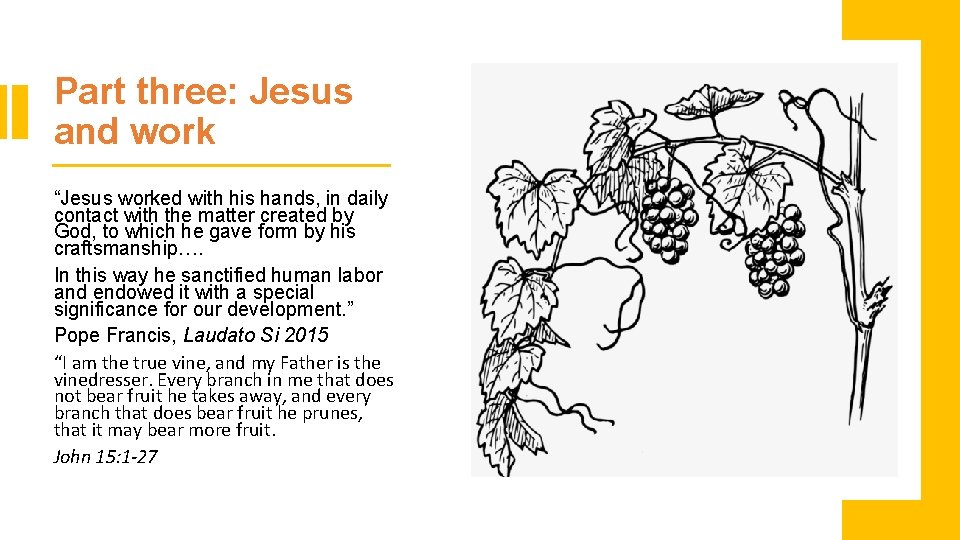
Part three: Jesus and work “Jesus worked with his hands, in daily contact with the matter created by God, to which he gave form by his craftsmanship…. In this way he sanctified human labor and endowed it with a special significance for our development. ” Pope Francis, Laudato Si 2015 “I am the true vine, and my Father is the vinedresser. Every branch in me that does not bear fruit he takes away, and every branch that does bear fruit he prunes, that it may bear more fruit. John 15: 1 -27
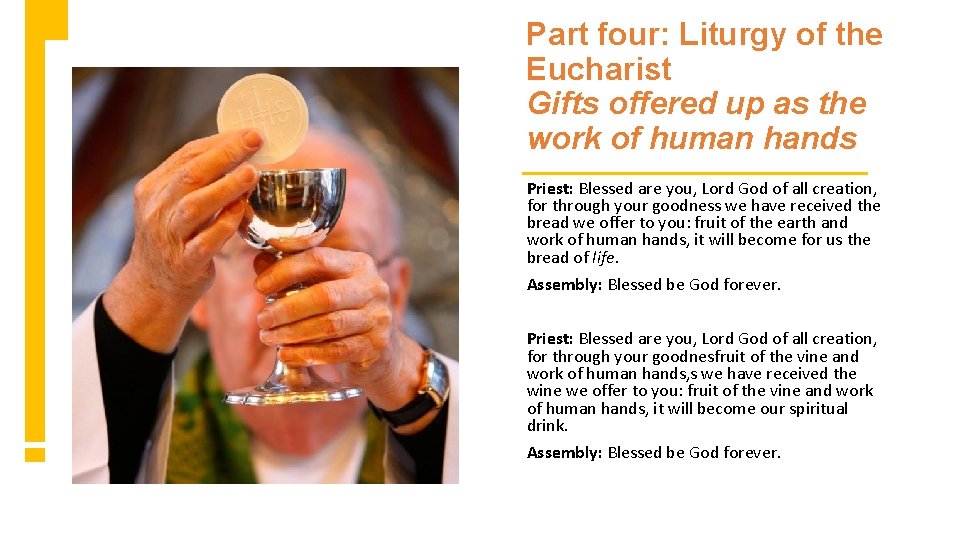
Part four: Liturgy of the Eucharist Gifts offered up as the work of human hands Priest: Blessed are you, Lord God of all creation, for through your goodness we have received the bread we offer to you: fruit of the earth and work of human hands, it will become for us the bread of life. Assembly: Blessed be God forever. Priest: Blessed are you, Lord God of all creation, for through your goodnesfruit of the vine and work of human hands, s we have received the wine we offer to you: fruit of the vine and work of human hands, it will become our spiritual drink. Assembly: Blessed be God forever.
The gifts in the Mass are the product of work and are offered up and then returned to us transformed Bread and wine symbolize a wonderful cooperation between God and humans. We lay upon the altar not only creation’s goods but ours, too. The gifts are not mere wheat and grapes, but “the work of human hands. ” Symbolically, that’s us on the altar, offering ourselves to God. In the eucharistic prayer, we will ask God to send the Spirit to change the gifts and change us as well. https: //www. archspm. org/faith-and-discipleship/catholic-faith/why-do-we-present-gifts-during-mass/ . …our Eucharist is possible because the work of so many brings the bread and wine to us so that we can offer it as a gift to each other… So, when we hear “the work of human hands” we are reminded that our Eucharistic food depends on the work of many. . . https: //frmarkmossasj. wordpress. com/2010/09/30/rough-hands/
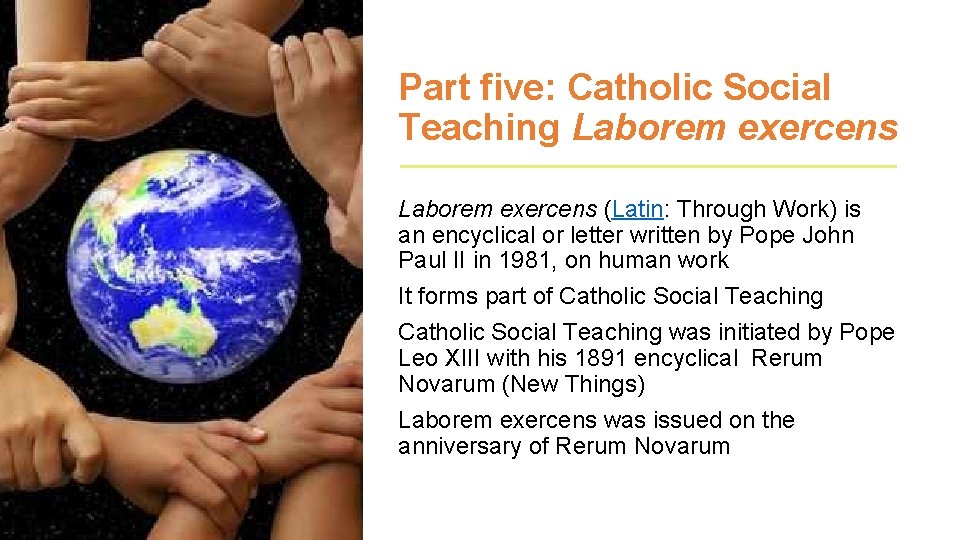
Part five: Catholic Social Teaching Laborem exercens (Latin: Through Work) is an encyclical or letter written by Pope John Paul II in 1981, on human work It forms part of Catholic Social Teaching was initiated by Pope Leo XIII with his 1891 encyclical Rerum Novarum (New Things) Laborem exercens was issued on the anniversary of Rerum Novarum
Laborem exercens: Key points • Our work connects us with God’s creation, through our work we are co-creators with God of the world we live in • Workers by enduring the toil of work are in union with Christ crucified for us, and as a result of our work we collaborate in the transformation and redemption of humanity • Work is the essential key, to the whole social question • Labour has priority over capital… things are at the service of people, capital is an accumulation of the labour of workers • John Paul proposed a family wage, i. e. enough to support the worker and their family, as a minimum • Workers have the right to form unions and have the right to withdraw their labour or to strike
The toil of work can reveal a new good • By enduring the toil of work in union with Christ crucified for us, workers in a way collaborate with the Son of God for the redemption of humanity. • The Christian finds in human work a small part of the Cross of Christ and accepts it in the same spirit of redemption in which Christ accepted his Cross for us. • In work, thanks to the light that penetrates us from the Resurrection of Christ, we always find a glimmer of new life, of the new good, as if it were an announcement of "the new heavens and the new earth" in which workers and the world participate precisely through the toil that goes with work… • On the one hand this confirms the indispensability of the Cross in the spirituality of human work; on the other hand the Cross which this toil constitutes reveals a new good springing from work itself, from work understood in depth and in all its aspects and never apart from work. 27 Laborem exercens
Capital is at the service of workers We recall a principle that has always been taught by the Church: the principle of the priority of labour over capital. This principle directly concerns the process of production: in this process labour is always a primary efficient cause, while capital, the whole collection of means of production, remains a mere instrument or instrumental cause. 2 Thus everything that is at the service of work, everything that in the present state of technology constitutes its ever more highly perfected "instrument", is the result of work. 12 We must emphasize and give prominence to the primacy of man in the production process, the primacy of man over things. 12 Laborem exercens
Working connects us with other workers Working at any workbench, whether a relatively primitive or an ultramodern one, a man can easily see that through his work he enters into two inheritances: the inheritance of what is given to the whole of humanity in the resources of nature, and the inheritance of what others have already developed on the basis of those resources, primarily by developing technology, that is to say, by producing a whole collection of increasingly perfect instruments for work. In working, workers also "enter into the labour of others“ 9 Laborem exercens
Private property is not an absolute right …it has always understood this right (of private property) within the broader context of the right common to all to use the goods of the whole of creation: the right to private property is subordinated to the right to common use, to the fact that goods are meant for everyone. 14 Laborem exercens
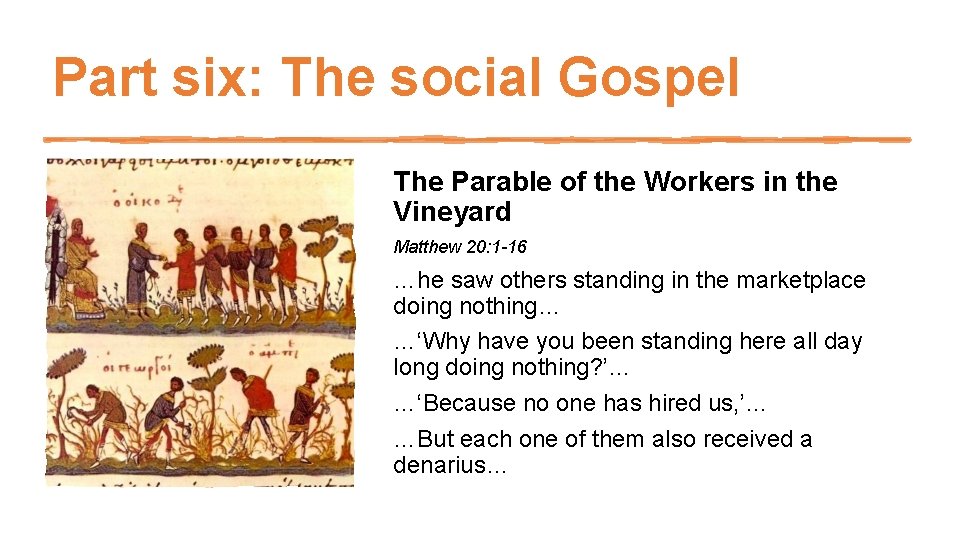
Part six: The social Gospel The Parable of the Workers in the Vineyard Matthew 20: 1 -16 …he saw others standing in the marketplace doing nothing… …‘Why have you been standing here all day long doing nothing? ’… …‘Because no one has hired us, ’… …But each one of them also received a denarius…
Part seven: Additional thoughts on the Spirituality of work Work is about relationships • Relationship between God and creation as co-creators • Relationships between workers and workers • Relationships between employers, workers and the community and the State (legal frameworks, the economy, culture etc). Work is also about rights and responsibilities in relationships