
Spirituality Culture Shock Original concept of 5 stages

- Slides: 20
Spirituality & Culture Shock Original concept of 5 stages by Oberg, Brazil, 1975 Count it all joy my brethren when you meet various trials….
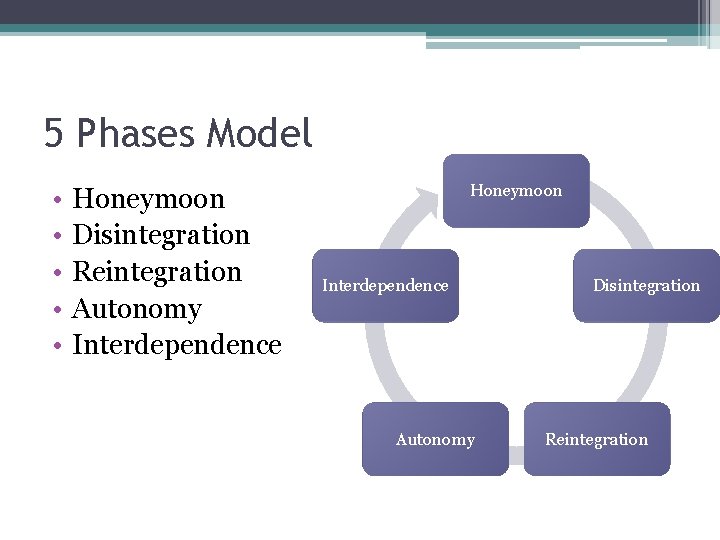
5 Phases Model • • • Honeymoon Disintegration Reintegration Autonomy Interdependence Honeymoon Interdependence Autonomy Disintegration Reintegration
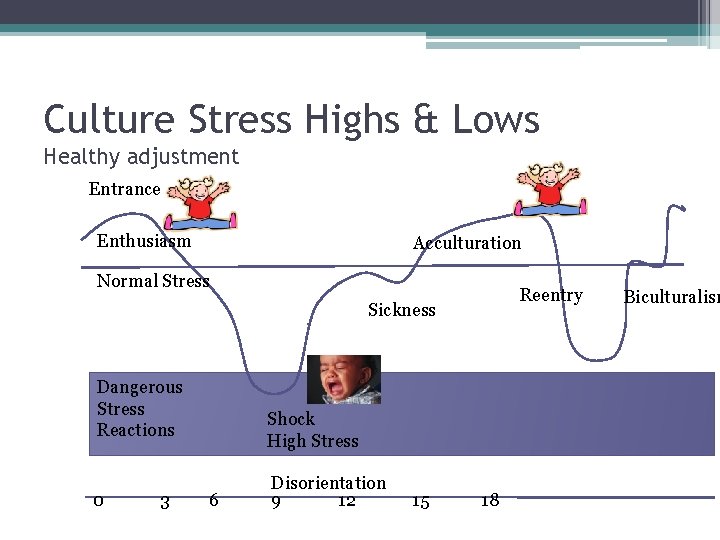
Culture Stress Highs & Lows Healthy adjustment Entrance Enthusiasm Acculturation Normal Stress Reentry Sickness Dangerous Stress Reactions 0 3 Shock High Stress 6 Disorientation 9 12 15 18 Biculturalism
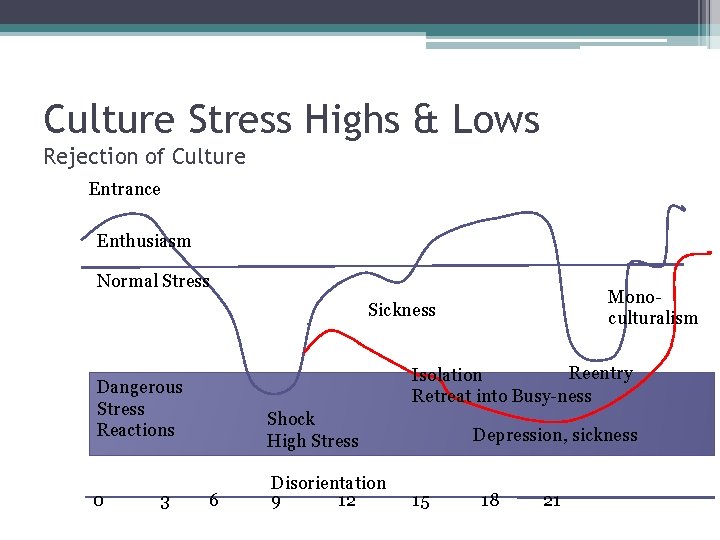
Culture Stress Highs & Lows Rejection of Culture Entrance Enthusiasm Normal Stress Monoculturalism Sickness Reentry Isolation Retreat into Busy-ness Dangerous Stress Reactions 0 3 Shock High Stress 6 Disorientation 9 12 Depression, sickness 15 18 21
Reversion & Accommodation My observations • People tend to return to the point of emotional dysfunctions that people did not work through in teenage years • Husbands and wives have to accommodate each other. This tends to be at the level of the lowest common denominator. • The more intense, higher achievers, all-American, perfectionists do less poorly than the laid back, sociable, B grade students. . . Aim for an all round lifestyle.
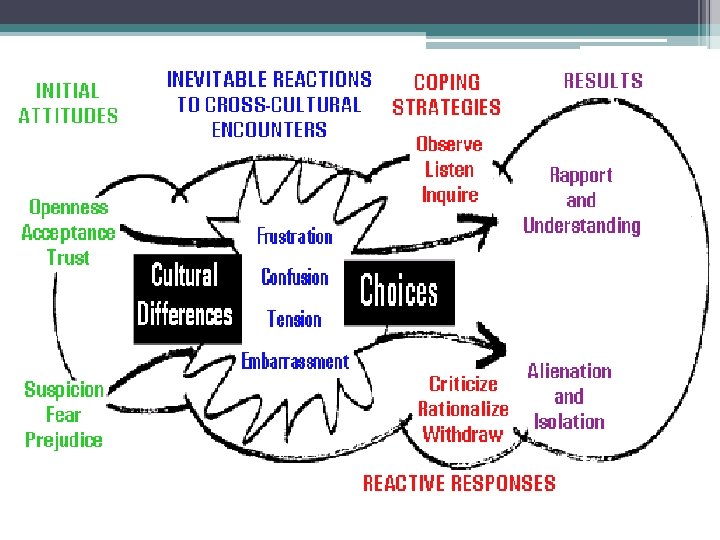
Definition • Culture Stress is a process of internalized mental, emotional and spiritual reactions, when the mazeways of the mind encounter a complex cultural configuration that is built around significantly new or different mazeways. • Culture Shock is an expression of the intensity of response to critical incidents in this process. • The internalized reactions involve grief and loss, changes in identity and role, sense of integration and meaning, or turangawaewae (place to stand). • Culture shock (though commonly used this way) has little to do with tourist shock but is an analysis of longer term entry dynamics to a culture.
Symptoms of Culture Shock • • too much sleep or too little sleep • feeling like you have no control in your life eating too much or no appetite • feeling unimportant and being a frequent minor illnesses foreigner upset stomach/headaches • crying • negative stereotyping of your Some of the psychological host country people symptoms of culture shock include: Many of these symptoms are not • loneliness or boredom unusual. This is why it can be • homesickness, idealizing home difficult to recognize when you • feeling helpless and dependent have culture shock. Not • irritability and even hostility everyone will experience all of • social withdrawal these symptoms, and each • excessive concern for health or person's reaction may be security different. • rebellion against rules and authority
Outcomes • As situations change, an alternative mazeway is created that enables a better “fit” • Individuals that “count it all joy when you encounter various trials” move to new senses of growth and identity, developing new coping strategies. • Individuals that retreat or become “angry” can move to a non-fit with the new mazeway configuration. • Usually there is an irrational mixture of these responses. • Healthy outcomes involve bicultural capacity.
Sickness Model of Culture Shock • Culture stress follows patterns of other kinds of stress. • Culture shock occurs when stress reaches levels reach unmanageable levels where unusual, uncontrollable reactions (coping mechanisms) occur • These often relate back to early childhood patterns of coping or maladjusted reacting. ▫ Usually fight (aggression) or flight (retreat into silence, depression) • Do you remember a grief reaction at loss of identity, loss of status, loss of family? These are likely to recur.
Disintegration Phase • After some time (usually three months but sometimes sooner or later, depending on the individual), differences between the old and new culture become apparent and may create anxiety. Excitement may eventually give way to unpleasant feelings of frustration and anger as one continues to experience unfavorable events that may be perceived as strange and offensive to one's cultural attitude. Language barriers, stark differences in public hygiene, traffic safety, food accessibility and quality may heighten the sense of disconnection from the surroundings. • While being transferred into a different environment puts special pressure on communication skills, there are practical difficulties to overcome, such as biological clock disruption that often leads to insomnia and daylight drowsiness; adaptation of intestinal flora to different bacteria levels and concentrations in food and water; difficulty in seeking treatment for illness, as medicines may have different names from the native country's and the same active ingredients might be hard to recognize.
Disintegration Phase (2) • Still, the most important change in the period is communication: those people who are adjusting to a new culture would feel lonely and homesick because they must get used to the new environment and meet people with whom they are not familiar every day. The language barrier may become a major obstacle in creating new relationships: special attention must be put one's and others' culture-specific body language signs, linguistic faux pas, conversation tone, linguistic nuances and customs, and false friends. • Due to the strain of living in a different country without family/church/ group support, some develop additional symptoms of loneliness, ultimately affecting the lifestyle as a whole. International students therefore often feel anxious and have a higher pressure in adjusting to the new culture. This is even more valid when the cultural distance is wide, as logical and speech patterns are different and a special emphasis is put on rhetorics.
Spirituality of Grief, Loss, Confusion, Sickness • Without a pattern of spirituality used to responding to these four areas, spirituality dies into despair during culture shock. • Predictors ▫ What have been your responses to grief and loss situations? ▫ What Spirituality have you developed in the context of confusion? ▫ What is your spirituality of living with sickness? ▫ Where did bitternesses, rejection of authority, halt your spiritual growth?
Spiritual Growth Model Count it all joy , my brethren, when you meet various trials for you know that the testing of your faith produces endurance, and endurance produces…. (James 1: 3 -5) ▫ Dependent on capacity for suspended judgement ▫ Directly related to depth of language mastery ▫ Directly related to number of deep friendships (thus early development of small group ministry is essential).
Outcomes There are three basic outcomes of the Adjustment Phase: • Some people find it impossible to accept the foreign culture and integrate. They isolate themselves from the host country's environment, which they come to perceive as hostile, withdraw into a "ghetto" and see return to their own culture as the only way out. These "Rejectors" also have the greatest problems reintegrating back home after return. • Some people integrate fully and take on all parts of the host culture while losing their original identity. They normally remain in the host country forever. This group is sometimes known as "Adopters". This rejection of part of oneself lead to unhealthy patterns. • Healthy Bicultural adaptation: Some people manage to adapt the aspects of the host culture they see as positive, while keeping some of their own and creating their unique blend. They have no major problems returning home or relocating elsewhere. This group can be thought to be somewhat cosmopolitan.
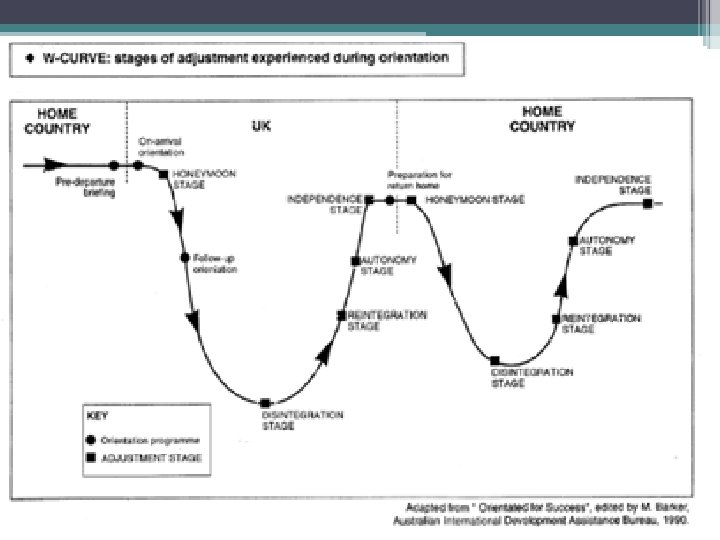
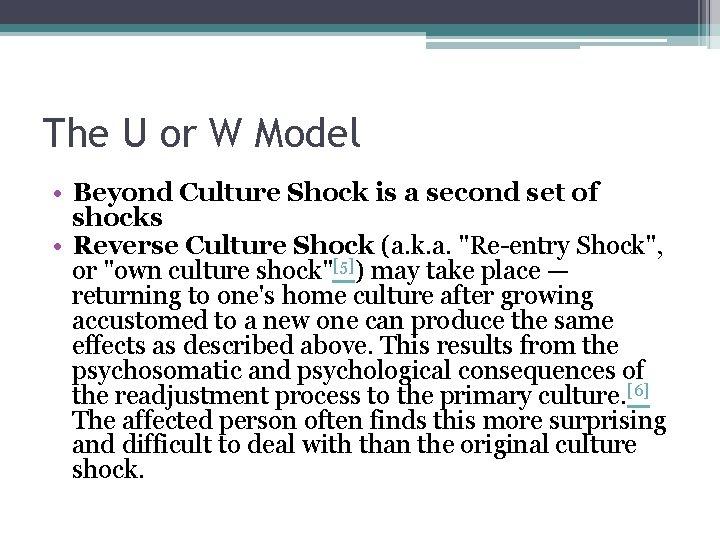
The U or W Model • Beyond Culture Shock is a second set of shocks • Reverse Culture Shock (a. k. a. "Re-entry Shock", or "own culture shock"[5]) may take place — returning to one's home culture after growing accustomed to a new one can produce the same effects as described above. This results from the psychosomatic and psychological consequences of the readjustment process to the primary culture. [6] The affected person often finds this more surprising and difficult to deal with than the original culture shock.
MATUL and Culture Shock • The MATUL is not a short term trip or a study abroad experience. In these you have probably not experienced culture shock, just the honeymoon phase • It is a longer term deep level entry to Language and Culture • It is critical to find both in-culture and expat mentoring relationships • It is critical both to bond and to find a Western backstop group • Shock does not mean you are psycho • APU has two counselling services that are available and a cluster of psychologists who are working on crosscultural issues, lead by Chris Adams, campus pastor.
Locate These Readings • T. Wayne Dye (1974) Stress-producing factors in cultural adjustment. Missiology 2 1974: 61 -77. • Foyle, M. (2010). Honourably Wounded: Stress Among Christian Workers. Grand Rapids, MI, Kregel Publications. • Rob Hay, V. L. , Detlef Blocher, et al (2007). Worth Keeping. William Carey Library, World Evangelical Alliance. • O'Donnell, K. (1977). Doing Member Care Well. California, William Carey library. • O'Donnell, D. (1992). Missionary Care - Counting the Cost for World Evangelization. P O Box 40129 Pasadena California 91114, William Carey Library. • Landis, D. , J. M. Bennett, et al. (2004). Handbook of Intercultural training. Thousand Oaks, CA, Sage Publication.