
Spiritual Diversity in Social Work Practice overview Professor




- Slides: 79
Spiritual Diversity in Social Work Practice -overview. Professor Edward Canda, MA, MSW, Ph. D. University of Kansas School of Social Welfare Copyright 2016 Note: Much of this material is presented in the book, Spiritual Diversity in Social Work Practice, by Edward R. Canda and Leola D. Furman (Oxford University Press, 2010)
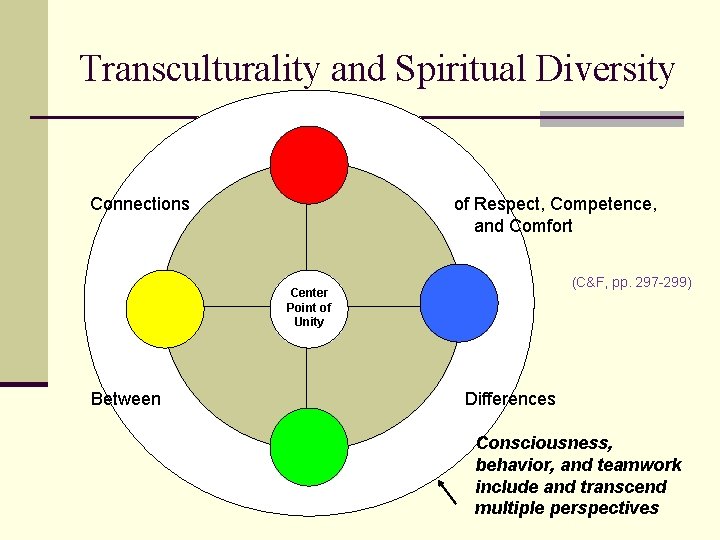
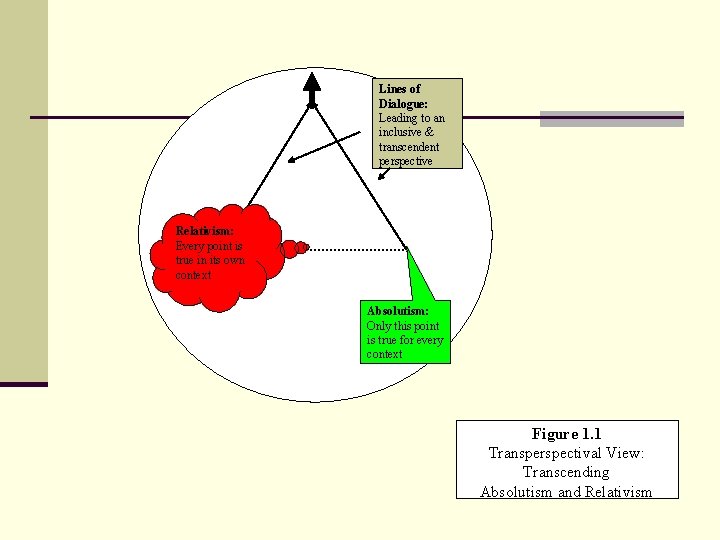
Transculturality and Spiritual Diversity Connections of Respect, Competence, and Comfort (C&F, pp. 297 -299) Center Point of Unity Between Differences Consciousness, behavior, and teamwork include and transcend multiple perspectives
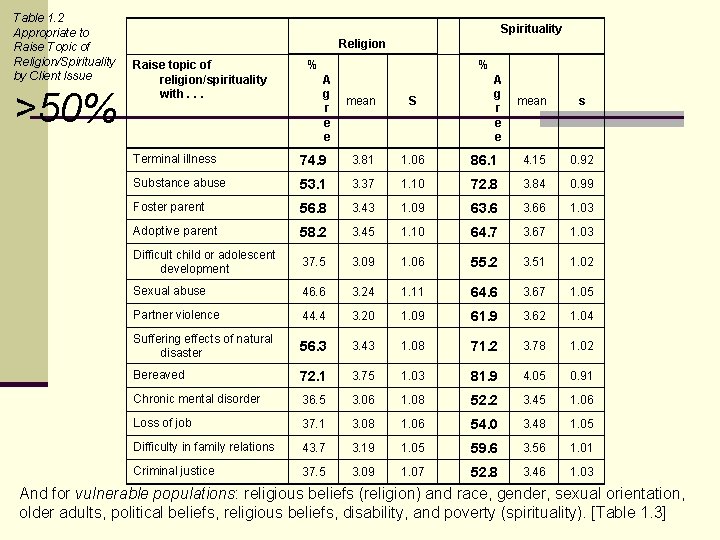
Table 1. 2 Appropriate to Raise Topic of Religion/Spirituality by Client Issue >50% Spirituality Religion Raise topic of religion/spirituality with. . . % % A g r e e mean S A g r e e mean s Terminal illness 74. 9 3. 81 1. 06 86. 1 4. 15 0. 92 Substance abuse 53. 1 3. 37 1. 10 72. 8 3. 84 0. 99 Foster parent 56. 8 3. 43 1. 09 63. 66 1. 03 Adoptive parent 58. 2 3. 45 1. 10 64. 7 3. 67 1. 03 Difficult child or adolescent development 37. 5 3. 09 1. 06 55. 2 3. 51 1. 02 Sexual abuse 46. 6 3. 24 1. 11 64. 6 3. 67 1. 05 Partner violence 44. 4 3. 20 1. 09 61. 9 3. 62 1. 04 Suffering effects of natural disaster 56. 3 3. 43 1. 08 71. 2 3. 78 1. 02 Bereaved 72. 1 3. 75 1. 03 81. 9 4. 05 0. 91 Chronic mental disorder 36. 5 3. 06 1. 08 52. 2 3. 45 1. 06 Loss of job 37. 1 3. 08 1. 06 54. 0 3. 48 1. 05 Difficulty in family relations 43. 7 3. 19 1. 05 59. 6 3. 56 1. 01 Criminal justice 37. 5 3. 09 1. 07 52. 8 3. 46 1. 03 And for vulnerable populations: religious beliefs (religion) and race, gender, sexual orientation, older adults, political beliefs, religious beliefs, disability, and poverty (spirituality). [Table 1. 3]
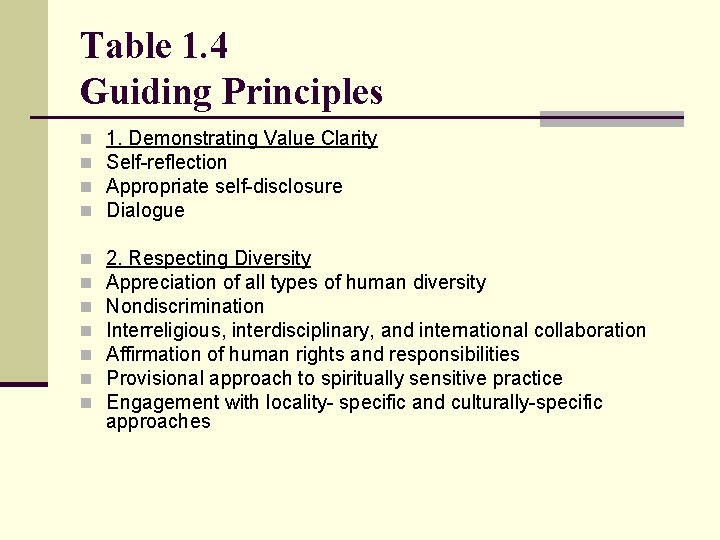
Table 1. 4 Guiding Principles n n 1. Demonstrating Value Clarity Self-reflection Appropriate self-disclosure Dialogue n n n n 2. Respecting Diversity Appreciation of all types of human diversity Nondiscrimination Interreligious, interdisciplinary, and international collaboration Affirmation of human rights and responsibilities Provisional approach to spiritually sensitive practice Engagement with locality- specific and culturally-specific approaches
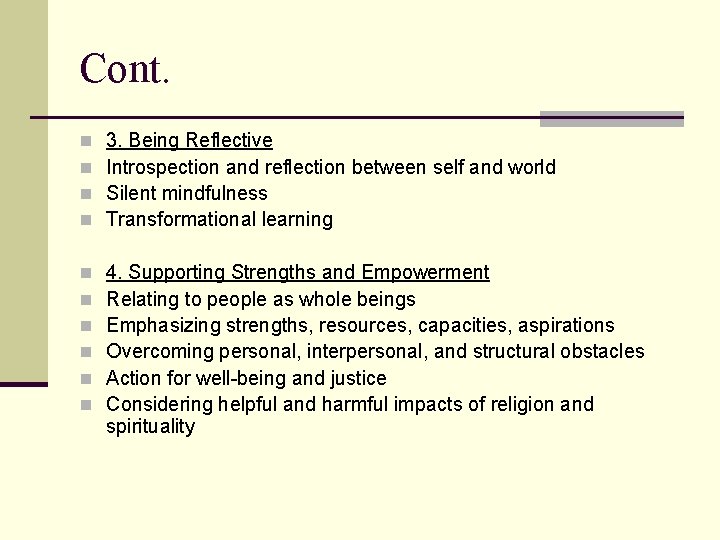
Cont. n n 3. Being Reflective Introspection and reflection between self and world Silent mindfulness Transformational learning n n n 4. Supporting Strengths and Empowerment Relating to people as whole beings Emphasizing strengths, resources, capacities, aspirations Overcoming personal, interpersonal, and structural obstacles Action for well-being and justice Considering helpful and harmful impacts of religion and spirituality
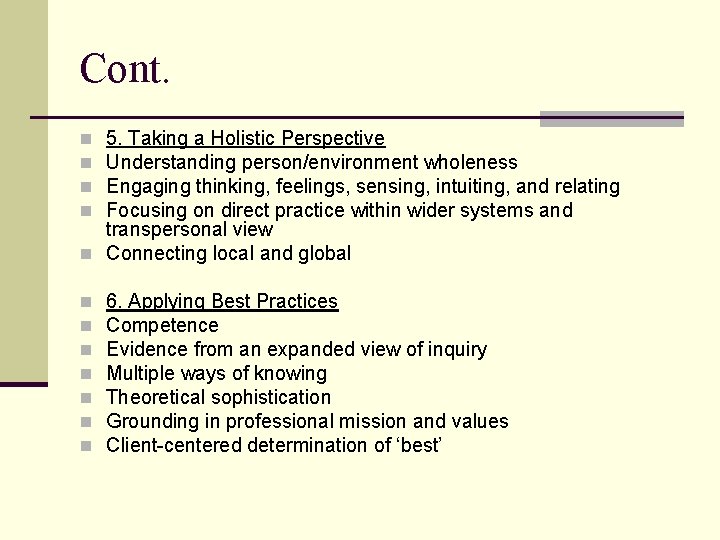
Cont. 5. Taking a Holistic Perspective Understanding person/environment wholeness Engaging thinking, feelings, sensing, intuiting, and relating Focusing on direct practice within wider systems and transpersonal view n Connecting local and global n n n 6. Applying Best Practices Competence Evidence from an expanded view of inquiry Multiple ways of knowing Theoretical sophistication Grounding in professional mission and values Client-centered determination of ‘best’
Lines of Dialogue: Leading to an inclusive & transcendent perspective Relativism: Every…… point is. . . true in its own context Absolutism: Only this point is true for every context Figure 1. 1 Transperspectival View: Transcending Absolutism and Relativism
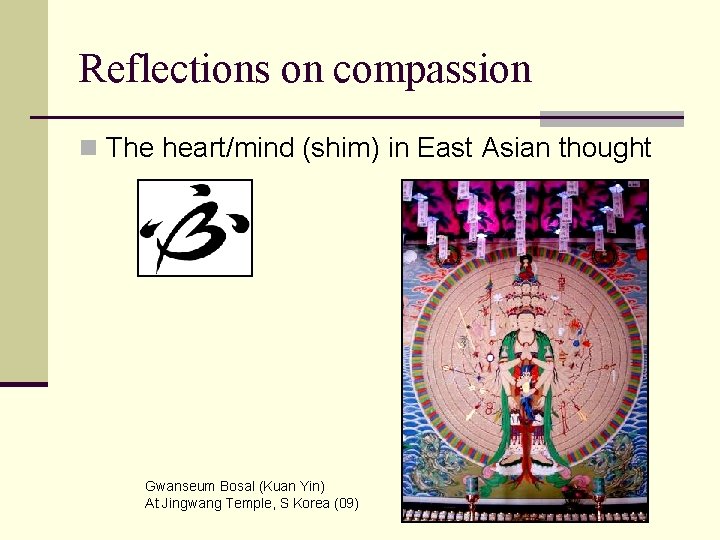
Reflections on compassion n The heart/mind (shim) in East Asian thought Gwanseum Bosal (Kuan Yin) At Jingwang Temple, S Korea (09)
Compassion n Engaging life, self, and relationships ‘with passion’ n Empathy, but not enmeshment n Saying of a Korean Zen master n Nonjudgmental, clear awareness n Skillful reaching out n Caring nonattachment to fruits of actions
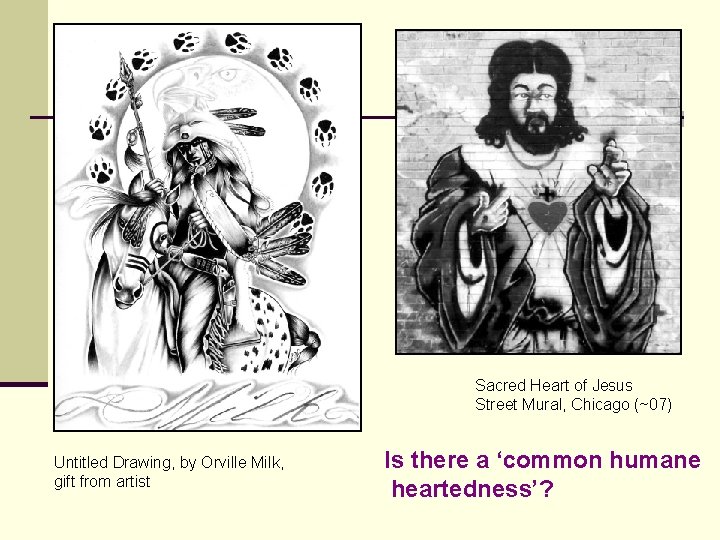
Sacred Heart of Jesus Street Mural, Chicago (~07) Untitled Drawing, by Orville Milk, gift from artist Is there a ‘common humane heartedness’?
Common Hazards for Burnout n Internal confusion n Overwork n Indirect trauma n Inhumane or dangerous work conditions n Inhumane ways of relating with clients n Existential angst n Imbalanced empathy
Self-Assessment Question n Rate your present general state of well-being or satisfaction in relation to your path of service: n Miserable? Adequate? Flourishing?
Cause for Hope: Stress can Become Eustress (good stress) n Convert constrained or misdirected energy into freely flowing enthusiasm n Stretch and breathe n What kind of practices do you regularly use for preventing distress, promoting eustress, relaxing, centering, and reenergizing? n Brief relaxation exercise
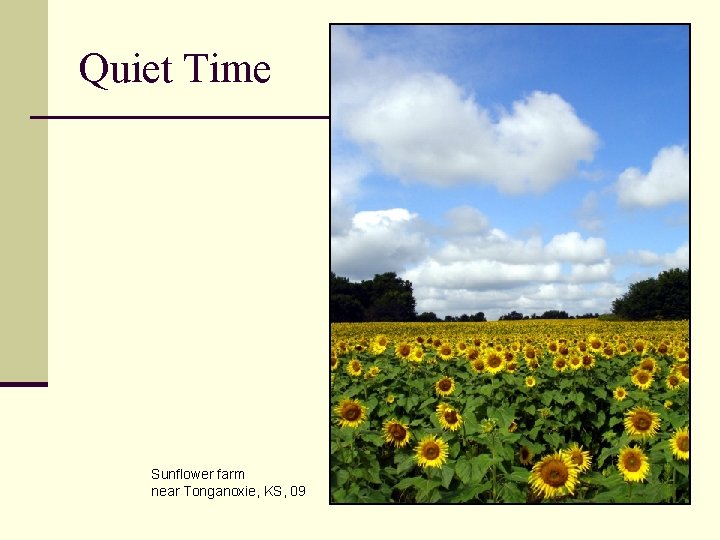
Quiet Time Sunflower farm near Tonganoxie, KS, 09
Challenges of Defining Spirituality n The Dao that can be named is not the real Dao Particular vs. Universal: emic/etic/transperspectival n Expressible vs. Inexpressible n n n Ineffable mystical experiences Concepts as pointers Use of metaphor, parable, paradox, poetry, symbolism, allegory Toward an Open Conceptualization
Spirituality is: n A process of human life and development n n focusing on the search for a sense of meaning, purpose, morality, and well-being; in relationship with oneself, other people, other beings, the universe, and ultimate reality however understood; orienting around centrally significant priorities; and engaging a sense of transcendence (experienced as deeply profound, sacred, or transpersonal).
Features of Spirituality n Individuals and groups may express spirituality in n n religious and nonreligious ways. They may express it in private ways and in public, shared ways. Spirituality may or may not permeate an individual’s daily life and a group’s culture. As a universal feature of persons and cultures, everyone has spirituality, though they vary in amount of focus on it. Healthy spirituality encourages a sense of personal integrity, wholeness, and well-being. It fosters transpersonal experiences, the emergence of transpersonal levels of consciousness, and an expanded sense of identity and connectedness.
Features of Spirituality continued: n Healthy spirituality engenders individual’s virtues, such as compassion and justice, as well as relational webs of caring, respect, and support extending outward to other people and beings. n However, spirituality does not always manifest in healthy ways. n ‘Spirit’ may or may not be understood literally n E. g. in terms of nonphysical beings or forces vs. sense of vitality
Religion is: n An institutionalized (i. e. systematic and organized) pattern of values, beliefs, symbols, behaviors, and experiences that involves n spirituality n a community of adherents n transmission of traditions over time, and n Community support functions (e. g. organizational structure, material assistance, emotional support, or political advocacy) that are directly or indirectly related to spirituality.
Features of Religion: n Religion always involves public and shared n n experience. It may or may not permeate a person’s daily life and a group’s culture. Not all individuals or societies are religious. Healthy religiousness, as an expression of spirituality, encourages a sense of well-being, transpersonal development, virtues, and relational webs of caring, respect, and support. However, religiousness does not always manifest in healthy ways.
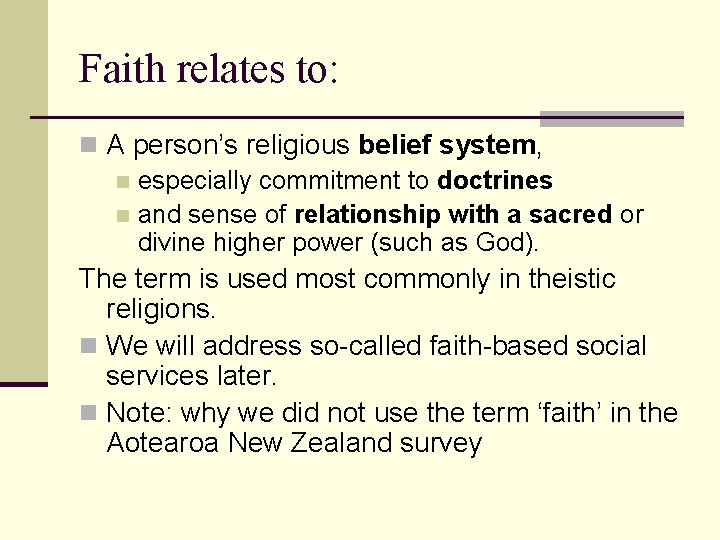
Faith relates to: n A person’s religious belief system, n especially commitment to doctrines n and sense of relationship with a sacred or divine higher power (such as God). The term is used most commonly in theistic religions. n We will address so-called faith-based social services later. n Note: why we did not use the term ‘faith’ in the Aotearoa New Zealand survey
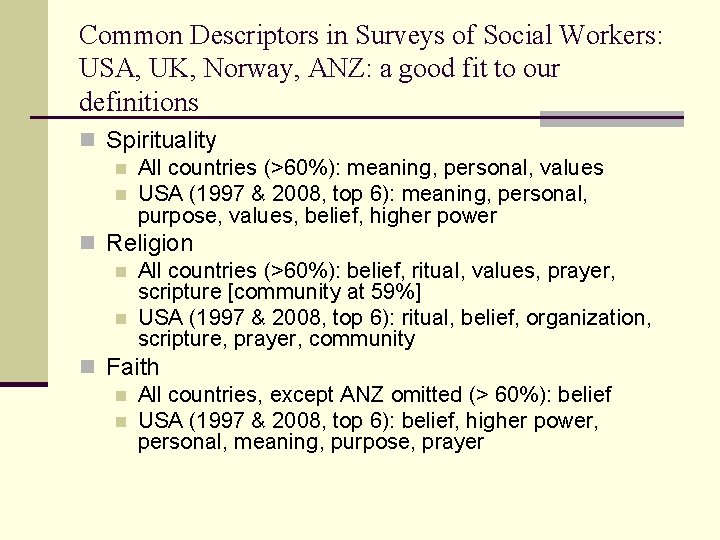
Common Descriptors in Surveys of Social Workers: USA, UK, Norway, ANZ: a good fit to our definitions n Spirituality n All countries (>60%): meaning, personal, values n USA (1997 & 2008, top 6): meaning, personal, purpose, values, belief, higher power n Religion n All countries (>60%): belief, ritual, values, prayer, scripture [community at 59%] n USA (1997 & 2008, top 6): ritual, belief, organization, scripture, prayer, community n Faith n All countries, except ANZ omitted (> 60%): belief n USA (1997 & 2008, top 6): belief, higher power, personal, meaning, purpose, prayer
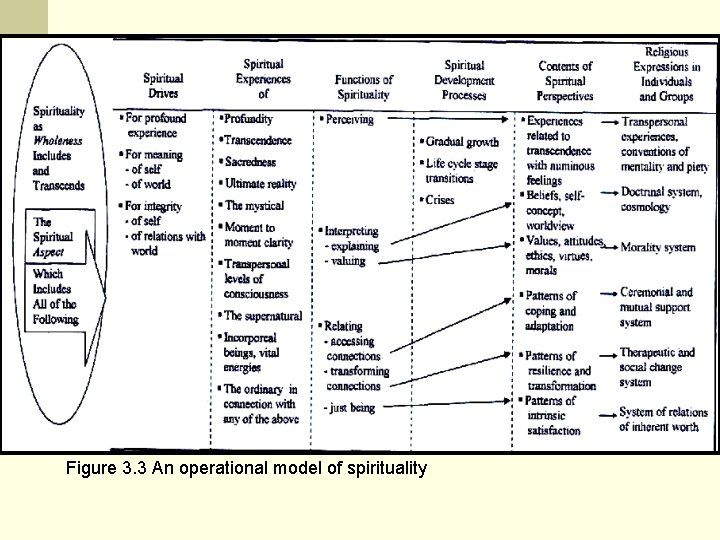
Figure 3. 3 An operational model of spirituality
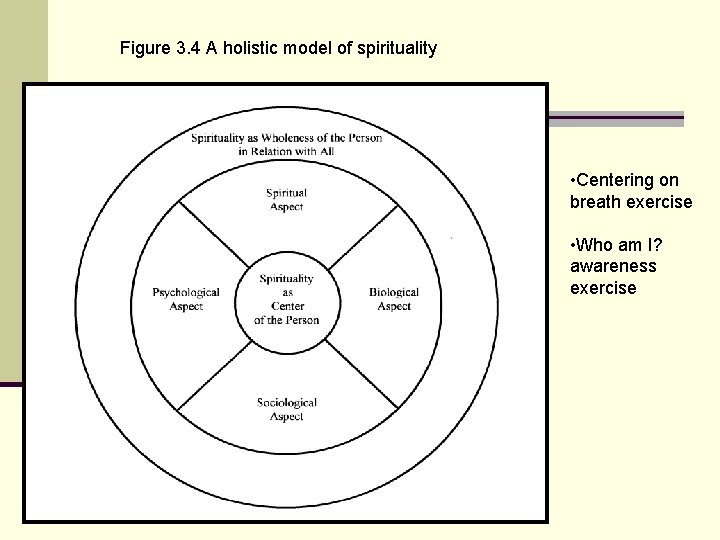
Figure 3. 4 A holistic model of spirituality • Centering on breath exercise • Who am I? awareness exercise
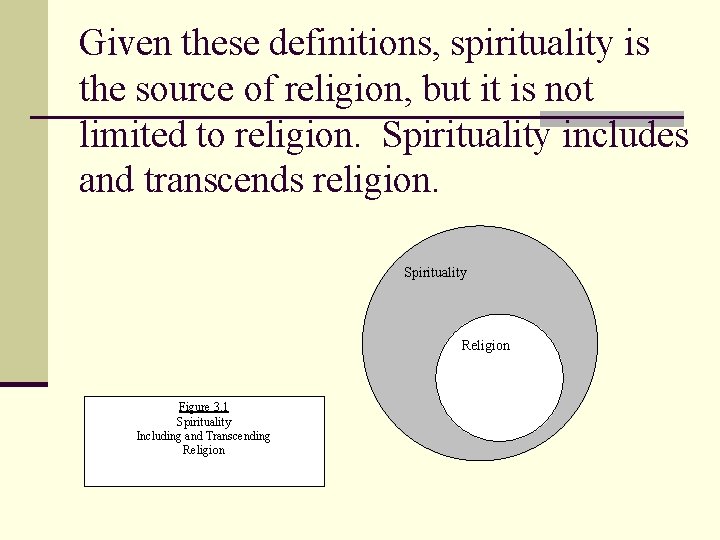
Given these definitions, spirituality is the source of religion, but it is not limited to religion. Spirituality includes and transcends religion. Spirituality Religion Figure 3. 1 Spirituality Including and Transcending Religion
Client-Focused Understanding n Clients vary in their own definitions of religion and spirituality. n Professional definitions set themes for possible exploration with clients, but client’s own terms, definitions, and interests relating to these themes should set the tone for communication in the helping relationship. n It is not necessary to use the terms religion or spirituality in order to get at themes explained above. n Of course, many clients may view spirituality as a wider concept than religion, as in the professional definition (especially baby boomers and younger).
Measures of s/r n Using qualitative, phenomenological, and transpersonal research methods to address holistic and ineffable qualities of spirituality n Using multiple quantitative and qualitative methods to explore operational aspects of spirituality (including religiousness) n Spiritual well-being as process and outcome of healthy spirituality n Clinical assessment will be addressed later
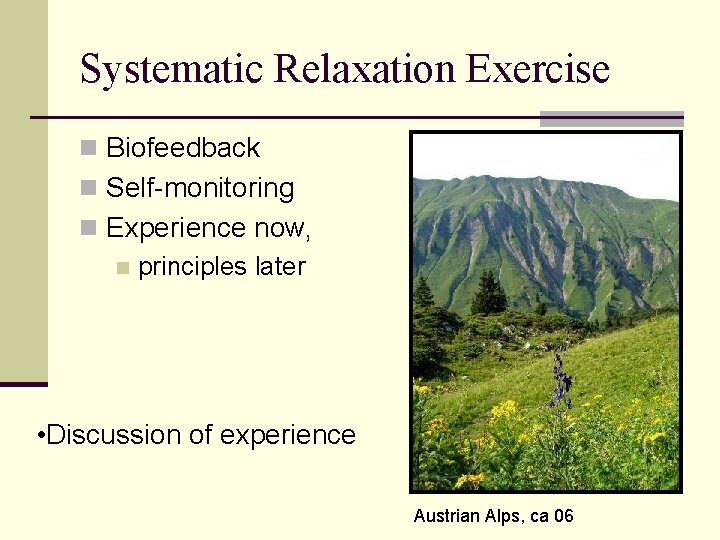
Systematic Relaxation Exercise n Biofeedback n Self-monitoring n Experience now, n principles later • Discussion of experience Austrian Alps, ca 06
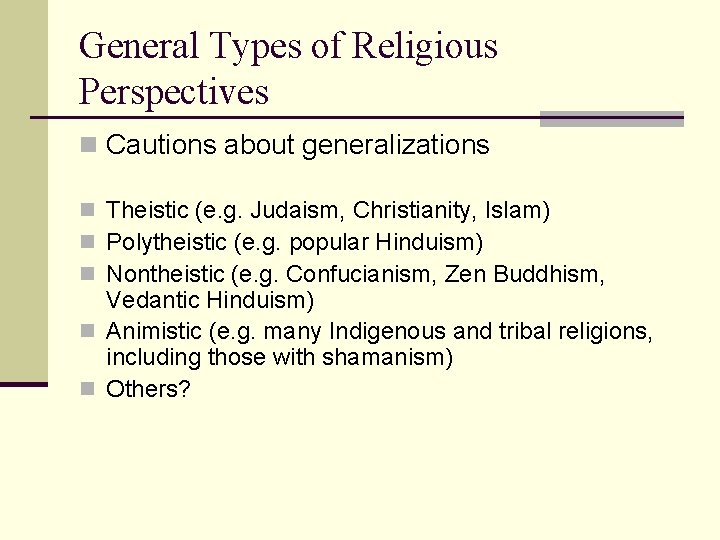
General Types of Religious Perspectives n Cautions about generalizations n Theistic (e. g. Judaism, Christianity, Islam) n Polytheistic (e. g. popular Hinduism) n Nontheistic (e. g. Confucianism, Zen Buddhism, Vedantic Hinduism) n Animistic (e. g. many Indigenous and tribal religions, including those with shamanism) n Others?
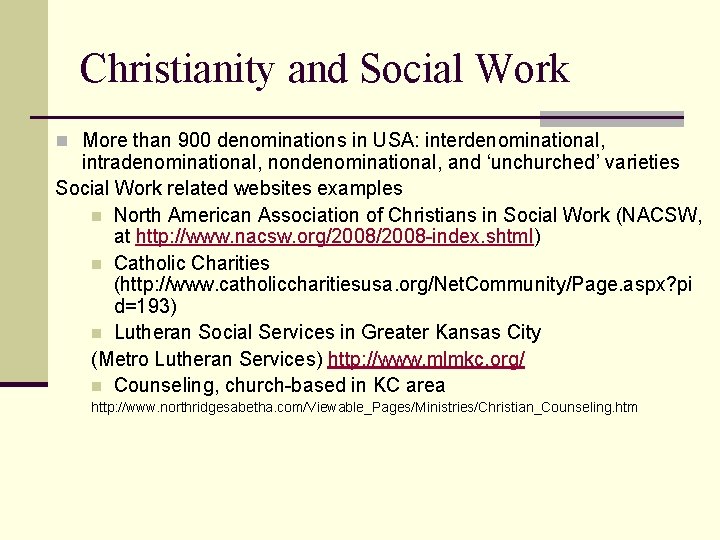
Christianity and Social Work n More than 900 denominations in USA: interdenominational, intradenominational, nondenominational, and ‘unchurched’ varieties Social Work related websites examples n North American Association of Christians in Social Work (NACSW, at http: //www. nacsw. org/2008 -index. shtml) n Catholic Charities (http: //www. catholiccharitiesusa. org/Net. Community/Page. aspx? pi d=193) n Lutheran Social Services in Greater Kansas City (Metro Lutheran Services) http: //www. mlmkc. org/ n Counseling, church-based in KC area http: //www. northridgesabetha. com/Viewable_Pages/Ministries/Christian_Counseling. htm
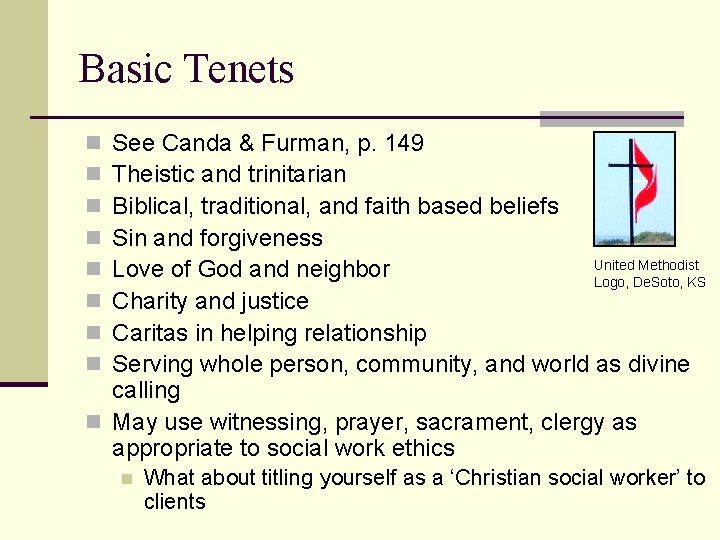
Basic Tenets See Canda & Furman, p. 149 Theistic and trinitarian Biblical, traditional, and faith based beliefs Sin and forgiveness United Methodist Love of God and neighbor Logo, De. Soto, KS Charity and justice Caritas in helping relationship Serving whole person, community, and world as divine calling n May use witnessing, prayer, sacrament, clergy as appropriate to social work ethics n n n n n What about titling yourself as a ‘Christian social worker’ to clients
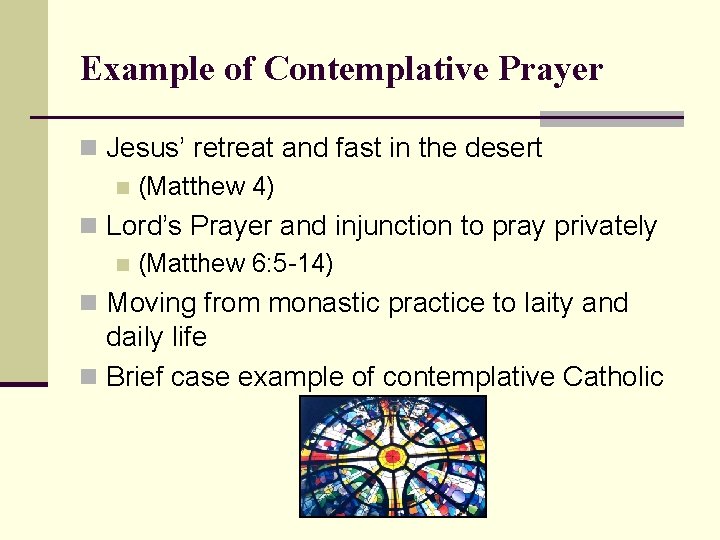
Example of Contemplative Prayer n Jesus’ retreat and fast in the desert n (Matthew 4) n Lord’s Prayer and injunction to pray privately n (Matthew 6: 5 -14) n Moving from monastic practice to laity and daily life n Brief case example of contemplative Catholic
Christian Contemplative Centering Prayer n A spiritual discipline to foster loving communion with God n Beyond images and conversation to silent awareness n Use of prayerful word as focus (e. g. God, love, Jesus, peace) or simple inward gaze n Begin with clear intention, verbal prayer n At end, reflect or journal n Extend to daily life
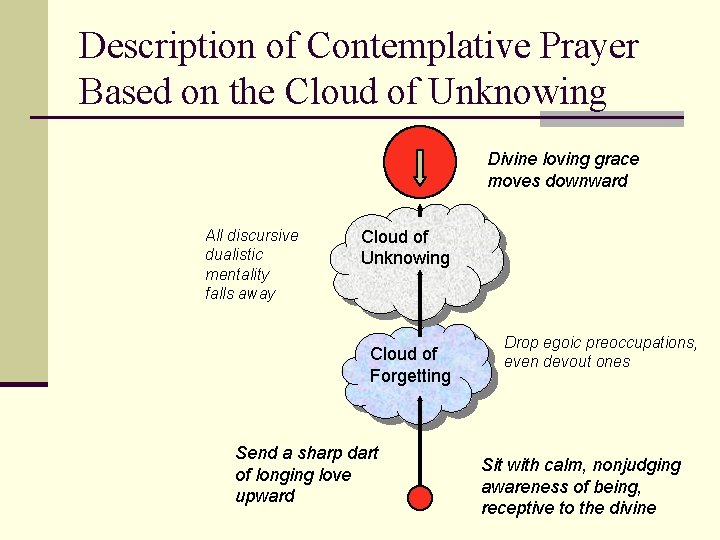
Description of Contemplative Prayer Based on the Cloud of Unknowing Divine loving grace moves downward All discursive dualistic mentality falls away Cloud of Unknowing Cloud of Forgetting Send a sharp dart of longing love upward Drop egoic preoccupations, even devout ones Sit with calm, nonjudging awareness of being, receptive to the divine
Christian Faith-Based Social Services n Major religiously sponsored professional organizations, such as Salvation Army, Lutheran Social Services, Catholic Social services n Congregation based parish nursing and social work n Religiously connected volunteerism, philanthropy, and policy advocacy n Issues of referral and collaboration n Of course, FB services can relate to any religion
NASW Position (2002) re: H. R. 7, Faith. Based and Community Services Act n FB entities receive government funds while retaining religious character n Recognizes history of charitable organizations and history of social work/religious collaborations n Concerns: n n n Voluntary access to services without discrimination Need accountability and transparency Appropriate, qualified staffing Separation of church and state Maintaining government responsibility
Case Example: Health Through Faith and Community Project (see Spiritual Diversity and Social Work Resource Center) n Funding by United Methodist Health Ministry Fund, 2000 -2005 n Development of curriculum for congregation based adult education linking spirituality to health and justice n Process of reaching mutual understanding and cooperation for ecumenical approach n Stories of publishing representative, conference attendee, advisory board
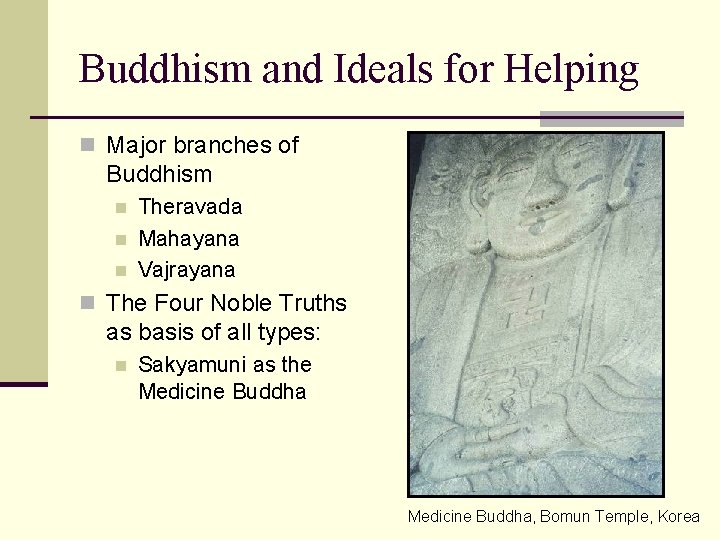
Buddhism and Ideals for Helping n Major branches of Buddhism n n n Theravada Mahayana Vajrayana n The Four Noble Truths as basis of all types: n Sakyamuni as the Medicine Buddha, Bomun Temple, Korea
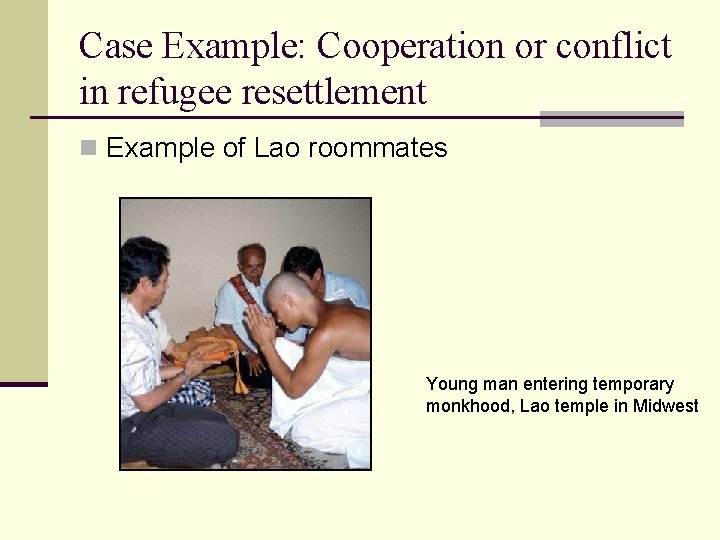
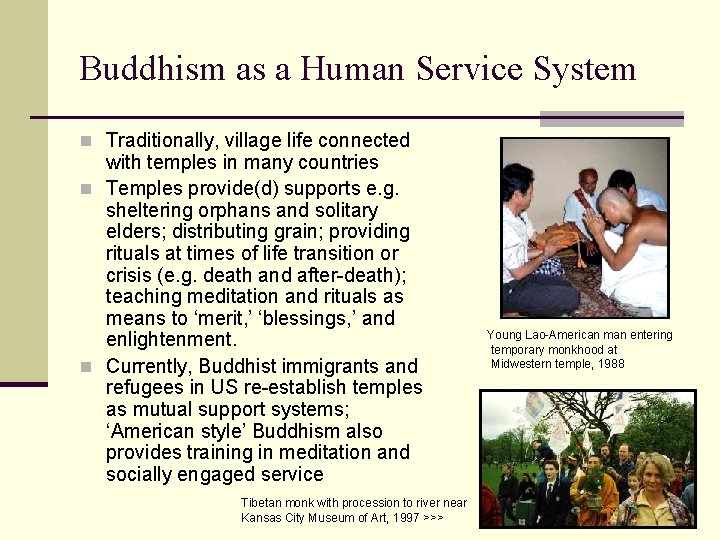
Case Example: Cooperation or conflict in refugee resettlement n Example of Lao roommates Young man entering temporary monkhood, Lao temple in Midwest
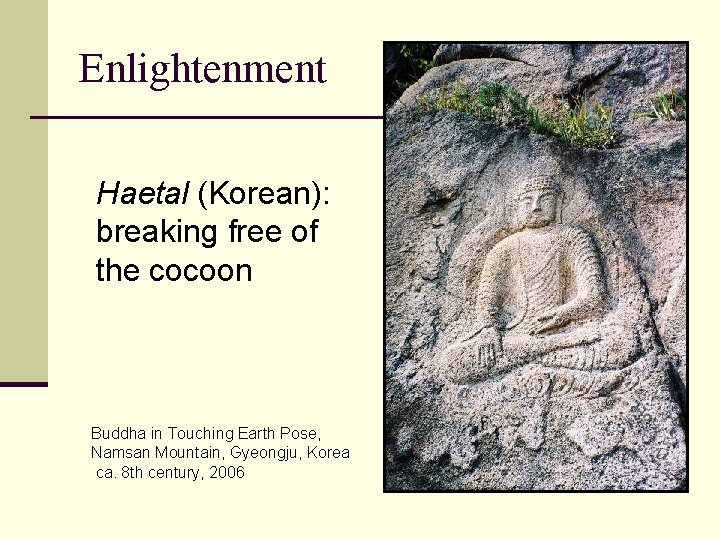
Enlightenment Haetal (Korean): breaking free of the cocoon Buddha in Touching Earth Pose, Namsan Mountain, Gyeongju, Korea ca. 8 th century, 2006
Buddhism as a Human Service System n Traditionally, village life connected with temples in many countries n Temples provide(d) supports e. g. sheltering orphans and solitary elders; distributing grain; providing rituals at times of life transition or crisis (e. g. death and after-death); teaching meditation and rituals as means to ‘merit, ’ ‘blessings, ’ and enlightenment. n Currently, Buddhist immigrants and refugees in US re-establish temples as mutual support systems; ‘American style’ Buddhism also provides training in meditation and socially engaged service Tibetan monk with procession to river near Kansas City Museum of Art, 1997 >>> Young Lao-American man entering temporary monkhood at Midwestern temple, 1988
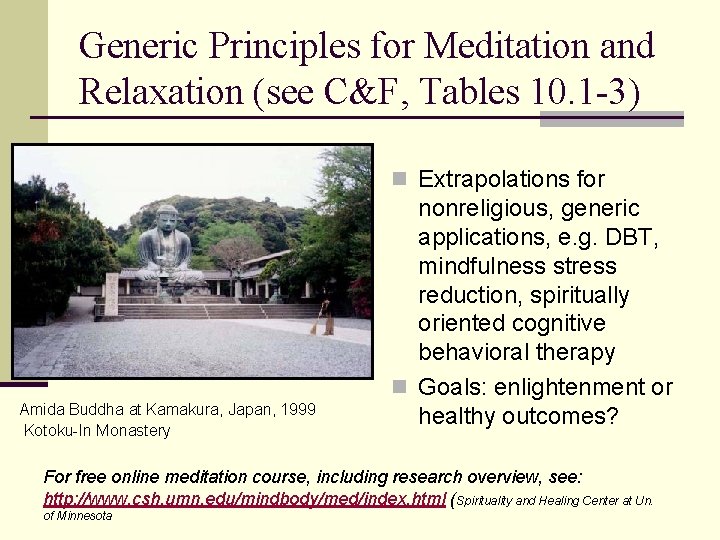
Generic Principles for Meditation and Relaxation (see C&F, Tables 10. 1 -3) n Extrapolations for Amida Buddha at Kamakura, Japan, 1999 Kotoku-In Monastery nonreligious, generic applications, e. g. DBT, mindfulness stress reduction, spiritually oriented cognitive behavioral therapy n Goals: enlightenment or healthy outcomes? For free online meditation course, including research overview, see: http: //www. csh. umn. edu/mindbody/med/index. html (Spirituality and Healing Center at Un. of Minnesota
Example of Coming to Terms with Death n Death on Your Back Scenes from Prague, Czech Republic n Playfulness with Death
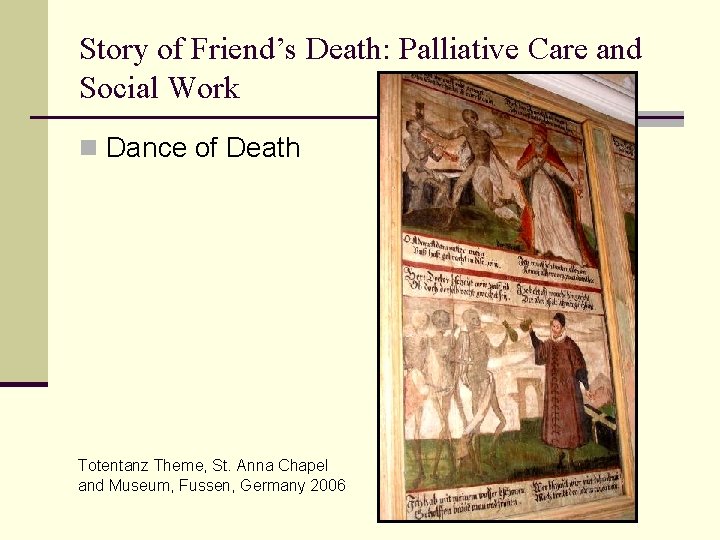
Story of Friend’s Death: Palliative Care and Social Work n Dance of Death Totentanz Theme, St. Anna Chapel and Museum, Fussen, Germany 2006
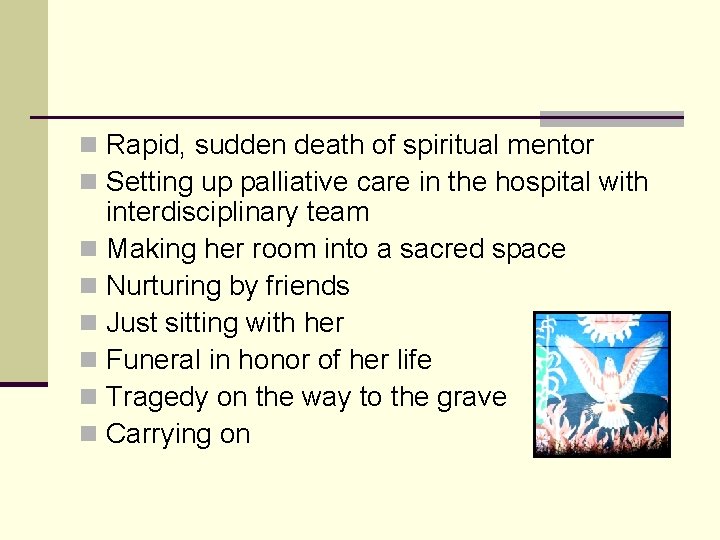
n Rapid, sudden death of spiritual mentor n Setting up palliative care in the hospital with interdisciplinary team n Making her room into a sacred space n Nurturing by friends n Just sitting with her n Funeral in honor of her life n Tragedy on the way to the grave n Carrying on
A funny thing happened on the way… n Flying to Hong Kong on my birthday n Book’s opening surprise n Airplane problems n Fellow passenger n Arrival See: Canda, E. R. (2007). Fall Forest Letter, 27(5), November. Reproduced by permission of Shantivanam, Forest of Peace House of Prayer, Easton, Kansas. http: //www. socwel. ku. edu/canda/Articles/fall forest letter. pdf
Discussion of your practice experience n Share story of how help client deal with death or a major life crisis n What nonreligious spiritual approaches did (could) you take? n What religious spiritual approaches did (could) you take, if appropriate?
Relaxation Exercise n n n n n Find balanced sitting posture Close eyes Pay attention to each moment without judgment Let yourself naturally relax Take in one deep breath and release, settling into gentle rhythm Count breaths, 1 to 10 Start over if lose count; no problem Practice for 5 minutes (increase time with practice) Discuss results Helpful website-- http: //stress. pmibooks. com/index. html, Preventive Measures
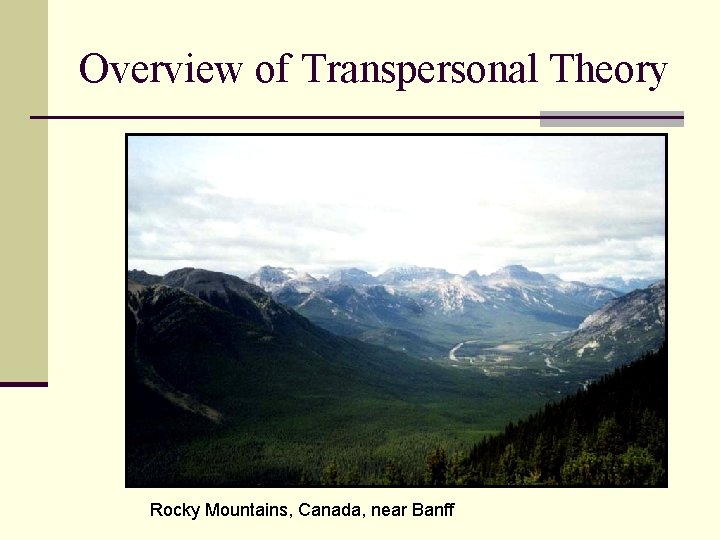
Overview of Transpersonal Theory Rocky Mountains, Canada, near Banff
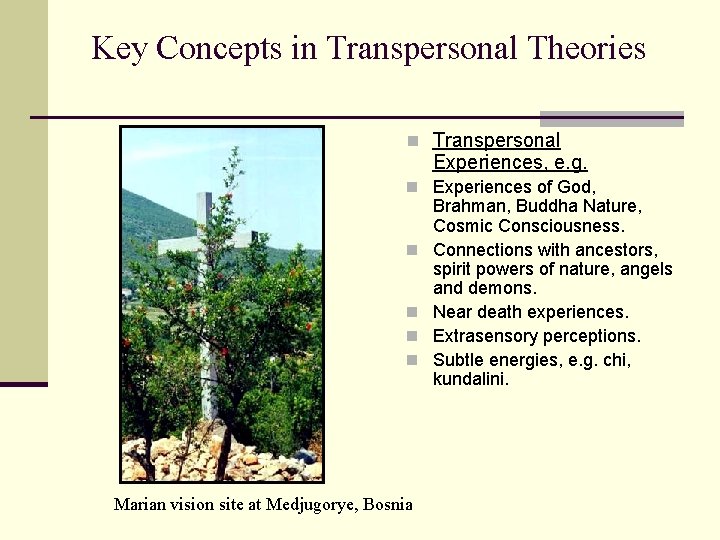
Key Concepts in Transpersonal Theories n Transpersonal Experiences, e. g. n Experiences of God, n n Marian vision site at Medjugorye, Bosnia Brahman, Buddha Nature, Cosmic Consciousness. Connections with ancestors, spirit powers of nature, angels and demons. Near death experiences. Extrasensory perceptions. Subtle energies, e. g. chi, kundalini.
Maslow’s peak, nadir, and plateau experiences n Peak: rising above ordinary body/ego limit. n Nadir: falling into a pit of crisis. n Plateau: integrating growth into life; subtle yet deep insights.
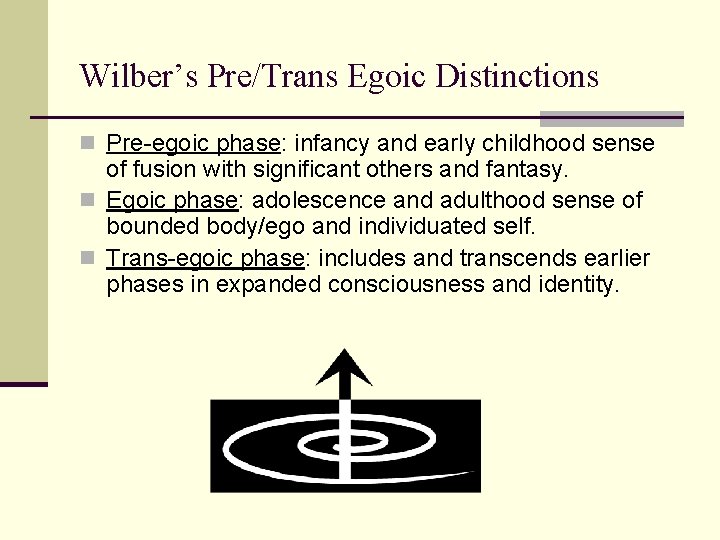
Wilber’s Pre/Trans Egoic Distinctions n Pre-egoic phase: infancy and early childhood sense of fusion with significant others and fantasy. n Egoic phase: adolescence and adulthood sense of bounded body/ego and individuated self. n Trans-egoic phase: includes and transcends earlier phases in expanded consciousness and identity.
The Theme of TRANSformation Developmental potential is already in the seed— And is drawn up in beauty by the light. Irises in the Canda garden
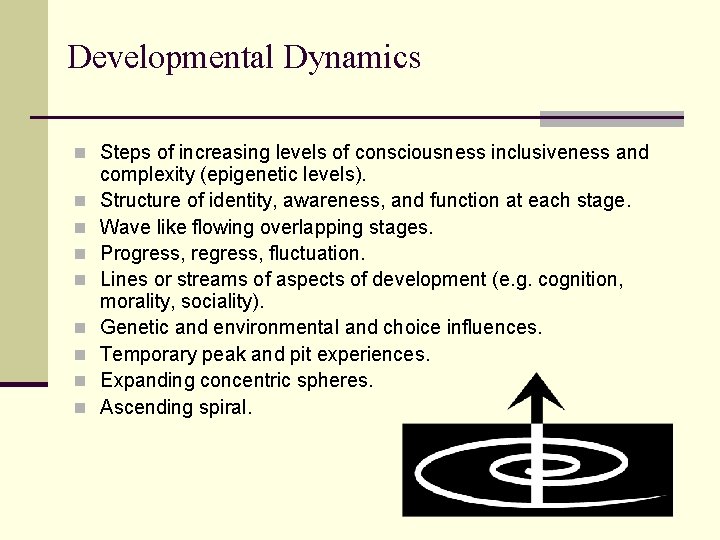
Developmental Dynamics n Steps of increasing levels of consciousness inclusiveness and n n n n complexity (epigenetic levels). Structure of identity, awareness, and function at each stage. Wave like flowing overlapping stages. Progress, regress, fluctuation. Lines or streams of aspects of development (e. g. cognition, morality, sociality). Genetic and environmental and choice influences. Temporary peak and pit experiences. Expanding concentric spheres. Ascending spiral.
What is happening in your practice? n Let’s start talking about how spirituality is addressed in your practice setting… Intake and assessment? n Training in specific helping practices? n Spiritually sensitive helping relationship? n Religious or nonreligious approaches? n Monitoring outcomes? n Formal policies or off-hand comments? n
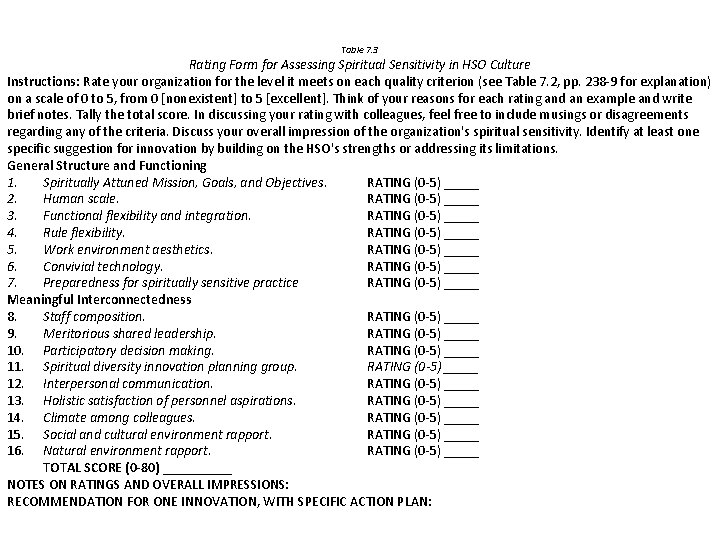
Table 7. 3 Rating Form for Assessing Spiritual Sensitivity in HSO Culture Instructions: Rate your organization for the level it meets on each quality criterion (see Table 7. 2, pp. 238 -9 for explanation) on a scale of 0 to 5, from 0 [nonexistent] to 5 [excellent]. Think of your reasons for each rating and an example and write brief notes. Tally the total score. In discussing your rating with colleagues, feel free to include musings or disagreements regarding any of the criteria. Discuss your overall impression of the organization's spiritual sensitivity. Identify at least one specific suggestion for innovation by building on the HSO's strengths or addressing its limitations. General Structure and Functioning 1. Spiritually Attuned Mission, Goals, and Objectives. RATING (0 -5) _____ 2. Human scale. RATING (0 -5) _____ 3. Functional flexibility and integration. RATING (0 -5) _____ 4. Rule flexibility. RATING (0 -5) _____ 5. Work environment aesthetics. RATING (0 -5) _____ 6. Convivial technology. RATING (0 -5) _____ 7. Preparedness for spiritually sensitive practice RATING (0 -5) _____ Meaningful Interconnectedness 8. Staff composition. RATING (0 -5) _____ 9. Meritorious shared leadership. RATING (0 -5) _____ 10. Participatory decision making. RATING (0 -5) _____ 11. Spiritual diversity innovation planning group. RATING (0 -5) _____ 12. Interpersonal communication. RATING (0 -5) _____ 13. Holistic satisfaction of personnel aspirations. RATING (0 -5) _____ 14. Climate among colleagues. RATING (0 -5) _____ 15. Social and cultural environment rapport. RATING (0 -5) _____ 16. Natural environment rapport. RATING (0 -5) _____ TOTAL SCORE (0 -80) _____ NOTES ON RATINGS AND OVERALL IMPRESSIONS: RECOMMENDATION FOR ONE INNOVATION, WITH SPECIFIC ACTION PLAN:
Meditation Exercise n Selecting a mantra or meaningful focus word n Choose a word or brief phrase that is meaningful to you n It should be brief enough to harmonize with each breath n Use the basic meditation technique, but rather than counting breaths, use the mantra to add focus to breath awareness n If one word or phrase, repeat silently on the in-breath and release the out-breath in silence n Pause slightly between each breath in/out n Let the out-breath be about twice as long as in-breath n If two words/phrases, use one word on in-breath and one on out-breath (e. g. peace… to all)
Applications to Assessment n To be done within context of spiritually sensitive relationship and strengths assessment n Initially determine if relevant to situation and purpose of helping, client’s goals n E. g. only concrete service? (if so, still can be spiritually sensitive) n Clarifies whethere is interest and purpose for engagement of spirituality by social worker in treatment setting or in discharge planning n n In own work with client In referral/collaboration
Spiritually Focused Assessment n Purposes for Spiritual Assessment n Spiritual assessment can be therapeutic in itself, engendering client insight. n Spiritual assessment can identify:
n Importance of spirituality in the client's life and family, n n community context Components of the client's spiritual perspective relevant to the focus of helping The spiritual aspect of the person/environment in a holistic strengths oriented assessment Client's interest in addressing spirituality within the helping process Proper fit between client's spiritual perspective and the social worker or agency
n Client's desire for referral to or collaboration with spiritual mentors of particular religious or nonreligious spiritual perspectives and styles n Ways in which the client's past and present spiritual beliefs, values, practices, and group participation (if any) are helpful or harmful to self-esteem, coping, wellbeing, and to dealing with the presenting issue
Specific spiritual strengths, such as inspirational religious or philosophical texts, music, art; enjoyable participation in religious or nonreligious spiritual support groups; personal practices of prayer, meditation, rituals; spiritually motivated healthy lifestyles; nurturing connection with God, nature, and other sources of profound meaning, sacredness, or transcendence; sense of life meaning and purpose; sources of joy, peace, harmony; qualities of empathy, compassion, wisdom, kindness, generosity, and other virtues; ability to forgive and be forgiven; effective ways of working through crises; spiritual mentors, healers, and friends; commitment to benefit family, society and world
n Spiritually based complementary or alternative healthcare and support practices (such as prayer, ritual, healing visualization, yoga, acupuncture, herbs) that might interact with possible helping activities and medications n Attitudes about death and the afterlife, especially in bereavement counseling and hospice n The nature of past or recent peak or pit experiences that shape the presenting issue n Intergenerational and current family patterns pertaining to spiritual perspective and relationship dynamics
n Complications of mental disorders due to religious beliefs, such as in delusions, hallucinations, unrealistic fears n Struggle with spiritual problems not necessarily related to mental disorders, such as spiritual emergencies; feeling of estrangement from God; religiously based inappropriate anxiety, shame, guilt; loss of life meaning or purpose; deep moral perplexity; loss of faith; loss of hope; sense of attack by harmful spirits or magic; abuse by clergy or other spiritual authorities; abuse by parents or caregivers under religious rationales; experience of religiously or ideologically based discrimination or oppression; alienation from or conflict with religious groups; collective persecution and genocide based on membership in an oppressed spiritual (religious or nonreligious) group
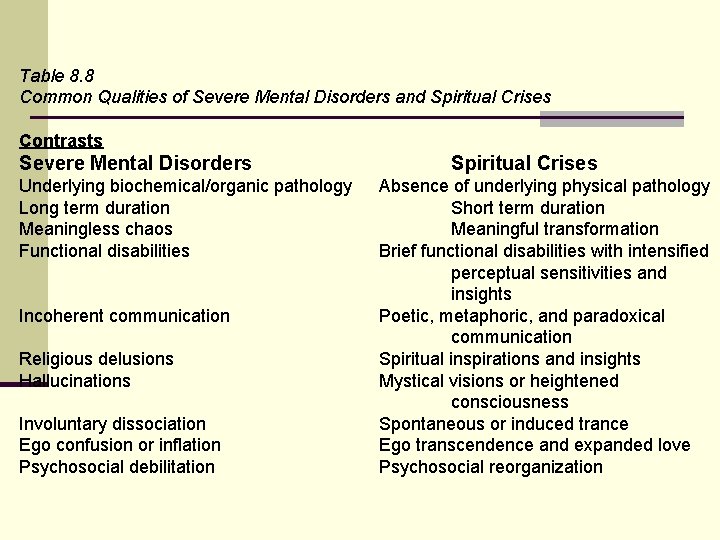
Table 8. 8 Common Qualities of Severe Mental Disorders and Spiritual Crises Contrasts Severe Mental Disorders Underlying biochemical/organic pathology Long term duration Meaningless chaos Functional disabilities Incoherent communication Religious delusions Hallucinations Involuntary dissociation Ego confusion or inflation Psychosocial debilitation Spiritual Crises Absence of underlying physical pathology Short term duration Meaningful transformation Brief functional disabilities with intensified perceptual sensitivities and insights Poetic, metaphoric, and paradoxical communication Spiritual inspirations and insights Mystical visions or heightened consciousness Spontaneous or induced trance Ego transcendence and expanded love Psychosocial reorganization
Issues of Further Complexity n Psychopathology, medical crises, and spiritual crises can intersect n Mental and physical illnesses can be opportunities for spiritual growth n Standards for normality vary by cultural and religious context n Interpretations of transpersonal experiences may shift over time n Spiritual import of a mental illness or crisis may unfold over a lifetime n Thorough assessment requires in-depth dialogue with client
Ethical Challenges and Dilemmas n Discussion of challenging situations n Raise awareness of own values, ethics n Consider professional ethical issues involved n Demonstrate complexity and subtlety n Suggest possible solutions and open alternative views n Accept real life ambiguities
Ethical Challenges and Dilemmas n Some of the reasons n Noncompliance with ethical standards n Tension between personal and professional values n Competition between ‘goods’ n E. g. protection of child vs parents’ right to religious freedom n Others? Clip art
Examples of cultural/spiritual incongruence between practitioner and client Clip art n Coining and cupping vs. child abuse n Jehovah’s Witnesses and refusal of blood products n See youtube. com “Bloodless Transfusions: Jehovah’s Witnesses” (4: 51)
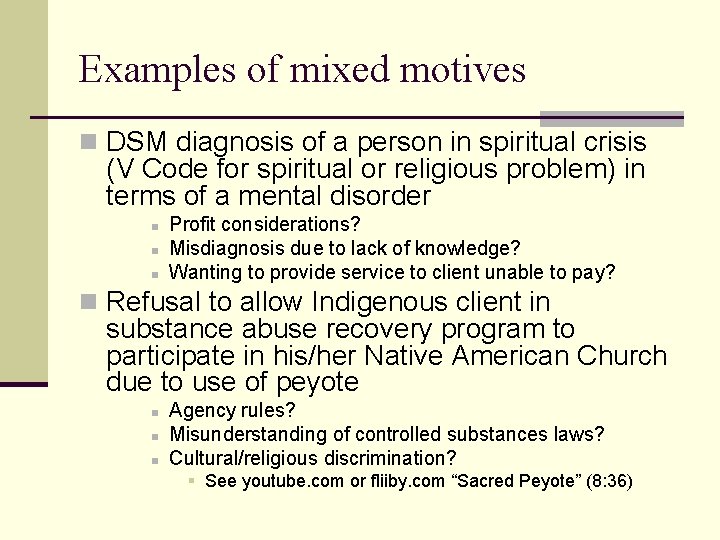
Examples of mixed motives n DSM diagnosis of a person in spiritual crisis (V Code for spiritual or religious problem) in terms of a mental disorder n n n Profit considerations? Misdiagnosis due to lack of knowledge? Wanting to provide service to client unable to pay? n Refusal to allow Indigenous client in substance abuse recovery program to participate in his/her Native American Church due to use of peyote n n n Agency rules? Misunderstanding of controlled substances laws? Cultural/religious discrimination? § See youtube. com or fliiby. com “Sacred Peyote” (8: 36)
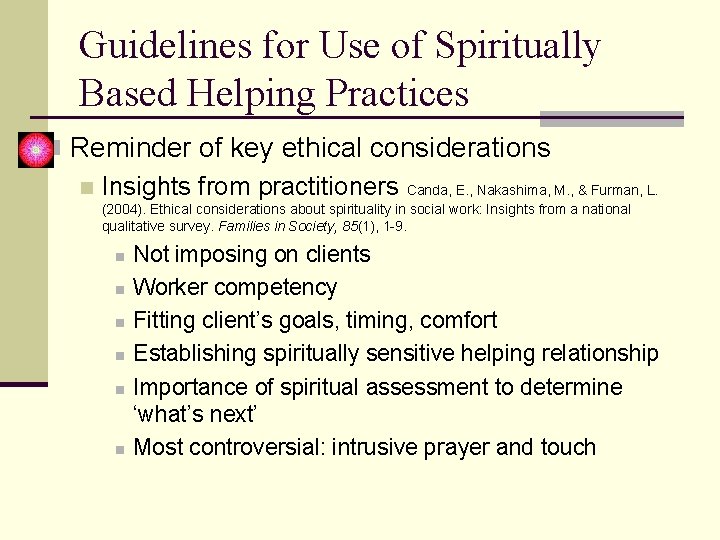
Guidelines for Use of Spiritually Based Helping Practices n Reminder of key ethical considerations n Insights from practitioners Canda, E. , Nakashima, M. , & Furman, L. (2004). Ethical considerations about spirituality in social work: Insights from a national qualitative survey. Families in Society, 85(1), 1 -9. n n n Not imposing on clients Worker competency Fitting client’s goals, timing, comfort Establishing spiritually sensitive helping relationship Importance of spiritual assessment to determine ‘what’s next’ Most controversial: intrusive prayer and touch
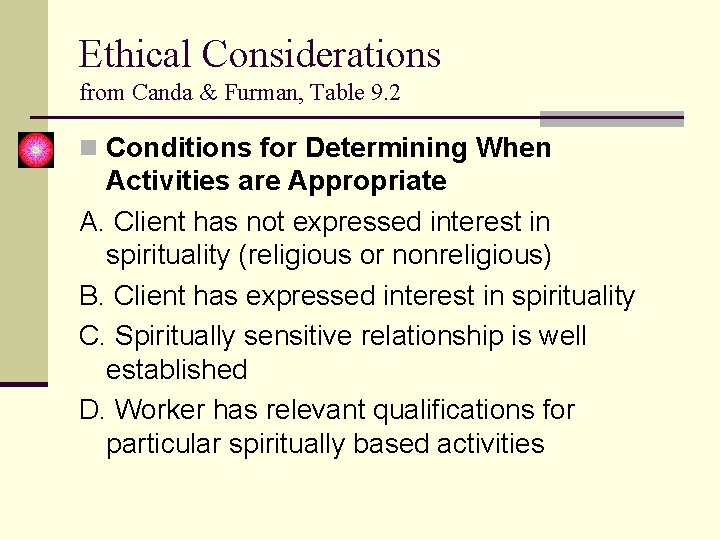
Ethical Considerations from Canda & Furman, Table 9. 2 n Conditions for Determining When Activities are Appropriate A. Client has not expressed interest in spirituality (religious or nonreligious) B. Client has expressed interest in spirituality C. Spiritually sensitive relationship is well established D. Worker has relevant qualifications for particular spiritually based activities
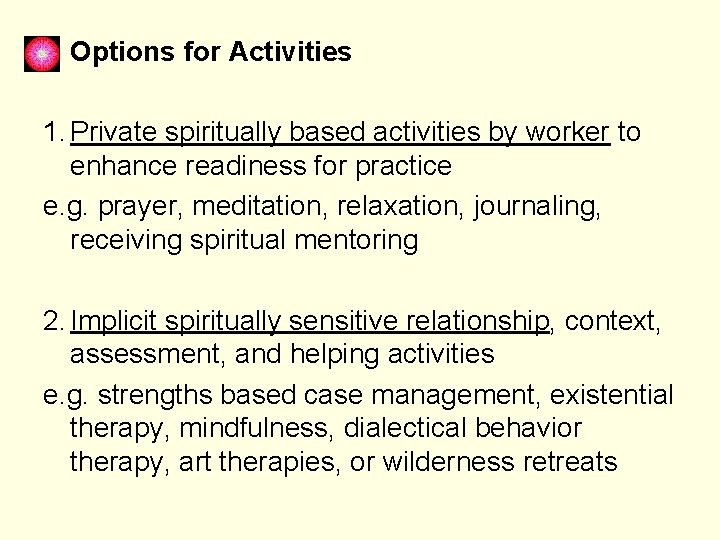
n Options for Activities 1. Private spiritually based activities by worker to enhance readiness for practice e. g. prayer, meditation, relaxation, journaling, receiving spiritual mentoring 2. Implicit spiritually sensitive relationship, context, assessment, and helping activities e. g. strengths based case management, existential therapy, mindfulness, dialectical behavior therapy, art therapies, or wilderness retreats
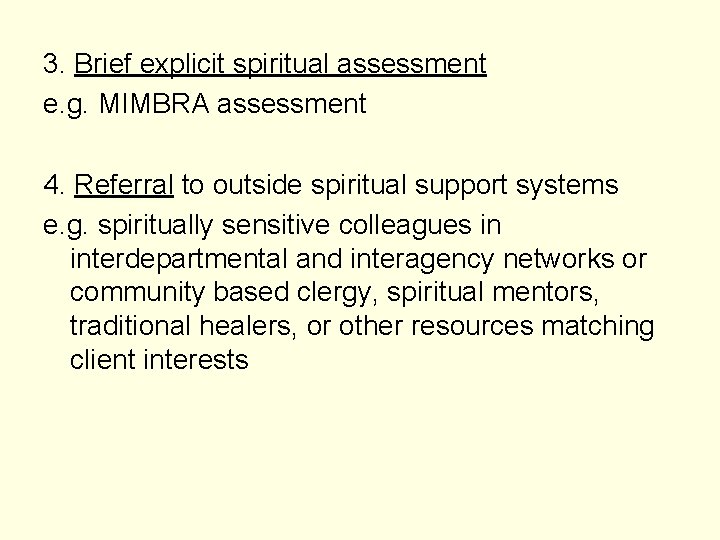
3. Brief explicit spiritual assessment e. g. MIMBRA assessment 4. Referral to outside spiritual support systems e. g. spiritually sensitive colleagues in interdepartmental and interagency networks or community based clergy, spiritual mentors, traditional healers, or other resources matching client interests
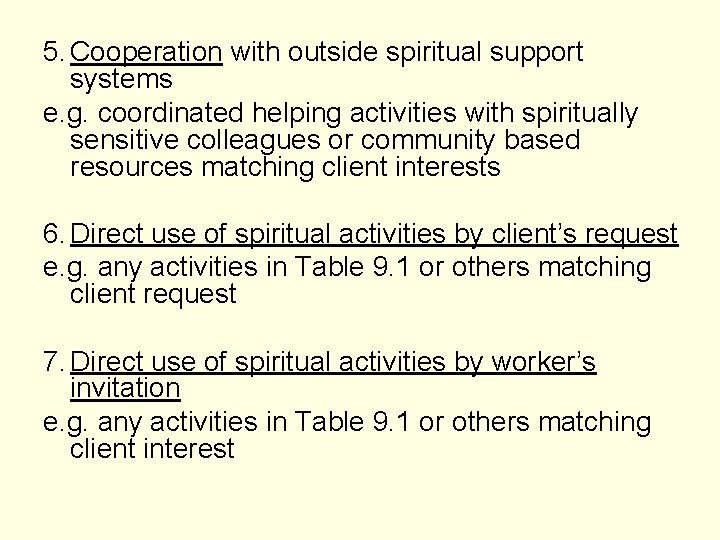
5. Cooperation with outside spiritual support systems e. g. coordinated helping activities with spiritually sensitive colleagues or community based resources matching client interests 6. Direct use of spiritual activities by client’s request e. g. any activities in Table 9. 1 or others matching client request 7. Direct use of spiritual activities by worker’s invitation e. g. any activities in Table 9. 1 or others matching client interest
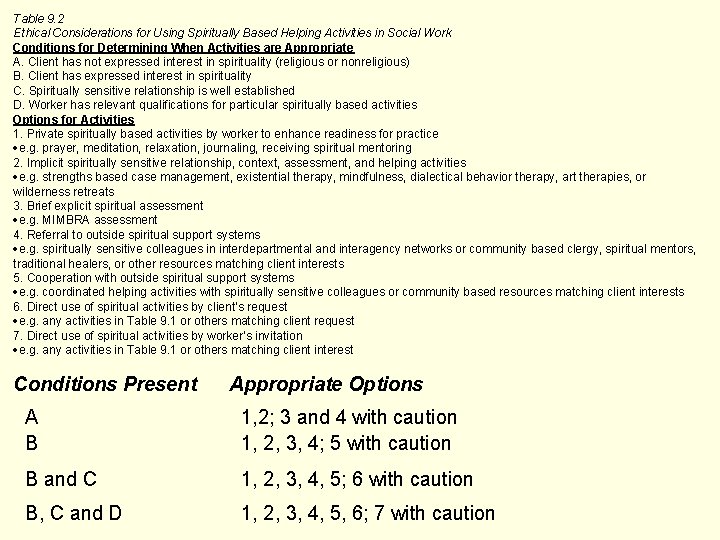
Table 9. 2 Ethical Considerations for Using Spiritually Based Helping Activities in Social Work Conditions for Determining When Activities are Appropriate A. Client has not expressed interest in spirituality (religious or nonreligious) B. Client has expressed interest in spirituality C. Spiritually sensitive relationship is well established D. Worker has relevant qualifications for particular spiritually based activities Options for Activities 1. Private spiritually based activities by worker to enhance readiness for practice e. g. prayer, meditation, relaxation, journaling, receiving spiritual mentoring 2. Implicit spiritually sensitive relationship, context, assessment, and helping activities e. g. strengths based case management, existential therapy, mindfulness, dialectical behavior therapy, art therapies, or wilderness retreats 3. Brief explicit spiritual assessment e. g. MIMBRA assessment 4. Referral to outside spiritual support systems e. g. spiritually sensitive colleagues in interdepartmental and interagency networks or community based clergy, spiritual mentors, traditional healers, or other resources matching client interests 5. Cooperation with outside spiritual support systems e. g. coordinated helping activities with spiritually sensitive colleagues or community based resources matching client interests 6. Direct use of spiritual activities by client’s request e. g. any activities in Table 9. 1 or others matching client request 7. Direct use of spiritual activities by worker’s invitation e. g. any activities in Table 9. 1 or others matching client interest Conditions Present Appropriate Options A B 1, 2; 3 and 4 with caution 1, 2, 3, 4; 5 with caution B and C 1, 2, 3, 4, 5; 6 with caution B, C and D 1, 2, 3, 4, 5, 6; 7 with caution