
Spiral Growth in Nature Chapter 9 Fibonacci Numbers
Spiral Growth in Nature Chapter 9
Fibonacci Numbers • 1, 1, 2, 3, 5, 8, 13, 21, 34, 55, 89, 144, . . Is a widely known Fibonacci numbers. • They are named after the Italian Leonardo de Pisa, better known by the nickname Fibonacci. • The first two numbers stand their own. • After the first two, each subsequent number is the sum of the two numbers before it. 2= 1+1, 3 = 2 + 1, 5 = 3+2, …

Fibonacci Numbers • Does the list of Fibonacci numbers ever end? No. • The list goes on forever, with each new number in the sequence equal to the sum of the previous two. • Each Fibonacci number has its place in the Fibonacci sequence. • The standard mathematical notation to describe a Fibonacci number is an F followed by a subscript indicating its place in the sequence. For example, F 8 stands for the eighth Fibonacci number, which is 21 (F 8 = 21).

Fibonacci Numbers • Fibonacci numbers that come before FN, are FN -1 and FN-2. • The notation to find a Fibonacci number FN from two previous Fibonacci numbers FN-1 and FN-2 is given by: FN = FN-1 + FN-2 • Where FN is a generic Fibonacci number, FN-1 is a Fibonacci number right before it and FN-2 is a Fibonacci number two positions before it. • We must give the values of F 1= 1 and F 2 = 1
Fibonacci Numbers (Recursive definition) • Seeds: F 1= 1 and F 2 = 1 • Recursive Rules: FN = FN-1 + FN-2 (N >= 3)
Fibonacci Numbers (Recursive definition) • The recursive definition gives us a blueprint as to how to calculate any Fibonacci number (E. g. , F 100), but it is an arduous climb up the hill, one step at a time. • Imagine climbing up to F 500 or F 1000. • The practical limitations of the recursive definition lead naturally to the question, Is there a better way? There is.
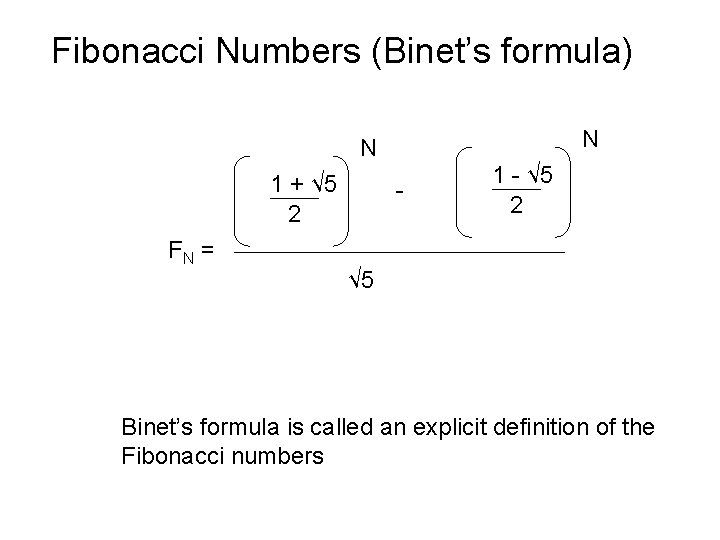
Fibonacci Numbers (Binet’s formula) N N 1 + √ 5 2 FN = - 1 - √ 5 2 √ 5 Binet’s formula is called an explicit definition of the Fibonacci numbers
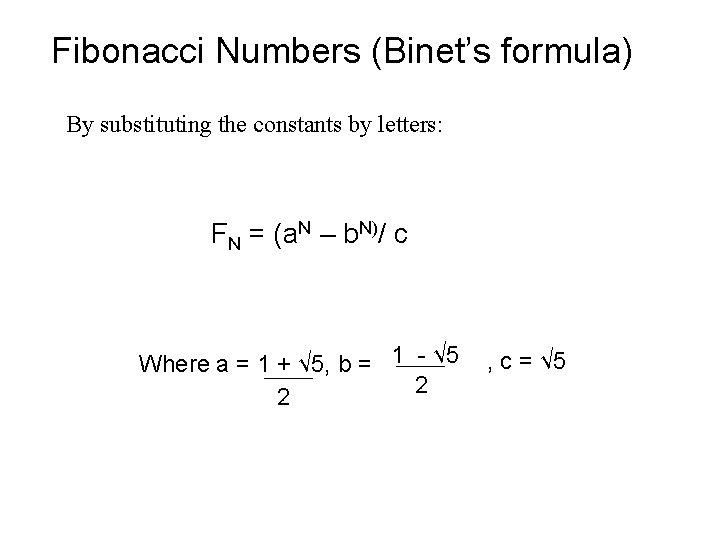
Fibonacci Numbers (Binet’s formula) By substituting the constants by letters: FN = (a. N – b. N)/ c Where a = 1 + √ 5, b = 1 - √ 5 2 2 , c = √ 5
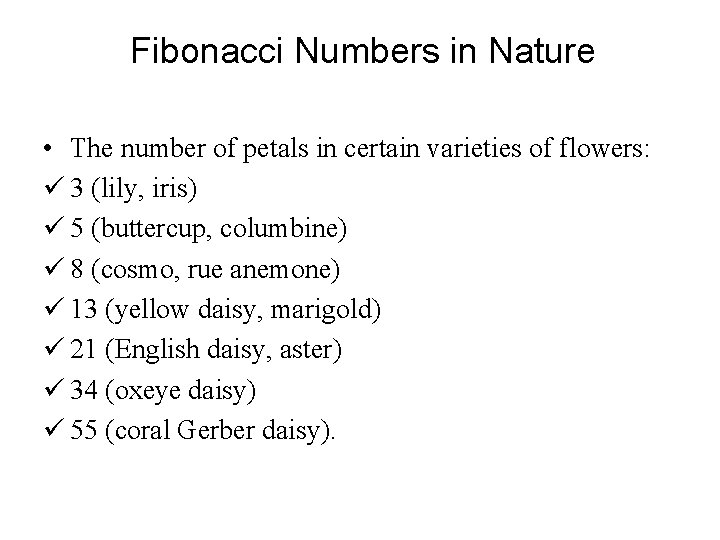
Fibonacci Numbers in Nature • The number of petals in certain varieties of flowers: ü 3 (lily, iris) ü 5 (buttercup, columbine) ü 8 (cosmo, rue anemone) ü 13 (yellow daisy, marigold) ü 21 (English daisy, aster) ü 34 (oxeye daisy) ü 55 (coral Gerber daisy).
- Slides: 9