
SpinWarp Imaging For each RF pulse Frequency encoding
- Slides: 36
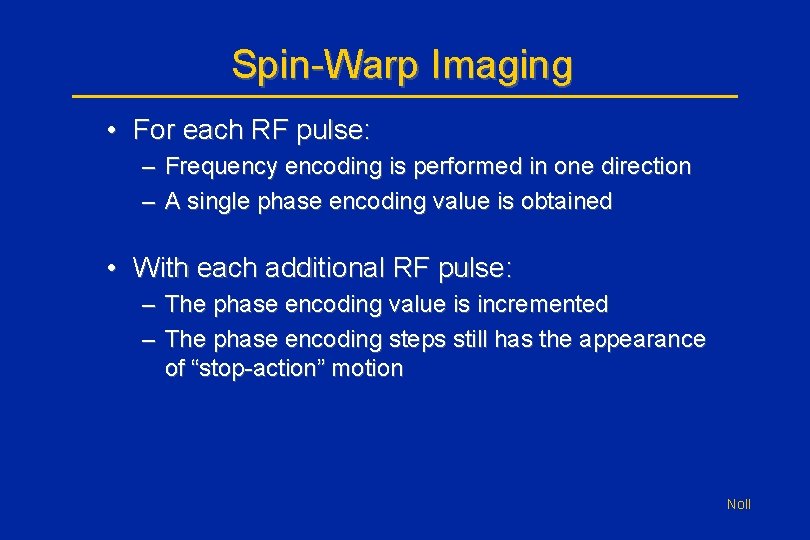
Spin-Warp Imaging • For each RF pulse: – Frequency encoding is performed in one direction – A single phase encoding value is obtained • With each additional RF pulse: – The phase encoding value is incremented – The phase encoding steps still has the appearance of “stop-action” motion Noll
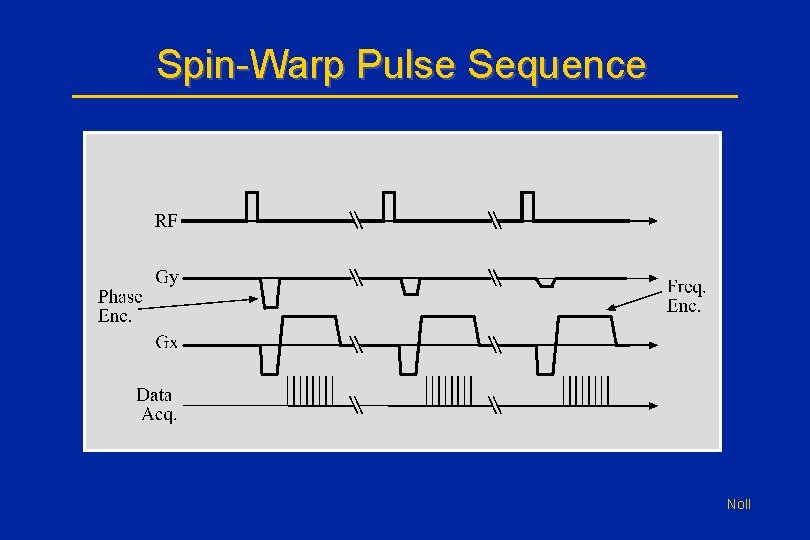
Spin-Warp Pulse Sequence Noll
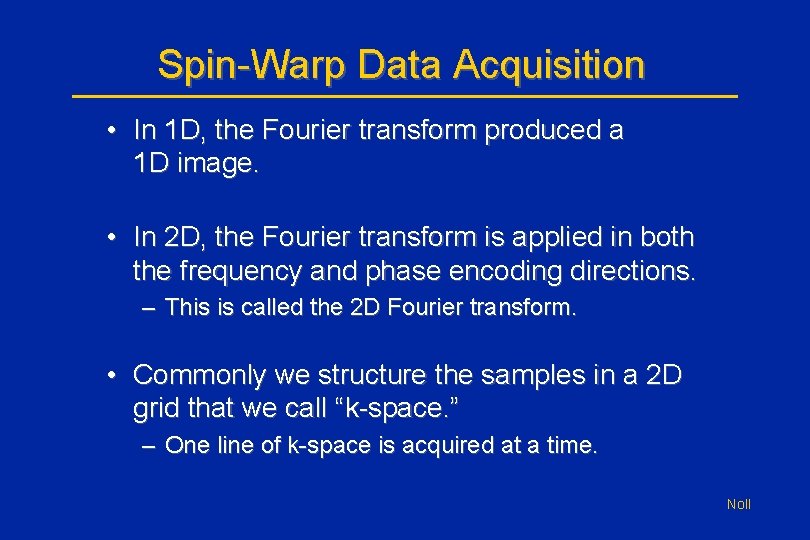
Spin-Warp Data Acquisition • In 1 D, the Fourier transform produced a 1 D image. • In 2 D, the Fourier transform is applied in both the frequency and phase encoding directions. – This is called the 2 D Fourier transform. • Commonly we structure the samples in a 2 D grid that we call “k-space. ” – One line of k-space is acquired at a time. Noll
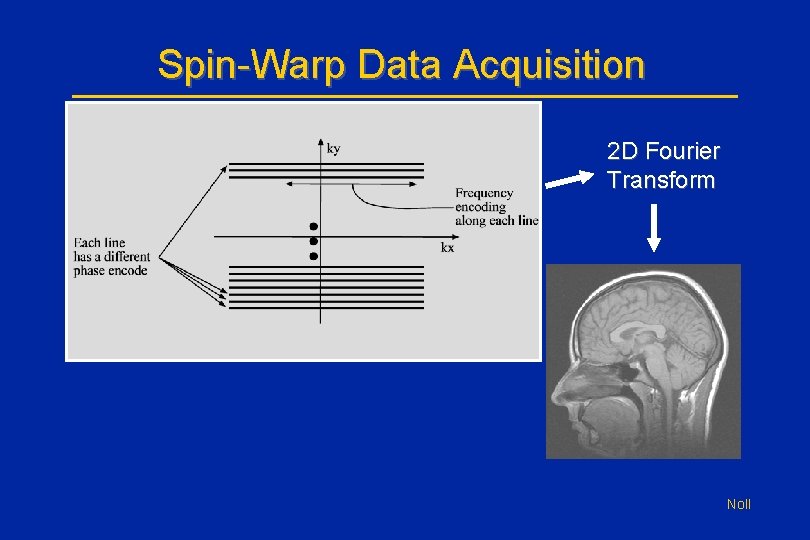
Spin-Warp Data Acquisition 2 D Fourier Transform Noll
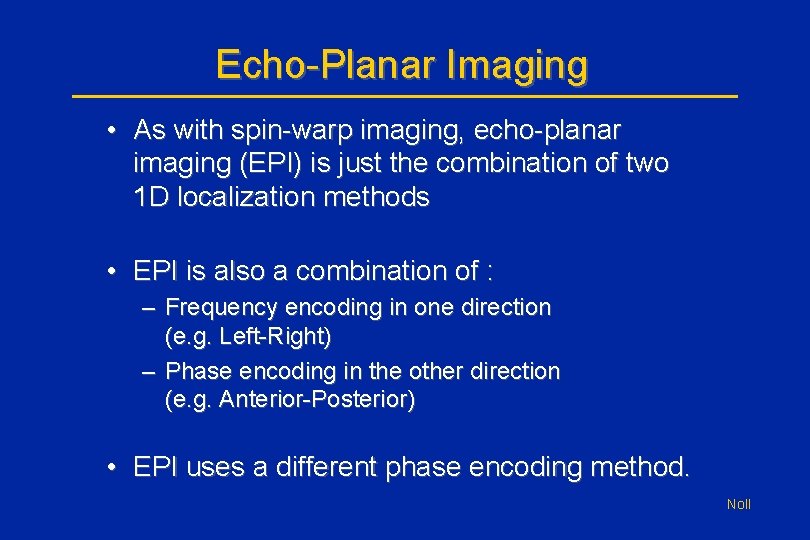
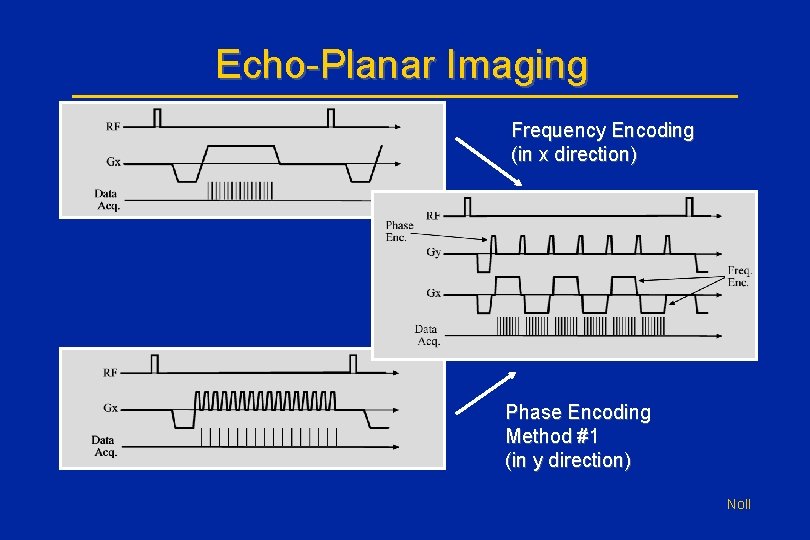
Echo-Planar Imaging • As with spin-warp imaging, echo-planar imaging (EPI) is just the combination of two 1 D localization methods • EPI is also a combination of : – Frequency encoding in one direction (e. g. Left-Right) – Phase encoding in the other direction (e. g. Anterior-Posterior) • EPI uses a different phase encoding method. Noll
Echo-Planar Imaging Frequency Encoding (in x direction) Phase Encoding Method #1 (in y direction) Noll
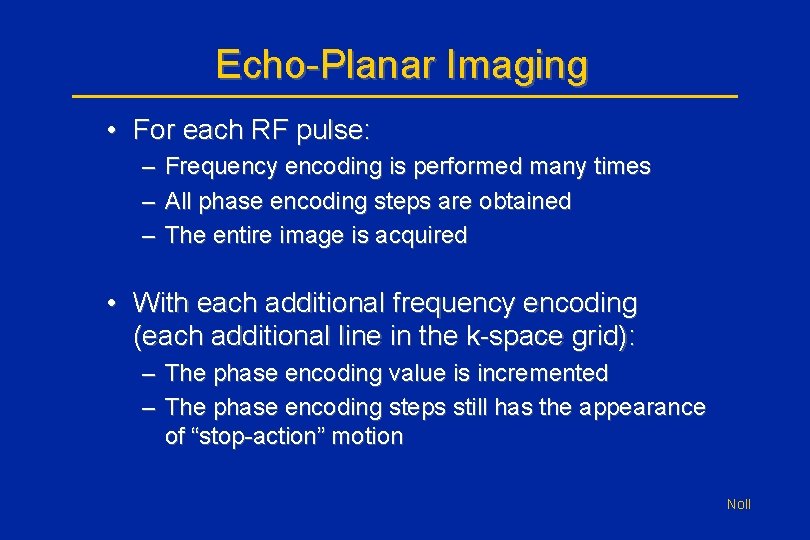
Echo-Planar Imaging • For each RF pulse: – – – Frequency encoding is performed many times All phase encoding steps are obtained The entire image is acquired • With each additional frequency encoding (each additional line in the k-space grid): – The phase encoding value is incremented – The phase encoding steps still has the appearance of “stop-action” motion Noll
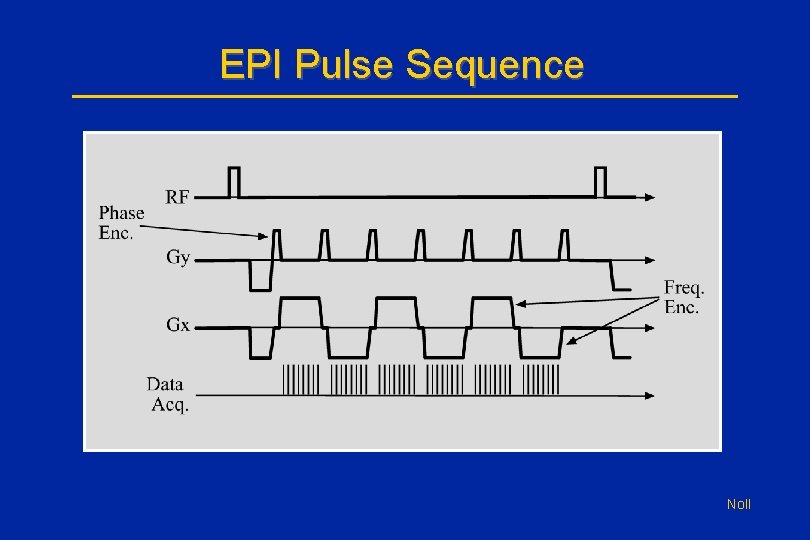
EPI Pulse Sequence Noll
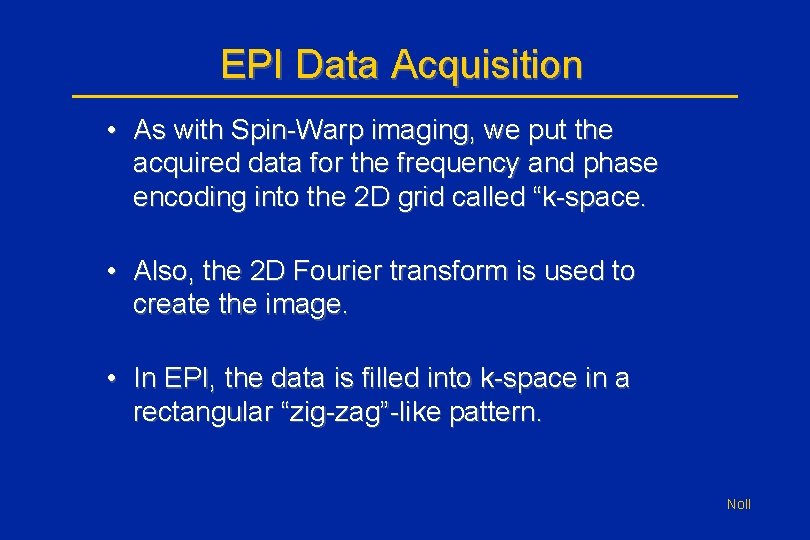
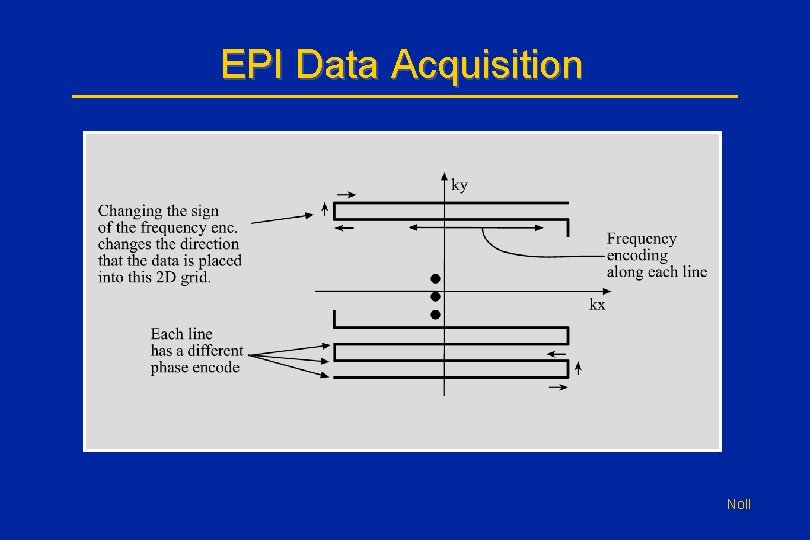
EPI Data Acquisition • As with Spin-Warp imaging, we put the acquired data for the frequency and phase encoding into the 2 D grid called “k-space. • Also, the 2 D Fourier transform is used to create the image. • In EPI, the data is filled into k-space in a rectangular “zig-zag”-like pattern. Noll
EPI Data Acquisition Noll
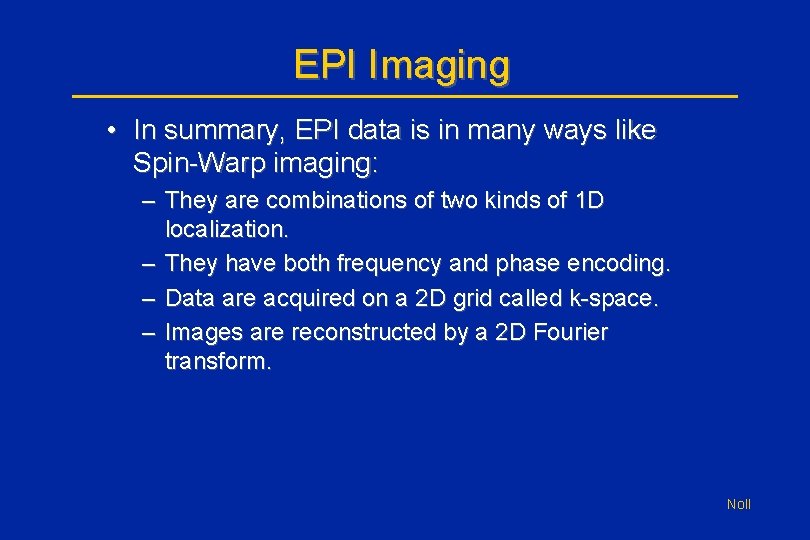
EPI Imaging • In summary, EPI data is in many ways like Spin-Warp imaging: – They are combinations of two kinds of 1 D localization. – They have both frequency and phase encoding. – Data are acquired on a 2 D grid called k-space. – Images are reconstructed by a 2 D Fourier transform. Noll
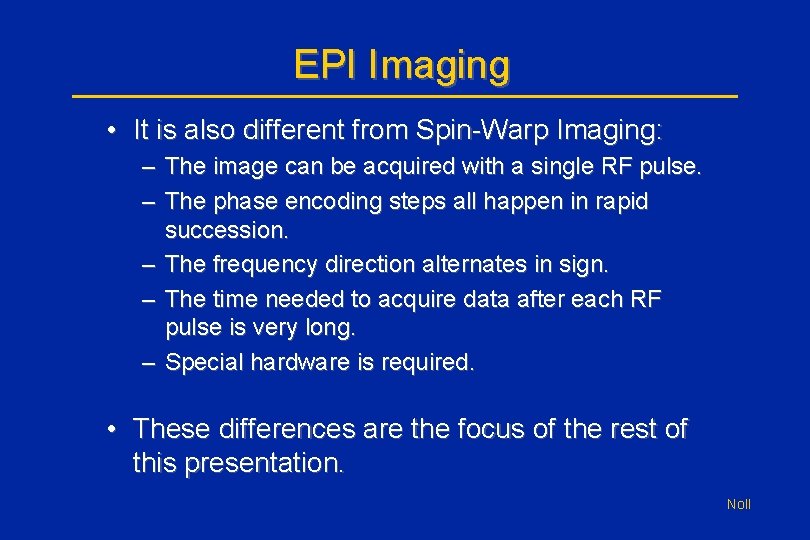
EPI Imaging • It is also different from Spin-Warp Imaging: – The image can be acquired with a single RF pulse. – The phase encoding steps all happen in rapid succession. – The frequency direction alternates in sign. – The time needed to acquire data after each RF pulse is very long. – Special hardware is required. • These differences are the focus of the rest of this presentation. Noll
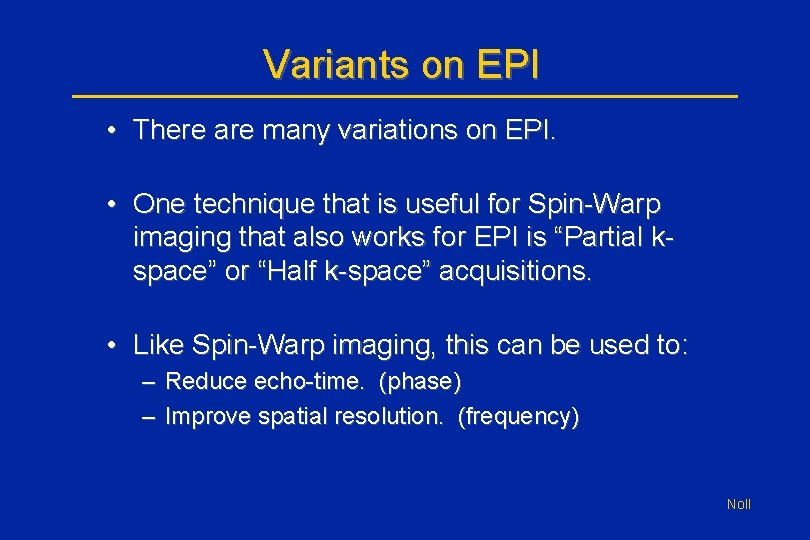
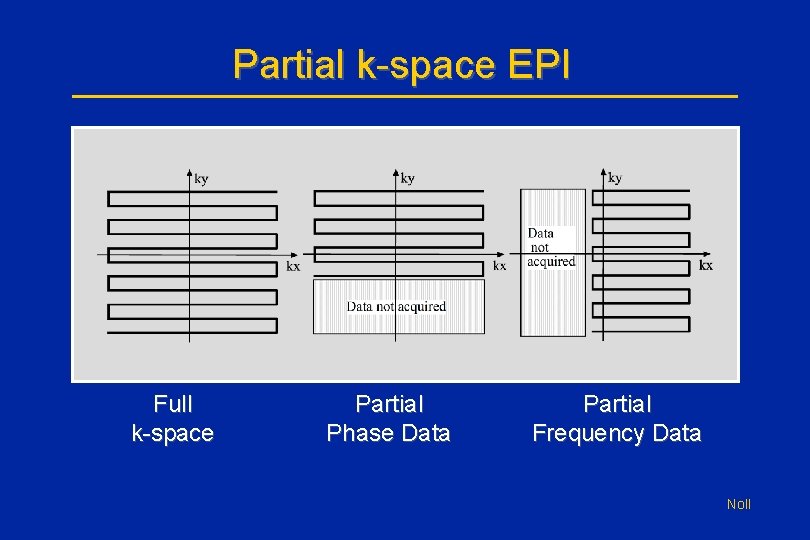
Variants on EPI • There are many variations on EPI. • One technique that is useful for Spin-Warp imaging that also works for EPI is “Partial kspace” or “Half k-space” acquisitions. • Like Spin-Warp imaging, this can be used to: – Reduce echo-time. (phase) – Improve spatial resolution. (frequency) Noll
Partial k-space EPI Full k-space Partial Phase Data Partial Frequency Data Noll
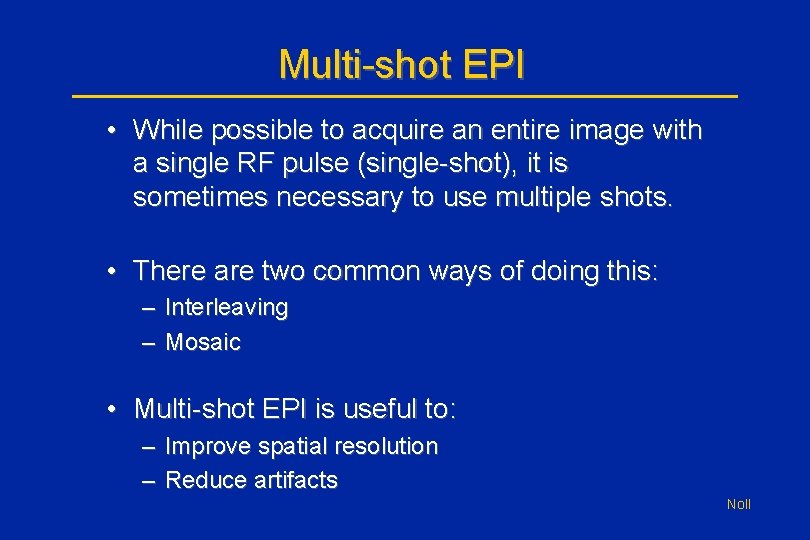
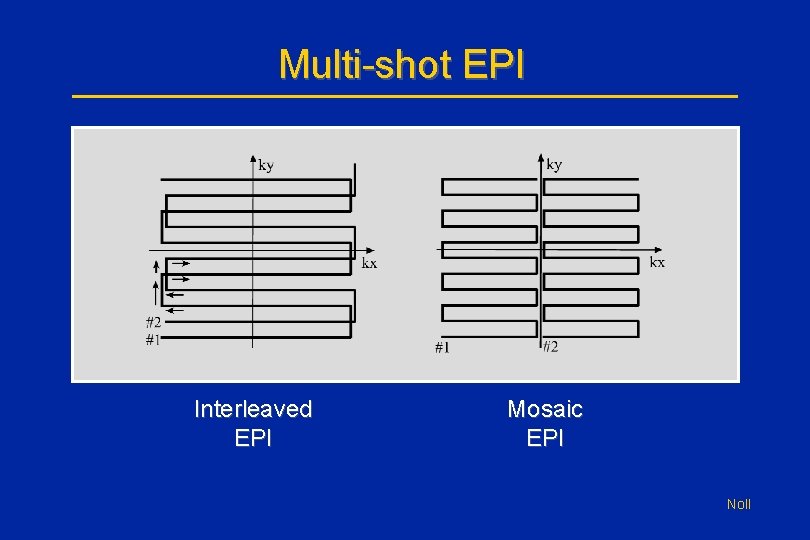
Multi-shot EPI • While possible to acquire an entire image with a single RF pulse (single-shot), it is sometimes necessary to use multiple shots. • There are two common ways of doing this: – Interleaving – Mosaic • Multi-shot EPI is useful to: – Improve spatial resolution – Reduce artifacts Noll
Multi-shot EPI Interleaved EPI Mosaic EPI Noll
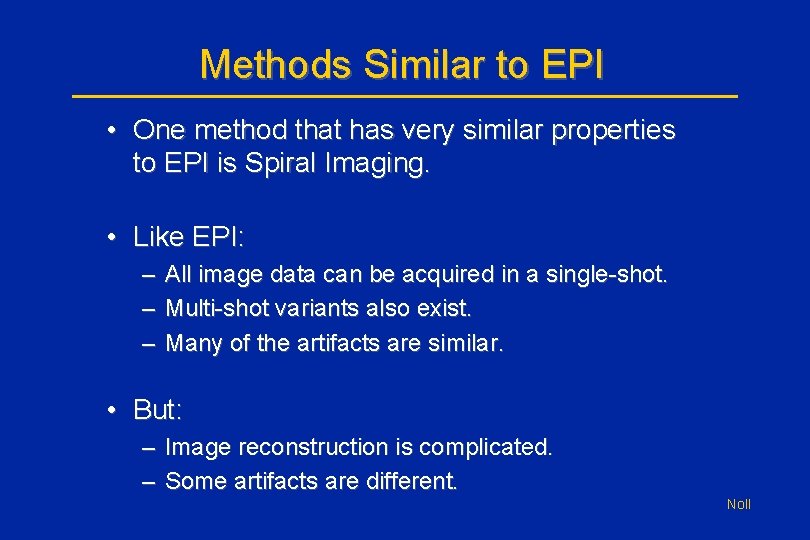
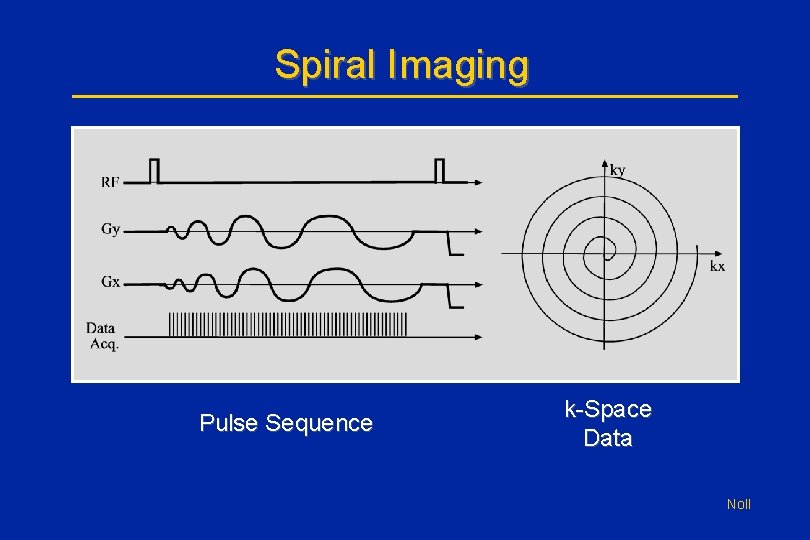
Methods Similar to EPI • One method that has very similar properties to EPI is Spiral Imaging. • Like EPI: – All image data can be acquired in a single-shot. – Multi-shot variants also exist. – Many of the artifacts are similar. • But: – Image reconstruction is complicated. – Some artifacts are different. Noll
Spiral Imaging Pulse Sequence k-Space Data Noll
EPI Parameters • Many parameters are the same as in spinwarp imaging: – – – SE vs. GRE or IR TR, TE, Flip Angle, TI FOV, matrix size, spatial resolution • Some parameters require extra thought, however: – If only a single image is acquired usingle-shot EPI, the TR might be meaningless. (TR is infinite) Noll
Scan Time in EPI • The scan time is most closely related to the “number of shots” and not matrix size. – Scan Time = (number of shots)*(TR) – Not (number of phase encodes)*(TR) • Consider 64 x 64 single-shot EPI and 128 x 128 single-shot EPI - both are single-shot and take a single RF pulse to acquire an image. • If 128 x 128 has artifacts that are too severe, however, multi-shot EPI may be required. Noll
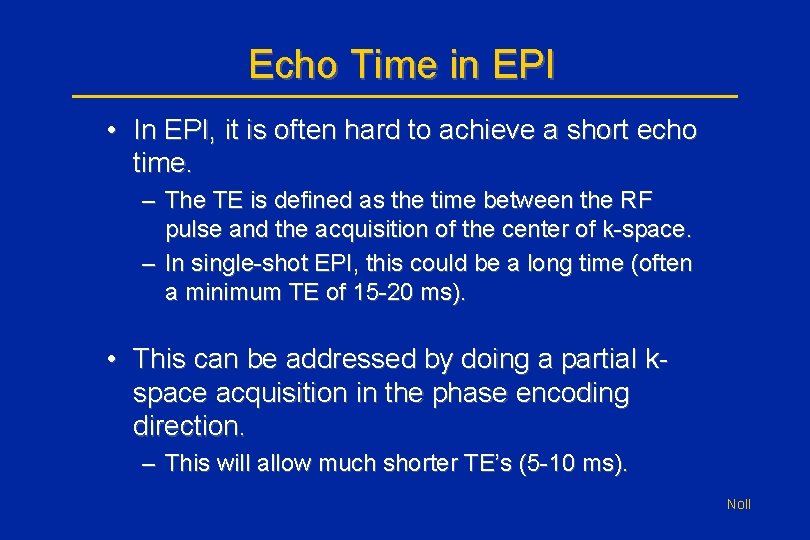
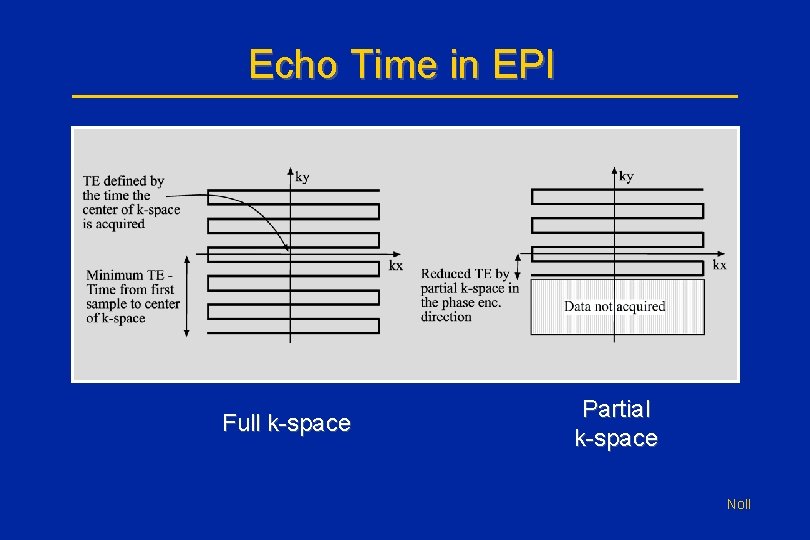
Echo Time in EPI • In EPI, it is often hard to achieve a short echo time. – The TE is defined as the time between the RF pulse and the acquisition of the center of k-space. – In single-shot EPI, this could be a long time (often a minimum TE of 15 -20 ms). • This can be addressed by doing a partial kspace acquisition in the phase encoding direction. – This will allow much shorter TE’s (5 -10 ms). Noll
Echo Time in EPI Full k-space Partial k-space Noll
Pulse Sequence Options in EPI • Flow Compensation (Gradient Moment Nulling): – Flow Comp (GNM) is often not as effective with EPI due to the long echo times. – Partial k-space (phase) acquisitions reduce echo time and make this technique more effective. • Spatial and chemical presaturation can also be used (fat saturation is nearly always used). • There also a 3 D (volume) versions of EPI. Noll
T 1 Weighting in EPI • In EPI, short TE’s are difficult to obtain and the TR is often very long. – EPI is not well suited to T 1 -weighted imaging with the usual short TR pulse sequences. • On the other hand, one shot (or a small number of shots) is required for an image. – EPI is well-suited to inversion recovery T 1 weighted imaging. Noll
Artifacts in EPI • The ability to acquire images very rapidly is the strength of the EPI method. • As a result, artifacts resulting from subject motion are nearly non-existent when imaging with single-shot EPI. • Ghosting artifacts resulting from pulsatile blood flow are also extremely rare with singleshot EPI. Noll
Artifacts in EPI • There are however, several kinds of image artifacts that are very different from those seen in spin-warp imaging: – “N/2” or Nyquist ghosting – Distortions from magnetic field inhomogeneity – Chemical shift and susceptibility artifacts Noll
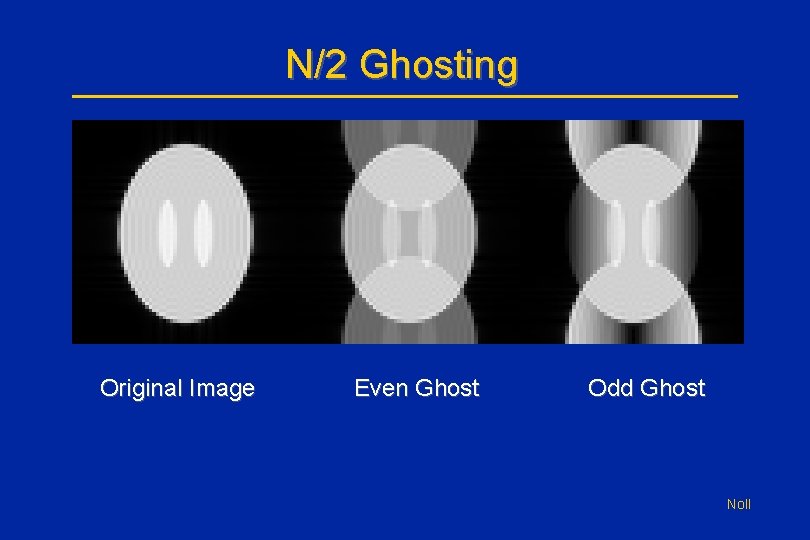
N/2 Ghosting • N/2 (“N over 2”) or Nyquist ghosting artifacts are unique to EPI. – Caused by imperfections in the image acquisition. • There are two distinct kinds: – Even and Odd Ghosts • “Ghost tuning” procedures can reduce or eliminate these ghosts. – Tuning can be done for each day, subject, or scan. – Might also be done automatically (with prescan). Noll
N/2 Ghosting Original Image Even Ghost Odd Ghost Noll
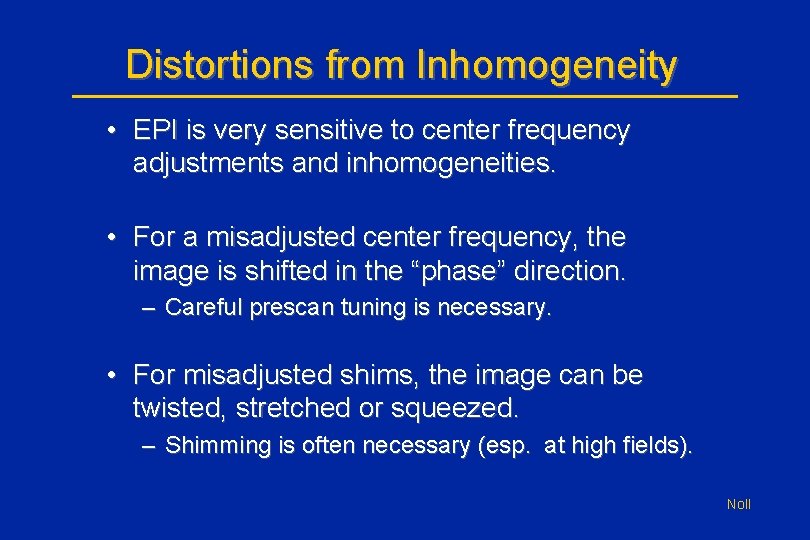
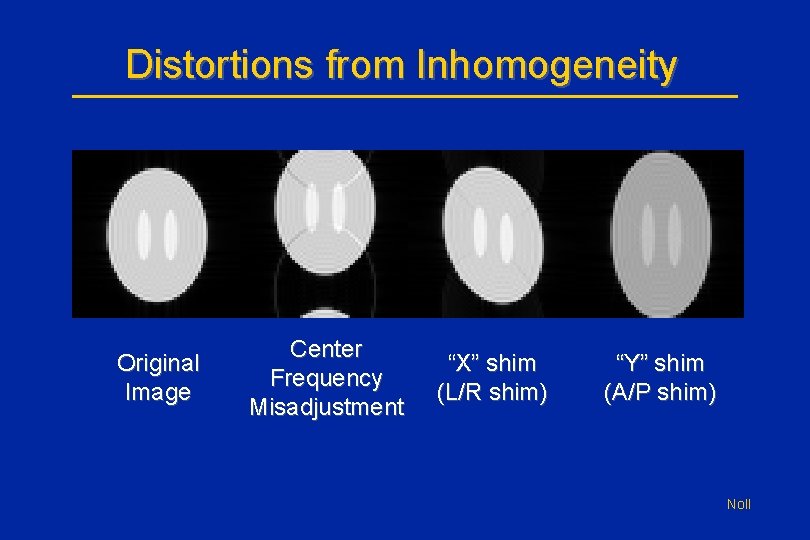
Distortions from Inhomogeneity • EPI is very sensitive to center frequency adjustments and inhomogeneities. • For a misadjusted center frequency, the image is shifted in the “phase” direction. – Careful prescan tuning is necessary. • For misadjusted shims, the image can be twisted, stretched or squeezed. – Shimming is often necessary (esp. at high fields). Noll
Distortions from Inhomogeneity Original Image Center Frequency Misadjustment “X” shim (L/R shim) “Y” shim (A/P shim) Noll
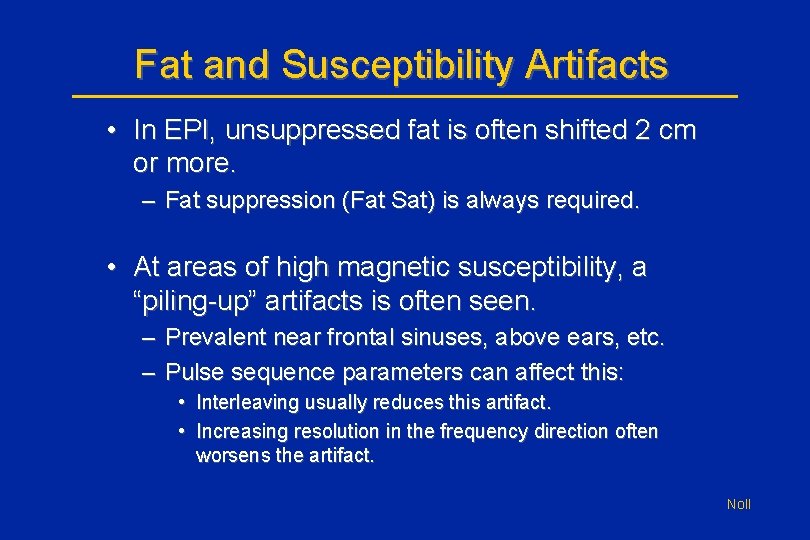
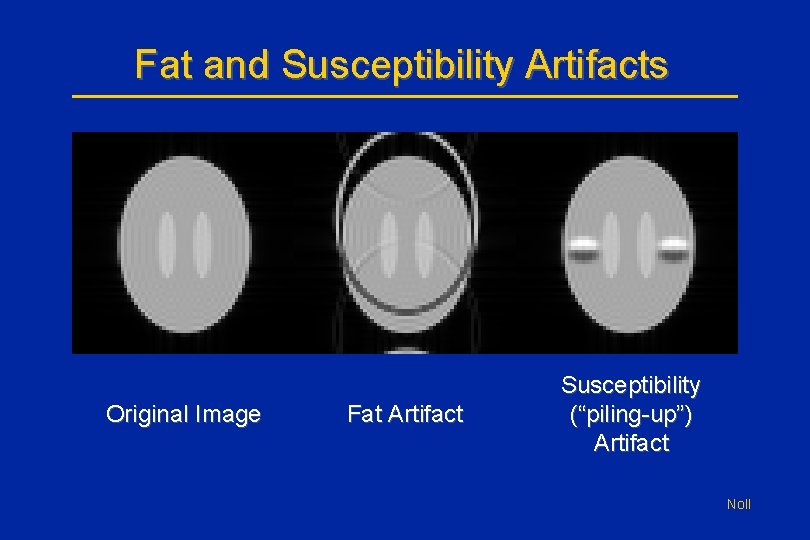
Fat and Susceptibility Artifacts • In EPI, unsuppressed fat is often shifted 2 cm or more. – Fat suppression (Fat Sat) is always required. • At areas of high magnetic susceptibility, a “piling-up” artifacts is often seen. – Prevalent near frontal sinuses, above ears, etc. – Pulse sequence parameters can affect this: • Interleaving usually reduces this artifact. • Increasing resolution in the frequency direction often worsens the artifact. Noll
Fat and Susceptibility Artifacts Original Image Fat Artifact Susceptibility (“piling-up”) Artifact Noll
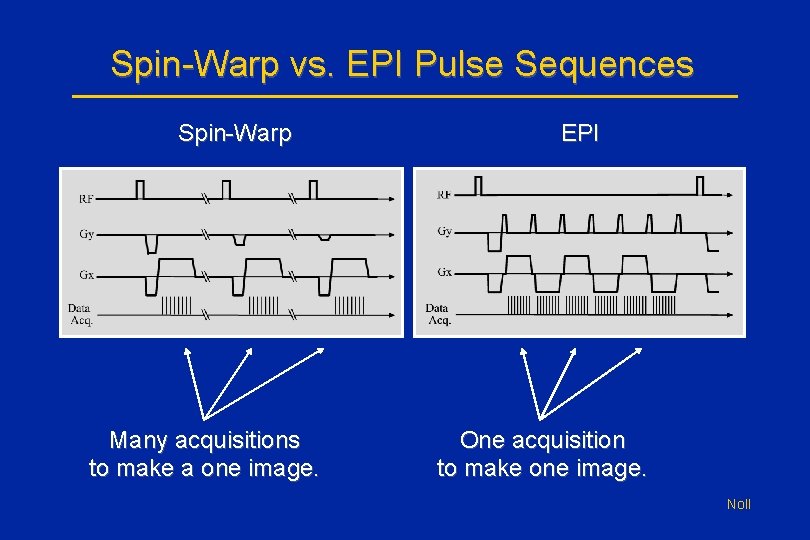
EPI Hardware • EPI is an extremely rapid and useful imaging method. • It does, however, require some special, high performance hardware. Why? – In spin-warp, we acquire a small piece of data for an image with each RF pulse. – However in EPI, we try to acquire all of the data for an image with a single RF pulse. Noll
Spin-Warp vs. EPI Pulse Sequences Spin-Warp Many acquisitions to make a one image. EPI One acquisition to make one image. Noll
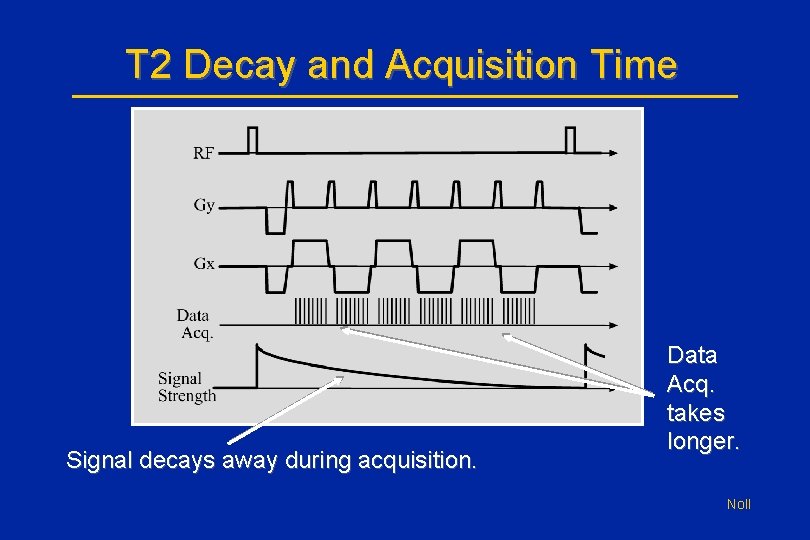
T 2 Decay and Acquisition Time • In spin-warp imaging, only a single phase encode need to be acquired. – Only takes a short time. • In EPI, all phase encode lines need to be acquired. – Takes longer. – Without special hardware - 100 ms to 1 second. • T 2 decay reduces signal throughout data acquisition. Noll
T 2 Decay and Acquisition Time Signal decays away during acquisition. Data Acq. takes longer. Noll