
SpinradWorld History English Civil War and Glorious Revolution
- Slides: 29
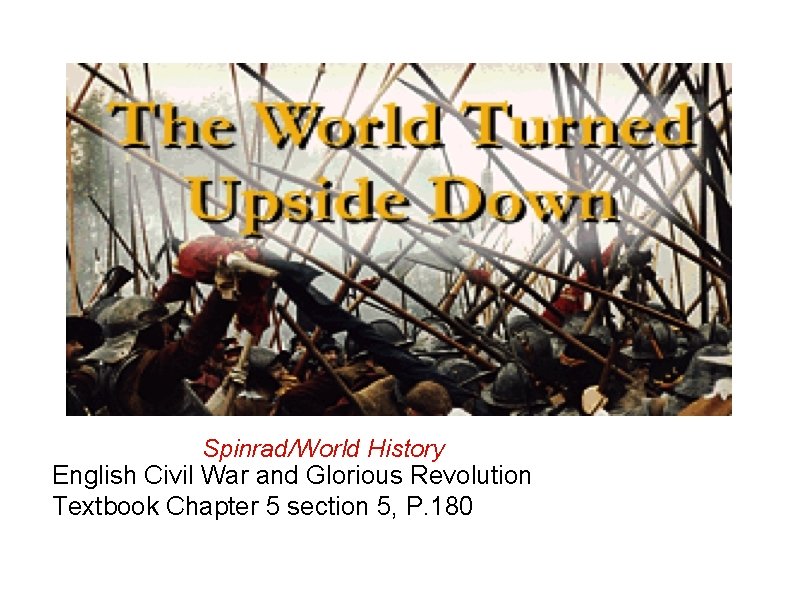
Spinrad/World History English Civil War and Glorious Revolution Textbook Chapter 5 section 5, P. 180
Why Should You Care? • Political democracy rests on the principal that gov’t derives (gets) its power from the consent (the “OK”) of the governed. • The foundations of English civil rights are: • 1. jury trial • 2. the Magna Carta • 3. common law • The English Civil War prompted further development of the rights of the common Englishman
What You Should Ask Yourself (and be able to answer) • How did the English Civil War and the Glorious Revolution (two different events) promote the development of the rights of Englishmen? How did these events then lead to the forming of American political documents?
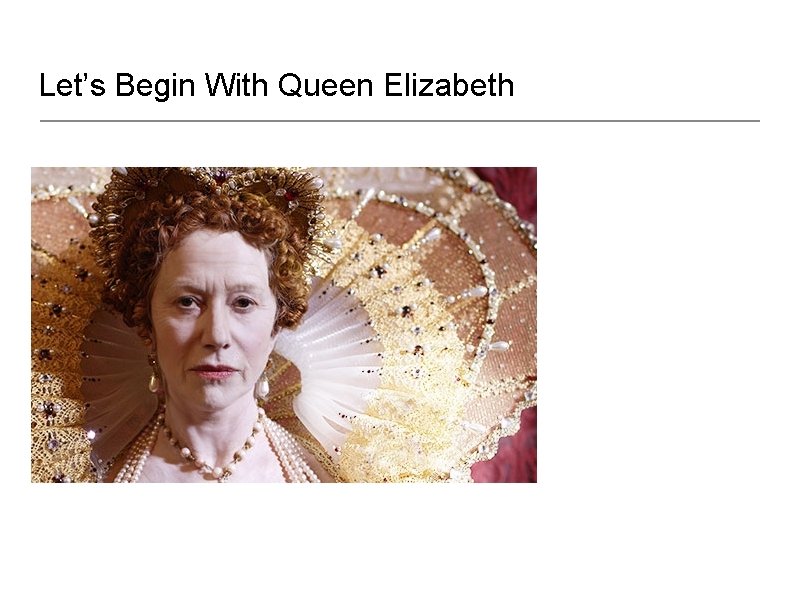
Let’s Begin With Queen Elizabeth
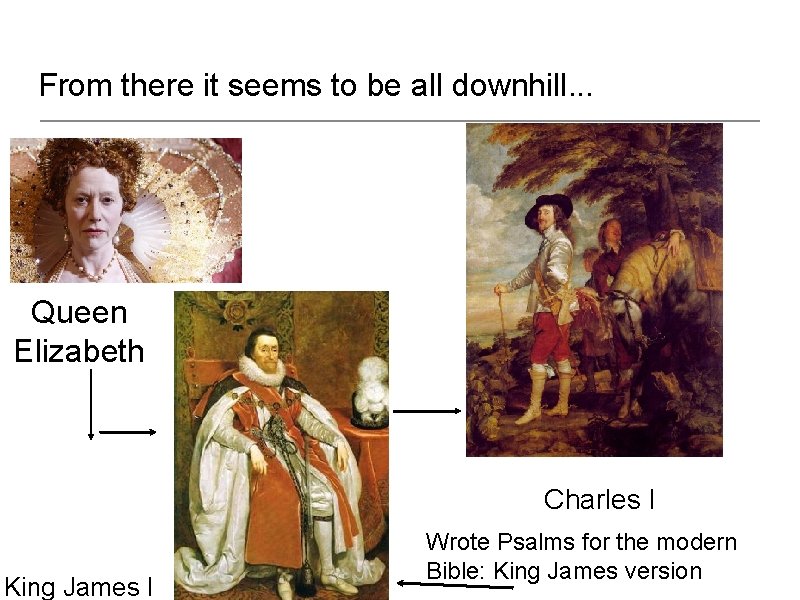
From there it seems to be all downhill. . . Queen Elizabeth Charles I King James I Wrote Psalms for the modern Bible: King James version
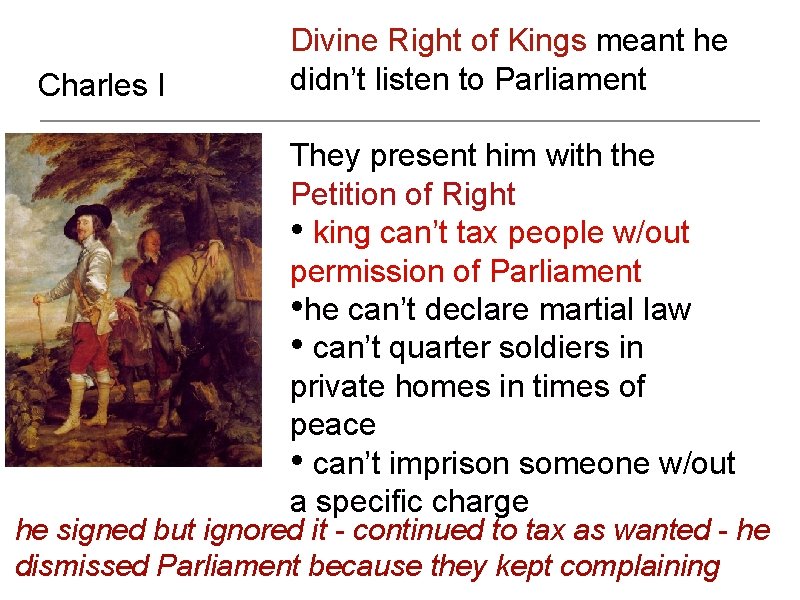
Charles I Divine Right of Kings meant he didn’t listen to Parliament They present him with the Petition of Right • king can’t tax people w/out permission of Parliament • he can’t declare martial law • can’t quarter soldiers in private homes in times of peace • can’t imprison someone w/out a specific charge he signed but ignored it - continued to tax as wanted - he dismissed Parliament because they kept complaining
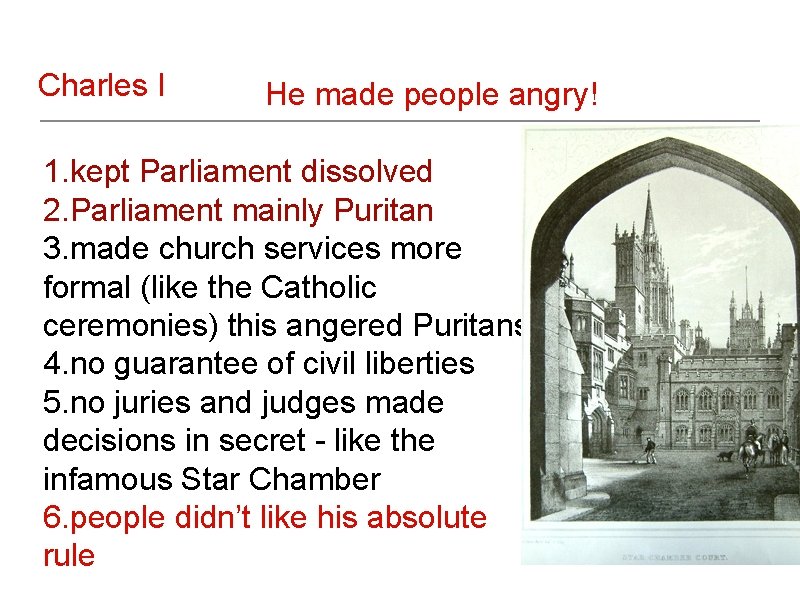
Charles I He made people angry! 1. kept Parliament dissolved 2. Parliament mainly Puritan 3. made church services more formal (like the Catholic ceremonies) this angered Puritans 4. no guarantee of civil liberties 5. no juries and judges made decisions in secret - like the infamous Star Chamber 6. people didn’t like his absolute rule
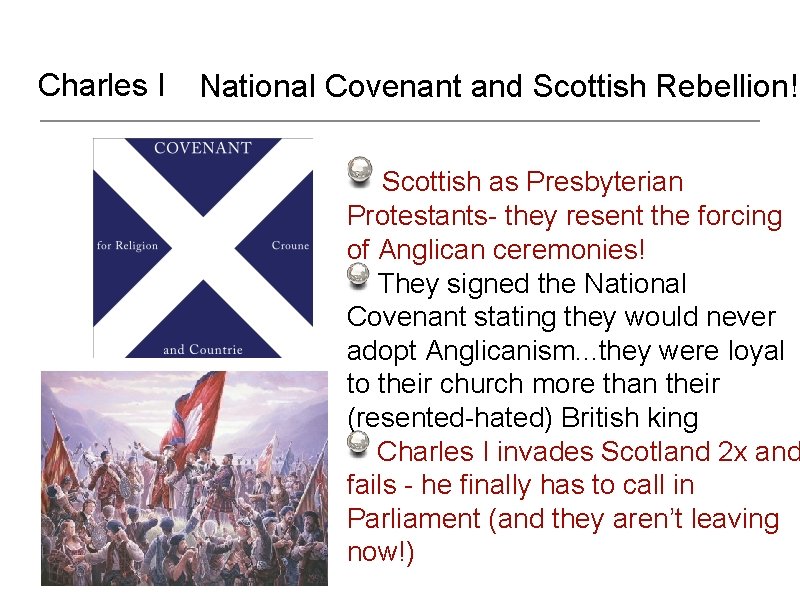
Charles I National Covenant and Scottish Rebellion! Scottish as Presbyterian Protestants- they resent the forcing of Anglican ceremonies! They signed the National Covenant stating they would never adopt Anglicanism. . . they were loyal to their church more than their (resented-hated) British king Charles I invades Scotland 2 x and fails - he finally has to call in Parliament (and they aren’t leaving now!)
This new Parliament is called the Long Parliament New Laws o. King can’t dissolve Parliament o Parliament must meet at least one time every 3 years o tried to change Anglican Church wasn’t successful Meanwhile. . bloody rebellion in British-controlled lands of Ireland Parliament said they needed an army. Charles refused and tried to arrest Parliament’s leaders leading to civil war in 1642 between Parliament (Puritans) and forces loyal to Charles.
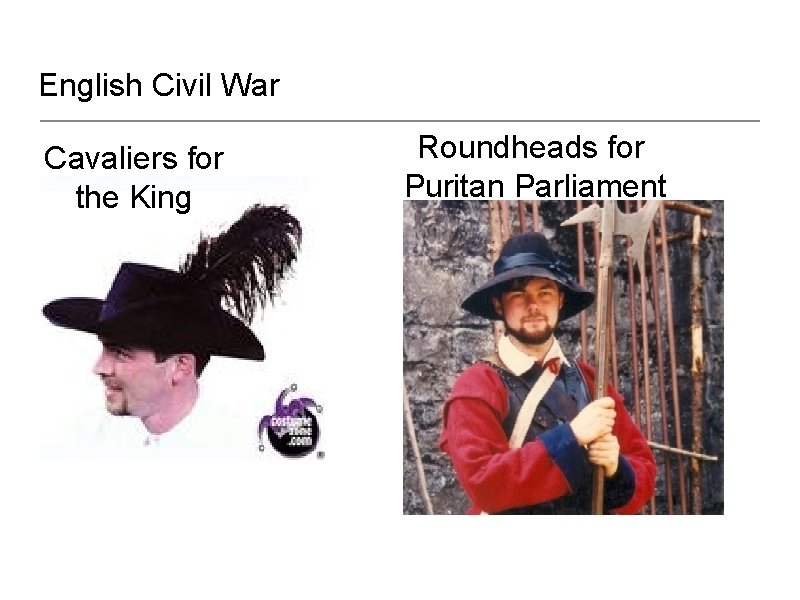
English Civil War Cavaliers for the King Roundheads for Puritan Parliament
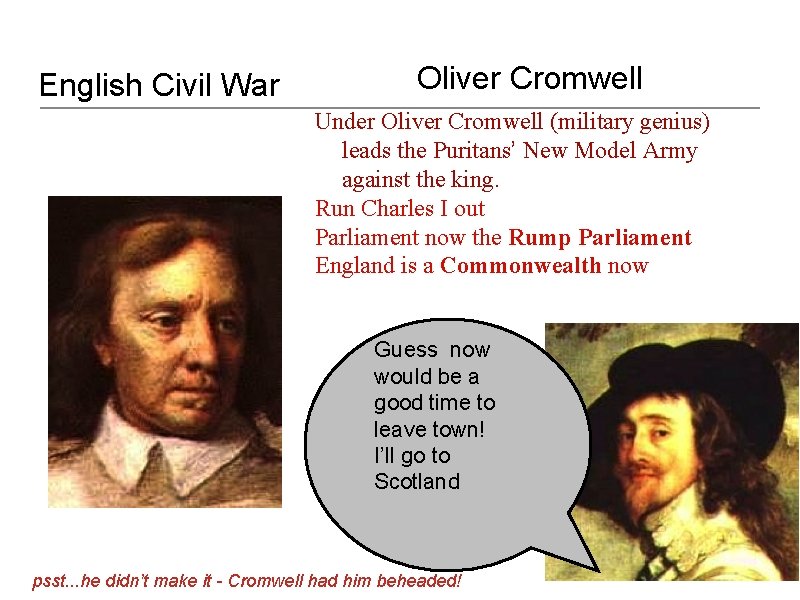
English Civil War Oliver Cromwell Under Oliver Cromwell (military genius) leads the Puritans’ New Model Army against the king. Run Charles I out Parliament now the Rump Parliament England is a Commonwealth now Guess now would be a good time to leave town! I’ll go to Scotland psst. . . he didn’t make it - Cromwell had him beheaded!
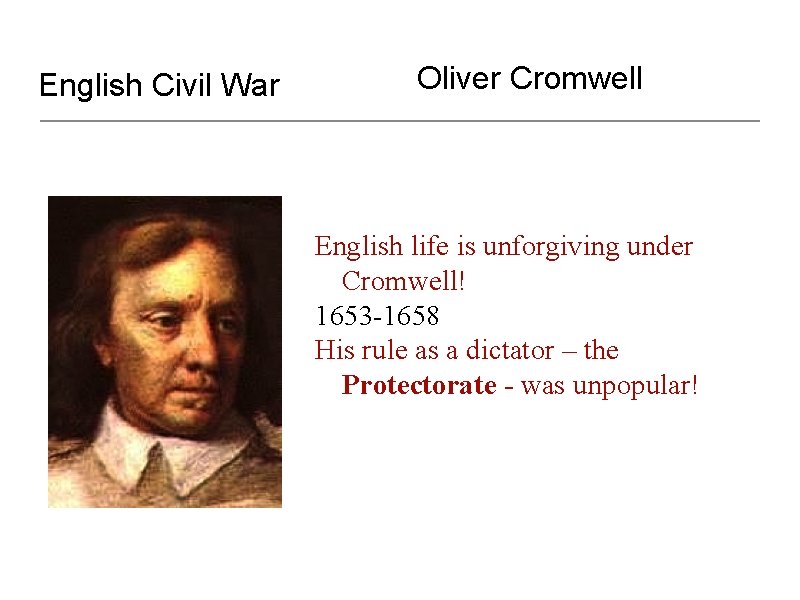
English Civil War Oliver Cromwell English life is unforgiving under Cromwell! 1653 -1658 His rule as a dictator – the Protectorate - was unpopular!
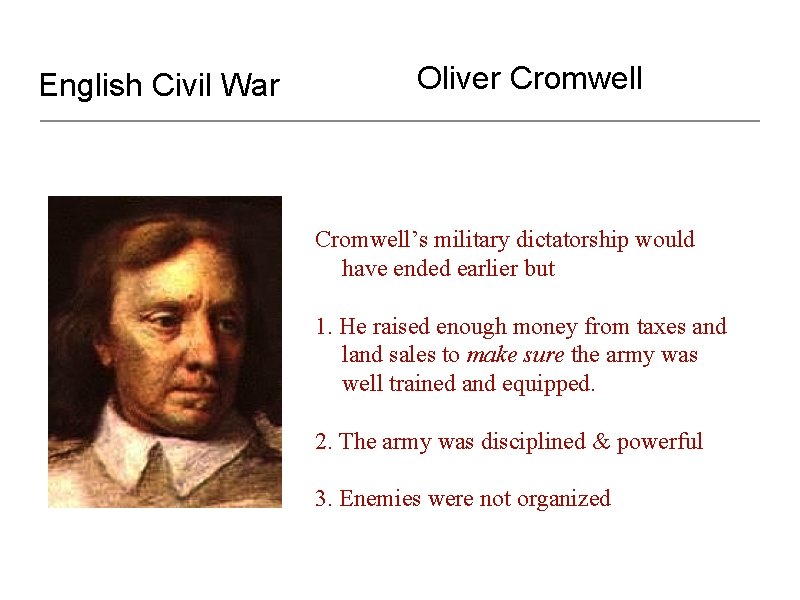
English Civil War Oliver Cromwell’s military dictatorship would have ended earlier but 1. He raised enough money from taxes and land sales to make sure the army was well trained and equipped. 2. The army was disciplined & powerful 3. Enemies were not organized
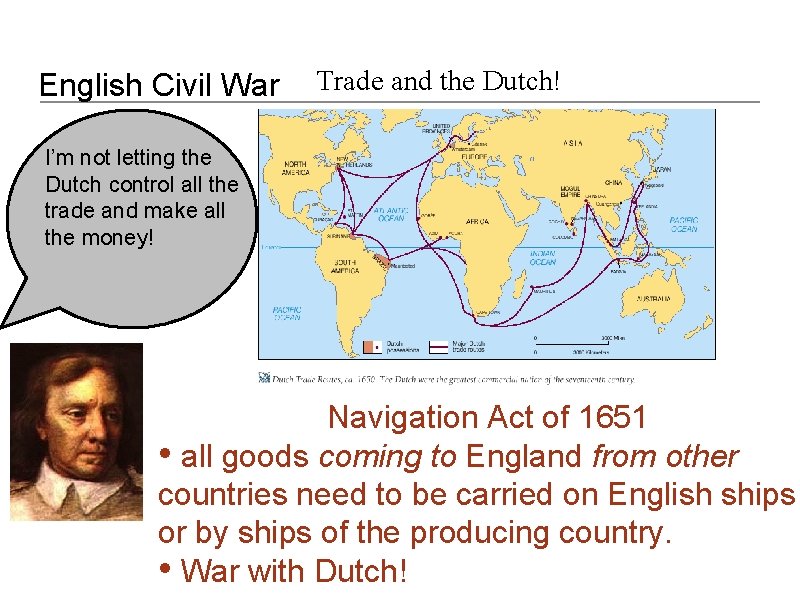
English Civil War Trade and the Dutch! I’m not letting the Dutch control all the trade and make all the money! Navigation Act of 1651 • all goods coming to England from other countries need to be carried on English ships or by ships of the producing country. • War with Dutch!
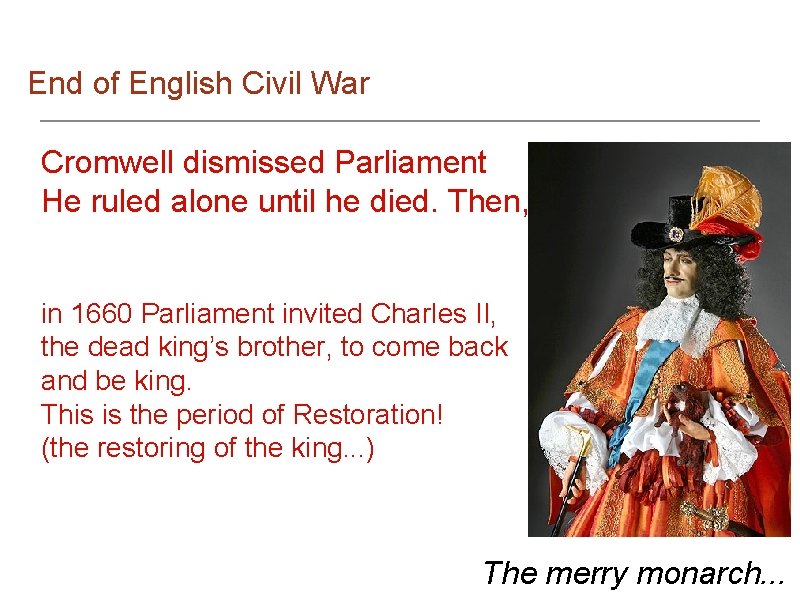
End of English Civil War Cromwell dismissed Parliament He ruled alone until he died. Then, in 1660 Parliament invited Charles II, the dead king’s brother, to come back and be king. This is the period of Restoration! (the restoring of the king. . . ) The merry monarch. . .
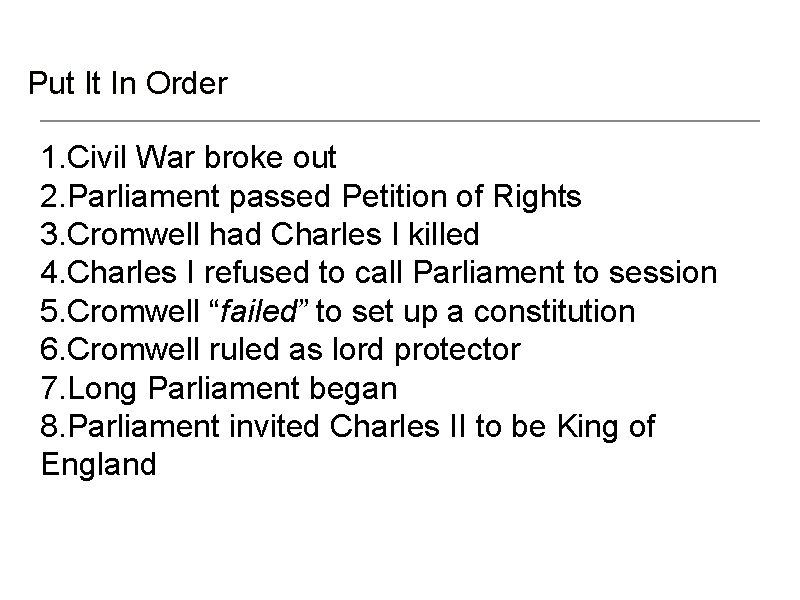
Put It In Order 1. Civil War broke out 2. Parliament passed Petition of Rights 3. Cromwell had Charles I killed 4. Charles I refused to call Parliament to session 5. Cromwell “failed” to set up a constitution 6. Cromwell ruled as lord protector 7. Long Parliament began 8. Parliament invited Charles II to be King of England
The Glorious Revolution • Why is the Glorious Revolution so glorious? • It brings a constitutional monarchy to the most powerful kingdom on Earth - Great Britain
The Glorious Revolution • Let’s get some timing in order. . . • 1066 - The original Norman invaders of 1066 (Remember William the Conqueror? ) • 1215 - The Magna Carta and its Rule of Law. • 1558 -1603 Elizabeth.
The Glorious Revolution • 1603 James I - then Charles I • 1642 -1651/1658 Oliver Cromwell and English Civil War • 1642 -1651/1658 then Oliver Cromwell and English Civil War • 1660 Charles II -then James II. (Catholic) • 1688 Glorious Revolution with William and Mary • A theme: establishing the worth of the individual vs. the rulers. • By the time of the Glorious Revolution it is pretty clear that the common man in England has rights not enjoyed anywhere else in the world.
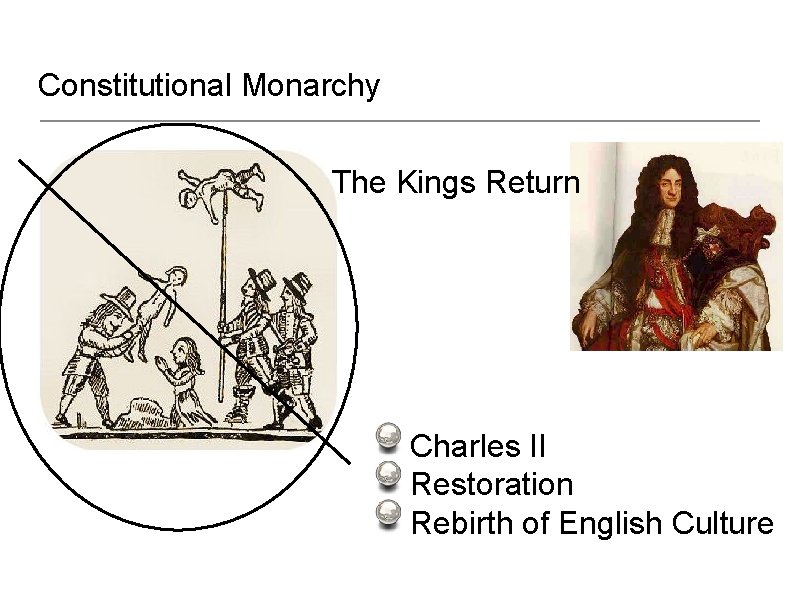
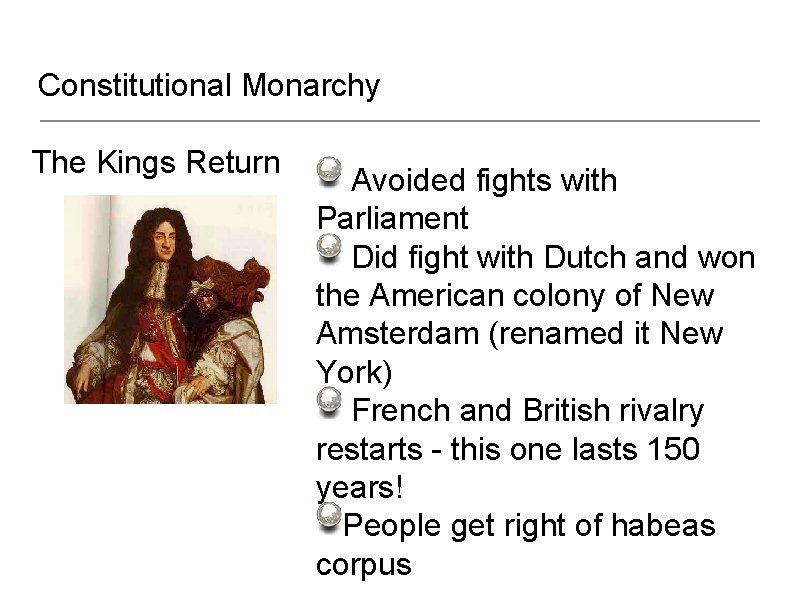
Constitutional Monarchy The Kings Return Charles II Restoration Rebirth of English Culture
Constitutional Monarchy The Kings Return Avoided fights with Parliament Did fight with Dutch and won the American colony of New Amsterdam (renamed it New York) French and British rivalry restarts - this one lasts 150 years! People get right of habeas corpus
Constitutional Monarchy • Charles II has no heir • It looks like James II - his brother - an avowed Catholic will inherit! Catholics could be king forever! • England is divided over this issue • Not enough for another bloody civil war like the one with they just had with the Cavaliers and Roundheads • This will be a peaceful revolution
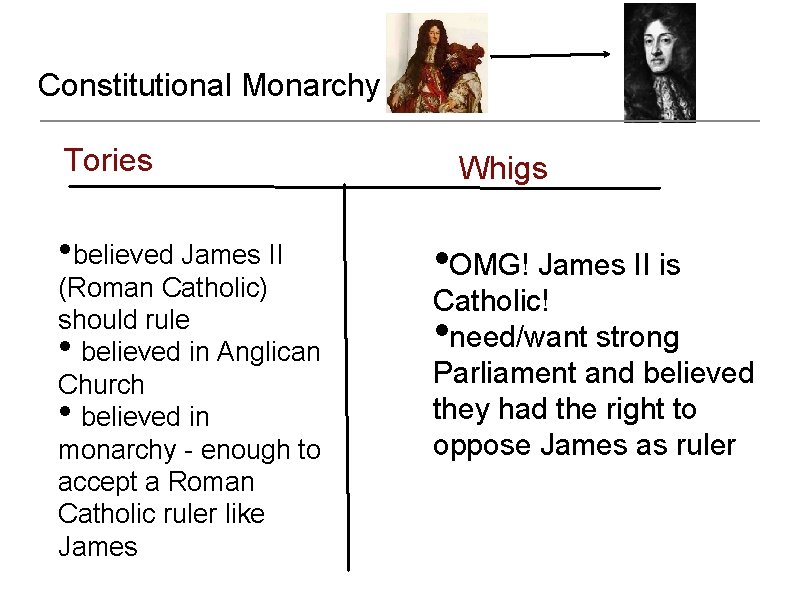
Constitutional Monarchy Tories • believed James II (Roman Catholic) should rule • believed in Anglican Church • believed in monarchy - enough to accept a Roman Catholic ruler like James Whigs • OMG! James II is Catholic! • need/want strong Parliament and believed they had the right to oppose James as ruler
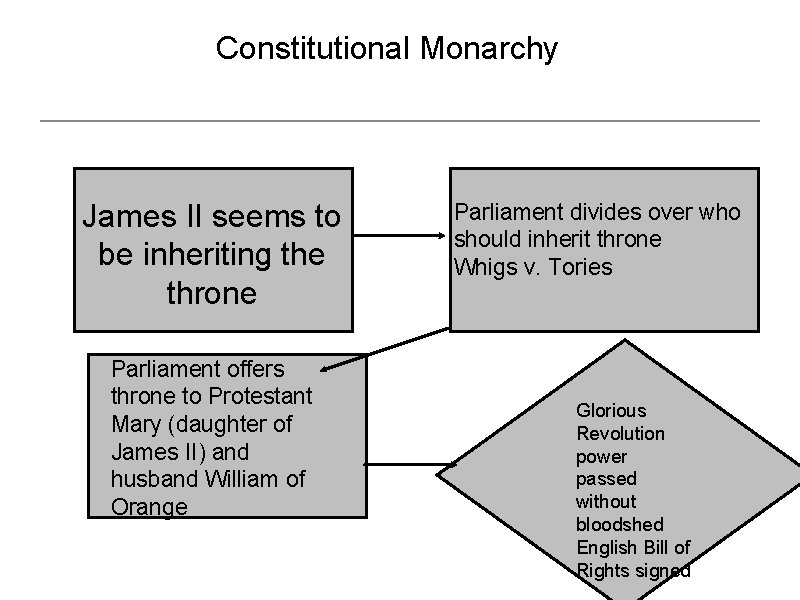
Constitutional Monarchy James II seems to be inheriting the throne Parliament offers throne to Protestant Mary (daughter of James II) and husband William of Orange Parliament divides over who should inherit throne Whigs v. Tories Glorious Revolution power passed without bloodshed English Bill of Rights signed
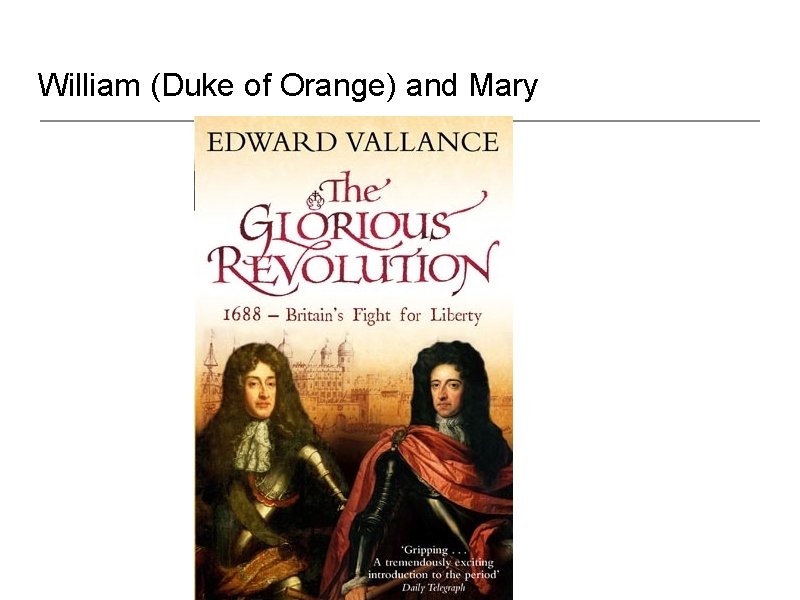
William (Duke of Orange) and Mary
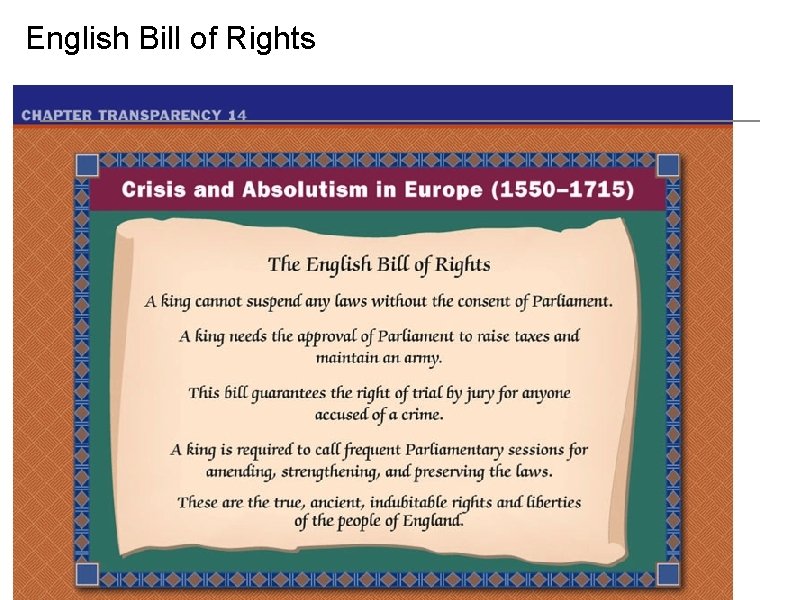
Glorious Revolution Democracy • The English Bill of Rights was passed by Parliament after the Glorious Revolution of 1688. • Power was transferred from Catholic James II to his sonin-law and daughter, William and Mary, both of whom were Protestant. The Bill of Rights ensured the supremacy of Parliament over the monarchy in England. • England was still not a true democracy, but it was taking steps toward becoming one.
English Bill of Rights
Catholics in Britain • Toleration Act - Religious Freedoms (protect everyone but Roman Catholics and Jews) • Act of Settlement 1701 - Keeps Catholics from the throne - if William III dies with no heirs then throne goes to Mary’s Protestant sister Anne. . . and so on always to Protestants
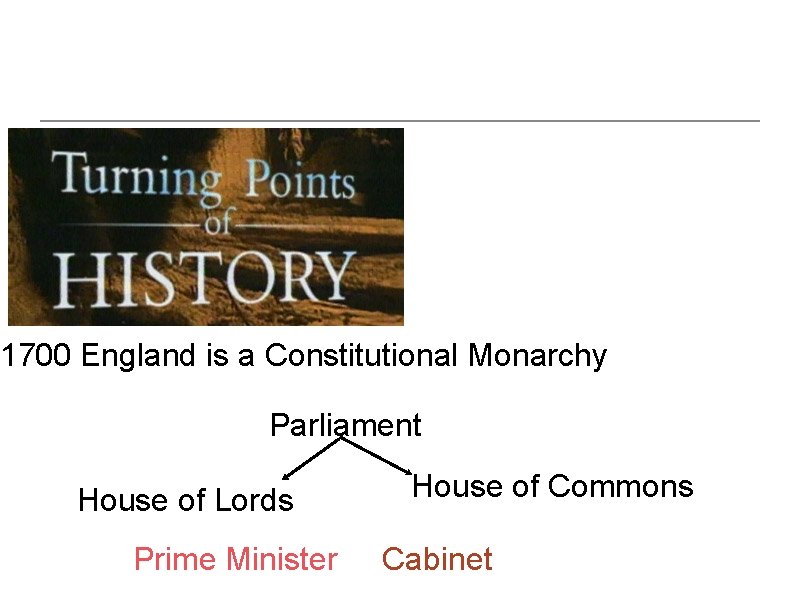
1700 England is a Constitutional Monarchy Parliament House of Lords Prime Minister House of Commons Cabinet