
Spinlocking Working at lower fields So far all
- Slides: 13
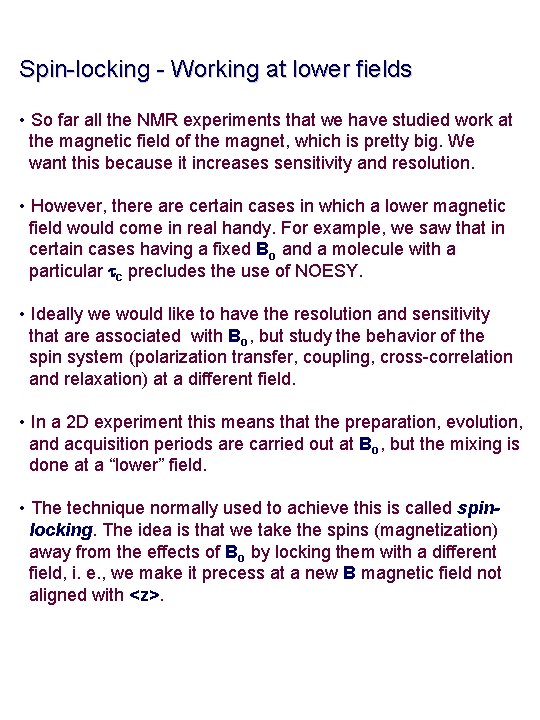
Spin-locking - Working at lower fields • So far all the NMR experiments that we have studied work at the magnetic field of the magnet, which is pretty big. We want this because it increases sensitivity and resolution. • However, there are certain cases in which a lower magnetic field would come in real handy. For example, we saw that in certain cases having a fixed Bo and a molecule with a particular tc precludes the use of NOESY. • Ideally we would like to have the resolution and sensitivity that are associated with Bo, but study the behavior of the spin system (polarization transfer, coupling, cross-correlation and relaxation) at a different field. • In a 2 D experiment this means that the preparation, evolution, and acquisition periods are carried out at Bo, but the mixing is done at a “lower” field. • The technique normally used to achieve this is called spinlocking. The idea is that we take the spins (magnetization) away from the effects of Bo by locking them with a different field, i. e. , we make it precess at a new B magnetic field not aligned with <z>.
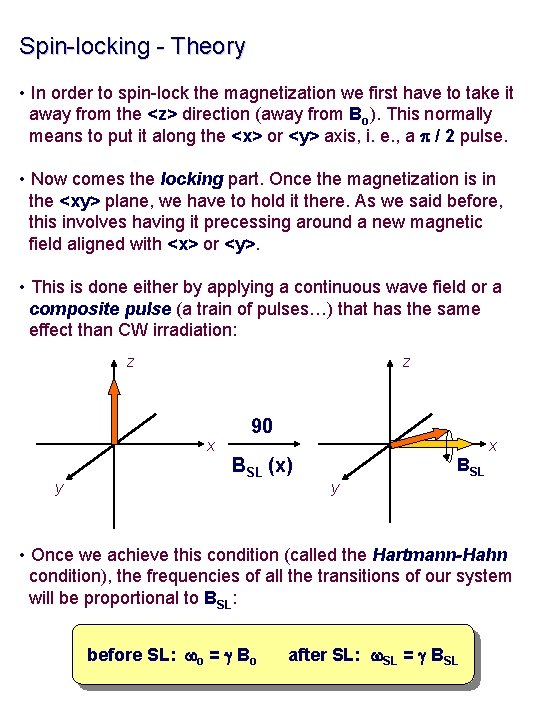
Spin-locking - Theory • In order to spin-lock the magnetization we first have to take it away from the <z> direction (away from Bo). This normally means to put it along the <x> or <y> axis, i. e. , a p / 2 pulse. • Now comes the locking part. Once the magnetization is in the <xy> plane, we have to hold it there. As we said before, this involves having it precessing around a new magnetic field aligned with <x> or <y>. • This is done either by applying a continuous wave field or a composite pulse (a train of pulses…) that has the same effect than CW irradiation: z z x y 90 BSL (x) x BSL y • Once we achieve this condition (called the Hartmann-Hahn condition), the frequencies of all the transitions of our system will be proportional to BSL: before SL: wo = g Bo after SL: w. SL = g BSL
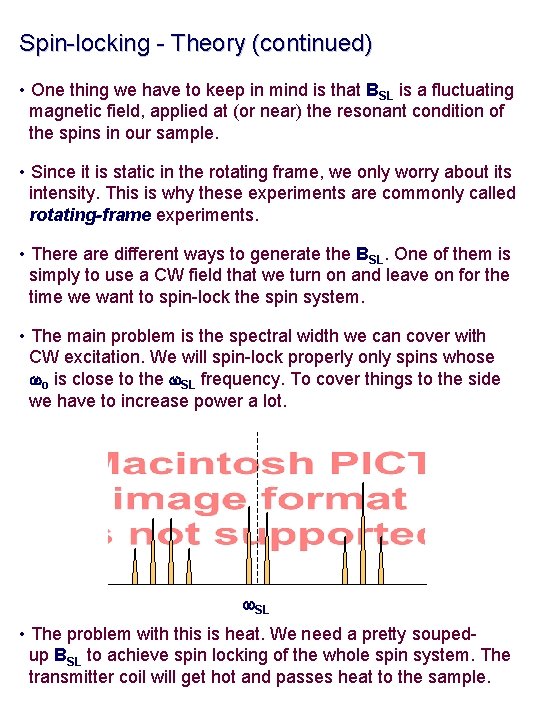
Spin-locking - Theory (continued) • One thing we have to keep in mind is that BSL is a fluctuating magnetic field, applied at (or near) the resonant condition of the spins in our sample. • Since it is static in the rotating frame, we only worry about its intensity. This is why these experiments are commonly called rotating-frame experiments. • There are different ways to generate the BSL. One of them is simply to use a CW field that we turn on and leave on for the time we want to spin-lock the spin system. • The main problem is the spectral width we can cover with CW excitation. We will spin-lock properly only spins whose wo is close to the w. SL frequency. To cover things to the side we have to increase power a lot. w. SL • The problem with this is heat. We need a pretty soupedup BSL to achieve spin locking of the whole spin system. The transmitter coil will get hot and passes heat to the sample.
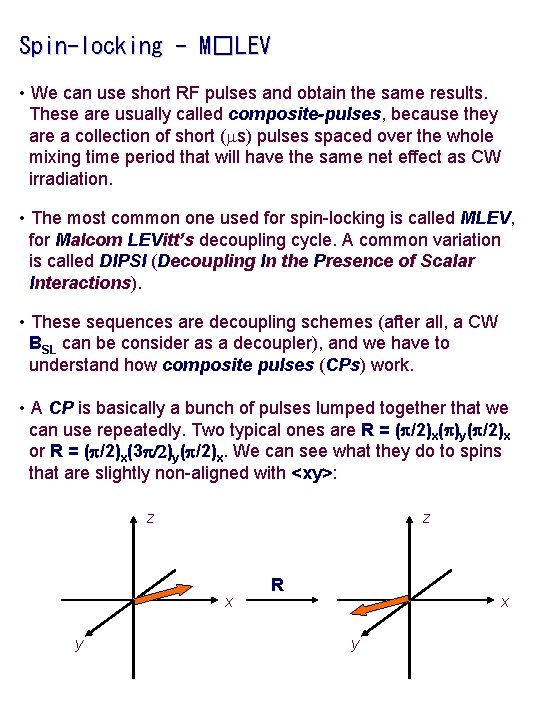
Spin-locking - M�LEV • We can use short RF pulses and obtain the same results. These are usually called composite-pulses, because they are a collection of short (ms) pulses spaced over the whole mixing time period that will have the same net effect as CW irradiation. • The most common one used for spin-locking is called MLEV, for Malcom LEVitt’s decoupling cycle. A common variation is called DIPSI (Decoupling In the Presence of Scalar Interactions). • These sequences are decoupling schemes (after all, a CW BSL can be consider as a decoupler), and we have to understand how composite pulses (CPs) work. • A CP is basically a bunch of pulses lumped together that we can use repeatedly. Two typical ones are R = (p/2)x(p)y(p/2)x or R = (p/2)x(3 p/2)y(p/2)x. We can see what they do to spins that are slightly non-aligned with <xy>: z z x y R x y
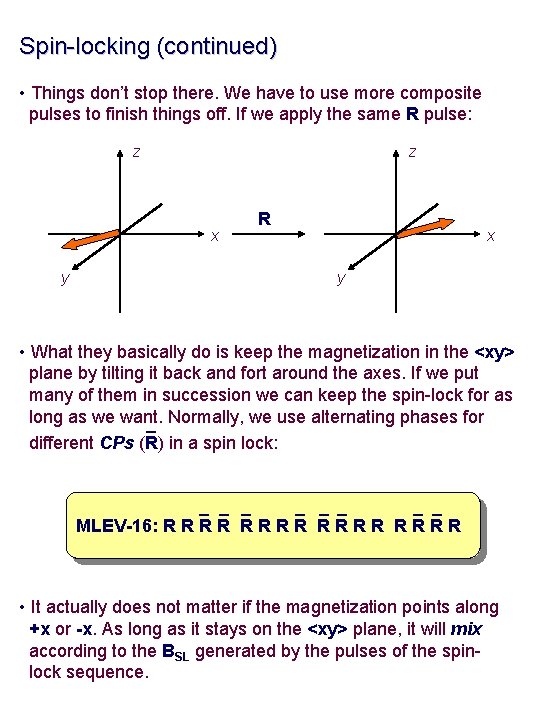
Spin-locking (continued) • Things don’t stop there. We have to use more composite pulses to finish things off. If we apply the same R pulse: z z x y R x y • What they basically do is keep the magnetization in the <xy> plane by tilting it back and fort around the axes. If we put many of them in succession we can keep the spin-lock for as long as we want. _ Normally, we use alternating phases for different CPs (R) in a spin lock: _ _ _ _ MLEV-16: R R R R • It actually does not matter if the magnetization points along +x or -x. As long as it stays on the <xy> plane, it will mix according to the BSL generated by the pulses of the spinlock sequence.
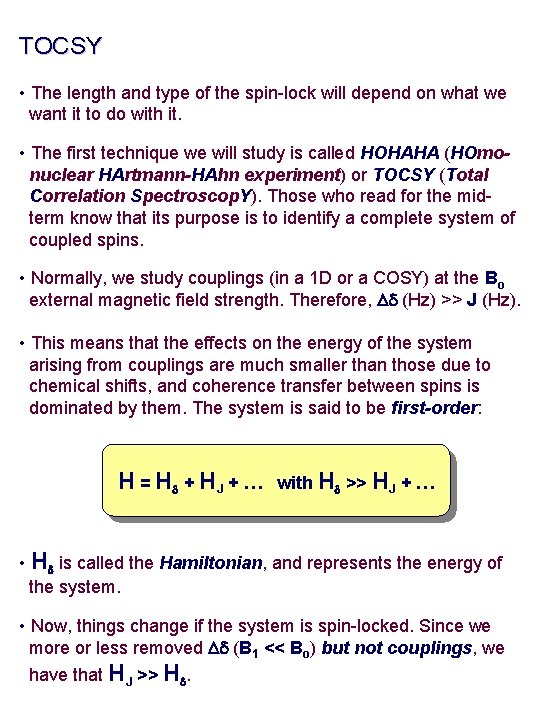
TOCSY • The length and type of the spin-lock will depend on what we want it to do with it. • The first technique we will study is called HOHAHA (HOmonuclear HArtmann-HAhn experiment) or TOCSY (Total Correlation Spectroscop. Y). Those who read for the midterm know that its purpose is to identify a complete system of coupled spins. • Normally, we study couplings (in a 1 D or a COSY) at the Bo external magnetic field strength. Therefore, Dd (Hz) >> J (Hz). • This means that the effects on the energy of the system arising from couplings are much smaller than those due to chemical shifts, and coherence transfer between spins is dominated by them. The system is said to be first-order: H = Hd + HJ + … with Hd >> HJ + … • Hd is called the Hamiltonian, and represents the energy of the system. • Now, things change if the system is spin-locked. Since we more or less removed Dd (B 1 << Bo) but not couplings, we have that HJ >> Hd.
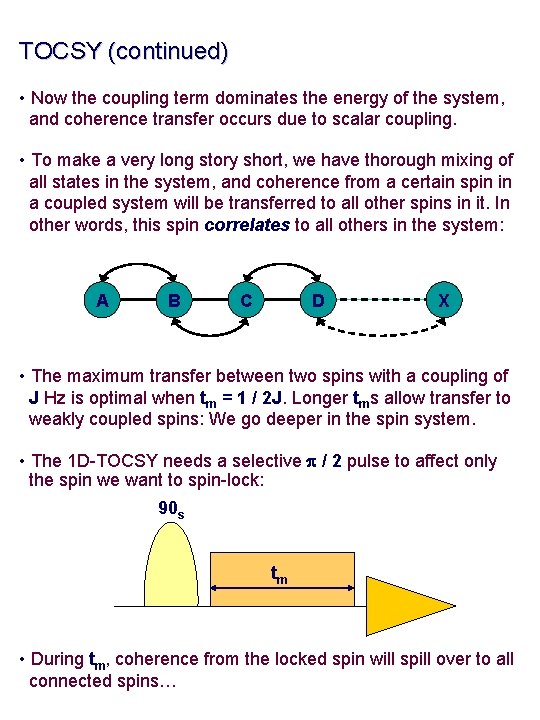
TOCSY (continued) • Now the coupling term dominates the energy of the system, and coherence transfer occurs due to scalar coupling. • To make a very long story short, we have thorough mixing of all states in the system, and coherence from a certain spin in a coupled system will be transferred to all other spins in it. In other words, this spin correlates to all others in the system: A B C D X • The maximum transfer between two spins with a coupling of J Hz is optimal when tm = 1 / 2 J. Longer tms allow transfer to weakly coupled spins: We go deeper in the spin system. • The 1 D-TOCSY needs a selective p / 2 pulse to affect only the spin we want to spin-lock: 90 s tm • During tm, coherence from the locked spin will spill over to all connected spins…
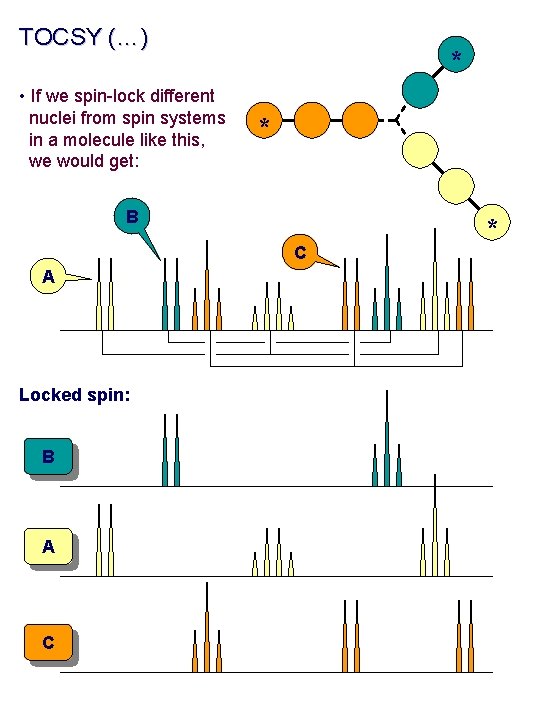
TOCSY (…) • If we spin-lock different nuclei from spin systems in a molecule like this, we would get: * * B C A Locked spin: B A C *
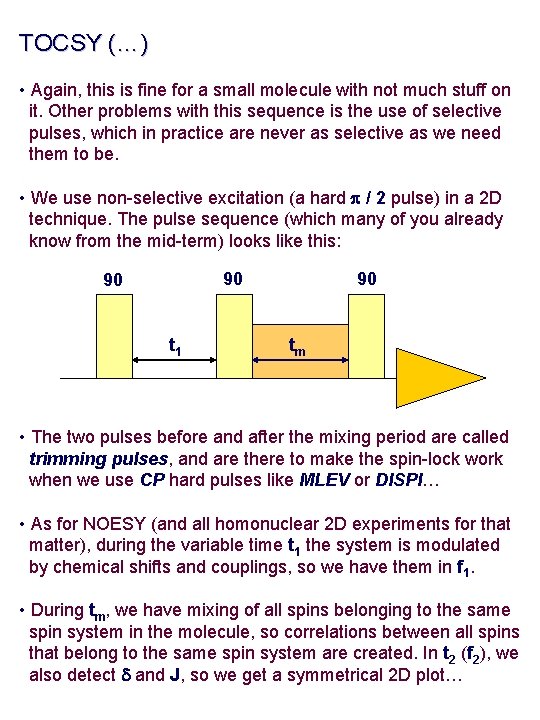
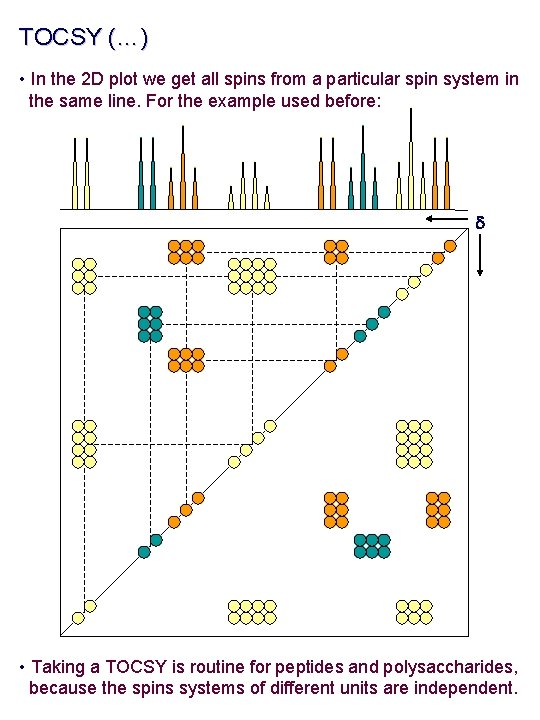
TOCSY (…) • Again, this is fine for a small molecule with not much stuff on it. Other problems with this sequence is the use of selective pulses, which in practice are never as selective as we need them to be. • We use non-selective excitation (a hard p / 2 pulse) in a 2 D technique. The pulse sequence (which many of you already know from the mid-term) looks like this: 90 90 t 1 90 tm • The two pulses before and after the mixing period are called trimming pulses, and are there to make the spin-lock work when we use CP hard pulses like MLEV or DISPI… • As for NOESY (and all homonuclear 2 D experiments for that matter), during the variable time t 1 the system is modulated by chemical shifts and couplings, so we have them in f 1. • During tm, we have mixing of all spins belonging to the same spin system in the molecule, so correlations between all spins that belong to the same spin system are created. In t 2 (f 2), we also detect d and J, so we get a symmetrical 2 D plot…
TOCSY (…) • In the 2 D plot we get all spins from a particular spin system in the same line. For the example used before: d • Taking a TOCSY is routine for peptides and polysaccharides, because the spins systems of different units are independent.
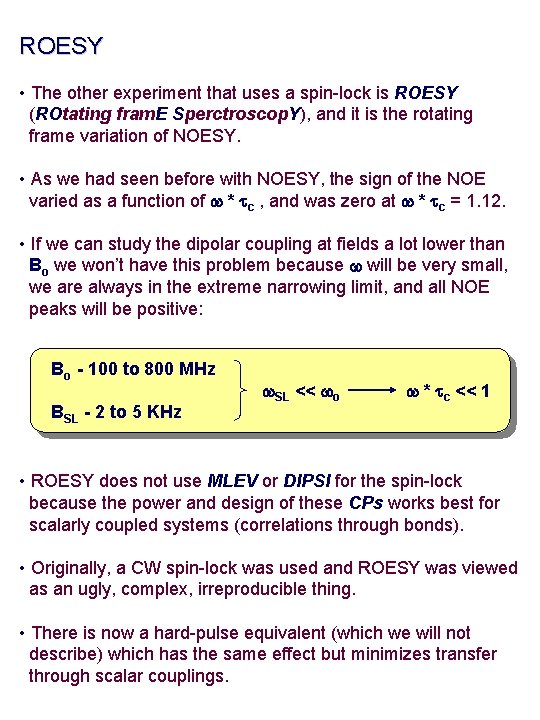
ROESY • The other experiment that uses a spin-lock is ROESY (ROtating fram. E Sperctroscop. Y), and it is the rotating frame variation of NOESY. • As we had seen before with NOESY, the sign of the NOE varied as a function of w * tc , and was zero at w * tc = 1. 12. • If we can study the dipolar coupling at fields a lot lower than Bo we won’t have this problem because w will be very small, we are always in the extreme narrowing limit, and all NOE peaks will be positive: Bo - 100 to 800 MHz BSL - 2 to 5 KHz w. SL << wo w * tc << 1 • ROESY does not use MLEV or DIPSI for the spin-lock because the power and design of these CPs works best for scalarly coupled systems (correlations through bonds). • Originally, a CW spin-lock was used and ROESY was viewed as an ugly, complex, irreproducible thing. • There is now a hard-pulse equivalent (which we will not describe) which has the same effect but minimizes transfer through scalar couplings.
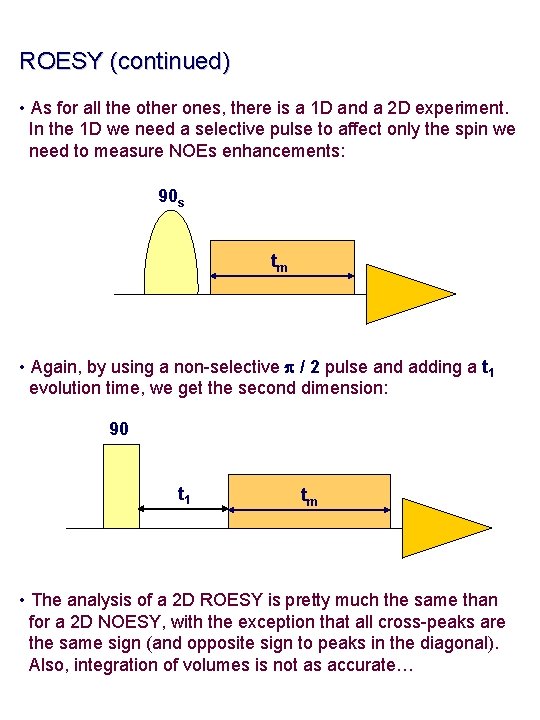
ROESY (continued) • As for all the other ones, there is a 1 D and a 2 D experiment. In the 1 D we need a selective pulse to affect only the spin we need to measure NOEs enhancements: 90 s tm • Again, by using a non-selective p / 2 pulse and adding a t 1 evolution time, we get the second dimension: 90 t 1 tm • The analysis of a 2 D ROESY is pretty much the same than for a 2 D NOESY, with the exception that all cross-peaks are the same sign (and opposite sign to peaks in the diagonal). Also, integration of volumes is not as accurate…
Summary • Both TOCSY and ROESY take advantage of mixing the spin system at effective magnetic fields lower than Bo. • In the two we achieve this by spin-locking the magnetization in the <xy> plane, so that transfer through scalar or dipolar couplings take place at BSL, which is << than Bo. • In TOCSY, this means that J >> Dd and we have thorough mixing of coherence through the spin system. This gives us correlations between all spins belonging to the same system. • For ROESY, the advantage is that we are always in the extreme narrowing limit. This means that we always have signals, and they are always positive. • As with COSY and NOESY, we can fail to filter TOCSY type peaks in ROESY spectra and vice versa. Next class • We’ll start with NMR of proteins. • Try to read the review I gave you a couple of weeks ago from M. P. Williamson on this topic.